

Types of Watch Cases: A Complete Reference Guide
Your weekend bag is almost packed, but your spare watch is still on the dresser. Wrapping it in a shirt feels improvised, while taking the entire watch box seems excessive. At home, you face a different problem: keeping your daily rotation accessible without leaving watches loose beside keys, chargers, and other objects.
Table of Contents
- Introduction to Watch Case Types
- Why Watch Case Design Matters
- Single Travel Cases for One Watch
- Watch Rolls for Flexible Travel Storage
- Compact Daily Boxes for Everyday Protection
- Multi-Watch Chests for Collectors
- Display Cases for Showcasing Collections
- How to Choose the Right Watch Case
- Quick Reference Comparison Table
- Frequently Asked Questions
Introduction to Watch Case Types
The right watch case starts with that distinction between carrying a watch and organizing a collection. A case that works well in a briefcase may be inconvenient on a dressing table. A handsome collector chest may offer useful separation at home but make little sense in a carry-on.
There's also a terminology trap. A watch case can mean the structural shell surrounding the movement, or the separate container used to store the complete watch. Collectors discuss both, but they solve different problems. Here, the focus is protective storage, with the watch's own construction informing what that storage needs to accommodate.
Match the format to the job
The main types of watch cases serve distinct purposes:
- Single travel cases isolate a watch during commuting, business travel, or a short stay.
- Watch rolls group a travel selection in a package that fits around other luggage.
- Compact daily boxes keep an active rotation organized and easy to reach.
- Multi-watch chests provide a more permanent arrangement for a larger or varied collection.
- Display cases prioritize visibility alongside organized storage.
These categories overlap. A daily box can have a display lid, and a roll can have a structured shell. Treat the name as a starting point, not a complete specification.
Before considering color or exterior finish, ask what must fit inside and what will happen around it. Will the case sit undisturbed on a shelf, share a crowded bag, or move between home and office? Does the collection include slender dress watches, bulky sports pieces, or bracelets that resist curling tightly?
Capacity, usable interior space, lining, closure, and portability matter together. Buying more slots won't solve a poor fit, and choosing a luxurious exterior won't compensate for a cushion that forces your bracelet closed. The useful choice is the format that suits your actual routine.
Why Watch Case Design Matters
Protective case-making predates the wristwatch. Historical horological scholarship records leather cases for clocks and other timekeeping devices from the Middle Ages onward, alongside early watch forms including round, square, octagonal, oval, drum-shaped, and spherical designs. These were not merely decorative variations; they reflect the long development of cases as specialized protective components, as described in this history of horological case-making.
That history offers a useful lesson for storage buyers: the object's geometry should determine its enclosure. A rectangular dress watch and a round chronograph should not be assumed to fit equally well because their advertised widths look similar.
Judge the inside before the outside
Consider a polished watch resting in an attractive wooden chest. If its crown touches a divider or its crystal meets the lid, the exterior material hasn't solved the essential problem. The same applies to leather: assess the complete construction rather than treating the covering as proof of protection.
Use these questions to evaluate the design:
- Capacity: Can every occupied compartment hold its intended watch without borrowing space from the next?
- Protection: Does the structure address the likely hazard, such as abrasion in a drawer or compression in luggage?
- Portability: Can you carry it comfortably without tipping or disturbing the contents?
- Intended use: Is the closure convenient enough for daily access, or secure enough for repeated transport?
A guide to watch case sizing can help distinguish the dimensions of the watch itself from the space its storage requires.
Practical rule: Evaluate the case with the watch installed and the lid closed, not just with the empty case open.
A storage container is also separate from the watch's pressure-rated shell. Don't transfer a performance claim from the watch to its box. For storage, ask concrete questions about support, clearance, and closure rather than accepting an undefined promise of complete protection.
Single Travel Cases for One Watch
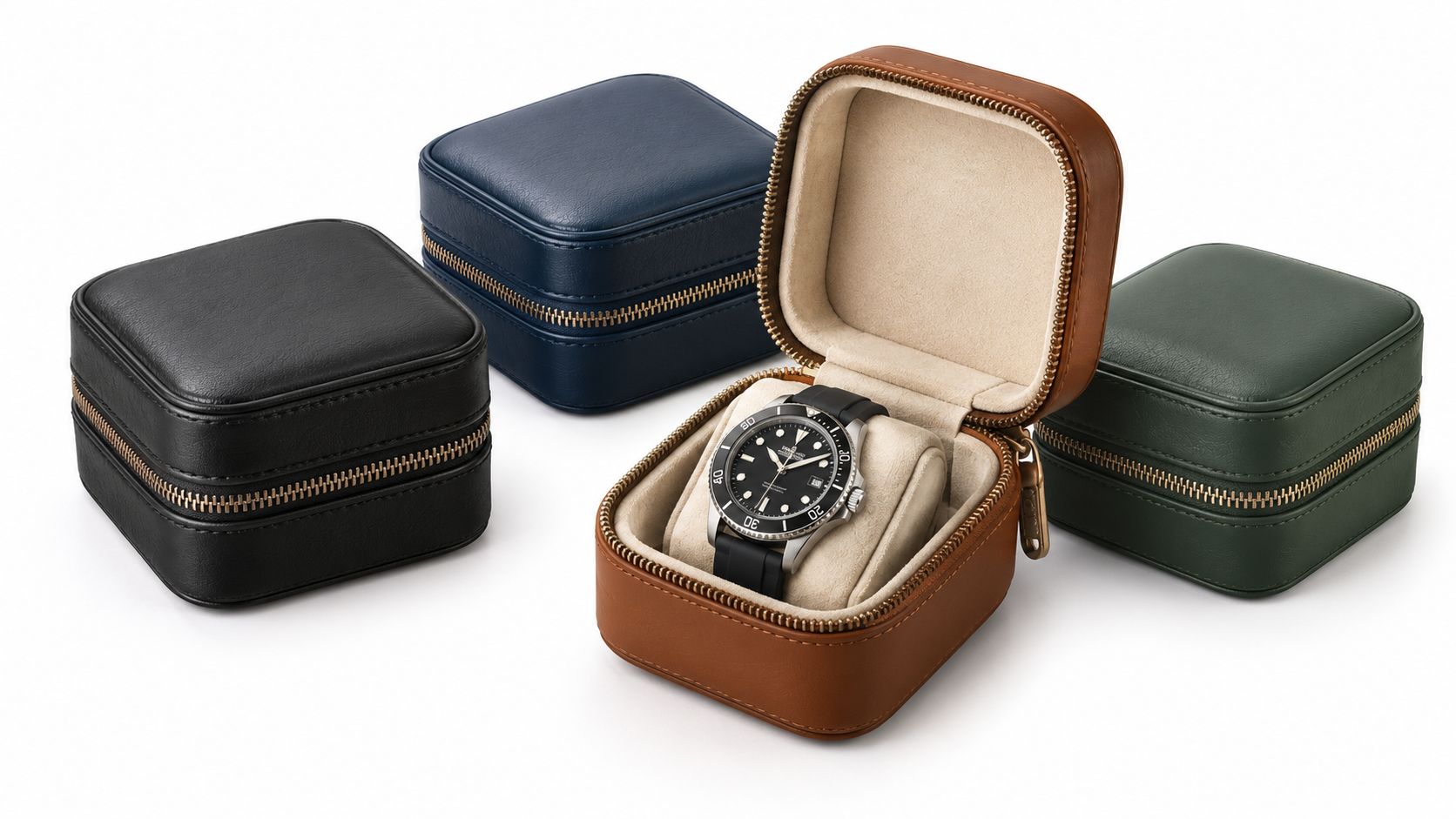
A single travel case is the most focused option: it gives a spare watch its own enclosure without requiring you to transport the rest of your collection. It suits the professional who wears a sports watch while traveling and changes to a dress watch for dinner.
Look for a model whose structure matches your packing habits. A soft pouch may suit an otherwise uncluttered pocket, while a structured case is the more sensible candidate when other belongings could press against it. Neither description replaces checking the actual product construction.
Check how the watch is held
Start with the support system. Does the watch wrap around a removable cushion, lie flat in a recessed bed, or sit beneath a retaining flap? Choose the arrangement that lets your particular strap or bracelet rest naturally.
- Cushion fit: The bracelet should close without force, and the watch shouldn't slide freely around the support.
- Interior finish: Inspect seams, zipper edges, exposed fasteners, and any surface the watch might touch.
- Closure behavior: Close the empty case first, then test it with the watch installed. Resistance shouldn't come from squeezing the watch.
- Access: Make sure you can remove the watch without dragging its finish across the opening.
A metal bracelet deserves special attention. Check whether the clasp folds beneath the cushion or rests against the caseback. Don't assume a case designed around a flexible strap will accommodate the same watch on a bracelet equally well.
When the format makes sense
A dedicated watch travel case for men is a useful format to compare when you need a spare watch for work or a short trip. Assess whether its shape fits your briefcase or weekend bag without placing it under heavier contents.
The main limitation is organization across a traveling collection. Separate cases can become awkward to retrieve and keep together. If you regularly pack a choice of watches, compare the total packed footprint of individual cases with a roll or compartmented travel box.
For occasional travel, however, avoiding unnecessary capacity can be an advantage. You're buying a specific place for the watch you carry, not empty space for a hypothetical collection.
Watch Rolls for Flexible Travel Storage
A watch roll makes sense when your travel wardrobe includes different watches for different activities. Instead of distributing separate cases through your luggage, you keep the selection together and open it as a group.
The name covers more than a fabric organizer that rolls up. Some designs wrap around a central support; others use a cylindrical or rounded shell with removable cushions and divided spaces. Inspect the layout rather than assuming all rolls behave alike.
Compare packing behavior
| Format | Packing advantage | Question to resolve |
|---|---|---|
| Single case | Easy to place in a small available space | Will separate cases become inconvenient? |
| Watch roll | Keeps a travel selection together | Are neighboring watches genuinely separated? |
| Compact box | Offers a defined, stable footprint | Will the rectangular shape suit your luggage? |
A roll can be convenient in the curved space beside clothing or along a bag's edge. A box may be easier to position on a hotel desk. Neither shape guarantees better protection; shell stiffness, internal support, and the way the contents are restrained matter more.
Inspect separation and support
Look closely at what happens when the roll is partly empty. Can an unused cushion move toward an occupied compartment? Does opening the flap disturb the watches? Can you remove the middle watch without lifting everything else?
- Partitions: Prefer a layout that keeps neighboring watch heads apart even when the roll is moved.
- Removable supports: Check whether each cushion releases independently and stays seated when secured.
- Bracelet accommodation: Integrated bracelets need a natural resting curve, not just enough room for the watch head.
- Closure reach: The fastening should engage comfortably with the intended contents installed.
A travel watch pouch offers another comparison when thin packing matters more than grouped presentation. Choose according to what surrounds the case in your bag, rather than assuming that a roll is always the travel specialist.
A flexible exterior is convenient only if the watches inside remain properly supported and separated.
The principal trade-off is between adaptable packing and resistance to outside pressure. A lightly structured roll shouldn't be treated like a rigid transport container. If your bag is routinely crowded, prioritize a supported shell or reconsider where the roll will sit.
Compact Daily Boxes for Everyday Protection
A compact daily box suits watches that mostly stay at home and move through a regular wearing rotation. Its value comes from access: you can select a watch, return another, and see which spaces are occupied without unpacking a travel arrangement.
For this job, ease of use matters. A lid that's awkward to hold open or cushions that are difficult to remove can turn a tidy-looking box into an inconvenient daily habit. Test the motions you'll repeat, not just the appearance of the closed product.
Compact Daily Box Capacity Comparison
There's no universal dimensional standard for these formats. Treat the descriptions below as shopping categories, and request measurements for the specific box.
| Capacity | Best For | Typical Dimensions |
|---|---|---|
| Small rotation | Keeping frequently worn watches together | Model-dependent; check each compartment's usable width |
| Broader daily selection | Separating work, casual, and occasion watches | Compare overall footprint with your available surface |
| Mixed-size rotation | Housing dress and sports watches together | Prioritize compartment depth and closed-lid clearance |
A shallow box may be easier to use than a deeper model if every watch remains visible and reachable. Extra depth is useful only when the contents require it.
Separate household protection from water resistance
Under ISO 22810, general water-resistant watches must withstand a minimum excess pressure of 2 bar, corresponding to 20 meters within the standard's testing framework, as explained in this account of watch water-resistance requirements. That rating belongs to the tested watch, not the leather or wooden container around it.
For a daily box, evaluate more relevant details:
- Lid operation: It should stay open reliably while you exchange watches.
- Interior accessibility: You should be able to lift a cushion without rubbing an adjacent watch.
- Surface placement: Choose a stable location where opening the box won't interfere with nearby objects.
- Visibility: A transparent lid helps selection, while an opaque lid suits owners who prefer a discreet arrangement.
Don't buy a daily box because it has enough advertised slots. Ask whether those slots remain useful with your collection installed. A box that accepts every watch comfortably is more practical than a larger-looking box with compartments you can't use.
Multi-Watch Chests for Collectors
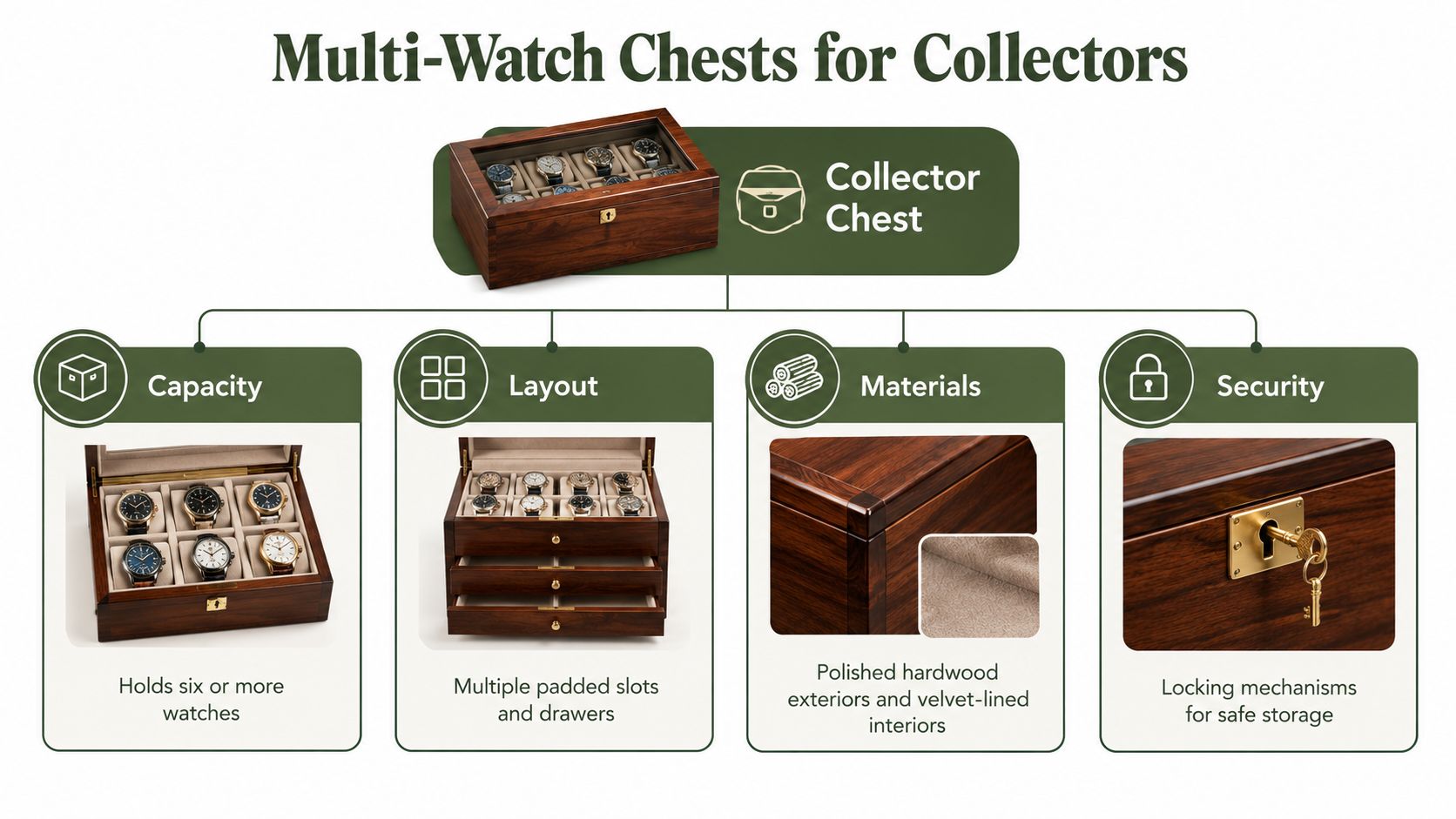
A collection of dress watches, sports watches, and larger cases rarely fits a uniform grid perfectly. A collector chest works best when its layout reflects the watches you own and how often you reach for each one. It is a long-term organizing choice, not merely a way to add more slots.
Before choosing a chest, measure the largest watch, including its crown and any protruding pushers. Compare that width and height with the cushion, compartment, and space beneath closed trays. This helps avoid a common mismatch: a watch fits in the slot but presses against a divider or lid.
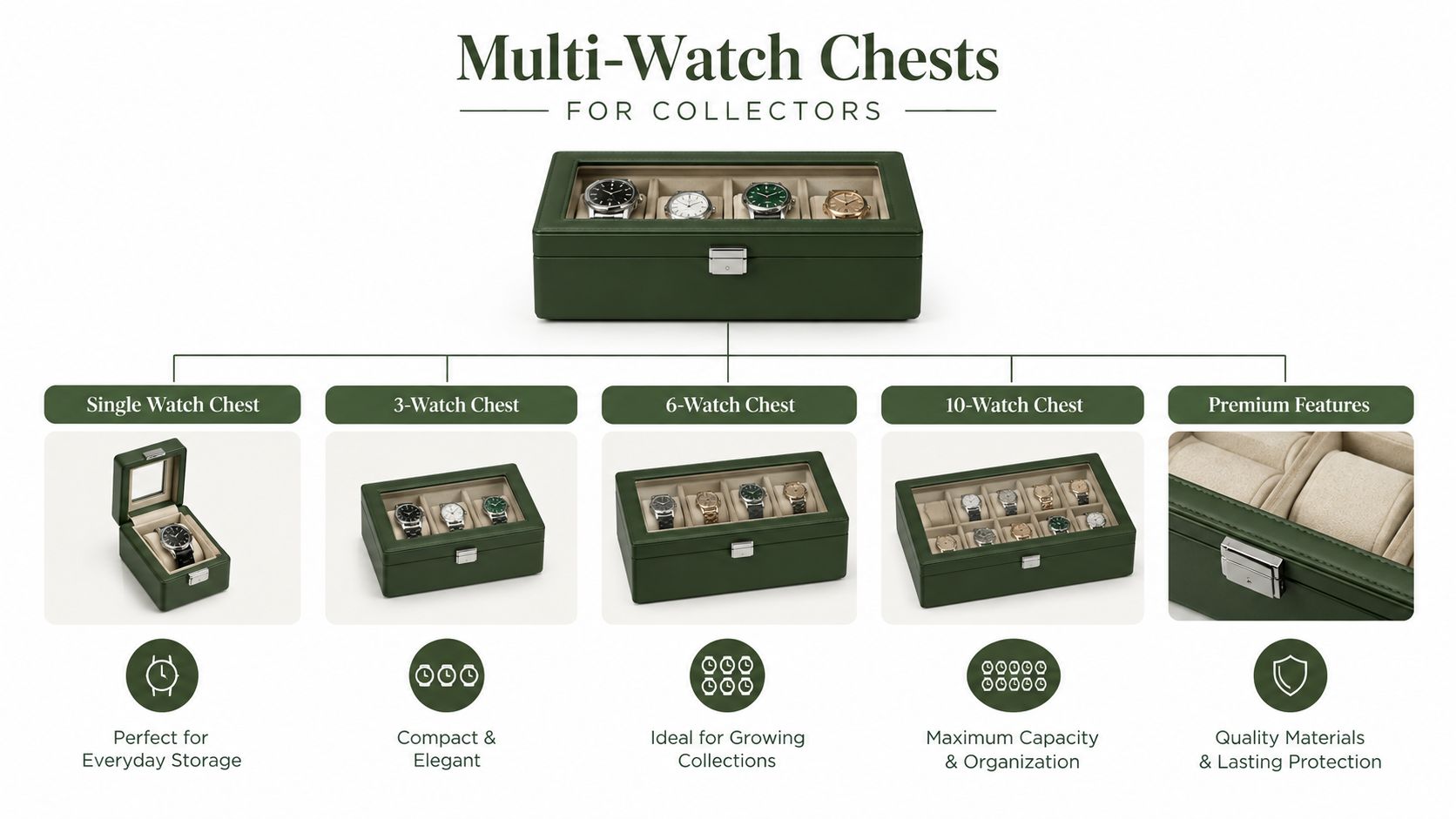
Match the layout to your rotation. Keep frequently worn pieces within easy reach, and use drawers or lower tiers for watches you wear less often. If your collection includes different case sizes, look for removable cushions and compartments that support both small and large watches without letting either shift around. Check drawer height and the clearance above each tray before filling the chest.
The watch's water resistance comes from its own construction, including its crystal joint, crown system, caseback seal, and manufacturing quality, as explained in this explanation of case construction and water-resistance testing. The chest has a different job: prevent contact, rubbing, and pressure during storage. Look for a non-abrasive lining, secure cushions, room around crowns and pushers, and a closure that keeps contents in place.
Materials matter through their construction. A wood or leather-covered exterior may suit your room, but inspect how the lining is attached and whether removable trays reveal unfinished edges. A plush surface cannot make up for a cushion that fits poorly.
Measure the space where the chest will sit, including room for its lid to open and drawers to extend. A heavy chest that must be shifted every time you select a watch can make daily use inconvenient.
Finally, distinguish a latch from a lock. A latch keeps the lid closed; a lock controls access. Neither, on its own, guarantees safe storage for high-value watches, so consider the chest alongside your home security arrangements.
Display Cases for Showcasing Collections
A collector who starts the day by choosing a watch from a visible display may value quick recognition as much as storage. A display case keeps selected pieces in view, reducing the need to open drawers or handle watches just to see what is available.
Display describes how a case presents its contents, not one fixed size or shape. A small box can show a few watches; a cabinet can present a larger collection. Choose according to which watches you want on view and how much space the case can occupy.
Arrange the collection around how you use it
If you rotate through several watches regularly, keeping that group visible can make selection easier. Pieces worn less often can remain in an opaque chest. This split arrangement avoids buying a large cabinet to display every watch.
The viewing angle matters as much as the layout. A case on a low shelf may need a different lid or interior arrangement than one placed on a dressing table. Check the view from where you will stand: tall dividers, deep recesses, or reflections can make dials harder to see.
A watch display case is useful to compare with an opaque chest when seeing the collection is a priority. The clear lid affects visibility, not the quality of the cushions or the fit of the interior. Watches should sit securely, and the layout should allow you to lift each one out without awkward handling.
Before buying, decide whether you are comfortable leaving the watches visible in that room. The case's location is part of the choice, not an afterthought. Keep it away from direct sunlight, splash-prone surfaces, and spots where household activity could knock it over. A transparent lid does not control the surrounding environment or replace the watches' care instructions.
Placement check: Stand where you expect to view the collection. Open the case in its intended spot and rehearse taking out a watch.
A display case suits collectors who enjoy seeing their watches and can place them where they remain easy to view and reach. For a mixed collection, display the current rotation and store less frequently worn pieces separately. This practical division balances visibility with everyday storage without requiring every watch to stay on show.
How to Choose the Right Watch Case
Start with the watch that is hardest to fit. A large case, long lugs, or protruding crown can reveal more about a storage option's limits than a typical piece in your rotation. Make a short record of your collection and how you store, wear, and transport each watch before choosing a format.
Measure each watch as it will be stored, including its fitted bracelet or strap. Use a ruler or caliper carefully, without dragging the tool across polished surfaces. Record the case diameter or width, lug-to-lug length, and overall thickness, including the highest point. Note the crown and pushers, how the bracelet or strap curves around a cushion, and where the clasp sits when closed.
Those details help you assess fit, rather than relying on a model name or product photo. Ask for usable compartment dimensions: exterior measurements say little about the room beneath a closed lid. For a watch with an automatic movement, guidance on choosing a case for automatic watches can help you compare storage formats without assuming that all such watches need the same case.
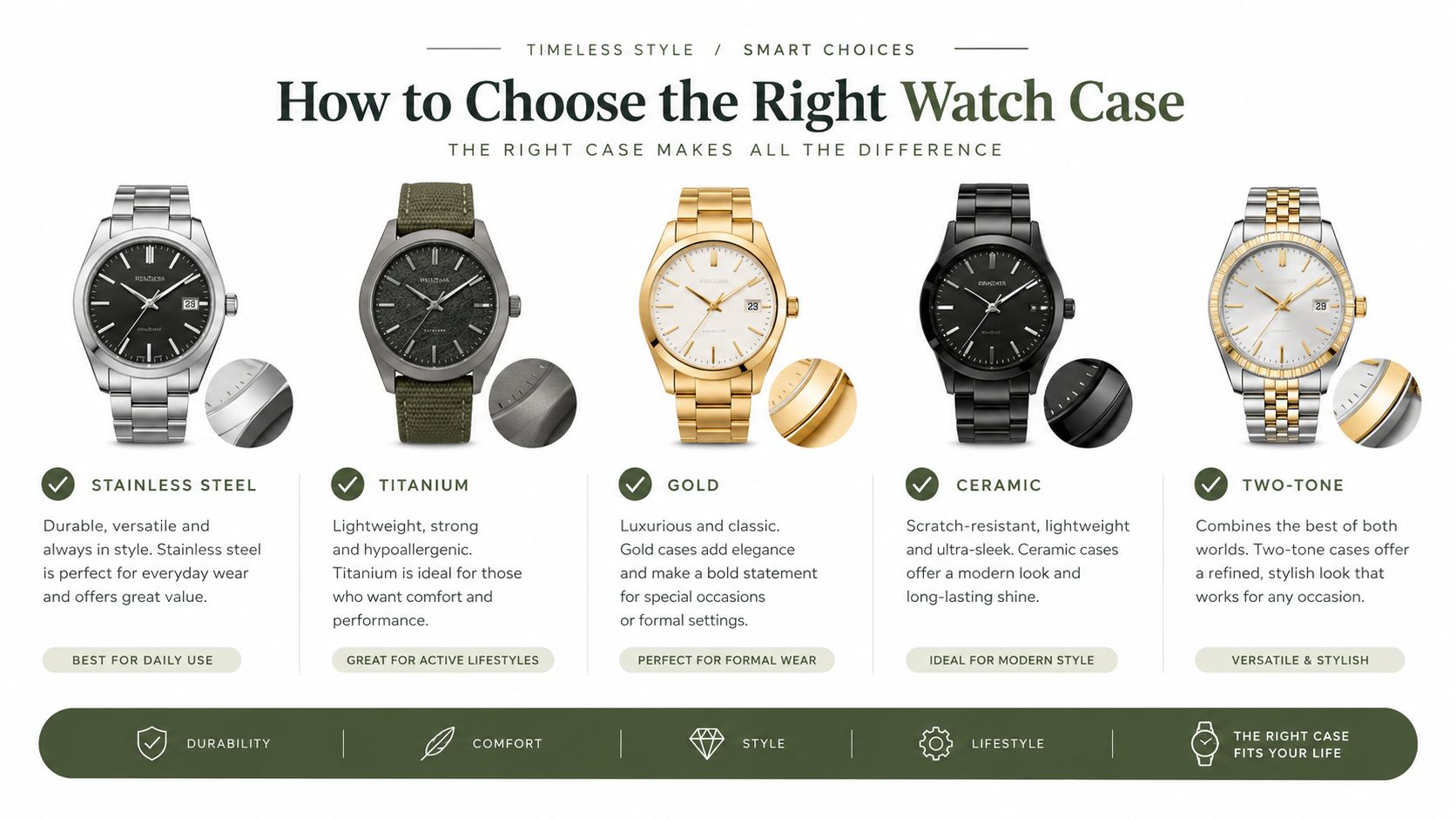
Material affects what kind of contact a watch can tolerate, but it does not determine the right storage format by itself. In 2025, non-precious-metal watches represented 97% of units and 61% of value in Swiss exports, according to Swiss customs watch-export data. Those figures describe a broad market category, not one shared level of durability.
Steel generally handles everyday knocks and refinishing better than harder, more brittle ceramic. Titanium is lighter but can mark; precious metals need care around dents. Ceramic resists scratches, yet sharp impacts can still damage it. In any case, choose storage that prevents watches from shifting or touching one another.
Let your routine settle the format. Frequent travel calls for manageable packed size, daily wear favors easy access, and a growing collection benefits from adaptable organization. Before ordering, compare your hardest-to-fit watch with the seller's interior specifications. If the fit is unclear, choose a product with clearer measurements rather than hoping the lid will close.
Quick Reference Comparison Table
The most useful comparison separates the purpose of the format from the protection of a particular product. A structured roll may resist outside pressure better than a lightly built box, even though both belong to familiar categories.
Watch Case Types at a Glance
| Case Type | Typical Capacity | Best Use | Protection Level |
|---|---|---|---|
| Single travel case | An individual watch | Spare-watch transport and short trips | Focused isolation; impact protection depends on shell construction |
| Watch roll | A grouped travel selection | Packing different watches together | Useful separation when divided; compression resistance varies |
| Compact daily box | An active rotation | Accessible home storage | Organized household protection; inspect lid and cushion fit |
| Multi-watch chest | An extended collection | Permanent organization | Extensive separation when correctly fitted; not automatically security-rated |
| Display case | A selected group or broader collection | Visible presentation | Enclosed display; performance depends on the underlying construction |
Read the table as a shortlist
Start with the Best Use column. Once you've identified the likely format, compare the construction of actual products rather than ranking the category names. “Travel,” “collector,” and “display” describe intended roles, not independently verified performance levels.
Don't let unused capacity outweigh everyday convenience. If your home storage already works, the next purchase may be a small travel case rather than a replacement chest. If travel is rare, prioritize an arrangement that makes daily selection easier.
- For mixed collections: Verify the largest watch's fit and the smallest watch's support separately.
- For crowded luggage: Ask about structure and restraint, not just exterior fabric.
- For permanent storage: Check access, placement, and whether every occupied space remains usable.
Market context reinforces the importance of thoughtful protection: Swiss exports totaled 14.6 million watches in 2025, while the average exported mechanical watch price reached about CHF 4,010, according to the Federation of the Swiss Watch Industry's annual overview. Those averages don't describe your collection, but they offer a reason to treat storage as a considered purchase.
The deciding question remains personal: which format lets you store and retrieve your own watches without forcing their fit or complicating your routine?
Frequently Asked Questions
How should I check fit when a seller lists only exterior dimensions?
Ask for compartment width, usable height beneath the closed lid, cushion dimensions, and photographs showing the interior arrangement. Send the seller your watch measurements and bracelet configuration. If the answer remains uncertain, don't assume generous exterior dimensions mean generous interior clearance.
Can a leather case protect a watch during air travel?
It can be an appropriate travel container, but leather alone doesn't establish impact or compression performance. Inspect the supporting structure and internal restraint, then pack it where heavier belongings won't press directly against it. Choose carry-on placement that lets you keep track of the case.
How should I care for a leather watch case?
Follow the manufacturer's instructions for the particular leather and finish. Remove the watches before cleaning or applying any approved care product, and let the case dry fully before reloading it. Avoid improvising with household cleaners or saturating the lining.
Will a watch box accommodate a metal bracelet?
Check the cushion with the bracelet adjusted to your wrist size. It should support the watch without requiring you to force the clasp shut. If the bracelet is too tight around the supplied pillow, ask whether a smaller or more compressible support is available.
Is a watch box the same as a watch winder?
No. A storage box holds the watch, while a winder is intended to move an automatic watch. Choose between them according to the watchmaker's guidance and your ownership preferences, rather than assuming powered movement is a requirement for storage.
Grainmark Leather offers full-grain leather goods alongside compact watch boxes, display storage, and collector chests. Visit Grainmark Leather with your watch measurements and storage priorities in hand, then compare the available formats against the way you carry, wear, and organize your collection.