

Watch Display Case Guide for Collectors and Gift Buyers
You take off your watch at day's end and set it beside your keys. By morning, it has shared the night with a phone charger, loose coins, and another watch. A small mark on a polished case or clasp may be easy to miss at first, but repeated contact turns a carefully made timepiece into something you handle nervously.
A watch display case gives that routine a better home. It keeps each watch supported, separated, and visible, while making the collection part of the room rather than something hidden in a drawer. The right choice isn't the box with the most slots. It's the case that fits your current collection, your travel habits, your climate, and the way you wear your watches.
Table of Contents
- Why Your Watches Deserve More Than a Drawer
- What a Watch Display Case Really Does
- Comparing Daily Boxes, Collector Chests, and Travel Displays
- Why Full-Grain Leather and Construction Quality Matter
- How a Display Case Can Protect or Harm Your Watches
- Choosing the Right Case for Your Collection Stage
- Caring for Your Leather Watch Case and Gifting It Well
Why Your Watches Deserve More Than a Drawer
A drawer seems harmless because it's dark and out of sight. In practice, it often becomes a shared space for watches, keys, chargers, sunglasses, and other hard objects. A bracelet can rub against a polished lug. A crown can press into a neighboring case. A watch left loose on a nightstand can be knocked onto the floor when you reach for your phone.
A dedicated display case solves two problems at once. It provides physical separation for the watch, and it gives you a clear place to see what you own. That second benefit matters. When watches disappear into drawers, you handle them more often while searching, and you lose the quiet pleasure of seeing the collection together.
Storage should match the way you wear
A person with one everyday watch doesn't need a large collector chest. A person who rotates between several watches needs more than a single padded pouch. Someone who travels regularly needs a format that stays secure inside luggage instead of turning a home display box into a makeshift travel case.
You can explore the practical differences in this guide to watch storage boxes for men, but the central principle is simple: buy for your real routine, not an imagined collection. A compact case on a nightstand may protect one watch better than a large box that leaves every slot occupied by loose cushions and unused space.
A useful test: If you can't put your watch away with one hand at the end of the day, the storage format probably doesn't suit your routine.
The case also affects presentation. A well-made lid, clean interior, and properly supported watch turn a daily object into something worth looking at. That doesn't mean every case needs a glass top or formal furniture styling. It means the watch should rest without rubbing, bending, or disappearing beneath other belongings.
This guide follows the collection as it grows. You'll see how daily boxes differ from collector chests and travel displays, why leather and lining quality matter, and how humidity, ultraviolet light, and magnetic hardware can create risks that extra padding won't solve.
What a Watch Display Case Really Does
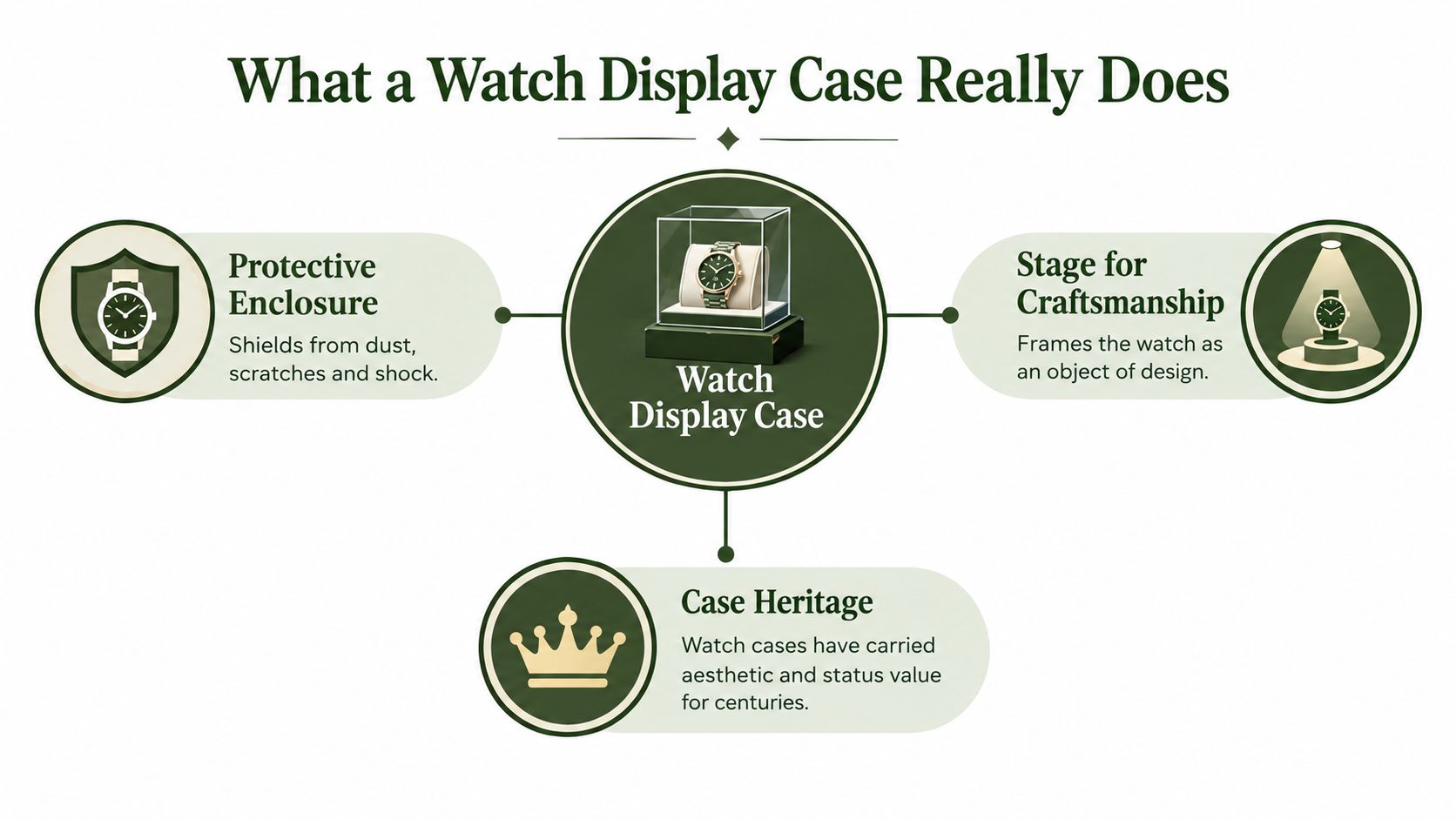
A watch display case has two jobs. First, it protects the watch from contact and exposure. Second, it presents the watch so its materials and workmanship remain visible. Treating it as simple storage misses half its value.
Watch cases themselves have followed this same pattern for centuries. Pocket watches of the 17th and 18th centuries were commonly made with brass cases. Enamel, silver, and precious stones added decorative and status value, while gold first appeared modestly on bezels during the 17th century and fully gold cases gradually became common by the mid-18th century, as described in this historical account of watch case materials.
Protection with a visible purpose
The transition from pocket watches to wristwatches accelerated in the 1920s. Wristwatch designs brought new case shapes and materials, including silver, gold, nickel-chrome, and gold-plated metal. In 1926, Rolex introduced the Oyster, described as the first commercially available watch with a legitimately water- and dust-resistant hermetically sealed case, using a screw-down caseback, bezel, and crown.
Those developments explain why separation and support matter. Watch cases have always done more than cover a movement. They protect delicate components while expressing design, engineering, and status. A display case continues that role at the storage level by reducing abrasion, dust, impact, and unnecessary handling.
Think of it as a frame for a painting. The frame doesn't create the artwork, but it protects the edges, controls how the piece is presented, and gives it a deliberate place in the room. A watch display case does something similar for the dial, case, bracelet, and strap.
A suitable interior should hold the watch without forcing the bracelet into an unnatural position. A padded pillow or removable support lets you adjust the fit, especially when one watch has a thin leather strap and another has a thick bracelet or deployant clasp. For further guidance on supporting mechanical pieces, see this explanation of a watch case for automatic watches.
The best result is quiet and practical. You open the lid, see the watches clearly, and lift one without moving the others. Protection becomes part of the ownership ritual rather than an obstacle between you and the collection.
Comparing Daily Boxes, Collector Chests, and Travel Displays
The first buying decision is the format. Materials and finish matter, but they come after a more basic question: where will the case live, and what will it need to do?
A compact daily box belongs near the place where you remove your watch. It might hold one or two pieces on a nightstand or dresser. The small footprint encourages consistent use, and the individual support keeps the watch away from keys and electronics.
A collector chest works differently. It lives in a bedroom, office, or dressing area and gives a growing collection a stable home. More compartments make rotation easier, but a large chest is less convenient to move and usually isn't the right object for a weekend bag.
A travel display is built around transport. It needs a secure closure, a compact shape, and enough padding to prevent watches from shifting when luggage moves. It may display the watches when opened, but its main task is controlled protection away from home. A dedicated watch travel case for men is generally more suitable than carrying a home box between hotels.
| Format | Typical Capacity | Portability | Best For |
|---|---|---|---|
| Daily watch box | One or two watches | Easy to leave beside a bed or dresser | One-watch owners and small daily rotations |
| Collector chest | Several watches in individual compartments | Intended for a fixed home location | Larger collections and regular rotation |
| Travel display | A compact selection for a trip | Designed for luggage and short-term transport | Frequent travelers and watch owners who rotate away from home |
Match the case to the collection
A collector with a rare or complicated timepiece may want to study examples such as a pre-owned Sky Dweller collection when thinking about case dimensions. The point isn't to copy someone else's capacity. It's to notice how larger watches, thicker cases, and substantial bracelets change the space each compartment needs.
A daily box should be easy to open and close without forcing a watch into place. A chest should offer enough separation that one watch doesn't touch the next. A travel case should keep each piece stable even when the case is packed inside a soft bag.
Visibility also changes by format. A glass or clear lid suits a home display where you enjoy seeing the watches throughout the day. A travel case may prioritize a firm exterior and discreet design instead. Neither is automatically superior. They solve different problems.
If you own one watch today and expect to travel with it, start with a compact case that serves both storage and transport. If you already rotate several watches at home, choose a chest with adjustable supports rather than buying multiple small boxes that scatter across the room.
Why Full-Grain Leather and Construction Quality Matter
Leather is more than an outer finish on a watch display case. It affects how the case ages, how it feels in the hand, and how well the structure holds its shape over time.
Full-grain leather is the intact top layer of the hide. It hasn't been sanded or heavily corrected to remove its natural surface. That intact grain gives the material visible character and allows it to develop patina through handling and use. The practical explanation in this guide to what full-grain leather means is useful because leather labels can otherwise sound interchangeable.

The interior does the protective work
An attractive exterior won't compensate for a rough seam or abrasive lining. Run your fingers along the interior and inspect the places where a watch will rest. The lining should feel smooth, the cushions should hold their shape without becoming rigid, and the edges shouldn't catch on a strap or bracelet.
Look for these construction signals:
- Stitched seams: Even stitching helps the case maintain its shape and reduces the chance that a glued edge will lift with use.
- Non-abrasive lining: The lining should protect polished surfaces rather than introduce another source of fine scratches.
- Removable pillows: Detachable supports make it easier to fit smaller wrists, thick bracelets, and watches with deployant clasps.
- Sound hardware: Hinges, snaps, and closures should operate smoothly without forcing the lid or pulling against the leather.
Individual compartments matter because watches don't share one universal exterior. Historical case surveys describe round cases as approximately 55% steel, 35% gold, and 10% two-tone or gold-plated materials in the cited analysis of case composition (source). Cushion-shaped cases in the same analysis were reported as 71% steel, 19% full gold, and 10% gold-plated.
Those proportions aren't a storage specification by themselves, but they show why one soft divider isn't enough. Steel, gold, titanium, and ceramic differ in weight, hardness, and surface behavior. Titanium entered watchmaking in 1970, the Royal Oak gave steel renewed luxury status in 1972, ceramic appeared in major watchmaking during the early 1980s, and Swatch introduced plastic in 1983, according to the same historical survey.
Construction rule: The pillow should support the watch, while the compartment should prevent it from touching its neighbors. Neither job should depend on the other.
A case made with full-grain leather can age alongside a collection, but the leather alone doesn't guarantee careful storage. The lining, stitching, structure, and fit determine whether the case protects the watch each time you use it.
How a Display Case Can Protect or Harm Your Watches
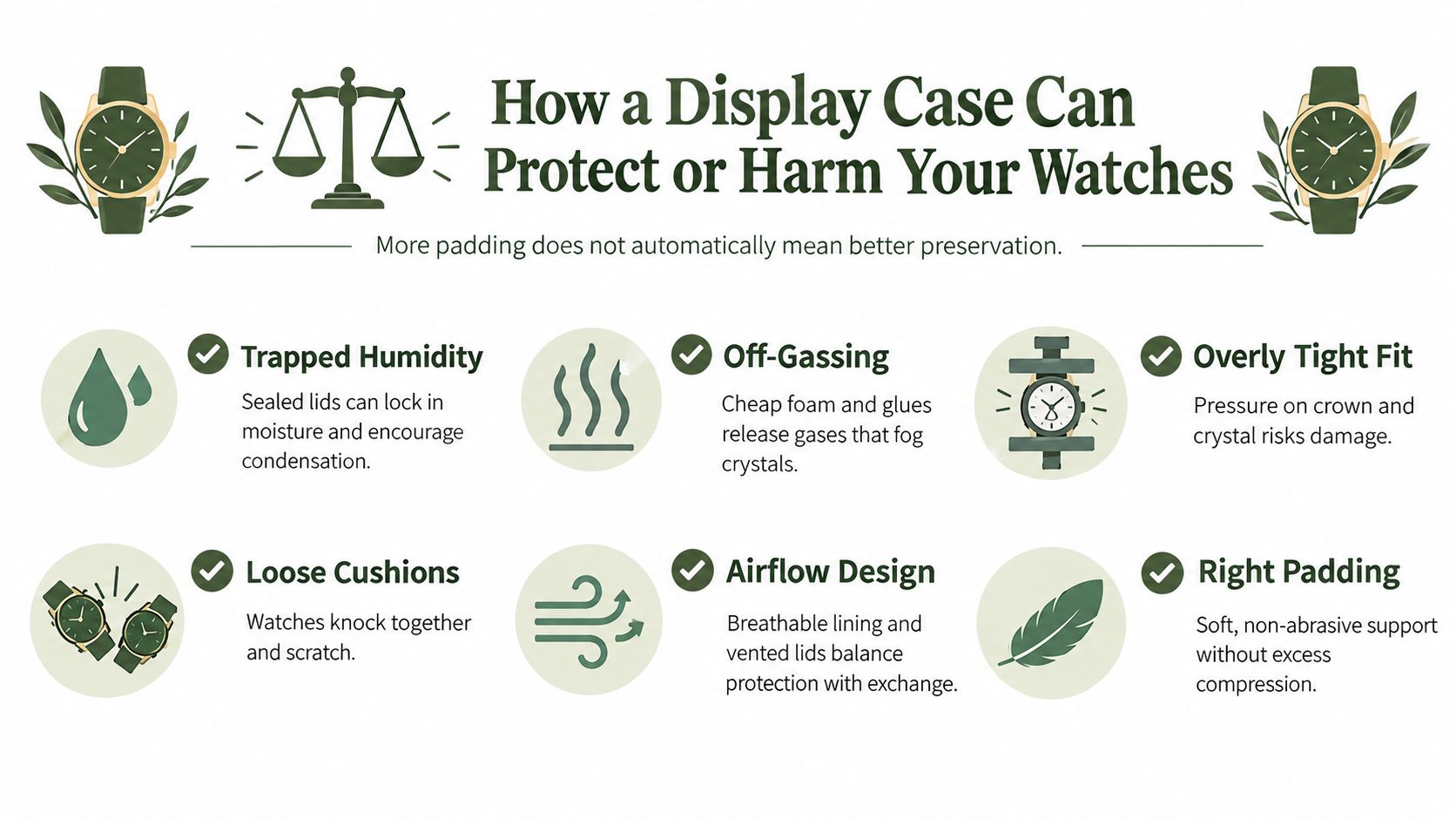
A heavier case with more padding isn't automatically safer. A tight lid can trap damp air. A magnetic snap can sit too close to a mechanical movement. A case placed beside a wireless charger may expose watches to a risk that its soft interior can't address.
Control the environment around the case
Humidity deserves attention when a case combines metal watches with leather, wood, textiles, or adhesives. Conservation guidance identifies a compromise between the needs of mixed materials. It gives roughly 35–50% relative humidity for some metal objects and 40–60% for mixed-material clock cases, while emphasizing stability rather than constant fluctuation, as outlined in museum conservation guidance for clocks.
That means you shouldn't place a watch case in a bathroom, against a damp exterior wall, or in a sealed cupboard that traps moist air. At the same time, aggressive drying can harm leather, adhesives, and finishes. A breathable lining, controlled air exchange, and a discreet space for a hygrometer are more sensible than sealing the case as tightly as possible.
Magnetism is another overlooked issue. ISO 764:2020 defines a magnetically resistant watch as resisting a continuous magnetic field of at least 4,800 A/m (ISO 764:2020). That benchmark applies to the watch, not as a blanket approval for magnetic case hardware.
Choose closures made from nonmagnetic or suitably selected materials, and keep the case away from speakers, chargers, laptop covers, phones, and watch winders where magnets may be present. If a product uses a magnetic closure, the maker should be able to explain where the magnet sits and how far it is from the cushion.
Use placement as part of the specification
Ultraviolet light also changes the decision. A watch case beside a bright window may protect against dust while exposing leather straps, textiles, and some finishes to prolonged light. A visible display should sit in a stable indoor location away from direct sun.
Use this placement checklist:
- Choose a stable room: Avoid bathrooms, kitchens, garages, and spaces with rapid temperature or humidity changes.
- Keep distance from electronics: Don't place the case beside speakers, wireless chargers, laptops, or magnetic clasps.
- Avoid direct sunlight: A shaded dresser or cabinet is safer for leather and sensitive finishes than a sunny windowsill.
- Allow measured airflow: Breathable materials and modest air exchange are preferable to a damp, airtight enclosure.
- Check the fit: A cushion should hold the watch securely without compressing the strap, crown, or crystal.
A display case should reduce risk, not hide it. The case can't replace servicing, water-resistance checks, or controlled storage for particularly valuable pieces. It should provide a sensible layer of protection while the owner manages the room around it.
Choosing the Right Case for Your Collection Stage
The right capacity changes as your habits change. A person with one watch needs a reliable landing place. Someone with a daily rotation needs separation and quick access. A growing collector needs flexibility without paying for empty space that makes the case awkward to use.
Choose by use, not by ambition
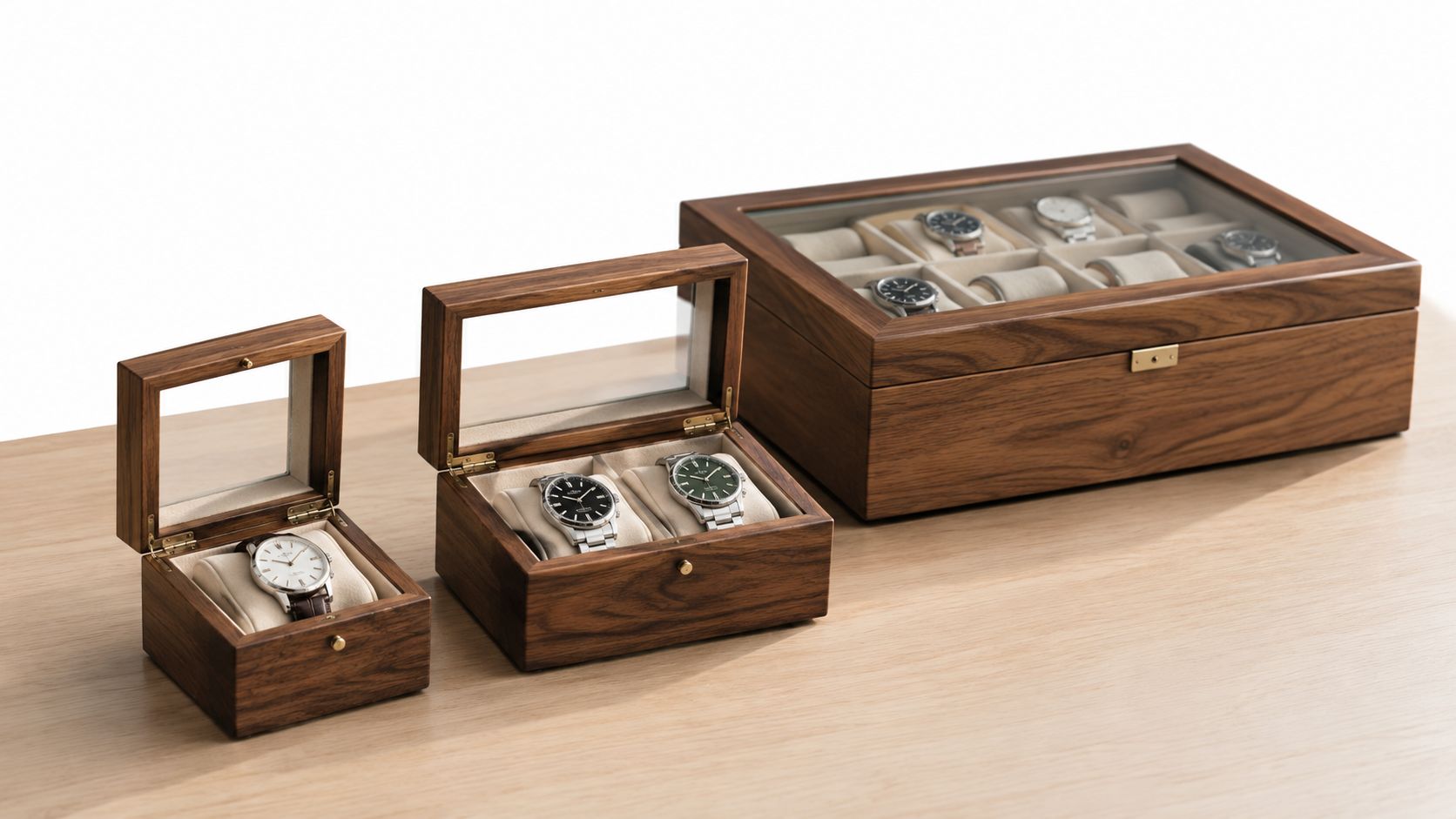
For one watch, a compact daily case is usually enough. It protects the piece from the nightstand and gives you a consistent place to store it. For two or three watches, a dual case or small box provides separation without turning a simple routine into furniture management.
For a growing collection, look for removable pillows, adjustable compartments, and a format that can coexist with a later chest. The available market discussion identifies single-watch boxes with minimalist ownership and multi-watch boxes with larger collections, while estimating that collectors with five or more watches account for about 45% of luxury watch-box demand (market overview). That doesn't mean you should buy for five watches today. It shows why collection stages deserve different solutions.
Frequent travelers should keep home display and travel protection separate whenever possible. A travel case can stay packed with the watches you actually take, while the home case remains in its stable location. Travel boxes account for 19.4% of demand in North America and Europe in the same market source, but demand doesn't decide which format suits your luggage or wrist rotation.
Thick divers, integrated bracelets, and deployant clasps need room to settle without strain. Smaller watches and gender-neutral designs deserve the same attention to pillow adjustment. A case that holds a watch technically but compresses the strap isn't properly fitted.
If your collection has outgrown a dresser box and you also want room for jewelry or other valuables, it may help to browse lockable display cabinets before choosing another open display format. The important distinction is whether you need watch storage, room display, security, or a combination of those functions.
Caring for Your Leather Watch Case and Gifting It Well
Leather benefits from simple, consistent care. Keep the case away from direct sunlight and humid bathrooms, wipe dust with a soft dry cloth, and use a suitable conditioner sparingly. The guide to conditioning leather explains why over-conditioning can be as unhelpful as neglect.
After travel, open the case and let it air in a dry indoor room before storing it again. Don't leave a damp travel case zipped inside luggage, and don't place it beside chargers, speakers, or other electronics once you return home. If the case has removable pillows, take them out occasionally so you can inspect the lining, seams, and interior for dust or moisture.
Humidity still requires balance. Conservation guidance places leather, wood, and textiles around 45–60% RH, while metals are listed around 0–35% RH, showing why a mixed-material case needs a stable compromise rather than aggressive drying. A small hygrometer can help you understand the room, especially in coastal, tropical, or poorly ventilated homes.
A watch display case also makes a thoughtful milestone gift because it supports a habit the recipient already values. For a new collector, a compact case gives the first watch a deliberate home. For someone with an established rotation, a leather chest or travel case can make daily use more orderly. If the occasion calls for something broader, you can pair the case with elevated floral gifting options without losing the practical focus.
Personalization adds meaning when it's available. A monogram or custom detail can turn a useful object into a keepsake, especially for a retirement, anniversary, wedding, or collection milestone.
Before buying, remember four points:
- Right-size the format: Choose for your current stage and actual routine.
- Inspect the interior: Look for smooth lining, secure pillows, and clean stitching.
- Check the hardware: Avoid unverified magnets near mechanical watches.
- Place it thoughtfully: Protect the case from damp air, direct sun, and nearby electronics.
Grainmark Leather offers full-grain leather watch boxes, compact cases, travel formats, and collector storage designed for separated, supported watch display. Visit Grainmark Leather to choose a case that fits your collection stage and gives each watch a considered place at home or on the road.