

Watch Travel Case for Men: A Complete Buyer's Guide
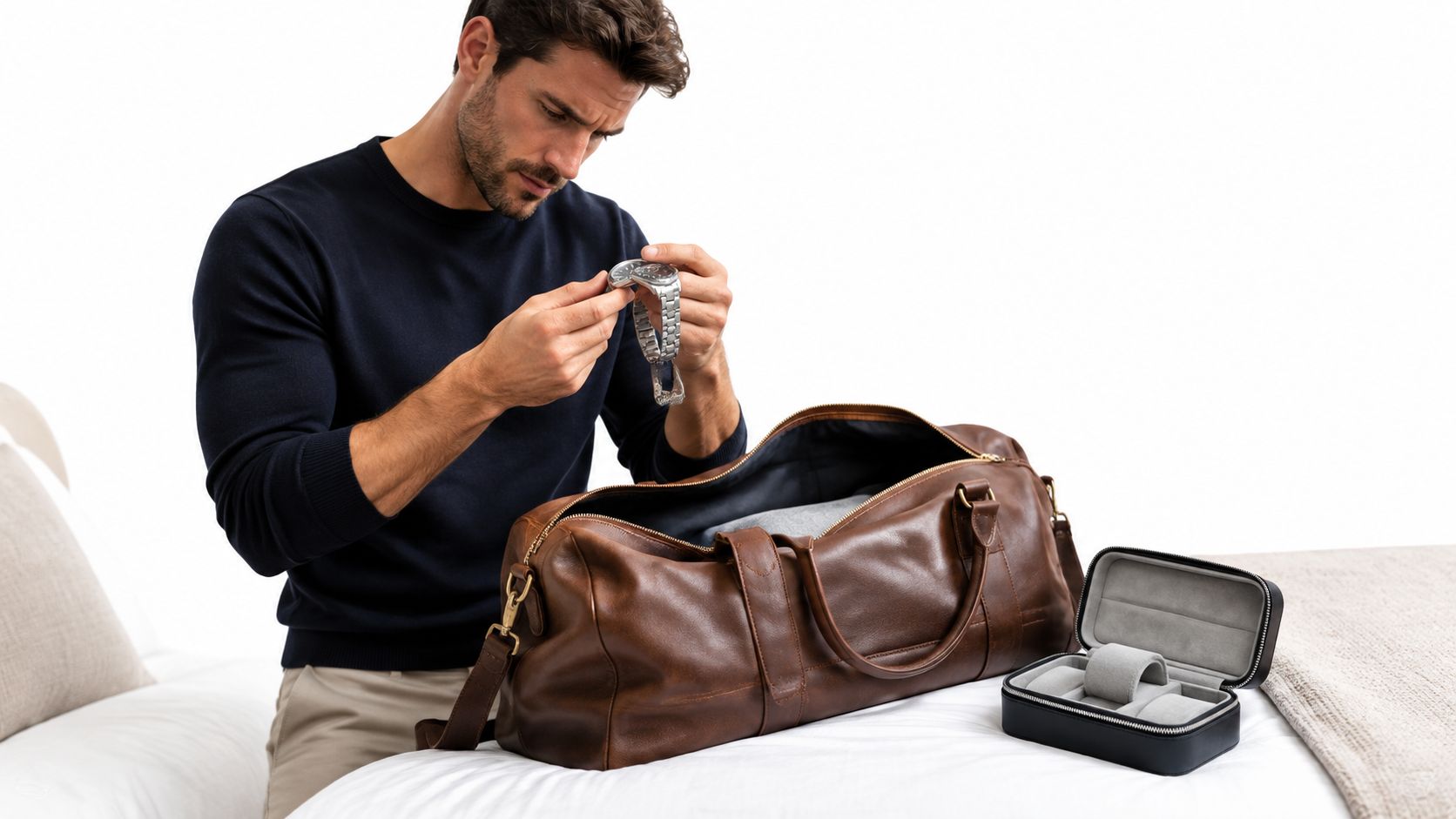
You're halfway through a business trip when you unzip your weekender at the hotel and find a fine scuff across the crystal of your daily watch. The bracelet has rubbed against a charging brick, the crown has pressed into a toiletry bottle, and the watch that looked perfect that morning now needs attention. A dedicated watch travel case for men prevents that kind of careless contact by giving the watch its own padded, organized space.
The right case isn't an attractive leather pouch. It needs to match your trip, luggage, watch count, and exposure to compression. This guide covers the move from fitted luggage trunks to compact watch rolls, the practical differences between leather and hard shells, sensible packing habits, personalization, and the maintenance that lets a well-made case age for decades.
Table of Contents
- Why a Dedicated Travel Watch Case Matters
- From Trunks to Travel Pouches
- Matching Case Formats to Your Trip
- Why Full-Grain Leather Leads the Category
- Soft Rolls, Reinforced Pouches, and Hard Shells
- Packing Habits That Actually Protect Your Watch
- Care and Maintenance for the Long Run
- Choosing the Right Case for You
Why a Dedicated Travel Watch Case Matters
A carry-on commute exposes a watch to constant friction. Keys, cables, pens, sunglasses, and toiletries shift around the same compartment, while a watch left loose takes the impact. Metal bracelets scratch against hard accessories, crowns catch on fabric, and a soft pouch can flatten under another item.
A dedicated case gives the watch its own protected position. A fitted cushion supports the case, the lining separates metal from rough surfaces, and the closure prevents movement inside the bag. That protection suits a daily steel watch as well as a finely finished piece you would handle with the care used when comparing Datejust 41 models.
Protection is more than appearance
A case must address two different forms of travel damage:
- Impact: Reinforced material and dense padding reduce the force reaching the crystal, bezel, caseback, and crown.
- Abrasion: A soft lining keeps the watch and bracelet from scraping against the interior or another watch.
This construction makes a travel case a fitted piece of luggage, not merely a leather pouch. Maison Goyard's Double Travel Watch Case illustrates the compact approach, measuring 16 cm by 10.5 cm and using two interior leather cushions to hold one or two watches. Its design follows the older luggage practice of shaping storage around valuable contents, then reducing that structure for modern travel. Maison Goyard's travel watch case demonstrates how the principle works in a smaller format.
Choose the case for the hazards it controls. Leather color comes after fit, cushioning, lining, and closure. For a short flight, a compact reinforced pouch keeps bulk down. For a collector carrying several watches, separate cushions and firmer walls prevent pieces from contacting one another. A refined exterior matters only when the interior holds the watch securely through the trip.
From Trunks to Travel Pouches
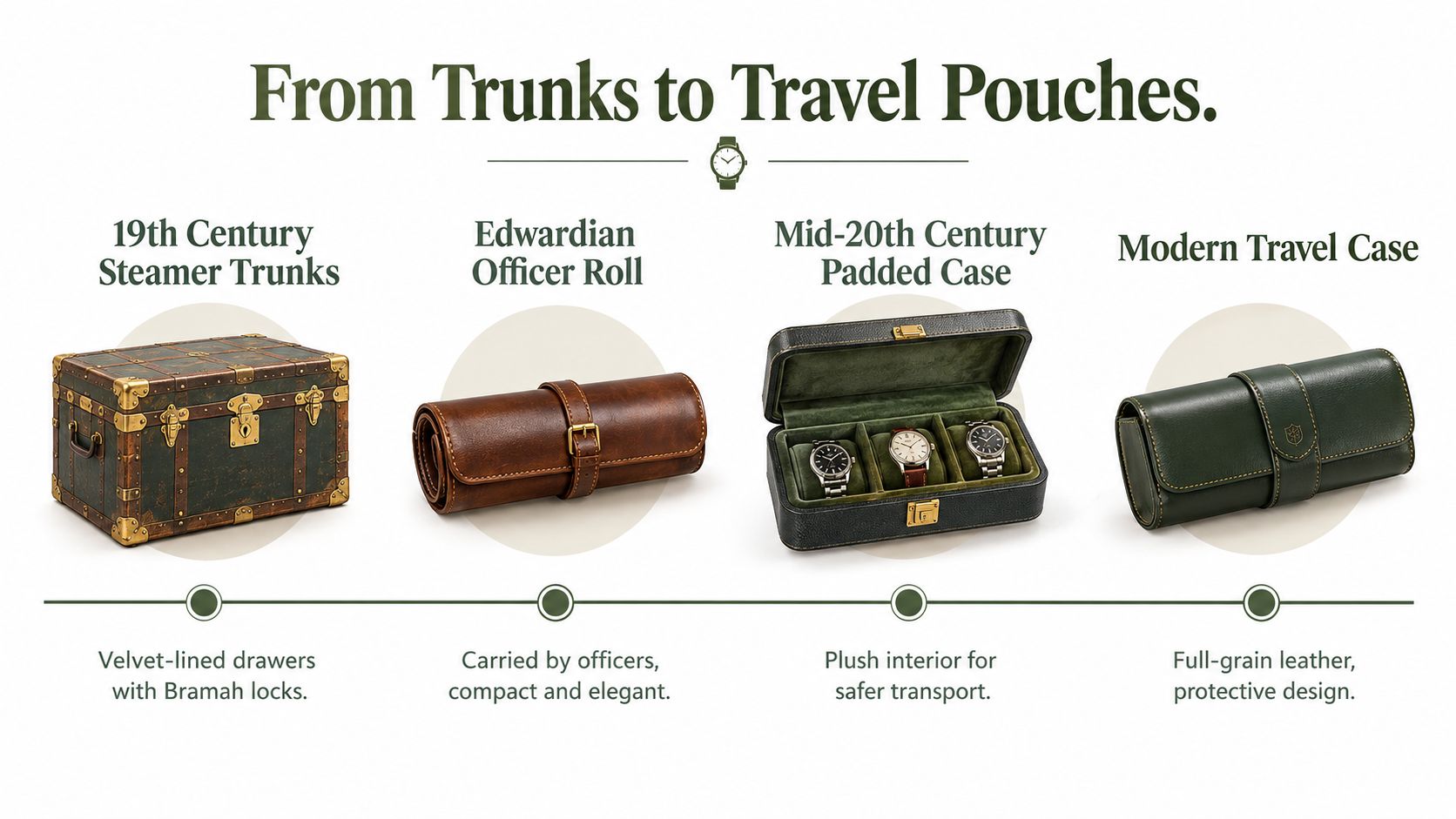
A short flight exposes the weakness of loose watch storage quickly. A watch moves inside a bag, presses against other items, and picks up scratches before the traveler reaches the hotel. The modern travel case solves that problem by shrinking an older luggage idea into a compact, leather-lined format.
That idea was established in the 19th century, when luxury trunks were built around their contents. Dedicated compartments, padded surfaces, and secure closures stopped valuable objects from shifting. Travel watch cases carry that logic forward. Maison Goyard describes its Double Travel Watch Case as part of the era's “art of travel,” while its construction reflects the premium-luggage preference for leather and durable natural materials, as documented in Goyard's product description.
The design progression is straightforward:
- Build the container around the object. A watch needs clearance for its crystal, crown, caseback, and bracelet.
- Replace unused volume with fitted padding. A trunk protects well, but wastes space when the traveler carries one or two watches.
- Keep the compartment principle in a portable format. Cushions and sleeves provide organized storage without the weight of a full luggage chest.
Why compact formats won
Travel became faster and more frequent, so watch storage had to fit inside a briefcase, duffel, or carry-on. A large wooden trunk suited extended passage. It does not suit a carry-on commute or a short business flight.
That shift produced the formats used now: single-watch pouches, double cases, multi-slot organizers, and cylindrical rolls. Their shapes are simpler than fitted trunks, but the protection principle remains unchanged. One watch belongs in one padded compartment, with enough structure to limit movement and a soft lining to prevent surface damage.
The right format depends on the trip. A carry-on commuter needs the smallest case that keeps one watch stable. A short-flight traveler gains flexibility from a double case, especially when switching between a daily watch and a dress watch. A collector traveling with several pieces needs separate cushions and firmer walls, accepting extra weight and bulk in return.
Each added cushion, reinforcement layer, and slot increases capacity, but also enlarges the case. Choose protection and organization before appearance. A handsome pouch that lets the watch shift is poorly fitted luggage.
Matching Case Formats to Your Trip
Choose capacity by the trip you take. A man who wears one watch most days should use a compact case for an overnight stay, not carry a collector organizer for unused slots. A collector traveling with several pieces needs separate protection, even when a thin roll fits more easily into luggage.
Match the format to the scenario
Single-slot zip case: Use this for one daily watch, a spare piece, or a carry-on commute. It takes the least space and keeps one watch contained, but leaves no room for a second piece and usually provides limited crush resistance.
Double case: This is the right choice for a short business flight when you alternate between a daily steel watch and a dress watch. Side-by-side cushions keep both pieces accessible, while a structured zippered body protects better than a loose sleeve. The cost is a wider case inside a briefcase or small carry-on.
Triple case: Choose three slots when a short trip calls for several dress options. It gives more flexibility without the bulk of a larger collector organizer, though it still needs firm walls and correctly sized cushions.
Multi-slot organizer: Use this for collector travel, a watch gathering, or any longer trip involving several pieces. Removable rolls or cushions let you leave unused capacity at home. The added slots increase bulk, and a rigid base helps keep watches at the edges away from pressure.
Watch roll: A roll is compact, attractive, and easy to place in controlled carry-on storage. It suits a minimalist traveler carrying a small selection. It is a poor choice under heavy luggage, where compression can reach the watches. Compare watch rolls and travel cases from Grainmark Leather when assessing compact leather formats.
| Format | Watch Capacity | Typical Dimensions (in) | Ideal Trip |
|---|---|---|---|
| Single-slot zip case | 1 | Compact personal-item footprint | Carry-on commute or overnight stay |
| Double case | 2 | Slim briefcase-friendly footprint | Short business flight |
| Triple case | 3 | Medium organizer footprint | Short trip with varied dress options |
| Multi-slot organizer | 3 to 6 | Larger carry-on footprint | Collector travel or watch meet |
| Watch roll | 2 to 6 | Compressible cylindrical format | Minimalist carry-on travel |
Treat the table as format guidance, not a universal sizing chart. Watch diameter, bracelet length, cushion thickness, and crown profile all affect fit. Secure the bracelet, measure the watch, and compare those measurements with the case's internal dimensions. Outer measurements alone can be misleading.
Why Full-Grain Leather Leads the Category
A watch case pressed under a laptop in a carry-on needs structure, while a case carried by hand can prioritize flexibility. For a serious watch travel case for men, full-grain leather is my default recommendation because it keeps the hide's original grain layer and its dense natural fiber structure. That gives the maker strength and body without depending entirely on thick, bulky layers.
The material also develops character through use. A chestnut or tan case gains darker contact points, surface variation, and a visible patina. That aging comes from the leather itself, not a printed finish. Read this explanation of what full-grain leather means before comparing products, because broad leather labels can conceal major differences in quality.
Material choices under pressure
Top-grain leather has been sanded or corrected for a more uniform surface. It remains usable, but the treatment removes some original grain character. “Genuine leather” provides an even weaker quality signal, since it can describe split leather covered with a coated or printed surface.
Synthetic covers and nylon shells make sense when low weight or water resistance takes priority. They do not age like full-grain leather or provide the same tactile depth. A poorly designed synthetic interior can also leave polished metal against a harsher contact surface, a poor choice for watches carried beside other objects.
Inspect the lining as closely as the hide. Suede microfiber, chamois, and soft calfskin cushion cases and crowns more reliably than slick satin. Compartments should stop the watch from sliding, while pillows should support the bracelet without forcing it tightly around the case. For a short flight, that combination matters more than a decorative exterior.

The honest drawbacks
Full-grain leather weighs and costs more than a thin fabric pouch. Ultraviolet exposure can darken it, and anyone expecting a showroom-perfect surface will be disappointed. I accept those trade-offs for carry-on commuting and short business flights because the case becomes a durable personal travel object instead of disposable packaging.
A three-slot soft travel case from Grainmark Leather uses recycled full-grain cowhide, full-grain calfskin, and suede lining. That formula remains sensible: durable outer leather, soft internal contact surfaces, and enough structure to keep watches separated.
Soft Rolls, Reinforced Pouches, and Hard Shells
Your luggage determines the case format. A soft roll, reinforced pouch, and hard shell address different risks, so match the protection to the journey rather than buying by appearance alone.
| Format | Capacity | Crush Protection | Best Trip Type |
|---|---|---|---|
| Soft roll | 2 to 6 watches | Low | Controlled carry-on commute |
| Reinforced pouch | 1 to 3 watches | Moderate | Short flight in a carry-on |
| Hard shell | Multiple watches | High | Collector travel and rough handling |
Soft rolls
Choose a roll when compact storage matters most. It folds around padded slots and slips into a carry-on sleeve, which suits rail journeys, office commutes, and short hotel stays. The trade-off is compression. If another item presses on the bag, the roll flexes and can force a crown or bracelet against an adjacent surface.
Keep a roll in a carry-on that you control. Surround it with soft clothing, and never place it in checked luggage where heavier bags can crush it.
Reinforced pouches
A reinforced pouch combines a stitched leather exterior with a foam or molded polymer core. That construction gives the best balance for a short flight. It handles ordinary bumps and holds its shape better than an unstructured roll, although sustained pressure from a heavy object can still deform it.
For several coordinated watches, a three-slot roll is a practical option when its cushions are removable and the compartments prevent contact between cases. This three-slot watch roll shows the capacity to look for before moving to a larger collector case.
The right pouch should support the watch without trapping it under rigid pressure.
Hard shells
Choose a molded ABS, aluminum, or carbon-wrapped case for collector travel and rough handling. Its rigid exterior offers the strongest defense against crushing when you cannot guarantee gentle treatment. That protection brings more weight, greater bulk, and less flexibility in a tightly packed bag.
For temporary cushioning around other belongings, bubble pouches from Storage & Removal Boxes Ltd can protect non-watch items. They do not replace a fitted watch case because they cannot hold a watch on a dedicated cushion or limit crown movement.
Inspect the hardware before buying. Check the zipper teeth, stitching, hinges, latch security, and pillow firmness. Good leather cannot compensate for a zipper that catches, a hinge that twists, or a pillow that collapses too easily. For a controlled commute, buy the softest format that keeps watches separated. For flights, choose reinforcement. For multi-watch collector travel, accept the extra bulk of a hard shell.
Packing Habits That Actually Protect Your Watch
At the airport security line, a watch case buried under a laptop and charger becomes a nuisance. Pack it where you can reach it, and prepare the watch before the bag leaves home. Loose bracelets, unsecured crowns, and pressure from nearby electronics cause avoidable trouble.
Prepare the watch first
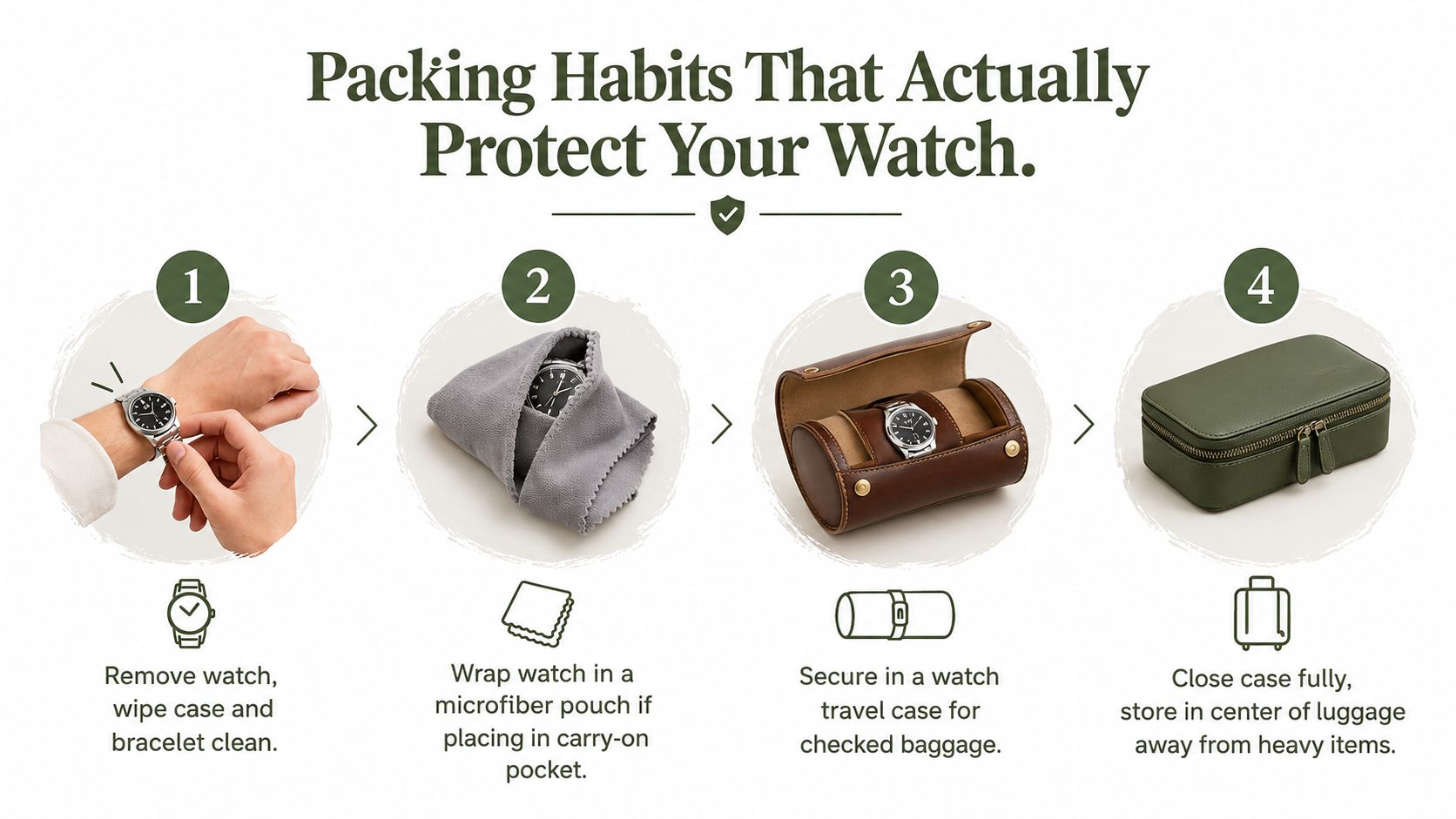
Remove the watch from your wrist and wipe the case and bracelet with a dry microfiber cloth. Check that the crown is screwed down or pushed fully in before placing the watch inside the case. This removes surface grit and reduces the chance of the crown catching or taking direct pressure.
Fasten the bracelet around the pillow at its loosest comfortable position. The watch should stay secure without being cinched tight. Excess tension can distort the bracelet's position, while a completely loose bracelet lets the watch shift from side to side.
For carry-on travel, keep the watch in its dedicated compartment, not an external luggage pocket. Position the case where you can reach it during security checks or a gate change without emptying the bag. A structured travel organizer, such as a men's toiletry bag for travel, can separate liquids and grooming tools from the watch case. The timepiece still needs its own padded enclosure.
Practical rule: Keep the watch case in your carry-on, never checked luggage, whenever you can control the arrangement.
Control the environment
Longines recommends storing watches in a cool, dry environment around 50°F to 80°F, or 10°C to 27°C, with humidity below 50%. Its guidance also recommends silica gel in humid conditions to improve moisture control. Longines' storage guidance provides the relevant temperature and humidity targets.
Place a small silica gel packet inside the case, away from direct contact with the watch and lining. Discard any packet that has leaked or become damaged. The aim is moisture management, not a dry, brittle interior.
Keep the case away from a laptop, shoe, camera body, or power brick. Put it near the center of the bag and surround it with soft clothing. If checked luggage is unavoidable, use a rigid hard shell and position it where other objects cannot crush it. Valuable mechanical watches belong in your carry-on because checked bags face greater handling and loss risks.
Personalization that earns its place
Choose personalization based on how you will use the case:
- Machine-debossed monogram: Clean, consistent initials or a short name suit a graduation watch or promotion gift.
- Hand-tooled initials: Foil or blind tooling adds visible craft and works well for a retirement piece or anniversary present.
- Bespoke interior: Stitched pillows, contrast lining, and pockets sized around a specific collection turn the case into a personal storage system.
Full-grain leather accepts deep impressions more gracefully than a heavily coated corrected surface, where the finish may crack or flake around the debossing.
Order carefully. Confirm the internal dimensions, provide a font sample, approve the maker's mock-up, and allow time for hand finishing. Decide first whether the case will hold one watch, a rotating pair, or a broader collection.
A dated lining or interior stamp can help organize a collector's set. It does not prove authenticity, but it can record which watches were purchased together and preserve useful provenance details for the owner.
Care and Maintenance for the Long Run
A leather watch case lasts when maintenance stays light and regular. Brush away dust with a soft, dry cloth. For grime, use a barely damp microfiber cloth, then let the case dry naturally. Keep water out of the leather and lining.
Wipe the lining after humid trips, then condition the exterior with a neutral-pH leather balm when use calls for it. Skip wax-heavy products, which can clog the pores and collect lint. Follow this guide to conditioning leather for the basic process.
Keep heat and sunlight away
Direct sunlight darkens and dries leather unevenly. Heater vents create concentrated heat, and a hot car trunk can expose the case to temperatures above 140°F, stressing stitching and adhesives. Never leave a leather case in a parked vehicle.
Between trips, store it horizontally and leave it half-open so the lining can breathe. Rotate the watch positions on fixed cushions. This distributes compression marks and prevents one outline from becoming permanent.
Repair before replacement
Chestnut and tan full-grain leather show patina clearly. Black leather develops softer highlights and quieter handling marks. Those changes are normal; inspect the construction rather than judging the case by every surface mark.
After years of travel, check the zipper tape, corner seams, snap closures, and cushion stitching. Send the case for re-stitching when the leather remains sound but a seam has opened. Replace it only when the shell has split, the lining has broadly degraded, or the structure no longer holds the watches securely.
A well-made case should record its travel history without becoming disposable after its first scratch. Keep it away from prolonged moisture, heat, and compression, and the leather will age with the watch rather than undermine its protection.
Choosing the Right Case for You
Choose around the journey you take most. A watch travel case for men should match your watch count, bag space, and handling conditions, not an imagined collection.
| Traveler Profile | Watch Count | Recommended Format | Key Trade-off |
|---|---|---|---|
| Daily commuter | 1 | Slim structured single case | Small footprint, limited capacity |
| Business traveler | 2 | Compact zippered double case | More protection, wider profile |
| Short-trip enthusiast | 3 to 6 | Structured case with removable rolls | Flexible capacity, added bulk |
| Collector traveler | 7 or more | Hard-sided trunk or modular tray system | Strong protection, highest weight |
For a daily carry-on commute, one structured case protects better than a limp sleeve while taking little room. A short flight with two watches suits a compact zippered double case, which balances quick access with separation. For three to six watches, choose removable cushions or modular rolls. They prevent you from carrying empty slots. A collector traveling with seven or more watches needs a hard-sided trunk or modular tray system to resist compression and keep each piece organized.
The format should reflect the shift from 19th-century trunk construction to today's modular, leather-lined travel gear. Inspect construction before surface finish. Choose full-grain leather over corrected grain, stitched seams over glued joins, removable cushions over fixed foam, and a dependable YKK zipper or equivalent. Rolls save space but flex more and can expose crowns to abrasion. Hard shells weigh more and occupy more bag space, but they protect better under rough handling.
Grainmark Leather offers a structured 2-Slot Dual Access Watch Case for two watches, plus watch, sunglasses, and accessory travel cases for broader carry needs. These formats suit men who want leather organization without carrying a large collector chest.
Measure your watches before ordering, then keep valuable pieces in your carry-on. Visit Grainmark Leather to compare full-grain leather watch cases, rolls, and travel organizers for your usual route.