

Leather Mens Crossbody
You're halfway through a crowded commute, one hand holding a coffee and the other searching through overloaded pockets for your keys. Your briefcase keeps knocking against your leg, your phone is buried under a charger, and the thin strap of a cheaper bag is cutting into your shoulder. A well-built leather men's crossbody solves that daily friction by keeping essential items close, organized, and accessible while leaving both hands free.
The difference isn't simply appearance. Leather quality, strap geometry, hardware placement, interior layout, and the way you wear the bag determine whether it becomes a dependable daily tool or an attractive accessory that stays in the closet. Crossbody styles have also moved beyond utility-only carry. Market coverage identifies cross-body bags as a demand driver among men, while leather remains the largest material segment in the broader crossbody sling category, according to Fortune Business Insights' North America handbag market coverage.
Table of Contents
- Why the Leather Men's Crossbody Is the Ultimate Daily Carry
- Full-Grain Leather and Long-Term Durability
- Strap Engineering and All-Day Carry Comfort
- Choosing the Right Size and Silhouette
- Interior Organization for High-Value Essentials
- How to Wear and Adjust for Commuting and Travel
- Investing in Craftsmanship Over Fast Fashion
Why the Leather Men's Crossbody Is the Ultimate Daily Carry
On a busy train platform, a poorly designed crossbody reveals its weaknesses quickly. The bag swings away from the body when you walk, the strap slips toward your neck, and every item inside settles into one heavy corner. By the time you reach your destination, the bag feels less like convenient carry and more like a small pendulum attached to your shoulder.
A properly designed leather men's crossbody behaves differently. It sits close to the torso, keeps its center of mass stable, and gives you access to your phone, wallet, travel documents, and small technology without forcing you to stop and unpack a larger bag. That combination matters in airports, cafés, offices, and crowded public transport, where a secure hands-free format is more practical than a handheld briefcase.
For a broader look at how compact leather carry supports flexible work routines, see this guide to leather bags for digital nomads. The useful principle is simple: the bag should adapt to movement rather than require constant correction.
What a daily driver must do
A reliable crossbody has to manage several competing demands:
- Stay secure: The body should remain close enough to discourage swinging and make the bag easier to monitor in crowded places.
- Remain accessible: A front pocket or top-opening compartment should allow quick access without exposing the entire contents.
- Distribute weight: The strap and attachment points should spread the load instead of concentrating pressure at one narrow section.
- Look appropriate: A restrained leather exterior can move between a work setting, travel environment, and casual evening use without appearing overly technical.
Leather adds a useful balance of structure and flexibility. A thin synthetic bag may feel light at first but can collapse around its contents, while an overly rigid case may resist comfortable movement. Full-grain leather, correctly reinforced, can support a structured shape while developing character through use.
Practical rule: A crossbody should disappear into your routine. If you're constantly lifting it back onto your shoulder, opening it with two hands, or searching through one deep compartment, the design is working against you.
The men's luxury bag market provides a useful proxy for this category. Leather accounts for nearly 68% of revenue in 2026, and the market is projected to rise from US$12.4 billion in 2026 to US$17.3 billion by 2033, a 4.9% CAGR, according to Persistence Market Research. That steady outlook favors construction, repairability, and long product life over disposable styling.
Full-Grain Leather and Long-Term Durability
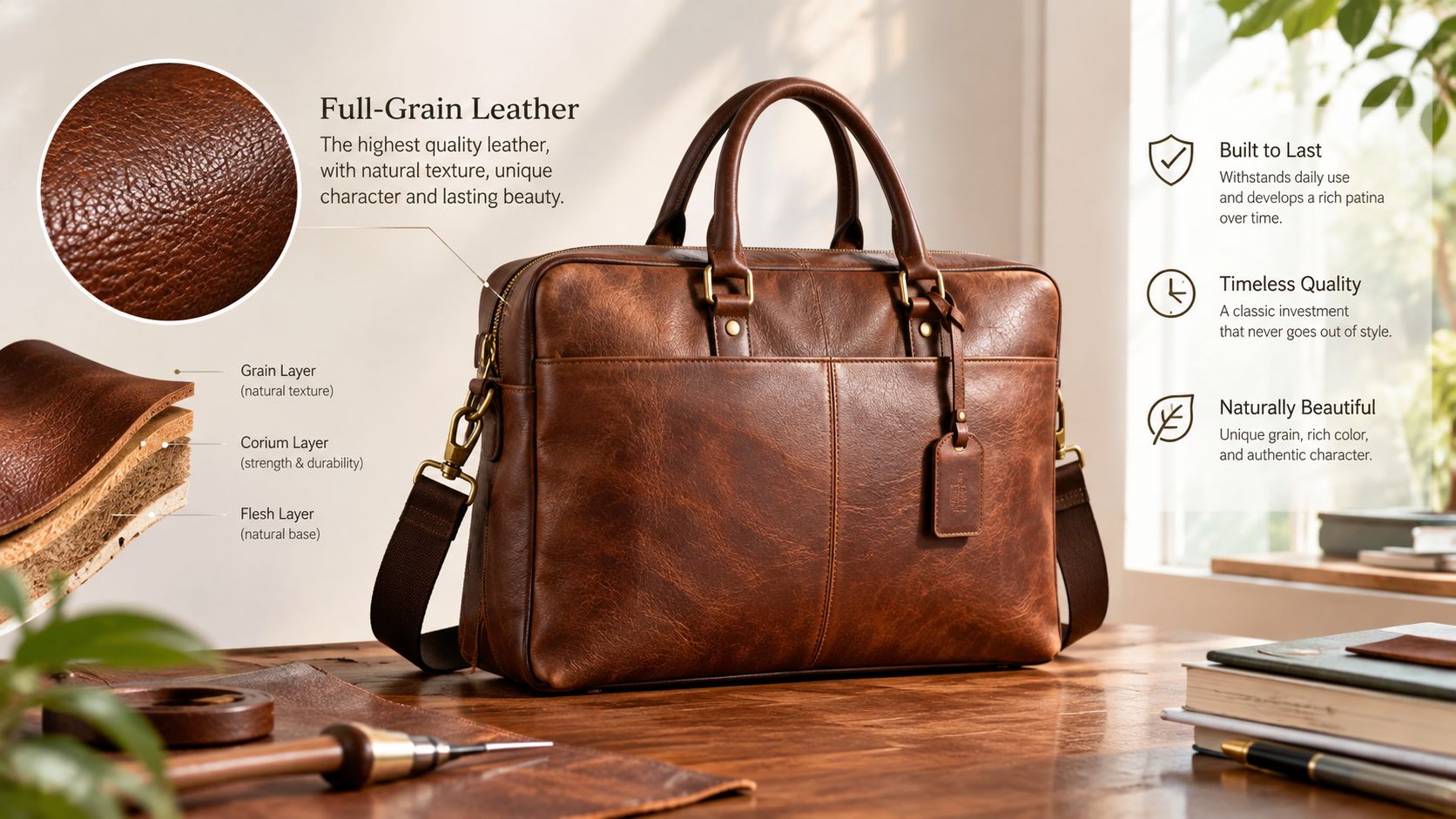
Full-grain leather keeps the hide's natural grain layer intact. That layer is the densest and most abrasion-resistant part of the hide, which is why it generally performs better around corners, edges, strap anchors, and flap folds than corrected-grain or split constructions.
Corrected leather has usually had its surface altered to remove or disguise natural marks. It can still produce an attractive finish, but the surface no longer tells the full story of the hide's original structure. Split leather uses a lower layer of the hide, while synthetic alternatives rely on a coated surface over a textile or polymer base. Those materials can serve particular price or maintenance goals, but they don't offer the same wear pattern as full-grain leather.
Why flex stress matters
A crossbody is folded, opened, compressed, and pulled every day. The most demanding areas aren't always the broad front panel. They're the points that repeatedly bend or carry tension:
- Strap attachment tabs
- Corners that brush against desks and train seats
- Flap folds
- Zipper ends
- Areas around magnetic closures
- Stitch lines that receive concentrated pull
Practical testing data cited by Alibaba's leather durability comparison places real leather at about 50,000 to 100,000 flex cycles, compared with 15,000 to 35,000 cycles for PU leather. The figures don't mean every full-grain bag will last for a specific number of years. Construction, finishing, moisture exposure, and care still matter. They do show why a natural leather structure can resist repeated folding and flexing more effectively than a cheaper coated alternative.
A full-grain surface also changes rather than deteriorates. Scratches can blend into a developing patina, and areas that receive regular contact may become darker and more supple. Peeling is a different failure mode. Once a synthetic coating begins to separate, the visible damage often spreads across the panel instead of becoming part of the bag's character.
What to inspect before buying
Look at the cut edges, not just the product photographs. Full-grain leather should have a convincing natural surface, consistent thickness, and edges that appear finished rather than visibly laminated. Check whether the strap anchors use reinforced leather, strong stitching, or supportive hardware instead of relying on a single thin tab.
A useful companion to this material discussion is this guide to full-grain leather lifespan. The central buying lesson is straightforward: leather grade matters, but leather grade must work with sound construction. A premium hide attached with weak hardware can still fail early, while a well-engineered bag makes better use of the material's natural strength.
Strap Engineering and All-Day Carry Comfort
The strap is the part of a crossbody that your body feels continuously, yet many product descriptions treat it as an afterthought. For a commuter or traveler, that's a costly omission. A beautiful bag with a narrow, rigid, poorly positioned strap can become uncomfortable long before the leather shows any wear.
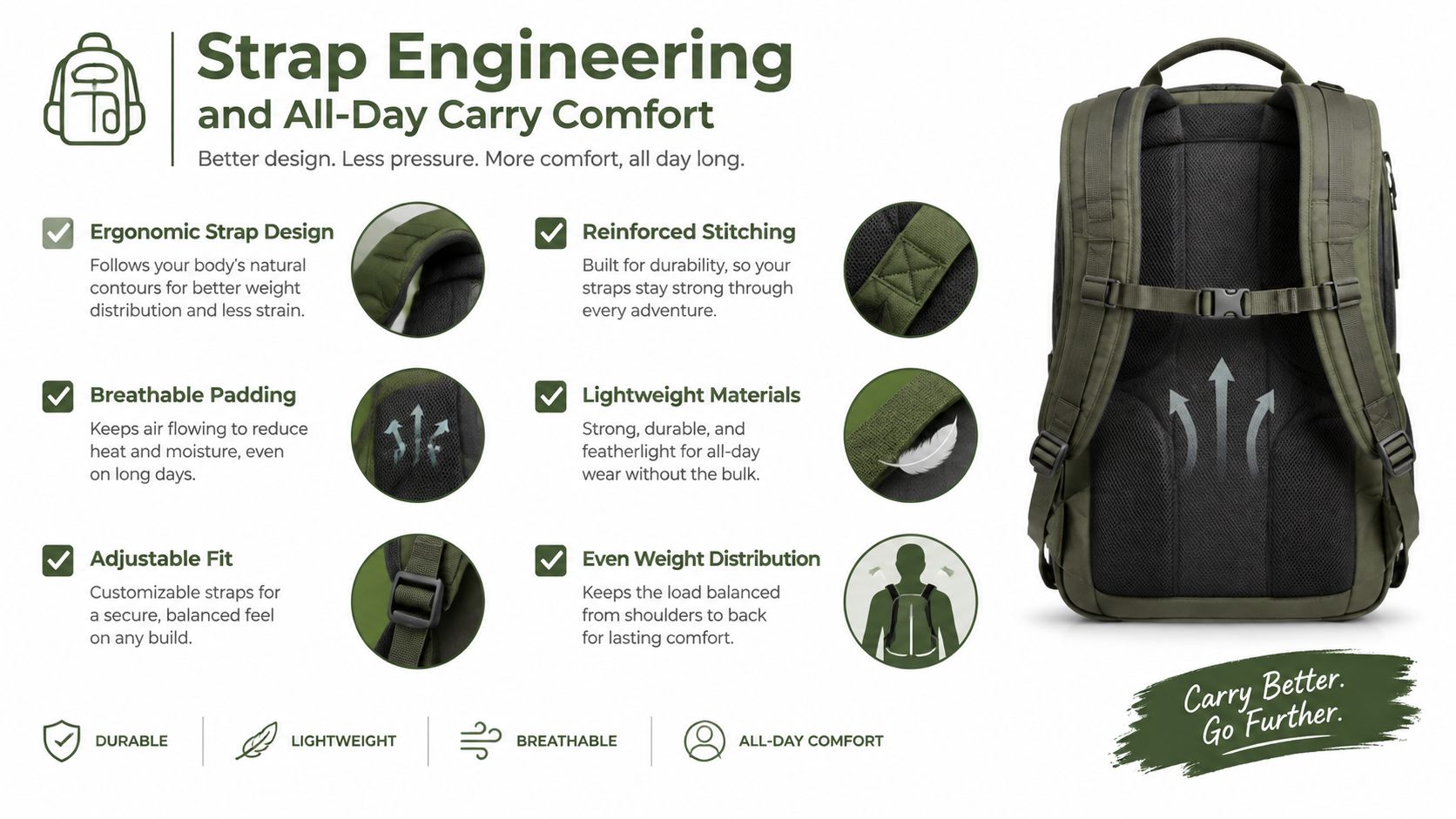
Ergonomic research on shoulder-carried loads found that wider straps reduce interface pressure, with the lowest measured pressure occurring at an 8 cm strap width, and that carrying the load higher on the body generally improves comfort by reducing shoulder and axillary pressure, as reported in this PubMed study. A men's crossbody doesn't need to copy that exact measurement to benefit from the principle. A padded strap roughly in the 1.5 to 3 inch range can spread pressure more effectively than a narrow leather strip, especially when the bag carries dense items.
Four points to evaluate
Start with width. A wider strap distributes load across more contact area. Very narrow straps may look sleek on a compact bag, but they can dig into the shoulder when you add a tablet, charger, wallet, and keys.
Then check padding and flexibility. Padding should cushion contact without creating a bulky ridge at the neck. A strap that's too stiff may resist the body's movement, while one that's too soft can allow the bag to sag and swing.
Inspect the adjuster. The slider should hold its position under tension. Loose adjustment hardware gradually lengthens the strap as you walk, lowering the bag and increasing movement. Smooth adjustment also matters when you switch between a shirt, coat, or heavier travel layer.
Study the anchor placement. Attachments positioned too close to the bag's center can cause twisting. Attachments placed toward the upper corners usually help the bag hang more predictably, provided the leather tabs and stitching are reinforced.
Keep the load close
The bag body should sit close to the torso rather than hanging low and swinging with every step. Keeping the load near the wearer's centerline reduces unnecessary movement and makes the same contents feel easier to control. It also helps in crowded settings, where a loose bag can bump into other people or catch on furniture.
Modular and adjustable carry systems deserve special attention. Recent market commentary identifies strap comfort and load-distribution information as an underserved purchasing concern, and it reports that buyers have abandoned purchases when those details remain unclear, according to Alibaba's 2026 men's crossbody buying guide. Treat that as a design warning rather than a reason to trust a headline figure. If a seller won't show the strap, anchor points, and adjustment system clearly, you can't properly assess the bag's daily performance.
For a useful comparison between related carry formats, read crossbody versus sling bag. The right choice depends less on naming and more on how the strap manages the load you carry.
Choosing the Right Size and Silhouette
A crossbody should be large enough for the essentials you carry repeatedly, not large enough to accommodate every possible situation. Oversizing creates a familiar problem: once unused space exists, it fills with items that make the bag heavier and less comfortable. Choosing too small a silhouette creates the opposite frustration, forcing chargers, sunglasses, or documents into the wrong compartment.
The best starting point is an inventory. Put the items you carry on a normal workday on a table. Include your phone, wallet, keys, glasses, charger, notebook, passport if you travel regularly, and the largest device you expect the bag to hold. Measure the device rather than relying on a vague label such as “tablet compatible.”
Crossbody silhouettes by use case
| Silhouette Style | Ideal Capacity | Best Suited For |
|---|---|---|
| Compact vertical crossbody | Phone, wallet, keys, glasses, small charger | Minimal daily carry and quick errands |
| Flat document crossbody | Notebook, documents, tablet, everyday accessories | Office commutes and meetings |
| Structured messenger | Tablet or compact laptop, documents, charger, personal items | Professionals who need work and personal carry together |
| Travel crossbody with expansion | Passport, phone, wallet, cables, travel papers, small accessories | Airports, sightseeing, and transit-heavy travel |
A compact vertical format often wins for people who want speed. Its narrow body stays close to the torso, and a front pocket can make phone access simple. The trade-off is limited capacity. If you force a bulky charger or notebook into it, the profile becomes distorted and the strap carries the resulting pressure unevenly.
A larger messenger gives you more separation between work documents and personal effects. It's more useful when you carry a tablet, notebook, or compact computer, but it also demands better structure and strap engineering. Without those features, the added volume can pull the bag away from the body.
Match structure to movement
Soft leather works well when you want a relaxed silhouette that conforms to the contents. Structured leather protects documents and keeps the opening stable, but it adds visual and physical weight. A flap offers classic styling and can protect the top opening, while a zipper provides a more predictable closure during travel. Magnetic closures are convenient, but they shouldn't replace a secure zipped compartment for passports, wallets, or other high-value items.
If your daily carry includes a computer, compare the intended format with a laptop bag versus a messenger bag. Don't buy capacity you won't use. The right leather men's crossbody should hold the actual load without becoming a portable storage drawer.
Interior Organization for High-Value Essentials
A leather exterior protects very little if the interior lets objects collide. Keys can scratch a watch crystal, a charger can press against documents, and loose pens can leak into a pale lining. Interior organization isn't decoration. It controls contact, movement, and access.
Start with the items most vulnerable to damage. A tablet or small laptop needs a padded sleeve that separates it from metal hardware and hard objects. The sleeve should hold the device firmly enough to stop it sliding into the bottom seam, but it shouldn't require force every time you remove the device.
Build compartments around the objects
Eyewear needs its own protected zone. A flexible slip pocket may keep glasses from disappearing, but it won't necessarily protect them when the bag is set down or compressed. A more structured pocket, or a separate rigid case, creates a barrier between the frames and the rest of the contents.
Writing instruments also benefit from dedicated storage. Fountain pens, in particular, shouldn't share a loose compartment with keys, coins, or charging plugs. A narrow pen sleeve keeps the pen upright and reduces scratches, while a rigid pen box makes more sense for delicate or valuable instruments. Grainmark Leather's wider range includes specialist storage for pens, watches, and eyewear, which reflects a useful principle: protective storage should follow the object's shape and vulnerability.
Use security pockets selectively
A zipped interior section is the right place for passports, spare cards, travel documents, or a wallet when you're moving through an airport or unfamiliar city. It shouldn't become the only compartment in the bag. If everything goes into one zipped pocket, access becomes slow and the contents still collide.
A practical layout might include:
- Padded device sleeve: Separates a tablet or compact computer from the main load.
- Zipped security pocket: Holds passports, cards, and documents close to the bag's interior.
- Pen loop or narrow sleeve: Prevents writing instruments from rolling beneath larger items.
- Open access pocket: Keeps a phone, transit card, or earbuds within immediate reach.
- Key leash or dedicated clip: Stops keys from scratching other possessions and makes them easier to find.
The interior lining should also be considered. A smooth, durable lining makes it easier to retrieve objects and clean out dust, while a loose or poorly secured lining can catch on zippers and corners. Excessive padding isn't automatically better. It can reduce usable space and make a compact bag feel crowded.
For a dedicated way to keep identification and cards organized, consider the role of a leather ID holder. The best interior is not the one with the most pockets. It's the one that gives each frequently used item a predictable home.
How to Wear and Adjust for Commuting and Travel
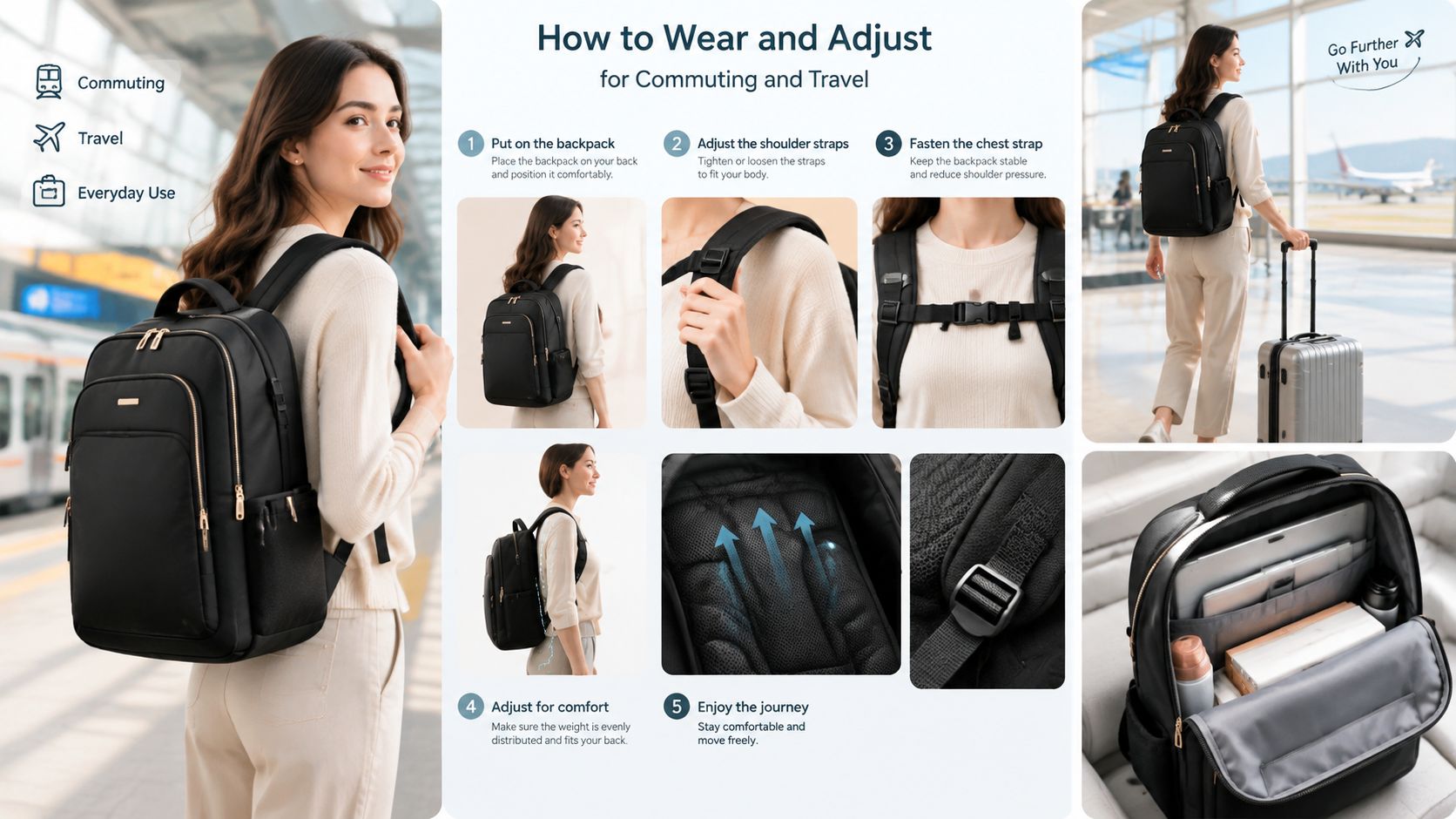
A well-made bag can still feel wrong if you wear it too low or leave the strap loose. Adjustment should begin with the bag's position, not the strap's appearance. Place the bag against your torso and shorten the strap until it sits high enough to remain stable without pressing into your ribs or restricting your arm.
For crowded transit, wear the bag across the body with the body positioned in front of your torso. That keeps the opening visible and reduces the chance of the bag swinging behind you. In a quieter environment, you can move it toward your hip for easier access, but shorten the strap if the bag begins to bounce.
Adjust for the setting
At a café or desk, move the bag to the side that keeps it out of your knees and away from the aisle. When seated, place the body between your feet or against your leg rather than leaving it hanging from the chair. That prevents unnecessary strain on the strap attachments and keeps the bag within reach.
Under a jacket, a slim crossbody can work well if the bag's profile remains flat. Wear it over a lighter layer when you need fast access, but avoid placing bulky contents in the outer pocket, where they can create pressure against the jacket and disrupt the silhouette.
Travel adds another consideration. Before boarding, put passports and tickets in a consistent secure pocket rather than relying on a last-minute search through the main compartment. Once you're walking, keep the bag high enough that it doesn't swing below your natural center of movement.
Carry check: Walk, sit, bend, and reach before committing to an adjustment. If the bag swings, the strap rubs your neck, or the opening shifts behind you, change the length or redistribute the contents.
The goal isn't to lock the bag into one position. It's to create a stable starting point that can adapt as you move from pavement to train seat to airport queue.
Investing in Craftsmanship Over Fast Fashion
A disposable crossbody usually reveals its priorities through small decisions. The leather may be thin, the strap hardware may feel loose, the lining may pull away from the edge, and the pockets may exist without a clear relationship to the objects they hold. Each compromise lowers the bag's usefulness, even if the silhouette looks current.
Craftsmanship takes a different approach. The maker has to think about how the hide bends at the flap, how the strap pulls on the body, how hardware bears weight, and how the interior protects the contents. Those choices don't always appear in a product photograph, but they determine whether the bag remains comfortable and presentable after repeated commuting.
The buying standard
A durable leather men's crossbody should meet four tests:
- Material integrity: Full-grain leather gives the bag a strong natural surface and a better chance of developing an attractive patina through use.
- Load control: A sufficiently wide, adjustable strap and reinforced attachment points help keep pressure manageable.
- Appropriate capacity: The body should fit your regular essentials without encouraging unnecessary weight.
- Object-specific protection: Devices, eyewear, pens, passports, and keys need separate spaces suited to their risks.
Classic styling strengthens the investment because it doesn't depend entirely on a short-lived visual trend. A restrained brown, black, or natural leather finish can work with professional clothing, travel layers, and casual outfits. As the surface gains marks and softens at contact points, the bag becomes more personal rather than more worn.
Cost should be judged against use, not only at checkout. A cheaper bag that cracks at the strap, peels at the corners, or loses its shape quickly may need replacement before it has served its purpose. A well-constructed piece costs more to produce because the hide, reinforcement, stitching, hardware, and finishing all require attention. That's the trade-off behind a bag intended for long-term daily carry.
The useful question isn't whether a bag looks premium on day one. It's whether the strap, leather, and interior will still make sense after months of actual movement.
Before buying, inspect the strap width, adjustment hardware, attachment tabs, opening, lining, device protection, and pocket placement. If a seller explains those features clearly, you can compare function rather than guessing from styling alone.
Grainmark Leather offers full-grain leather bags and small leather goods for men, including crossbody formats designed around compact everyday carry, adjustable straps, secure pockets, and practical storage. Visit Grainmark Leather to compare leather men's crossbody options built for commuting, travel, and organized daily use.


