

Laptop Bag vs Messenger Bag: Which One Works for You?
A laptop bag is a structured carry case designed to protect devices and organize business accessories, while a messenger bag is a crossbody bag built for quick access and flexible daily carry. The laptop bag vs messenger bag decision comes down to four factors: carrying comfort, organizational depth, professional image, and commute type. Neither option is universally better. Each serves a distinct set of daily conditions.
What is the difference between a laptop bag and a messenger bag?
A laptop bag prioritizes device protection through rigid frames, padded compartments, and structured organization. A messenger bag prioritizes access speed through a single crossbody strap and an open, front-swinging design. Both categories now overlap significantly, as modern messenger bags include padded laptop sleeves, zippered tech pockets, and trolley straps that were once exclusive to briefcase-style laptop bags.
The core distinction remains in form factor. Laptop bags hold their shape and keep contents separated by category. Messenger bags offer a wider main compartment that fits items of irregular shapes and sizes. Grainmarkleather builds both styles from full-grain leather, which means the structure holds over years of daily use rather than softening into a shapeless shell after a few months.
Capacity is another clear dividing line. Messenger bags range from 16.5L to 24L, making them well suited for light to moderate daily setups. Laptop bags typically offer less total volume but more organized internal space, with dedicated slots for chargers, cables, notebooks, and business cards.
How does carrying style affect comfort and daily use?
Carrying style is where the two bag types diverge most noticeably over the course of a workday. Laptop bags typically offer a top handle and a detachable shoulder strap, which suits short walks between a car and an office. Messenger bags use a single crossbody strap that keeps the bag accessible at all times without removal.
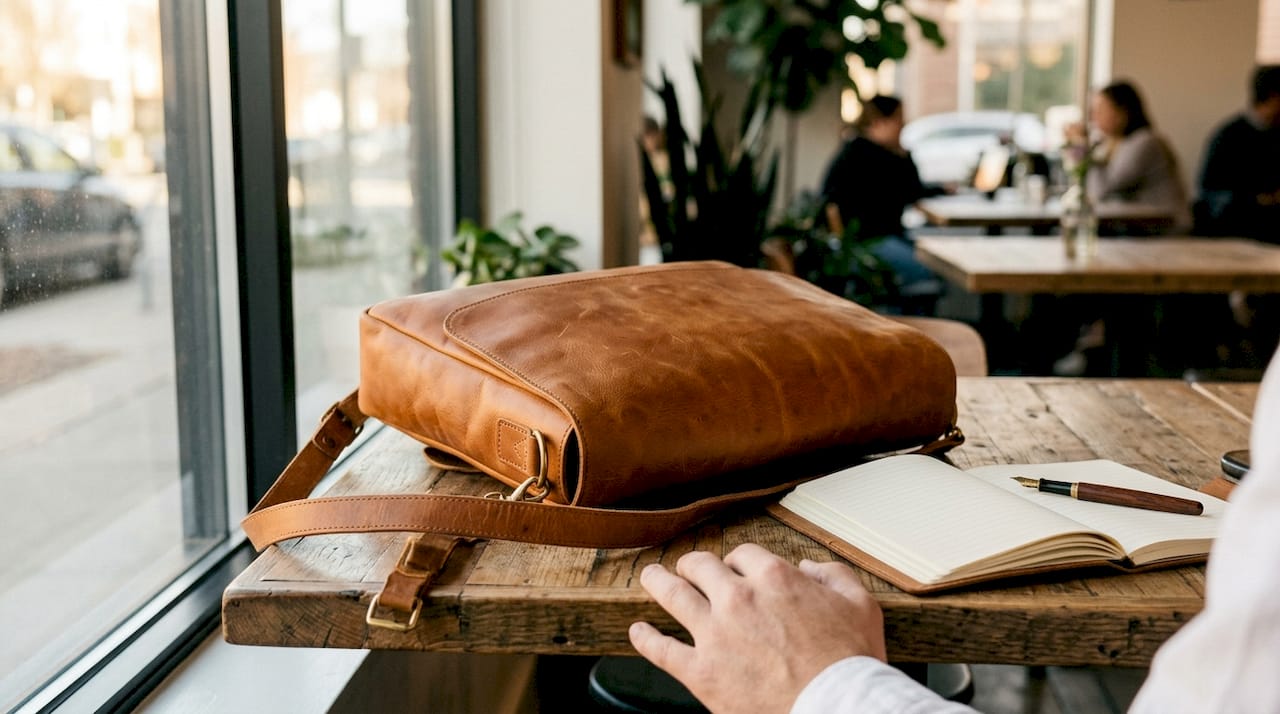
The ergonomic trade-off is real. Messenger bags concentrate load on one shoulder, which causes fatigue on longer commutes, particularly when carrying a 15-inch laptop plus accessories. That strain accumulates across a full workday in ways that are easy to underestimate until you have experienced it firsthand. Laptop bags with detachable straps distribute weight similarly but are typically carried by hand for short distances, which reduces shoulder fatigue.
The quick-access advantage of messenger bags is genuine. Swinging the bag forward without removing it lets you retrieve a laptop, transit card, or notebook in seconds. That matters on a crowded subway platform or in a meeting room where unstrapping a bag is awkward.
Pro Tip: If your commute involves more than 20 minutes of walking or standing transit, test the bag’s strap width before buying. Wider straps distribute shoulder load more evenly and reduce fatigue significantly over time.
- Laptop bags: top handle plus shoulder strap, suited for short-distance office carry
- Messenger bags: single crossbody strap, suited for mobile access in transit
- Laptop bags: better for heavier loads carried over longer distances
- Messenger bags: better for quick retrieval in crowded or fast-moving environments
- Both styles: available with padded compartments, though laptop bags offer more structured protection
How do capacity and organization compare?
Capacity and organization determine how well a bag fits your actual daily load. Messenger bags offer generous volume, with capacities from 16.5L to 24L covering most light to moderate professional setups. That volume sits in a wide main compartment, which makes retrieval fast but organization loose.
Laptop bags work differently. They divide internal space into dedicated zones: a padded laptop sleeve, a front organizer panel with pen loops and card slots, and a secondary compartment for documents or a tablet. The trade-off is that you carry less total volume but always know where each item is.
The table below compares the two bag types across the features that matter most for daily professional use.
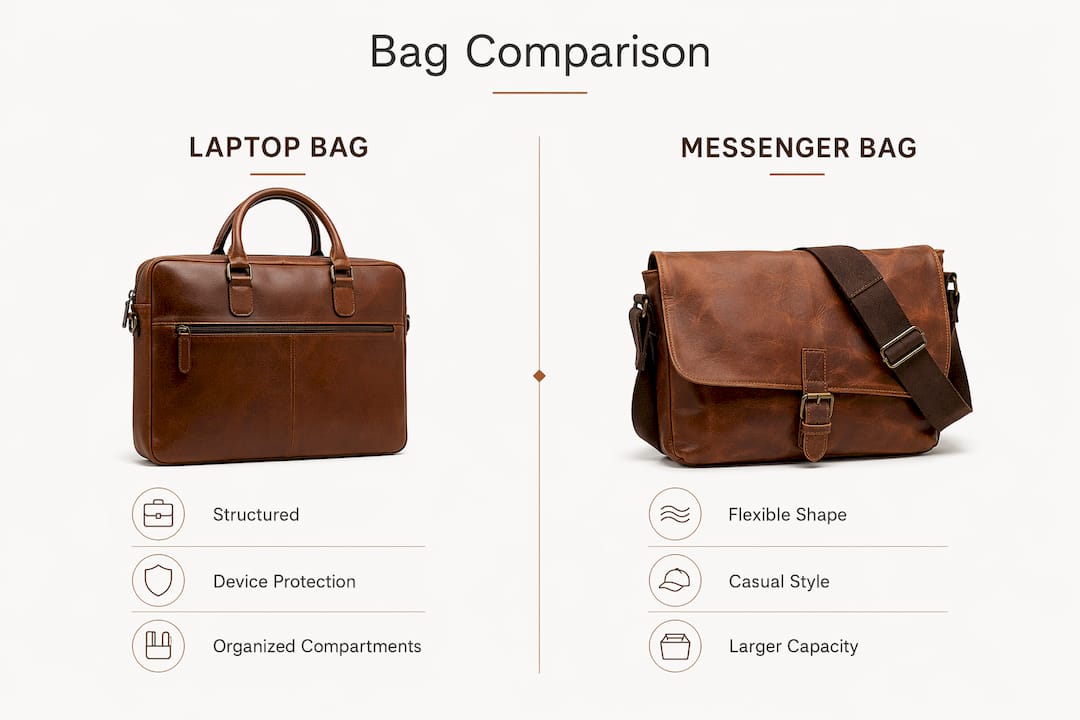
| Feature | Laptop bag | Messenger bag |
|---|---|---|
| Typical capacity | Smaller, highly organized | 16.5L–24L, open main compartment |
| Laptop protection | Rigid padded sleeve, structured frame | Padded sleeve, less rigid outer shell |
| Organizational depth | High: dedicated slots and panels | Moderate: fewer fixed dividers |
| Access speed | Slower: requires opening top or front | Fast: swing forward, open flap |
| Carrying method | Handle or shoulder strap | Single crossbody strap |
| Best load weight | Moderate to heavy | Light to moderate |
Modern messenger bags close some of this gap. Advanced designs now include padded laptop sleeves with non-slip linings and lockable zippers, which address the protection concerns traditionally associated with side-carry bags. Still, a structured laptop bag remains the stronger choice when device protection is the top priority.
Does bag style affect professional image?
Bag style communicates something before you say a word. Laptop bags signal a formal, business-ready appearance that suits traditional office environments, law firms, finance settings, and client-facing roles. The structured silhouette reads as organized and deliberate.
Messenger bags carry a smart-casual reputation that fits hybrid offices, creative agencies, tech companies, and academic environments. The assumption that messenger bags look unprofessional is outdated. A leather messenger bag with a structured shape projects a sophisticated image that holds up in business casual settings and many formal ones.
Material plays a large role in how professional a bag reads. Full-grain leather, regardless of bag style, signals quality and durability in a way that nylon or polyester cannot. Grainmarkleather uses full-grain cowhide across its bag range, which means both its laptop bags and messenger-style bags carry the same material credibility in a professional setting.
Consider these style factors when choosing:
- Dress code: Formal offices favor structured laptop bags. Casual or hybrid offices accept either style.
- Industry: Finance and law lean toward briefcase-style laptop bags. Creative and tech fields accept messenger bags readily.
- Material: Full-grain leather elevates any bag style. Synthetic materials reduce perceived formality.
- Color: Dark tones (black, dark brown) read as more formal across both bag types.
- Shape: Structured shapes signal professionalism regardless of whether the bag is a laptop bag or a messenger bag.
When should you choose a laptop bag vs a messenger bag?
The right choice depends on your commute, your daily load, and how often you need to access your bag in motion. These are the clearest decision points.
Choose a laptop bag when:
- Your commute involves driving or short walks between a parking lot and a building.
- You carry a full laptop, charger, notebook, documents, and multiple accessories daily.
- Your workplace has a formal dress code or client-facing expectations.
- Device protection is a top priority, particularly for expensive or fragile hardware.
- You prefer organized compartments over open-access storage.
Choose a messenger bag when:
- Your commute involves public transit, cycling, or frequent movement between locations.
- You carry a lighter load: laptop, one notebook, a few cables, and personal items.
- Your workplace culture is casual, hybrid, or creative.
- You need fast access to your bag without removing it or setting it down.
- You move between meetings, coffee shops, and co-working spaces throughout the day.
Messenger bags excel in crowded, short-distance transit scenarios, while structured laptop bags perform better on longer commutes with heavier loads. Cycling commuters in particular benefit from the crossbody design, since the bag stays in place during movement and swings forward when you stop.
Pro Tip: If you carry both a laptop and a camera or a second device regularly, a laptop bag’s structured compartments will protect your gear better than a messenger bag’s open main section.
Urban environments add another variable. In dense cities, a messenger bag worn across the body is harder to snatch than a bag carried by a top handle. That practical security advantage matters in high-traffic commuting conditions.
Key Takeaways
The best bag for daily professional use is the one that matches your commute length, load weight, and workplace culture rather than the one with the most features.
| Point | Details |
|---|---|
| Carrying comfort | Messenger bags cause shoulder fatigue on long commutes; laptop bags suit short-distance carry better. |
| Capacity and organization | Messenger bags offer 16.5L–24L of open volume; laptop bags offer structured, compartmentalized space. |
| Professional image | Full-grain leather elevates both styles; structured shapes read as more formal in traditional settings. |
| Access speed | Messenger bags swing forward for instant access; laptop bags require opening and setting down. |
| Best use case | Choose a laptop bag for heavy loads and formal settings; choose a messenger bag for mobile, light carry. |
My take on choosing between these two bag types
I have used both styles across different work phases, and the honest answer is that the messenger bag gets overused by people who would be better served by a structured laptop bag. The appeal of quick access is real, but most professionals do not actually need to retrieve their laptop while standing on a train platform. They need it at a desk, in a meeting room, or at a café table. In those settings, the access speed advantage of a messenger bag disappears.
What does not disappear is the shoulder strain. Carrying a 15-inch laptop plus a charger in a messenger bag for a 45-minute commute each way adds up. Most people notice it after a few weeks, not on day one. A structured laptop bag with a padded shoulder strap distributes that load more evenly and causes less fatigue over time.
That said, I think the messenger bag gets unfairly dismissed in formal settings. A well-made leather messenger bag with a clean silhouette holds its own in most business casual environments. The material and construction matter more than the bag category. A full-grain leather messenger bag from a quality maker looks more professional than a cheap nylon laptop bag from a mass-market brand.
My practical advice: map your actual week before deciding. Count how many times you access your bag in motion versus at a desk. If the answer is mostly at a desk, buy the laptop bag. If you are constantly on the move between locations, the messenger bag earns its place.
— Jevgeni, Founder
Grainmarkleather’s full-grain leather bags for daily carry
Grainmarkleather builds bags from full-grain cowhide with heavy-duty stitching and a one-year warranty on every piece. The construction holds up to daily professional use without the softening or cracking that affects lower-grade leathers.
The personalized leather laptop backpack fits a 15.6-inch laptop and includes travel-ready organization for professionals who carry a full daily load. For a lighter carry option, the full-grain leather laptop sleeve protects devices inside any bag without adding bulk. Both options are available with personalized embossing for a clean, professional finish. The full range of leather bags and accessories covers both structured and flexible carry styles.
FAQ
What is the main difference between a laptop bag and a messenger bag?
A laptop bag uses a structured frame and dedicated compartments to protect devices, while a messenger bag uses a crossbody strap and open main compartment for fast access. The primary trade-off is protection and organization versus speed and flexibility.
Are messenger bags good for carrying laptops?
Messenger bags work well for laptops on short commutes and light daily loads. Modern messenger bags include padded laptop sleeves and lockable zippers that provide adequate protection for most professional use cases.
Which bag is better for long commutes?
A structured laptop bag or a backpack-style carry option is better for long commutes. Single-shoulder messenger bags cause fatigue when carrying heavier loads over extended distances.
Can a messenger bag look professional?
A leather messenger bag with a structured shape reads as professional in business casual and many formal settings. Material and silhouette determine perceived professionalism more than bag category alone.
What capacity do I need for a daily laptop bag?
Messenger bags in the 16.5L–24L range cover most light to moderate daily setups. If you carry a laptop, charger, documents, and personal items, a bag at the higher end of that range or a structured laptop bag with dedicated compartments will serve you better.