

Men's Billfold Wallet Guide for Everyday Carry
You tap your phone at the café counter, then reach for your wallet when the cashier asks for an ID. A receipt needs somewhere to go, a transit card isn't in your digital wallet, and the emergency note you keep tucked behind your license still matters. That small pause reveals why a men's billfold wallet hasn't disappeared. It no longer needs to carry your entire financial life, but it can still organize the physical items that digital payment can't replace.
A good billfold should feel like a quiet tool, not a brick in your pocket. It should open without fighting you, hold the cards you use, keep cash reasonably flat, and age without losing its shape. The wrong one becomes a daily irritation. It stretches when overfilled, develops sharp edges, or forces you to carry compartments designed for a life you don't have.
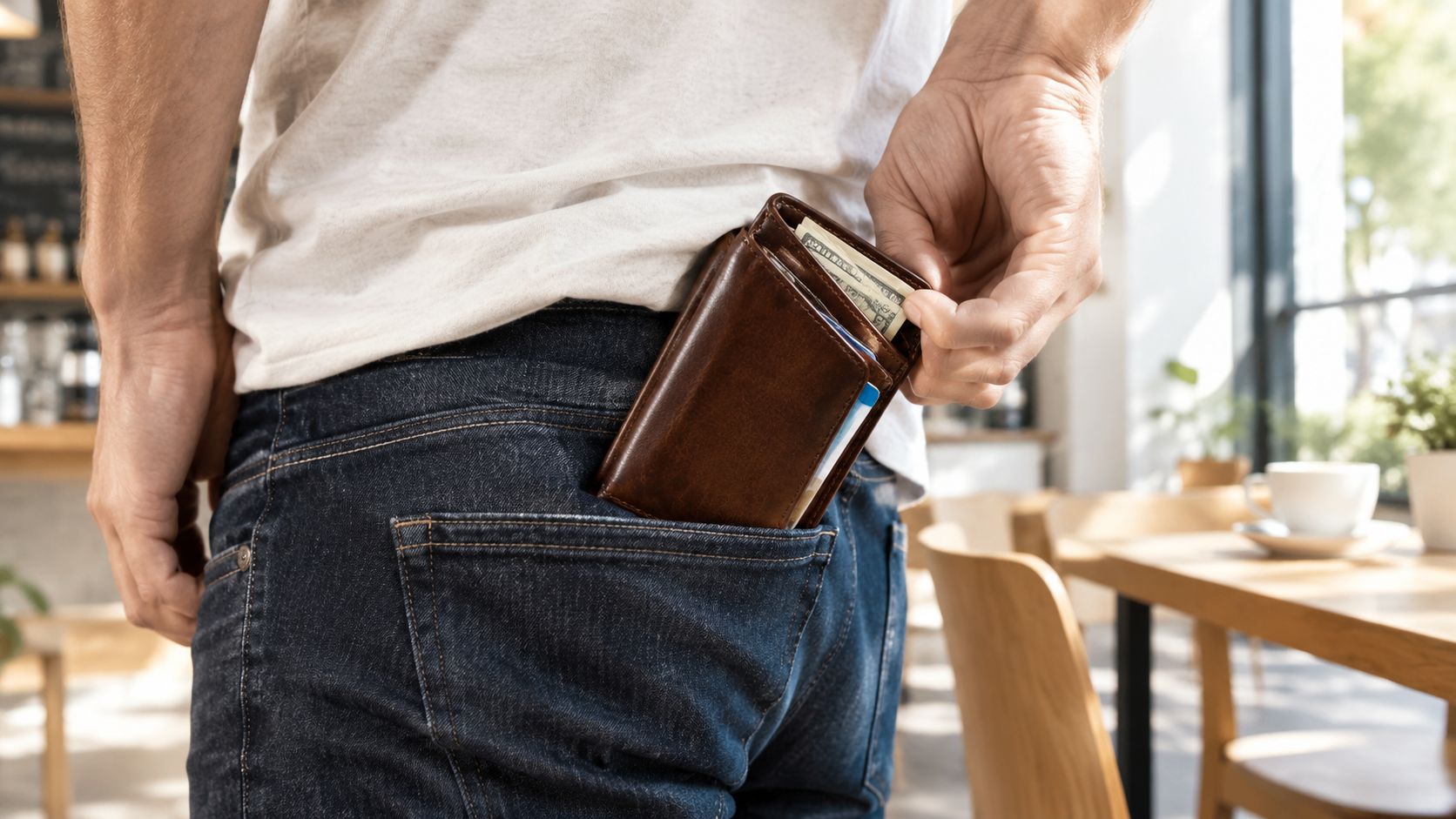
This guide treats the billfold as a deliberate hybrid-carry choice for a cashless but not cash-free world. You'll learn how the fold works, why card dimensions influence the shape, how full-grain leather and internal construction affect comfort, and which layout suits work, travel, minimal carry, or gifting. The same practical lens used across men's leather accessories applies here: inspect the material, understand the construction, and buy for the way the item will be handled every day.
Table of Contents
- Introduction Why the Billfold Still Earns Its Pocket Space
- What a Men's Billfold Wallet Is and How It Works
- Full Grain Leather and Construction That Determines Longevity
- Billfold Styles and Capacity Compared by Everyday Needs
- How to Choose the Right Billfold for Your Use Case
- Care Maintenance and Personalization for Gifting
- Final Takeaways and Your Next Carry Decision
Introduction Why the Billfold Still Earns Its Pocket Space
The men's wallet category remains substantial and globally distributed. One estimate values the global men's wallet market at about USD 11.92 billion in 2026, with a projection of USD 17.91 billion by 2035 at a 4.5% CAGR, while another estimate places Asia-Pacific at roughly 39%, North America at 32%, and Europe at 24% of market share. These figures describe a mature everyday-goods category, not a novelty accessory trend. Market estimates for men's wallets show why materials, regional habits, and practical layouts still matter to product decisions.
The billfold's continued usefulness doesn't depend on carrying a thick wad of cash. It depends on the awkward middle ground between physical and digital life. Your phone can handle a payment, but it may not hold every membership card, local-use card, receipt, ID, or backup note. A bifold gives those items a defined place while keeping the carry familiar.
A pocket tool should earn its volume
Think of your wallet as a small desk drawer. The drawer only helps if you can find the objects inside it, and it becomes frustrating when you fill it with things you never use. The same principle applies to card slots. Capacity printed on a product page isn't a target. It's an upper boundary that may feel uncomfortable when every slot is filled.
Full-grain leather adds another consideration. It can feel firm at first, then develop a more personal hand feel as it flexes and wears. That change is part of the appeal, but only if the wallet begins with a sensible profile and strong construction. A thin wallet made from weak material may feel comfortable on its first day and disappointing later. A well-built wallet should balance resistance with flexibility, like a sturdy notebook cover rather than a rigid board.
The right purchase can reduce pocket bulk, prevent loose cards from sliding out, and keep you from replacing a worn wallet because its edges have failed. The decision isn't “cash or no cash.” It's whether a folded format still supports your real routine better than a card case.
What a Men's Billfold Wallet Is and How It Works
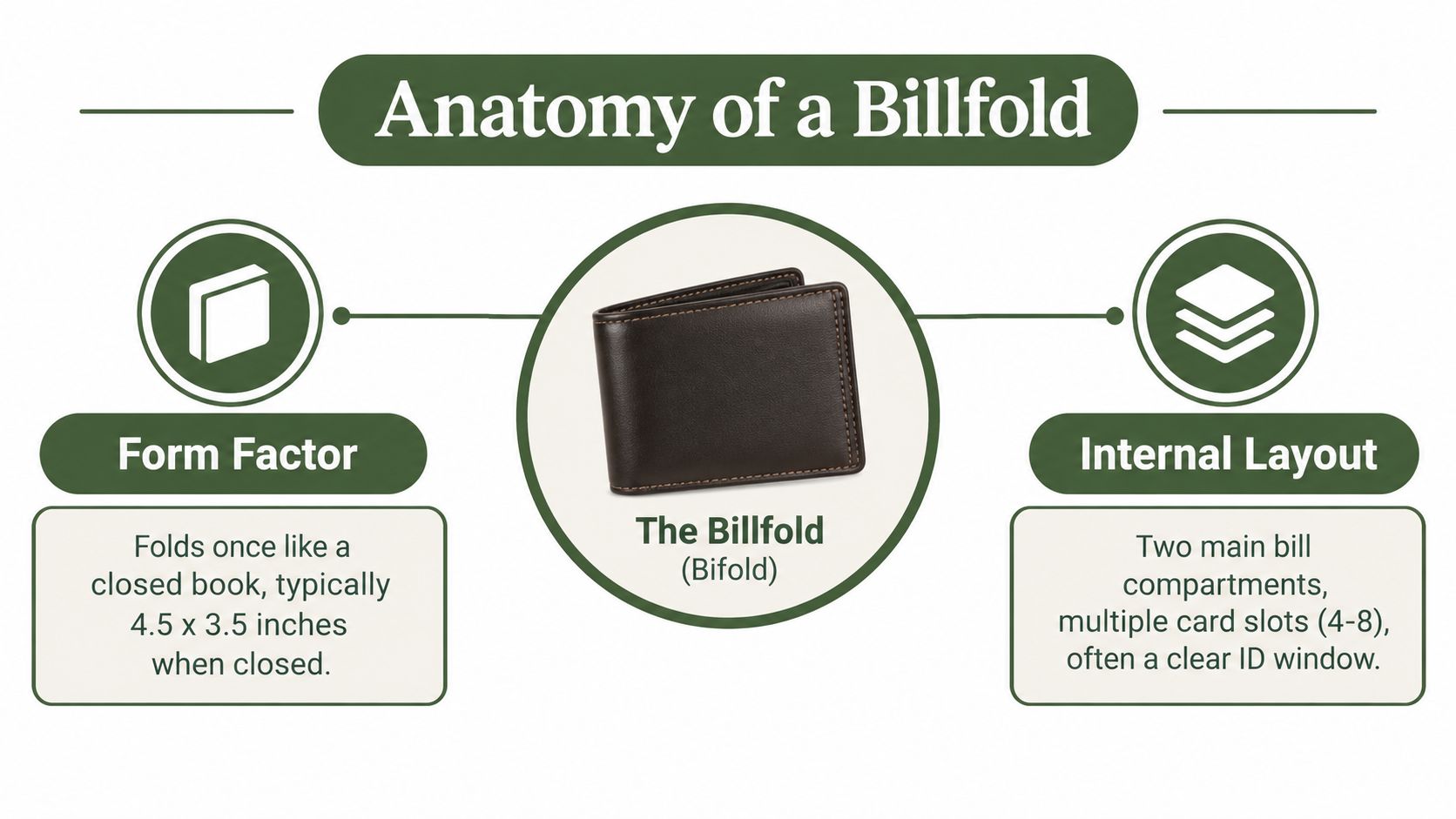
A bifold works like a small book with pockets. The leather folds once down the middle, the outside forms the cover, and the inside divides your cards and notes into accessible sections. Open it flat to see the organization. Close it, and the two panels bring the contents together into a compact everyday-carry shape.
Start with the fold and the cards
The proportions aren't arbitrary. Credit cards and similar identification cards follow the ISO ID-1 format, measuring 85.60 × 53.98 mm. That standard size explains why a bifold needs enough height for cards without allowing them to disappear into the leather. It also explains why many wallets settle near 110 × 90 mm closed and offer layouts around 8 to 12 card slots, according to wallet sizing and construction guidance.
The main parts have separate jobs:
- Card slots: These hold your frequently used cards individually or in small groups. A slot should grip a card without making removal feel like pulling a nail from wood.
- Bill compartment: This runs along the inside length of the wallet and accepts folded banknotes. Some designs divide it into separate sections for local currency, receipts, or a small reserve.
- ID window: A clear panel lets you show identification without removing it. It's convenient, but it can add a layer and make the wallet less flexible.
- Center or hidden pockets: These provide room for a backup card, folded receipt, or occasional paper item. They become clutter traps if you use them as permanent storage.
A closed billfold is often described as being around 4.5 by 3.5 inches in general product explanations, but actual dimensions vary with the card layout, leather thickness, edge treatment, and number of compartments. The key test is practical. Load the wallet with your normal essentials, close it, and check whether the fold lies naturally rather than bowing outward.
Cashless payment changes the job
Cashless payment is clearly expanding. Japan's cashless-payment ratio reached 58.0% in 2025, and the euro area recorded 77.7 billion non-cash payments in the first half of 2025, up 7.7% year over year, according to Japan's Ministry of Economy, Trade and Industry payment data. Those figures don't make physical wallets obsolete. They make the choice more personal.
A billfold makes sense when you carry cash, an ID, several physical cards, receipts, or backup cards. A card case may suit you better if your phone handles most payments and your daily physical carry is limited to a few cards. The modern billfold is therefore a hybrid format, useful when digital payment handles the transaction but physical objects still support the rest of the day.
For broader context on the different layouts available, see this guide to leather wallet types.
Full Grain Leather and Construction That Determines Longevity
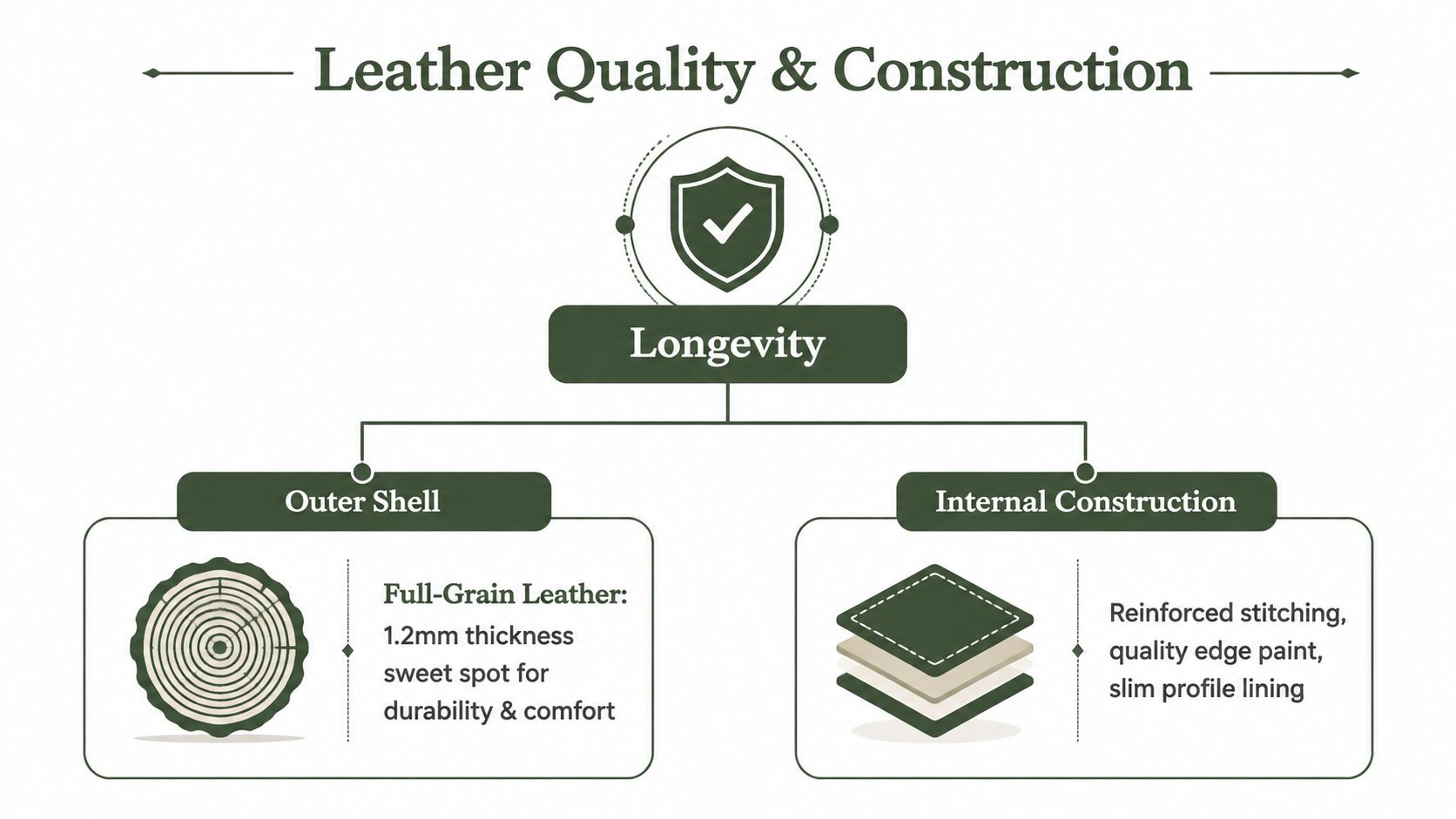
Leather quality is easier to understand by touch than by label. Full-grain leather retains the hide's natural grain surface, so you can often see subtle variation rather than a perfectly uniform finish. That surface gives the wallet character, but the actual buying question is how the material, thickness, stitching, and edges work together under repeated bending.
Thickness is a balance, not a contest
For a men's billfold wallet, a practical material range is typically 0.8 to 1.2 mm for the outer shell and 0.4 to 0.8 mm for internal layers. Thicker leather can improve resistance to tearing and abrasion, but excessive thickness adds to the closed stack and makes the wallet feel bulky. Leather thickness guidance also points to ISO 2589 as the standard method for measuring leather thickness, which matters because a hand estimate isn't the same as a controlled measurement.
A useful comparison is a boot sole. More material can improve toughness, but a sole that's too heavy changes how the boot feels with every step. Wallet construction works similarly. The outer shell needs enough body to protect the fold and resist wear, while internal panels can be skived, or tapered, so the card stack doesn't become unnecessarily thick.
The word stack-up describes the total thickness of overlapping leather, cards, lining, thread, and any shielding layer. A wallet can use excellent leather and still feel uncomfortable if the maker ignores that combined thickness.
Look beyond the grain name
Inspect the fold first. It should bend cleanly without showing brittle cracking, deep creasing, or a sharply compressed edge. Then examine the stitching. Even spacing, secure ends, and thread that sits properly in the seam indicate care in an area that flexes constantly.
Edges deserve equal attention. An unfinished edge can fuzz and spread as it rubs against fabric, while a properly burnished or coated edge gives the layers a unified boundary. Reinforcement at corners and the central fold can preserve shape, especially when the wallet is opened and closed repeatedly.
Waxed Crazy Horse leather offers a different aging experience from a smooth, highly coated surface. Its waxed finish can show lighter marks when brushed or flexed, and those marks may blend into a changing patina with use. That isn't automatically a flaw. It's a visible record of handling, provided the underlying leather and construction remain sound.
Workshop rule: Choose the thinnest construction that comfortably handles your real load, not the thinnest wallet label you can find.
For a deeper look at how full-grain material changes with use, consult this explanation of full-grain leather lifespan.
Billfold Styles and Capacity Compared by Everyday Needs
A classic bifold, a slim bifold, an ID-window model, and a hybrid design all fold in broadly the same way, but they don't behave the same in a pocket. The differences come from how many layers sit inside, where cards enter, whether cash lies flat, and whether added features interrupt the central fold.
| Style | Best For | Typical Capacity | Pocket Profile |
|---|---|---|---|
| Classic bifold | Regular cash and card carry | Moderate card load with a full bill section | Traditional, with more visible depth when full |
| Slim bifold | Users reducing pocket bulk | Essential cards and folded notes | Flatter and easier to carry daily |
| Bifold with ID window | Frequent ID checks | Essential cards plus visible identification | Convenient, but the window adds an internal layer |
| Hybrid bifold | Mixed carry with coins or extra cards | Cards, notes, and occasional small items | More adaptable, though added compartments increase bulk |
Match the format to the contents
The classic bifold suits someone who still uses banknotes, keeps a few backup cards, and prefers a familiar opening. Its weakness is temptation. Extra slots make it easy to retain expired cards, old receipts, and loyalty cards that could live elsewhere.
A slim bifold is a better fit for a cashless-first routine. It preserves the book-like opening and bill compartment without pretending you need every possible pocket. The comfort gain comes less from the fold itself than from limiting the layers placed inside it.
An ID window saves a step when you regularly show identification. It also creates a surface that can catch against a card or add stiffness to one panel. If you rarely display an ID, a standard slot may keep the wallet simpler.
Hybrid models add flexibility through a coin pocket, extra card flap, or separated bill sections. Those features solve specific problems, such as carrying coins for local transport or keeping travel cards apart from daily payment cards. They also need discipline. A compartment that exists will eventually attract clutter.
Treat RFID as a construction feature
Leather alone doesn't block radio frequency. An RFID wallet needs a conductive shielding layer designed to attenuate contactless-card signals at 13.56 MHz. That layer can affect flexibility and contributes to the overall stack, so inspect how it has been integrated rather than assuming the leather provides protection.
RFID matters most when it fits your setting and preferences, such as frequent travel or crowded public environments. It shouldn't decide the wallet by itself. Start with the way you carry cards and cash, then judge whether the added barrier supports that routine.
For readers who want a thinner approach without abandoning leather, this overview of a minimalist leather wallet offers a useful comparison point.
How to Choose the Right Billfold for Your Use Case
Don't start with color or brand. Start by emptying your current wallet onto a table and separating what you use from what you've merely carried forward. Your ideal billfold is usually revealed by the first group, not the full pile.
Audit the load before buying
Use four practical questions:
- What must stay physical? Keep your ID, payment cards, transit cards, access cards, and any cash you regularly use in one group.
- What is occasional? Separate backup cards, foreign currency, receipts, and coins. These may need a hidden pocket or a travel wallet rather than permanent space in your daily billfold.
- Where does the wallet ride? A back pocket, jacket pocket, work bag, or front pocket changes how much depth feels acceptable. Sitting on a thick wallet can become more irritating than carrying it while standing.
- What do you reach for first? Place frequent cards in the easiest slots. A design with impressive capacity is poorly suited to you if the useful cards are buried.
Choose by routine, not by fantasy
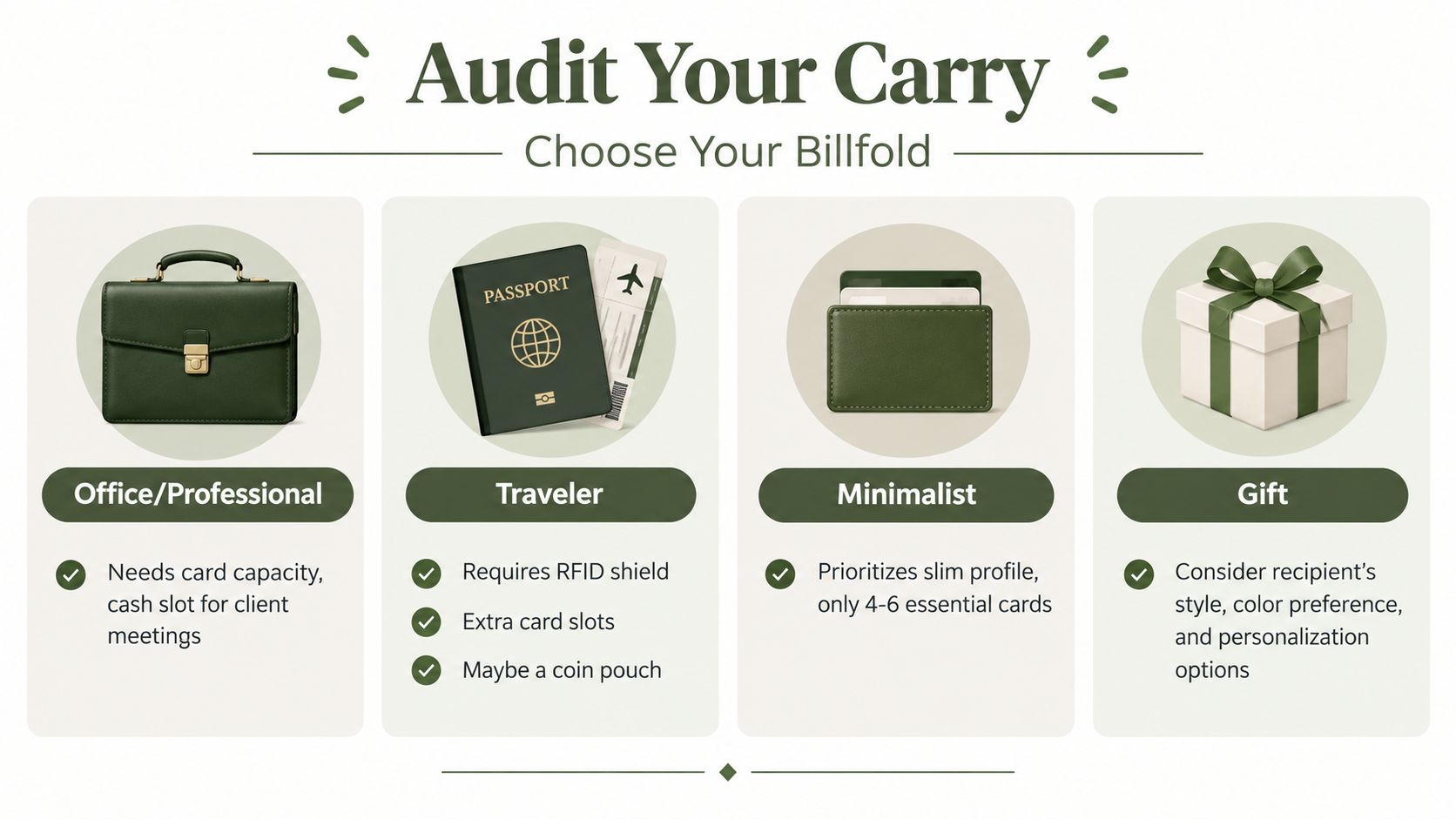
For office or professional carry, a conventional bifold with a clean bill compartment and accessible card slots often works well. It supports cash, identification, and business-related cards without requiring an unusual opening motion.
Travel introduces different priorities. You may value RFID shielding, a separate place for backup cards, a coin pocket, or enough room for local currency. Don't confuse “travel-ready” with “carry everything every day.” A travel wallet can be larger because its job is different.
Minimal carry calls for restraint. If you only use a few cards and rarely handle cash, a slim bifold gives you familiar access without the excess of a full compartment system. A cardholder may be the better answer if you don't need folded notes at all.
Gifting requires a little detective work. Notice whether the recipient carries brown or black leather, uses cash, shows an ID often, or prefers a front pocket. A coordinated finish can also pair naturally with a briefcase, portfolio, pen case, or travel bag. Grainmark Leather offers full-grain leather wallets and related small leather goods, including bifold formats with features such as RFID protection and ID windows, so it can be considered alongside other construction-focused options.
Test the filled wallet
Never judge bulk from an empty wallet. Insert the cards and cash you carry, close it, and place it in the pocket where it will live. The center fold should not gape, the cards shouldn't slide loose, and the edges shouldn't press sharply into your leg when you sit.
RFID features deserve a separate decision rather than an automatic upgrade. This guide to RFID wallet advantages and trade-offs can help you decide whether shielding belongs in your particular carry.
Care Maintenance and Personalization for Gifting
Full-grain leather doesn't need complicated treatment, but it does respond well to consistent habits. During the early break-in period, carry only your normal contents. Don't force extra cards into empty slots just to soften the leather faster. Natural flexing is gentler than artificial stretching.
Wipe surface dust with a soft, slightly damp cloth, then let the wallet dry at room temperature if it gets damp. Avoid radiators, hairdryers, and prolonged direct heat, which can pull moisture from the leather and distort the shape. Apply a suitable leather conditioner sparingly after the surface is clean. Too much conditioner can leave the wallet greasy and soften areas that need structure.
Care principle: Clean lightly, condition sparingly, and never use overstuffing as a shortcut to break-in.
Keep the edges and fold healthy
The fold receives concentrated stress, especially when the wallet is carried in a back pocket and sat on throughout the day. Empty receipts regularly, remove expired cards, and check whether the slots still hold cards securely. If an edge begins to fuzz or a stitch loosens, address it early through a qualified leather repair service rather than waiting for the seam to open further.
Store the wallet in a cool, dry place when you aren't using it. If you rotate between a daily wallet and a travel wallet, empty both before storage and avoid leaving cards pressed into every slot for long periods.
Personalization turns a useful object into a more considered gift. A discreet monogram can mark a milestone without overpowering the leather, while a classic brown, black, or tan finish gives the recipient more flexibility across work and casual clothing. For a first wallet, graduation, promotion, retirement, or anniversary, choose the layout based on the person's actual carry habits, then add personalization only if it suits their style.
The strongest gift isn't the wallet with the most compartments. It's the one that feels natural in the recipient's hand, holds what they carry, and remains attractive as the leather records years of use.
Final Takeaways and Your Next Carry Decision
A men's billfold wallet still earns its place when it solves a physical problem your phone can't. It can hold cash, identification, receipts, backup cards, transit cards, and local-use items while keeping them organized in a familiar folded format. In a cashless-first world, that makes the billfold a choice for hybrid carry, not an automatic uniform for every man.
The buying order is simple. First, judge the material and construction. Full-grain leather can offer natural character and long-term wear, but thickness must be balanced against comfort. Next, choose the layout. A classic bifold, slim bifold, ID-window model, or hybrid format each serves a different load. Finally, test capacity with your real cards and cash, because an empty wallet tells you very little about its pocket behavior.
Don't mistake more space for more usefulness. A wallet becomes better when every compartment has a job, the fold closes naturally, and the edges can tolerate daily handling. RFID shielding, coin pockets, hidden compartments, and personalization are meaningful only when they match your routine.
Your next decision can be practical rather than sentimental. Empty your current wallet, remove what you never use, identify the cards and cash that remain, and choose the smallest construction that handles them without strain. If you're buying a gift, observe the recipient's existing leather goods and select a finish and format that will fit the life they already lead.
A billfold isn't merely a container. It's a small piece of equipment that sits against your body every day. Choose one with sound material, honest capacity, and a construction you can maintain, then let the leather become more familiar through use.
Grainmark Leather offers full-grain leather wallets, cardholders, travel journals, and other small leather goods designed for organized everyday carry, with personalization available on select products. Visit Grainmark Leather to compare billfold layouts and choose a wallet that matches your cards, cash habits, and preferred pocket profile.