
Full Grain Leather Sling Bag: The Complete 2026 Guide
You're halfway through a commute when the train doors open. Your phone is in one hand, your coffee is in the other, and your passport or wallet is buried somewhere under a charging cable. A good sling bag should make that moment easier, not turn it into a search through a soft, overfilled pouch.
A full grain leather sling bag is best understood as a compact carry system. It has to keep essentials close to your body, remain comfortable while you walk, protect contents from daily friction and weather, and still look appropriate when you arrive at work or pass through an airport. Full-grain leather can help with durability and structure, but it also brings real trade-offs in weight, finish, weather care, and price.
Table of Contents
- Why a Sling Bag Deserves a Closer Look
- What Full Grain Leather Actually Means
- Construction and Hardware That Hold Up
- Size, Finish, and Format Choices
- Capacity and Organization in a Compact Silhouette
- How to Judge Quality Before You Buy
- Care That Protects the Leather for Years
- Bringing It All Together
Why a Sling Bag Deserves a Closer Look
A sling bag works hardest when you're moving. On a train platform, you may rotate it from your back to your chest without removing it. At an airport checkpoint, you may need a passport and phone within reach while keeping one hand free for luggage. On a normal workday, the bag rubs against a shirt or jacket, flexes at the strap anchors, and absorbs the repeated movement of getting in and out of cars, trains, cafés, and offices.
That use differs from a briefcase or a backpack. A briefcase spends much of its time resting on a surface. A backpack spreads its load across two shoulders and often hides its lower corners from contact. A sling bag concentrates movement on one strap, one side of the body, and a smaller set of seams. The visible front panel also stays close to clothing, so scuffs and edge wear become noticeable quickly.
The decision deserves more care than a simple comparison of leather labels. A compact bag that holds a phone, wallet, keys, and passport may be ideal for flights or quick errands, while a slightly larger format may be necessary for a notebook, charger, or tablet. The right choice depends on the carry load, the way the zipper opens, the strap's adjustment range, and whether the leather finish suits your environment.
If you're still deciding between related formats, this practical comparison of crossbody and sling bags helps clarify how each silhouette sits and opens on the body.
Full-grain leather matters because it's repeatedly exposed to the conditions that reveal weak construction. The material may resist surface wear well, but a poor lining, thin D-ring, or badly reinforced anchor can still end the bag's useful life. The sections ahead focus on those practical pressure points, from hide selection to organization and rain handling.
Practical rule: Choose the sling around what you carry every day, then choose the leather and hardware that can tolerate that routine.
What Full Grain Leather Actually Means
Full-grain leather comes from the outermost layer of the hide. The natural grain surface remains intact, so the leather hasn't been heavily sanded or buffed to remove scars, wrinkles, or other natural marks. That dense fiber structure is why industry sources associate full-grain leather with durability and long service in high-contact products. A comparative leather-properties study also explains why abrasion testing matters for bags that experience repeated rubbing.
Top-grain leather begins with a similar upper layer, but manufacturers lightly sand or correct the surface for a more uniform appearance. It can look cleaner when new, although that surface intervention changes how the leather responds to wear and aging. Genuine leather is a broad commercial label, not a reliable quality grade. It can refer to a lower split layer or a processed material covered with a finish designed to resemble a higher grade.
For a sling bag, those distinctions become visible in daily use. Full-grain leather can develop a patina, meaning the color and surface character deepen with handling and exposure. Smooth top-grain leather may maintain a more consistent appearance at first, but scratches can stand out against that uniform surface. Lower-grade or heavily coated leather may dry, crack, peel, or lose its finish where the edges flex and rub.
Finish also changes the experience. Aniline leather keeps a more natural surface and shows variation, marks, and color change readily. A more heavily finished leather offers greater visual consistency and can be easier to wipe clean, but it may show less of the natural aging that attracts buyers to full grain.
| Grade | Surface Treatment | Durability Under Sling Use | Aging Behavior |
|---|---|---|---|
| Full grain | Natural grain retained, minimal surface correction | Strong choice for repeated shoulder friction and flexing | Develops visible character and patina |
| Top grain | Surface lightly sanded or corrected | Durable, but surface wear may appear more uniformly | More consistent appearance, usually less natural variation |
| Genuine leather | May use split, bonded, or heavily coated layers | Performance varies widely and requires careful inspection | Can lose finish or dry at flexible edges |
The phrase full grain leather still needs context. Hide quality, tanning, thickness, stitching, and finish all affect the final bag. A credible seller should identify the material clearly rather than relying on “genuine leather” as a premium-sounding substitute. This plain-language guide to what full-grain leather means is useful when a product description leaves the grade unclear.
Construction and Hardware That Hold Up
Leather can outlast a bag's hardware if the maker cuts corners. A sling usually fails at a stress point first, especially where the strap meets the body, where a buckle pulls against its tab, or where a zipper ends at a corner. Look at those areas before admiring the leather color.
Stitching and reinforced stress points
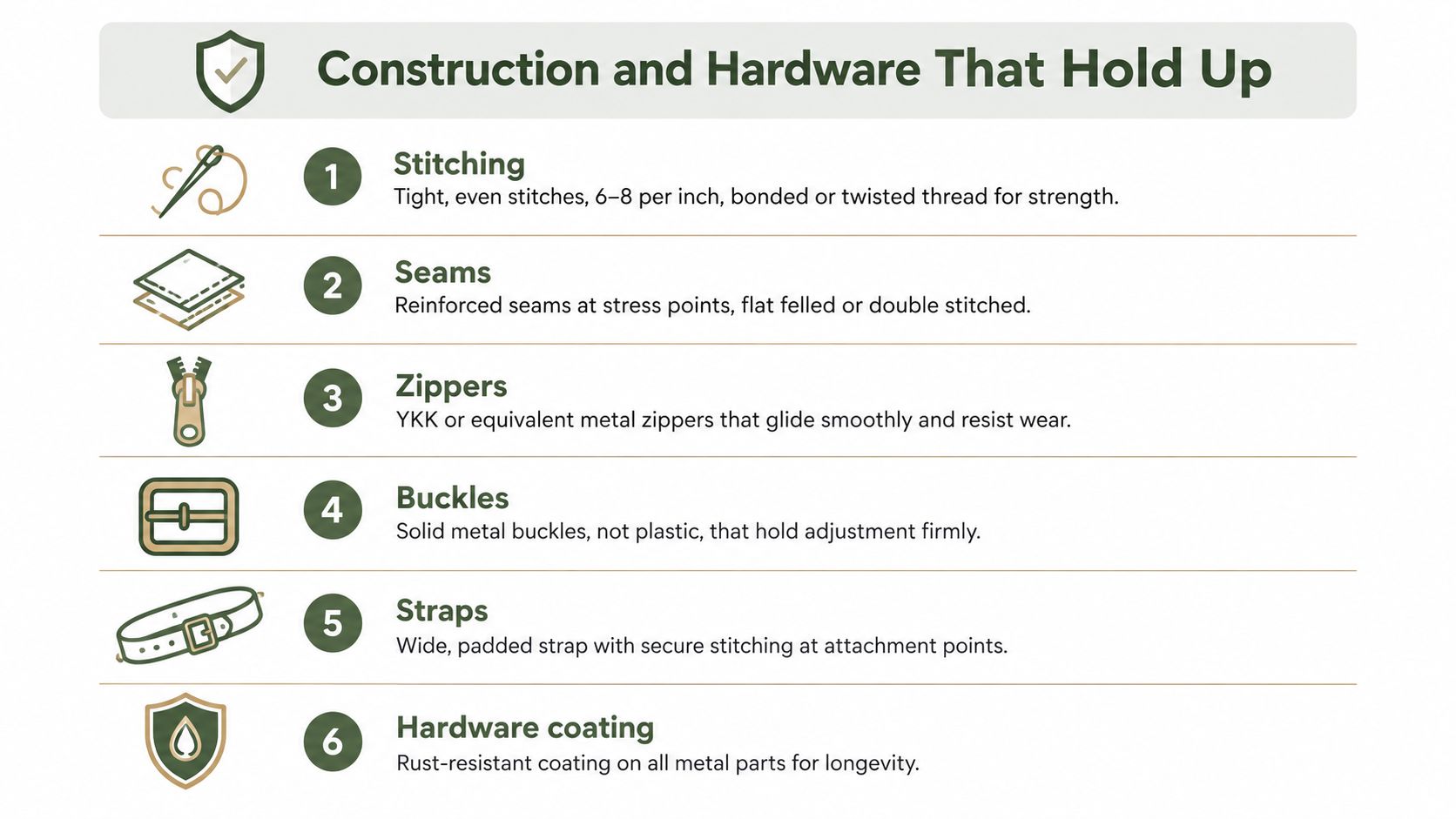
Tight, even stitching matters more than decorative thread. A useful inspection range is 6 to 8 stitches per inch, with bonded or twisted polyester thread that resists tension and abrasion. Technical leather testing information discusses rub-fastness testing and illustrates why surface durability needs to be considered alongside construction.
The strap anchors should have doubled rows, a box-and-cross pattern, or bartacks. Rivets can add mechanical support, but they shouldn't replace sound stitching where the leather flexes. Check for skipped stitches, loose thread ends, and holes that sit too close to the leather edge.
Lining and edge treatment
A sewn-in fabric lining protects the leather interior from keys, phone corners, and charger plugs. It also helps the bag retain its shape. Glued linings can separate as the bag flexes, especially around the opening and corners.
Raw cut edges are another warning sign. A full-grain panel may be excellent, but an unfinished edge can absorb moisture, catch on clothing, and start to fray. Burnished edges or carefully applied edge paint create a smoother barrier. Multiple thin coats usually look and wear better than one thick, brittle layer.
Hardware that carries the load
A smooth YKK or equivalent zipper is a sensible preference for the main compartment. The brand name isn't enough, though. Run the zipper from end to end and check whether it catches at the corners or pulls the leather out of alignment.
For D-rings, sliders, and buckles, solid brass or stainless steel generally offers a more dependable foundation than fragile cast zinc. Thin stamped metal may bend under strap tension. Rivets are preferable to staples at primary strap anchors because they provide a mechanical connection rather than relying only on folded material and adhesive.
Cosmetic hardware has a different role. A large logo, unusual buckle shape, or polished finish may influence appearance, but it doesn't prove that the bag will survive daily carry. Inspect the load-bearing parts first, then decide whether the decorative details justify the cost.
Size, Finish, and Format Choices
Capacity feels different in a sling than it does in a backpack. The bag sits against your side or back, so extra depth can pull it away from the body and make it swing. A wider profile may spread contents across your back but can bulge when filled. A taller, front-loading shape often rides flatter, though it may be less convenient for broad objects.
Use this table to narrow the format before comparing colors or logos.
| Volume / Format | Best For | Finish Match | Trade-off |
|---|---|---|---|
| Compact, around 2 liters | Phone, wallet, keys, passport, and quick errands | Smooth or pebbled full grain | Light and discreet, but limited room for chargers or notebooks |
| Mid-size, around 4 to 6 liters | Commuting with a notebook, charger, and everyday essentials | Pebbled, smooth, or pull-up | More versatile, but can feel bulky when fully loaded |
| Larger, around 7 to 10 liters | Travel with passport, water bottle, and a folded light layer | Pull-up or crazy horse for a relaxed appearance | Better capacity, but heavier and more noticeable on one shoulder |
A smooth aniline finish suits an office or dressier wardrobe. It shows scratches quickly, but those marks can blend into a rich patina as the leather is handled. Crazy horse and pull-up leathers contain oils or waxes that shift lighter when bent or rubbed. That color movement can disguise small marks, although it creates a deliberately rugged look.
Pebbled full grain breaks up the appearance of minor scuffs and can be forgiving for travel. Its textured surface may not burnish as smoothly at the edges, and it usually looks less formal than a clean smooth hide. The choice should follow your routine, not a general claim that one finish is superior.
Your strap needs enough adjustment for a secure high carry across the chest and a lower carry around the back. Check whether the slider stays put and whether the strap can shorten without leaving a long loose tail. For fit, this guide to leather men's crossbody bags can help you compare silhouettes that overlap with sling use.
Capacity and Organization in a Compact Silhouette
Test a bag with the objects you carry, not with an empty product photograph. A realistic kit might include a smartphone, bifold wallet, passport, key organizer, small A5 notebook, 10,000 mAh power bank, short cable, earbuds, and a folded receipt. That load quickly exposes whether the interior is organized or merely spacious.
A single deep compartment looks flexible, but small items sink to the bottom. A key clip prevents keys from disappearing, yet it doesn't solve the problem of stacking a wallet, power bank, and phone in one cavity. The result is slow access, especially when the bag stays on your body.
A wide zippered main compartment paired with a flat front slip pocket handles many quick grabs. The phone, transit card, or wallet can sit near the opening, while the main cavity carries the charger and notebook. The compromise is crowding. Once the main compartment fills, the front pocket may press against the contents behind it.
The most useful interior arrangement
The strongest layout for mixed daily and travel carry usually combines three zones:
- Protected rear sleeve: Holds a phone or small tablet against the body and keeps it away from keys.
- Organizer panel: Provides pen loops, card slots, and a small zip pocket for cash or documents.
- Open main compartment: Leaves room for a power bank, notebook, folded receipts, or a light layer.
A passport pocket should be easy to locate but not exposed at the outermost edge. A hidden zip pocket near the body can provide better security for cash and travel documents, while an external pocket improves speed for items you use constantly.
Zipper orientation creates a real security trade-off. A back-facing opening is harder for someone behind you to access in a crowd, but it may be slower to operate with one hand. A front-facing zipper opens quickly while the bag rests on your chest, but it demands more awareness in busy stations and queues.
Choose a fabric-lined or mesh-lined interior over raw suede when possible. Raw suede can shed fibers onto dark clothing and absorb spills. A lining that can be wiped or brushed clean is more practical for a bag carrying electronics, cards, and travel papers.
How to Judge Quality Before You Buy
Product pages often spend more space describing color than construction. Use a short inspection sequence that starts with the material and ends with the fit.
Start with the material claim
The seller should name the leather grade and explain enough about the hide and tanning process for you to understand what you're buying. “Real leather” doesn't answer whether the bag uses full grain, top grain, split leather, or a bonded construction. If the description uses several grades interchangeably, ask for clarification before ordering.
Natural grain variation isn't automatically a defect. Small marks can be consistent with minimally corrected leather, while deep cuts, structural holes, peeling, delamination, or loose grain deserve concern.
Inspect the load path
Follow the force from your shoulder to the bag body. Look at the strap, slider, D-rings, tabs, stitches, and the panels around each anchor. You want doubled or otherwise reinforced seams with no skipped stitches, loose threads, or visibly stretched holes.
Run every zipper several times. Open and close each buckle, adjust the strap, and check whether the hardware feels thin, sharp, or loose. A buckle that slips under light hand pressure won't become more reliable once the bag contains a passport, power bank, and notebook.
Ask direct questions
- Leather identity: Is the exterior full grain throughout, or are only selected panels full grain?
- Finish: Is the surface smooth, pull-up, crazy horse, pebbled, or heavily coated?
- Interior build: Is the lining sewn in, and are the seams bound or turned?
- Fit: What strap adjustment range is available, and what is the empty bag weight?
- Aftercare: How will the leather darken, mark, or develop patina?
- Support: What warranty applies to stitching, hardware, and zipper failure?
Vague answers are useful information. If a seller can't explain the leather or show the anchor construction, don't let a polished photograph substitute for evidence. This overview of leather grades gives you useful language for asking better questions.
Care That Protects the Leather for Years
Daily carry creates a simple care problem. Dust, clothing fibers, skin oils, and occasional moisture collect on the surface, while over-cleaning can strip the finish and leave the leather dry. A light routine works better than aggressive treatment after neglect.
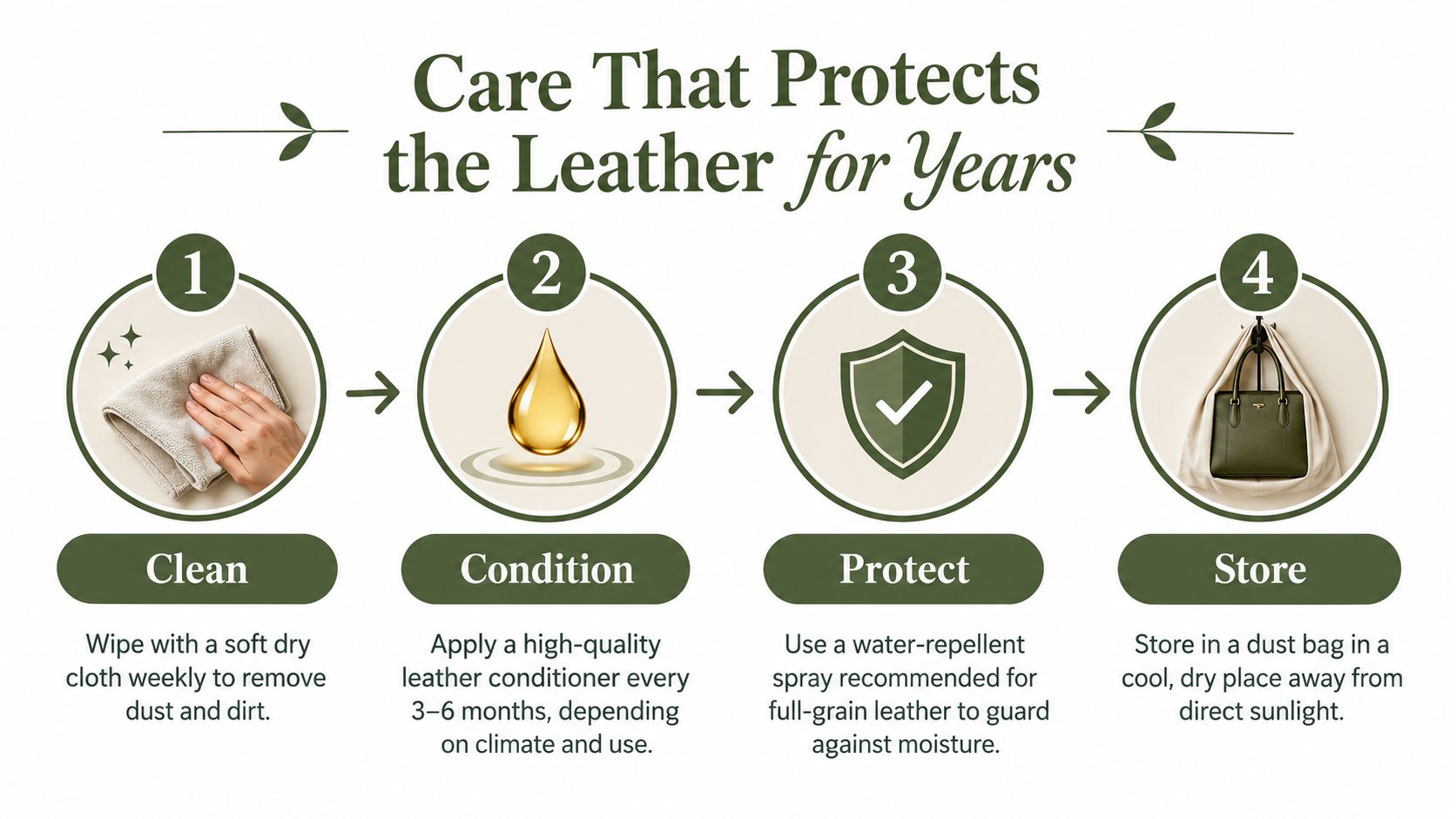
Wipe the bag with a soft, dry cloth when dust or surface dirt appears. For a light mark, use gentle pressure and a clean section of cloth. Small scuffs on suitable full-grain finishes may soften when you buff them with a fingertip, but test any product on a hidden area first.
Condition according to use
Conditioning every 3 to 6 months, depending on climate and use, is a practical starting point. The interval is included in the leather-care infographic, but your bag's surface is the better guide. Dry indoor heating, frequent travel, and heavy handling may call for attention sooner than occasional use in a mild climate.
Use a neutral conditioner or one matched to the leather's color and finish. Apply a small amount, spread it thinly, and allow the leather to absorb it before buffing. Heavy waxing can clog the surface and dull the patina, while too much conditioner can soften structured panels and make them lose their shape.
Avoid household soap, repeated saddle-soap cleaning, silicone sprays, radiators, hair dryers, and other direct heat. These shortcuts can alter the finish or dry the leather unevenly. The practical routine in this guide to conditioning leather is safer than treating the bag like washable fabric.
Deal with rain and storage properly
If the bag gets wet, blot it rather than rubbing the surface. Remove the contents, reshape the bag, and let it dry at room temperature. Keep it away from direct heat, and don't pack it away while the lining is damp.
For storage, fill the bag lightly with acid-free tissue so the panels don't collapse. Place it in a breathable dust bag, then hang it or lay it flat in a cool, dry place. Plastic traps moisture and creates a poor environment for leather, especially after travel.
Bringing It All Together
A satisfying full grain leather sling bag comes from matching four decisions, not from selecting the most expensive-looking option. First, choose a leather grade and finish that fit your tolerance for marks, weight, and maintenance. Second, inspect the construction where the bag carries force, especially the strap anchors, zipper ends, edges, and lining.
Third, size the bag around a real load. If you carry only a phone, wallet, passport, and keys, a compact profile should stay discreet and comfortable. If your routine includes a notebook, power bank, charger, or tablet, a mid-size format may prevent the overstuffing that distorts leather and strains zippers. A travel-oriented design needs more than extra volume. It needs protected documents, deliberate pocket placement, and an opening you can control in a crowd.
Finally, accept the care that comes with the material. Full grain is appealing because it can gain character rather than hiding wear, but that benefit depends on sensible cleaning, careful drying, and occasional conditioning. A bag exposed to rain, rough clothing, and daily shoulder movement won't remain factory-perfect, and it shouldn't have to.
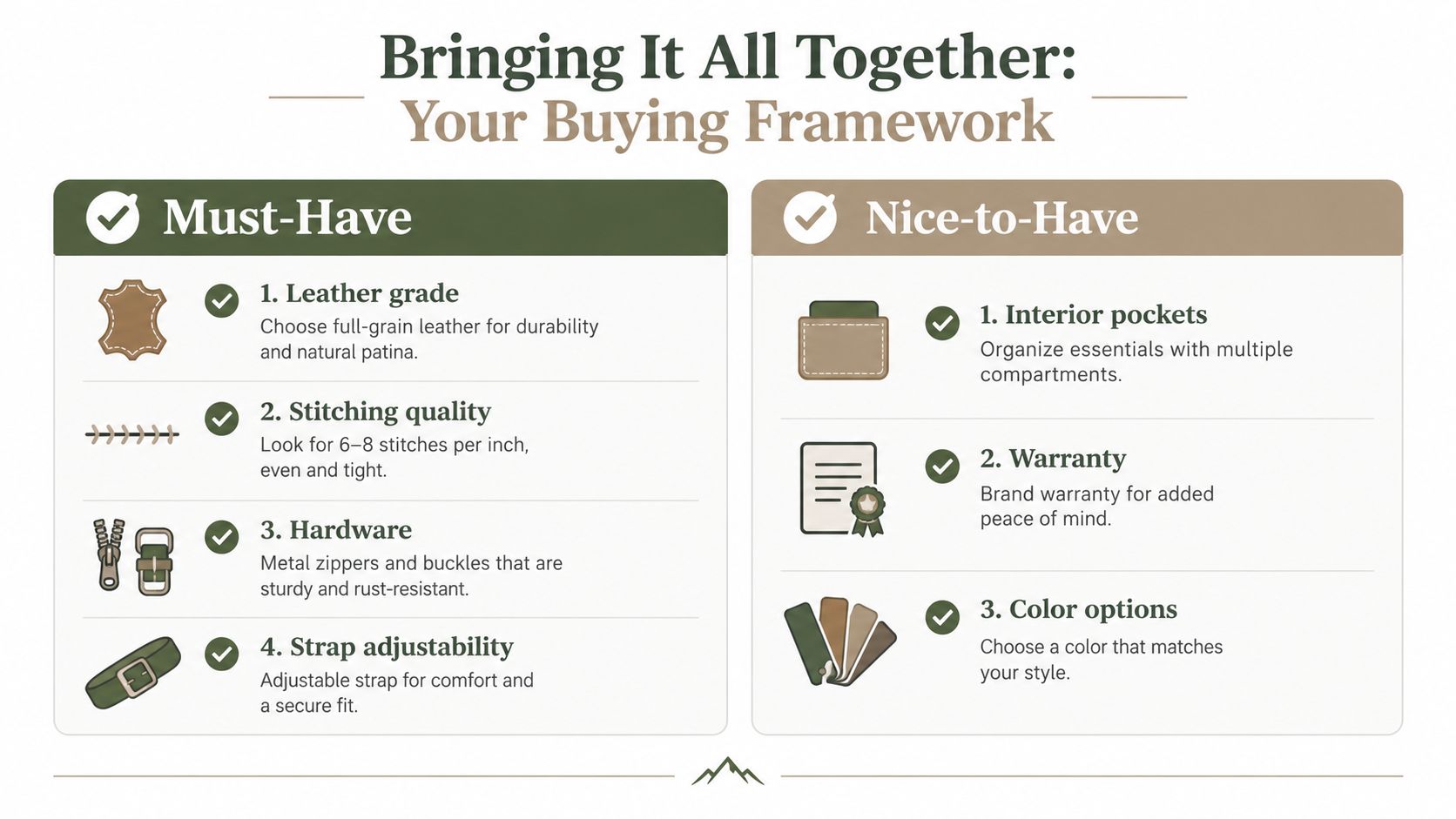
A useful final checklist looks like this:
- Leather: Confirm full grain, the finish type, and the expected aging behavior.
- Construction: Look for reinforced strap anchors, even stitching, finished edges, and a sewn-in lining.
- Hardware: Test the zipper, D-rings, sliders, buckles, and rivets instead of judging them by appearance.
- Capacity: Load the bag mentally, or physically if you can, with your phone, wallet, passport, keys, notebook, and charger.
- Security: Decide whether body-facing access or faster front access better suits your commute and travel habits.
- Care: Make sure you're willing to wipe, condition, dry, and store the bag properly.
Grainmark Leather offers full-grain bags and small leather goods for daily carry and travel, including formats designed around organized storage and long-term use. Visit Grainmark Leather to compare its leather carry options with this checklist in hand, then choose the size, finish, and pocket layout that match what you carry.