Zipper Card Wallet Guide for Everyday Carry
You're on a crowded platform, reaching for a transit card while your wallet hangs half open in your hand. A loyalty card slips out. Later, at airport security, loose coins and a folded receipt tumble onto the tray. At the café, a contactless card slides from a sleeve and disappears between the seat cushions.
These small failures usually come from carrying more than a minimalist cardholder was designed to contain. Payment cards, IDs, transit passes, work badges, receipts, coins, and emergency cash all compete for a little space. A zipper card wallet responds with one simple idea: enclose the load so it stays together during fast, distracted movement.
The zipper itself, however, isn't the whole buying decision. You also need to consider loaded capacity, leather behavior, pocket comfort, compartment layout, and genuine RFID construction. The right wallet should match what you carry, not what looks impressive on an empty product page.
Table of Contents
- The Everyday Carry Problem a Zipper Card Wallet Solves
- What a Zipper Card Wallet Actually Is
- Key Aspects Buyers Should Compare
- Zipper Card Wallet vs Minimal Cardholder
- Materials, Leather, and Build Quality
- Security, RFID, and the Zipper Myth
- Matching the Wallet to Real Use Cases
The Everyday Carry Problem a Zipper Card Wallet Solves
A sleeve-style wallet works beautifully until your routine becomes less tidy. You pull out a payment card on a moving train, return it in a hurry, and leave the opening slightly exposed. The wallet may still look slim, but it can't stop a loose card or receipt from escaping. A zipper card wallet closes around the contents, giving cards, folded bills, and small metal items a contained place.
That physical enclosure matters most during transitions. Commuters move between gates, turnstiles, vehicles, and shops. Travelers empty pockets at security, repack them quickly, and often handle several currencies or identification cards. A zippered cavity won't make access instant, but it reduces the chance that one rushed movement scatters the contents.
Practical rule: A zipper protects against accidental opening and loss. It doesn't automatically protect against electronic scanning.
The broader leather wallet category also shows why this format remains relevant. One 2026 market estimate values the global leather wallet market at USD 46.06 billion in 2024, projecting USD 68.29 billion by 2033 at a 4.5% CAGR. Another projection estimates USD 35.6 billion in 2025, rising to USD 47.2 billion by 2032 at a 4.1% CAGR. These figures describe the wider leather wallet market, not zipper card wallets alone, but they place the format inside a large category shaped by premium materials, daily carry, and travel storage. (leather wallet market estimates)
The design also follows a longer functional progression rather than appearing as a short-lived novelty. Patent records describe wallet and card-holder formats with zipper closures, including a bi-fold neck wallet reference and later wallet-type filings. That history supports viewing the zipper card wallet as an enclosed development of the traditional wallet, especially for people who want organization without carrying a full travel wallet. (zipper wallet patent reference)
For a useful contrast, compare the enclosed format with the slim profiles discussed in this minimalist leather wallet guide. The question isn't whether one style is universally better. It's whether your daily carry regularly creates the kind of spill, shuffle, and pocket search that an enclosed wallet is meant to prevent.
What a Zipper Card Wallet Actually Is
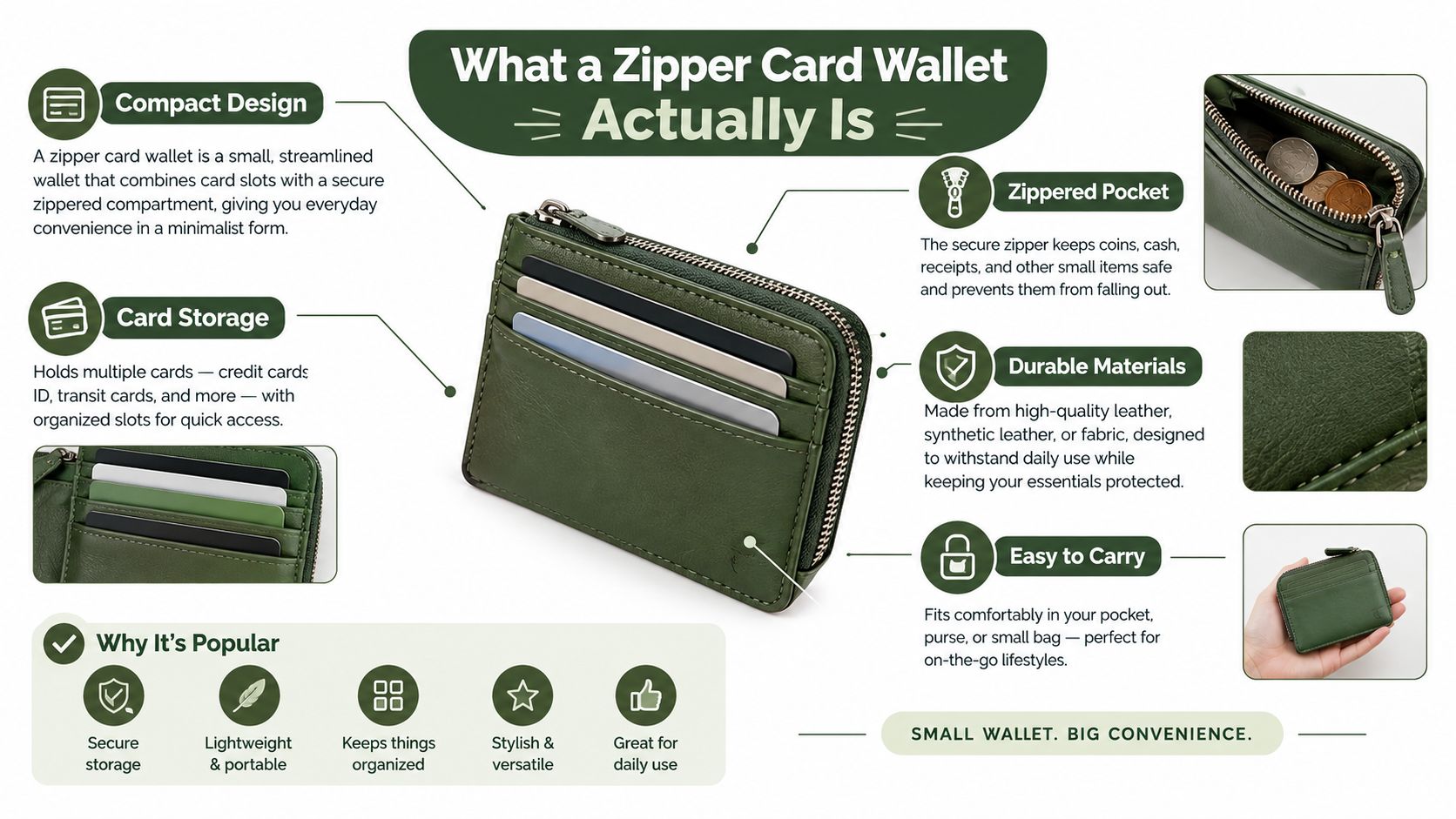
A zipper card wallet is a compact wallet built around a zippered inner cavity. The zipper commonly runs around three sides in an L-shaped path or around the full perimeter, depending on the design. Unlike a simple zip pocket added to a bifold, this closure usually seals the main storage area.
Start with the outside shape. A perimeter zipper joins the wallet panels and keeps the contents inside when the wallet is moved, dropped, or placed in a bag. The closure may use metal or synthetic teeth, a single pull, or dual pulls. The pull position affects access, while the zipper path affects how widely the wallet opens.
Inside, layouts vary, but common arrangements include:
- Fixed card slots: These separate frequently used cards and reduce the pressure created by one deep stack.
- A central divider or bill pocket: This gives folded cash or receipts a distinct location instead of mixing them with cards.
- An expandable compartment: Extra depth accommodates irregular items, although it can encourage overloading.
- A coin section: A separate zip pouch keeps coins from rubbing against cards and makes the main cavity easier to search.
- A thumb cutout or pull tab: These features can speed up card access when the wallet is tightly packed.
A bifold closes by folding on itself, often with a snap, open edge, or internal structure that holds cards in place. It usually gives faster access to cash and may feel flatter when lightly loaded, but its open edges offer less containment. A minimalist cardholder is simpler still, a sleeve or a few stitched slots without an enclosed cavity.
The zipper format sits between those two familiar categories. It's generally thicker and slightly longer than a cardholder, while remaining shorter and narrower than a full zip-around continental wallet. That middle position suits front-pocket users who need more than a few cards but don't want a large cash-and-travel organizer.
Before buying, examine the handmade leather bifold and zipper wallet option as an example of how bifold structure and zippered storage can be combined. The important point is structural: a zipper card wallet isn't defined by decoration or leather color. It's defined by how the closure contains a working carry load.
Key Aspects Buyers Should Compare
A zipper card wallet is judged in use, not only by its product-page specifications. Slot count, leather, dimensions, and closure interact: adding cards increases thickness, thicker leather may resist bending, and a stiff, crowded wallet can press against the pocket even when its empty measurements look compact.
Capacity starts with the loaded wallet
Many zipper card wallets are built for roughly 8 to 16 cards, while expandable designs may claim more than 20 cards. Treat those figures as upper limits, not comfort targets. A zip wallet capacity example shows why stated capacity needs context: usable room depends on how many cards, bills, coins, and receipts share the interior.
Count the cards you use, then include irregular items. A commuter might carry payment cards, identification, a transit card, and a few coins. A consultant may add a work badge, business cards, receipts, and folded cash. Putting everything into one deep compartment creates a concentrated bulge, which can stress the zipper and nearby stitching.
Loaded capacity, leather behavior, and pocket comfort form one trade-off. A roomier interior is useful only if the wallet remains comfortable after it is filled.
Security has two separate meanings
A zipper provides physical containment. It helps keep cards and loose items inside when the wallet shifts or drops, provided the pull moves smoothly, the teeth stay aligned, and the closure does not snag at the corners. Check these details with the wallet loaded, because uneven pressure can make a zipper harder to close.
Physical containment does not equal RFID shielding. RFID protection requires a conductive layer in the wallet's construction, so a zipper alone cannot provide it.
Materials affect feel and long-term shape
Full-grain leather generally feels substantial and develops visible changes through use. Corrected or coated surfaces can look more uniform, but they may age differently. Linings can reduce friction and weight, while heavier metal hardware can support durability while adding bulk.
Leather choice also affects how the wallet behaves when loaded. A stiff hide may hold its form but feel less forgiving in a front pocket. Softer leather may be easier to carry, though a crowded interior can make it lose shape. Use this guide to leather grades and this guide to leather for wallets to compare surface treatment and structure before focusing on appearance.
Size must be checked when loaded
Exterior dimensions describe an empty wallet. Compare them with the thickness after inserting your normal cards, folded bills, and coins. A wallet that slips easily into a trouser pocket when empty can become awkward once expandable sections are filled.
Organization trades speed for separation
More compartments make sorting easier, but they can slow access when every card has a fixed location. A central cavity gives quicker access to a mixed stack, while individual cards are harder to locate. Choose among rapid retrieval, visible organization, or maximum containment based on your daily routine.
| Axis | What to Check | Trade-Off It Creates |
|---|---|---|
| Capacity | Comfortable card count, bill space, coin room | More storage usually means more thickness |
| Closure | Smooth travel, aligned teeth, secure pull | Stronger hardware may add weight |
| Materials | Leather surface, lining, hardware | Stiffer materials can feel heavier |
| Sizing | Empty and loaded dimensions, pocket fit | A roomy interior may reduce front-pocket comfort |
| Organization | Slots, dividers, coin separation, card visibility | More sorting can mean slower access |
A balanced design spreads cards across pockets or expandable bays instead of forcing every item into one deep compartment. This distributes pressure, supports more reliable closure, and reduces strain on individual seams.
Zipper Card Wallet vs Minimal Cardholder
A person carrying only a few cards may find a minimalist holder easier to live with. Someone who leaves home with cards, folded cash, receipts, coins, or a work badge needs containment as well as slimness. The useful comparison is therefore your loaded carry, not the wallet's empty silhouette.
| Criterion | Zipper Card Wallet | Minimal Cardholder |
|---|---|---|
| Card capacity | Often suits 8 to 16 cards, with expandable designs accommodating more than 20 in some cases | Suits a small working set, often four to six cards in practical use |
| Coins and cash | Holds coins, folded bills, receipts, and mixed small items | Usually needs a separate pocket or money clip |
| Pocket profile | Becomes thicker as coins and expandable sections fill | Stays slimmer and is easier to place in a front pocket |
| Protection from drops | Enclosed contents are less likely to spill | Open edges can release cards if the holder shifts |
| RFID shielding | Exists only when the wallet includes a conductive shielding layer | Exists only when the construction includes shielding |
| Weight | Leather panels, lining, zipper, and hardware add weight | Fewer components usually mean a lighter carry |
| Access | Requires a zipper movement, while keeping contents contained | Exposed slots allow quick card access |
| Price tier | More construction and hardware can place it higher | Simpler construction may cost less, depending on leather |
Capacity and comfort are connected. A zipper wallet can hold more, but the added cards, coins, and folded bills push against the leather and increase the loaded thickness. Leather may also soften or stretch with use, so a wallet that feels comfortable when lightly filled can become less comfortable when every compartment is occupied. Check the loaded shape in the pocket, not only the empty dimensions.
A commuter carrying a transit card, driver's license, two payment cards, a work badge, and a few coins may value the zipper format. It keeps small items together and reduces the chance of contents spilling while moving through a crowded train. The trade-off is a thicker pocket and one extra hand movement whenever a card is needed.
A minimalist holder fits a different routine. An office worker carrying an ID, two payment cards, a transit card, and a building pass may prefer direct access and a flatter shape inside a jacket pocket. If cash and coins rarely come along, the enclosed cavity adds structure without solving a daily problem.
Closure security and RFID protection address different risks. A zipper helps contain physical contents during a drop, but it does not create RFID shielding. A cardholder can be slim and unshielded, while a zipper wallet can include a conductive liner. Check the construction rather than treating either format as an automatic security feature.
Choose the zipper wallet when your regular load needs containment and separation. Choose the minimalist holder when a small card set matters more than carrying flexibility. The better fit leaves enough room for normal use without making your pocket carry unused volume.
Materials, Leather, and Build Quality
Leather grades are easier to understand when you connect them to what you'll see and feel. Full-grain leather retains the strongest outer layer of the hide. It can develop a patina, show natural variation, and become more individual with handling. Top-grain leather has been sanded or corrected for a more even surface, which can make it look consistent and resist some visible marks, but it gives up part of the original grain character.
Labels such as genuine leather don't automatically describe premium quality. The term can refer to leather that has been split, layered, or heavily finished. Bonded leather uses reconstituted leather fibers held together with binders, and its surface may crack or wear differently from a solid hide. A buyer should inspect the construction rather than rely on a single grade word.
Crazy Horse leather shows use openly
Crazy Horse leather is full-grain leather treated with wax. A scratch can shift the surface color, and rubbing it with a fingertip may soften or reduce the mark. That changing appearance appeals to people who want a wallet that records use instead of remaining visually uniform.
The finish also means you should expect variation. A pocket, key, or coin may leave a temporary mark, while repeated friction can create a darker or smoother area. That isn't necessarily damage, but it does make Crazy Horse leather a poor match for someone who wants a pristine, unchanging surface.
Construction decides whether the materials work
Inspect the stitching line. A tight, even seam with consistent tension is more important than decorative thread. A hand saddle stitch can offer useful repair behavior because each stitch is formed independently, so one broken thread doesn't automatically unravel the entire seam. Machine lockstitch construction can also be durable when executed well, but the seam's tension, backstitching, and edge treatment deserve attention.
Look at the edges next. Burnished or painted edges should feel smooth rather than sharp, with no loose fibers or uneven buildup. Then test the zipper repeatedly. A reputable component such as a YKK zipper or an equivalent quality zipper should move without catching, while tooth alignment and pull strength matter more than the logo alone.
Hand check: Open the wallet, flex the panels gently, and run a finger along the seam and edge. Uneven tension, rough cuts, or a zipper that catches at a corner will become more noticeable after loading.
A sturdy zipper can still fail if the surrounding leather stretches or the seam receives uneven pressure. Build quality is therefore a system of hide, lining, thread, edge work, and hardware, not a single material claim.
Security, RFID, and the Zipper Myth
A zipper closure solves a physical problem. It keeps cards from sliding out, helps contain coins, and makes it harder for an open pocket to expose its contents. It does not create an electronic barrier.
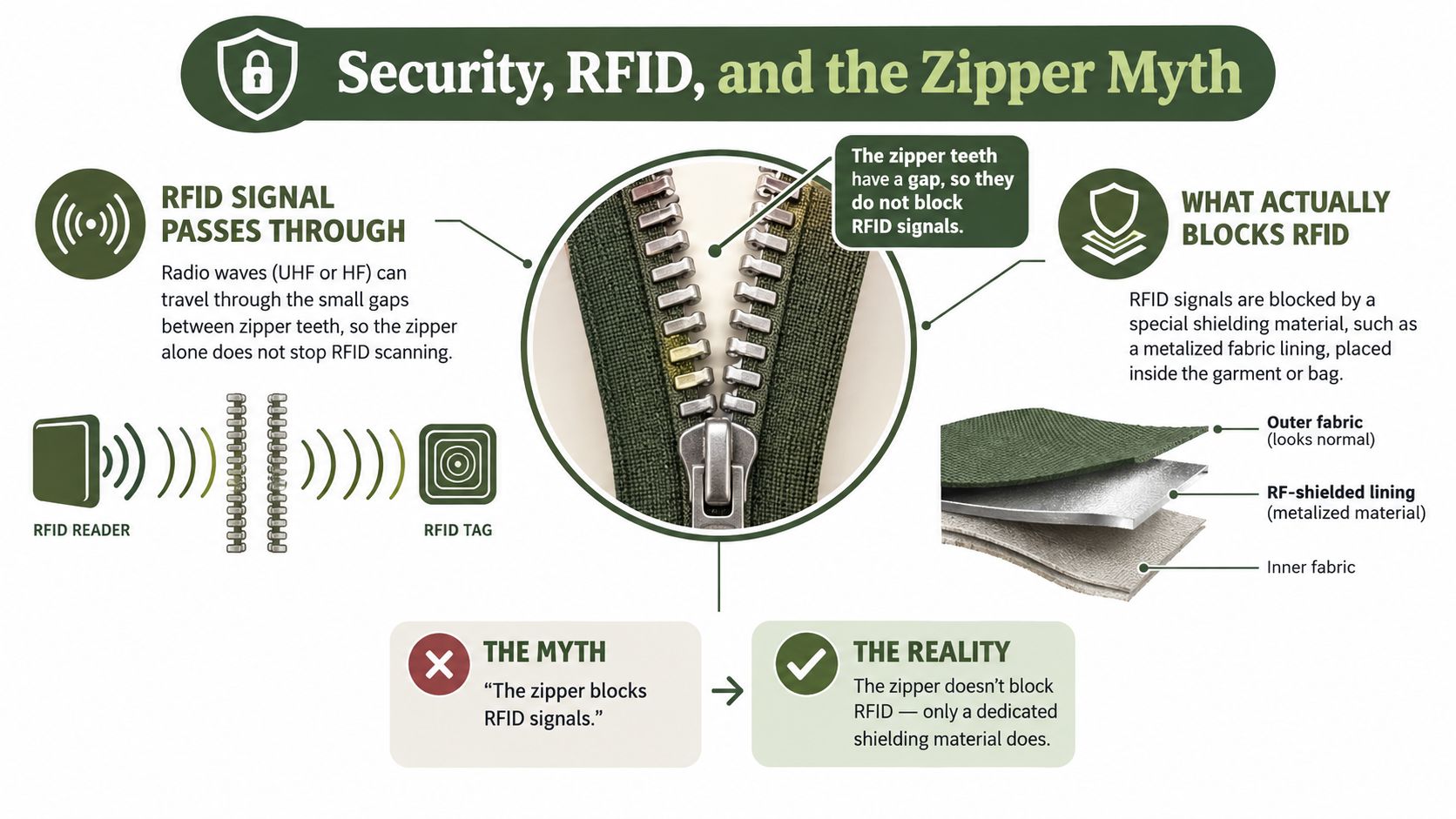
The gaps between zipper teeth, the opening around the pull, and the leather panels allow radio-frequency fields to pass. A metal zipper may look like a shield, but appearance isn't the same as a continuous conductive enclosure. The actual blocking element must be a liner or insert that surrounds the card compartment.
Effective RFID construction can use copper, silver-infused fabric, aluminum foil laminate, or metallic mesh. The material needs to create a near-continuous Faraday-cage effect around the cards. Some products specify coverage across approximately 100 kHz to 4 GHz, a range that includes low-, high-, and ultrahigh-frequency systems used by cards and identification systems. (RFID wallet shielding example)
Security distinction: The zipper controls physical loss. The conductive liner controls radio-frequency access.
Check the product description for clear wording about the shielding layer and the protected cavity. “RFID-safe,” “RFID-ready,” or “secure zipper” without construction details doesn't tell you enough. A blocking card inserted into one slot may protect a limited area, but it shouldn't be confused with a liner that encloses the whole compartment.
The threat model also deserves a calm assessment. Independent coverage describes RFID skimming risk as relatively low while noting that the cost of protection is also low, which supports a practical rather than fear-based buying decision. Contactless fraud protections and locked-phone payments may already reduce a person's exposure, depending on the card issuer and payment setup. (balanced anti-pickpocket wallet coverage)
If you carry contactless cards or an e-passport and want shielding, keep the wallet fully closed when it matters. A zipper left open can interrupt the enclosure, just as a poorly fitted liner or unshielded pocket can leave part of the contents exposed. If your main concern is dropping cards on a train or at a café, the zipper's physical containment may be the feature that matters most.
For a deeper look at the material question, this explanation of whether leather blocks RFID separates the hide from the shielding layer. Leather can protect against abrasion and impact, but it shouldn't be marketed as a radio barrier without an engineered conductive component.
Matching the Wallet to Real Use Cases
The right configuration changes with the contents you handle during a normal day. Start by tracking the cards you touch, then add the items you carry only because they occasionally matter. That distinction prevents you from buying a large wallet for an imaginary load.
| Use Case | Card Capacity | Material Weight | RFID Needed? | Key Feature |
|---|---|---|---|---|
| Daily public transit | 6 to 10 cards | Medium leather | Consider it if contactless cards are carried together | Coin pocket and quick-access slot |
| Business travel | 12 or more cards | Medium to substantial leather | Prioritize it for contactless cards and identification documents | Multiple compartments and expandable storage |
| Office carry | 4 to 6 cards | Slim leather | Personal preference based on card use | Visible ID slot and compact zip closure |
| Weekend or outdoor carry | Carry only the working set | Rugged full-grain leather | Secondary to physical containment unless contactless cards are a concern | Secure closure and abrasion-resistant construction |
Public transit rewards quick containment
A commuter may carry payment cards, an ID, a transit pass, a work badge, and a few coins for a machine or café. A design suited to 6 to 10 cards can provide room without requiring a large travel wallet. Place the frequently used transit card in an accessible slot, and reserve the zippered cavity for coins, receipts, and backup cards.
Travel increases variety faster than it increases convenience
Business travel can add multiple payment cards, identification, loyalty cards, receipts, and folded currencies. A configuration for 12 or more cards may be useful, but only if the compartments distribute the load. An overfilled single pocket can become difficult to close and uncomfortable in a trouser pocket, especially when substantial leather holds its shape.
Office carry favors a restrained layout
If you carry 4 to 6 cards, an office-focused zip wallet can fit a jacket pocket while keeping an ID or access card visible. RFID shielding is a personal decision here. It makes sense to prioritize a genuine liner if your cards and identification documents remain together in the closed wallet, but don't assume the zipper itself provides that protection.
Weekends expose weak construction
Keys, a lighter, or a small multitool can share a bag with a rugged wallet, but hard objects can mark leather and stress a zipper. Full-grain leather with firm edge finishing and a secure closure suits this setting better than a delicate, lightly structured card sleeve. Keep sharp objects separate when possible, because durability isn't immunity from abrasion.
The most useful buying test is simple: load the wallet with your actual cards, folded bills, receipts, and coins, then check whether it closes without force and whether it still sits comfortably in your preferred pocket. Premium wallet FAQs also distinguish comfortable capacity from a maximum count, a distinction that is more useful than a headline slot number. (wallet capacity and fit FAQs)
Grainmark Leather offers full-grain leather wallets and cardholders, including a vintage-style bifold wallet with a zipper compartment and RFID protection for shoppers who want enclosed storage alongside card organization. Visit Grainmark Leather to compare its small leather goods with your everyday carry needs, then choose the format that balances access, loaded capacity, leather feel, and pocket comfort.