
Best Mens Travel Duffle Bag for 2026
At 5 a.m., the duffle is usually the last thing between you and the door. Your keys have vanished, your jacket is inside out, and the bag on the kitchen counter is still half-packed. A weak zipper, a handle that pulls away from the shell, or a shoulder strap that starts fraying halfway through the trip turns a minor inconvenience into the part of the journey you remember.
The best men's travel duffle bag isn't the one with the most pockets or the most polished product photography. It's the one sized for your actual itinerary, built from material suited to your climate and handling habits, and comfortable enough to carry when wheels would be impractical. The US travel-goods category, including luggage, backpacks, duffels, and related bags, reached $6.4 billion in 2025, with duffels representing 11% of sales according to reported US travel-goods market data. That makes the duffle an established travel format, not a decorative alternative to a suitcase.
This guide starts with travel pattern, then moves through capacity, airline fit, materials, competing bag formats, packing technique, and coordinated accessories. If your travel habits point toward a suitcase or backpack instead, I'll say so plainly.
Table of Contents
- Why the Best Mens Travel Duffle Bag Matters More Than You Think
- Matching Duffel Size to How You Travel
- Airline Carry On Rules and the 22 x 14 x 9 Sweet Spot
- Full Grain Leather vs Ballistic Nylon vs Canvas and Recycled Fabrics
- Duffel vs Hard Carry On vs Backpack for Flying
- Packing and Carrying Tactics for a Soft Travel Bag
- Building a Coordinated Leather Travel Kit Around Your Duffle
- Which Travel Duffle You Should Buy by Trip Type
Why the Best Mens Travel Duffle Bag Matters More Than You Think
A duffle earns its place by appearing in more situations than a checked suitcase. It handles a short hotel stay, a business carry-on, a gym visit, an overnight train, and the awkward final transfer from airport curb to hotel lobby. That repeated use exposes weak construction quickly. A decorative bag can survive a few gentle outings, but frequent travel tests stitching, zipper tracks, strap anchors, base panels, and corner reinforcement.
The market backdrop supports that broader role. The global travel bag market is projected to grow from US$21.3 billion in 2026 to US$32.7 billion by 2033, implying a 6.3% CAGR, while North America holds a 34% share in the cited forecast from Persistence Market Research. Duffels sit inside that larger category, alongside the bags travelers use for both business and leisure trips.
The real cost of choosing by appearance
Leather photographs well. Waxed canvas suggests adventure. Technical nylon looks capable. None of those impressions tells you whether the bag will sit comfortably against your body, fit under an airline seat, or remain manageable after you add shoes and a jacket.
A practical buying decision starts with four questions:
- How long is the trip? One night and a conference require different capacities.
- Where does the bag travel? A car trunk, overhead bin, cobbled street, and wet ferry deck punish bags differently.
- What must stay protected? Suits, laptops, camera gear, and shoes need different structures.
- How will you carry it? Handles work for short transfers, while a padded shoulder strap or backpack conversion matters across terminals.
For a deeper look at how leather travel bags fit remote work and mobility, see this guide to leather bags for digital nomads. The same principle applies here: a travel bag should support the way you move, not force you to redesign every trip around its limitations.
Practical rule: Buy for the hardest regular journey you'll actually make, not the imaginary expedition you might take someday.
The right duffle becomes nearly invisible. It opens wide, carries predictably, and keeps its shape without demanding constant attention. The wrong one announces itself at every transfer.
Matching Duffel Size to How You Travel
Capacity should match the trip, not the label on the product page. A large duffle may look impressive in a showroom, then become uncomfortable when full, difficult to fit overhead, and easy to overpack. A smaller bag works well until shoes, a blazer, and a toiletry kit turn it into a strained cylinder.
Use your travel pattern as the starting point:
| Trip Type | Capacity | Carry Method | Watch Out For |
|---|---|---|---|
| Weekend trip | 25–35L | Hand carry or shoulder strap | Too little room for bulky shoes and extra layers |
| Business carry-on | 35–45L | Shoulder strap, handles, trolley sleeve | Overpacking can defeat carry-on compliance |
| Gym-to-office commute | 20–30L | Short handles or compact shoulder strap | Oversized shells balloon during daily use |
| Longer-haul primary bag | 50L+ | Shoulder strap, backpack straps, or wheels | Weight, awkward lifting, and likely checked-bag use |
Weekend travelers
For a one- or two-day trip, choose the 25–35L range. That capacity holds a couple of outfits, shoes, underwear, a toiletry kit, and a light layer when you pack with discipline. A wide opening and a stable base matter more than decorative details. A narrow zipper makes a compact bag frustrating to load.
Business travelers
A 35–45L duffle gives conference travel enough room for clothing and work gear. Look for a laptop sleeve, a dedicated charger pocket, a shoe compartment, and a trolley sleeve that keeps the bag secure on rolling luggage. If you pack a suit, choose a wider model so the jacket does not get crushed into a dense bundle.
Your transport plan matters too. A Unique Private Transportation point to point service can take you directly between terminals, hotels, or meeting venues, reducing the time you carry the bag. That does not excuse poor ergonomics, but it makes a structured leather duffle more practical than it would be on a route involving long walks and several train changes.
Gym-to-office and longer trips
Commuters should stay around 20–30L. A larger bag forces you to carry unused space every day and looks swollen once shoes and clothing fill it. Choose compact handles or a short shoulder strap that suits brief transfers.
A 50L-plus bag makes sense only when the duffle is serving as your primary travel bag. Expect more weight, less convenient lifting, and likely checked-bag use. If that is your regular pattern, a duffle may be the wrong primary bag, especially for flights or long urban transfers.
For a material and construction comparison, this guide to men's canvas duffle bags is useful. Canvas suits short road trips and casual use, but capacity still needs to match the route.
Practical rule: Buy for the hardest regular journey you'll make, not the imaginary expedition you might take someday.
Airline Carry On Rules and the 22 x 14 x 9 Sweet Spot
For a duffle intended to fly, start with the widely accepted carry-on envelope of 22 x 14 x 9 inches, or 56 x 36 x 23 cm, including handles and straps. The dimensions and practical volume guidance are summarized by Luggage Inspector's carry-on duffle guide. Measure the finished bag, not just the fabric body. A protruding handle or overfilled end pocket counts when the airline checks the bag.
The useful capacity range is 35–45L. That gives you enough room for a short trip while preserving the soft-sided advantage. An underfilled duffle can compress into an overhead bin, while a rigid case cannot adapt when the available space is slightly narrower than expected.
Pack to the route, not the label
A disciplined 35L bag handles a short overnight or two-day trip comfortably. A 40L or 45L model can support a tightly packed business trip, especially with packing cubes and a restrained shoe strategy. A four-day trip is possible only when you plan each garment and avoid treating empty space as an invitation to add more.
Anything beyond that should be approached with checked-bag expectations. A soft bag that exceeds its usable dimensions when full loses the flexibility that made it attractive in the first place. Gate staff don't care that the bag technically fits when empty.
Softness helps, but only within limits
The best soft carry-on duffles have a structured base, reinforced corners, and a top opening that doesn't collapse over the contents. They should compress along the sides without folding into an unstable mass. A shoe compartment can improve hygiene and organization, but it also consumes volume, so don't treat every feature as free capacity.
A dedicated men's leather duffel collection can be a sensible place to compare silhouettes, but check the published exterior measurements before you compare appearance. Airline compliance is a dimension problem first and a style problem second.
The airport test: Fill the bag with your normal load, close every pocket, and measure it as you'll carry it. If the shell bulges beyond the stated envelope, assume the airline will notice.
Full Grain Leather vs Ballistic Nylon vs Canvas and Recycled Fabrics
Material determines how a duffle behaves after repeated handling. It affects surface wear, rain response, empty weight, maintenance, repair options, and whether the bag looks better or worse after years of use. The right answer depends on whether you value patina, low weight, weather tolerance, or easy cleaning.
| Material | Durability | Weight | Weather Resistance | Aging Character | Best For |
|---|---|---|---|---|---|
| Full-grain leather | Excellent against ordinary abrasion when well constructed | Heavier | Moderate without treatment | Develops patina and visible marks | Polished business and weekend travel |
| Ballistic nylon | Very high abrasion resistance | Light to moderate | Good, especially with a coating | May crease, scuff, or show shiny wear | Frequent flying and hard use |
| CORDURA-class fabric | High abrasion resistance and dependable structure | Light to moderate | Good, depending on finish | Technical, utilitarian appearance | Adventure travel and repeated transit |
| Heavyweight canvas | Strong with a substantial hand feel | Moderate to heavy | Moderate, improved by wax or coating | Softens and gains character, absorbs stains | Road trips and heritage styling |
| Recycled nylon | Variable by weave and treatment | Light | Often good with a coating | Can show creasing and surface wear | Buyers prioritizing lower-impact material choices |
Leather rewards care
Full-grain leather is the choice for a traveler who wants the bag to look more individual over time. Scratches and handling marks can become part of the surface character, but rain, grit, and neglect will show. Leather also weighs more than many technical-fabric alternatives, which matters when you're already carrying a laptop, shoes, and toiletries.
A leather duffle makes sense for business trips, car travel, and hotel-to-office movement. It's less convincing as an all-weather adventure hauler. Buyers comparing construction and hide quality should look at this guide to the best full-grain leather duffel bags, then inspect stitching, hardware, lining, and base reinforcement rather than judging hide alone.
Technical fabrics win under rough handling
Independent testing consistently favors 900D to 1000D ballistic nylon or CORDURA-class shells for demanding use, as summarized in Pack Hacker's duffel guide. These fabrics handle abrasion and weather more confidently than lighter polyester or fashion-weight textiles. Technical nylon can look creased under load and may feel less refined at a client dinner, but it's usually the better tool for wet platforms, rough trunks, and frequent gate handling.
Canvas sits between the two. It offers character and a firm feel, but it absorbs stains more readily and often needs more attention in wet conditions. Recycled nylon can be a worthwhile choice, though “recycled” doesn't by itself tell you the fabric's denier, coating, repairability, or long-term performance.
For wet excursions, packing a separate dry bag is sensible. A guide to manta night snorkel packing illustrates the broader point: water-sensitive items deserve dedicated protection instead of relying on a fashionable outer shell to do every job.
Duffel vs Hard Carry On vs Backpack for Flying
A duffle is flexible, but flexibility isn't automatically an advantage. At the gate, it competes with wheeled hard cases and travel backpacks, each of which solves a different problem.
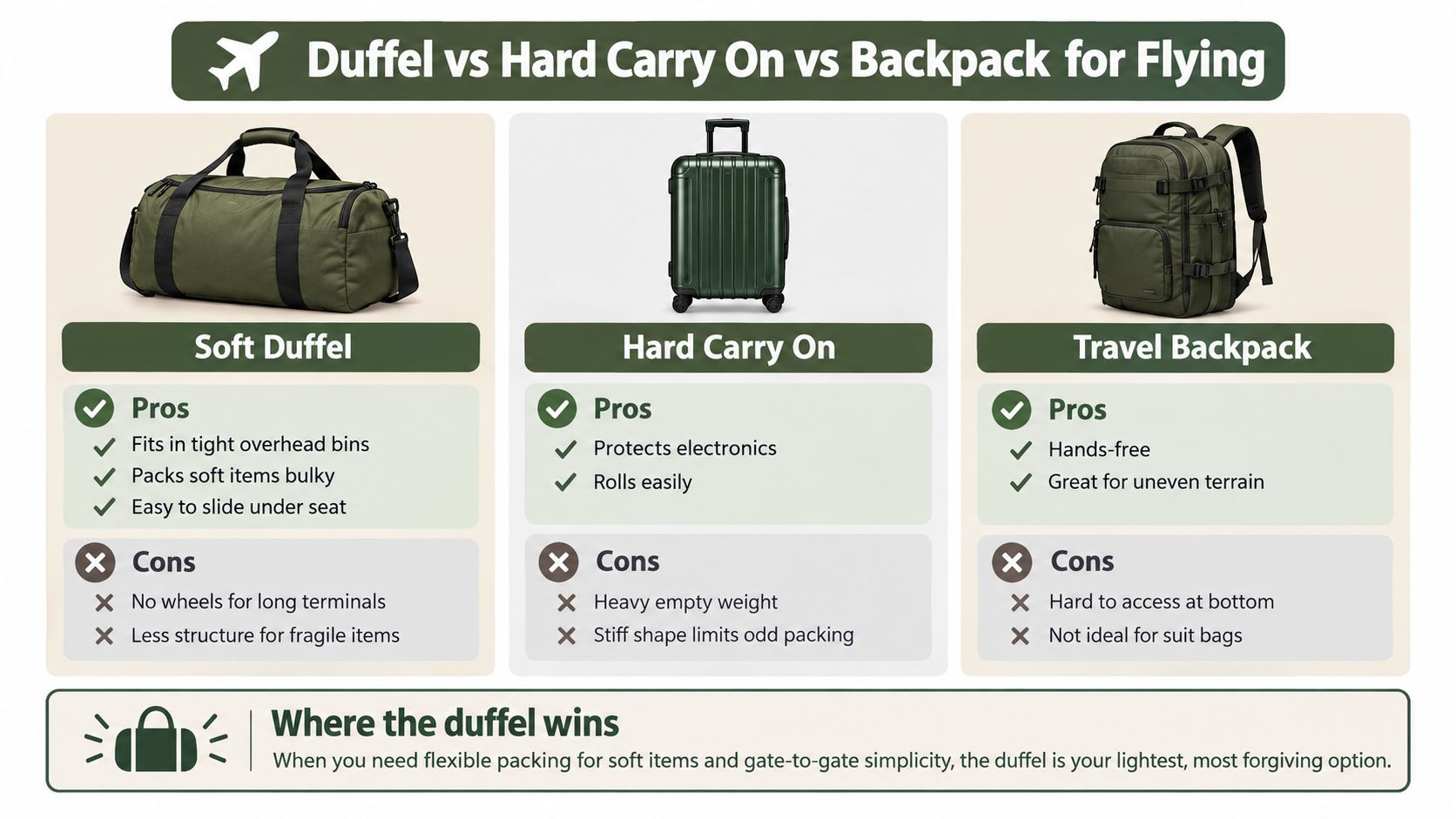
A soft duffle wins when you're carrying soft goods, loading into tight spaces, and moving through a route with short walks between car, terminal, and hotel. It can slide into an irregular overhead space and compress when partially empty. Its weak points are just as clear: no wheels, less protection for fragile equipment, and more strain when the bag is heavily loaded.
A hard carry-on is better for electronics, bottles, and items that need a rigid shell. It rolls efficiently through long terminals and stacks neatly, but its fixed shape wastes odd spaces and makes bulky clothing harder to arrange. The case itself also adds weight before you pack anything.
A travel backpack is the strongest choice for uneven ground, public transport, and routes where both hands need to stay free. It distributes weight well when properly fitted, but deep compartments can be difficult to access, and a suit usually fares better in a structured duffle or garment-focused case. For a more formal alternative, compare the construction and layout of leather backpacks for travel.
Choose by route
- Regional hops: A compact duffle is excellent when transfers are short and overhead space is uncertain.
- Business trips: A structured leather duffle works when you need a polished appearance, but a rolling case may protect custom-fit clothing better.
- Adventure transit: A rugged nylon or CORDURA-class duffle is preferable when the bag will meet dirt, rain, and rough surfaces.
- Long terminals: Wheels or backpack straps pull ahead because hand carrying becomes tiring.
- Gate-checked connections: Choose a hard case for fragile gear, or a duffle with strong compression and internal protection.
The honest answer is that a duffle is the wrong primary bag when your trip requires heavy loads, fragile equipment, long walking distances, or predictable garment protection. Use it as a companion bag instead of forcing it to replace a wheeled carry-on.
Packing and Carrying Tactics for a Soft Travel Bag
Soft construction works best when you give the bag an internal system. Without one, clothing migrates toward the ends, shoes crush clean garments, and the shell swells in every direction.
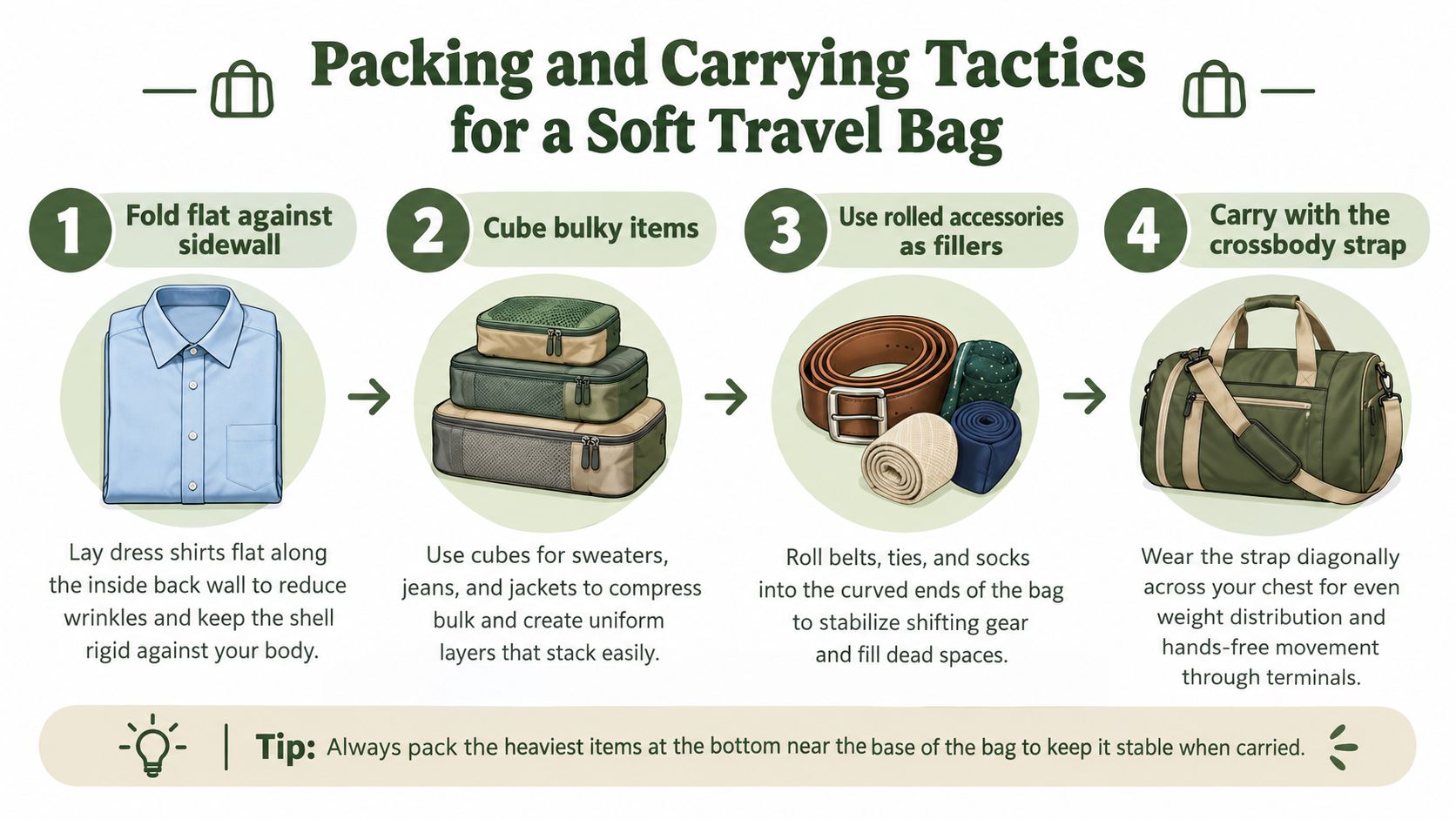
Start by laying dress shirts flat against the inside sidewall. This creates a smoother layer against the body and helps limit wrinkles. Put the heaviest items, such as shoes or dense toiletry containers, at the base and near the center, rather than at one rounded end.
Build the load in layers
Use packing cubes for sweaters, jeans, and other bulky pieces. Cubes stop soft clothing from spreading into every corner and create stable layers that are easier to remove in a hotel room. Keep one cube for clean shirts and trousers, another for casual items, and a smaller pouch for underwear and socks.
Small accessories are useful as fillers. Roll belts, ties, and socks into the curved ends of the bag, where larger cubes leave dead space. Put shoes in washable bags, and keep chargers in an exterior pocket or compact organizer so you don't have to unpack clothing to find them.
Carry with control: Tighten the shoulder strap so the bag sits close to your body. A loose strap makes the load swing, while short alternating carries on the grab handles can reduce fatigue during brief transfers.
A detachable crossbody strap is the best option for walking through terminals because it leaves your hands available for documents and doors. Before lifting the bag into an overhead bin, grip both short handles and keep the base level. That prevents the contents from sliding into the far end and reduces the chance of a zipper or seam taking the full load.
Once you reach the room, unpack by category instead of emptying the entire bag. Put the clothing cubes in a drawer, place shoes on the floor, and keep the toiletry kit near the bathroom. The bag should become storage, not a second suitcase scattered across the room.
Building a Coordinated Leather Travel Kit Around Your Duffle
A coordinated travel kit should support how you carry the duffle, not match it. Keep the leather tone, hardware finish, edge treatment, and stitch color within the same visual range. The result looks deliberate in an airport lounge or hotel room without requiring every item to come from one collection.
For business travel, use a structured leather briefcase for the laptop, documents, and meeting materials. It keeps work gear separate from clothing and gives you a cleaner setup when the duffle stays in the room. If the duffle is checked, a slim leather backpack keeps essentials with you. A roll-up toiletry kit contains liquids and grooming tools, while a compact watch case protects a timepiece from chargers and keys.
| Piece | Best Pairing Role | Trip Types | Tone Matching Tip |
|---|---|---|---|
| Structured briefcase | Laptop and documents | Business travel | Match the duffle's leather family and hardware |
| Slim leather backpack | Cabin backup when the duffle is checked | Longer trips and mixed transit | Keep the color close, but avoid unnecessary contrast |
| Zippered toiletry kit | Grooming and liquid organization | Any overnight or business trip | Use matching edge paint for a unified look |
| Compact watch case | Timepiece protection | Business and formal travel | Pair dark leather with restrained metal hardware |
| Pen sleeve or small portfolio | Writing tools, notes, and chargers | Meetings and work trips | Match stitch color or use it as the single accent |
Keep the palette disciplined
Choose one primary leather tone, one accent, and one hardware finish. Dark brown with brass looks traditional. Black with subdued metal appears more formal. Lighter tan suits casual travel, but it shows handling sooner and needs more care.
Coordination should also improve access. A second portfolio adds little if your phone, charger, and passport already have reliable places. A watch case, pen sleeve, or toiletry kit earns its space when it protects a specific item or keeps loose gear from rubbing against clothing.
Grainmark Leather offers full-grain leather duffle bags with briefcases, backpacks, toiletry bags, watch cases, pen storage, and other small leather goods. That range lets you compare related pieces before building a kit around the duffle.
Keep the kit compact enough to preserve the duffle's usable capacity. For a short trip, take the duffle, toiletry kit, and one small organizer. Add a briefcase for meetings or a watch case for a valuable timepiece. Decorative extras stay home. The right accessory solves a carrying or protection problem, then disappears into the routine.
Which Travel Duffle You Should Buy by Trip Type
The best men's travel duffle bag changes with the traveler. There isn't one universal winner, and a larger capacity doesn't compensate for the wrong carry system or material.
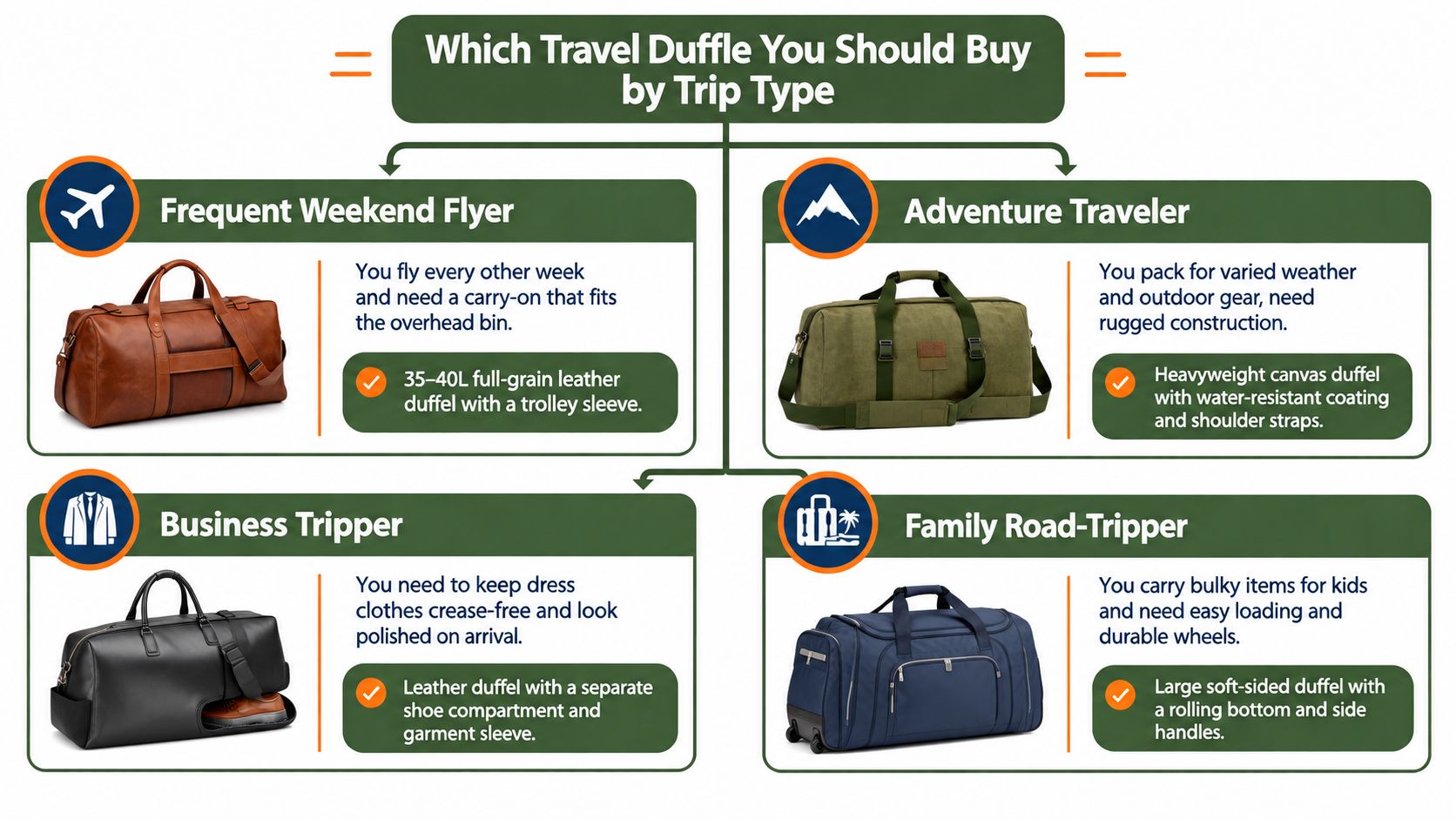
Frequent weekend flyer
Choose a 35–40L full-grain leather weekender with a trolley sleeve, reinforced base, and removable shoulder strap. This is the strongest fit for someone making regular short flights and wanting a bag that looks appropriate at a hotel, restaurant, or meeting. Accept the tradeoff: leather weighs more and needs protection from persistent rain.
One-bag business traveler
Choose a 40–45L carry-on duffle with a laptop sleeve, garment-friendly opening, trolley sleeve, and removable shoulder strap. A structured base matters more than a pile of small pockets. Accept that a full bag may become uncomfortable to carry over long terminals, especially if your itinerary includes connections or public transport.
Gym-to-office commuter
Choose a 25–30L nylon or canvas holdall with a ventilated shoe compartment and compact structure. It should carry a change of clothes, shoes, toiletries, and work essentials without becoming a sagging sack. Accept less room for spontaneous overnight packing.
Longer-haul traveler
For trips lasting several days, choose a 60–70L checked-size duffle with wheels or backpack straps, then pair it with a cabin backpack for documents, electronics, and essentials. A travel guide covering what to pack for a high-end safari is a useful reminder that specialized trips often need different equipment than ordinary business travel. Accept that a large duffle is no longer an effortless carry-on and becomes awkward when fully loaded.
The shortcut is simple: decide trip length, check the airline's dimensional rules, then choose your preferred material behavior. Those three filters narrow the field faster than comparing logos, pocket counts, or staged photographs.
Grainmark Leather offers full-grain leather duffle bags, briefcases, backpacks, toiletry kits, watch cases, and pen-storage pieces for travelers who want a coordinated carry system. Visit Grainmark Leather to compare the duffle styles and supporting accessories, then choose the capacity that matches your next real trip.