

Mens Canvas Duffle Bags: Complete Buying Guide 2026
You're halfway through an airport walk when the weather turns, your shoulder strap starts cutting into your neck, and the duffle you chose because it looked good online begins collapsing around everything inside. At the gate, the soft sides bulge past the carry-on sizer, while the zipper pulls strain against an overfilled opening.
That's the difference between a canvas duffle that works and one that merely photographs well. Mens canvas duffle bags combine flexible capacity, rugged fabric, and several ways to carry them, but those advantages depend on how the fabric, hardware, seams, base, and straps work together. A thick canvas body won't rescue weak handle stitching, and a generous compartment won't help if the bag becomes miserable to carry.
The right choice starts with four connected decisions: capacity, carry system, reinforcement, and packing method. Choose them around your actual commute, flights, weekend trips, and weather, rather than around a feature list. By the end, you'll know which construction details matter and which ones are mostly decoration.
Table of Contents
- Why the Right Canvas Duffle Changes How You Travel
- Understanding Canvas as a Travel Material
- Matching Capacity to Trip Length
- Carry Options That Match How You Move
- Reinforcement and Construction Details That Matter
- Packing Strategies for Weekend and Travel Trips
- When More Pockets and Features Make Things Worse
- A Simple Checklist for Choosing Your Next Duffle
Why the Right Canvas Duffle Changes How You Travel
A good duffle stays quiet during travel. You lift it into an overhead bin by the handles, pull it close through a crowded terminal, and set it down without the base folding beneath its contents. A poor one demands attention at every step. Its shoulder strap slips toward your elbow, its round body rolls away when opened, and its unreinforced corners pick up abrasion before the first trip is over.
Canvas behaves differently from nylon luggage because it has more body and a more tactile surface. It can soften with use without becoming as slick or technical-looking as many synthetic fabrics. Compared with a leather weekender, it usually weighs less and handles rougher treatment with less concern about scratching the surface. The trade-off is that canvas depends heavily on finishing and construction, especially when rain, packed weight, and repeated lifting enter the picture.
The airport test
The most revealing moment comes when the bag is partly full. A well-designed duffle keeps a controlled shape, stands on a stable base, and lets you reach the main zipper without wrestling the fabric. A poorly balanced bag sags toward the heaviest side, twists its handles, and makes every lift feel more awkward than its weight suggests.
A frequent traveler should also think about how the bag moves between modes. You might carry it by hand from a car, use a shoulder strap across a station, and then place it overhead. The best construction supports those transitions without leaving loose hardware to snag clothing or weak attachment points to absorb the entire load.
Practical rule: Judge a duffle by the moments when it's inconvenient, not by the way it looks when empty.
A canvas duffle earns its place when it works across several situations without needing delicate treatment. The sections that follow focus on the details that determine whether it does that job: the behavior of the canvas, the size of the shell, the carry options, the reinforcement, and the way you pack it.
Understanding Canvas as a Travel Material
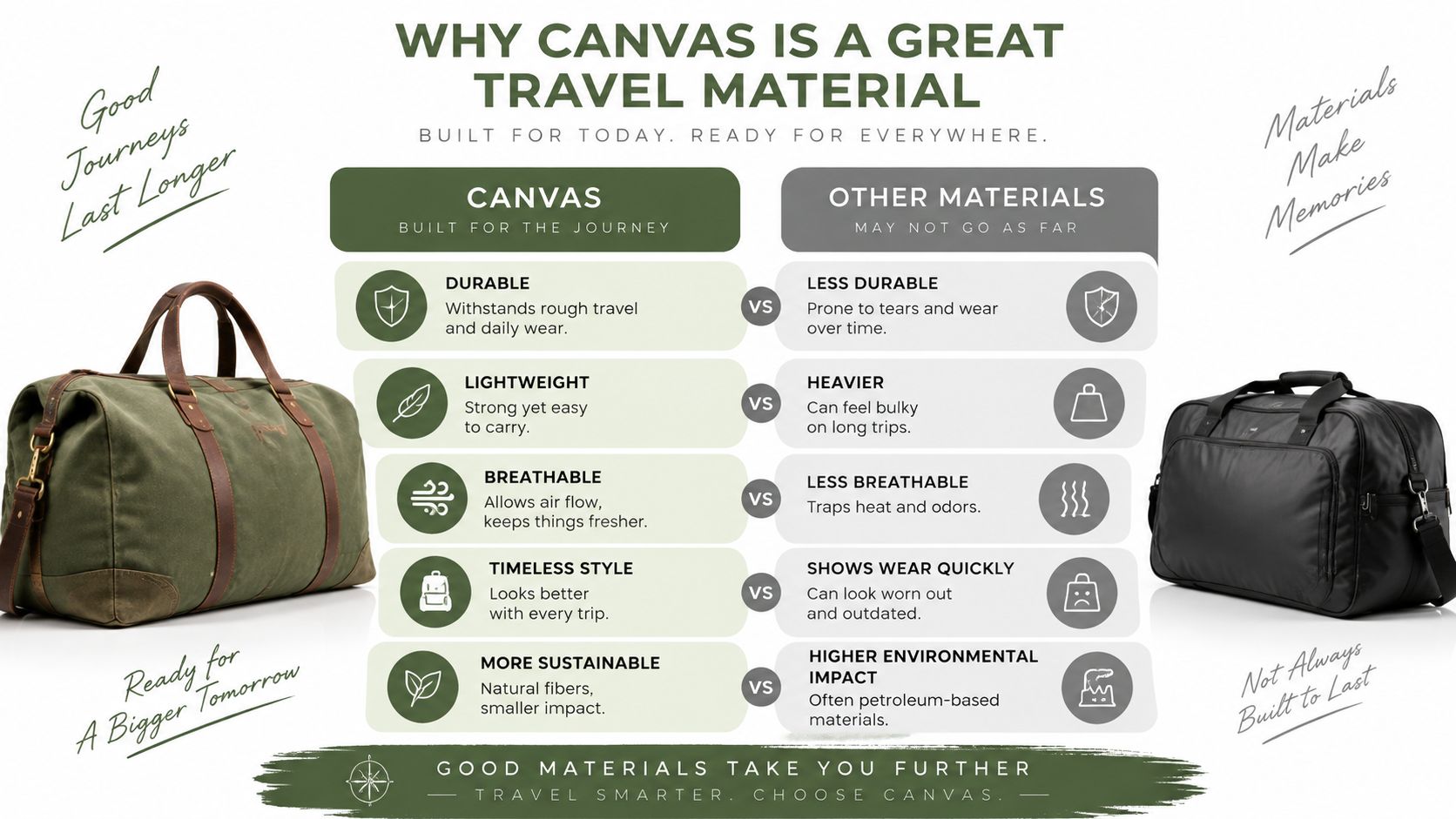
Canvas is a tightly woven fabric, commonly associated with cotton, workwear, tents, and sails. Think of it as the luggage equivalent of heavy denim. The weave gives the material substance, while the finishing treatment determines how it responds when water lands on the surface.
The duffle's modern form traces to Duffel, Belgium, in the 17th century, when thick wool cloth was used for early versions. By World War I, duffel bags had become standard issue for soldiers carrying uniforms, gear, and bedrolls. By World War II, every American GI was reported to have one, usually a green canvas cylinder marked with a service number and destination, as described in this history of the duffel bag.
Canvas later became the defining material for men's duffle bags because it replaced heavy wool with a lighter, tougher construction suited to military and travel use. The wider canvas bags market was valued at US$2.18 billion in 2023 and is projected to reach US$3.8 billion by 2032, with a 6.38% CAGR, according to this canvas duffel bag market overview.
Weight, weave, and feel
Heavier canvas generally feels denser and more resistant to abrasion, but weight alone doesn't prove quality. A dense fabric with poor seam work is still a weak bag. A lighter construction may be more comfortable for commuting, particularly when you're already carrying a laptop, coat, and other daily items.
Look for a product description that identifies the fabric clearly rather than relying on vague phrases such as “premium canvas.” The weave should look even, without loose areas around zipper openings or handle attachments. You'll find more practical material guidance in this overview of canvas travel bags.
How finishes change the bag
Untreated cotton canvas absorbs water readily. That doesn't make it unsuitable, but it means you shouldn't expect reliable protection during a wet walk from a taxi to a hotel. Waxed canvas sheds short exposure more effectively and develops darker areas where your hands and clothing repeatedly contact the surface. The finish adds character, though it can also add weight and make the fabric feel stiffer at first.
DWR and silicone treatments resist water through a different surface approach. They can preserve a relatively dry hand feel, but performance depends on how evenly the treatment is applied and how the bag is maintained. A finish isn't a substitute for sealed seams, covered zippers, or a protected lining. Canvas durability is a system involving fabric, thread, seams, hardware, and surface treatment, not a single material specification.
Matching Capacity to Trip Length
Choose capacity around the trips you take, not the largest trip you might take someday. A duffle sized for a two-day meeting can feel awkward as a daily office bag, while a small commuter model becomes frustrating when every weekend requires careful compression.
For frequent air travel, use 22 x 14 x 9 inches, or 56 x 36 x 23 cm, as the practical carry-on benchmark used by most major U.S. airlines, including handles and wheels, according to this airline carry-on size chart. Measure the finished exterior. A product label may list only the fabric body, while a thick handle, end panel, or hardware can push the packed bag beyond the permitted outline.
The three useful size buckets
| Size bucket | Best fit | What to check |
|---|---|---|
| Carry-on | Gym-to-office use, short business travel, compact weekends | Exterior dimensions, rectangular base, low-profile hardware |
| Weekend | Two-day leisure trips, casual meetings, road travel | Full-width opening, shoe placement, comfortable shoulder carry |
| Extended-stay | Longer travel, bulky clothing, equipment-heavy trips | Base strength, balanced loading, wheels or a serious carry system |
Carry-on sizing leaves little room for decorative construction. A thick canvas shell, wrapped zipper, leather trim, reinforcement panels, and bulky clips all take up usable space within the airline-compliant outline. Soft canvas can compress when partly full, then swell past the limit once you pack it tightly.
A weekend duffle should separate shoes, toiletries, and clothing without collapsing into a shapeless sack. For a bag that serves both commuting and travel, a moderate body with a firm base and removable organizers works well. The base keeps the load controlled during the workweek, while removable inserts preserve open space for a change of clothes at the end of the week.
Extended-stay capacity changes the strain on every part of the bag. As the load grows, the base, seams, and carry points receive more punishment, and one shoulder strap becomes less comfortable. Choose a wheeled base or reinforced handles if the route includes long terminals, train platforms, or parking areas. Extra volume only helps when the fabric, hardware, and carry system can support it without making the bag difficult to control.
Carry Options That Match How You Move
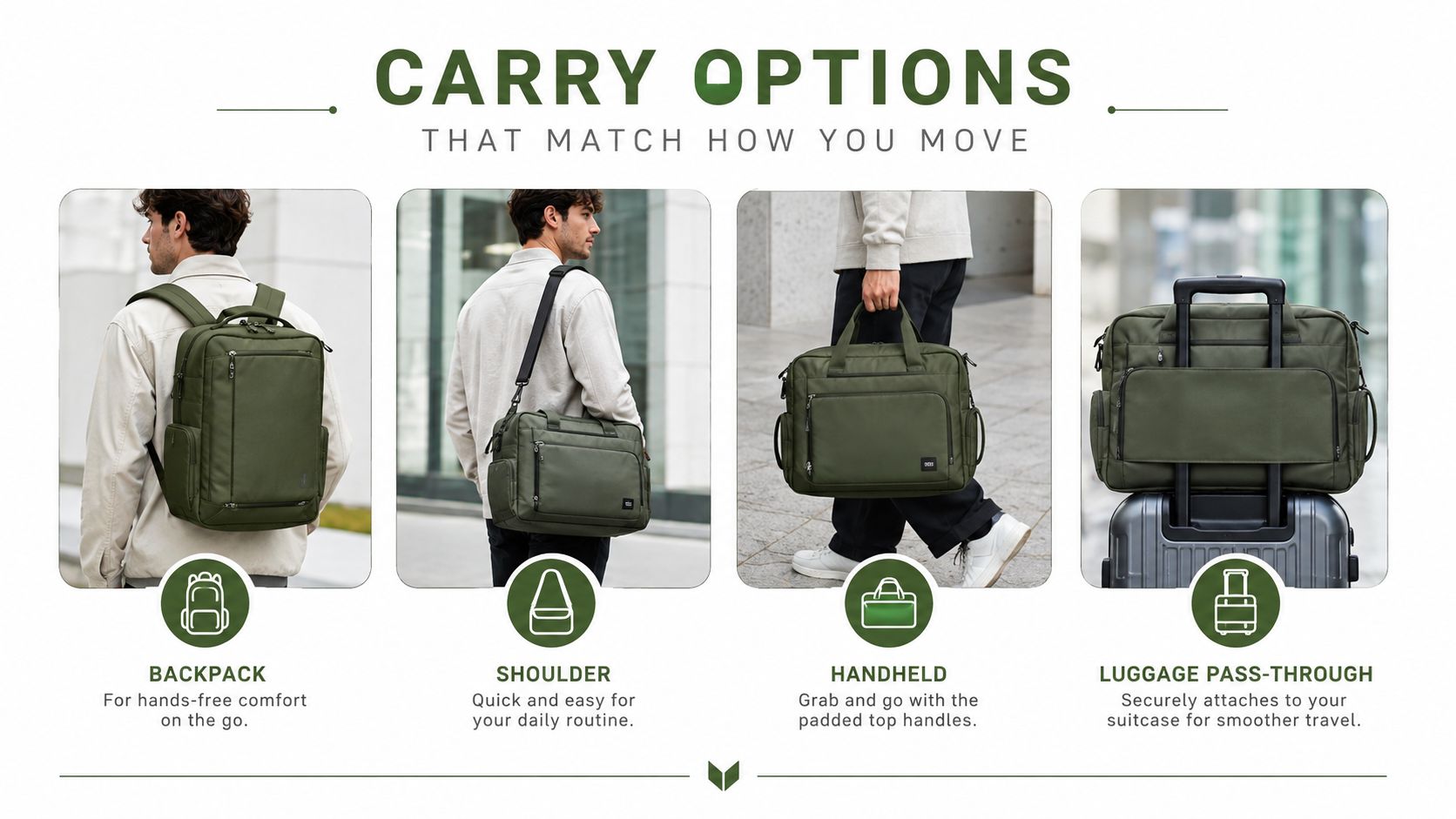
The strap arrangement determines how a duffle feels after the first comfortable lift. Product pages often list “multiple carry options” as if each configuration were equally useful. They aren't. A commuter who walks through a station has different requirements from a driver who carries the bag only between a trunk and a hotel room.
Top handles offer the cleanest design and the fastest access. They're excellent for short carries, car travel, and lifting into overhead bins. They become tiring when the bag is full and the route involves stairs or a long terminal walk. Check that the handles have enough drop to clear a coat and that they meet the body through broad, well-stitched attachments rather than narrow fabric tabs.
A detachable shoulder strap adds flexibility without permanently complicating the bag. Its weak points are the clips, adjustment hardware, and anchor placement. A strap that attaches too close to the end seams can make the duffle twist, while a slick webbing strap may slide off a jacket. The principles discussed in this guide to crossbody versus sling bags also apply here: balance and attachment position matter as much as the presence of a strap.
Matching the system to the route
Convertible backpack straps can solve a real mobility problem, especially for travelers who walk between transit connections. They also create a different load on your body. A heavily packed duffle can become uncomfortable on the back because the soft body may press unevenly and the straps may lack the shaping found on a dedicated backpack.
Wheeled bases remove shoulder strain, but they add weight, hardware, and another set of parts that can fail. Wheels also change the classic duffle silhouette and may reduce the useful interior space within a carry-on envelope. They make sense for longer corridors and heavier loads, less so for short trips where you'll frequently lift the bag over curbs and stairs.
A carry option is only useful if you'll use it for the longest part of your journey.
For most mixed-use buyers, top handles plus a removable padded shoulder strap offer the best balance. Choose backpack straps when walking is central to the trip. Choose wheels when the bag regularly becomes too heavy to carry comfortably, and inspect the handle mechanism and wheel tracking as carefully as the canvas itself.
Reinforcement and Construction Details That Matter
A duffle usually fails at the transitions between materials, not across an uninterrupted canvas panel. Handle attachments, zipper ends, base corners, strap anchors, and load-bearing seams all receive different stresses as the bag is lifted, dragged, packed, and placed overhead. Judge the fabric and hardware as one system.
Handles and load-bearing points
Examine where each handle enters the body. Stitching should extend beyond the visible handle, with a box pattern or dense bar tacks securing the webbing. Rivets can provide extra mechanical support, but they should reinforce sound stitching rather than disguise a weak attachment. Leather-wrapped handles improve grip and may make a full bag more comfortable to carry. The wrap must be fixed in place, or it can slide along the handle under load.
The base needs its own structure. A leather panel helps protect canvas from floor scuffs and damp surfaces. A plastic sheet can help the bag keep a flatter shape, while webbing around the lower perimeter shields exposed canvas from abrasion. These solutions involve different compromises in weight, flexibility, and appearance. An unsupported bottom will sag as the contents shift.
Leather trim also deserves a closer look. The material label alone does not show how a component will perform, so compare construction with the distinction covered in this guide to top-grain versus genuine leather.
Zippers, seams, and weather protection
Run the zipper through its full length. It should move smoothly without forcing the canvas into a tight curve. Storm flaps limit direct rain exposure, and a water-resistant finish helps the outer shell resist wetting. Neither protects the interior if needle holes, zipper ends, and seams remain exposed.
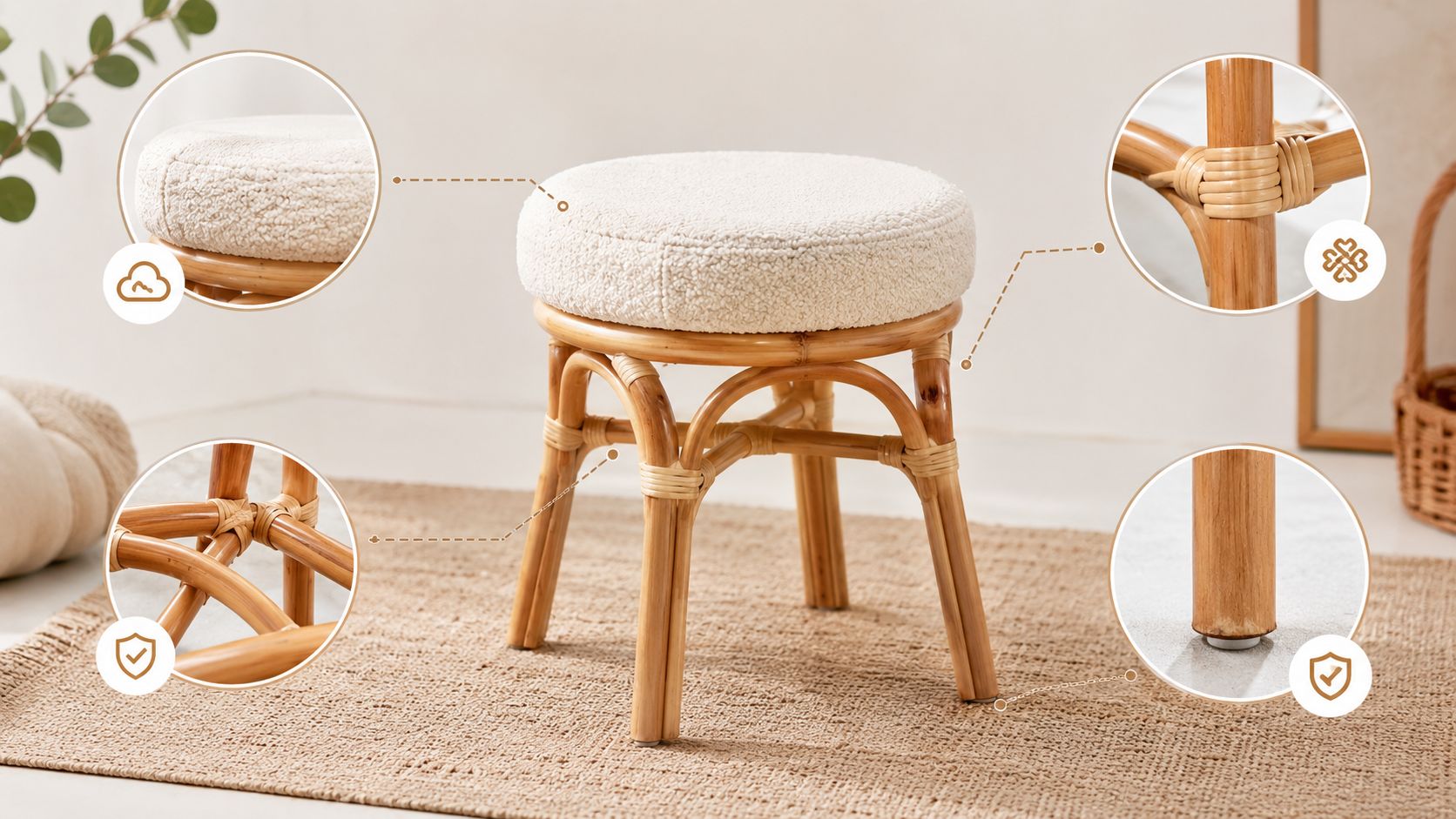
Canvas becomes heavier when it absorbs water and takes longer to dry. Moisture can also pass through seams and needle holes, so pair water-repellent treatment with sound reinforcement at handles, zipper ends, and base corners. Those areas face repeated pulling and abrasion during lifting, stuffing, and overhead-bin handling.
Use this visual check before buying:
- Handle attachments: Look for broad contact areas, dense stitching, and no puckering around the body.
- Base corners: Check for a separate protective panel or a clearly reinforced seam.
- Zipper ends: Look for secure stitching and a flap or construction that limits direct rain exposure.
- Hardware: Test clips and rings for smooth movement, without sharp edges or loose play.
- Interior structure: Open the bag fully and check that the lining and canvas do not pull apart.
Packing Strategies for Weekend and Travel Trips
A canvas duffle packs best when you build a stable core instead of filling every gap at random. Put shoes and other dense items near the base, then place softer clothing around them to prevent the bag from leaning. If the bag has a structured bottom, use that surface as the foundation rather than letting hard objects press directly against the side panels.
Roll casual shirts, knitwear, and soft trousers when you want to use the corners efficiently. Fold dress shirts and jackets more traditionally, then place them near the top where they won't be compressed by footwear. Packing cubes help separate categories without turning the main compartment into a rigid grid. A small toiletry bag collection can keep liquids and grooming items from migrating into clothing.
Two practical packing patterns
For a two-day business trip, start with one compact clothing cube, place shoes in a protective shoe bag at the bottom, and reserve the top layer for a folded shirt or jacket. Keep documents, chargers, and medication in a small pouch near the opening so you won't unpack the entire bag at security or in a hotel lobby.
For a five-day leisure trip, divide clothing by type rather than by day. One cube can hold tops, another underwear and sleepwear, while a lightweight laundry pouch keeps worn items separate on the return journey. If you're unsure what to bring, use an ultimate travel packing checklist as a planning reference before you start filling the bag.
Don't use the flexibility of canvas as permission to overfill. Once the zipper begins straining, the bag loses its intended shape and the zipper tape, end stops, and seam attachments absorb unnecessary force. A partially full duffle needs support too. Fill empty side spaces with soft garments, keep dense items centered, and use a cube or folded sweater to stop the body from collapsing around a single heavy object.
When More Pockets and Features Make Things Worse
A duffle's main advantage is open, flexible capacity. Every fixed divider, external pocket, and decorative zipper works against that advantage by claiming space and adding another place where stitching, tape, or hardware can fail.
External pockets are useful when you regularly need quick access to a passport, keys, or travel documents. Beyond that, extra pockets often create seam lines that catch on armrests and luggage handles. Their zipper pulls can snag, and their volume encourages you to load the outer walls unevenly, which makes the bag hang badly from a shoulder strap.
Keep organization modular
A simple interior usually adapts better than a built-in office. Use a small pouch for cables, a toiletry case for liquids, and a clothing cube for garments. You can remove those organizers when the same duffle carries gym shoes, camera accessories, or equipment that doesn't fit a fixed compartment.
Useful filter: If a pocket doesn't solve a problem you have on nearly every trip, it may be paying for itself in complexity rather than convenience.
Laptop sleeves deserve a separate judgment. A padded sleeve can protect a device during a commute, but it also creates a rigid bulge inside a soft bag. If you already carry a briefcase or computer sleeve, a cleaner duffle interior may be more versatile. If the duffle is your only work bag, look for a restrained sleeve that doesn't consume the entire wall.
The same logic applies to hidden pockets, compression straps, and shoe compartments. They're valuable when they match a repeated habit. They're counterproductive when they turn a flexible travel bag into a compartmentalized case that can't accommodate bulky or irregular items. Buyers who work remotely can compare this approach with the organization principles in this guide to leather bags for digital nomads, then choose only the storage features their routine requires.
A Simple Checklist for Choosing Your Next Duffle
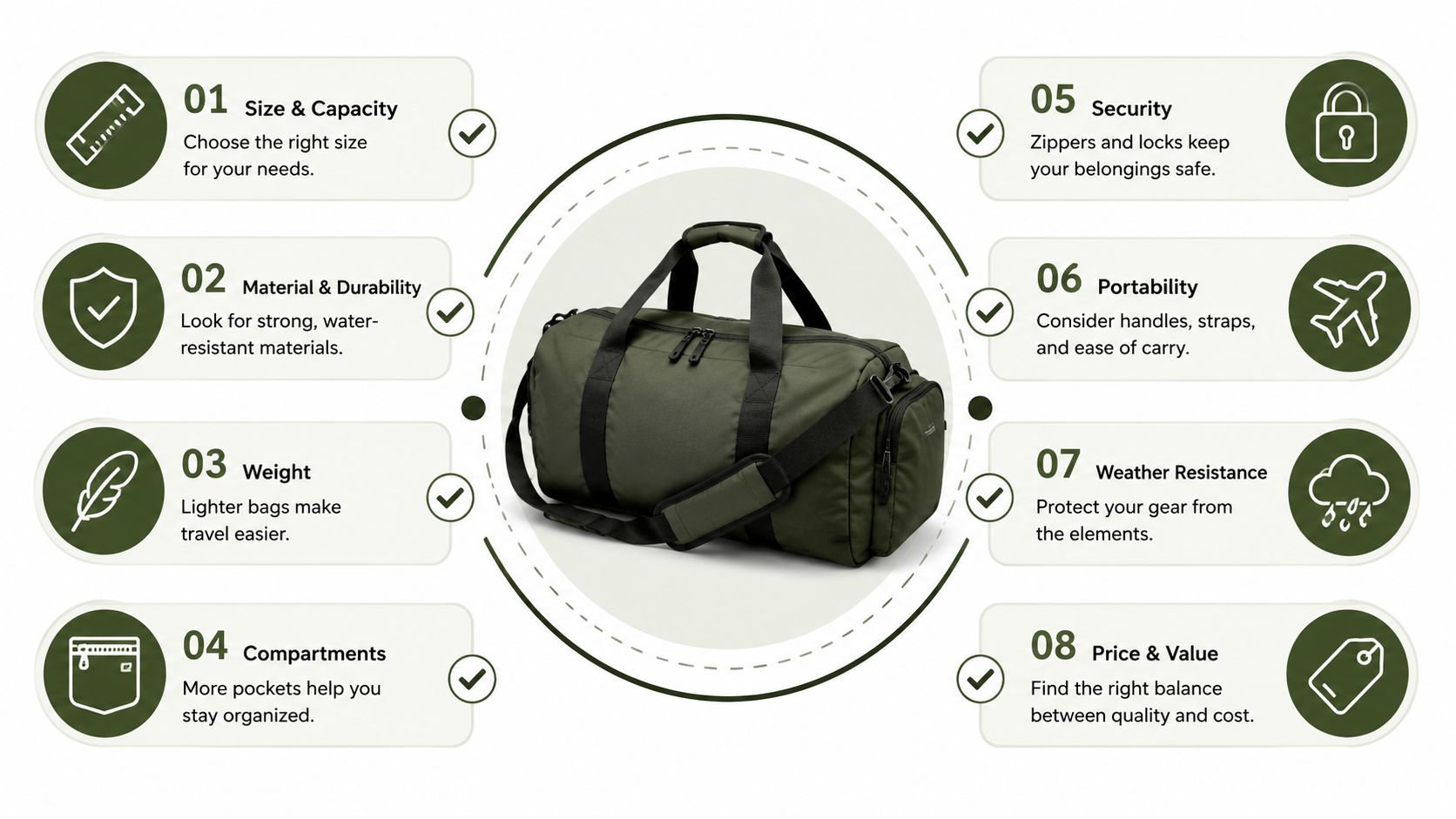
A dependable buying decision starts with the route, load, and weather you face. Assess the duffle as a system, because fabric, hardware, reinforcement, and carry options affect one another in use.
- Choose the size bucket first. Frequent flyers should check the finished exterior dimensions, including handles and hardware, against the airline's current cabin limits. Drivers taking two-day trips may prefer a weekend size for better balance. Choose an extended-stay model only when your regular packing requires it.
- Match the carry system to movement. Top handles work for short transfers. A detachable shoulder strap helps when carrying methods change. Backpack straps suit longer walks if the loaded body stays comfortable. Wheels reduce shoulder strain but add weight and mechanical parts that can fail.
- Inspect stress points. Examine handle stitching, strap anchors, zipper ends, base corners, and the lower perimeter. Heavy canvas cannot compensate for weak attachments or a base that collapses under load. The body, hardware, and reinforcement should support the same carrying pattern.
- Match the finish to weather. Untreated canvas needs more care in rain. Waxed, silicone-treated, and DWR-finished fabrics handle brief exposure differently, while changing the bag's hand feel, weight, and aging. Finishes work better with protected seams and reinforced interfaces.
- Leave room for sensible packing. A duffle should close without force. Keep dense items low and central, use removable organizers, and leave enough flexibility for the bag to retain its intended shape. A rigid, overfilled body can strain the zipper and make the carry system uncomfortable.
Canvas changes with use. Untreated fabric softens, waxed surfaces darken where handled, and scuffs record the trips the bag has taken. That character suits buyers who accept visible history rather than expecting an untouched appearance.
Grainmark Leather offers men's leather duffel bags, weekenders, travel pieces, rolling duffles, and matching small goods that can complement a canvas travel system. Visit Grainmark Leather to compare carry options and organizers before choosing a bag for your weekly routine.