
Leather Briefcase Backpack Guide for Professionals
You're leaving the office for a client meeting, carrying a laptop, documents, charger, notebook, and the jacket you won't need until tonight. A briefcase looks right for the meeting, but a backpack would feel better on the train. By the time you reach the platform, you're shifting a one-shoulder load from side to side and wondering why one bag can't handle the whole day.
That's the practical appeal of a leather briefcase backpack. It can present a structured, business-ready face when you're walking into a meeting, then move the load onto both shoulders when the commute, airport connection, or hotel transfer makes that the sensible choice. The format has grown alongside work routines that move between offices, home workspaces, client sites, and travel rather than staying in one place.
The category deserves careful buying, though. Convertibility doesn't automatically mean better comfort, and every extra strap, clasp, swivel, or attachment point creates another component that can wear. The right choice depends on how you move, what you carry, how formal your workplace is, and whether you'll use the second carry mode.
This guide focuses on those decisions rather than treating leather as decoration. You'll find a side-by-side comparison, construction details that matter, scenario-based recommendations, and a maintenance approach for daily use. For a broader look at office carry, the guide to the best leather work bags provides useful context before you narrow the choice to a hybrid.
Table of Contents
- Introduction Why Your Work Bag Choice Matters More Now
- Understanding the Three Professional Carry Formats
- Detailed Comparison of Briefcase Backpack and Hybrid Designs
- Materials Sizing and Construction That Affect Daily Performance
- Real World Use Cases and Which Format Wins Each Scenario
- Caring for Leather and Protecting Your Investment in Any Climate
- How to Choose the Right Leather Briefcase Backpack for Your Work Life
Introduction Why Your Work Bag Choice Matters More Now
A professional work bag has to solve several problems at once. It needs to protect a laptop, keep documents presentable, hold the small items that otherwise disappear into a compartment, and look appropriate when it sits beside a conference table. It also has to remain comfortable during the parts of the day that don't appear in a product photograph, such as standing on a crowded platform or carrying it from a station to a client's office.
A classic briefcase handles presentation and access well. You can lift it by the top handle, place it beside a chair, and retrieve a document without taking the bag off. Its limitation appears when the walk gets longer or the contents get heavier. The load stays concentrated in one hand or on one shoulder, which can become tiring during repeated transitions.
A backpack solves that load-distribution problem with two shoulder straps. The trade-off is visual and practical. A casual, rounded backpack can feel out of place with formal tailoring, and accessing a document usually means removing it or twisting it around your body.
The hybrid tries to remove that compromise. In briefcase mode, it can use a top handle or shoulder strap. In backpack mode, it gives you hands-free movement and a more balanced load. Some travel-focused designs add a roller-board strap, creating another option when an airport trolley is available. The result is flexible, but flexibility only helps if the hardware is comfortable, secure, and built for repeated changes.
Practical rule: Choose the bag for your most demanding regular movement, not for the shortest part of your commute.
The global leather goods market is projected by one independent estimate to rise from USD 531.07 billion in 2025 to USD 982.42 billion by 2034, with a 7.13% CAGR across 2026 to 2034. That broad category includes many products beyond work bags, but it places leather briefcases and backpacks inside a large, expanding accessories market rather than a tiny specialist niche. The leather goods market estimate also helps explain why buyers can find so many variations in structure, finish, and carry configuration.
The decision becomes clearer when you stop asking which format looks best and ask which one matches your actual workday. A formal client-facing schedule may favor a briefcase. A long walk or bike commute may favor a backpack. A day that repeatedly switches between those conditions is where the leather briefcase backpack earns its place.
Understanding the Three Professional Carry Formats
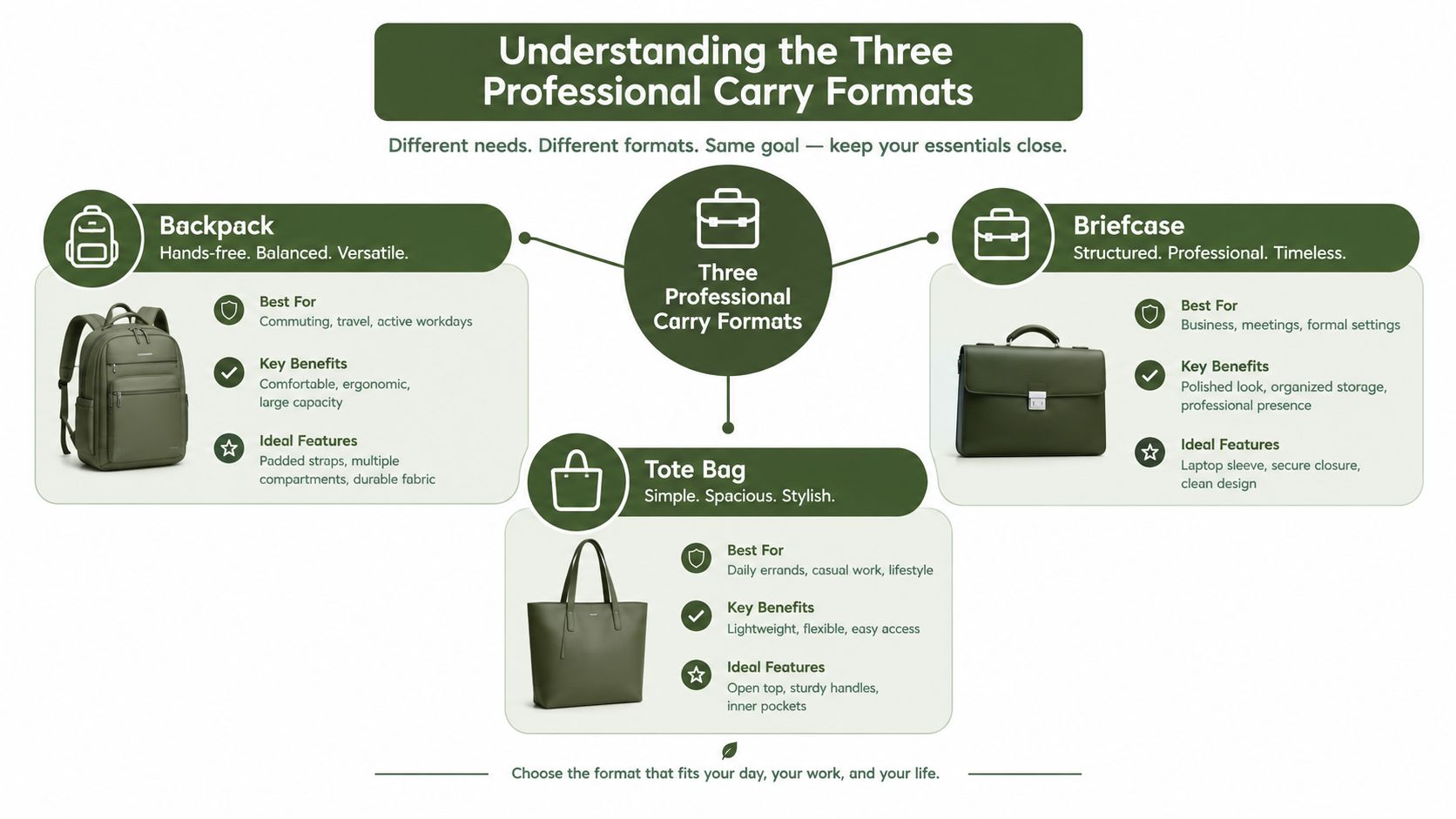
A leather briefcase is built around upright organization and immediate access. Its body usually keeps documents flat, places the laptop in a protected sleeve, and presents a structured profile. You carry it by a top handle or attach a shoulder strap, but the load remains primarily in one hand or on one side of the body.
A leather backpack follows a different carry logic. The back panel and shoulder straps become the main support system, allowing the load to sit closer to your centerline. That makes the format more suitable for longer walks, cycling, and commutes where both hands need to remain free. Its access pattern is less immediate, because the bag normally has to come off your back before you can reach the main compartment.
A leather briefcase backpack combines those systems in one body. It may include a top handle, a removable or stowable shoulder strap, backpack straps, and sometimes a luggage pass-through. The best designs don't merely add straps to a briefcase. They reinforce the points where those straps pull, protect the laptop compartment in both orientations, and prevent unused hardware from creating bulk.
Briefcase logic
The briefcase works when presentation and access take priority. Its rectangular silhouette supports A4 documents and tends to complement formal clothing. It also makes sense for a short transfer from a car to a meeting room, where the comfort advantage of backpack straps won't justify the extra structure.
The weakness is sustained asymmetric carrying. If the laptop compartment, charger, and papers make the bag dense, your shoulder or hand absorbs that load for the entire trip. A padded strap can improve the experience, but it can't change the basic one-sided distribution.
Backpack logic
The backpack wins when distance and balance dominate. Two shoulder straps spread the load and leave your hands free for a bicycle, coffee, phone, or luggage handle. A professional leather backpack can still look restrained, but its visual language is more relaxed than a structured briefcase.
The drawback is meeting-room access. You may need to set it down, open it from the top, and search through the main compartment. Internal organization can reduce that friction, but the bag still sits behind you while you're moving.
Hybrid logic
The hybrid earns consideration when your week contains both conditions. It lets you carry documents by hand into a formal setting and switch to backpack mode for a longer transfer. The cost is complexity. More hardware means more weight, more places for abrasion, and more components to inspect.
The laptop bag and messenger bag comparison is also useful here because it highlights the same underlying question: do you value immediate side access, or balanced hands-free carrying?
Detailed Comparison of Briefcase Backpack and Hybrid Designs
Compare all three formats against the movement your workday requires. A bag may look refined in a showroom yet become frustrating if its conversion takes too long, its laptop sleeve shifts, or its structure collapses when set on the floor. The practical question behind any briefcase vs backpack comparison is how often you change carrying modes, and whether the hardware can tolerate that routine.
| Criteria | Leather Briefcase | Leather Backpack | Leather Briefcase Backpack |
|---|---|---|---|
| Carry comfort | Suitable for short transfers and lighter loads | Strongest for long walks and balanced loads | Flexible, with backpack comfort when the straps are well designed |
| Access | Fast access by hand or shoulder | Main access usually requires removing the bag | Good in briefcase mode, moderate in backpack mode |
| Professional appearance | Most formal and structured | Ranges from polished to casual | Can shift between formal and relaxed settings |
| Laptop and document handling | Excellent for flat documents and organized sleeves | Good protection, with more vertical packing | Strong if the laptop compartment works securely in both orientations |
| Travel utility | Easy to lift and place beside a seat | Comfortable through stations and terminals | Particularly useful with a luggage pass-through |
| Main weakness | One-sided load distribution | Less immediate access and potentially more casual styling | Additional hardware, weight, and failure points |
Comfort and weight distribution
A briefcase works well for short walks, quick transfers, and restrained loads. Its top handle gives immediate control, while a shoulder strap helps when your hands are occupied. The trade-off appears during a long commute. A laptop, charger, notebook, and documents remain concentrated on one side, so your shoulder and hand absorb the load for the whole trip.
A backpack distributes that weight across both shoulders and keeps your hands available for a bicycle, coffee, phone, or luggage handle. The compromise is access. You usually need to remove it before reaching the main compartment, and its shape can appear more casual in a conservative office.
A hybrid only delivers the backpack advantage if its straps are padded, adjustable, and anchored to reinforced areas. Thin straps, loose attachment points, or hardware that twists during conversion make backpack mode feel secondary. Each buckle and swivel also introduces another abrasion point and another component that can fail.
A convertible bag should feel like a competent backpack, not a briefcase wearing spare straps.
Organization and access
Briefcases normally give the fastest access to papers because the opening faces you and the contents remain arranged horizontally. Backpacks can hold more vertically and may offer useful exterior pockets, but quick access depends on the internal layout.
A hybrid has to work in both orientations. Look for a separate laptop compartment, a document section that keeps its shape, and smaller pockets positioned so they remain usable whether the bag is carried by hand or on your back. A pocket that behaves well upright may spill pens or cables when the bag rests on its side. Test the opening with the laptop installed, not while the bag is empty.
Appearance and versatility
A structured leather briefcase remains the safer choice for conservative client meetings, court days, and formal offices. A leather backpack can suit a relaxed workplace when its panels are clean, its branding restrained, and its volume controlled. Excessive external webbing and loose straps usually weaken that professional impression.
The hybrid can move between formal and relaxed settings, though its conversion hardware may interrupt a clean silhouette. Concealed straps, low-profile fittings, and adjustment tails that stay secured reduce that problem. Durability still matters more than a tidy first impression. Hardware that is constantly tucked, pulled, and repositioned must be firmly stitched into reinforced zones.
Capacity and device fit
The broader leather bags category was estimated at USD 55.0 billion in 2025, with a projection of USD 90.4 billion by 2034 at a 5.6% CAGR, according to this leather bags market estimate. The figures cover many bag types, but the practical point is clear: work and travel bags are built around different expectations for capacity and handling.
Independent specifications for hybrid business bags commonly fall around 11 to 19 liters, with empty weights around 880 grams to 1.1 kilograms, and dimensions near 26 to 29 centimeters wide, 35 to 45 centimeters tall, and 11 to 14 centimeters deep. Those figures appear in the hybrid briefcase backpack specifications, which also show the use of PU-coated zippers for added rain resistance. Match those measurements to your laptop, charger, papers, and daily extras. A convertible system saves effort only when its added structure does not become the load you carry most often.
Materials Sizing and Construction That Affect Daily Performance
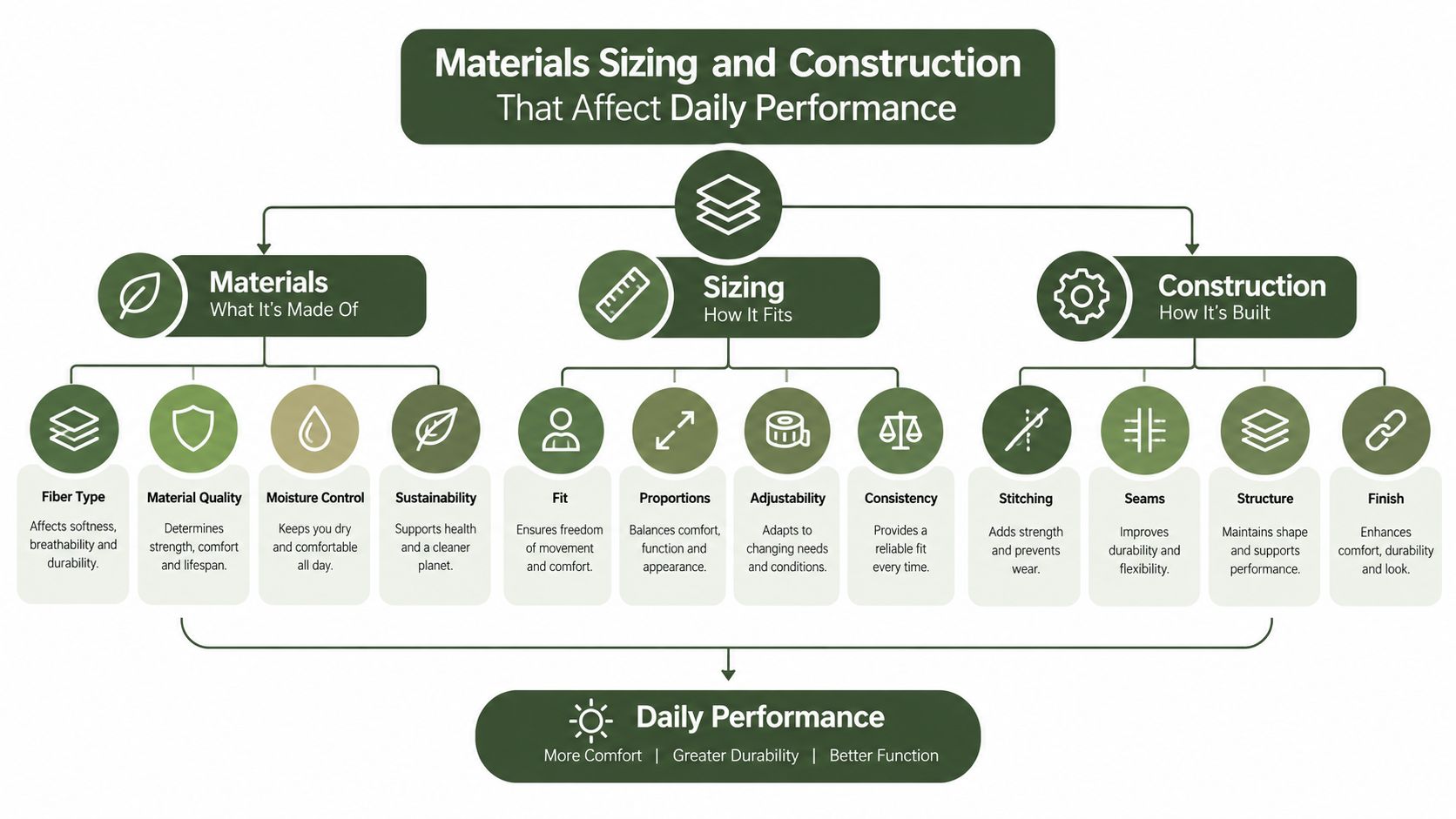
Leather quality matters, but thickness and construction determine how that leather behaves in a working bag. Full-grain leather retains the natural grain of the hide, so surface variation, creasing, and patina are part of its normal aging. That doesn't make every full-grain bag equally durable. Stitching, edge finishing, lining, reinforcement, and hardware still decide whether the bag survives daily handling.
A useful specification example is a high-capacity four-way briefcase made from 8-ounce full-grain vegetable-tanned leather. Its body measures 16.5 by 12 by 5.5 inches, weighs 4.5 pounds, and offers a shoulder strap, two backpack straps, and a roller-board strap, as documented in the four-way briefcase product specification. That is a business-travel build, not an ultralight commuter. The thicker leather and multiple carry systems create durability and flexibility, but you'll feel the empty weight before adding a laptop.
Read the dimensions against your load
A laptop sleeve should fit your actual device, not just its advertised class. A compartment described for a 15-inch laptop may be too tight for a thick workstation, while a loose sleeve can allow movement that increases impact risk. Measure the laptop with its protective case if you plan to keep the case on.
A4 documents need a compartment that protects corners and keeps pages from bending. If you carry a notebook, charger, headphones, water bottle, and lunch, the bag needs usable depth rather than inflated external dimensions. More volume can be helpful for overnight travel, but a deep bag can become uncomfortable and visually bulky during a normal office day.
Inspect the stress points
Convertible hardware puts concentrated force into a few areas. Examine the stitching where shoulder straps meet the body, the leather patches around rings and clasps, and the top handle anchors. Reinforcement should spread the pull rather than leave a small line of stitching carrying the entire load.
Zippers deserve the same scrutiny. A smooth-running zipper with a substantial pull is easier to use under pressure, while a zipper that catches at the corners will receive more force from rushed opening. PU-coated zippers can improve rain resistance, but they don't turn a leather bag into a waterproof container.
Construction check: The leather may outlast the clasp, zipper, or strap anchor if the maker treats convertibility as an accessory instead of a load-bearing system.
Natural grain and patina are advantages of full-grain leather, but they also require realistic expectations. The guide to leather grades can help you distinguish material terminology from the construction details that control everyday performance.
Real World Use Cases and Which Format Wins Each Scenario
The right bag changes with the route. A professional who drives from a garage to an office has different requirements from someone who walks through a station, boards a train, and reaches a client site on foot. The same person may need different carry modes on different days.

Formal client meetings and court days
A structured leather briefcase usually wins when the bag forms part of a formal presentation. It sits upright, keeps documents orderly, and doesn't introduce backpack straps into the visual impression. The top handle also lets you place the bag beside a chair without removing straps or adjusting fittings.
A hybrid can work if its backpack straps stow cleanly and the body retains a firm shape. Choose it when the meeting is only one part of a longer day that includes walking or transit. If the entire trip is short and formal, the dedicated briefcase is simpler and has fewer components to manage.
Daily transit and walking
A backpack is the practical winner for a long walk, crowded train, or bicycle commute. Balanced shoulder straps reduce the awkward pull created by a dense laptop load, and both hands remain available. A hybrid earns the same recommendation only when its backpack harness is comfortable and its body doesn't swing or twist.
The dedicated briefcase becomes less attractive as distance increases. You can carry it by hand for short stretches, but switching to a shoulder strap doesn't eliminate the asymmetric load. If you need to reach documents repeatedly, a messenger-style carry may be convenient, but convenience doesn't outweigh comfort for a demanding daily route.
Airport transfers and business travel
Travel rewards flexibility. A hybrid with a luggage pass-through can sit on a roller suitcase, then convert to a backpack when you reach stairs or a long terminal corridor. A high-capacity example documented in the four-way leather briefcase specification uses three carry modes and a dedicated laptop compartment for a 15 to 16 inch class device.
The trade-off is empty weight and hardware complexity. A large, thickly built hybrid may be excellent for business travel but excessive for a light daily commute. Check whether the laptop sleeve stays suspended and whether the external fittings can avoid catching on luggage handles.
Hybrid work and frequent mode switching
This is the clearest use case for a leather briefcase backpack. You may leave home with the straps deployed, switch to a top handle when entering a client space, and return to backpack mode for the journey home. That flexibility removes the need to own separate bags for every part of the day.
It only works if the change takes little effort. If you need to unpack the bag, detach multiple clips, or hide straps in a cramped rear pocket, you'll eventually stop converting it. Test the mechanism with the bag loaded, because hardware that feels easy when empty can become awkward under tension.
Caring for Leather and Protecting Your Investment in Any Climate
Full-grain leather handles ordinary use well, but rain, heat, abrasion, and neglect leave visible consequences. The objective isn't to keep the bag untouched. It's to prevent moisture, grime, and over-drying from turning normal wear into structural damage.
Start with a simple routine:
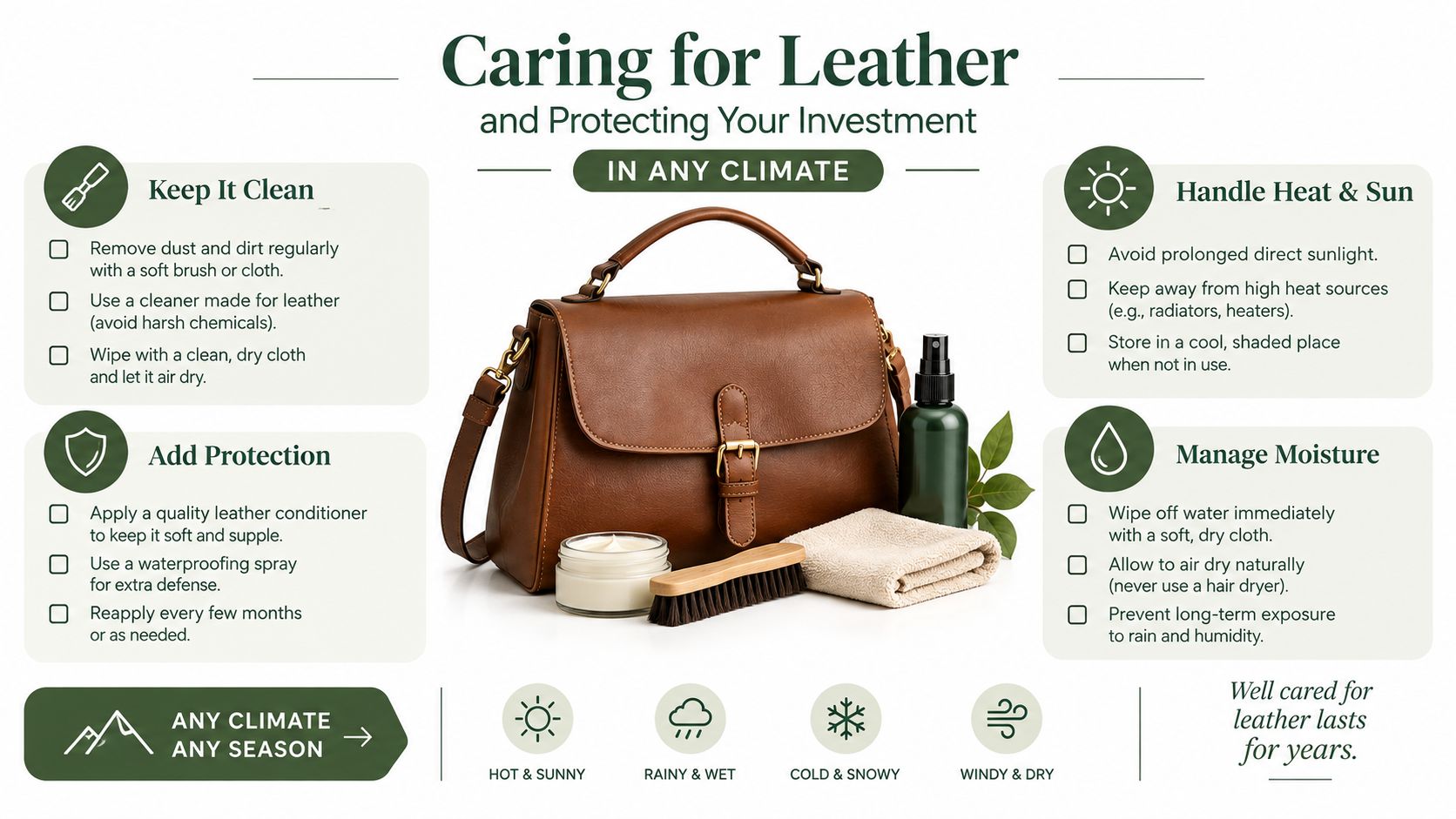
- After wet travel: Wipe surface moisture with a soft cloth and let the bag dry naturally away from direct heat.
- After dusty commutes: Brush or wipe away grit before it works into seams and zipper tracks.
- During storage: Keep the bag upright or supported so the body doesn't develop a permanent collapse.
- Before conditioning: Test any product on a hidden area, because treatments can darken or alter the finish.
Conditioning should be based on the leather's condition and climate rather than an arbitrary calendar. Dry indoor heating and intense sun can pull moisture from leather, while a wet climate demands more attention to drying and surface protection. Apply a modest amount, work it evenly, and allow the leather to absorb it before buffing away residue. The leather conditioning guide covers the basic process without treating conditioner as a substitute for careful use.
Inspect the convertible system
A hybrid has more maintenance points than a dedicated bag. Check the strap anchors, D-rings, clasps, zipper teeth, and stitching around reinforcement patches. Look for loose threads, stretched leather, metal deformation, or a clasp that no longer closes cleanly.
Hardware can fail before the leather because repeated conversion concentrates stress in small components. Remove unnecessary weight when possible, avoid hanging a full bag from a single handle for long periods, and don't force a zipper around an overpacked corner. In wet climates, dry the hardware and zipper areas as well as the leather surface.
A dedicated briefcase or backpack has fewer moving parts, which can make it the better long-term choice for a consistent routine. Choose the hybrid when you'll use its modes often enough to justify that added inspection and care.
How to Choose the Right Leather Briefcase Backpack for Your Work Life
Make the decision from four facts about your week: how far you walk, how formal your meetings are, what you carry, and how often you travel.
Choose a leather briefcase if your route is short, your dress code is formal, and documents need to be accessed quickly. Choose a leather backpack if you walk, cycle, or carry a dense load for extended periods, especially in a workplace where a more relaxed silhouette fits.
Choose the hybrid when your movement pattern changes repeatedly. It's the strongest option for someone who carries a laptop and documents to formal meetings, then needs balanced shoulder carrying for transit or airport connections. Prioritize a comfortable harness, a laptop compartment that fits your device securely, reinforced strap anchors, a stable base, and hardware that converts without a struggle.
Don't judge the bag empty. Load the laptop, charger, notebook, and daily accessories you use, then test every mode. Check whether the bag remains comfortable, whether the document compartment stays orderly, and whether the unused straps disappear cleanly. Personalization can also matter if the bag is intended as a long-term professional accessory or gift, but it should come after fit and construction.
Grainmark Leather offers full-grain leather briefcases, backpacks, travel bags, organizers, and selected personalized goods. Its work-bag range includes formats suited to laptop and document carry, so you can compare a dedicated design with a convertible one against your real routine.
Visit Grainmark Leather to compare full-grain leather briefcases and backpacks for your workday, including options designed around laptop protection and organized carry. Choose the format that matches your movement pattern, then inspect the straps, hardware, and compartments before committing to daily use.


