
Journal with Pen Holder How to Choose the Right One
You're halfway through a meeting when someone asks you to note an idea. The journal is in your bag, but the pen has migrated to a coat pocket, a desk drawer, or the bottom of the main compartment. By the time you find it, the moment has passed.
A journal with pen holder solves that small but repeated interruption by treating paper and pen as one carry system. The point isn't decoration. It's to make writing available when you need it, keep the pen from disappearing during transport, and give the journal a format that works in a meeting, on a commute, at an airport, or beside your bed.
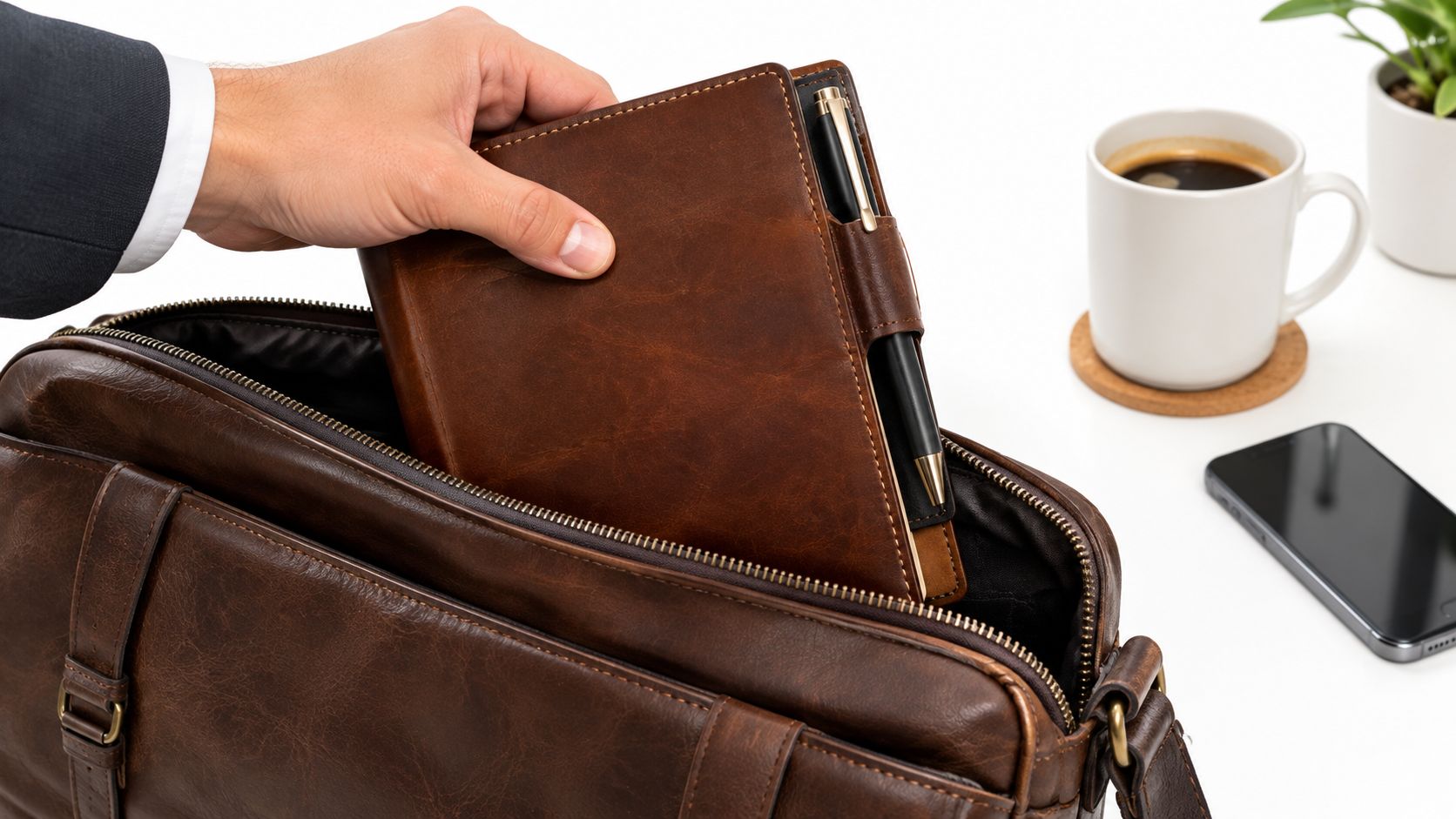
The right choice depends on more than the cover color. You'll need to consider how tightly the holder grips your pen, whether the attachment can move between notebooks, how the closure behaves inside a bag, and whether the leather and binding can tolerate repeated handling. This guide moves from the basic mechanism to formats, materials, closures, and practical buying decisions, so you can build a setup that reduces friction instead of adding another accessory to manage.
Table of Contents
- Introduction Why a Journal With Pen Holder Changes Daily Carry
- What a Journal With Pen Holder Is and How It Works
- Pen Holder Formats Compared and When Each Makes Sense
- Paper Types Leather Choices and Build Quality That Lasts
- Closure Styles Personalization and Everyday Practicality
- How to Choose the Right Journal With Pen Holder for Your Routine
- Final Thoughts on Building a Carry Ready Writing System
Introduction Why a Journal With Pen Holder Changes Daily Carry
A meeting ends, a thought arrives, and your journal is already beside you. The pen stays attached instead of hiding in a pocket or slipping beneath other items. That small change turns writing into one action rather than a search followed by a decision about which pen will suit the paper.
For commuters, this reduces the number of pieces to manage when leaving a briefcase or backpack. Travelers gain the same benefit as the journal moves between trains, cafés, and hotel rooms. For daily journalers, the paired format supports a regular habit because the writing tools begin and end together.
A pen holder also affects how the journal ages. A loose pen can press into pages, scratch nearby objects, or disappear during repeated handling. A holder with the right retention keeps the barrel in place without forcing the cover out of shape. That balance resembles a well-fitted belt loop: secure enough for movement, but easy to use every time.
The design has a practical history. In the early nineteenth century, pen-and-holder formats became more portable as steel pens replaced older quill-based practices. In 1831, Sampson Mordan and William Brockedon patented an oblique pen and holder, linking the design with comfortable writing and longer pen life, as documented in Leuchtturm1917's history of pens and storage. Modern notebook loops are different products, yet they address the same everyday need: keeping a writing instrument aligned, accessible, and ready.
Practical rule: Judge the holder with the paper and cover. A polished exterior cannot make up for a pen that slips out whenever the journal enters your bag.
The useful questions are hands-on. Does the holder grip your pen without stretching? Can it accommodate the barrel you use? Will the attachment stay comfortable as the cover bends and the material gains wear? A good setup reduces small interruptions across the day, then disappears from your attention once the journal closes.
What a Journal With Pen Holder Is and How It Works
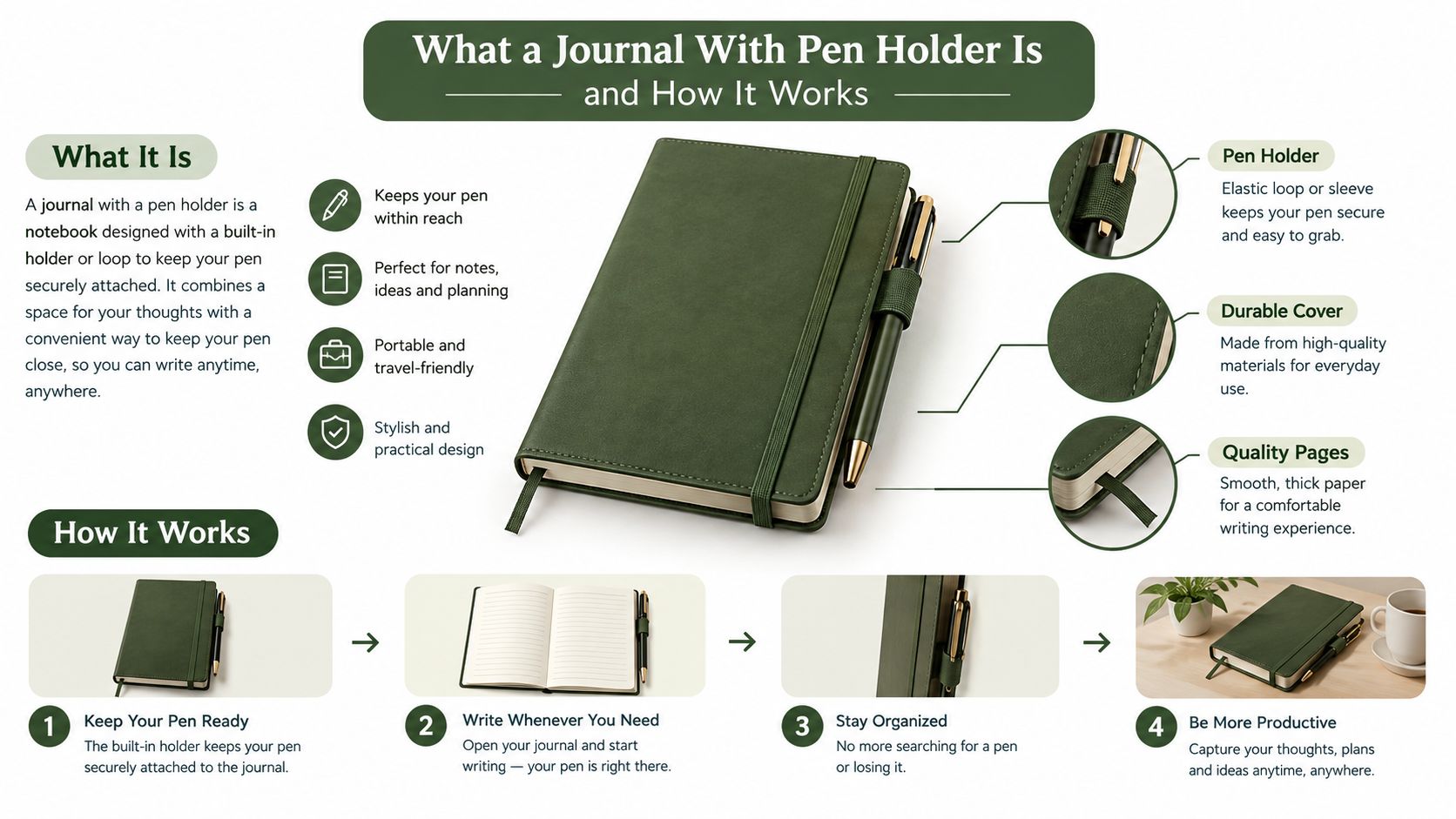
A journal with pen holder combines a notebook or refillable cover with a dedicated retention point for a pen. The holder may be an elastic loop, a stitched leather sleeve, an adhesive tab, a clip-on piece, or a magnetic accessory. Each format performs the same basic job, but the way it grips and attaches determines whether it feels secure in daily use.
Think of a holder as a small holster rather than a pocket. A pocket leaves space around the object, while a holster is shaped to hold a particular size. If the opening is too wide, the pen can slide out when the journal is carried vertically. If it's too narrow, insertion becomes awkward and the barrel may rub against the material.
The location matters too. A holder on the outside edge gives fast access, but it can catch on other objects in a crowded bag. A holder positioned along the cover may protect the pen more effectively, though it can add pressure to the journal's spine or make the cover feel less flat. Integrated stitching generally creates a more permanent arrangement, while adhesive or magnetic systems can offer more flexibility.
The category has grown beyond novelty stationery. The modern notebook pen-loop segment was valued at $642 million in 2024 and is projected to reach $1.12 billion by 2033, implying a 6.4% compound annual growth rate over that forecast period. North America held about 32% of global market share in 2024, according to the notebook pen-loop market report. Those figures suggest that integrated pen storage belongs to a wider convenience and premium stationery market, not just a decorative niche.
A useful distinction is whether the holder belongs to the journal or travels independently. A built-in loop stays paired with one cover. A modular holder can move between notebooks, which is valuable if you change sizes, use separate work and personal journals, or prefer to keep one familiar pen with several writing systems. For background on how cover construction affects the overall notebook experience, see this guide to a journal notebook cover.
Pen Holder Formats Compared and When Each Makes Sense
Choose the holder around your daily movement, pen, and notebook habits. A slim elastic loop suits one lightweight ballpoint. A magnetic or removable format works better if you change journals often. A wraparound case keeps several pens contained, though it occupies more space in a bag.
Start with the pen barrel. One leather notebook pen holder specification lists compatibility with pens up to 12 mm in diameter, which provides a practical reference for standard ballpoints and many slim pens. Measure the widest point of your pen, including the grip and the transition near the cap. Tip size alone does not show whether the holder will fit.
| Holder Format | Retention Strength | Repositionable | Best For |
|---|---|---|---|
| Elastic loop | Moderate, depending on stretch and fit | Usually no | Minimalist carry with one slim pen |
| Stitched leather loop | Moderate to strong when correctly sized | No | A permanent, coordinated journal setup |
| Adhesive loop | Variable, dependent on surface and bonding | Limited | Adding storage to an existing cover |
| Wraparound case | Strong, with broader protection | Sometimes | Travel, multiple pens, and bag carry |
| Magnetic holder | Moderate to strong, dependent on alignment and cover thickness | Yes | Users who switch notebooks or want modular storage |
Elastic loops are easy to use and tolerate small differences in barrel width. Repeated pulling can make the elastic loosen, twist, or lose its neat shape. They perform best with one everyday pen and a light load.
Stitched leather loops provide a more substantial feel and sit neatly against leather covers. Their fixed position makes sizing more important. A tight loop slows removal, while a loose loop allows movement and can let a clip or barrel rub against the journal.
Adhesive holders retrofit a notebook you already enjoy using. They make sense when the paper and cover work well, but pen storage is missing. Bonding depends on a clean, compatible surface and the amount of flexing the cover receives. An attached holder is not automatically a permanent one.
A separate case can protect an individual writing instrument without forcing it into a narrow journal loop. Compare options such as single pen cases when the pen is valuable, delicate, or wider than the journal holder allows.
Magnetic holders are suited to a modular carry system. One design uses two strong magnets to sandwich the front cover, allowing the accessory to move between notebooks without stitching or adhesive, as shown in this magnetic journal holder design. Alignment affects retention. A thicker cover or magnets that sit slightly off position can reduce holding force while the notebook is moving. Check that the holder stays flat and that the pen remains secure before relying on it for a daily commute.
Paper Types Leather Choices and Build Quality That Lasts
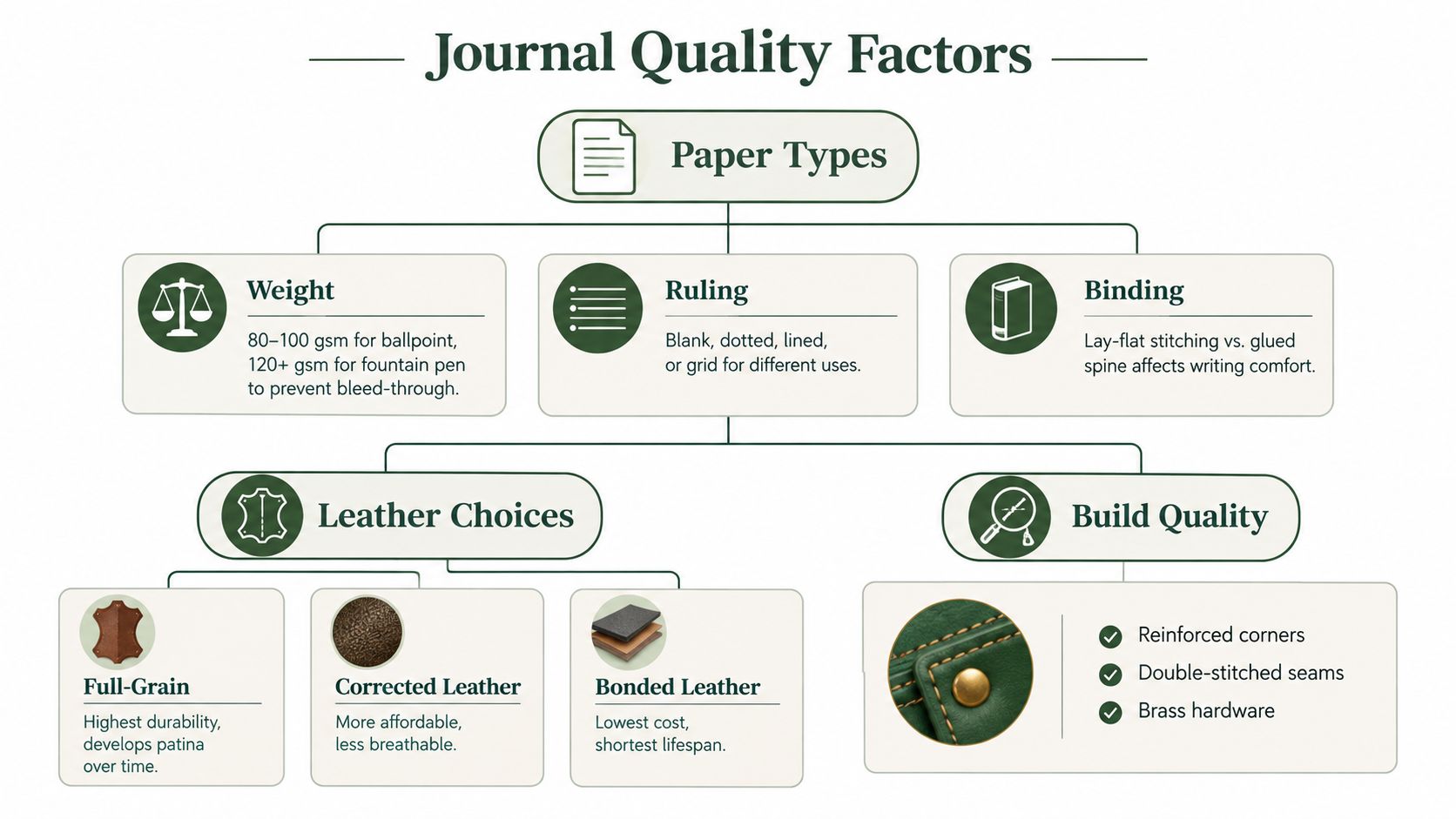
A pen holder can keep your tools together, but the journal still has to support the way you write. Paper affects ink flow, show-through and the sense of control under the pen. Lined pages suit meeting notes and lists, dotted pages support flexible layouts, grids help with diagrams, and blank paper works well for sketches or unstructured writing.
Paper weight should match the instrument. Ballpoints and many gel pens generally need less resistance than wet fountain pens or brush pens. If you use a fountain pen, look for paper described as fountain-pen friendly and test for feathering and bleed-through rather than trusting the cover alone. Binding matters just as much. A stitched notebook that opens flat is easier to write in near the spine, while a tightly glued binding can make the inner margins less comfortable.
Reading the leather surface
Full-grain leather keeps the hide's natural surface. It can show variation, marks and grain changes, but those details are part of how it develops character. Corrected leather has a more uniform surface created through additional treatment, while bonded leather is made from leather fibers and composite material. These options can look consistent at first, but they don't offer the same aging behavior.
For a daily carry journal, leather thickness and flexibility need balance. A very soft cover feels pleasant in hand but may crease under bag pressure. A rigid cover protects pages but can make the journal harder to open quickly. You can learn more about how leather categories differ in this guide to leather grades.
Inspecting construction
Look closely at the points that receive stress:
- Stitching: Even, tight stitches matter around loops, corners and spine areas.
- Edges: Burnished or sealed edges resist roughening and reduce the chance of catching on fabric.
- Lining: A smooth lining protects pages and reduces friction against the pen.
- Hardware: Snaps, rings and closures should move cleanly without sharp edges.
- Corners: Reinforced corners help when the journal slides into a packed bag.
Price can make this inspection harder. Sales-intelligence data places about 90% of listed pen-loop-holder assortment in the $0 to $10 band, while leading listings reach around 1,000 monthly U.S. sales, according to the pen loop holder category analysis. That concentration indicates crowded competition, so a low price alone doesn't tell you whether the material or attachment will survive repeated opening and closing.
If you're making a notebook from scratch, a practical resource on how to print a custom journal can help you think through page format, binding and cover specifications before adding a holder.
Closure Styles Personalization and Everyday Practicality
A closure determines how reliably the journal stays together after writing. On a desk, an open cover may feel convenient. In a bag, loose pages can fan out, the pen can catch on nearby items, and pressure can shift the cover. Choose the closure for your carrying routine, not only for its appearance.
Elastic bands open quickly and add little bulk. They suit regular desk-to-bag movement, though the elastic may stretch with use. If the pen holder sits along the same edge, the band can also press against the barrel. Snap closures hold a leather cover firmly and give a more deliberate feel. They need accurate alignment, and a full journal may require both hands to close.
Zip closures contain the journal around its perimeter, which helps with loose inserts and small accessories during travel. The trade-offs are added weight, zipper noise and another point that can catch on fabric. Wrap ties adjust well as the journal changes thickness and give the cover a softer traditional look. They take longer to open, and the tie can loosen when the wrapping method varies.
The closure and pen holder should work as one carry system. A secure closure keeps the notebook shut, while a correctly sized holder keeps the pen from escaping or shifting into the closure path. Test both with the journal filled, because extra inserts change the pressure and available space.
Making personalization useful
Personalization should support ownership and regular use. A monogram can identify a journal in a shared office or make a practical gift feel considered. A restrained stamp or matching hardware finish usually remains easier to use daily than decoration that competes with the journal's function.
Ask three questions before adding custom details:
- Will the mark remain readable? Place it on a stable cover panel, away from folds and closure hardware.
- Does it suit the setting? A subtle monogram works across professional carry, gifting and travel.
- Will the journal change contents? A refillable cover may hold several notebooks, so the design should suit future inserts as well.
A magnetic holder supports this adaptable format by avoiding permanent attachment to the cover. The Itoya journal Sidekick uses two magnets to sandwich the front cover, allowing the accessory to move between notebooks. Its grip still depends on the notebook's thickness and the magnets' alignment, so check retention before placing the setup in a crowded bag.
For more on refillable formats and the connection between personalization and long-term use, see this guide to a personalized refillable notebook. In practice, choose quick access for frequent writing, stronger containment for travel, and a movable holder when your notebook system changes.
How to Choose the Right Journal With Pen Holder for Your Routine
Your daily routine should determine the journal, not the other way around. Start with the pen you already use. Measure its widest barrel point, check the clip shape and cap length, and decide whether it must stay capped while stored. A holder is like a belt loop: it works only when its opening matches what it carries.
The commuting professional
You move the journal between a desk, briefcase and meetings. A stitched leather loop or fitted elastic holder keeps the setup slim and gives quick one-handed access. Choose a snap or elastic closure when the journal shares space with a laptop, charger and documents. The closure should keep the cover from opening without making a short writing session feel difficult.
The frequent traveler
Travel adds movement, compression and contact with other items. Select a holder that resists accidental release, then pair it with a cover that closes fully. A wraparound case or magnetic format can suit a notebook system that changes over time, but test the complete setup inside a bag. A holder that feels secure on a table may shift when packed between clothing, cables or books.
The fountain pen user
A fountain pen can be wider, heavier and more vulnerable to pressure than a slim ballpoint. Look for generous clearance and a position that protects the pen from being crushed against the cover. If the pen is valuable, a separate sleeve can reduce contact with the journal and keep its clip from pressing into the leather.
The gift buyer
You may not know the recipient's preferred pen, paper or carrying habits. A refillable cover with a moderate-size holder leaves more room for future choices than a highly specialized loop. Use this guide to notebook sizes to compare formats against the recipient's bag and writing style. Size affects comfort in the hand as well as how easily the journal fits into daily carry.
Before ordering, run through this check:
- Measure the pen: Compare the widest barrel point with the holder's stated capacity.
- Check the attachment: Choose between permanent stitching, adhesive, a clip or a repositionable magnet.
- Assess movement: Consider whether the journal lies flat in a bag, stands upright or travels loose among other items.
- Count the pens: A single loop will not replace a case if you carry several writing instruments.
- Test the closure: Check it around the actual journal thickness, including inserts and notes.
- Inspect access: Remove and replace the pen several times. Awkward movement now will become a daily annoyance later.
The idea of retaining a writing instrument is longstanding. The 1831 oblique pen and holder patent falls within the broader 1820 to 1860 period, when steel pens were commonly fixed into holders, as noted by Leuchtturm1917. Modern leather, elastic and magnetic fittings differ, but the buying test remains simple: the pen should stay aligned, accessible and secure without slowing your writing.
Final Thoughts on Building a Carry Ready Writing System
The best journal with pen holder isn't necessarily the most elaborate one. It's the setup that keeps your preferred pen paired with usable paper, closes securely in transit, and feels natural when you reach for it. A decorative loop that doesn't fit your pen creates more friction than a plain holder that works every time.
Judge the system in this order:
- Fit the holder to the pen. Diameter and retention come before color or finish.
- Match the closure to movement. Desk use, commuting and travel place different demands on a cover.
- Choose materials for wear. Leather, stitching, edges and hardware should tolerate repeated handling.
- Keep flexibility in mind. A removable holder or refillable cover can serve you through changing notebooks and routines.
- Reduce decisions. Your journal should tell you where the pen is, not give you another item to organize.
Audit your current carry today. Notice whether you lose time searching for a pen, whether your journal opens in your bag, and whether the paper suits the ink you use. Then choose the smallest change that solves the problem, whether that's an integrated leather loop, a modular holder, or a separate pen case.
Grainmark Leather offers full-grain leather journals, travel journals, and writing-instrument storage options that support an organized daily carry setup. Visit Grainmark Leather to compare journal and pen-storage formats for your work, travel, or gifting routine.