Does Leather Block RFID: What You Need to Know
No — leather alone does not block RFID signals. Natural leather is non-conductive, which means radio waves pass through it without measurable attenuation. Effective protection requires a conductive internal layer, typically aluminum, copper, or a metallic fabric, stitched between the outer leather and the lining. The Identity Theft Resource Center and major banks note that modern contactless payment cards use encryption and one-time transaction codes, making real-world skimming largely theoretical. Still, if you want physical shielding, the material inside the wallet is what counts, not the leather itself.
Table of Contents
- How do RFID and contactless cards actually communicate?
- Does leather actually block RFID signals?
- Which materials actually block RFID signals?
- How leather wallets actually provide RFID protection
- How effective is RFID blocking, and how real is the skimming risk?
- How to test whether your wallet actually blocks RFID
- What to look for when buying a leather RFID wallet
- Does RFID protection degrade, and how do you care for the wallet?
- What experts and current guidance say about leather and RFID
- Key Takeaways
- A practical view on RFID wallets
- Grainmarkleather’s RFID leather wallets and key fobs
- Useful sources
How do RFID and contactless cards actually communicate?
RFID cards transmit data using radio waves. Most contactless payment cards and passports operate at high frequency (HF), specifically 13.56 MHz. When you tap a card at a reader, the reader emits an electromagnetic field that powers the card’s chip and antenna, and the chip sends back a short encrypted data packet.
Three elements must align for a read to succeed:
- Proximity: The card must be within the reader’s field range, typically a few centimeters for payment cards.
- Clear signal path: No conductive barrier between card and reader.
- Frequency match: The reader and card must share the same operating frequency.
Visualize it simply: card on one side, reader on the other, and whatever sits between them either passes the signal or blocks it. Leather, as a material, passes it.
Does leather actually block RFID signals?
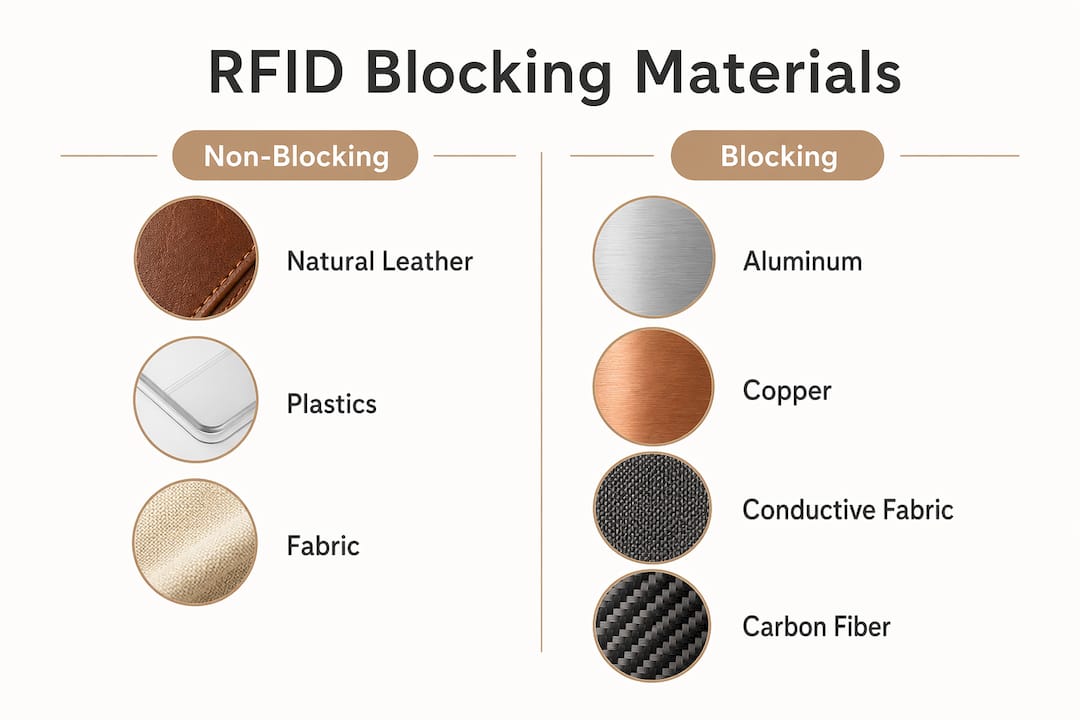
Natural leather is not conductive and does not reliably block RFID signals at any thickness. The electromagnetic field at 13.56 MHz passes through organic, non-metallic materials with minimal loss.
A few common misconceptions:
- “Thick leather blocks signals.” Thickness has no meaningful effect. Signal attenuation depends on conductivity, not density of an organic material.
- “Full-grain leather offers more protection.” Full-grain leather is the most durable grade, but its grain structure has no bearing on electromagnetic shielding.
- “Folding the wallet doubles the protection.” Multiple leather layers still provide near-zero attenuation.
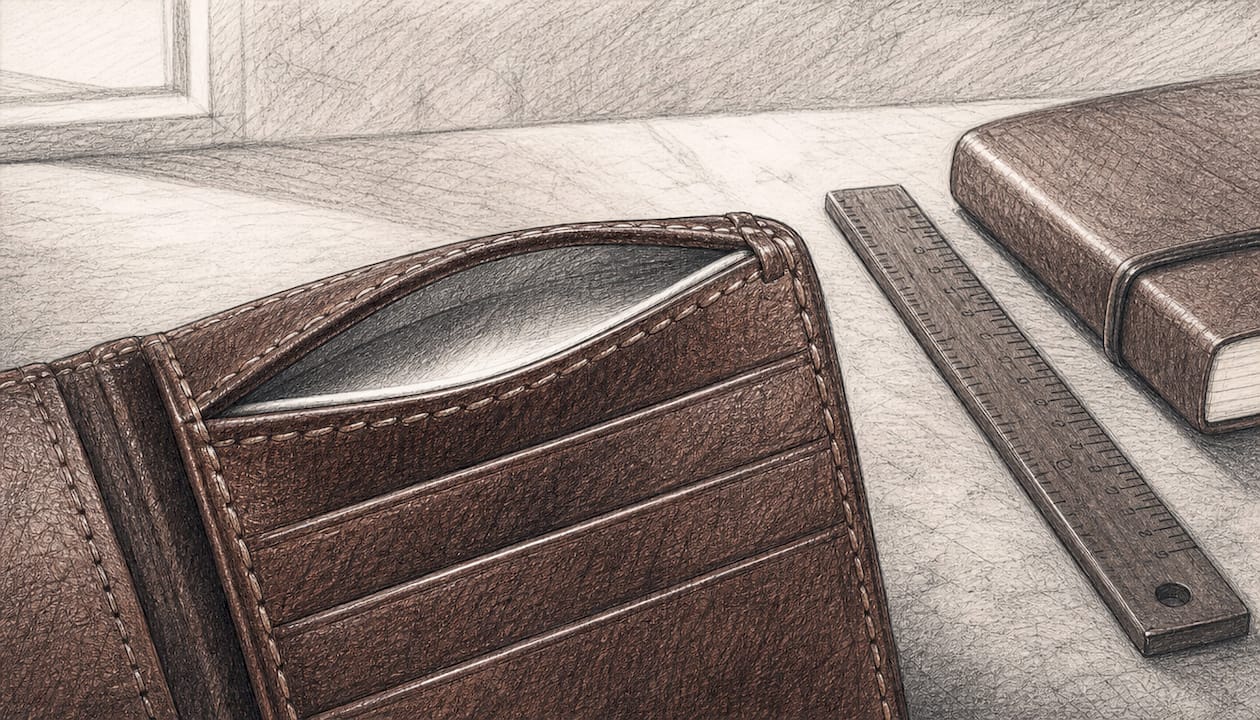
Wallets that genuinely block RFID work because of what is hidden inside them, a conductive layer, not because of the leather exterior. The leather provides structure, durability, and aesthetics, such as in the Fame Leather Accent Suede Crescent Shoulder Bag – Wildflower Wardrobe. The shield is a separate component entirely.
Which materials actually block RFID signals?
Aluminum, copper, conductive fabrics, and carbon fiber all provide measurable RFID signal attenuation. Conductive fabrics are the most common choice in leather wallets because they stay thin and flexible while still delivering meaningful HF blocking.
| Material | Primary frequency blocked | Flexibility | Bulk added |
|---|---|---|---|
| Aluminum foil/sheet | HF (13.56 MHz) | Low | Minimal to moderate |
| Copper sheet/mesh | HF (13.56 MHz) | Low to moderate | Moderate |
| Conductive fabric | HF (13.56 MHz) | High | Minimal |
| Carbon fiber | Broadband | Moderate | Moderate |
Pros and cons at a glance:
- Conductive fabric: Slim, flexible, integrates cleanly into leather linings. Slightly higher cost than foil.
- Aluminum foil: Inexpensive and effective, but adds rigidity and can crack with repeated bending.
- Copper mesh: Strong attenuation, but heavier and less forgiving in slim designs.
- Carbon fiber: Broadband blocking, but expensive and rarely used in consumer wallets.
One practical boundary: most consumer wallets focus on HF (13.56 MHz) and do not claim to block low-frequency building access badges or cellular signals. Know what you are buying protection for before you buy.
How leather wallets actually provide RFID protection
The shield sits between the outer leather and the inner lining. Conductive fabric linings are stitched directly into card pockets, covering the full surface area of each slot. Metal foil or mesh versions are laminated to a backing material before being sewn in. Either way, the conductive layer must cover the entire card face without gaps.
Common construction types:
- Full bifold lining: Conductive fabric covers the entire interior panel, protecting all card slots simultaneously.
- Per-pocket sleeves: Each card slot has its own shielding layer, which allows more precise coverage but requires careful stitching at every seam.
- Removable Faraday cards or sleeves: An insert placed in the wallet rather than sewn in. Effective when used consistently, but easy to misplace.
- Faraday key fobs: A small leather pouch with a full metallic lining that completely encloses a car key fob, blocking relay attack signals.
Pro Tip: Run your finger along the seams of a card slot. If the lining feels loose or the edge of a pocket has no stitching reinforcement, the shield may shift over time and leave a gap at the card’s edge where signals can still pass through.
How effective is RFID blocking, and how real is the skimming risk?
Shielding works when it is properly constructed and fully covers the card. The practical question is whether you need it.
“Authorities such as the Identity Theft Resource Center and major banks consider RFID skimming a largely theoretical threat because modern contactless payments use encryption and one-time transaction codes.” — AARP
Security professionals point out that careless physical handling of cards, leaving them on a counter, losing a wallet, or sharing card numbers, is a more immediate threat than RFID skimming. An RFID-blocking wallet addresses one narrow attack vector, not the full range of card fraud risks.
Shielding also has physical limits. Edge leakage can occur if a card protrudes slightly from a pocket. Angle and distance matter: a reader held at an oblique angle may still pick up a partial signal if the shield does not wrap around the card’s edges. These are edge cases, but they are worth knowing.
How to test whether your wallet actually blocks RFID
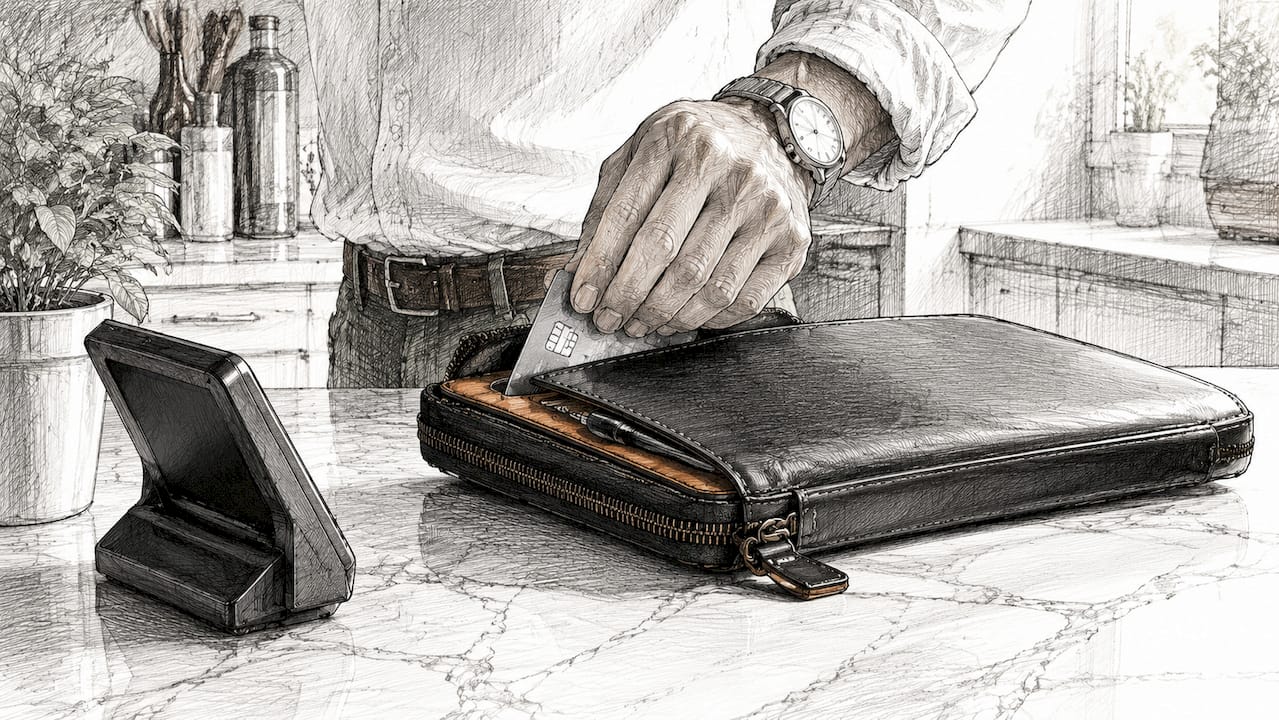
The most direct test: try scanning a card inside the wallet using a known working contactless reader or an NFC-enabled smartphone app.
- Select a card that you know reads reliably on a contactless terminal or phone.
- Download an NFC reader app on an Android phone (iPhone NFC is more restricted but some apps work for basic reads).
- Scan the card outside the wallet to confirm the app reads it.
- Place the card in the wallet and attempt the same scan through the closed wallet.
- Interpret the result: A failed read indicates the shielding is working. A successful read means the wallet is not blocking signals at that position.
- Test every card slot separately, not just the most accessible one.
Pro Tip: Repeat the test after six months of regular use. Conductive linings can delaminate or shift with repeated bending, and a wallet that passed the test when new may develop gaps over time.
A safety note: use only your own card and your own device. Never share card numbers or test with a stranger’s reader.
What to look for when buying a leather RFID wallet
Many RFID accessories are sold without independent testing; the marketing claim alone is not sufficient. Look for concrete signals:
- Named shielding material: The product description should state aluminum, copper, or conductive fabric, not just “RFID blocking technology.”
- Full slot coverage: Shielding must cover every card pocket, not just one or two slots.
- Reinforced seams: Stitching at the edges of card pockets keeps the lining in place.
- Attenuation data or lab testing: A seller who provides dB figures for 13.56 MHz is offering verifiable evidence. Most do not, which is a gap worth noting.
- One-year warranty: Covers manufacturing defects including lining failure.
- Clear return policy: Lets you verify with the home test and return if shielding is absent.
Higher price does not guarantee tested shielding. A $200 wallet with vague specs offers less assurance than a $60 wallet with a named conductive material and a stated warranty. Ask the seller directly: what is the shielding material, and does it cover all card slots?
For a broader look at full-grain leather options that include RFID protection, the small leather goods collection at Grainmarkleather lists current wallet and accessory options.
Does RFID protection degrade, and how do you care for the wallet?
RFID layers can shift, crack, or delaminate with regular use, particularly in wallets that use foil rather than woven conductive fabric. Care preserves both the leather and the shield.
Leather care:
- Keep the wallet dry; prolonged moisture softens the leather and can loosen adhesive layers holding the shield.
- Avoid solvents, alcohol-based cleaners, and harsh conditioners that may degrade the lining adhesive.
- Apply a leather conditioner appropriate for full-grain leather, per the product label, to maintain suppleness without saturating the material.
Shield care:
- Avoid folding the wallet sharply or overstuffing it; repeated stress at the fold line is the most common cause of foil cracking.
- Check seams every few months for loosening or puckering, which signals the lining is shifting.
Inspection checklist:
- Run a finger inside each card slot; a sagging or wrinkled lining suggests the shield has moved.
- Perform the NFC scan test described above if you notice any change in how cards sit in the wallet.
- If the lining has failed, contact the manufacturer about repair or lining replacement under warranty.
What experts and current guidance say about leather and RFID
The consensus across security authorities and consumer guidance is consistent: leather alone provides no RFID protection, conductive layers do, and the real-world skimming risk for encrypted contactless cards is low.
Key source positions:
- The FTC’s RFID workshop report examined RFID applications and consumer implications, establishing the foundational regulatory framing.
- The FTC’s identity theft guidance covers card fraud broadly and notes that encryption is the primary defense for modern contactless payments.
- AARP’s consumer guidance cites the Identity Theft Resource Center and major banks in characterizing RFID skimming as a largely theoretical threat for encrypted cards.
- Norton’s privacy blog describes conductive fabrics offering approximately 30 dB attenuation as the practical standard for HF blocking in consumer wallets.
- The IRDA’s RFID blocking materials page outlines the material categories used in commercial shielding products.
- The DHS DPIAC recommendations paper addressed RFID privacy concerns in government-issued documents, providing early policy context for consumer shielding products.
The practical takeaway from this body of guidance: buy a wallet with a named conductive lining if peace of mind matters to you, verify it with the home test, and do not rely on leather thickness or brand claims alone.
Key Takeaways
Leather alone does not block RFID signals; only a conductive internal lining, aluminum, copper, or metallic fabric, provides genuine protection for your cards.
| Point | Details |
|---|---|
| Leather provides no shielding | Natural leather is non-conductive; radio waves at 13.56 MHz pass through it regardless of thickness or grade. |
| Conductive lining is the shield | Effective wallets use aluminum, copper, or conductive fabric stitched inside card pockets to attenuate HF signals. |
| Skimming risk is low | The Identity Theft Resource Center and major banks describe RFID skimming as largely theoretical for encrypted contactless cards. |
| Test your wallet at home | Scan a card through the closed wallet with an NFC app; a failed read confirms the shielding is working. |
| Grainmarkleather options available | Selected Grainmarkleather wallets and key fobs include internal conductive linings, backed by a one-year warranty. |
A practical view on RFID wallets
The conversation around RFID wallets tends to split into two camps: people who dismiss the whole category as a marketing gimmick, and people who treat it as essential security gear. Neither position is quite right.
The dismissal camp has a point about risk. Encrypted contactless payments are genuinely difficult to skim in a useful way. A thief who captures a transaction code from your card in a crowd gets a one-time token that cannot be replayed. The threat model for most people in the United States is not a sophisticated RF attacker; it is a lost wallet, a phishing email, or a data breach at a retailer.
But the “it’s all marketing” argument goes too far when it implies the shielding itself is fake. Conductive fabric at 30 dB attenuation does block HF signals. The product works. The question is whether the specific threat it addresses is the one you face.
Where I land: a well-made RFID wallet is worth buying if you travel internationally, carry a passport, or simply prefer not to think about it. The condition is that the wallet must have a named conductive material, full slot coverage, and reinforced seams. A vague “RFID protected” stamp on a wallet with no material specs is not worth a premium. Verify with the home test, check the seams after six months, and treat the shielding as one layer of a broader approach to card security, not a complete solution.
Grainmarkleather’s RFID leather wallets and key fobs
Grainmarkleather builds selected wallets and accessories with internal conductive linings, not as a marketing addition but as a functional layer integrated into the construction. Three specific options address the most common needs.
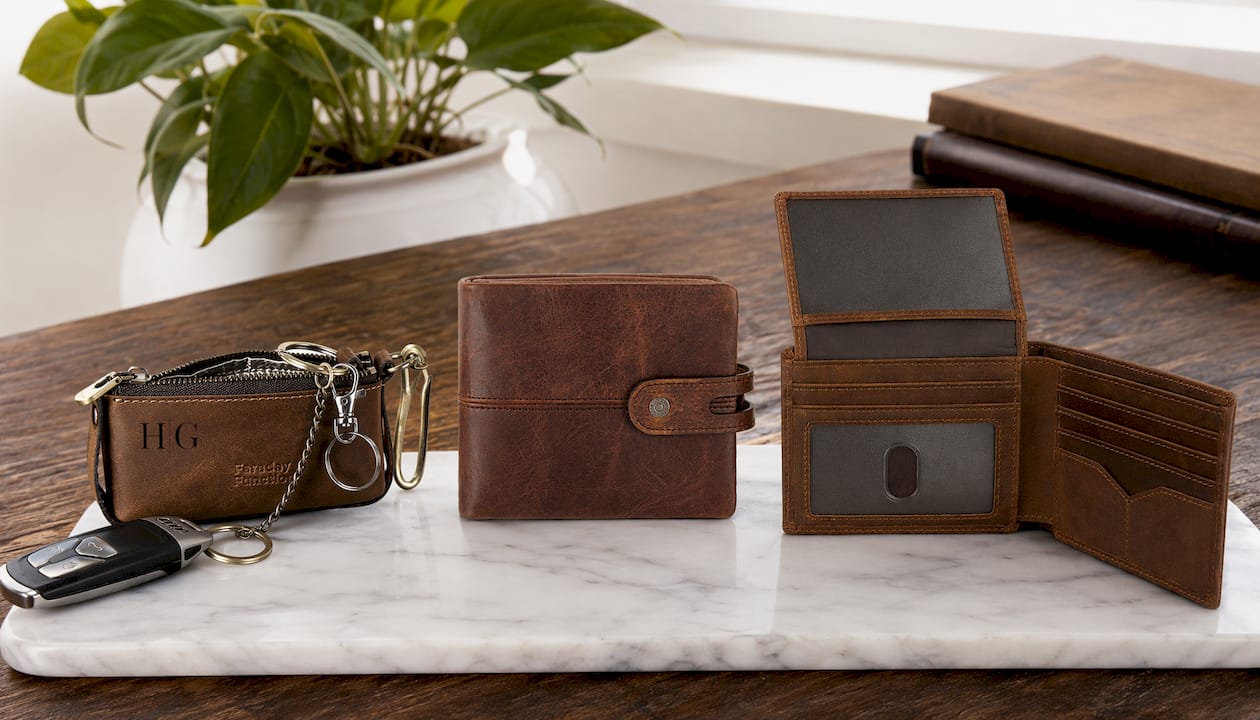
The Personalized Leather Faraday Key Fob uses a full metallic lining to enclose a car key fob and block relay attack signals, a specific and practical use case for anyone with a keyless entry vehicle. The Vintage Leather Bifold Wallet with RFID and Coin Pocket combines full-grain leather construction with an integrated RFID lining and a coin pocket, covering everyday carry needs. For a slimmer profile, the Slim Leather Bifold with ID Windows includes RFID protection alongside clear ID slots. All three carry a one-year warranty. Use the home NFC test after purchase to confirm the shielding covers your specific cards.
Useful sources
- FTC RFID Workshop Report — FTC staff report on RFID applications and consumer implications.
- FTC Identity Theft Guidance — FTC consumer resource on card fraud and identity theft.
- DHS DPIAC Recommendations on RFID Privacy — DHS policy paper on RFID privacy in government-issued documents.
- AARP: Do RFID-Blocking Wallets Work? — Consumer guidance citing the Identity Theft Resource Center on skimming risk.
- Norton: RFID Blocking Explained — Overview of shielding materials and attenuation standards.
- IRDA: What Are RFID Blocking Materials Made Of? — Industry resource on conductive materials used in shielding products.
- RFID4U: Shielding and Blocking Materials — Technical overview of aluminum, copper, and fabric shielding options.