Slim Card and Cash Holder: Front-Pocket Carry Guide
A slim full-grain leather card and cash holder with an RFID liner is the most practical front-pocket carry for daily use. It balances card capacity, bill storage, and low bulk without the thickness of a traditional bifold.
The recommended pick: A full-grain leather holder with a passive RFID foil liner, room for several cards, and a folded-bill slot. Grainmarkleather’s slim cardholder meets all three criteria and backs each piece with heavy-duty stitching and a one-year warranty.
Table of Contents
- What is a card and cash holder, and who needs one?
- Key features to check before you buy
- How do materials and RFID liners affect build quality?
- How many cards and bills can you actually carry?
- How to care for a leather card and cash holder
- Grainmarkleather slim cardholder: specs and fit
- What if a card-and-cash holder isn’t the right fit?
- Which option is right for you?
- What does RFID protection actually do?
- Why slim front-pocket fit matters
- How many cards does a typical holder fit?
- How is cash carried in a card holder?
- What materials and construction details should you look for?
- What warranty and reviews tell you about a holder
- What price range should you expect?
- How do buyers choose the right holder?
- Leather care: what to do and what to avoid
- Security features beyond RFID blocking
- How do different holder types compare?
- What convenience features make daily use easier?
- Key Takeaways
- Why the cheapest holder usually costs more over time
- Grainmarkleather: where to find the right holder for you
- Sources and further reading
What is a card and cash holder, and who needs one?
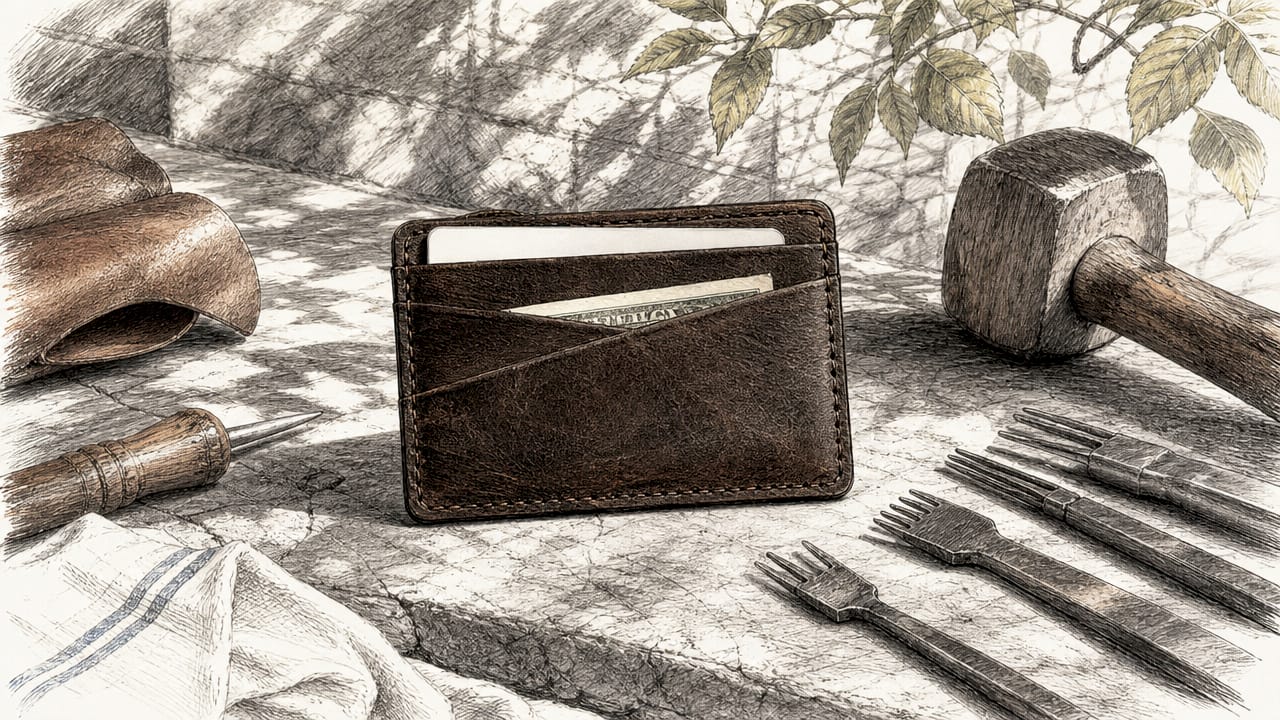
A card and cash holder is a slim wallet designed to carry your primary cards and folded bills in a single, front-pocket-friendly profile. It sits between a bare card sleeve and a full bifold: more organized than a sleeve, thinner than a bifold.
Who it fits:
- Commuters who want one pocket for transit cards, a debit card, and a few bills
- Travelers using a travel cash organizer to separate daily spend from passport documents
- Minimalists replacing a bulky bifold with something that holds only active cards
- Anyone who wants RFID protection without carrying a separate sleeve
- Planner users: some holders fit Grand Voyageur A5/XL inserts as a built-in card pocket
Key features to check before you buy
The right wallet for cards and cash depends on a short list of measurable specs. Check each before purchasing.
Capacity and dimensions:
- Card slots: a moderate number is practical for daily carry; many slots usually means a thicker profile
- Cash slot: confirm it fits folded US bills (a single fold produces roughly 3.5" x 3")
- Dimensions: front-pocket fit typically means under 4.5" wide and under 3.5" tall when closed
Protection and materials:
- RFID liner type: passive foil liner (blocks all cards inside) vs. individual RFID sleeves (blocks only sleeved cards)
- Material: full-grain leather, top-grain, elastic, carbon fiber, or metal each carry different thickness and durability trade-offs
- Stitching and edge finish: look for saddle-stitched or lock-stitched seams, not glued edges
Access and closure:
- Quick-access exterior slot for the card you reach for most
- Closure type: open-top, snap, or money clip
- Weight: under 2 oz. is achievable in leather; metal holders run heavier
Pro Tip: Count only the cards you use in a given week. Most people carry 2–3 active cards daily. Buying a 10-slot holder for 3 cards stretches the leather unnecessarily and adds bulk you will not use.
Mini checklist for scanning product listings:
- Dimensions listed (width x height x depth when closed)
- Card count confirmed (not “up to” without a stated maximum)
- RFID liner type specified (foil vs. sleeve)
- Material grade stated (full-grain, top-grain, or unspecified)
- Warranty terms present
How do materials and RFID liners affect build quality?
Full-grain leather is the most durable option. It develops a patina over time, holds its shape, and typically runs a few millimeters thick per layer. Top-grain leather is sanded for a uniform finish but loses some of the fiber density that makes full-grain resilient. Elastic and fabric holders are the thinnest but stretch out with repeated use. Carbon-fiber and metal holders are rigid, scratch-resistant, and thin, though they offer no flex and can feel cold in hand.
| Material | Durability | Thickness | Patina | RFID liner compatible |
|---|---|---|---|---|
| Full-grain leather | High | Moderate | Yes | Yes |
| Top-grain leather | Moderate | Moderate | Minimal | Yes |
| Elastic / fabric | Low | Very thin | No | Sleeve only |
| Carbon fiber | High | Very thin | No | Yes |
| Metal (aluminum) | High | Thin | No | Inherent blocking |
RFID blocking works two ways: a passive foil liner sewn into the holder blocks every card inside simultaneously, while individual RFID sleeves block only the cards placed inside them. Foil liners add a small amount of thickness but require no extra steps. Sleeve-based protection keeps the holder thinner but demands that you remember to sleeve each card.
Construction detail to look for: Saddle stitching uses two needles and two threads passing through each hole from opposite sides. If one thread breaks, the seam holds. Glued or single-thread machine stitching does not offer the same redundancy. When reviewing product pages, look for “heavy-duty stitching” or “hand-stitched” as explicit claims, not just photos. Acne Studios, for example, documents LWG-certified tannery sourcing (Silver rating) on their product pages, showing how material provenance can be verified from a spec sheet.
How many cards and bills can you actually carry?
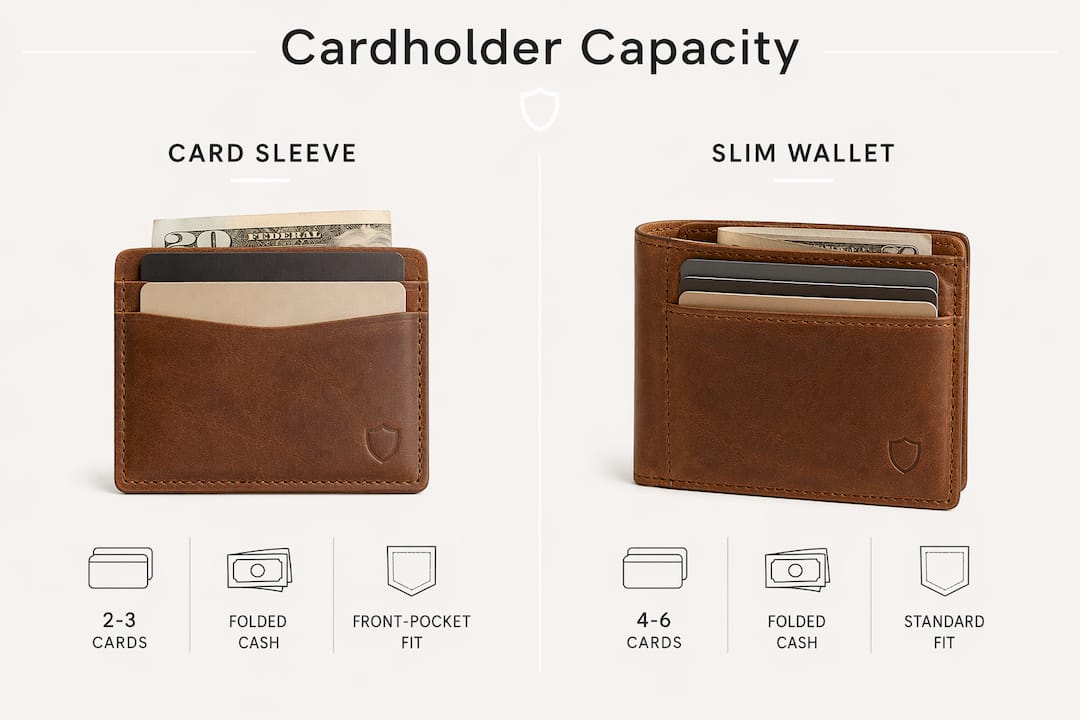
Advertised card counts often reflect maximum physical capacity, not comfortable daily capacity. A holder listed for 8 cards will typically feel tight at 6 and may stretch the leather at 8 if the cards are thick (chip-embedded cards run about 0.8 mm each).

| Holder type | Comfortable card count | Folded cash | Front-pocket fit |
|---|---|---|---|
| Card sleeve | 2–3 | No | Yes |
| Card and cash holder | 4–6 | Single or double fold | Yes |
| Slim bifold | 6–8 | Single fold | Yes (if under 10 mm thick) |
| Full bifold | 8 | Unfolded | Rear pocket only |
Some independent retailers list holders with 2 card slots and 2 larger pockets for cash or documents, sized to fit Grand Voyageur A5/XL planner inserts. The Topdrawer XL version lists dimensions of approximately 13.5 x 20 cm closed with two card slots and two cash pockets, which is closer to a planner insert than a front-pocket wallet.
Pro Tip: Fold bills in half once (single fold) for the slimmest profile. A double fold fits more bills but adds 3–4 mm of thickness. Tri-folding bills is unnecessary in any holder with a dedicated cash slot.
How to care for a leather card and cash holder
Leather holders last years with minimal maintenance. The steps below apply to full-grain and top-grain leather.
- Clean gently. Wipe the surface with a dry or slightly damp cloth. Avoid soaking the leather or using alcohol-based cleaners, which strip natural oils.
- Condition every 3–6 months. Apply a small amount of leather conditioner (beeswax-based or lanolin-based) with a soft cloth. Buff off the excess. This prevents cracking and keeps the leather supple.
- Dry away from heat. If the holder gets wet, let it air-dry at room temperature. Direct heat from a radiator or dryer causes the leather to stiffen and crack.
- Treat minor scuffs with conditioner first. Most surface scuffs on full-grain leather respond to a light conditioning pass. Do not sand or use shoe polish unless the product documentation explicitly permits it.
- Store flat when not in use. Avoid leaving the holder compressed under heavy objects, which can deform the card slots over time.
Warranty note: Grainmarkleather’s one-year warranty covers manufacturing defects in stitching and construction. It does not cover wear from overfilling, water damage from submersion, or damage from improper cleaning products. For warranty claims, contact Grainmarkleather directly through the website before attempting any repair.
When a seam separates at the stitching within the warranty period, contact the maker. DIY repairs using super glue or household adhesives can void the warranty and make professional repair harder.
Grainmarkleather slim cardholder: specs and fit
Grainmarkleather’s slim cardholder is built from full-grain leather with heavy-duty stitching and ships with a one-year warranty covering manufacturing defects.

| Spec | Detail |
|---|---|
| Material | Full-grain leather (crazy horse finish available) |
| Card capacity | several cards (comfortable daily carry) |
| Cash slot | Yes, folded bills |
| RFID protection | Yes, liner included |
| Stitching | Heavy-duty, saddle-style |
| Warranty | One year (manufacturing defects) |
| Customization | Available (engraving/personalization) |
The holder’s profile fits a standard front trouser pocket without creating a visible bulge. The crazy horse leather finish develops a natural patina with use, which is a characteristic of full-grain hides rather than a defect.
Pro Tip: Order the holder with personalization if it’s a gift. Grainmarkleather offers engraving, which adds no meaningful thickness and makes the piece identifiable if lost.
Grainmarkleather has accumulated over 358 five-star reviews across its wallets and cardholders collection, which reflects consistent quality across multiple product lines, not a single item.
What if a card-and-cash holder isn’t the right fit?
Not every carry situation calls for the same form factor. Here are the main alternatives and when each makes sense.
- Minimalist card sleeve: Holds 2–3 cards, no cash slot. Best for someone who pays digitally and carries one backup card. Very thin (under 5 mm), but no room for bills.
- Slim bifold wallet: Holds 6–8 cards and unfolded bills. The right choice when you regularly carry more than 6 cards or need to store receipts. Grainmarkleather’s slim bifold with RFID adds ID windows for license carry.
- Money clip: Holds 2–4 cards and a folded bill stack with a metal clip. Fastest access, lowest bulk, no RFID protection unless a liner is added. Works well for someone who pays cash frequently.
- Zipper pouch: Holds cards, coins, and loose items. Best for international travel where coin currency is common. Grainmarkleather’s leather travel pouches serve this use case.
- Vegan leather keychain holder: A compact option for a single card or transit pass, such as a keychain card holder in saffiano finish. Minimal capacity, but attaches to keys for hands-free carry.
Which option is right for you?
The Grainmarkleather slim cardholder is the practical choice for front-pocket daily carry with 4–6 cards and a few bills. Full-grain leather, RFID protection, heavy-duty stitching, and a one-year warranty make it a defensible pick at its price point.
- 4–6 cards, a few bills, front pocket: Grainmarkleather slim cardholder
- 6+ cards or unfolded bills: Slim bifold with RFID
- Coins or international travel: Leather zipper pouch
- Single card, digital-first: Card sleeve or keychain holder
The one-year warranty applies to manufacturing defects. Condition the leather every 3–6 months to keep the holder in shape beyond the warranty period.
What does RFID protection actually do?
RFID (Radio Frequency Identification) chips are embedded in most modern credit cards, debit cards, and transit passes. A contactless reader can query these chips from a short distance, which creates a theoretical risk of unauthorized scanning in crowded spaces. An RFID-blocking liner, typically a thin metallic foil, interrupts the radio frequency signal and prevents a reader from communicating with the chip. The protection is passive: no battery, no activation required.
The practical risk of RFID skimming in the United States is considered low by most security researchers, but the liner adds negligible weight and thickness, so including it is a reasonable default for any card holder.
Why slim front-pocket fit matters
A holder that sits in a front trouser pocket rather than a rear pocket reduces the risk of pickpocketing and eliminates the pressure on the spine that a thick rear-pocket wallet creates over time. Front-pocket fit generally means a closed profile under 4.5" wide, under 3.5" tall, and under 10 mm thick. Most slim card-and-cash holders meet these dimensions when not overfilled.
How many cards does a typical holder fit?
Most slim card and cash holders are designed for a moderate number of cards. The comfortable count is usually two fewer than the stated maximum, because chip-embedded cards are thicker than the plain PVC cards manufacturers use for capacity testing. Carrying only the cards you use in a given week, typically a few, keeps the holder slim and prevents the card slots from stretching.
How is cash carried in a card holder?
Cash fits in a dedicated slot or pocket, separate from the card compartments. US bills fold to dimensions suitable for most holders designed for front-pocket carry. A double fold (folding again to roughly 3.5" x 1.5") reduces bulk further but makes bills harder to retrieve quickly. Holders with a full-width cash pocket accommodate single-folded bills without forcing them into a card slot.
What materials and construction details should you look for?
Full-grain leather is regarded as a durable option for a card and cash holder. It holds its shape, develops a patina, and responds well to conditioning. Carbon-fiber holders are thin and scratch-resistant but rigid. Elastic holders tend to be thinner but may stretch out over time. For stitching, saddle stitching or lock stitching is more durable than glued seams. Edge finishing, whether burnished, painted, or folded, indicates the level of construction detail. A raw, unfinished edge on a leather holder is a sign of lower build quality.
What warranty and reviews tell you about a holder
A stated warranty signals the maker’s confidence in their construction. Grainmarkleather backs each piece with a warranty covering manufacturing defects, which is a verifiable claim on their product pages. Many positive reviews across the Grainmarkleather catalog reflect consistent production quality. When evaluating any holder, check whether the warranty terms are written out explicitly, not just implied by a return policy.
What price range should you expect?
Slim card and cash holders span a wide price range. Elastic or fabric holders are available at lower price points. Carbon-fiber and metal options are priced somewhat higher. Full-grain leather holders from independent makers generally command mid-range prices, depending on construction complexity and customization options. Mass-produced leather-look holders at the low end of that range often use bonded or split leather, not full-grain. The price difference between a bonded leather holder and a full-grain one is visible in the edge finish and stitching within the first few months of use.
How do buyers choose the right holder?
The criteria that matter most, in order: card capacity for your actual daily carry, dimensions for your pocket, RFID liner type, material grade, stitching quality, and warranty. Price is a factor, but a full-grain leather holder with a one-year warranty typically costs less per year of use than replacing a cheaper holder annually. Check that the product page lists dimensions explicitly, not just “slim” or “compact” without measurements.
Leather care: what to do and what to avoid
Condition full-grain leather every 3–6 months with a beeswax or lanolin conditioner. Wipe off surface dirt with a dry cloth before conditioning. Keep the holder away from prolonged sun exposure, which fades the leather and dries it out. Do not use saddle soap on finished leather unless the product documentation recommends it. Minor scuffs on crazy horse leather often disappear with a light rub from a fingertip, as the finish is designed to show and absorb contact marks as part of its character.
Security features beyond RFID blocking
RFID blocking addresses electronic skimming. Physical security features address theft and loss. Zippered compartments prevent cards from falling out in a bag or during transit. Snap closures keep the holder closed in a crowded environment. Some holders use a pull-tab mechanism that requires deliberate action to access cards, which slows unauthorized access. For travel, a holder that fits inside a front pocket or a zipped bag compartment is more secure than one clipped to a belt or carried in an open tote.
How do different holder types compare?
| Type | Cards | Cash | RFID option | Front-pocket fit | Best for |
|---|---|---|---|---|---|
| Card sleeve | 2–3 | No | Sleeve only | Yes | Digital-first carry |
| Card and cash holder | 4–6 | Folded | Liner or sleeve | Yes | Daily minimalist carry |
| Slim bifold | 6–8 | Single fold | Liner | Yes (if thin) | Moderate card count |
| Money clip | 2–4 | Folded stack | Add-on only | Yes | Fast cash access |
| Zipper pouch | 4–8 | Loose | Liner | Bag pocket | Travel, coins |
What convenience features make daily use easier?
A quick-access exterior card slot, positioned on the front face of the holder, lets you tap a transit card or show an ID without opening the holder. Pull-tab mechanisms inside card slots push cards up for easy retrieval without fingernail digging. A full-width cash slot with a clean opening edge makes bill retrieval faster than a narrow slit. Holders with a clear ID window add convenience for license display without removing the card. These features are worth checking in product photos and descriptions before purchasing.
Key Takeaways
A slim full-grain leather card and cash holder with an RFID foil liner and front-pocket dimensions is the most practical daily carry for 4–6 cards and folded bills.
| Point | Details |
|---|---|
| Capacity rule | Carry only active cards (typically a few); buy a holder rated for 4–6 to avoid overstretching. |
| RFID liner choice | A passive foil liner blocks all cards simultaneously; individual sleeves require you to sleeve each card separately. |
| Material grade | Full-grain leather holds shape and develops patina; bonded leather and elastic stretch out faster. |
| Dimension check | Front-pocket fit means under 4.5" wide, under 3.5" tall, and under 10 mm thick when closed. |
| Grainmarkleather option | The Grainmarkleather slim cardholder uses full-grain leather, heavy-duty stitching, RFID protection, and a one-year warranty. |
Why the cheapest holder usually costs more over time
The conventional wisdom on slim wallets is that any thin holder solves the bulk problem. It does not. A holder that stretches out after three months, loses its card slots’ tension, or has a seam separate at the glue line has to be replaced. Full-grain leather with saddle stitching holds its shape for years. The one-year warranty Grainmarkleather includes is a direct claim about construction confidence, not a marketing line. When a maker puts a written warranty on a $50–$80 leather piece, they are stating that the stitching and material will not fail within that period. That is a different proposition than a $15 elastic holder with no stated warranty.
The other thing buyers underestimate is the RFID liner placement. A liner sewn into the body of the holder blocks every card inside. A liner that is only in one card slot leaves the others exposed. Read the product description carefully: “RFID blocking” on the label does not always mean full-liner protection.
Grainmarkleather: where to find the right holder for you
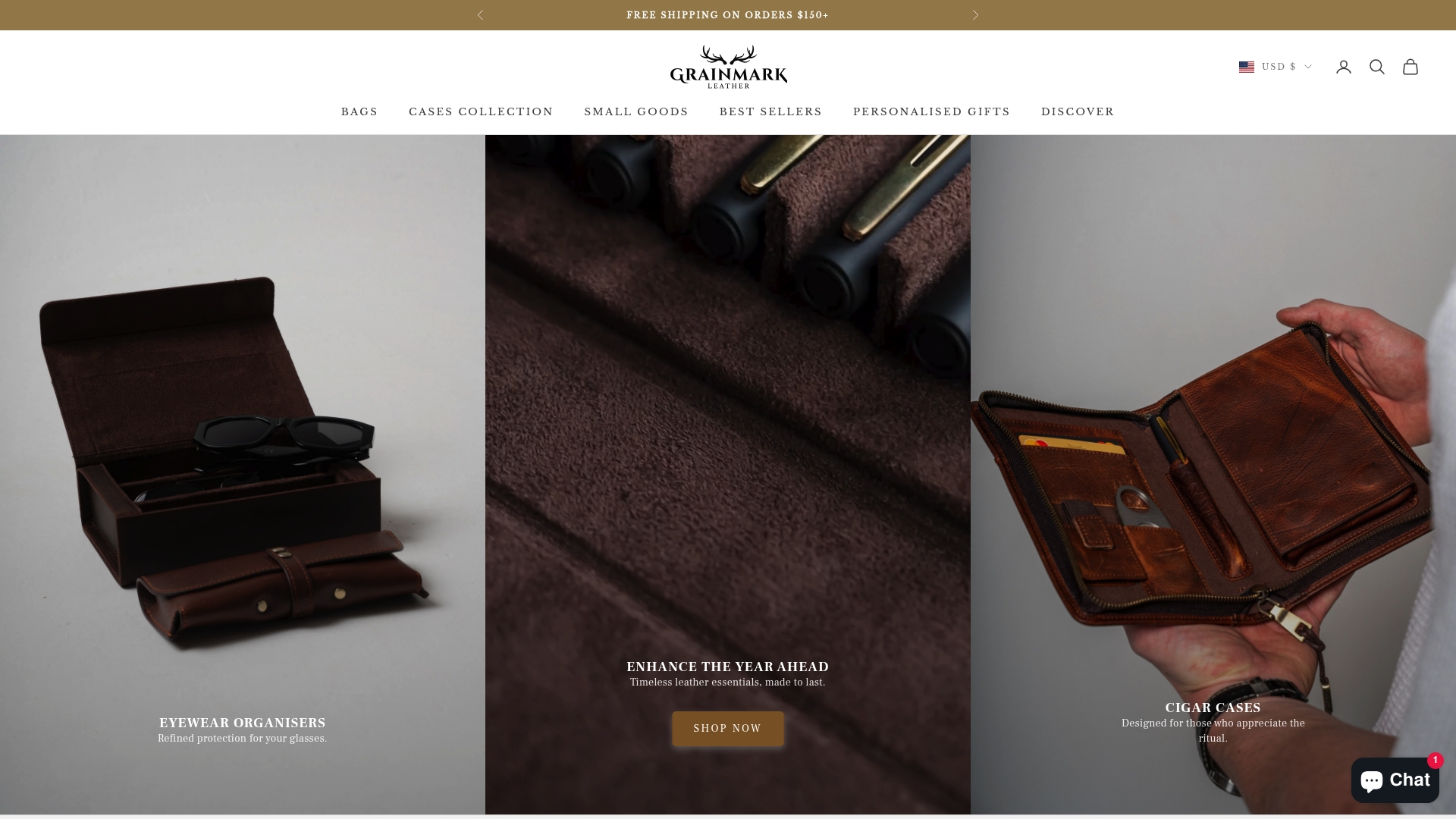
Grainmarkleather’s wallets and cardholders collection includes RFID-lined slim cardholders, bifold wallets with ID windows, and full-grain leather options across several finishes. Each piece ships with a one-year warranty and heavy-duty stitching as standard.
For travelers building a coordinated carry set, the small leather goods collection includes passport holders, travel organizers, and the Crazy Horse Leather Watch & Sunglasses Case as a matching travel organizer. Personalization (engraving) is available on most items.
Buying details:
- One-year warranty on manufacturing defects, stated on each product page
- International shipping available
- Personalization available at checkout on eligible items
Browse the full cardholder range or go directly to the slim cardholder product page to check current finishes and pricing.
Sources and further reading
The following sources were used to build this article or provide useful context for further research.
- Grainmarkleather Wallets & Cardholders Collection: Grainmarkleather’s full range of RFID-lined slim cardholders and bifold wallets, with product specs and warranty details.
- Grainmarkleather Slim Cardholder Product Page: Full specs, finish options, and warranty terms for the slim cardholder featured in this article.
- Grainmarkleather Small Leather Goods Collection: Related small leather goods including travel organizers and passport holders.
- Acne Studios Leather Card Holder (US): Industry example of a slim leather card holder with documented LWG-certified tannery sourcing (Silver rating) and explicit product measurements.
- 26market Card & Cash Holder: Independent retailer listing showing capacity specs (2 card slots, 2 cash pockets) and Grand Voyageur A5/XL planner compatibility.
- Topdrawer Card & Cash Holder XL: XL format listing with stated dimensions (13.5 x 20 cm closed) for readers comparing planner-insert sizing.
- Next Gen Cards: Why Card Organization Matters: Background on card organization principles and small-holder use cases.
A note on sourcing: Product dimensions and capacity figures in this article come from manufacturer and retailer product pages. Warranty terms are sourced directly from Grainmarkleather’s product listings. RFID blocking principles reflect standard industry descriptions of passive foil liner technology. This article is general buying guidance, not professional security or legal advice. Verify current product specs and warranty terms directly with the seller before purchasing.