
Mens Jewelry Box for Watches: A Real Buyer Guide
You've bought a watch you intend to keep for years, then placed it in a handsome box that lets the bracelet scrape the cushion, the crown press against the lid, and damp leather sit without airflow. The box looks expensive. The storage environment is poor.
That's the mistake I see most often with a mens jewelry box for watches. Buyers compare slot counts, leather color, and hardware finish, then discover later that the box doesn't fit their larger cases, protect their straps, or suit the way they rotate their watches. A watch box should be judged as a small protective environment, not as decorative furniture.
Table of Contents
- Why a Watch Box Is an Environment, Not Just Furniture
- What Protects a Watch Inside a Box
- Comparing Materials From Full-Grain Leather to Hard Alternatives
- Reading Slot Capacity Without Being Misled
- Matching Box Formats to Real Use Cases
- Why Most Multi-Watch Owners Need Two Boxes Instead of One
- Price Tiers and What Each One Actually Buys You
- Which Box to Buy for Your Situation
Why a Watch Box Is an Environment, Not Just Furniture
A customer will often walk into a leather workshop with the same request: “I need a six-watch box.” That sounds specific, but it tells me almost nothing. I need to know whether those watches have steel bracelets or leather straps, whether the box will stay on a bedroom shelf or travel in luggage, whether the collection contains mechanical pieces, and whether the largest case can sit without touching the lid.
A box with six narrow slots may be worse than a four-slot case with proper clearance. If the cushions force a bracelet into a sharp bend, or if adjacent watches touch whenever the box moves, the advertised capacity becomes a liability. The right question isn't how many watches fit on paper. It's what conditions the box creates for each watch.
The four conditions I check first are straightforward:
- Humidity and temperature: Longines recommends storing watches roughly between 10°C and 27°C, with humidity below 50%, to reduce condensation risk and help protect components and leather straps. Longines' watch-storage guidance provides a useful benchmark.
- Magnetism: Speakers, laptops, magnetic phone mounts, and some charging accessories can affect mechanical movements. A premium exterior doesn't compensate for a bad storage location or magnetic hardware.
- Physical clearance: Crowns, clasps, crystals, and case edges need room. A lid that presses down on the tallest watch is a design failure, not a snug fit.
- Air and inspection access: Damp straps should not be sealed into an unventilated cavity. Removable cushions make it easier to inspect leather, lining, and case backs before small problems become expensive repairs.
A display tray, such as the kind discussed in this guide to jewelry display trays, can work well for short-term access and presentation. It shouldn't automatically replace a protective watch case, especially if the watches are exposed to dust, sunlight, accidental knocks, or household moisture.
Workshop rule: Buy the box for the largest and most delicate watch in your rotation, not for the average watch you own.
What Protects a Watch Inside a Box
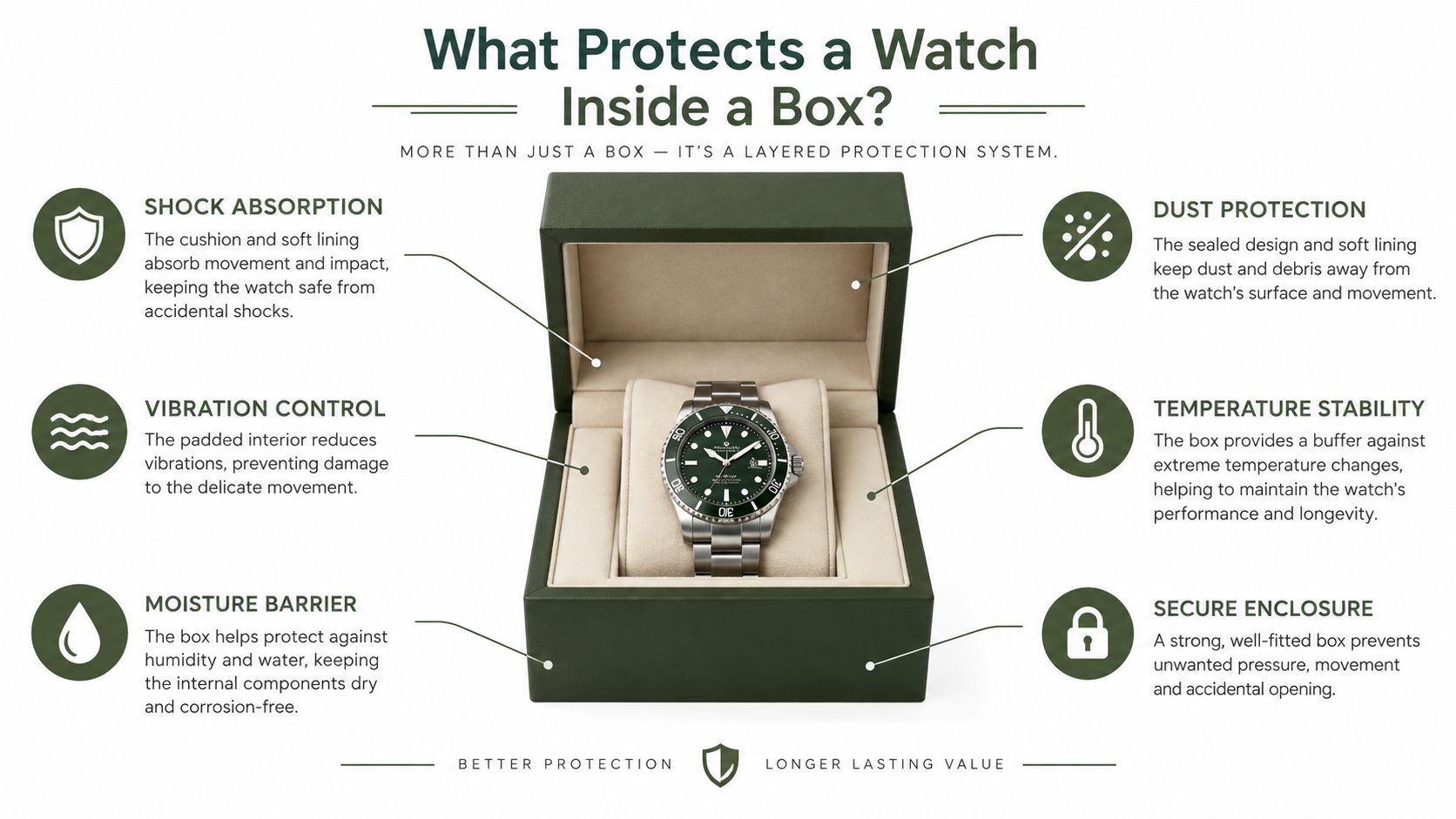
“Padded” and “shockproof” are not specifications. They're sales language until the seller explains what the padding does, how the watch is held, and what the outer shell can withstand.
Start with the cushion. It should compress enough to hold the watch securely without squeezing the crown or forcing the bracelet into a permanent curve. A cushion that's too soft allows movement inside the slot. One that's too firm can put constant pressure on the strap, clasp, and case sides. Independent supports are preferable because they stop neighboring watches from becoming a single moving bundle.
Next, inspect the spacing. The watch head should have lateral clearance from the dividers, while the lid should close without contacting the crystal, bezel, or crown. A well-made interior supports the bracelet or strap rather than leaving it hanging from the case. That matters during transport, when repeated movement can create abrasion even without a dramatic impact.
The outer shell also matters. A rigid or semi-rigid case limits deformation when the box is squeezed in a drawer, bag, or suitcase. Closure hardware should resist accidental opening but shouldn't require such force that the box twists every time you use it. Loose hinges, weak magnets, and thin walls are common reasons an attractive case disappoints within a year.
Separate watch resistance from box protection
ISO 1413:2016 evaluates the shock resistance of a watch, not the protective performance of a watch box. Its test models a fall from approximately 1 meter onto a horizontal wooden surface and checks timekeeping in multiple positions. The standard permits a residual rate change of up to 60 seconds per day for mechanical watches and 2 seconds per day for quartz watches after testing. The ISO 1413 sample explains the distinction.
A box manufacturer claiming “shockproof” should identify the drop height, surface, impact orientation, sample count, and inspection criteria. Without those details, treat the word as decoration. A box can reduce secondary scratches and movement inside a compartment, but it doesn't turn an ordinary watch into a certified shock-resistant timepiece.
Environmental care belongs in the same inspection. Longines recommends stable storage conditions, while practical jewelry-storage advice from Jackpot Candles also supports keeping delicate items away from moisture, abrasion, and careless stacking. Choose a non-abrasive, colorfast lining, avoid exposed fittings that touch the case, and use a designated desiccant pocket rather than loose packets rubbing against leather or polished surfaces.
Comparing Materials From Full-Grain Leather to Hard Alternatives
Material determines how a box ages, but it doesn't rescue poor engineering. Full-grain leather can develop a handsome patina while a badly designed interior still scratches a watch. Aluminum can offer a highly rigid shell while adding unnecessary weight to daily travel.
Here's how the common choices compare:
Watch Box Materials Compared
| Material | Aging Behavior | Scratch Resistance | Weight | Typical Price Band |
|---|---|---|---|---|
| Full-grain leather | Develops patina and can last for years with care | Good against everyday exterior wear, but can mark | Medium | Mid to premium |
| Top-grain leather | More uniform appearance, ages neatly | Good, though surface finish can show wear | Medium | Mid to premium |
| Vegan or bonded leather | Often stays visually consistent at first, then may peel or crack | Fair | Light to medium | Entry to mid |
| Hardwood | Can age beautifully and feel substantial | Good on the structure, vulnerable to dents and finish marks | Medium to heavy | Mid to premium |
| Molded fabric | Practical and often forgiving in travel | Fair to good depending on weave and shell | Light | Entry to mid |
| Aluminum | Stable, rigid, and resistant to crushing | Good on the shell, but interior lining remains decisive | Heavy | Mid to premium |
Full-grain leather is my preferred exterior for a home box or refined daily case when the owner accepts natural wear. It retains the surface grain rather than hiding it under heavy correction, so minor marks become part of the finish instead of looking like sudden plastic failure. You'll still need to keep it away from persistent dampness and wipe spills promptly.
Top-grain leather offers a more consistent appearance. It can be sensible when you want an even color and predictable finish, but compare the lining and structure rather than assuming the leather grade tells you everything. A useful explanation of how leather grades differ is available in this overview of leather grades.
Hard shells and synthetic coverings
Hardwood suits a stationary collector chest. It gives the box weight and visual presence, but a glass lid, lacquered finish, or metal hinge can introduce new contact points. Check whether the interior hardware is recessed and whether the cushions are removable.
Vegan and bonded leather make sense for buyers who prioritize a lower entry price or a uniform appearance. I'd skip any model with a strong chemical odor, peeling edges, or exposed adhesive around the lining. Molded fabric cases are less glamorous, but a good one can be the practical choice for travel because it keeps weight down and disguises the value inside.
Aluminum is best reserved for rough travel or security-led storage. It offers shell rigidity, but it can be needlessly heavy and cold-looking for a bedroom or office. For buyers who care about atmosphere as well as organization, even a small connection between materials and surroundings matters. Loyaltie's selection lets you browse artisan candles, but keep scented products physically separate from watches and leather interiors. Fragrance oils and vapors don't belong in a sealed watch compartment.
Reading Slot Capacity Without Being Misled
A box advertised as six-slot can hold only four of your watches. Capacity depends on the watches, cushions, clasps, dividers, and lid clearance, not the number printed on the product page.
Measure your collection before shopping. Case diameter is only the starting point. Record thickness, including the crystal, lug-to-lug length, bracelet circumference, clasp bulk, and crown position. Rectangular and tonneau cases require different slot geometry from round cases, even when their widest measurement appears similar.

Use this in-store fit check
- Start with the largest watch. Place it in the intended slot and close the lid slowly. Check the crystal, bezel, crown, and clasp for contact.
- Check the cushion circumference. It should secure the watch without stretching the strap or allowing the case to shift.
- Test neighboring slots. Place the widest watch beside another piece. Loaded cushions should keep cases and clasps apart.
- Inspect divider height. Low dividers may look tidy while allowing watches to slide into one another.
- Repeat the closure test. The clasp or zipper should close without compressing the contents or distorting the shell.
- Test the awkward watch. Use the rectangular, oversized, thick, or bracelet-heavy piece. It exposes the box's usable capacity.
A large collection also needs a rotation strategy. Keep frequently worn watches in the most accessible slots, while less-used pieces can occupy a separate layer or box. Two-layer storage works better than forcing every watch into one crowded compartment, especially when case heights vary.
Skip listings that show only polished lifestyle photographs and hide internal measurements. Ask for the usable slot length, width, depth, cushion size, and divider height. A display case can help you judge spacing and access, so apply the same measurement discipline with this watch display case guide before choosing a format. A stated capacity is credible only after your largest and most awkward watch passes the closure and contact tests.
Matching Box Formats to Real Use Cases
A daily wearer, a frequent flyer, a collector, and a gift buyer shouldn't receive the same box. The correct format follows the handling pattern.
Daily rotation
For one or two watches in regular use, choose a two- to four-slot case with a rigid or semi-rigid shell, padded independent compartments, and a secure closure. It should be compact enough to sit away from keys, chargers, and desk clutter. A removable cushion is useful because it lets you inspect the lining and wipe the interior rather than treating the box as a permanent sealed container.
A two-watch case is often more practical than a large chest for an owner who changes watches during the week. It limits unnecessary exposure and keeps the active rotation visible without displaying the entire collection.
Frequent travel
Travel demands a zippered or snap-secured case with a protective shell, low-profile shape, and compartments that prevent case-to-case contact. A roll can work for soft luggage, but I prefer a structured travel case when the watch will share space with shoes, toiletries, or electronics. Keep the case separate from magnetic accessories and avoid packing it where heavy objects can press directly on the lid.
This watch travel case guide for men is a useful reference when comparing compact formats with home storage. The travel case shouldn't try to replace a collector chest. It should protect the small group of watches you're carrying.
Collector display
A home collector should look at a larger chest with stable cushions, dust exclusion, inspection access, and a lining that won't shed fibers. A glass top improves visibility, but it also makes security and placement more important. Don't put valuable watches in direct sun or in a location where visitors can handle them casually.
Collectors often appreciate a hardwood or full-grain leather exterior, provided the interior dimensions suit the collection. A decorative mineral or fossil box, such as the formats available when you shop Astro West fossil jewelry, may be attractive for presentation, but decorative appeal shouldn't override cushion fit or environmental control.
Gift presentation
A single-slot presentation box should prioritize a clean lining, reliable closure, and enough clearance for the recipient's actual watch. If you don't know the watch dimensions, avoid a tightly molded interior. A flexible but supportive cushion gives the recipient more room to use the box after the presentation moment.
Why Most Multi-Watch Owners Need Two Boxes Instead of One
You leave for a weekend with three watches, then return to a crowded chest where straps are bent, cushions are compressed, and the pieces you wear most sit buried underneath the rest. One oversized box looks efficient, but it creates poor access and encourages unnecessary movement of the full collection.
The 2025 Jewelers Mutual study surveyed more than 1,500 U.S. watch owners and found that 83% owned multiple watches. Its guidance on secure storage, magnet avoidance, and separating pieces supports a two-layer setup. Read the 2025 Jewelers Mutual watch ownership study for the source behind those findings.
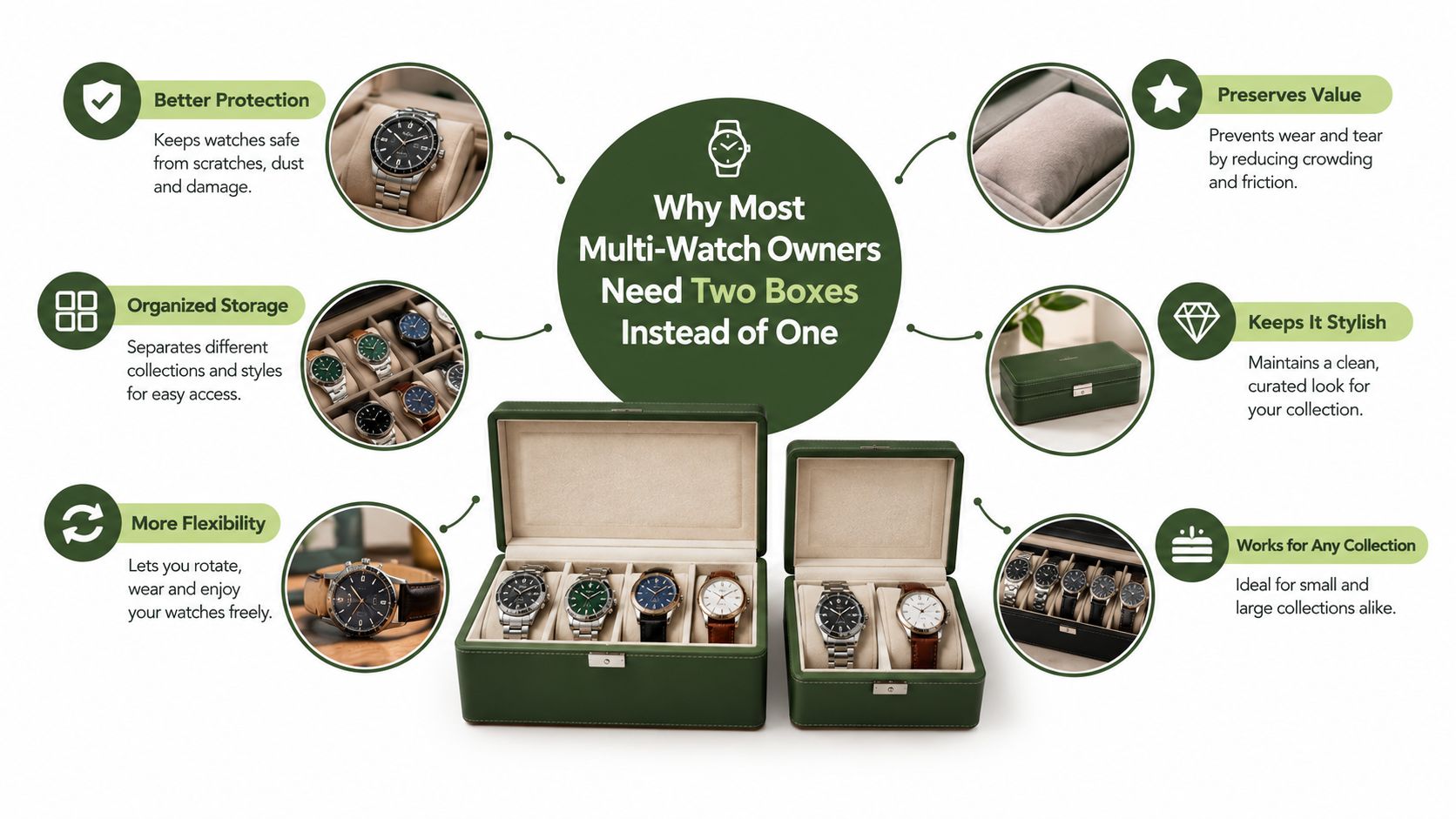
Use the first layer as a compact daily or travel case for the active rotation. Keep only the watches you expect to wear or carry inside it. Choose a rigid shell, a secure closure, and a discreet exterior. A small case leaves less unused space, makes inspection faster, and keeps the entire collection out of airports, hotel rooms, and car bags.
Use the second layer as a larger home chest for watches outside the current rotation. Its job is organized access, stable cushions, dust control, and a suitable interior environment. Place it away from speakers, magnetic mounts, damp areas, and direct sunlight. A display window is useful only when the chest remains protected from casual handling.
Two boxes also solve fit problems. Rectangular watches, oversized cases, leather straps, and steel bracelets rarely suit identical slot geometry. Select the daily case around the pieces you wear most. Give the home chest wider compartments or removable cushions for unusual shapes and less predictable storage needs.
Practical rule: Build a small storage system around movement, access, and environment. Do not force every watch into one huge box.
Price Tiers and What Each One Actually Buys You
Price doesn't automatically equal protection. It should buy better construction, not merely a more impressive logo or a larger slot count.
Entry boxes usually provide basic compartmentalization, a lighter shell, and synthetic covering. They can work for an everyday wearer with modest storage needs, but inspect the closure, cushion stitching, and lid clearance carefully. The weak points show up in handling before the exterior does.
Mid-tier boxes typically improve lining quality, shell rigidity, hardware consistency, and cushion design. This is the sensible range for many owners because the money goes toward the parts that prevent contact, movement, and premature wear. A mid-tier home box paired with a separate compact travel case often makes more sense than one expensive all-purpose chest.
Premium boxes add refined leather, hardwood construction, personalization, stronger hardware, and more consistent finishing. Some also offer better display access and custom dimensions. They're justified when the box will remain visible, serve as a long-term collector piece, or hold watches whose value makes careful storage a priority.
What doesn't automatically improve is usable capacity. A premium box can still have oversized pillows, narrow dividers, or a lid that crowds larger watches. Pay for fit, lining, shell construction, and closure reliability before paying for extra compartments.
Which Box to Buy for Your Situation
Frequent traveler: Choose a compact two- to four-slot case with a rigid shell, secure zipper or snap closure, and non-abrasive lining. Skip glass-top display cases and soft rolls that allow watches to press together in packed luggage.
Active collector: Use a small daily case for the current rotation and a larger home chest with removable cushions and stable compartments for the rest. Measure rectangular and oversized watches before buying.
Gift buyer: Select a single-slot or small presentation box with a forgiving cushion and clean lining. If you don't know the watch dimensions, avoid molded inserts that fit only one case shape.
Everyday wearer: A two-slot case is usually enough. Choose full-grain leather or a well-constructed hard alternative, then verify that the closure doesn't press the crown or crystal.
Before checkout, confirm internal dimensions, cushion circumference, lining material, shell rigidity, and closure type. Review the available watch boxes from Grainmark Leather if full-grain leather, compact storage, or coordinated travel accessories fit your needs.
Grainmark Leather offers full-grain leather watch boxes, compact watch cases, collector storage, and travel formats designed around organized protection rather than slot count alone. Visit Grainmark Leather to compare a case for your active rotation with a larger storage option for the watches you keep at home.