
Case Watch Size: How to Measure and Choose Right
The most popular advice about case watch size is also the least reliable: choose a watch by its diameter. A 40 mm case can sit neatly on one wrist, overhang another, and feel unexpectedly compact on a third. The number describes only one span of the case, not the footprint that meets your wrist or the clearance a storage compartment needs.
At the bench, four measurements matter far more than a headline specification: diameter, lug-to-lug length, thickness, and end-link or crown extension. A useful sizing decision compares those measurements with the flat width of the wrist, then checks how the watch sits. The same logic applies when you're choosing a watch display case, because a slot that accepts the diameter may still reject the lugs, crown, bracelet, or case height.
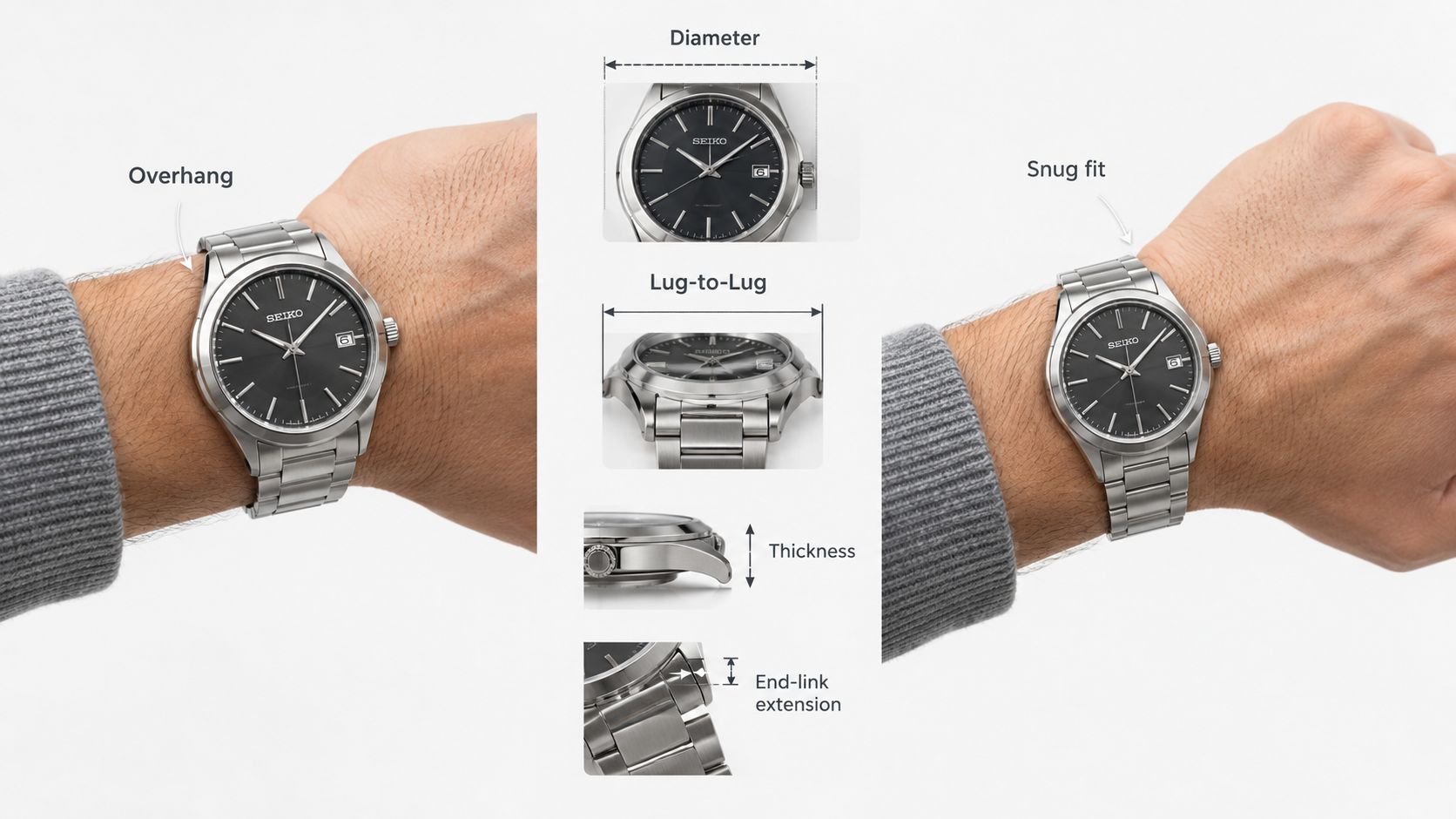
Table of Contents
- Why Case Watch Size Is More Than the Diameter
- Measuring Your Wrist the Right Way
- Recording Diameter, Lug-to-Lug, Thickness, and Crown
- Matching Watch Specs to Wrist Size Bands
- Applying the Same Framework to a Leather Watch Case
- Trying It On Without the Guesswork
- What to Record Before You Buy or Store Any Watch
Why Case Watch Size Is More Than the Diameter
Diameter is a useful first filter, but it isn't a fit verdict. Measure a round watch straight across the case and you learn how broad it looks from above. You don't learn whether the lugs extend beyond the wrist, whether the case rocks when you move, or whether a thick bezel and crystal push the watch uncomfortably high.
Lug-to-lug length usually answers the practical fit question more directly. It measures the distance between the outer tips of the lugs, which is the part most likely to overhang the flat portion of the wrist. A short-lug 40 mm watch can therefore wear smaller than a long-lug 40 mm watch, while a curved case may sit more comfortably than its dimensions suggest.
Practical rule: Diameter helps you shortlist. Lug-to-lug tells you whether the watch has a realistic chance of sitting within your wrist.
Thickness changes the experience again. A slim dress watch can disappear beneath a cuff, while a tall diver or chronograph can feel top-heavy even when its diameter looks sensible. End links and integrated bracelets add rigid length that may continue beyond the case lugs, so the effective footprint can exceed the published case measurement.
The storage problem is similar but not identical. A watch that fits your wrist may not fit a narrow leather slot if its crown presses against the divider or its bracelet prevents the pillow from closing. Storage should therefore be specified by usable compartment dimensions, not by the number of watches a case holds.
The right objective isn't winning a specification comparison. It's finding a proportionate, stable fit on the wrist and a protective fit in storage. Record both sets of dimensions before you buy.
Measuring Your Wrist the Right Way
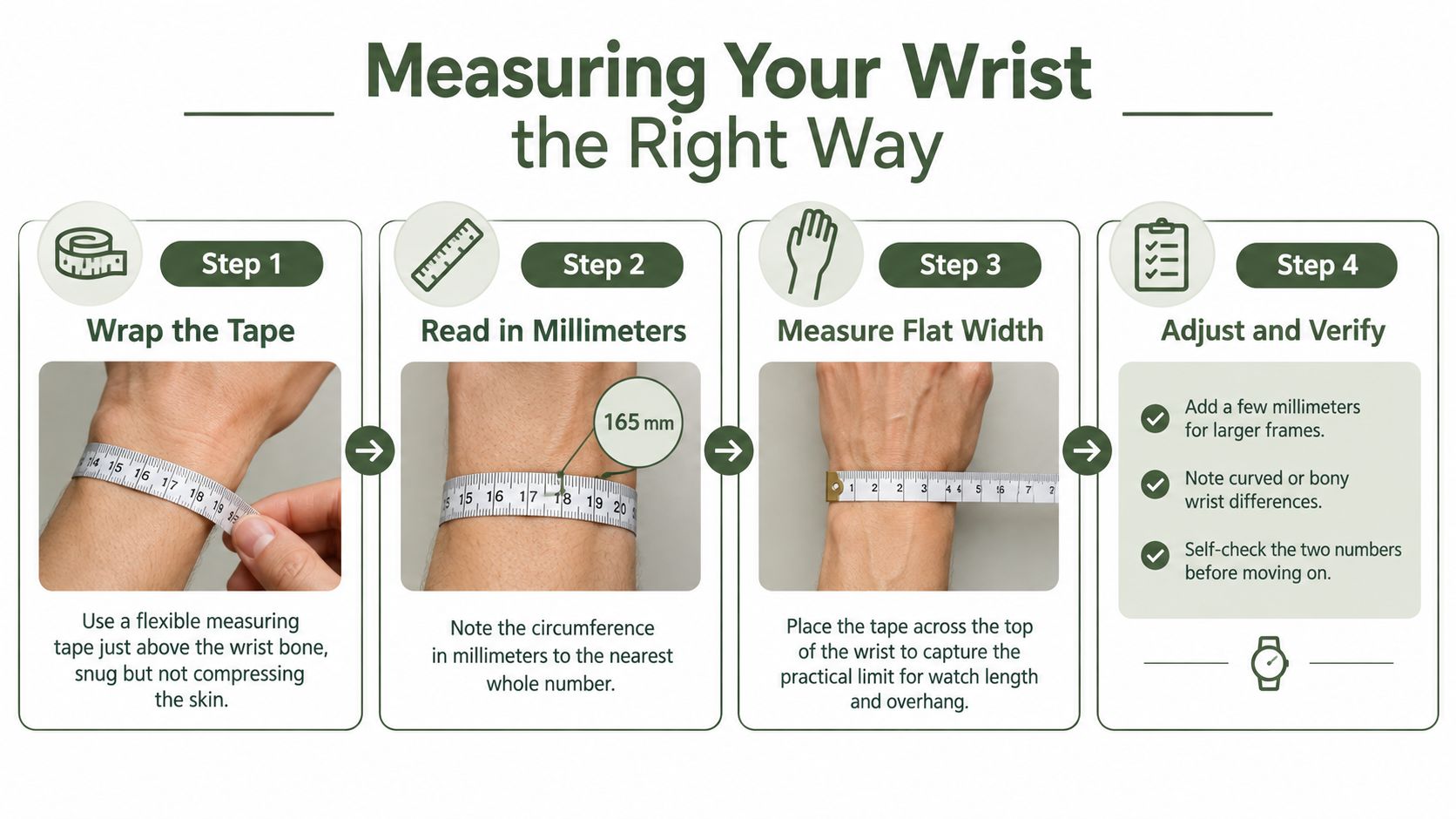
Your wrist supplies two different measurements, and each answers a different question. Circumference helps establish a starting size range. Flat width determines how much lug-to-lug length the top of the wrist can support without overhang.
Start with circumference
Use a flexible tape, not a rigid ruler. Place it just above the wrist bone, where you normally wear the watch, and keep it snug without compressing the skin. Record the result in millimeters, because watch specifications and sizing references are usually stated in that unit.
If you don't have a flexible tape, wrap a strip of paper or thread around the wrist, mark the overlap, then measure that strip against a ruler. Keep your hand relaxed. Clenching your fingers or pulling the material tight can produce a reading that makes every later recommendation too small.
Capture the flat width
Next, measure across the top of the wrist from one practical edge to the other. This isn't the circumference divided into a convenient formula. It's the usable flat surface that supports the watch head.
A curved or bony wrist can make the edges less obvious. In that case, hold a ruler or straight edge lightly across the wrist and identify where the watch would begin to tip over the sides. Measure that span, then repeat it with the wrist relaxed and slightly rotated. The smaller repeatable reading is the safer basis for shortlisting.
Larger frames may have more usable surface than circumference alone suggests, so don't force the flat-width result to match a generic chart. Your two measurements should still make physical sense together. If the circumference seems generous but the flat width is narrow, check that the tape wasn't angled or placed over the wrist bone.
Measure the wrist you actually wear the watch on, in the position you use every day. A clean measurement is more useful than a precise-looking guess.
Recording Diameter, Lug-to-Lug, Thickness, and Crown
Watch specifications become useful only when you measure them consistently. Manufacturers don't always present dimensions in the same way, and retailers sometimes list the diameter while omitting the length that decides fit.
Build a watch-side record
Measure diameter straight across the case, excluding the crown. Don't include the crown in the headline diameter, because that would make comparisons between watches inconsistent.
Measure lug-to-lug as a straight line from the outer tip of the upper lug to the outer tip of the lower lug. Don't follow the curvature of the case, and don't substitute strap width. A strap may be narrow while the lugs reach much farther across the wrist.
Thickness is the vertical stack from the lowest caseback point to the highest crystal or bezel point. It matters for cuff clearance, perceived weight, and storage height. A soft pillow can accommodate some variation, but a rigid compartment cannot compensate for a case that is too tall.
Also record the furthest projection of the crown and pushers from the case body. For watches with fixed end links, measure the rigid extension beyond the lugs as well. The relevant storage footprint is often the widest or longest point that must pass into the compartment, not the polished case body alone.
Prioritise the measurement that matches the watch
For a simple dress watch, diameter and lug-to-lug usually establish the basic proportion. A diver needs more attention on thickness, bezel width, crown guards, and strap articulation. A chronograph may need extra crown and pusher clearance, while an integrated-bracelet design can have a long, visually continuous footprint even when its case diameter seems moderate.
For storage, note the maximum width, maximum length, and maximum height with the watch configured as it will be stored. A bracelet left open can require more room than the same watch on a fitted pillow. A rigid end link can also defeat a slot that would accept a watch on a flexible leather strap.
A watch case for automatic watches should therefore be assessed by its interior geometry and padding, not just its advertised capacity. The number of slots tells you how many compartments exist. It doesn't tell you whether your particular watch can enter, sit flat, and close without pressure.
Matching Watch Specs to Wrist Size Bands
Wrist circumference can narrow the shortlist, but it cannot determine fit by itself. These commonly cited starting ranges pair wrist circumference with case diameter and lug-to-lug length. Treat them as a screening tool, not a fitting rule.
| Wrist circumference | Diameter range | Lug-to-lug range |
|---|---|---|
| Below 152 mm | 36–38 mm | 44–46 mm |
| 152–171 mm | 38–42 mm | 46–48 mm |
| 171–190 mm | 42–44 mm | 48–50 mm |
The table helps reduce a large field of watches to a workable shortlist. The case still needs inspection. A curved 42 mm case with compact lugs may sit better than a flat 40 mm case with long, rigid lugs. A broad or thick bezel can also make a watch appear more dominant from above than its diameter suggests.
The same diameter can produce different outcomes
| Watch example | What the diameter suggests | What the wrist experiences |
|---|---|---|
| 40 mm round dress watch | Moderate, balanced case | Often restrained if the lugs are short and curved |
| 42 mm diver with thick lugs | Only slightly broader on paper | More substantial because of height, bezel, and rigid lug shape |
| 42 mm tonneau case | Similar nominal width | Different footprint because the case spreads through its curved geometry |
These examples describe tendencies, not fixed outcomes. Effective length becomes the deciding check when the watch approaches the flat width of the wrist. Fixed end links, cushion cases, tonneau cases, and rounded wrists can all change how far the watch extends beyond the case body.
A sizing chart is useful only when its labels are clear. It helps to find sizing chart tips that explain what is measured and separate a body dimension from the product's usable dimensions. Apply the same discipline when comparing watch specifications, since “diameter” may exclude guards, crown projections, or other parts that affect fit.
If the lug-to-lug span exceeds the flat part of your wrist, stop treating diameter as the deciding number.
For a remote purchase, ask the seller for missing measurements rather than relying on the advertised diameter. Record the watch's effective length, widest point, thickness, and crown or pusher projection before choosing a size.
Storage requires the same caution. A 12-slot watch strap organiser may offer the right number of compartments while still lacking the interior width, depth, or height needed for a particular watch. Slot count describes capacity, not fit.
Applying the Same Framework to a Leather Watch Case
Wrist fit and storage fit are separate problems, but they use much of the same measurement language. On the wrist, you compare the watch's effective footprint with the wrist's flat width. In a leather case, you compare the watch's maximum external dimensions with the usable compartment, including enough clearance for insertion and removal.
A traditional dress watch can be relatively compact, while modern sports and pilot watches occupy more lateral and vertical space. Historical dimensions show why a single case architecture can fail: men's dress watches in the 1950s commonly measured about 34 to 36 mm, the first Rolex Submariner reference 6204 measured approximately 37 mm in 1953, and the Rolex Explorer debuted at 36 mm that same year. The IWC Big Pilot introduced in 2002 used a 46 mm case, and industry commentary now describes 40 to 42 mm as a modern standard range for many men's watches. These figures are documented in this history of changing watch sizes.
Design the compartment around the watch
A case intended around a 36 mm dress watch may accept the case body while failing on a larger bezel, protruding crown, or rigid bracelet. A compartment needs lateral clearance for the widest point, sufficient height for the thickest profile, and a pillow or cradle that holds the watch without forcing the lugs outward.
A useful assortment can label capacity ranges such as:
- Under 38 mm: suited to smaller traditional cases, subject to lug and crown clearance.
- 38 to 42 mm: a practical middle range for many current watches, provided the compartment is deep enough.
- Above 42 mm: intended for larger sports and pilot profiles, with extra lateral and vertical room.
These labels are more informative than “fits all watches.” They describe a likely starting point while leaving room for unusual geometry. Multiple compartment sizes also make it easier to store a mixed collection without wedging a large diver into a narrow slot.
Materials affect the margin for error
Full-grain leather can form a durable exterior, but the protective result still depends on the interior construction. Padded pillows help support the case and reduce movement. Rigid shells resist crushing in luggage better than soft pouches, while smooth interior surfaces reduce unnecessary contact with polished components.
A best leather watch case should therefore be judged by more than finish and slot count. Check the compartment's clear opening, the height under the lid, the pillow diameter, and the room around crowns and pushers. Storage capacity is credible only when it describes what the compartments can hold.
Trying It On Without the Guesswork
Numbers narrow the choice, but a simple template catches errors that a specification sheet misses. Draw or print a shape using the watch's diameter and lug-to-lug length, then cut it from paper or light cardboard. Include any fixed end-link extension in the longest dimension.
Place the template flat on top of the wrist, aligned as the watch would sit. Look from above for lug overhang, then rotate the wrist slowly. If the template rocks, reaches the wrist edge, or pivots on a bony point, the watch may feel unstable even if its diameter falls within a recommended range.
Check height separately. Hold a side profile or use the manufacturer's thickness measurement to judge whether the watch can pass under your usual shirt cuff without catching. A fixed end link, curved lug, or tonneau case can change the contact points, so don't rely on a flat rectangle alone when the case shape is complex.
For remote purchases, request a dimensioned drawing or make your own template from the published measurements. A clear product chart can help reduce returns with size charts, but the chart needs to show the dimensions that determine fit, not only a broad small, medium, or large label.
Record the result beside the watch specifications. If the template overhangs, don't talk yourself into the purchase because the dial looks appealing. If it sits comfortably but the height is excessive, look for a thinner alternative or confirm that your storage case has enough lid clearance.
What to Record Before You Buy or Store Any Watch
Keep one short measurement record for both wrist decisions and storage decisions:
- Wrist circumference: measured snugly above the wrist bone.
- Flat wrist width: the practical surface available for the watch's length.
- Case diameter: measured across the case, excluding the crown.
- Lug-to-lug: measured straight from outer lug tip to outer lug tip.
- Thickness: measured across the complete vertical case stack.
- Crown, pusher, and end-link extension: the points that enlarge the effective footprint.
- Storage clearance: the compartment's usable length, width, and height.
Lug-to-lug is usually the number that decides whether a watch sits within the wrist's flat area. Diameter remains a useful screening figure, while thickness and crown clearance become more important for divers, chronographs, and watches with prominent controls. Cushion and tonneau cases, integrated bracelets, and fixed end links deserve a physical template or unusually careful measurement.
This approach also makes choosing a watch storage box more straightforward. You're no longer asking whether a case holds a certain number of watches. You're checking whether each compartment can accept the actual dimensions of the watches you own and protect them without pressure or abrasion.
Choose your wrist and watch measurements first, then compare them with the usable interior dimensions of a case. Grainmark Leather offers full-grain leather watch storage and travel cases designed for organised protection, with formats suited to different collections. Visit Grainmark Leather to find a case that matches your watches rather than forcing every watch into the same slot.