Black Leather Laptop Bag Buying Guide for Pros
You leave the office with a laptop, a charger, a notebook, maybe a set of documents that can't wrinkle, and you want one bag that handles all of it without looking like you borrowed it from a student. That's where a black leather laptop bag earns its place. It needs to move cleanly from commute to meeting room, keep its shape, and still look right beside a suit jacket or business-casual layers.
A good one works like a modern briefcase. The leather gives it the familiar professional look, but the genuine value is in the structure, the interior layout, and how long it stays useful when you carry it every day. The German Leather Museum traces bags from prehistoric containers to medieval pouches and later work bags, which is a useful reminder that today's laptop bag sits in a long line of practical carry tools, not just fashion items. A black leather version is the latest form of that tradition, tuned for a computer and a modern workday, not a novelty accessory. A canvas alternative can be useful in different settings, but the black leather format still reads as the most straightforward choice for formal or client-facing work.
Market demand also helps explain why this category stays relevant. One forecast projects the global laptop-bag market at about USD 3.13 billion in 2026 and USD 4.29 billion by 2035, with a 3.6% compound annual growth rate, while business users represent a major share of demand in that estimate. Those numbers don't describe black leather bags alone, but they do show how much buying pressure comes from professionals who need durability, appearance, and organization in one piece.
Table of Contents
- Why a Black Leather Laptop Bag Still Makes Sense
- Matching Bag Size to Your Laptop Dimensions
- Understanding Full Grain Leather and Protective Build
- Organization Features That Keep Workdays Smooth
- Choosing a Professional Style That Fits Your Role
- Travel Compatibility and Everyday Care Essentials
- Making a Lasting Choice With Personalization
Why a Black Leather Laptop Bag Still Makes Sense
You're rushing from a train platform to a client meeting, and the bag has to do more than hold a laptop. It needs to stay upright under a bench, not dump your charger into the bottom corner, and still look deliberate when you set it on the conference table. That's why structure matters more than shine.
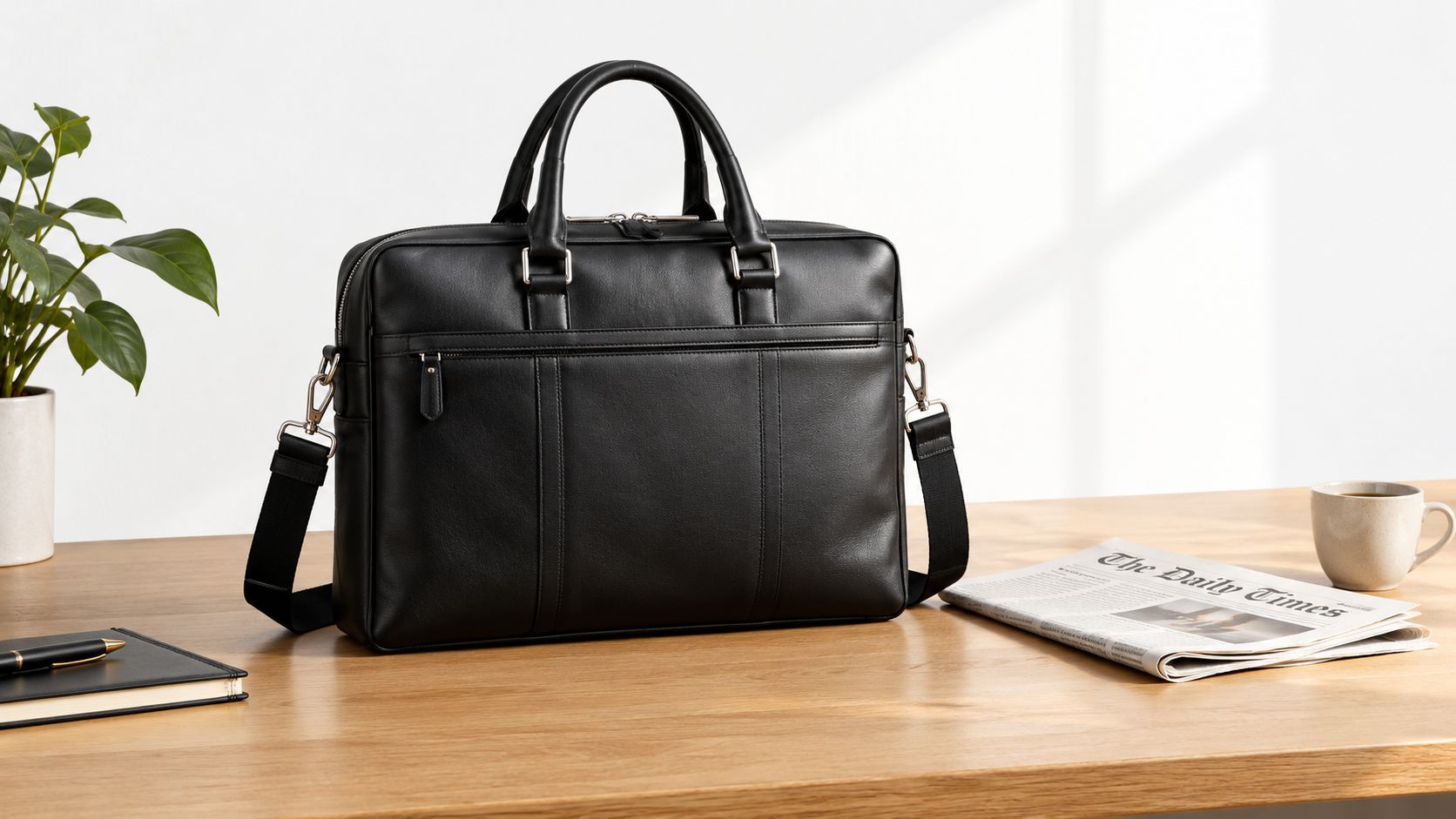
The laptop bag is a modern development of an older carrying tradition, and that history helps explain its appeal. Bags started as practical containers, then became pouches and belt bags, then evolved into more specialized work and travel accessories as daily life changed. A black leather laptop bag fits that pattern neatly because it combines protection, portability, and organization in a format that still looks appropriate in public and workplace settings.
Why professionals keep choosing this format
The business case is simple. Professional users remain central to laptop-bag demand, and a forecast places that segment at about USD 1.51 billion in 2025, which is roughly 50% of the market in that estimate, alongside roughly 310 million laptop bags sold globally in 2025. Those figures are for laptop bags broadly, not leather only, but they show why buyers keep prioritizing carry solutions that look credible in an office setting and survive daily transit.
A black leather bag also avoids one common style problem. Some bags read as too casual for client work, while others look formal but are awkward to use. A structured black leather model sits in the middle, which is why it keeps showing up in offices, airports, and co-working spaces.
Practical rule: if the bag can't sit flat, hold its shape when full, and keep your work items separated, the leather alone won't save it.
Matching Bag Size to Your Laptop Dimensions
Laptop sizing trips people up because the screen size on the box isn't the same thing as the bag fit. A 14-inch laptop can be thicker, wider, or more angular than another 14-inch model, and the ports, hinges, and charging cable can make the difference between a clean fit and a frustrating one. Measure the machine you own, not the label you remember.
Measure the device, then the bag
Use a tape measure and note width, depth, and thickness. Compare those numbers with the bag's interior dimensions, not the advertised screen size, because “fits up to 15.6 inches” often leaves out how much padding or structure the compartment has. For daily use, you want enough clearance to slide the laptop in without forcing it, but not so much room that it bounces around inside.
A simple home check helps. Put the laptop on a table, measure it, then compare it to the compartment while imagining the charger, mouse, and paperwork you usually carry too. That extra load changes how the bag behaves in real life.
Fit matters more than a rough category label
People often think in categories like 13-inch, 14-inch, 15.6-inch, and 16-inch, but those are only starting points. A sleeve that works on paper can still press too tightly against the lid or leave the device loose enough to shift when you walk. That's why the internal shape of the bag matters as much as the exterior style.
Laptop protection depends more on internal shock management and construction than on leather alone, and a rugged-computer benchmark such as MIL-STD-810G Method 516.6 Procedure IV uses controlled drop testing, with one commercial protection specification identifying a 1.2 m (4 ft) drop as its benchmark. A leather bag should not be described as meeting that standard unless the full bag-and-device system has been tested for it. For a closer fit reference, this hard case fit guide by model shows the kind of model-specific thinking that helps buyers avoid vague sizing mistakes.
Use a document holder when you travel with papers so the laptop compartment doesn't become a catch-all for folders and receipts.
If the laptop slides around, the compartment is too loose. If you have to push hard to close it, the compartment is too tight.
Understanding Full Grain Leather and Protective Build
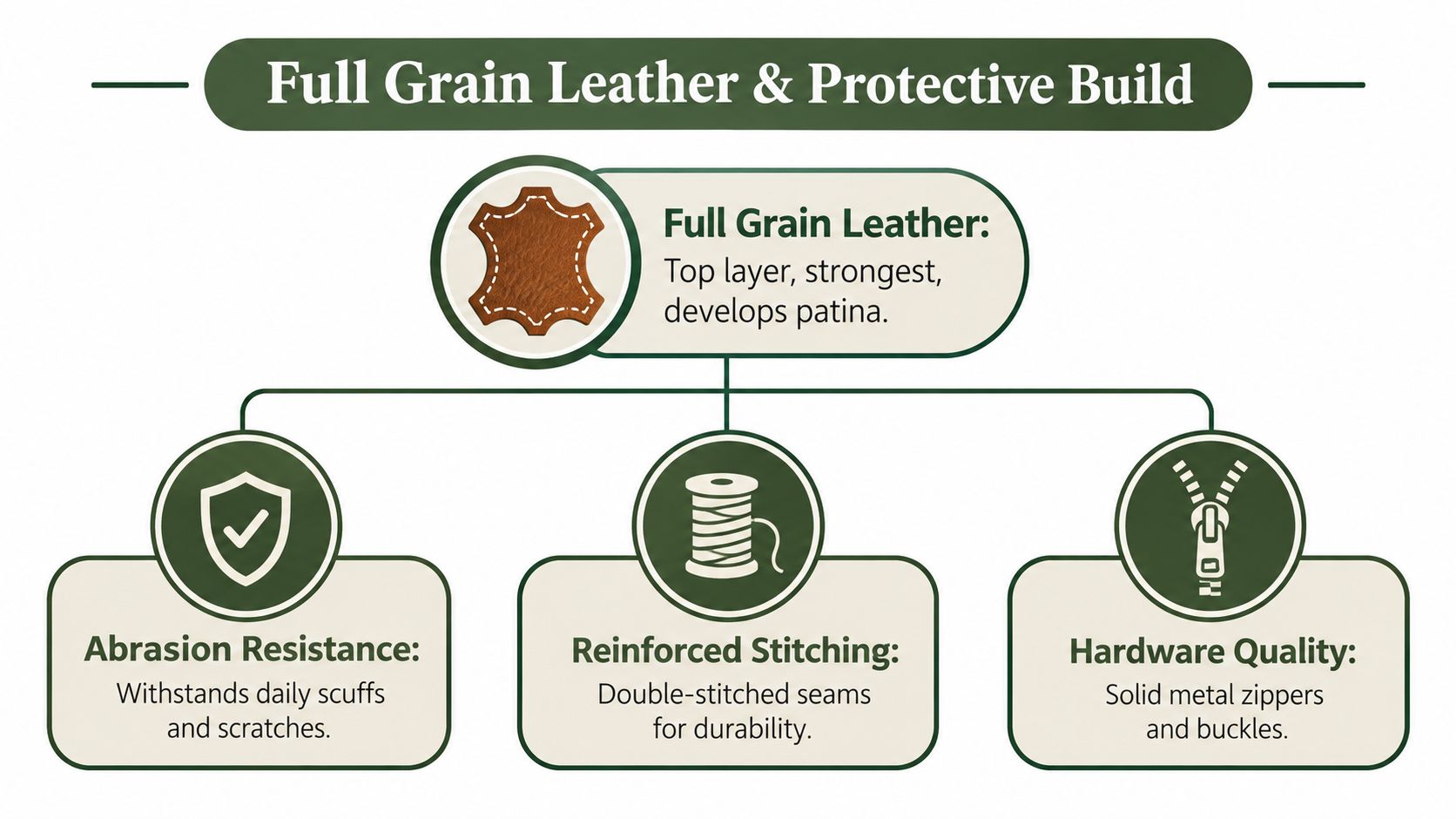
Leather quality is easiest to understand if you think about wood grain. The top layer is the part that carries the character and the strength, while lower layers are less useful for long-term wear. In a bag, full-grain leather means you're working with that top layer, which is why it tends to age better and develop a more useful patina over time.
What wear actually does to a commuting bag
For a black leather laptop bag, the pressure points are abrasion and repeated flexing. Shoulder straps rub against clothing, the base scrapes desk edges, the bag gets compressed in vehicles, and the leather bends every time you open or lift it. In a comparative leather-material study, cow leather showed no visible change after 400 abrasion cycles, while goat leather in the same comparison was damaged after 50 cycles; the same study also tested flexing endurance over 25,000 cycles, with cow leather showing slightly stronger resistance to continuous flexing. Those figures don't predict the life of a complete bag, because stitching, lining, hardware, and edge finishing matter too, but they do support a substantial cowhide build for frequent commuting.
This plain-language explanation of full-grain leather is helpful if the terminology still feels fuzzy.
What to inspect before you buy
Look closely at the parts that fail first. Handles, shoulder-strap anchors, and flap edges deserve reinforced stitching. Smooth edge finishing matters because raw edges fray faster and show wear sooner. Hardware should feel solid in the hand, not flimsy or overly light, because zippers and buckles get touched every day.
A black finish can hide scuffs better than a lighter color, but it doesn't stop fiber fatigue. Conditioning helps only when used sparingly, and it should be spot-tested first because too much oil can soften the structure and transfer onto clothing. If you're comparing bags online, zoom in on seam lines, base corners, and strap joins before you look at anything else.
Organization Features That Keep Workdays Smooth
A bag can look refined and still waste your time every morning if the layout is wrong. The most useful interiors don't just add pockets, they separate the things that need protection from the things that need quick access. That's the difference between a bag you enjoy carrying and one you keep repacking.
Compare the interior, not just the silhouette
| Feature | Best for Commuting | Best for Minimal Carry |
|---|---|---|
| Suspended laptop sleeve | Keeps the device off the base and away from impact points | Useful if you carry your laptop every day |
| Retention strap | Holds the device steady during transit | Less useful if you only move between desk and meeting room |
| Document divider | Prevents papers from curling against the laptop | Helpful for one notebook or slim folder |
| Separate charger pocket | Keeps cable bulk from pressing into the lid | Optional if you travel light |
| Pen slots and key leash | Reduces small-item digging at security or in taxis | Only worth paying for if you use them daily |
Why structure inside matters more than extra leather outside
The most protective design usually isn't the thickest leather shell. It's the one with a suspended or lifted sleeve, closed-cell foam or similar padding, a secure retention strap, and a rigid base that keeps the computer from striking the ground directly. A loose compartment lets the laptop move when the bag shifts, while an over-tight compartment can put pressure on ports and hinges.
If you like a cleaner document-focused setup, this leather portfolio case guide is a useful companion piece. It shows how a slimmer organizer can pair with a laptop bag when you don't want one oversized catch-all.
Pay for the features that stop clutter, not for pockets you'll never remember to use.
Choosing a Professional Style That Fits Your Role
A structured black leather bag sends a different signal than a soft messenger or a gym-leaning backpack. Neither option wins in every office, but the choice gets easier once you match the silhouette to your work setting. The right format should fit your dress code, your commute, and how often you carry paper alongside your laptop.
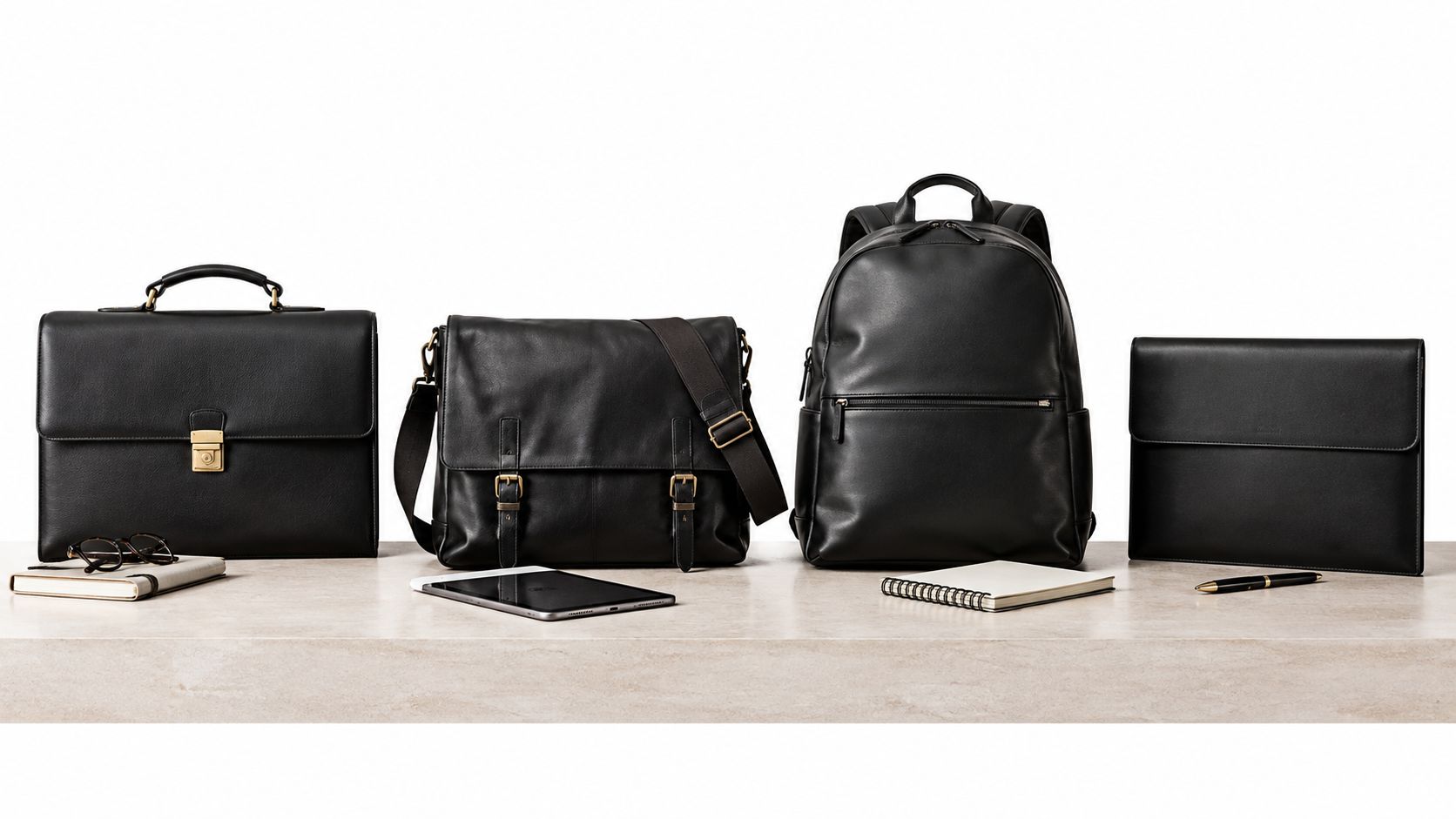
The German Leather Museum explains that bags changed with work, travel, and fashion needs over many centuries. That long shift matters because the modern briefcase is not a random style choice, it's the latest version of a work bag built for professional use. In that sense, a black leather laptop bag reads as a continuation of office carry, not a reinvention.
Match the shape to the setting
A briefcase works well when you want a firm structure, top handles, and a clean profile on a meeting table. A messenger bag is easier for quick cross-body access, but it usually looks more relaxed. A backpack distributes weight better for longer commutes, although it can feel less formal in conservative workplaces. A slim portfolio is ideal when you carry a laptop less often and mostly need documents, a notebook, and a phone.
Black finish helps all of those shapes read more professionally, but the cut still matters. Rounded lines feel softer. Sharp edges and crisp panels feel more like a business tool.
Travel compatibility in plain terms
A slimmer profile clears security trays and overhead bins faster, while a bulky silhouette slows you down at exactly the wrong moments. Keep the deeper travel-packing advice for the care section below.
One last test before you buy: ask whether the bag can be repaired. A style you can resole, restitch, and re-hardware will outlast a prettier piece that fails at the first broken zipper, and that long service life is the measure of value in a professional bag.
Travel Compatibility and Everyday Care Essentials
A bag that starts out handsome can still lose its shape if it's treated like a storage bin. Travel, weather, and daily handling all matter, and the care routine should protect the bag's structure instead of smothering the leather. The goal is simple, keep it clean, keep it dry, and keep it from getting crushed.
When you pack for a flight or a long commute, balance the load so the bag doesn't sag to one side. Put the laptop in its sleeve first, then place cables and the adapter in a separate pocket so they don't press against the lid. If the bag has a firm base, use it. If it doesn't, avoid overloading the bottom with heavy items.
Care that preserves the shape
Wipe off dust and surface dirt regularly with a soft dry cloth. If the leather needs more attention, use a small amount of conditioner sparingly and test it on an inconspicuous area first. Too much product can darken the surface unevenly, soften the body, or rub onto clothing.
Store the bag stuffed lightly with paper or a soft insert so the panels don't collapse when it sits unused.
Hardware needs attention too. Check zippers, snaps, and strap hardware for play or rough movement, because those are usually the first parts to show fatigue. If a bag includes replaceable parts or repair access, that matters more than it sounds. A repairable piece keeps its value longer than one that looks perfect on day one but can't be fixed later.
If you're working remotely from a shared desk or moving between client sites, finding coworking space in Funchal is easier when your bag stays compact, balanced, and easy to carry through a full day.
Making a Lasting Choice With Personalization
A black leather laptop bag earns its price when you stop judging it by appearance alone. The better questions are practical ones. How long will it stay useful? Can it be repaired when a strap or zipper gives out? Will it still look professional after years of commuting? A recent global life-cycle assessment of leather production found that impacts vary widely depending on tanning chemistry, energy mix, and facility practices, and its authors noted that better raw-material data is still needed. That is why a simple leather-versus-vegan verdict does not hold up, and why the bag itself matters more than the material debate around it.
Long service life and repairability are therefore your strongest buying filter. Ask where the hide came from, what tanning method was used, whether the lining and hardware can be repaired, and whether the seller offers a meaningful warranty or repair path. Vague answers usually mean the bag looks premium without being a sound long-term purchase. A craftsman would put it this way: a bag you can resole, restitch, and re-hardware is a tool, while a sealed unit is a consumable.
Personalization fits into this same long-term view, especially if the bag is a gift or a piece you plan to keep for years. A discreet monogram adds ownership without changing the function, and it tends to age better than extra hardware or decorative details. For a closer look at that decision, this initials guide covers the practical side of making a personalized piece feel intentional rather than ornamental.
Pick the bag whose size, sleeve, and interior layout fit your real workday, and favor the maker who can repair it years from now. Buy once, use it often, and let the leather age into a tool that still earns its place.
If you want a structured black leather laptop bag with a focus on full-grain build, daily carry function, and professional styling, visit Grainmark Leather and compare the work bags, portfolios, and travel pieces side by side. You will find options designed for business carry, which makes it easier to choose a bag you keep using for years.