

Travel Watch Boxes: A Complete Guide for Collectors
At the airport gate, a traveler is holding three watches and trying to decide which one belongs in a carry-on, which can go in a case, and which should stay home. One watch is on the wrist, another is loose beside a phone, and the third is at risk of being dropped into a screening tray at the worst possible moment. A well-designed travel watch box turns that scramble into a controlled packing decision.
The box has a practical job beyond looking good. It must keep each watch from rubbing against zippers and laptop corners, limit movement if a suitcase drops, and make valuables easier to handle at security. Full-grain leather can offer a durable outer layer that takes everyday friction and develops a patina, but leather alone doesn't provide a measured guarantee against shock, crushing, or magnetism. Those protections depend on the case's structure, fit, lining, closure, and hardware.
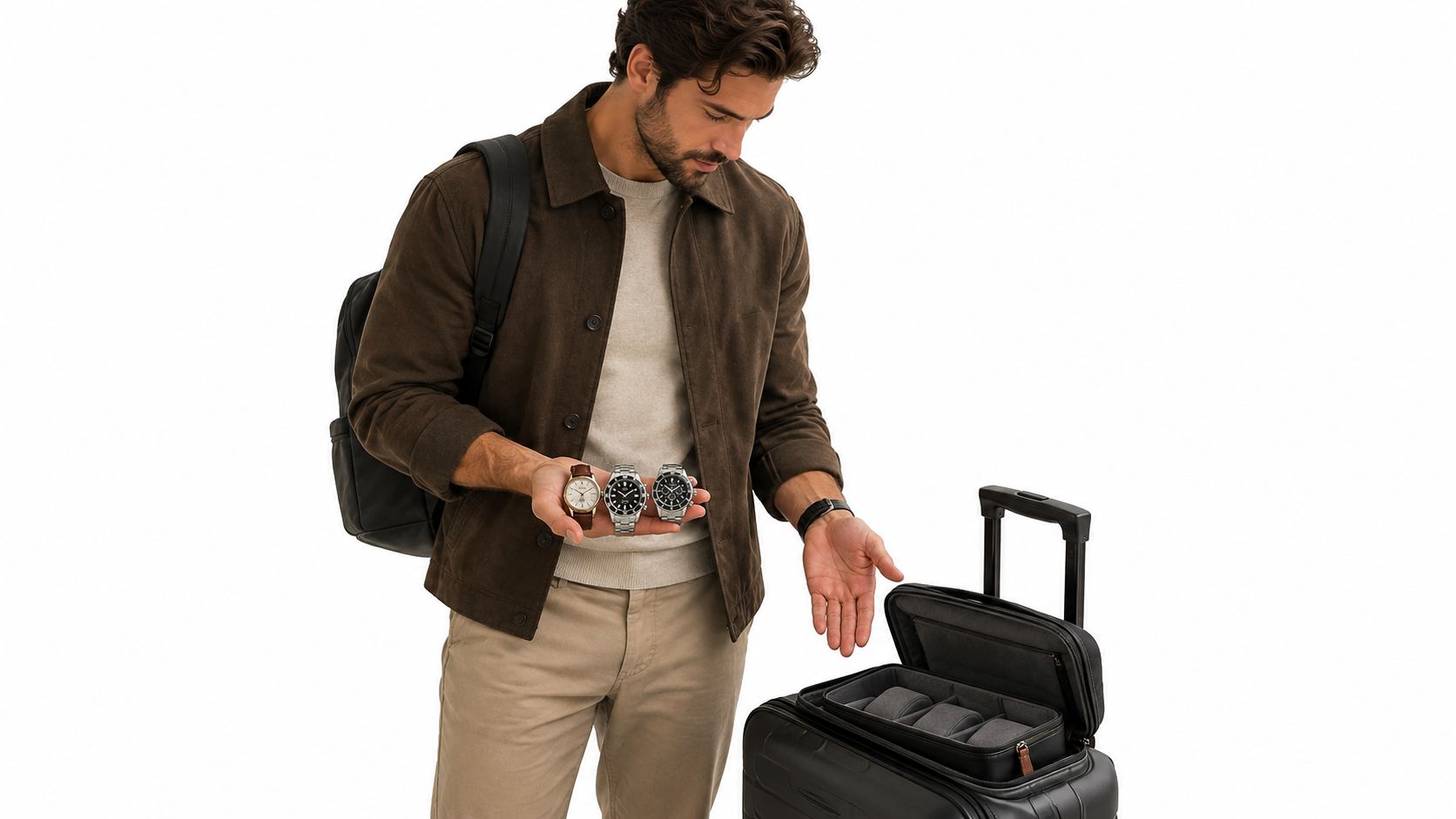
Table of Contents
- Why Travel Watch Boxes Matter More Than the Box Itself
- The Three Main Formats of Travel Watch Boxes
- How ISO Standards Define Real Protection
- Materials and Linings That Actually Protect the Watch
- Capacity Tradeoffs and the Economics of Watch Travel
- Packing Tips for Carry-On, Security, and Magnetic Risks
- Care, Maintenance, and the Limits of a Sealed Box
- Choosing the Right Travel Watch Box for Your Next Trip
Why Travel Watch Boxes Matter More Than the Box Itself
A watch in a bag faces several different hazards, and the outer material addresses only some of them. A soft case may guard against scuffs but offer little resistance when clothing or a laptop presses down on it. A rigid shell may resist compression yet still allow a watch to shift inside, leaving the crown or crystal exposed to contact.
The distinction matters for mechanical watches in particular. A suitcase drop or hard bump against an overhead bin creates a brief impact; if the watch head can move freely, the box transfers more of that jolt to the watch. Inside a packed bag, a loose bracelet can also scrape a polished case or catch on another item. At airport security, an uncontained watch is easier to overlook or leave behind while handling trays, electronics, and documents.
Practical rule: A box should control movement as well as keep objects apart. If the watch rattles inside, the fit needs attention.
Magnetic exposure is a separate concern. A leather exterior, textile lining, or cardboard reinforcement doesn't automatically shield a mechanical movement from magnetic fields. Smartphones, tablet covers, and charging accessories are better treated as items to keep apart from the watch compartment unless a product's shielding has been tested.
For a leather goods specialist, leather is an outer-surface choice, not a substitute for engineering. Full-grain leather can resist wear and retain its character with use, but the case still needs structure, a secure closure, a soft non-abrasive lining, and a fitted cushion. That's what makes travel watch boxes protective equipment, rather than packaging dressed up as an accessory.
The Three Main Formats of Travel Watch Boxes
Think of choosing a watch case as packing a carry-on: every item has to earn its space. Start with the number of watches you'll bring, then consider how much protection and room the luggage can spare.
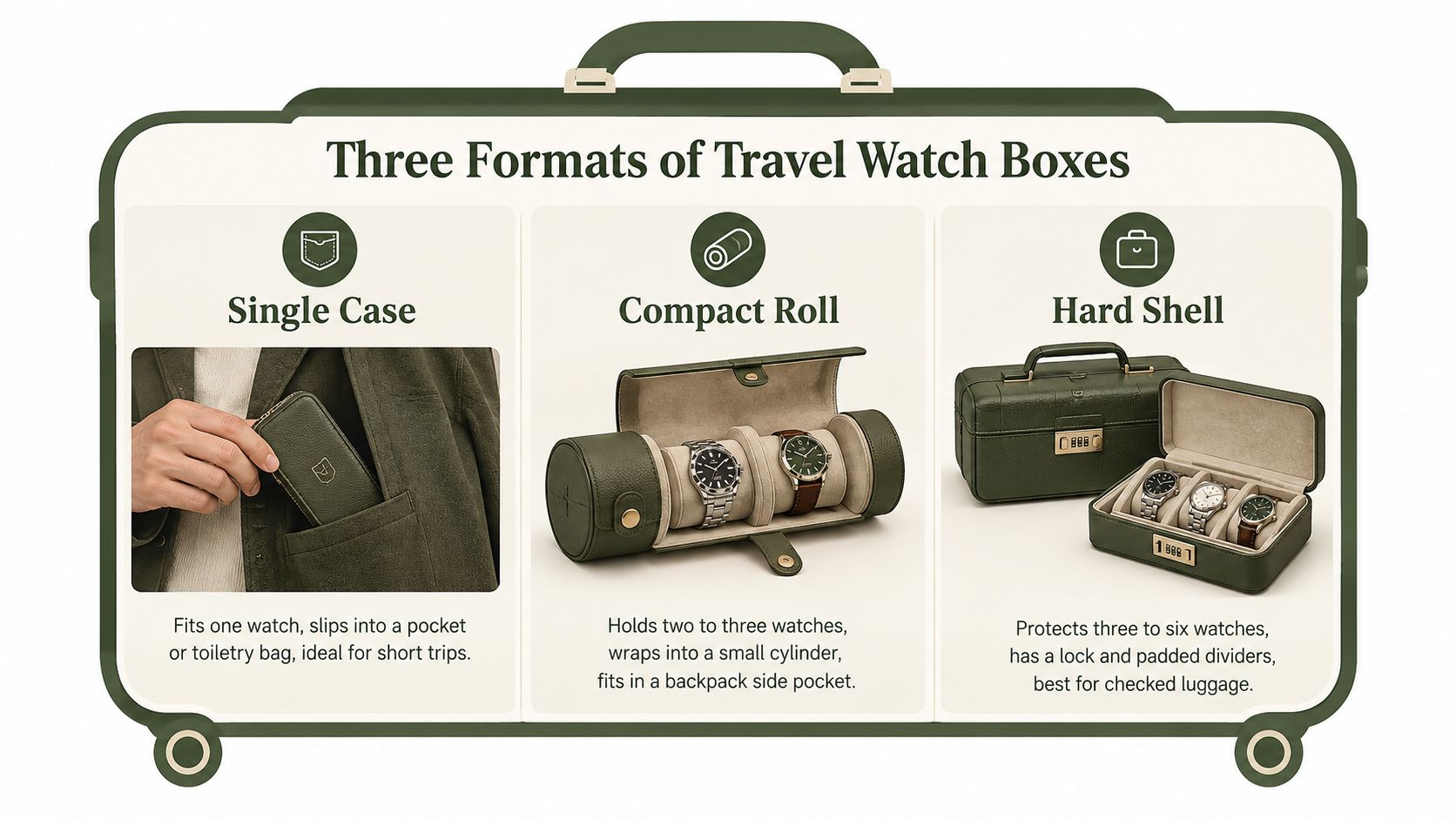
Single case
A single-watch case suits a short trip when you're taking one timepiece and want it contained in a pocket or toiletry bag. It's discreet, light, and quick to pack. The limitation is obvious: it won't organize a backup watch or keep a second piece from sharing space with other belongings. Check that the cushion holds the watch securely, especially if the case is soft-sided.
Compact multi-slot case or roll
This is the middle ground for a small travel selection. Separate compartments reduce contact between watches, while a slim box or roll usually takes less room than a collector chest. A roll can be easy to fit into a bag, but its flexible shape may provide less resistance to pressure than a rigid case. A compact box offers more defined structure, though it still shouldn't be buried under heavy luggage.
Collector chest
A larger, structured case works when you're transporting several watches for a longer trip or carrying a rotation of pieces. It offers more room for individual cushions and dividers, but that protection costs space and weight. In a carry-on, a large chest may compete with a laptop, documents, or spare clothing.
Match the format to the trip, not the full size of your collection. If you'll use only one watch, carrying a large chest creates bulk without adding useful capacity. If you need several watches, a single case leaves the rest inadequately organized. Choose the smallest format that fits the watches you plan to wear.
How ISO Standards Define Real Protection
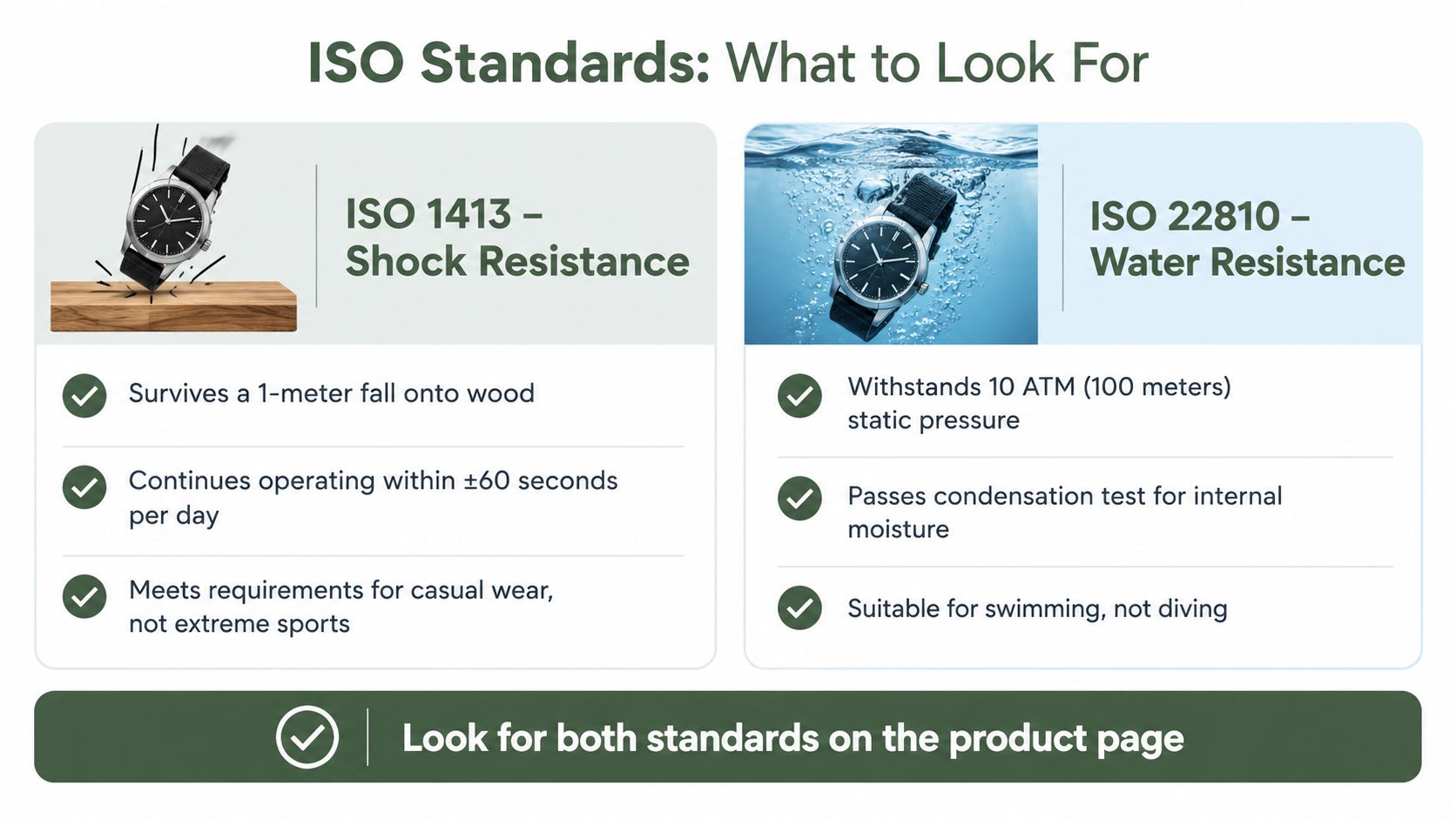
A leather box can look protective without meeting any measurable test. Two watch standards offer useful criteria for judging what protection means: ISO 1413 covers shock resistance, and ISO 764 covers antimagnetic performance. Both test watches, not travel boxes. A case should not be described as certified to either standard unless the box itself has been tested and certified.
ISO 1413 simulates a fall of approximately one meter onto a horizontal wooden surface. After controlled impacts, the watch is assessed for continued operation, rate stability, and visible damage (ISO 1413 shock-resistance standard). For a travel box, the practical goal is to limit movement and prevent the watch head, crown, or crystal from striking the case. Padding should absorb motion rather than transfer it directly to the watch.
Turn the benchmark into a case check
Inspect how the box handles pressure from outside and movement inside:
- Rigid outer shell and firm lid: The structure should retain its shape under ordinary pressure in a packed bag.
- Non-abrasive lining: The watch head and bracelet need a contact surface that won't mark their finish.
- Fitted cushion: The watch should stay put without forcing the strap into a damaging bend.
- Positive closure: A zipper, snap, or other fastening should remain shut when the box is moved.
- Clearance around the watch: The crown and crystal should not press against the walls or lid.
ISO 764 classifies everyday antimagnetic watches against a continuous homogeneous field of at least 4,800 A/m, with controlled field application during performance testing (ISO 764 antimagnetic-watch standard). Ordinary leather and fabric do not shield against magnetic fields. If magnetic protection matters, ask for product-level testing of the complete box, including its hardware and closure. Otherwise, keep magnetic accessories away from the watch compartment.
For an automatic watch, a secure cushion fit helps limit movement during transit. Grainmark's guide to a watch case for automatic watches explains how to assess whether a case accommodates the watch it carries.
Materials and Linings That Actually Protect the Watch
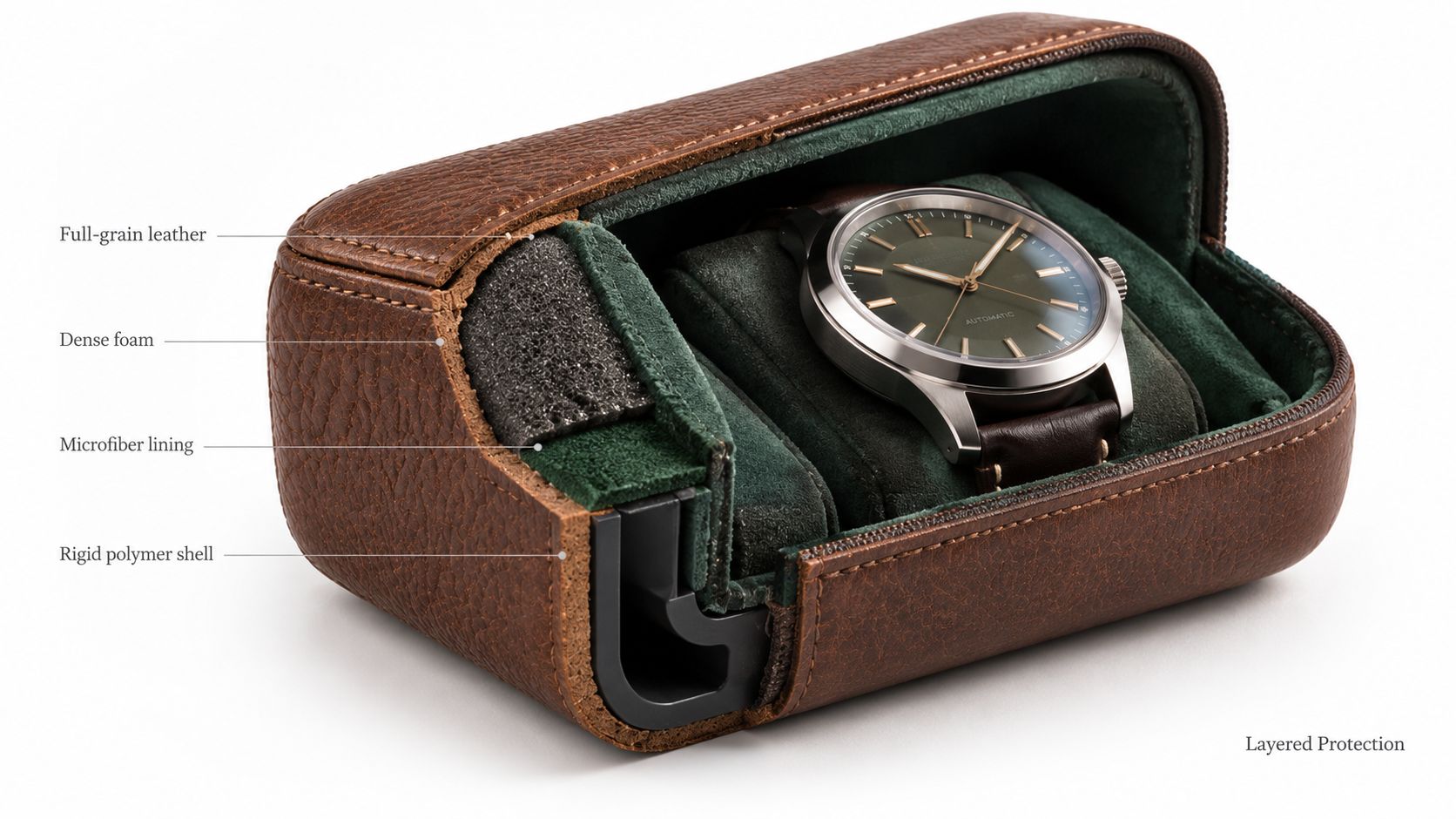
The outer shell takes friction and pressure from the bag. The lining and cushion determine what happens to the watch itself. A strong case with a rough interior can still mark a polished watch, while a soft lining inside a collapsible shell won't prevent a heavy item from pressing into the contents.
Full-grain leather keeps the natural grain layer intact and can develop a patina with wear. It's a durable choice for a leather exterior, but don't mistake its surface for a rigid frame. A well-constructed leather travel case still needs a supportive structure beneath the hide to resist ordinary compression. Corrected-grain leather has been sanded and finished to create a more uniform surface; that may suit a different look, but it doesn't retain the same intact grain character.
Choose the lining for contact, not appearance
- Microfiber has a smooth feel and is a practical option for reducing surface abrasion when the watch rests against it.
- Suede feels soft, but its nap can collect dust and particles. Keep it clean, especially if the case travels with other items.
- Nappa offers a supple contact surface, though a very soft lining won't provide structural protection by itself.
- Flannel or untreated textile can vary in texture and finish. Check for loose fibres, seams, or rough areas that could catch a bracelet or touch a crown.
- Canvas is more commonly an exterior material. It can take everyday handling, but it shouldn't be assumed to cushion a watch unless paired with a suitable padded interior.
The cushion is as important as the fabric around it. It should hold the case and bracelet steadily, but not squeeze a leather strap hard enough to leave it bent or compressed. A bracelet with a loose clasp shouldn't be allowed to swing against the watch head.
Material choice shapes how a case wears over time, but the practical test is still simple: does the shell hold its form, and does the watch sit securely against a clean, non-abrasive lining? Grainmark's comparison of suede lining and fabric offers more detail on those interior choices.
Capacity Tradeoffs and the Economics of Watch Travel
Choose capacity around the watches you intend to take and the protection each one needs. In 2025, Switzerland exported watches worth CHF 24.4 billion. Watches priced above CHF 3,000 accounted for CHF 19.5 billion, across approximately 1.9 million pieces, about 13% of exported watches, according to the Federation of the Swiss Watch Industry export figures. These are export figures rather than final consumer sales, but they show how much industry value sits in a relatively small number of watches.
The same report shows the United States received 17% of Swiss watch exports in 2025, making it the leading destination in the figures. For a traveler carrying a valuable watch, capacity is only one part of the decision. The case also needs to hold each piece securely, while remaining practical to pack and carry.
Use the number of watches as a starting point:
- One watch: A slim case usually suits a short trip where low bulk and discretion matter.
- Two or three: A compact case or roll allows a business traveler to bring a style change or backup without carrying a larger chest.
- Four to six: This can work for a longer trip or planned rotation, as long as the box fits comfortably in carry-on luggage.
- Eight or more: A collector-grade chest makes sense when transporting a working set and allocating more room to secure storage.
More slots mean more room devoted to cushions and dividers. Wider spacing helps prevent watches from contacting one another, though it increases the case footprint. Tighter compartments reduce bulk, but can make oversized cases and bracelets difficult to fit. A large empty chest adds weight and takes up carry-on space without improving protection for the watches you bring. Measure your watches, then compare their dimensions with this case watch size guide before settling on a format. A close fit should keep each watch steady without forcing the case shut or leaving metal parts free to move.
Packing Tips for Carry-On, Security, and Magnetic Risks
Keep the watch box in your carry-on throughout the trip. Checked baggage exposes it to handling and pressure, while a box is meant to limit movement and contact, not absorb every impact. A consistent packing routine also makes security checks easier to manage.
- Choose what travels. Decide which watches you expect to wear and whether any piece should stay in secure storage at home. Extra space in the case is not a reason to bring another valuable watch.
- Prepare each watch. Make sure it is dry, secure the crown as intended for that model, and inspect the seals if you have concerns about water resistance. The box can limit knocks and contact, but it cannot fix a compromised seal.
- Keep the case within reach. Place it inside the main compartment of a personal item, where you can keep it under your control. Avoid checked baggage and outside pockets. For a larger carry-on setup, this men's travel duffle bag guide can help you plan where to keep items you need close at hand.
- Manage screening carefully. Leave the case inside your bag until you reach a stable place to handle it. If security staff ask you to remove it, open the case only when you can watch it directly. Keep any loose watch out of conveyor-belt trays, and don't leave a tray unattended. Airport procedures vary, and wearing the watch may be simpler in some situations. Choose the option that keeps it visible and under your control.
- Separate magnetic accessories. Keep mechanical watches from resting directly beside smartphones, magnetic tablet covers, or wireless charging equipment. The 4,800 A/m benchmark from ISO 764, covered earlier in this guide, describes controlled testing for watches. It does not mean an ordinary travel case shields a watch from magnetic fields. Leave space between devices, and don't treat non-magnetic hardware as tested protection.
Plan clothing and other carry-on essentials alongside the watch case. This ultimate packing list for Japan visitors can help organize the rest of your luggage. Keep the case away from damp toiletries, and avoid packing devices directly against it.
Care, Maintenance, and the Limits of a Sealed Box
A more enclosed case doesn't always mean a safer environment. If a watch goes into storage damp from a wrist or humid conditions, a sealed compartment can trap that moisture beside the watch. A case helps limit abrasion, impact, and crushing, but it can't repair a gasket or prevent internal condensation caused by compromised seals.
Dry the watch before packing, including around the bracelet and case back. Keep it away from wet toiletries, and don't put it away immediately after exposure to rain or seawater. Coastal travel can leave salt or sand on surfaces, so wipe the watch carefully before it goes into its compartment.
A protective case should reduce hazards, not create a damp, closed environment around a watch that wasn't dry when packed.
Balance protection with the environment
For a short journey, careful drying and separation from toiletries may be enough. Longer travel or consistently humid conditions call for more attention to the watch's condition, strap material, and seals. A vintage or poorly sealed watch needs a different level of caution from a modern watch whose water resistance is known and maintained.
Desiccants aren't a universal fix. They can be useful in some circumstances, but adding one without considering the watch's seals, leather strap, and storage duration may create a mismatch between the contents and the environment. Avoid treating a travel box as a humidity-control device unless it's designed and tested for that purpose.
Temperature transitions deserve the same restraint. Cold conditions can affect movement oils, and a warm, damp watch brought into a cooler environment may be vulnerable to condensation if its seals are compromised. Don't assume the case itself controls temperature or moisture. For leather care after a trip, follow material-appropriate guidance such as Grainmark's advice on how to condition leather, and keep conditioning products away from the watch interior.
Choosing the Right Travel Watch Box for Your Next Trip
Before choosing a travel watch box, answer four questions: How many watches are coming? What protection does each watch need? Where will the case fit in your carry-on? How should its materials wear over time? Those answers narrow the choice more reliably than appearance or capacity alone.
Use this checklist while comparing options:
- Trip and capacity: Choose one watch, a compact group, or a larger collector case based on what you'll wear.
- Structure and fit: Look for a shell that holds its shape, a lid that resists pressure, and cushions that prevent free movement without forcing the strap.
- Magnetic exposure: Prefer non-magnetic hardware and keep magnetic devices separate. Don't assume leather or fabric provides shielding.
- Materials and upkeep: Consider how the outer material will age and whether the lining is suitable for polished surfaces, bracelets, and delicate straps.
- Changing collection: Removable or replaceable cushions can help a case adapt as your watches or straps change.
A large chest isn't automatically more protective for a short trip, and a soft roll isn't automatically the right choice just because it packs small. Match structure and capacity to the luggage, the watch, and the handling conditions. Choose the format that fits the trip, the material that suits your collection, and protection features that make sense for the value and needs of the watches you're carrying.
Grainmark Leather offers watch cases and boxes in several capacities, alongside full-grain leather travel goods for organizing the rest of your carry-on. Compare the construction, compartment layout, and materials, then visit Grainmark Leather to find a format suited to your next trip.