
Portfolio with Zipper: A Practical Buyer's Guide
You're halfway through a commute when your open folio shifts in your bag. A few papers slide loose, the pen you thought was secure rolls against your tablet, and you're suddenly checking the floor instead of heading into your meeting. That small moment captures the question behind buying a portfolio with zipper: do you need a style of folio, or do you need a reliable enclosure for the things you carry?
A zipper does structural work. It keeps contents together while you move, but it also introduces a load-bearing seam that can strain if the portfolio is packed too full or built poorly. The right choice balances containment, access speed, capacity, and repairability, not just leather color or a polished product photo.
Table of Contents
- Why the Zipper on a Portfolio Matters More Than You Think
- What a Zippered Portfolio Actually Is
- Zippered vs Non-Zippered Portfolios
- Construction Details That Actually Predict Longevity
- Matching the Portfolio to the Way You Work
- How to Pack a Zippered Portfolio Without Damaging It
- Sustainability, Repair, and When to Replace
- Care Routine and Final Buying Checklist
Why the Zipper on a Portfolio Matters More Than You Think
On a crowded train, an open folio can be awkward to manage. You're holding a strap or a handrail, keeping an eye on your stop, and trying not to let loose notes or a charging cable escape. A zippered portfolio closes around those contents, which makes it a more practical choice when you carry papers and small accessories through busy places.
That's the point of the zipper: it joins two rows of teeth into a controlled closure. The mechanism has roots in earlier fastening experiments. Elias Howe patented an “Automatic Continuous Clothing Closure” in 1851, and Whitcomb Judson patented the “Clasp Locker” in 1893. Gideon Sundback redesigned Judson's mechanism and developed the basic modern form, with opposing rows of interlocking teeth drawn together by a slider, by December 1913. The history of Sundback's zipper design helps explain why the closure's original value was practical containment, not decoration.
A practical fastener for a portable case
The zipper moved from industrial and military applications into consumer goods. During World War I, the U.S. government bought Sundback-style fasteners for military pouches, uniform trousers, and aviator clothing. Early civilian uses included boots and tobacco pouches. Those examples share a basic need with a document case: hold useful things securely while someone carries them.
In a portfolio, that means papers, a notebook, pens, and perhaps a small device stay inside when you lift, turn, or pack the case. A zipper doesn't make the contents impact-proof or protect a tablet from pressure. It does reduce the chance that a portfolio will open accidentally and spill what you've put inside.
Buying principle: Choose a zipper because you need a more enclosed carrier, not because a product photo makes the hardware look premium.
The closure only works as well as its construction and the way you load it. A portfolio can be beautifully made and still become a poor choice if it's too small for your documents or routinely packed beyond what its zipper can handle. Treat the zipper as part of the case's structure from the start.
What a Zippered Portfolio Actually Is
A zippered portfolio is a document case designed to close around its contents, usually with pockets and holders arranged inside. Product listings may use terms like folio, padfolio, or document case for formats that look similar at first glance but differ in size, opening, and storage.
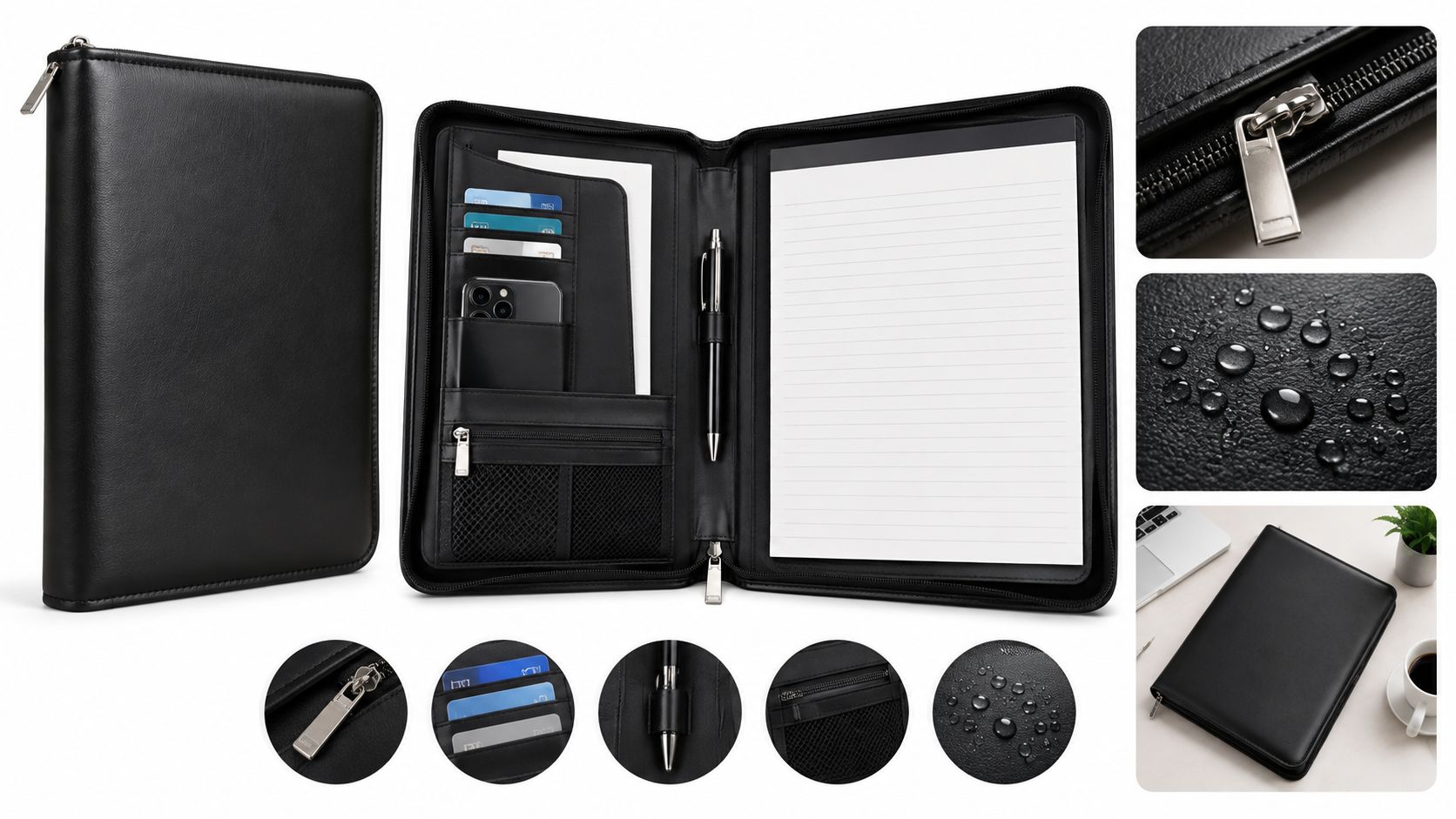
Identify the format before judging the pockets
A perimeter-zip folio opens like a book and has a zipper running around most or all of its outer edge. It can open wide, giving you a clear view of the inside. A zippered padfolio typically adds a notepad or writing pad, with pockets and card slots arranged alongside it. A larger document case is intended to carry full-size papers, such as A4 or legal documents, and may offer less of a meeting-ready writing surface.
Don't assume every portfolio has the same internal layout. Look for a document pocket, a notepad or pad slot, card slots, a pen loop or sleeve, and, if you need it, a separate compartment for a tablet. Each feature takes space. A pen loop may keep a writing instrument from moving around, but it doesn't replace a protected sleeve for a device.
Match the closure to how you open the case
A full-perimeter zipper generally gives you a wider opening than a top-only zipper or a simple flap. That makes the inside easier to see and reach, but you'll need room to open the folio fully. A three-sided zipper offers broad access while leaving one edge connected. A flap closure opens quickly, but it doesn't fully enclose loose contents.
Check the interior dimensions, not just the outside measurements. Your papers need to lie flat, and the pockets shouldn't force their corners to curl. If a product page doesn't clearly identify the closure path or show the case open, ask the maker before buying. The exterior shape alone won't tell you whether the layout suits your work.
Zippered vs Non-Zippered Portfolios
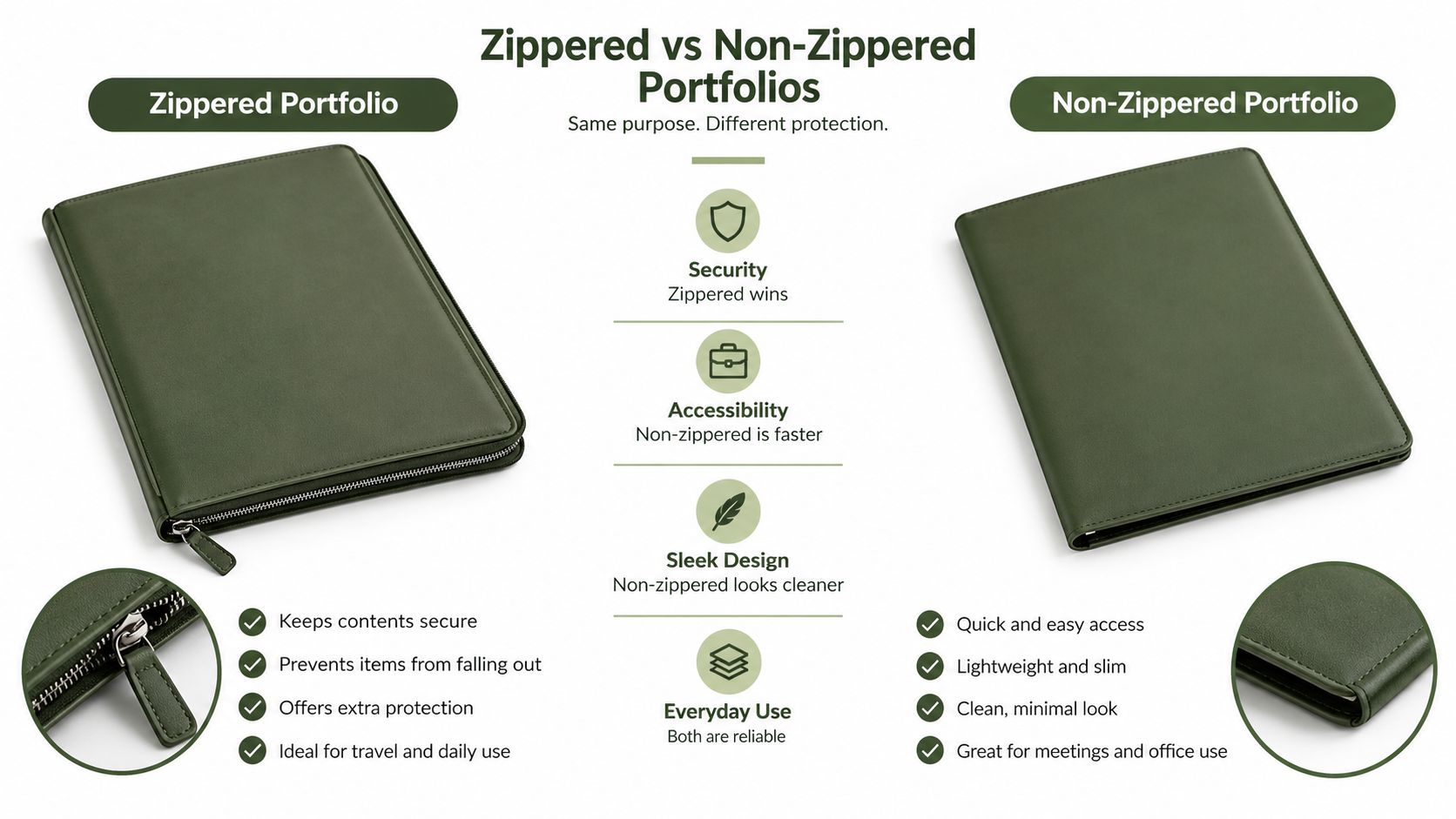
A zippered folio and an open folio solve different problems. One prioritizes enclosure; the other makes quick access easier. Compare them by what you carry and where you use them, rather than assuming that either style is universally better.
| Buying factor | Zippered portfolio | Non-zippered portfolio |
|---|---|---|
| Containment under movement | Better for loose papers, small accessories, and travel | Depends on pockets or a flap; loose items can escape |
| Access during a meeting | Requires operating the zipper before opening | Usually faster to open and set down |
| Visual discretion | Encloses contents when closed | Contents may be easier to glimpse from the side |
| Weight | Adds zipper hardware and tape | Usually lighter, all else being equal |
| Capacity pressure | Overfilling stresses the closure | No perimeter zipper to strain, though the folio can still bulge |
| Price | Construction and hardware can affect price | Often simpler, but material and workmanship still matter |
Choose for the setting, not the label
A zippered portfolio is usually the sensible pick for commuters, travelers, and anyone carrying loose papers or small electronics. It contains the load when the case moves between a desk, bag, and vehicle. It also makes it easier to carry a mix of paper and small items without relying on a flap to hold everything in place.
A non-zippered folio is often preferable if you spend most of your time seated in meetings, want to open the case immediately, or carry only a notebook and a few stable documents. It's lighter and has fewer closure parts, but that convenience comes with less enclosure.
Capacity is where buyers make the wrong trade-off. A zipper doesn't turn a slim folio into a roomy briefcase. Once contents press hard against the edges, the closure has to work under tension, and the case gets harder to open and close.
My recommendation is direct: pick the zippered style when containment matters more than instant access. Pick an open folio when speed and lightness matter more than enclosing loose contents. Then judge the construction, because a zipper is only useful if the case can support the way you use it.
Construction Details That Actually Predict Longevity
“Premium zipper” and “heavy-duty hardware” don't tell you how a portfolio will perform. Ask what the zipper is designed to withstand, how its ends are secured, and whether the leather, stitching, and closure have been considered as one assembly.
YKK describes zipper tests under JIS S3015 and ASTM D2061 frameworks. These include measurements of chain strength, stop strength, separating-unit strength, slider-lock strength, and pull-tab strength. For several strength measurements, the listed method uses a tensile speed of 300 mm/min and a clamp width of 25 mm; pull-tab testing uses 100 mm/min, with loading at 90° and 45°. YKK's zipper testing methods give you a useful vocabulary for asking a maker about real performance rather than relying on an undefined “heavy duty” label.
Use this inspection checklist
| Component | What to check | Why it matters |
|---|---|---|
| Zipper chain | Ask whether it's coil or molded, and whether the maker specifies standard or abrasion-resistant construction | Chain type and construction affect how the closure responds to repeated use and contact |
| Zipper tape and corners | Look for firm attachment and reinforcement where the zipper turns | Corners concentrate bending and pulling forces |
| Top and bottom stops | Check whether the ends are secured and backed by sound stitching | Stops keep the slider from pulling off the chain |
| Slider and lock | Ask how the slider stays in position when closed | A locking slider can help prevent unintended opening |
| Pull tab | Inspect how the tab attaches and whether it feels sturdy enough for normal use | Angular pulls can put stress on the attachment point |
| Leather surface | Look for full-grain or minimally corrected leather, with a finish that doesn't hide every natural mark | The surface and finish affect how the leather wears |
| Stitching and edges | Check for even seams, secure zipper attachment, and neatly finished edges | Weak stitching or brittle edge paint can undermine an otherwise sound case |
| Finished-product testing | Ask whether the filled portfolio is flexed, opened repeatedly, and checked under load | Component quality doesn't guarantee the assembled case will perform well |
Judge the whole case, not one specification
Leather durability isn't captured by thickness alone. Flex resistance, abrasion resistance, tear strength, seam strength, and finish cracking all matter, especially around a portfolio's spine, corners, and zipper attachment line. ISO 5402 is a relevant method for assessing leather flex resistance, but cycle results vary by leather type, finish, thickness, and intended use, so a universal cycle claim isn't meaningful.
Full-grain leather retains the hide's natural outer surface with minimal correction. That's a useful material description, not a promise that every full-grain case will outlast every alternative. Look for thoughtful construction: reinforced zipper attachment, consistent seams, protected edges, and a maker that can explain how the finished product is tested. For a broader way to think about durability in long-lived purchases, see this guide to furniture that lasts.
For more leather-specific buying criteria, Grainmark's leather bag quality guide offers another useful reference. Apply the same habit here: ask what a product is made of, then inspect how the materials and hardware are joined.
Matching the Portfolio to the Way You Work
A portfolio that looks compact online may fail on the day you need to carry a tablet, paper files, and writing tools together. Start with what you bring to work, then choose a size that contains it without making access awkward. A large case can feel cumbersome if your daily load is only notes and a few loose sheets.
Choose around a real workday
- Lawyer or consultant: For case files and meeting notes, choose a document case that lets papers lie flat. A slim portfolio won't protect a laptop unless it has a suitable padded compartment. If you carry a laptop regularly, use a briefcase for it and keep the portfolio for documents and notes.
- Designer or architect: Match the case to the paper size you transport. Sketches and a tablet need room without sharp folds or pressure from other contents. If your work involves oversized sheets, choose a format that fits them rather than forcing them into a standard document case.

- Frequent flyer: A perimeter zipper keeps documents and small accessories contained inside a carry-on. Choose a size you can remove and open easily, and keep bulky electronics and dense accessories in your main bag. The zipper is a load-bearing closure, not a reason to pack the folio beyond its capacity.
- Student or writer: A padfolio suits a workday that calls for a writing surface, notebook slot, and storage for pens and cards. Review the layout before choosing, using Grainmark's personalized leather padfolio information to identify which features fit your routine.
Buying test: check fit, closure, and access
The zipper became a familiar fastening on portable goods through mass production. By 1930, Talon was producing approximately 30 million fasteners for B.F. Goodrich boots, about 16 years after Sundback's 1914 Hookless No. 1 design. The zipper's early move into mass production traces that shift.
Before buying, lay out your ordinary workday load. Compare formats the way you would compare furniture options before buying, then check your largest paper, device, and notebook against the interior dimensions. Test whether the case closes without pushing contents against the zipper or forcing the slider. Choose a perimeter-zip folio when keeping items contained matters more than grabbing them quickly. If your load changes substantially each day, use the portfolio for documents and stationery inside a larger work bag.
How to Pack a Zippered Portfolio Without Damaging It
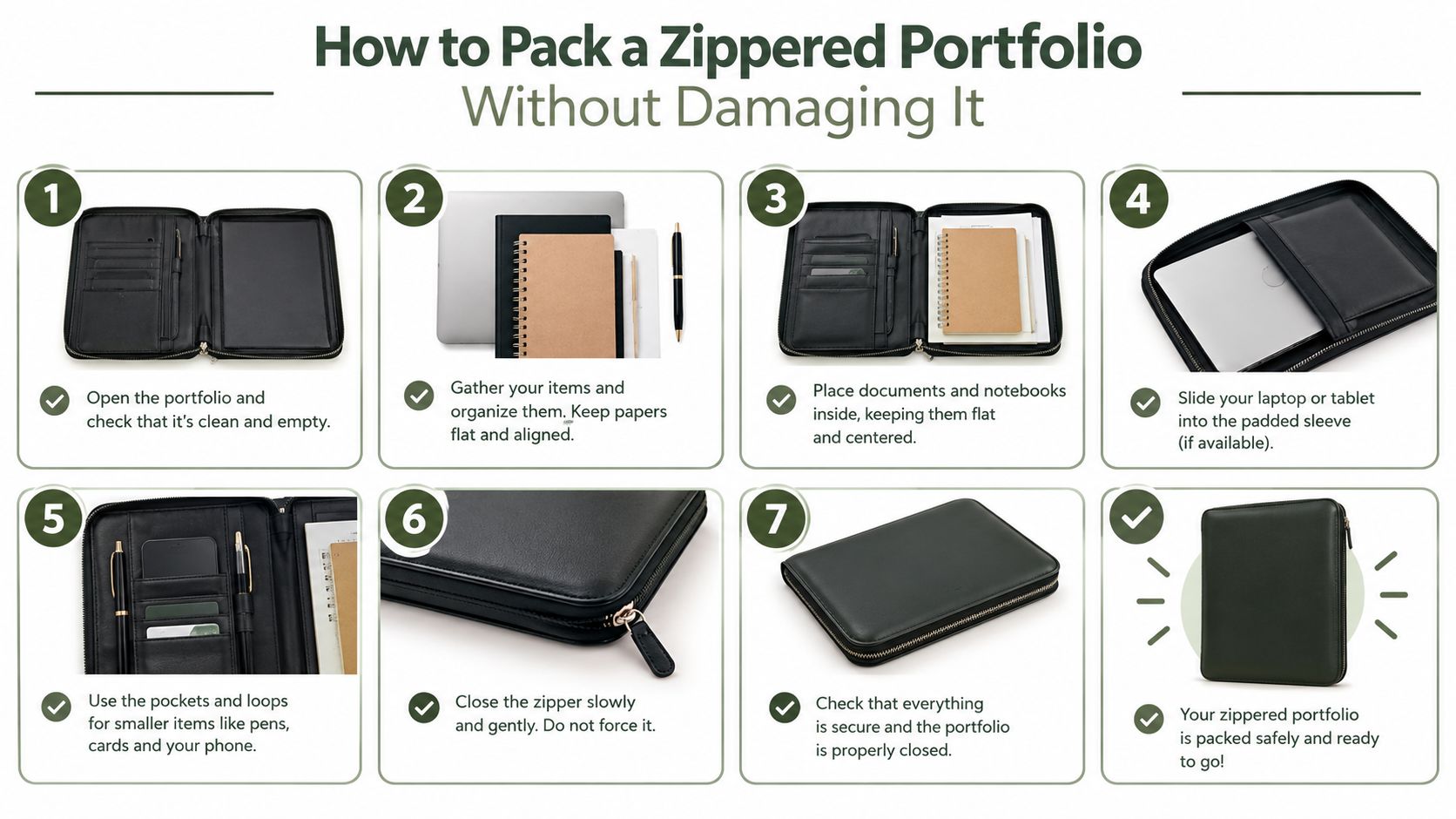
Pack the case to lie flat and close without force. If you have to squeeze the sides together to move the slider, remove something. An overstuffed portfolio puts transverse load on the zipper chain, the kind of strain that strength testing is intended to assess. Smooth slider travel on an empty case doesn't prove that the closure can handle repeated use under lateral tension.
Load it from the spine outward
Start with the heaviest flat items closest to the spine. That gives the portfolio a stable center and keeps hard edges from pressing into the zipper line. Keep paper stacks aligned and flat, rather than forcing oversized sheets into a smaller compartment.
Place a tablet in its own padded sleeve. A portfolio's zipper prevents items from falling out; it doesn't cushion a device from pressure caused by notebooks, chargers, or accessories. Store pens in a dedicated loop or sleeve, preferably positioned so an exposed nib or loose cap won't rub against the leather or paper. For fountain pens, follow sensible carry practices such as securing the cap and keeping the pen in a protective sleeve; Grainmark's fountain pen travel guide covers related considerations.
Route cables so they don't cross the teeth or pull against the zipper tape. Small hard accessories should sit in a pocket rather than against a tablet screen. If the case closes with a bulge, treat that as a capacity warning, not a cue to pull harder.
Practical rule: Close the zipper with the contents arranged naturally. Never use the slider to compress the load.
For air travel, keep the folio easy to remove from your carry-on and open flat when you need to access its contents. A crowded case that takes effort to unzip is slower to manage at a checkpoint and more likely to catch on nearby items. The best packing order is simple: flat, heavy items near the spine; fragile devices in their own protection; pens and cables secured away from the chain.
Sustainability, Repair, and When to Replace
Full-grain leather isn't automatically sustainable. A product's useful life depends on its construction, whether key parts can be repaired, how it's maintained, and whether you'll use it consistently. The zipper, lining, stitching, and edges matter as much as the leather label.
A practical way to compare options is purchase price divided by expected years of service, plus likely repair costs. A $200 portfolio that serves you for ten repaired years might be better value than a $90 one replaced three times, but only if those service lives are realistic and the repairs are accessible. Use this as a decision framework, not a guarantee about any particular product.
Run a repairability audit
Before buying, ask whether a repairer can replace the zipper, swap a damaged slider, restitch the attachment line, patch the lining, or restore worn edge paint. A small pull-tab problem may be straightforward to fix; damaged zipper teeth or torn leather at the seam may require more involved work. Check whether the maker offers repair help or can explain how a local leather repair shop could work on the case.
Care helps, but it isn't a cure-all. Brush away grit before it settles into the zipper tape, avoid forcing the slider past a snag, and use leather products suited to the finish. If the zipper jams, inspect for trapped fabric or debris rather than pulling harder. For broader advice on material lifespan, Grainmark's full-grain leather lifespan guide is a useful starting point.
Repair is part of the buying decision, not an afterthought. One market estimate puts leather-goods repair-services value at $2.13 billion in 2024 and $2.29 billion in 2025, a reported 7.4% increase; these figures describe an estimate, not a guarantee of repair access for any individual portfolio. Market reporting on leather-goods repair supports treating repair as a relevant option, while the condition of your actual case should drive the decision.
Know when repair stops making sense
Replace the portfolio when failed teeth keep skipping under light load, the leather has cracked across a flex point, or the lining no longer protects what you carry. If a repair would cost nearly as much as a suitable replacement and leave the case unreliable, replacement may be the sensible choice. Don't retire a sound portfolio just because it shows ordinary wear, but don't trust a closure that can't hold its load.
Care Routine and Final Buying Checklist
A simple routine protects the leather and helps keep the zipper moving freely. Brush off grit before it works into the zipper tape, store the portfolio flat or upright with its contents removed, and deal with small stains before they set. Condition only with a product suited to the leather's finish. Grainmark's guide to conditioning leather can help you approach that step with care.
Before checkout, use this checklist:
- Leather: Confirm the leather description and inspect what the finish allows you to see.
- Zipper: Ask about chain construction, stop reinforcement, and any test backing the maker can provide.
- Stitching and edges: Look for even seams, secure zipper attachment, and a clean, flexible edge finish.
- Layout: Check that the pockets and compartments fit your papers, notebook, pens, and protected device.
- Capacity: Confirm the case closes without compressing or bulging around your normal load.
- Repair: Ask whether the zipper, pull, lining, or stitching can be repaired and who can do the work.
Buy for the load you carry, not the most impressive list of features. If the case fits that load without forcing the zipper, and the maker can explain its construction and repair options, you've found a more dependable companion for work and travel.
Grainmark Leather offers full-grain leather bags, cases, and small goods, including portfolio and padfolio options for organizing work essentials. Compare the dimensions, layout, and closure details against your daily carry, then visit Grainmark Leather to explore the available styles.