How to Travel with Expensive Fountain Pens Without Leaks or Damage
The safest way to travel with expensive fountain pens in 2026 is to carry them in cabin baggage, keep inked pens nib-up during ascent and descent, fly with each pen either full or empty, and use a structured case with a secondary leak barrier.
Fountain pens usually leak on flights because lower cabin pressure allows trapped air inside the converter, piston chamber, or cartridge area to expand and push ink through the feed.
Pens are allowed in carry-on and checked bags under TSA guidance, while bottled ink must still follow liquid rules when carried through security.
For a Montblanc, Pelikan, Pilot Custom 823, Sailor 1911, Visconti, Lamy 2000, or vintage Parker, safe travel comes down to four habits: reduce loose air, protect the nib, separate pens from hard objects, and never let a prized writer roll loose in a laptop compartment.
Why Fountain Pens Leak On Flights

Fountain pens leak on flights because air expands as pressure drops, and expanding air inside an ink reservoir can force liquid ink into the feed and cap.
Modern aircraft cabins are pressurized, but certification rules aim to limit passenger exposure to cabin pressure altitudes above 8,000 feet rather than keep cabin pressure equal to sea level.
A fountain pen depends on a delicate exchange of ink and air. At a desk, capillary action and gravity move ink from the reservoir to the feed in a measured way.
On a plane, a large air bubble inside a partially filled converter or piston chamber has room to grow.
NASA explains Boyle’s law as the pressure-volume relationship in which gas volume changes as pressure changes when temperature and gas amount stay constant.
Put plainly: air causes the mess, not the ink. A full pen leaves less air to expand. An empty pen leaves no ink to expel. A half-filled pen has both ink and air, making it the riskiest setup for takeoff.
The Best Pre-Flight Setup: Full, Empty, Or Cartridge
The best pre-flight setup is either a full pen, an empty pen, or a sealed cartridge carried separately.
A partially filled converter or piston filler is the least predictable option because a larger air pocket can pressurize the feed.
| Setup | Best Use | Leak Risk | Practical Move |
|---|---|---|---|
| Completely full pen | Short trips, daily writer | Low to moderate | Wipe feed, cap tightly, keep nib-up |
| Completely empty pen | Rare or very valuable pen | Lowest | Clean and dry before packing |
| Cartridge carried separately | Conferences, forms, journaling | Low | Install after landing or at cruising altitude |
| Half-filled piston or converter | Last-minute packing | Higher | Top up or empty before airport arrival |
| Bottled ink | Long stays | Moderate | Use 100 ml or smaller container in liquids bag |
Cartridges suit travel because each unit is sealed, light, and easy to replace after landing.
Bottled ink still makes sense for longer trips, but a 30 ml or 50 ml glass bottle adds spill risk, breakage risk, and screening hassle.
A plastic sample vial with a tight cap, placed inside a zip bag with tissue, usually makes more sense than a full retail bottle.
Carry On Beats Checked Luggage

Carry-on baggage is safer for expensive fountain pens because pens stay close, upright, and protected from rough handling.
TSA lists pens as permitted in both carry-on and checked bags, but the final decision at screening remains with the officer.
Collectors should treat a fountain pen like a watch, camera lens, or jewelry item.
Replacement value matters, but sentimental value matters more.
A restored family Parker 51 or a limited edition Montblanc cannot always be replaced at retail.
Cabin carry also allows one more advantage: during ascent, a pen can remain nib-up in a seat pocket, inner jacket pocket, or upright pouch rather than lying sideways under a stack of clothes.
Ink And Security Rules In 2026
Bottled fountain pen ink counts as liquid for airport screening, so pack it under current liquid limits.
Traveling soon? Liquids, creams, gels, and aerosols need to be 3.4 oz or less in your carry-on bag. Larger amounts of sunscreen or other liquids should be packed in your checked bag or purchased at your destination. Learn more at: https://t.co/PdGvIArQrl pic.twitter.com/5VCfK6iPIs
— TSA (@TSA) April 22, 2021
TSA says liquids, gels, and aerosols above 3.4 oz or 100 ml should go in checked baggage, while IATA notes many countries restrict carry-on liquid containers to 100 ml inside a transparent resealable bag with a maximum capacity of 1 liter.
For international routes, follow the strictest airport on the itinerary, not the most relaxed one. Fountain pen ink in a 30 ml bottle generally fits the liquid framework.
A 120 ml bottle, even half full, may fail because limits usually apply to container capacity, not remaining liquid.
A safe 2026 ink kit is small: two sealed cartridges, one 5 ml sample vial, one folded tissue, one microfiber cloth, and one resealable plastic bag for any pen already inked.
Avoid carrying irreplaceable vintage ink bottles. Airport staff will not care that a discontinued bottle of Parker Penman Sapphire has collector value.
A Better Packing System For Fountain Pens
A good travel setup has two layers: a primary pen case for impact protection and a leak layer for ink containment.
The case protects resin, lacquer, urushi, celluloid, ebonite, trim, clips, and nibs from knocks. The leak layer protects clothing, documents, and electronics from a surprise ink bloom.
Leather Single Fountain Pen Case

For one special pen, our Leather Single Fountain Pen Case gives a slim single-slot option for one standard or oversized pen, with listed dimensions of 17 × 3.5 cm and a weight of 28 g.
It suits a business traveler carrying one main writer for meetings, signatures, or a journal.
3 Slots Retro Leather Pen Pouch

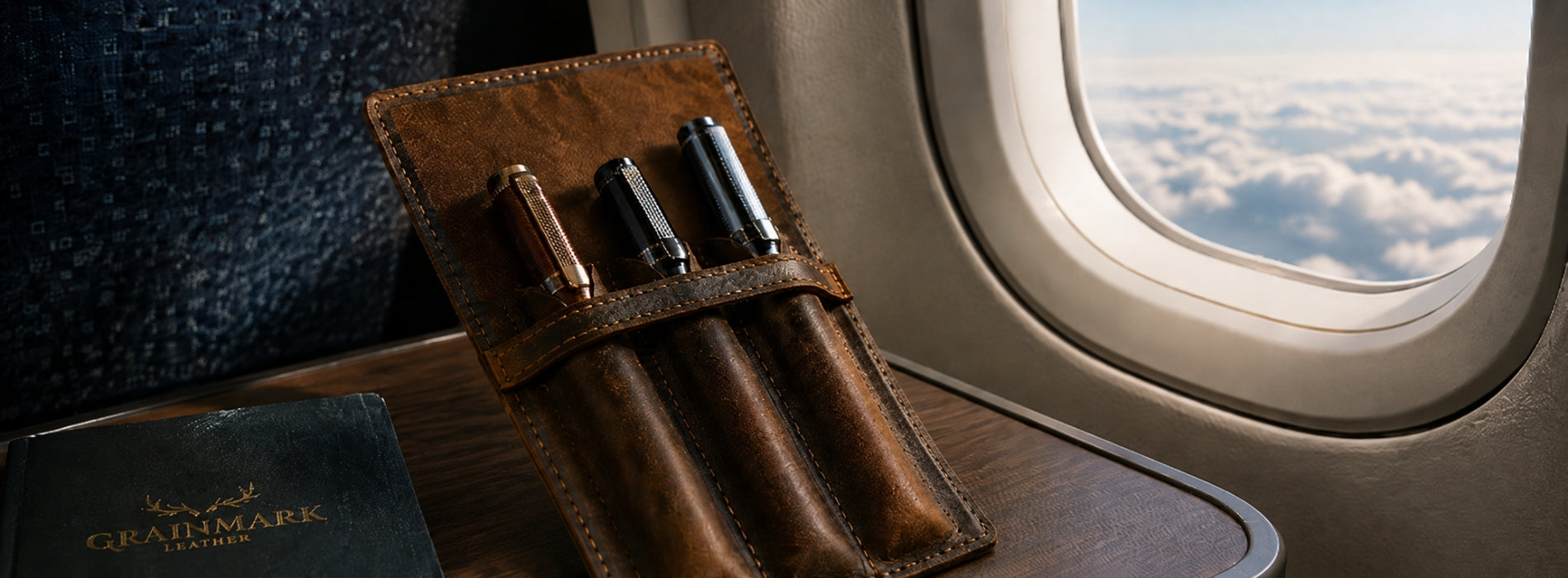
For a small rotation, our 3 Slots Retro Leather Pen Pouch uses separate molded slots, a flap-and-loop closure, hot-press molded leather, and a 15.5 × 8.6 × 2 cm profile.
Separation matters because two polished pen bodies rubbing together for six hours can create micro-scratches long before any leak appears.
Leather 5 Slots Zippered Pen Case

For longer trips, Grainmark Leather’s Leather 5 Slots Zippered Pen Case holds up to five pens plus cards, cash, or erasers, with elastic loops, a mesh pocket, a zip-around closure, and a 180 × 105 × 25 mm listed size.
A zip case will not stop pressure physics, but it can keep pens grouped, separated, and easy to inspect at the hotel.
Best Orientation During A Flight

Keep an inked fountain pen nib-up during boarding, taxi, ascent, descent, and landing.
Nib-up orientation keeps liquid ink away from the feed while the air pocket expands.
Fountain pen specialists commonly recommend removing pens from a carry-on and flying with them nibs-up in the seat pocket, while also warning travelers not to forget them when leaving the aircraft, according to The Gentleman Stationer.
When writing during the flight is necessary, wait until cruising altitude after cabin pressure stabilizes. Open the cap slowly with the nib pointing upward, then inspect the section before placing the nib on the paper.
Avoid using a wet, broad, flex, or music nib on tray-table paperwork unless a cloth is ready.
After landing, do not immediately uncap a valuable pen over a white shirt, passport, or hotel check-in form. Hold the pen nib-up, loosen the cap slowly, and give the feed a moment to settle.
Pen Types And Leak Risk
Different filling systems travel differently. Brand prestige does not cancel physics.
A $900 piston filler can leak when half full and sideways, while a modest cartridge pen can arrive spotless.
| Pen Type | Travel Behavior | Best Travel Method |
|---|---|---|
| Cartridge pen | Simple, predictable, easy refill | Carry cartridges separately |
| Converter pen | Good if full, risky if half-filled | Fill fully or empty converter |
| Piston filler | Large ink capacity, larger air space when partly used | Top up before the flight |
| Vacuum filler | Often has a shutoff valve, but pressure can still surprise users | Keep full, shut, nib-up, open cautiously |
| Eyedropper pen | High capacity, large air chamber when partly filled | Avoid air travel unless full and bagged |
| Vintage lever or sac pen | Age and seal condition vary | Clean and carry dry if valuable |
Specialist retailers and pen writers often give similar advice: fly with pens full or empty, keep them nib-up, and use a padded case or sleeve, as Appelboom explains.
Leak risk rises when a pen has a loose converter, cracked section, poor nib-feed fit, or dried ink in the feed.
Fountain Pen Revolution’s leak guide also points to common leak causes such as cracks, loose parts, overfilling, temperature, and maintenance problems.
What To Do If A Pen Leaks Mid Trip

If a fountain pen leaks during travel, keep the cap on until a sink, tissue, or hard surface is available. Panic uncapping often spreads ink from the cap lip to hands, cuffs, and bag lining.
Place the capped pen on tissue with the nib end slightly raised. Open slowly over a sink or disposable towel.
Wipe the section, cap threads, and grip first, then blot the feed rather than dragging tissue across nib tines. Rinse the cap interior if ink has pooled inside. Let the pen rest nib-up before reuse.
For celluloid, urushi, maki-e, or vintage hard rubber, avoid alcohol wipes. Plain water and a soft cloth are safer for most finishes.
Common Travel Mistakes With Expensive Pens
The biggest mistake is packing a half-filled fountain pen sideways inside a bag. A second mistake is trusting a luxury brand name more than basic preparation.
Even a well-made Pelikan Souverän, Pilot Custom 823, Sailor Pro Gear, Aurora 88, or Montblanc Meisterstück can release ink when air pressure, orientation, and storage all work against it.
Other common errors include carrying loose pens beside keys, packing ink bottles without a secondary plastic bag, opening a vacuum filler nib-down at cruising altitude, leaving a pen in direct sun inside a parked car after landing, and using permanent ink on a trip without cleanup supplies.
Bottom Line
Traveling with expensive fountain pens is safe when packing follows the mechanics of ink, air, pressure, and impact.
The most reliable formula is full or empty, nib-up, carry-on, structured case, and secondary leak protection.
Bottled ink belongs in a compliant liquids setup, while cartridges or sample vials reduce risk for most trips.
For one prized writer, a slim single pen case keeps travel elegant and controlled. For a working rotation, separated slots or a zipped case protect finishes and make inspection easier.
The goal is not to baby the pen so much that it never leaves the desk. The goal is to travel with enough care that a fine nib, lacquer barrel, or sentimental vintage pen arrives ready to write.