Do You Need a Cigar Case or a Travel Humidor? Here’s How to Decide
For the aficionado whose journey is brief, an evening at the lounge, a celebratory wedding, or a curated round of golf, the cigar case serves as the preeminent vessel.
It is designed for the immediate horizon, where sticks transition from the sanctuary of a primary humidor to be savored within hours of departure.
Conversely, when a voyage extends overnight or ventures into the unforgiving climates of air travel and desiccated hotel suites, a travel humidor becomes an absolute necessity to safeguard the integrity of the leaf.
In today’s contemporary landscape, these accessories are vital instruments of preservation that must harmonize with one's lifestyle and aesthetic sensibilities.
While a case prioritizes structural protection and sartorial grace, a true travel humidor integrates active moisture management, often featuring dedicated humidification reservoirs, precision hygrometers, and cedar-lined internals.
The choice hinges upon the duration of transit, environmental volatility, and the precious nature of the vitolas in question.
Cigar Case Vs Travel Humidor - The Core Difference

The fundamental axiom of tobacco transport is this: a cigar case defends against physical trauma, whereas a travel humidor defends against both trauma and the silent degradation of atmospheric imbalance.
A masterfully crafted leather case acts as a pocketable bastion, shielding delicate wrappers from the fractures and indentations common in the confines of a jacket pocket or briefcase.
Beyond utility, it imparts a sense of occasion; there is an undeniable gravitas in extracting a fine vitola from a full-grain leather sleeve that a common container simply cannot replicate.
A travel humidor, however, assumes the mantle of environmental stewardship. Cigar Aficionado posits that a true humidor must facilitate controlled airflow and active humidification, noting that any vessel lacking these is merely a box.
To maintain the "sweet spot" of maturation, one must aim for a relative humidity of 70 to 75 percent and a stable temperature near 70 degrees Fahrenheit.
| Decision Point | Cigar Case | Travel Humidor |
|---|---|---|
| Main role | Protects cigars from pressure and damage | Protects cigars and helps manage humidity |
| Best use | Same-day carry, lounge visit, dinner, wedding | Overnight travel, flights, hot weather |
| Typical capacity | 1 to 5 cigars | 5 to 10 cigars for compact models |
| Humidity control | Usually none | Humidifier slot, pack space, hygrometer, or sealed chamber |
| Style factor | Highest, especially in leather | More practical, still refined when leather wrapped |
| Grainmark example | The Fogwalker or 5-slot full-grain case | 7-slot premium leather travel humidor |
When a Cigar Case Is Enough
A dedicated case is more than sufficient when the interval between storage and combustion is measured in hours.
For the seasoned smoker, this encapsulates the majority of daily social engagements.
Whether attending a dinner engagement or an afternoon on the links, the objective is to prevent mechanical damage.
During these brief excursions, the cigar relies on its internal thermal mass and residual moisture; the priority is physical armor, not long-term conditioning.
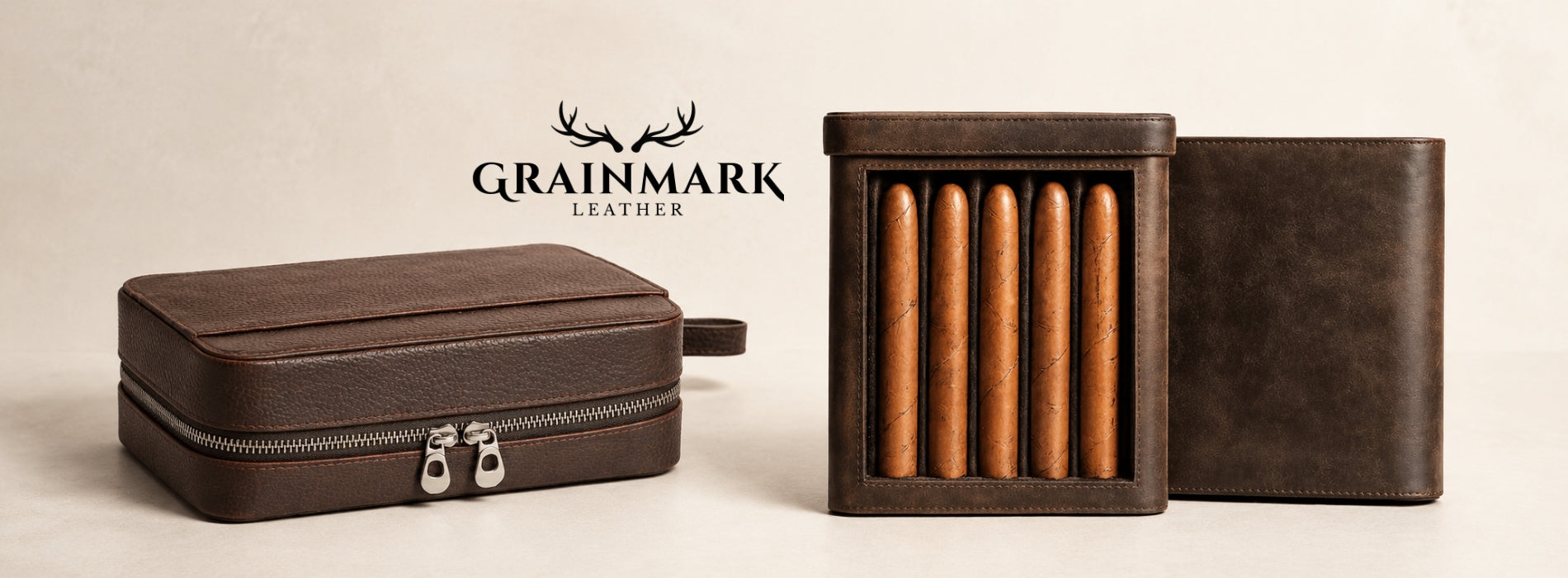
We Recommend: 5-Slot Full Grain Leather Cigar Case

Our 5-Slot Full Grain Leather Cigar Case accommodates five vitolas up to 6.5 inches with a 60 ring gauge, it integrates ergonomic pouches for your essential cutlery and flame.
Measuring 21.5 x 14 x 8 cm, it provides a commanding presence in a day bag without the cumbersome footprint of a stationary chest.
For more intimate gatherings, a minimalist approach is often preferred. Offerings like the 2-Slot Genuine Leather Case or "The Fogwalker" 3-Slot pouch are ideal for hosting a guest or enjoying a singular evening at the terrace.
These selections are curated within our travel humidor collection to meet the needs of the discerning traveler.
How Long Can Cigars Stay In a Case?

Without active humidification, a case should be viewed as a temporary transit cell. The rate of desiccation is dictated by ambient variables: climate, HVAC systems, and the initial hydration of the tobacco.
A tight seal can extend this window, but it is not an indefinite solution.
In climate-controlled environments, cigars can lose their essential oils at an alarming rate.
While a humidor facilitates years of graceful aging, a mere day in a dry room can render a fine stick unsmokable, underscoring the critical nature of humidity control as time elapses.
When a Travel Humidor Is the Better Choice
The transition to a travel humidor is mandatory when the voyage entails overnight stays or exposure to atmospheric extremes.
High-altitude flight cabins and arid hotel climates are notorious for stripping tobacco of its nuance.
Expert consensus suggests maintaining a range of 65 to 72 percent relative humidity. As noted by IP Industrie, keeping temperatures between 18 and 20 degrees Celsius is equally paramount.
Furthermore, Havana House observes that while long-term sleepers benefit from the lower end of that spectrum, vitolas intended for immediate enjoyment thrive closer to 70 percent.
We Recommend: 7-Slot Premium Full Grain Leather Cigar Humidor

Beyond its capacity for seven large vitolas, it features an integrated digital hygrometer, a dedicated humidification slot, and a Spanish cedar tray wrapped in suede to cradle the cigars.
At 748 g, it offers substantial environmental security for the dedicated traveler.
Why Humidity Changes the Smoke
Humidity is the architect of the smoking experience, governing the burn rate, draw, and flavor profile.
A desiccated cigar burns hot and acrid, while one that is oversaturated will struggle to stay lit and produce a heavy, muted smoke.
Fragility and a sharp, fast burn characterize a dry stick; conversely, excessive moisture invites uneven combustion and the risk of mold. Precision, therefore, is not a luxury but a requirement.
An Aficionado’s Framework for Selection
Navigating this choice requires a fourfold interrogation: the duration of the venture, the severity of the destination climate, the volume of the collection, and the rarity of the cigars being transported.
| Situation | Better Choice | Why |
|---|---|---|
| One cigar after dinner | 1-slot or 2-slot case | Easy pocket or jacket carry |
| Lounge visit with a guest | 2-slot or 3-slot case | Enough capacity without bulk |
| Golf day or business day | 5-slot cigar case | Room for cigars plus accessories |
| Weekend hotel stay | Travel humidor | Better humidity control |
| Destination wedding or holiday | Travel humidor | Plans may shift by a day or two |
| Rare or sentimental cigar | Travel humidor | Less risk for a cigar with meaning |
A sophisticated rotation often pairs a slim case for evening use with a robust travel humidor for weekend excursions.
Within the Grainmark Leather catalog, the distinction is clear: the Fogwalker serves the lounge, the 5-slot case serves the day-long event, and the 7-slot humidor stands as the definitive answer for the humidity-conscious voyager.
Material and Construction Details Worth Checking

While the exterior aesthetic of full-grain leather provides tactile pleasure and a lasting patina, the interior architecture is what ultimately preserves the leaf.
Rigidity and thoughtful compartmentalization are non-negotiable.
We emphasize small-batch craftsmanship, ensuring that each piece within our cigar case collection reflects a commitment to quality that evolves with use, developing a unique character over time.
Before committing to a purchase, scrutinize the slot dimensions, the integrity of the closure, and the efficiency of the accessory storage.
A true travel humidor is distinguished by its inclusion of climate monitoring and active humidification, alongside molded supports that eliminate damaging internal movement.
Flying With Cigars & the Small Rules Worth Checking

Regarding domestic air travel, while cutters are technically permitted, the TSA advises checked transport to avoid the vagaries of checkpoint discretion, as outlined in their cigar cutter guidance.
Lighters demand even greater vigilance. TSA mandates that torch lighters, the aficionado’s preferred tool, remain prohibited.
Conversely, disposable and unfueled Zippo lighters are generally accepted in checked baggage, subject to Department of Transportation oversight.
A prudent traveler carries their cigars in a dedicated travel humidor, opts for a modest cutter rather than an irreplaceable heirloom, and meticulously reviews the current regulations of their airline and destination authority.
The Final Verdict
The distinction is absolute: the cigar case is for transport; the travel humidor is for preservation. Understanding this is the hallmark of a true aficionado.
Reserve the case for the elegance of a single day’s ritual. Entrust the travel humidor with your rare acquisitions, your multi-day excursions, and any scenario where the integrity of the tobacco cannot be compromised by the environment.
Grainmark Leather offers a comprehensive spectrum for these needs.
From the minimalist 2-slot case to the 7-slot premium humidor, their collection ensures that whether you are venturing out for an hour or a week, your cigars arrive in the same pristine condition they left your humidor.
Exercise caution: never mistake an aesthetic carrier for a functional humidor.
Avoid the catastrophic heat of a parked vehicle and remain mindful that tobacco is a sponge for ambient aromas; keep your collection away from potent fragrances and leather treatments to preserve the purity of the blend.
Ultimately, the superior choice is not defined by volume, but by a respect for the leaf, the occasion, and the journey itself.