
Leather Sunglass Cases: How to Choose and Care for Them
A leather exterior doesn't automatically make a sunglass case protective. The details that matter most are often hidden: whether the lining is smooth, whether the frame fits without rattling, and whether the case holds its shape under pressure. A beautifully made case can still scratch lenses or let frames bend if those details are wrong.
Choose the case as a piece of protective equipment first and a leather accessory second. Once fit and construction are right, leather grade, finish, and personalisation can help make it a useful everyday item that wears well over time.
Table of Contents
- Why the Case Matters More Than the Brand
- What Actually Does the Protecting Inside a Leather Case
- Soft Sleeves, Semi-Rigid Clamshells, and Hard Boxes Compared
- Sizing and Fit for Different Frame Shapes
- Personalisation and Coordinating With Other Leather Goods
- Heat, Humidity, and Other Storage Risks Buyers Overlook
- Care and Conditioning for the Case Itself
- Buying Checklist and Common Questions Answered
Why the Case Matters More Than the Brand
The name stamped on a leather case tells you almost nothing about whether your frames survive the day. In a bag, the case takes the hits: keys drag across it, a charger presses into it, and whatever sits on top tests whether the walls hold their shape. The logo handles none of that. What decides the outcome is the lining against the lens, the clearance around the frame, and how the body behaves when the bag warms up in a parked car or gets compressed under a laptop.
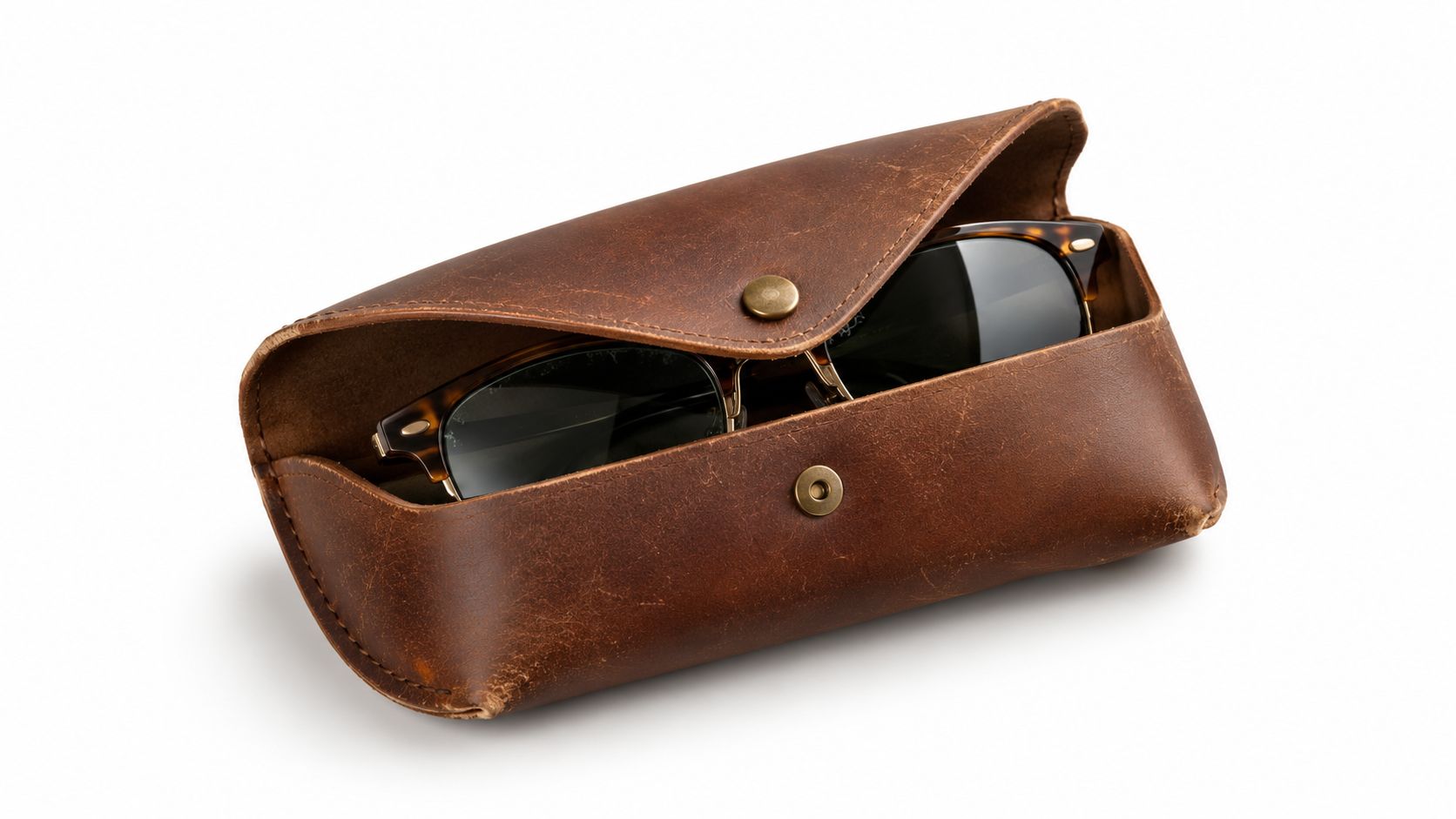
Sunglasses became everyday kit faster than many owners assume. The College of Optometrists' British Optical Association Museum identifies 1916 as a milestone in the promotion of sunglasses as a distinct product category, and its account describes how aviation and mountaineering shaped their design in the 1920s (history of sunglasses from the College of Optometrists). Once eyewear moved into daily carry and travel, storing it safely between wears stopped being optional.
Leather cases were solving that problem long before modern branding existed. Winterthur Museum records a leather spectacles case made between 1800 and 1830, and the Metropolitan Museum of Art preserves an American leather eyeglass case made around 1860. Both are narrow forms built to hold folded spectacles rather than to impress (Winterthur's leather spectacles case).
What to judge before the logo
Handle the case the way your bag will. Check the lining for grain ridges or exposed hardware, confirm the frames sit without rattling, and press the body to see whether it flexes or holds. Then consider the exterior. For a closer look at how leather itself wears, Grainmark's guide to full-grain leather lifespan can help separate surface durability from the protection the interior provides.
The wider market gives context here, though it says nothing about any single case: the global sunglasses market generated approximately US$38.7 billion in 2024 and is projected to reach about US$72.8 billion by 2030 (Grand View Research). More frames in more bags means the unglamorous details inside the case deserve the same scrutiny as the hide outside.
What Actually Does the Protecting Inside a Leather Case
Leather is the outer shell, not the whole protection system. A polished hide can conceal an interior that catches a lens, a closure that pops open, or a body that gives way in a packed bag. Before buying, open the case and examine what touches the glasses.
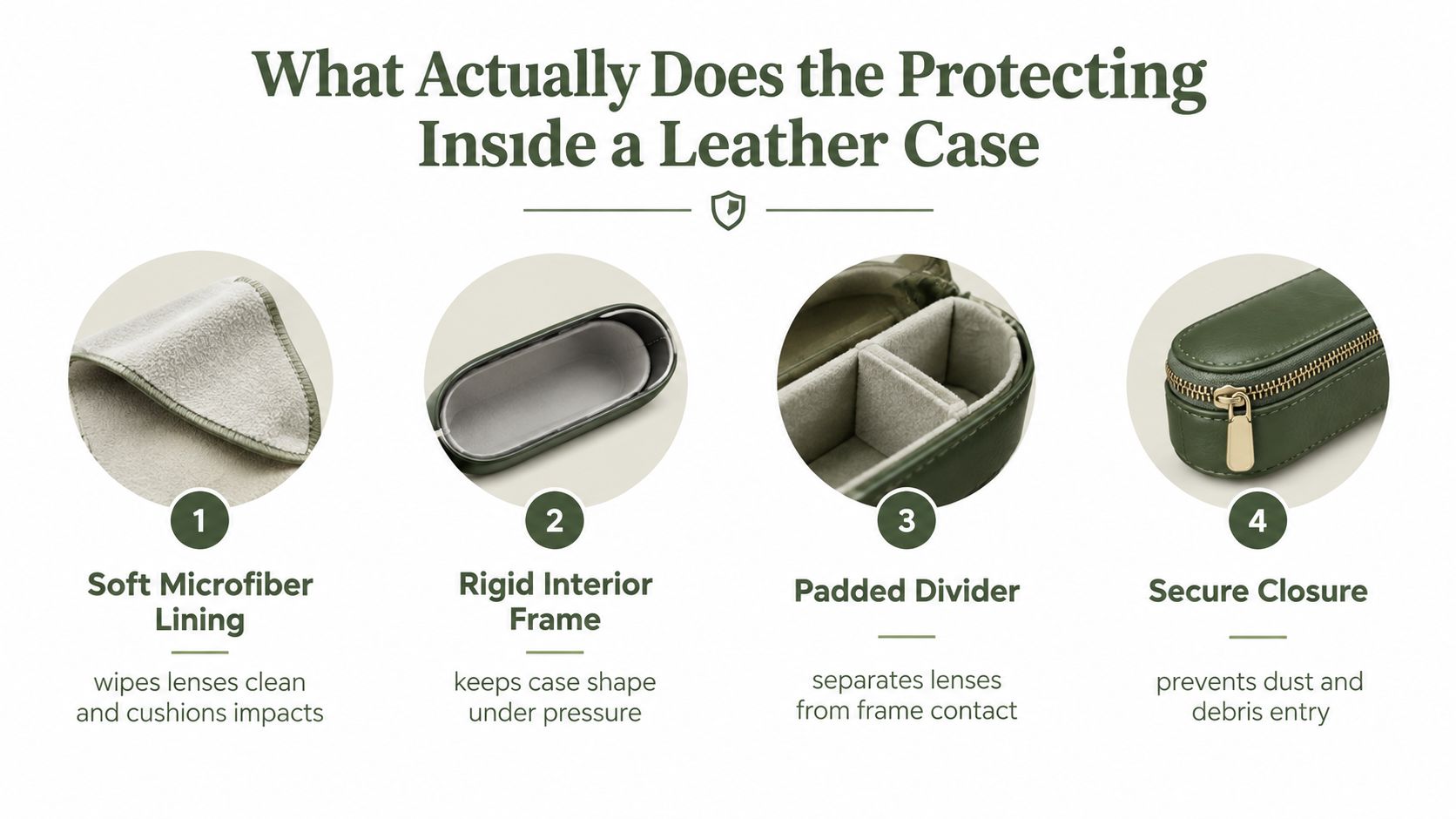
Lens coatings can be damaged by abrasion, and scratch-resistant doesn't mean scratch-proof. Coating defects can include scratches, haze, adhesion failure, and increased light scatter, so a case should keep the lens surfaces away from rough grain, seam ridges, exposed hardware, and debris (research on optical coating defects).
A good interior feels smooth and clean, with seams placed where they won't drag across the lenses. The glasses should sit securely without pressure on the lens or hinges. Check for a lining that sheds lint or has loose threads, and look for rivets, magnets, or unfinished edges that intrude into the compartment.
Practical rule: If the case's interior can touch the lens, assess that contact surface as carefully as you assess the leather outside.
A quick inspection checklist
- Lining: Choose a soft, smooth material that doesn't leave lint or catch on frame details. Grainmark's overview of suede lining versus fabric can help clarify the trade-offs between common interior materials.
- Fit: The glasses should stay in place without being forced in or rattling around.
- Structure: Press the closed case gently. If it collapses easily, it may offer little resistance to pressure in a bag.
- Closure: It should remain shut during movement but open without a forceful tug that twists the frame.
A complete case also needs testing as a unit. Repeated opening and closing can reveal a weak closure or a lining that shifts; gentle compression can show whether the case holds its shape. Look for visible lens scratching, frame deformation, and hinge misalignment after testing. Standards for protective eyewear include impact tests, but those apply to eyewear assemblies, not ordinary fashion cases. Don't treat a leather case as safety-rated unless the complete system has been independently tested to a recognised standard.
Soft Sleeves, Semi-Rigid Clamshells, and Hard Boxes Compared
There's no single format that suits every pair or routine. A slim sleeve is easy to carry, but it can't provide the same crush resistance as a structured case. A rigid box may protect more effectively against pressure, but its bulk can make it a poor fit for daily commuting.
| Format | Crush resistance | Best for | Trade-off |
|---|---|---|---|
| Soft leather sleeve | Low | Light carry when the glasses won't be packed beneath other items | Slim and easy to pocket, but offers little resistance to crushing |
| Semi-rigid clamshell | Moderate | Everyday bags, commuting, and travel | Balances structure and weight, but still needs a secure closure and a fitted interior |
| Rigid hard box | High | Luggage or bags where heavier pressure is likely | Stronger crush protection, with more bulk |
A soft sleeve works well when the main concern is keeping glasses clean and separate from loose objects. It's less suited to a packed backpack or suitcase, where books, bottles, or electronics could press against the frames. If you choose this style, give it a dedicated pocket rather than tossing it into a crowded bag.
A semi-rigid clamshell is a practical middle ground for many owners. A supportive insert beneath the leather helps the case resist collapse, while a soft lining limits direct contact with the frames. Check that the case closes securely and doesn't require you to squeeze the glasses into place. Too much structure won't help if the frame is under constant pressure.
A case should match the load it's likely to face, not just the way it looks on a shelf.
A hard box makes sense when the glasses are packed among heavier travel items or when the wearer wants added protection against pressure. Its downside is straightforward: more protection usually means more space taken up. If the case stays in a coat pocket or small everyday bag, that extra volume may make it inconvenient enough to leave behind.
Choose by routine. For light, controlled carry, a sleeve may be enough. For mixed commuting and travel, a semi-rigid design often balances protection with portability. For luggage or heavier packing, favour a sturdier shell, while still checking the lining and fit.
Sizing and Fit for Different Frame Shapes
A case that's too tight can press on temples, hinges, or lenses. One that's too roomy lets the frames shift and rub against the interior. Don't rely on labels such as “large” or “oversized” alone. Compare the actual glasses with the case's internal dimensions, and consider the frame's depth as well as its width.
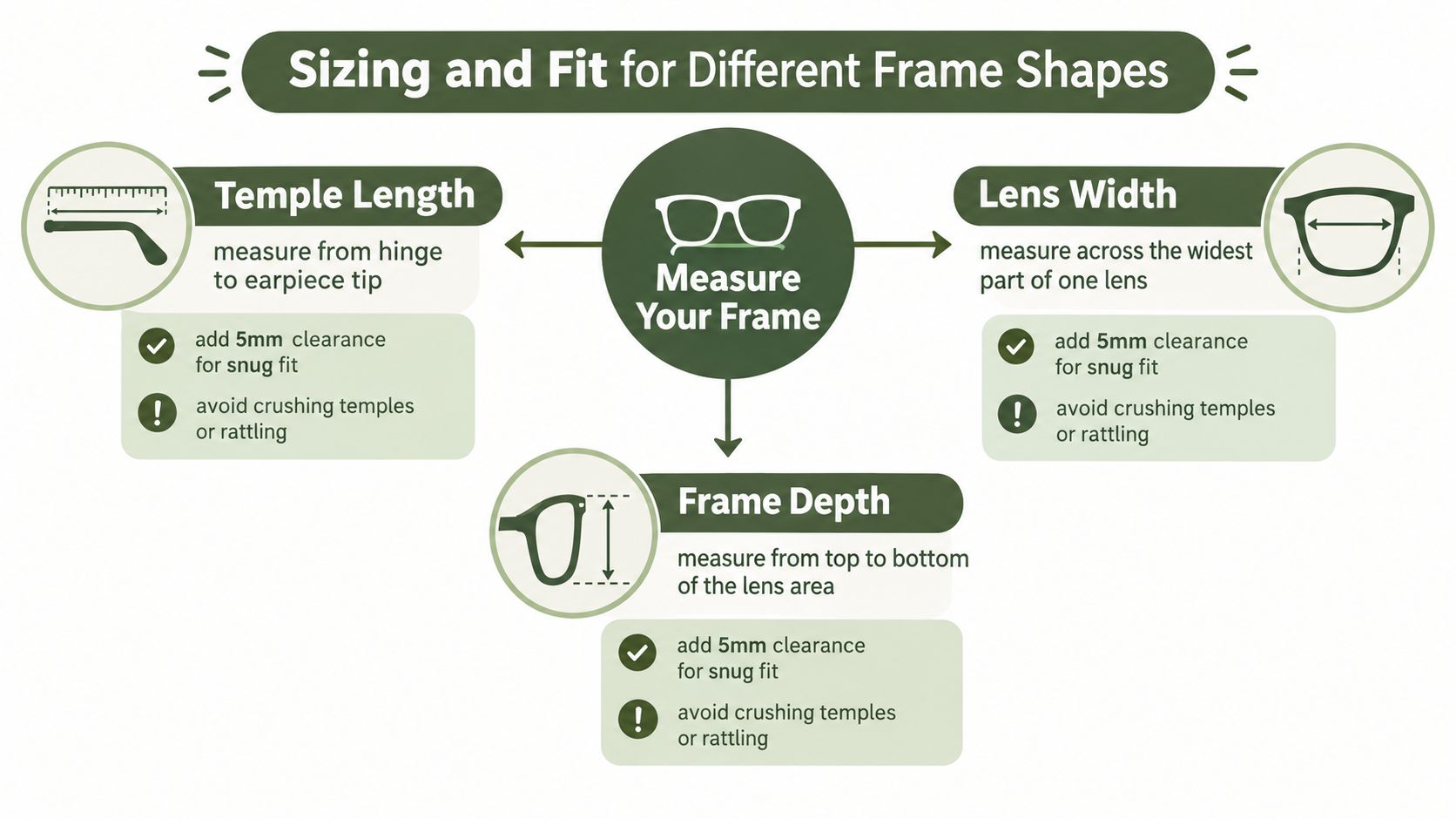
Measure the frame before choosing a case
- Frame width: Measure across the front of the glasses, from the outer edge of one lens or frame to the other. This is the key dimension for checking whether the case opening and cavity can accept the pair.
- Bridge width: Measure the gap between the lenses at the bridge. It helps you understand how the frame sits and where pressure could land inside a narrow case.
- Temple length: Measure each arm from the hinge to the tip. Fold the temples as you would for storage, then check that they fit without being forced or bent.
- Lens height and frame depth: Measure the lens area from top to bottom, then consider how far the frame and folded temples project from the front. This matters for thick frames and curved designs.
Match the case to the frame style
Oversized fashion frames need enough width and depth to close without pressure. Wraparound sport sunglasses can be difficult to fit because their curved fronts and temples take up more room than flat frames; a conventional slim case may not accommodate them safely. Prescription polarized sunglasses deserve the same careful fit check as any coated pair, since pressure and internal rubbing can still harm the lens surface or frame alignment.
Frame material doesn't replace measuring. Bio-acetate, recycled plastics, and other alternatives appear in eyewear markets, but buyers shouldn't assume every material flexes or responds to pressure in the same way. Match the case to the specific frame, and avoid choosing a size that relies on forcing the temples inward. A single-pair case is generally easier to fit securely than a multi-pair organizer, where dividers and spacing need to keep separate frames from rubbing against one another.
Personalisation and Coordinating With Other Leather Goods
A case can be practical without looking anonymous. Monogramming, stitching colour, leather finish, and hardware offer ways to make it personal, but the available options vary by maker and model. Check where initials will sit, whether the surface is large enough to keep them legible, and whether a personalised item can still be returned or exchanged.
Stitching and hardware are small details, but they influence how the case fits into a collection. A dark case with understated stitching can sit comfortably beside a work bag or briefcase. A contrasting thread or warmer leather tone can make the case an intentional accent rather than a match.
Coordinate by tone, not by uniformity
Exact matches across a wallet, belt, watch strap, and sunglasses case aren't necessary. Leather pieces often differ in grain, finish, and how they age, so forcing a perfect colour match can draw attention to minor variations. A more considered approach is to coordinate the overall tone or hardware while letting each item retain its own character.
Leather grade matters here as a durability and aging choice, not as a substitute for a good lining or secure fit. The same grade can look different across pieces depending on finish, use, and exposure. Before building a coordinated set, compare the qualities that affect everyday wear and read about leather grades.
A monogram can make a case a thoughtful gift, especially when the recipient already uses sunglasses regularly. Grainmark's personalised leather goods page is one place to check which items offer custom details. Confirm the available characters, placement, and processing expectations with the retailer before ordering, particularly if the case is for a specific occasion.
Heat, Humidity, and Other Storage Risks Buyers Overlook
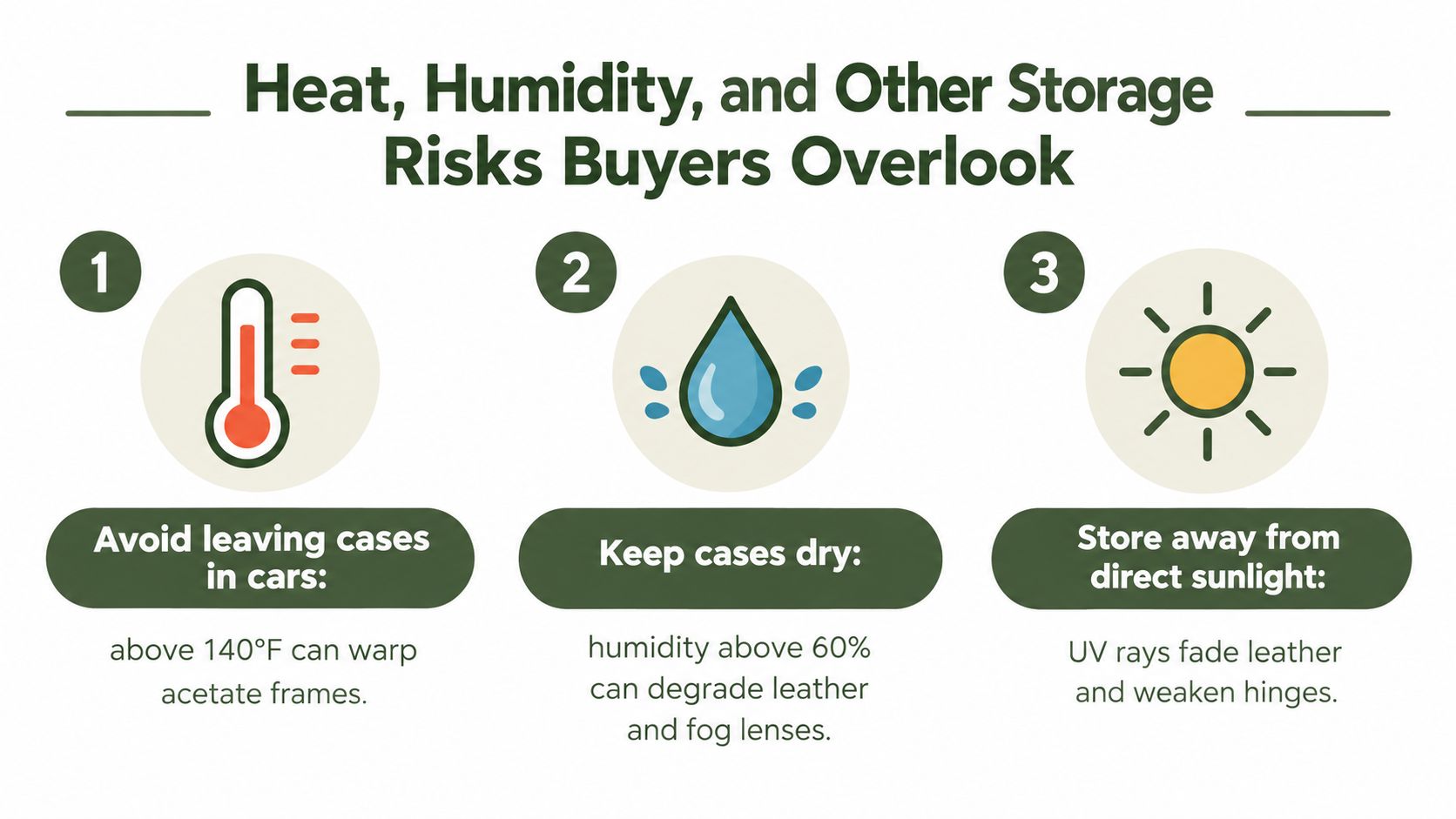
A closed case protects against some kinds of contact. It doesn't make sunglasses safe from ambient heat. A case left on a sunlit dashboard can heat up along with its contents, so a rigid exterior shouldn't be treated as a thermal barrier.
A care guide reports that summer dashboard temperatures can reach roughly 150–170°F (66–77°C), while standard polycarbonate and acetate frames can begin softening around 140–176°F (60–80°C). It also reports that lens coatings may degrade above 140°F (60°C) (sunglass-care guidance on heat exposure). The practical takeaway is simple: don't leave a cased pair on a dashboard in direct sunlight.
Separate impact protection from temperature protection
Move the case into a glove compartment, centre console, or shaded bag pocket instead. A leather shell can help reduce abrasion and impact, but it doesn't keep the interior cool if the whole case is exposed to heat. Prolonged heat can also dry, fade, or crack leather, so avoid storing the case in a hot vehicle for extended periods.
Moisture calls for a different precaution. Don't put damp glasses into an enclosed case and leave them there; trapped moisture can affect the lining and leave lenses fogged or marked. If the frames are wet, dry them before storage, and let the case air out if its interior feels damp.
Heat rule: A case isn't a safe place for sunglasses if the storage location itself is too hot.
Direct sunlight and humid conditions can affect the case as well as the eyewear. Store the case in a cool, dry place when it's not in use, and don't assume that a closed lid makes an unsuitable environment harmless. Thermal protection and physical protection are separate questions.
Care and Conditioning for the Case Itself
Leather care should be restrained. Too much conditioner can leave a greasy surface, while unsuitable cleaners may change the finish. Start by removing dust with a soft, dry cloth, and follow the maker's care guidance if it differs from general advice.
For a full-grain case, occasional conditioning can help keep the exterior supple. Use a small amount of a neutral wax conditioner on a discreet area first, then buff gently with a clean cloth. Grainmark's guide to conditioning leather offers more detail on choosing and applying conditioner. Avoid silicone-heavy products, which can leave an unwanted coating or alter the surface.
A simple care routine
- Wipe the exterior: Use a soft, dry cloth to lift surface dust. Address water spots promptly, but don't scrub aggressively or soak the leather.
- Clean the lining carefully: Brush or wipe away visible debris with a clean, dry cloth. Don't saturate the interior, especially if the case has a structural insert.
- Inspect the build: Look for loose stitching, damaged edges, or a closure that no longer holds. Stop using the case if a rough interior detail can contact the lenses.
- Store it properly: Keep the case in a cool, dry place away from prolonged direct sun and damp storage.
The glasses need their own routine before they go back into the case. Blow or rinse away grit before wiping, because rubbing loose particles across a lens can cause scratches. Use a clean lens cloth rather than paper tissues, and don't put dusty or wet glasses straight into an enclosed compartment. These habits protect both the eyewear and the interior that touches it.
Buying Checklist and Common Questions Answered
Before buying, work through the basics in order:
- Measure the folded frame and compare it with the case's internal dimensions.
- Choose a format suited to how the glasses travel, from a slim sleeve to a structured case.
- Inspect the lining and closure for smooth contact surfaces and secure retention.
- Pick the leather and finish for the look and wear you want, without treating grade as proof of lens protection.
- Check personalisation, returns, and warranty terms before placing an order, especially for custom work.
Common questions
Can one case hold two pairs? It can if it has separate, padded compartments that keep the frames apart. Two pairs loose in one compartment can rub against each other, so don't use a single-pair case as a shared container.
What about prescription sunglasses? Measure the frame carefully and confirm the case has enough depth. A secure fit shouldn't press on the lenses, bridge, or hinges.
Is a leather case a good gift? It can be a useful choice when you know the recipient's frame size and carry habits. If you're also comparing compact travel storage for other personal items, this guide to perfume travel case types offers a related perspective on choosing a case by what it needs to protect.
What should international buyers check? Confirm shipping availability, return eligibility, warranty coverage, and who pays for return shipping. Don't assume personalised items follow the same return policy as standard products.
A leather sunglass case earns its place through fit, lining, and construction. Decide what your pair needs, then choose leather and personal details that suit how you'll carry it.
Grainmark Leather offers leather eyewear cases and organisers for single-pair storage and travel. Compare the lining, structure, and fit against your frames, then visit Grainmark Leather to explore the available options.