
Watch Organizer for Men: A Practical Buying Guide
Your everyday watch is on the nightstand, your dress watch is still in its presentation box, and the watch you packed for your last trip hasn't left your wash bag. You don't need a bigger collection to justify better storage. You need somewhere dependable to put the watches you already wear.
The right watch organizer for men starts with your watches, not the number of empty slots in a product photograph. Choose around case dimensions, strap materials, and where the organizer will live. A handsome leather exterior matters, but it can't compensate for an interior that fits badly.
Table of Contents
- Why Men Need a Dedicated Watch Organizer
- The Market Behind Your Watch Collection
- Travel Cases, Daily Boxes, and Collector Chests Compared
- Why Full-Grain Leather Suits Watch Storage
- Matching Capacity and Sizing to Your Watches
- Caring for a Leather Watch Organizer Over Time
- Choosing the Right Organizer for Your Habits
Why Men Need a Dedicated Watch Organizer
A dedicated organizer gives every watch a predictable home. That sounds ordinary until you're getting dressed for a meeting, packing for a flight, or trying to remember where you left the watch you wore last weekend. Good storage removes that small, repeated search.
My recommendation is to treat an organizer as working equipment, not collection furniture. It should make putting a watch away as straightforward as picking it up. If opening the case, removing a cushion, and replacing the watch feels unnecessarily awkward, choose a simpler format.
Give storage a clear job
A useful organizer should meet these priorities:
- Protection: Give unworn watches a defined place rather than leaving them loose among keys, cufflinks, and other accessories.
- Separation: Keep each timepiece in its own position, with its strap and clasp accounted for.
- Accessibility: Let you identify and retrieve the watch you want without unpacking the whole collection.
Those priorities matter more than decorative locks, elaborate stitching patterns, or a dramatic display lid. Judge the case with watches inside it, not just when it's empty.
Practical rule: Buy the organizer you'll use every evening, not the one you'll enjoy arranging once.
Match the organizer to your routine
Start by separating your storage needs from your shopping preferences. A frequent traveler needs portability and dependable closure. Someone who changes watches before work needs convenient access. A collector who stores pieces between occasional outings needs a suitable location and a manageable inspection routine.
Movement type belongs in that decision too. If your collection includes automatic watches, use this guide to choosing a watch case for automatic watches to refine your requirements rather than assuming every presentation box serves the same purpose.
Don't buy every format at once. Identify where your current arrangement fails, then solve that problem first. A compact daily case can be a more sensible purchase than an imposing chest if most of its compartments would sit empty.
The Market Behind Your Watch Collection
The value concentrated in mechanical watches helps explain why thoughtful storage deserves attention. It doesn't mean you need an expensive organizer. It means you should expect more than an attractive container.
The Federation of the Swiss Watch Industry reported CHF 24.4 billion in Swiss watch exports in 2025, within CHF 25.6 billion in total watch-industry exports; mechanical watches accounted for 5.2 million exported pieces worth CHF 20.9 billion, averaging approximately CHF 4,010 per mechanical wristwatch, and the United States represented 17% of Swiss watch exports (Swiss watch-industry annual statistics). These are export figures, not retail valuations of individual collections.
Read value figures carefully
An export average can't tell you what your watch is worth or what you should spend on its case. My buying advice is simpler: assess the organizer's fit and construction independently of the watch's price. A sentimental daily wearer deserves appropriate storage just as a costly mechanical piece does.
The graphic below contains an inaccurate headline. Use the cited figures above, not the graphic's market total.

Multiple-watch ownership changes the buying question
In a 2025 survey of more than 1,500 U.S. adult watch owners, Jewelers Mutual found that 83% identified as collectors who owned multiple watches, while more than 70% of collectors reported some form of watch insurance; the online Qualtrics survey covered adults responsible for household insurance decisions (Jewelers Mutual watch-owner study).
That sample shouldn't be treated as a description of every watch owner worldwide. It does provide useful context for a customer who already rotates several watches and takes their protection seriously.
For that buyer, I'd prioritize:
- Usable positions: Every occupied compartment should suit the watch assigned to it.
- Practical access: Frequently worn pieces shouldn't require rearranging the collection.
- Relevant presentation: Display features should support the owner's habits, not dictate them.
If you're shopping for someone else, these gift ideas for a watch lover can help you consider the recipient's routine. Ask what they wear and where they store it before choosing a larger box.
Travel Cases, Daily Boxes, and Collector Chests Compared
Choose the format before choosing the leather color. A travel roll, a daily box, and a collector chest solve different problems. Trying to make a large display chest double as convenient luggage storage usually means accepting compromises you didn't need to make.
Watch organizer formats at a glance
| Format | Typical Capacity | Best For | Footprint |
|---|---|---|---|
| Travel case or roll | A selected travel rotation | Packing watches you intend to wear away | Compact and luggage-oriented |
| Daily rotation box | Your regularly worn collection | Convenient dressing and watch changes | Dresser or shelf space |
| Collector chest | A broader collection | Assigned storage and considered display | Larger, permanent surface |
Treat capacity descriptions as starting points, not specifications. Compare the actual exterior dimensions and interior layout of the products you're considering.
Travel cases should stay manageable
For travel, I favor a case you can open without spreading its contents across a hotel desk. Removable watch holders are useful only if you can lift them out and replace them without disturbing neighboring pieces.
Inspect the closure closely. With a zipper, check where the zipper path sits relative to the watches. With snaps or a wraparound flap, check whether fastening the case pushes against the contents. Don't assume a secure-feeling closure guarantees a well-fitted interior.
A roll earns its place when you want a compact travel selection. A more structured portable case is worth considering when you prefer a defined shape during packing. Neither should become an excuse to pack watches you won't wear.
Daily boxes should make selection easy
A daily box belongs where you dress, provided that location meets the environmental guidance below. Look for a lid you can operate comfortably and an arrangement that lets you remove a watch without reaching across another.
A transparent lid is a preference, not a requirement. If you enjoy seeing the collection, choose it deliberately. If you want orderly storage, an opaque lid may suit your space just as well.
Keep spare straps, tools, and loose accessories in their own designated area. Don't let a watch compartment become a general-purpose drawer.
Collector chests need a permanent home
A collector chest makes sense when you want assigned positions across a larger collection. Before buying, check the space needed with its lid fully open, not merely its closed footprint.
- For frequent packing: Choose a portable case and a restrained travel selection.
- For regular rotation: Choose a convenient daily box.
- For broader storage: Choose a chest that fits both the watches and the available furniture.
The right answer may be a daily box at home and a separate travel case. Buy the second format only when your routine gives it a clear job.
Why Full-Grain Leather Suits Watch Storage
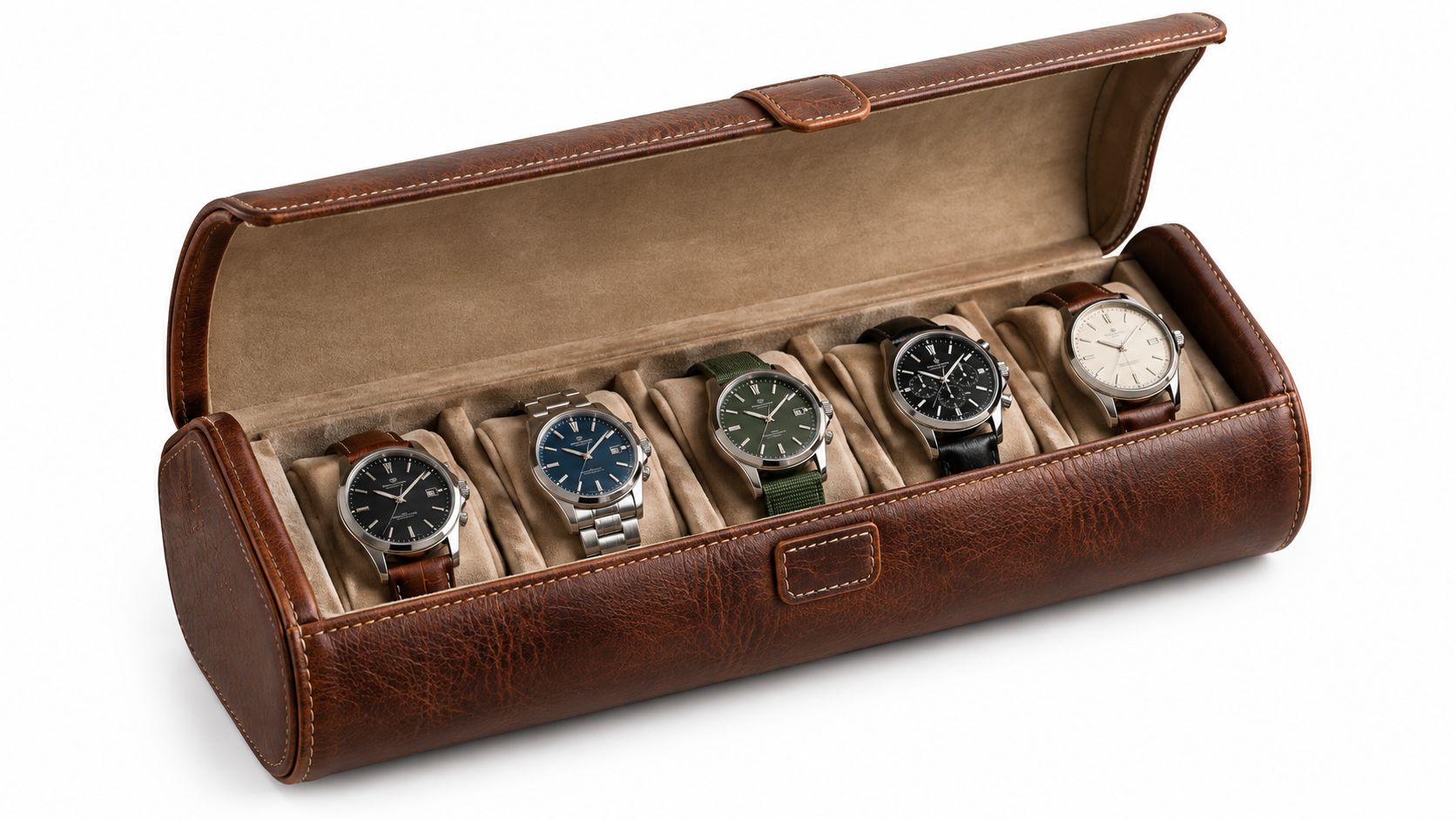
Full-grain leather is my preferred starting point for a watch organizer, but I wouldn't approve a case on the material label alone. Ask the seller to identify the leather clearly and explain its finish, care requirements, and construction. A vague luxury description isn't a specification.
The exterior and interior deserve separate judgments. Choose leather you'll enjoy handling, then assess whether the lining, cushions, edges, and hardware suit the watches. Don't let an appealing surface distract you from an awkward interior.
Ask for material clarity
When comparing full-grain, corrected-grain, and products described as genuine leather, insist on precise descriptions. Use this explanation of leather grades to frame your questions, but judge the finished organizer as a complete product.
If you're considering a waxed or Crazy Horse-style finish, ask for photographs showing normal handling marks as well as the new surface. Decide whether you want a changing, visibly handled appearance or something more uniform. Don't buy an aged-looking finish if you'll dislike every new mark.
My inspection checklist starts with construction:
- Edges and seams: Look for tidy finishing around the opening and areas you'll grip.
- Lid and hinges: Ask whether the lid stays clear of the watches when closed.
- Interior access: Make sure removable components are practical to handle.
- Material disclosure: Request the lining material and care instructions, not just the exterior leather name.
Separate appearance from protection
A leather case can look substantial and still be wrong for the watches inside it.
That's why I'd choose a restrained exterior with a well-considered interior over an ornate case with poorly explained dimensions. Full-grain leather should be part of the specification, not a substitute for one.
The same discipline applies to care products. Before applying a cleaner or conditioner, identify the finish and follow the organizer maker's instructions. Eco Clean Solutions' leather type cleaning essentials provides additional context for distinguishing leather-care needs.
Don't assume the product you use on a bag or pair of shoes belongs on a watch case. Keep exterior maintenance separate from the watch-contact surfaces, and ask the seller for guidance when the finish isn't clearly identified.
Matching Capacity and Sizing to Your Watches
Fit beats slot count. Start with the most demanding watch in your collection, whether that's the widest case, the thickest profile, or the shortest fitted bracelet. If that watch doesn't sit comfortably, the organizer isn't a good match regardless of its advertised capacity.
Expert storage guidance recommends a soft, full-length cuff that separates each timepiece and prevents cases, bracelets, and clasps from contacting one another; it also advises avoiding pressure on crowns and sharply compressed straps (Intelligent Collector's guide to storing fine timepieces). That's the standard I'd use when evaluating a compartment.
Measure the watch as it will be stored
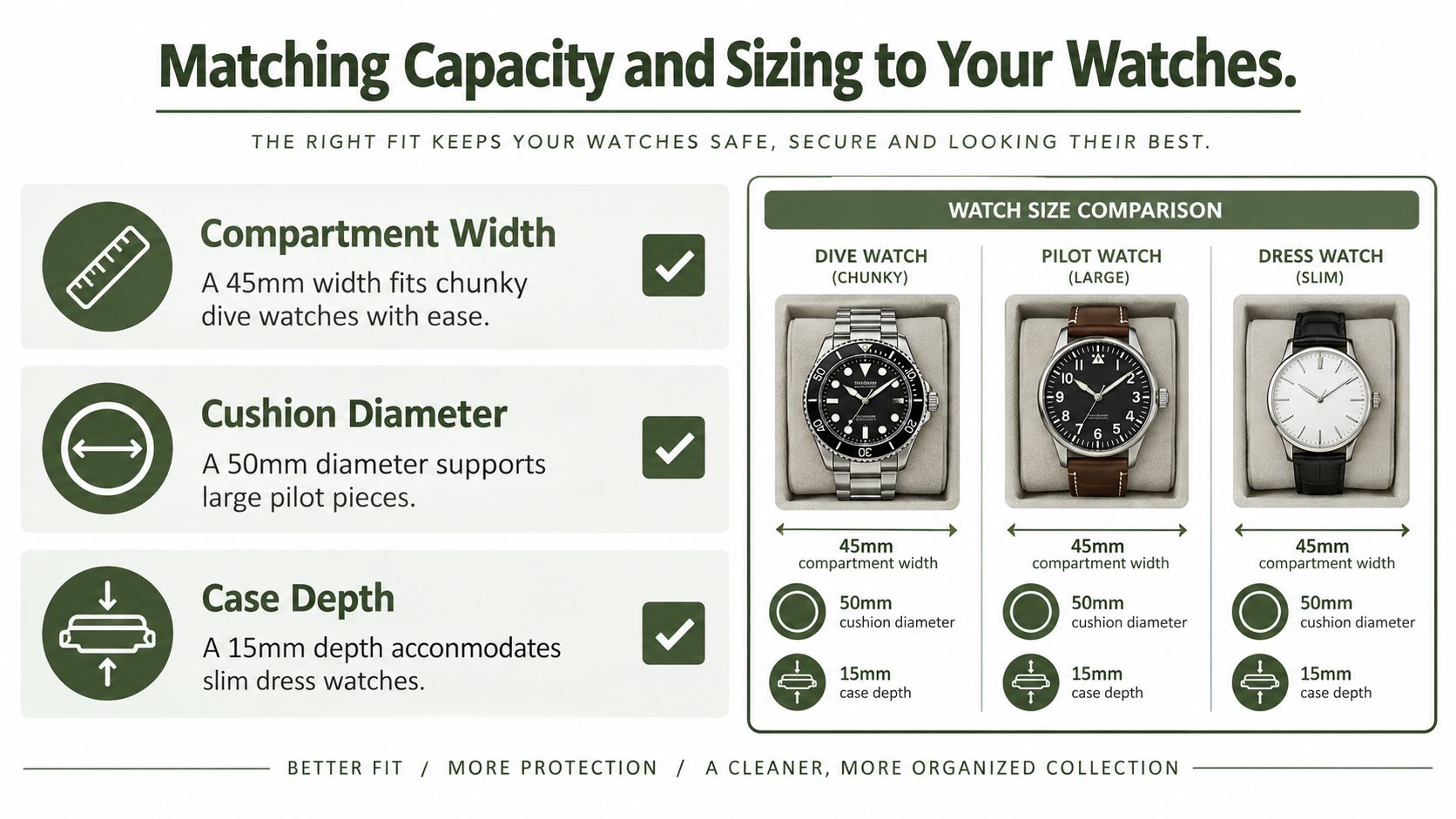
Record case width including protruding controls, overall length, and height when mounted on a cushion. For bracelets, assess the closed bracelet's fit rather than relying on case diameter alone. For straps, look at the curve the cushion creates.
This guide to watch case sizing can help you organize those measurements before asking a seller for usable compartment dimensions.
Use the graphic below as a reminder of what to measure, not as a universal sizing specification. Its example dimensions don't establish compatibility with your watches.
Use a watch-specific decision matrix
| Watch or storage condition | What to verify | Buying priority |
|---|---|---|
| Mechanical or quartz watch | Actual case profile and protruding controls | Clearance without crown pressure |
| Metal bracelet | Closed bracelet fit around the support | A removable, appropriately sized cushion |
| Leather strap | Natural curve and buckle position | No forced tight bend |
| Rubber strap | Shape when fastened or laid out | Support that suits the actual strap |
| Smartwatch | Body shape, band arrangement, and charging routine | Compatibility confirmed for the device |
| Daily rotation | Ease of removal and replacement | Convenient access |
| Longer-term storage | Inspection access and storage location | Manageable upkeep |
| Humid environment | Room conditions and interior dryness | Environmental control before display |
A full-grain leather exterior can accompany any of these arrangements. The construction choice doesn't remove the need to verify the interior against your collection.
Before ordering, ask for photographs with watches comparable in shape to yours. Ask specifically about usable compartment width, lid clearance, and cushion flexibility. “Fits large watches” isn't detailed enough to make a confident purchase.
Leave room for a plausible future addition, but don't buy around an imaginary collection. Usable capacity means positions your watches can occupy properly, not the number printed beside the product name.
Caring for a Leather Watch Organizer Over Time
Put the organizer somewhere suitable before worrying about conditioner. A poor storage location is not something you can fix by polishing the exterior.
The U.S. National Park Service recommends keeping leather environments around 40–60% relative humidity, avoiding levels above 65%, and limiting daily changes to less than 5 percentage points (National Park Service leather and skin conservation guidance). These are leather-conservation parameters, not a guarantee for every watch, lining, or adhesive inside a consumer case.
Choose a stable location
A practical approach is to aim for a stable room environment and verify it with a hygrometer. Don't guess from how comfortable the room feels. Keep the organizer away from bathroom moisture, damp basement storage, direct heat, and strong sunlight.
If the room is persistently humid, address the room rather than expecting the organizer to solve it. Use silica gel only as a monitored supplement, not as an uncontrolled drying strategy. Independent watch-storage guidance also emphasizes dry, suitable conditions and protection from environmental hazards.
Placement check: If the shelf gets direct sun or the room regularly feels damp, choose another home for the case.
Keep the routine restrained
The watch-storage guidance cited earlier also recommends wiping watches before storage to remove skin oils. Make that part of putting the watch away rather than turning cleaning into an occasional project.
For the organizer itself, follow a short routine:
- Inspect the interior: Check for debris, dampness, loose lining, and anything that could interfere with placement.
- Follow finish-specific instructions: Use only products the maker considers suitable for the exterior.
- Empty before maintenance: Remove watches and detachable interior parts before treating the leather.
- Return watches only when ready: Make sure the case is dry and free of product residue.
For a more detailed maintenance sequence, consult this guide to conditioning leather. Don't set an automatic conditioning schedule without considering the finish and the maker's recommendations.
Open and inspect a case that hasn't been used recently rather than assuming its interior remains suitable. If you air it, do so in a dry, appropriate room. Finally, keep checking the watches themselves: storage doesn't replace attention to strap condition, seals, or water resistance.
Choosing the Right Organizer for Your Habits
The best watch organizer for men is the one that matches how its owner wears watches. Buy for your real week, your actual luggage, and the space you have available.
If you own a small rotation and travel frequently, start with a compact portable case. If you change watches regularly at home, favor an accessible daily box. If you maintain a broader collection, consider a chest with individually usable positions and a permanent home.

Make the final decision with the watches present
Treat the graphic's layouts as examples, not targets. The export values discussed earlier put mechanical watches in context, but your buying decision still comes down to suitability, not prestige.
Before paying, confirm:
- Fit: Your most demanding watch sits naturally inside.
- Access: You can retrieve a piece without rearranging its neighbors.
- Location: The organizer fits its intended shelf with the lid open.
- Care: The seller explains both the exterior finish and interior materials.
- Purpose: You can name the problem this purchase will solve.
If you're reducing the collection, decide which watches will remain before buying storage. For owners considering that route locally, Idaho Pawn & Gold Exchange's information on how to sell a Rolex in Meridian is a separate resource to review, not a reason to choose a particular organizer.
Don't confuse collector-grade with oversized or elaborate. My recommendation is a clearly specified case that fits your watches, suits your environment, and makes daily use straightforward. Everything else is secondary.
Grainmark Leather offers full-grain leather watch-storage options, including compact daily cases and collector chests, alongside leather goods for travel and everyday carry. Visit Grainmark Leather with your watch measurements and preferred format in hand, then compare the available layouts against the collection you wear.