

Watch Case for Automatic Watches: 2026 Buyer's Guide
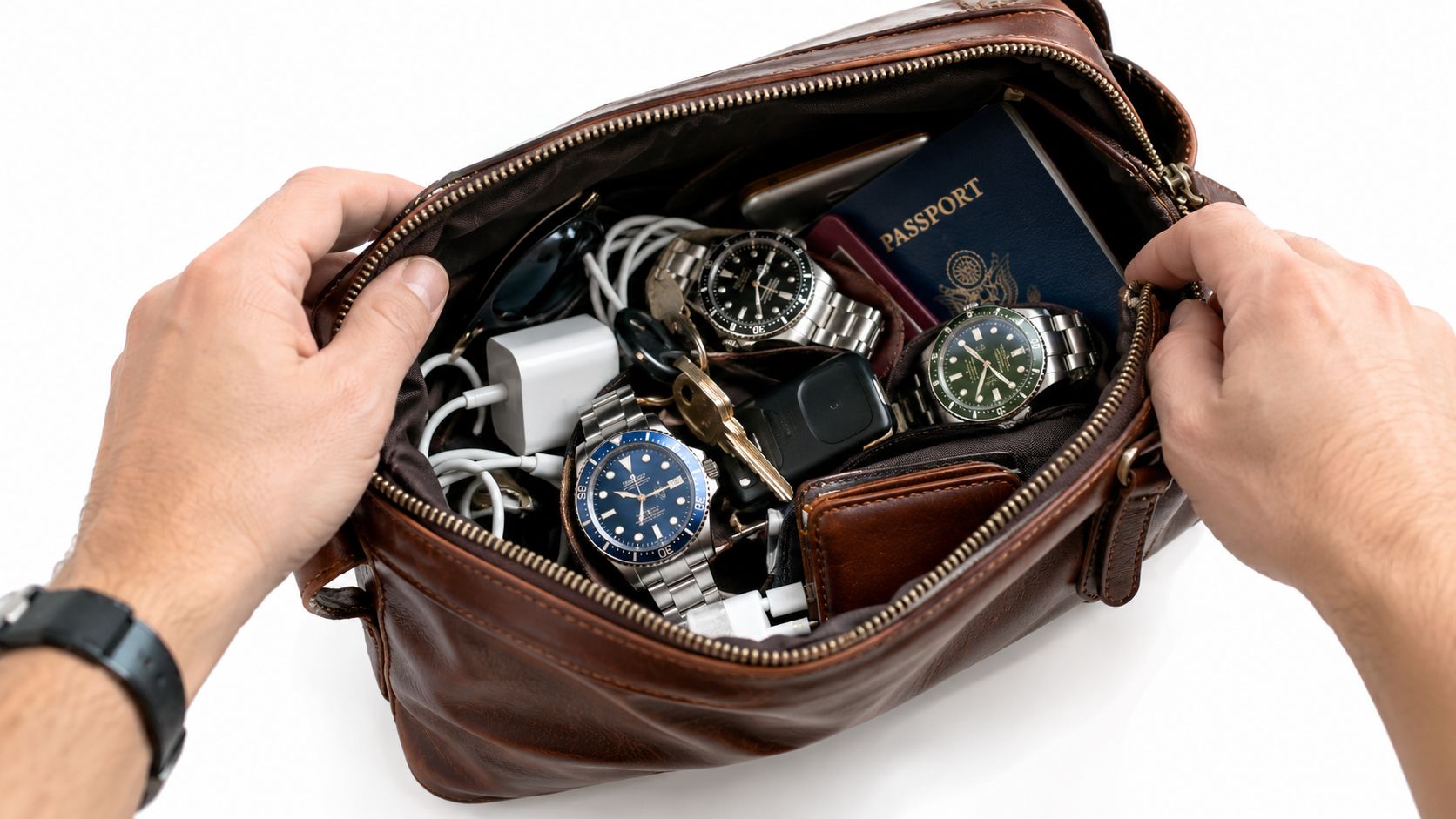
You've packed your automatic watch carefully, or so you think. Then the zipper closes over a charger, a set of keys, and a pair of sunglasses, while the watch sits loose in the same compartment. The worry isn't limited to a scratched bezel. Inside the case, a rotor moves to wind the mainspring, and a hard knock can reach the bearings, gears, crystal, or crown.
A proper watch case for automatic watches separates the timepiece from everything that can abrade, crush, or strike it. The right format also makes a difference to winding preservation, storage position, humidity control, and access during servicing. A soft leather roll may be ideal for a controlled commute, while a rigid shell is more appropriate when luggage will be handled roughly. The case should match the movement and the situation, not just the watch's appearance.
Table of Contents
- Why Automatic Watches Need Special Protection
- Core Functions of a Watch Case for Automatic Watches
- Rigid Cases vs Soft Cases for Automatic Watch Storage
- Materials That Protect Automatic Watch Movements
- Travel vs Home Storage for Automatic Watches
- Humidity and Environmental Protection for Automatic Watches
- Choosing the Right Watch Case for Your Automatic Watch
Why Automatic Watches Need Special Protection
Automatic watches turn the movement of your wrist into stored mechanical energy. Their rotor swings as you move, transferring energy to the mainspring through the winding system. That arrangement gives the watch its character, but it also means the movement contains more moving parts than a simple battery-powered timepiece and needs sensible protection when it isn't on the wrist.
The case around the movement matters for the same reason. John Harwood's automatic system received a Swiss patent in 1924 and reached the market in 1926, while Rolex introduced the Oyster Perpetual in 1931, combining a sealed Oyster case with a 360-degree winding rotor. That development helped establish the closed, durable case architecture now associated with practical everyday automatic watches, as described in this history of watch case styles.
What can go wrong in loose storage
A loose watch can suffer in several ways before you notice a visible mark:
- Abrasion: Keys, buckles, and chargers can rub against polished surfaces and crystals.
- Compression: A packed bag can press the crown, push the watch against its own bracelet, or force the case into an awkward position.
- Shock transfer: A dropped bag sends energy through every object inside it. Padding reduces the force reaching the watch, but it doesn't make poor packing harmless.
- Rotor movement: The automatic rotor is designed to move freely in normal use. Repeated uncontrolled impacts are different from ordinary wrist motion and can stress delicate components.
- Contamination: Dust, grit, and moisture become more likely when the watch shares an open compartment with everyday items.
A watch case doesn't replace professional servicing or a properly sealed watch. It creates a controlled environment around the watch during the periods when you aren't wearing it. For a useful overview of practical gifts and storage formats for enthusiasts, see this watch-lover storage guide.
Practical rule: If the watch can touch another hard object inside your bag, it needs its own protected compartment.
Core Functions of a Watch Case for Automatic Watches
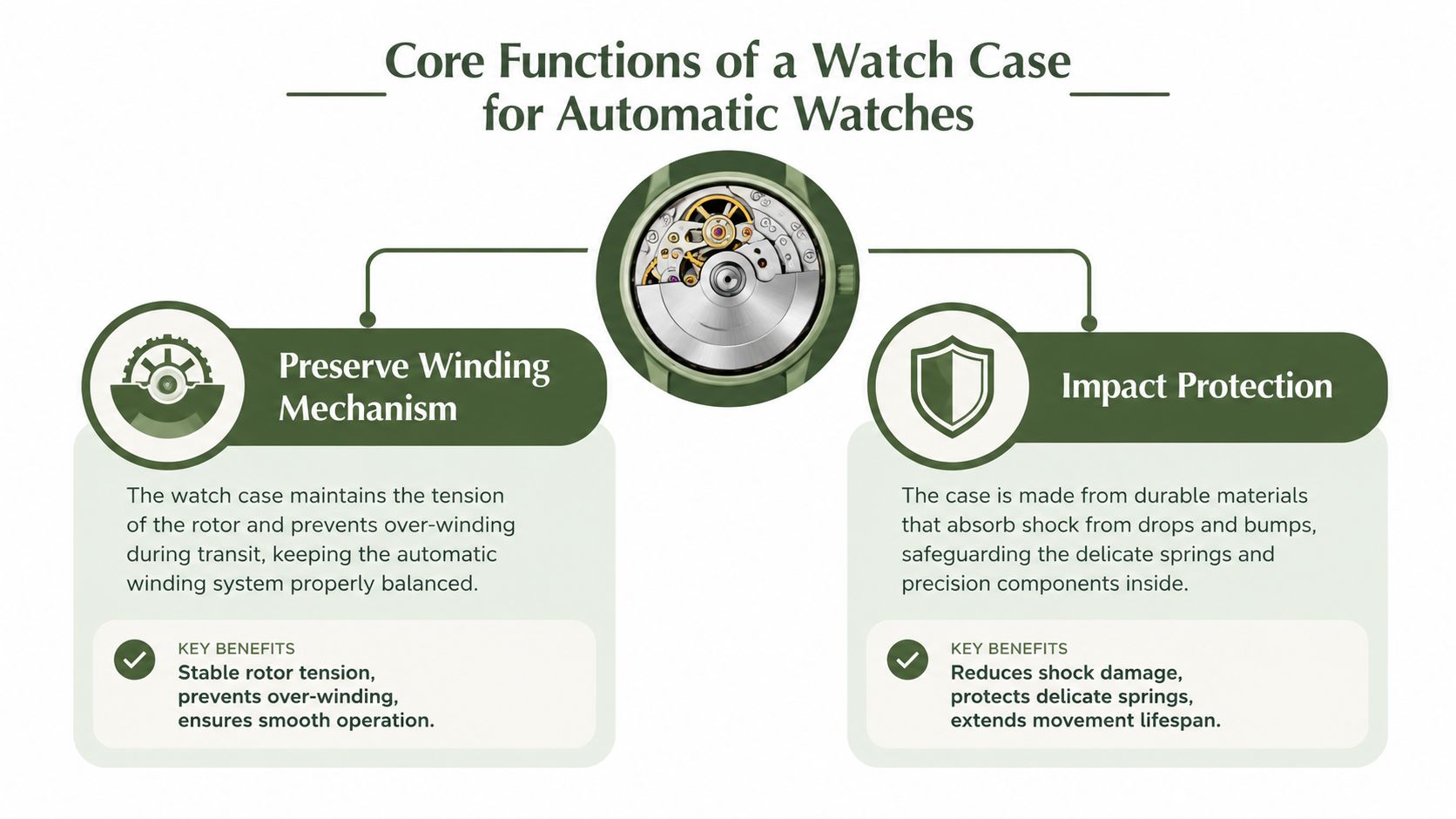
A useful automatic-watch case performs two jobs. It preserves the movement's operating environment, and it limits the energy of impacts before that force reaches the rotor, balance assembly, crystal, or dial. Decoration comes after those requirements.
The first job starts with fit. A watch should sit securely on a pillow or in a shaped compartment without being squeezed against the crown. The pillow must support the strap or bracelet while leaving the caseback, lugs, and controls clear. A cavity that's too tight can put pressure on the watch when the case closes. A cavity that's too loose lets the watch move during transport.
The second job is controlled restraint. Padding shouldn't merely feel soft to the touch. It should stop the watch from gaining momentum inside the case. A useful closure keeps the lid from opening in a bag, while raised dividers prevent one watch from striking another. A fabric lining also reduces surface abrasion, especially on polished steel and coated finishes.
Read the construction, not the marketing
Inspect these details before buying:
- Pillow tension: The pillow should hold the watch without forcing the strap into an unnatural bend.
- Compartment spacing: Adjacent watches need enough separation that crowns, buckles, and bracelets can't contact each other.
- Closure security: A zipper, snap, or clasp should remain closed when the case is carried vertically.
- Interior finish: Smooth suede, microfiber, or carefully finished leather is safer than a rough lining that can catch on spring bars.
- Caseback clearance: The watch shouldn't rest directly on an exposed metal fastener or hard internal seam.
- Lid depth: The lid must close without touching a raised crystal, chronograph pusher, or protruding bezel.
Automatic watches also need sensible positioning during storage. A case shouldn't claim to keep a watch “fully wound” through a storage angle or movement alone. If an automatic watch has stopped, follow the manufacturer's winding instructions rather than using a case as a substitute for normal operation. For broader home-storage formats, compare the watch storage box options with the dimensions of your collection and the watches you wear.
Rigid Cases vs Soft Cases for Automatic Watch Storage
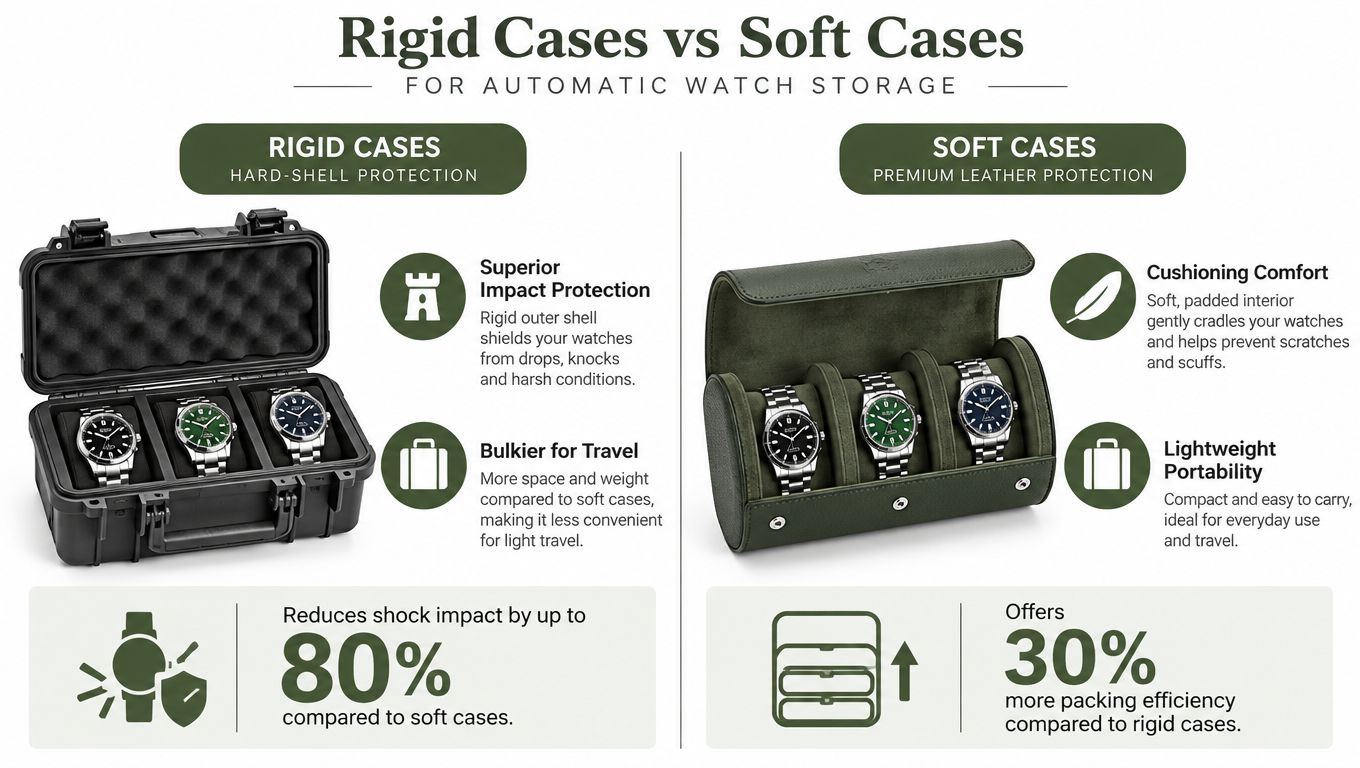
Rigid and soft cases solve different problems. A rigid case gives the watch a protective boundary that resists crushing and blunt force. A soft case takes less room, weighs less, and often works better when the watch is carried inside a carefully managed personal bag.
Hard shells made from polycarbonate, ABS, or aluminum are suited to transport where luggage may be squeezed or knocked. Their walls create separation between the watch and external objects. That protection comes with added bulk, harder edges, and less flexibility when the case must fit into a small day bag.
Soft leather cases and rolls offer a more discreet profile. A well-made roll cushions the watch and keeps individual pieces apart, but its protection depends on how the bag is packed. If the roll is placed under heavy electronics or loose metal accessories, the leather cannot provide the same crush resistance as a structured shell.
Match the format to the journey
For daily commuting, a compact soft case usually makes sense if it travels inside a briefcase or backpack with a dedicated pocket. It's quick to open, easy to carry, and less conspicuous than a large display box.
For air travel, use a case with a secure closure and one compartment per watch. Carry it in hand luggage rather than checked baggage, and keep the crown fully secured. The purpose is not only to prevent theft or loss. It also keeps the watch away from the uncontrolled compression and impacts of checked luggage.
For a collection at home, a rigid watch box or chest offers order and display access. It can be placed on a stable surface where it won't be crushed, dropped, or exposed to repeated movement. It's less practical for daily transport because its size encourages overpacking and makes discreet carrying difficult.
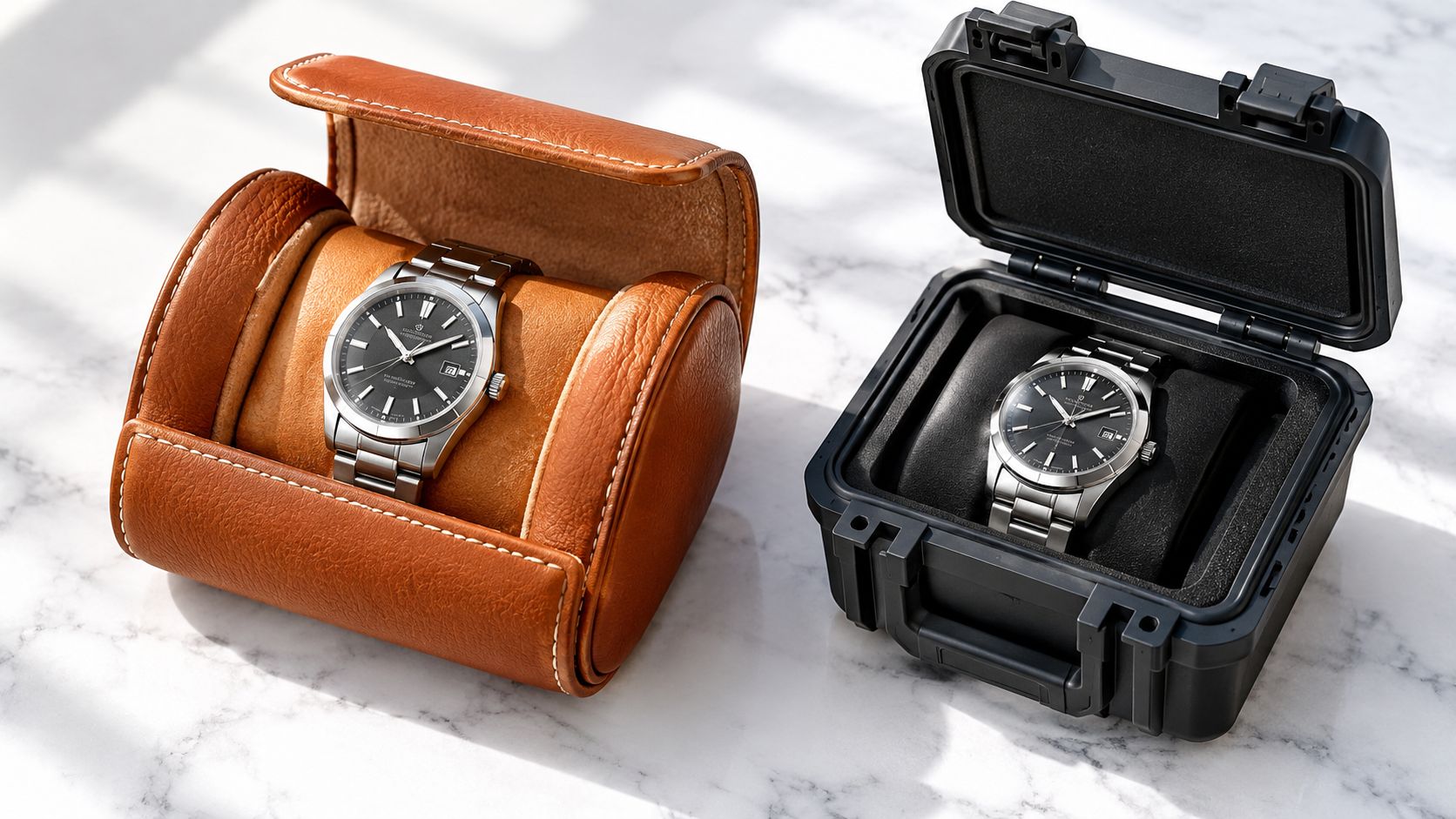
A compact three-slot watch roll suits someone carrying a small rotation and prioritizing portability. It won't replace a hard shell when the case itself may face serious external force. The most reliable choice is often a two-case system, one soft format for controlled daily use and one rigid format for demanding travel.
Materials That Protect Automatic Watch Movements
Material selection should begin with impact behavior, not scratch resistance. A surface can resist marks yet fail when a sharp blow causes it to crack. That distinction matters because the case's job is to absorb or distribute force before it reaches the automatic movement.
Leather works well when its construction includes firm walls, properly attached padding, and smooth interior contact points. Full-grain leather can age attractively, but the hide alone doesn't determine protection. Stitching, reinforcement, edge finishing, pillow shape, and closure design decide whether the case behaves like a protective organizer or merely a soft pouch. The differences between leather grades are outlined in this guide to leather quality.
Polycarbonate and ABS are practical hard-shell choices for travel. They provide structure without relying on the watch itself to resist compression. Polycarbonate is commonly chosen where impact resistance and lighter handling matter, while ABS can offer a firm shell at a practical cost. In either case, the interior still needs padding and separation. A hard exterior with a poor internal layout can allow the watch to rattle inside.
Aluminum gives a case a rigid, premium-feeling shell, but metal construction can transmit a sharp impact unless the interior is engineered to isolate the contents. It can also add weight and show dents or scuffs more readily than a flexible fabric or leather exterior. Titanium is useful as a reference point for watch construction because its strength-to-weight advantage shows why low mass and durability can coexist, but a storage case doesn't need to copy the watch case material to protect the movement.
Hardness isn't the same as resilience
Technical coverage comparing watch-case materials places high-tech ceramic at around 1,200–1,400 Vickers hardness, compared with roughly 200 for steel, while also warning that ceramic has low impact toughness and may fracture rather than dent under a sharp blow. Those figures come from this technical comparison of durable watch-case materials.
For a travel case, that principle leads to a practical preference:
- Choose leather for cushioning, quiet handling, and compact daily carry.
- Choose polycarbonate or ABS when crush resistance and portability need to coexist.
- Choose aluminum when rigid structure matters more than low weight.
- Prioritize internal isolation regardless of the shell material.
- Avoid exposed hard hardware where it can contact a caseback or crystal.
The best case doesn't just feel hard or luxurious. It keeps the watch from moving, cushions the contact points, and manages the force that reaches the movement.
Travel vs Home Storage for Automatic Watches
Automatic watches need storage that controls movement as well as contact damage. During travel, vibration and compression can let a rotor, bracelet, or clasp strike the case. At home, the priority is orderly access, stable support, and enough clearance to inspect each watch without forcing it into a slot.
For transport, give each watch its own compartment and use a closure that cannot open accidentally. Padding should hold the watch still without pressing the crown or crystal. Keep the dial, crown, and caseback away from zippers, snaps, and exposed stitching. A soft roll suits a structured personal bag, provided heavier items cannot compress it. Check that the case leaves room for the rotor to move freely and does not force the watch against its cushion.
For air travel, a hard shell made from polycarbonate, ABS, or aluminum gives stronger protection against blunt impact. EVA and padded rolls reduce bulk while still providing cushioning, but they need a bag that will not be crushed. Isolate each watch and choose a closure that stays shut during handling. For formats designed for this situation, see this watch travel case guide for men. The material trade-offs are covered in this watch travel-case material guide.
Build a routine around the movement
Before leaving home, confirm that each watch sits fully inside its compartment. A bracelet should not press against the caseback, and a leather strap should not be folded so tightly that its hardware pushes into the watch. If a watch has stopped, wind it according to the manufacturer's instructions before wearing it. Do not shake it aggressively to restart the movement.
At home, choose storage that lets you inspect each watch without removing the others. A display box works when it stays closed, stable, and away from direct moisture sources. A larger chest suits a collection only when every slot fits the watches you own. Oversized cavities allow movement, while undersized slots can press against the crown, crystal, or caseback.
Match the format to your routine. A commuter carrying one automatic watch needs quick access and low bulk. A collector rotating several watches needs separation, clear inventory, and a stable place to return each piece after wear. One oversized case built for hypothetical trips often performs poorly in daily use.
Humidity and Environmental Protection for Automatic Watches
A watch case can protect against contact damage while still creating a poor environment. Automatic watches contain steel parts, brass components, lubricants, and often leather straps. Excess moisture can encourage corrosion, oxidation, lubricant degradation, and mold, while overly dry conditions can affect leather, lubricants, and rubber components.
For long-term storage, independent guidance generally recommends relative humidity around 40–60%. Sustained humidity above 60% increases preservation risks, while humidity below 30% can dry leather, accelerate lubricant evaporation, and make rubber straps brittle, according to this automatic-watch storage guide.
Set up the case correctly
- Use a hygrometer. Measure the room or cabinet rather than guessing from how the leather feels.
- Control swings. A stable mid-range is more useful than repeatedly moving between damp and very dry conditions.
- Add desiccant carefully. Silica gel can help in a suitable closed case, but replace or refresh it according to the product instructions.
- Keep the case away from bathrooms and kitchens. Steam and rapid humidity changes are more difficult to manage than a stable room environment.
- Inspect straps separately. Leather can show environmental damage before the watch movement does.
A storage case with a reasonably closed structure and room for humidity control is more useful than a decorative box with a loose lid and no way to monitor conditions. Don't seal a damp watch or wet strap inside it. Let the watch and accessories reach a dry, stable condition first, then return them to storage.
Choosing the Right Watch Case for Your Automatic Watch
A watch case should match the way you use and transport the watch. A drawer favors organization, stable support, and easy access. A backpack or suitcase demands stronger impact protection, a secure closure, and enough padding to prevent the rotor from receiving repeated shocks.
Check these practical criteria before buying:
- Compartment fit: The watch should sit firmly without crown pressure, strap distortion, or caseback contact with hard fittings.
- Rotor clearance: Leave enough depth for the rotor and caseback, especially on automatic watches with thick movements or exhibition backs.
- Winding preservation: A pillow should support the watch without forcing the crown against the compartment wall or keeping the strap under tension.
- Closure security: Zippers, snaps, and clasps should remain closed when the case is turned or packed.
- Impact management: Use a structured shell where luggage may be crushed. A padded roll suits controlled daily carry.
- Capacity discipline: Buy enough slots for the watches you rotate. Excess space can let cases shift during transport.
Case dimensions matter at the watch level, not only at the outside of the storage case. A 2026 catalog analysis found that 40–41 mm is the largest listed case-size band, representing roughly a quarter of models, with a median case diameter of 40.5 mm, as reported in this watch-case market overview. Because many modern automatic watches sit near this range, verify the largest watch's compartment depth, pillow range, and crown clearance before buying.
| Case Type | Protection Level | Portability | Best For |
|---|---|---|---|
| Soft leather roll | Cushioned, dependent on packing | High | Daily carry and light travel |
| Padded EVA roll | Balanced cushioning and crush resistance | High | Frequent travel with limited space |
| Polycarbonate or ABS shell | Strong external impact protection | Moderate | Air travel and packed luggage |
| Aluminum case | Rigid protection, potentially heavier | Moderate to low | Serious transport and fixed kits |
| Home watch box or chest | Strong organization and stable storage | Low | Collection storage and display |
Choose the case around the main risk. A soft roll is lighter and easier to carry, but it offers less protection against crushing. A hard shell handles external impact better, though it can add bulk and may need a softer interior to prevent scratches. At home, a box or chest keeps watches separated and reduces unnecessary handling.
For a practical leather option, Grainmark Leather offers watch rolls, cases, and multi-slot watch boxes for daily carry, travel organization, and collection storage. Visit Grainmark Leather to compare a compact case with a larger format. Select the option that gives each automatic watch secure support, rotor clearance, suitable padding, and room for the crown and winding system.