

Travel Watch Pouch Guide: Choose, Pack, and Protect
You've probably done it before. You set a watch on a dresser, pack in a hurry, and by the time you reach the hotel it's riding loose in a backpack with keys, a charger, maybe a laptop speaker, and a half-open zipper worth of clutter. That's where a travel watch pouch earns its keep, not as a soft cosmetic sleeve, but as a separation-and-restraint system that keeps the watch away from hard objects, vibration, and the small hazards that build up over a trip.
The reason this matters is simple. Swiss watch exports reached 16.9 million wristwatches in 2023, with a total export value of CHF 26.7 billion, and wristwatch export value alone rose to CHF 25.5 billion in that same year Swiss watch export statistics. Even if your watch isn't in that export flow, the logic is the same. A timepiece is small enough to lose in a bag, valuable enough to protect, and delicate enough that the wrong packing habit can leave marks you notice later.
If you already keep jewelry or small leather goods separate when you travel, the habit is worth applying to watches too, and how to store your gold is a useful parallel for thinking about isolated storage, surface protection, and avoiding mixed-contact damage.
Table of Contents
- Why Watches Need Protection on the Move
- Which Risks a Travel Watch Pouch Actually Addresses
- Soft Pouches, Watch Rolls, and Rigid Cases Compared
- Sizing a Pouch to Your Watch Type
- Packing Tips for Flights, Hotels, and Daily Carry
- Caring for a Leather Travel Watch Pouch
- Recommendations by Traveler and Watch Collection
Why Watches Need Protection on the Move
A watch usually doesn't fail on the road in one dramatic moment. It gets marked slowly, first by the corner of a key, then by a zipper tooth, then by repeated contact with a power brick or tablet cover. In a full bag, that kind of contact is easy to ignore until the clasp picks up a scratch or the bracelet rubs a polished edge dull.
The damage that happens most often
The most common travel damage is abrasion, followed by compression and incidental impact. A watch bouncing around in a bag can strike harder objects many times during a commute or flight, even if nothing feels rough in the moment. That's why the pouch should stop the watch from moving, not just surround it with soft material.
Practical rule: if the watch can slide, flip, or rotate inside the case, the case is too loose for travel.
The next issue is contact with other bag contents. Keys, chargers, metal pens, sunglasses, and laptop accessories are the usual offenders because they live in the same zones of a backpack or carry-on. This is why a dedicated pouch is more useful than a general pocket, it gives the watch a defined space that doesn't share pressure with the rest of your kit.
A good mental model is the same one used for other valuables. Watch owners often pack them the way they'd pack a ring or bracelet, in a place that stops rubbing and keeps each object from touching the next. In that sense, a pouch is just disciplined packing.
Why the pouch is a control, not a cushion
The important shift is to see the pouch as a control layer. It separates the watch from the rest of the luggage and restrains it so the case, bezel, crystal, and crown don't keep hitting the inner walls of the bag. That's more practical than promising vague “protection,” because the main win is reducing movement and contact.
That's also why high-value items travel better when each one has a place of its own. Watches are not the only things that benefit from it, but they're one of the easiest to damage through casual packing. If you own a watch you'd hesitate to toss into a desk drawer with coins, it deserves a dedicated travel position too.
Which Risks a Travel Watch Pouch Actually Addresses
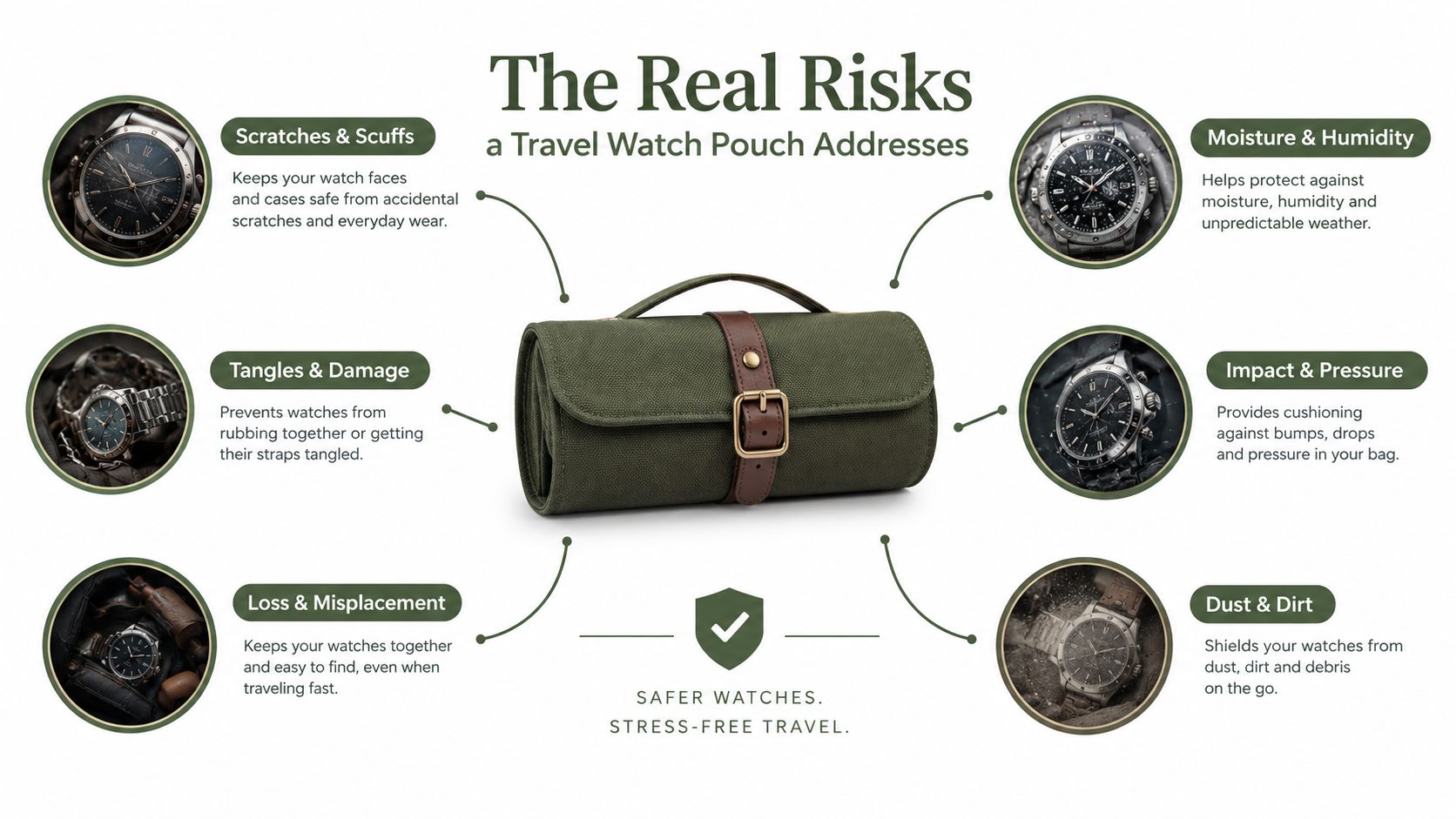
A watch pouch should be chosen by the risks on your route, not by padding alone. It handles abrasion and movement well, offers limited help against crushing, and does little for magnetism or theft. Your bag, watch value, and packing habits determine which of those limits matter.
What the pouch handles first
Abrasion and scratching are the most straightforward risks to control. A watch loose in luggage can rub against keys, chargers, metal pens, hard plastic, or bag hardware for hours. The lining matters as much as the outer material. A smooth, low-abrasion interior reduces friction around the case, bezel, crystal, and bracelet, while a rough lining can create wear inside the pouch itself.
Crown clearance also matters. The watch should sit without the crown pressing into a seam or closure, and the pouch should close without forcing the bracelet against the case. Leather can soften with use, so check that the interior still holds the watch in position rather than allowing it to rotate during handling.
Impact and crushing require a more careful assessment. A soft pouch provides separation and some padding during controlled carry-on transport, but it cannot match a rigid shell when a bag is compressed under another suitcase or jammed into a full overhead bin. A structured insert can reduce pressure, though it adds bulk and may change where you can carry the watch.
A high-value watch, a crowded backpack, and frequent transfers call for more structure than a lightly packed personal item. A soft pouch suits a predictable route and a disciplined bag. It is a poor substitute for a rigid case when your luggage may be squeezed, dropped, or placed near dense equipment.
What the pouch does not solve
Magnetism is a separate risk. ISO 764 evaluates magnetic resistance at 4,800 A/m. Compliant watches must not stop during exposure, and the standard limits residual timing effects to 30 seconds per day for movements larger than 20 mm and 45 seconds per day for smaller movements ISO 764 magnetic resistance standard. A pouch should not be treated as magnetic shielding.
Use nonmagnetic hardware where practical, and keep the watch separated from magnetic chargers, speakers, and phone mounts. The pouch provides physical organization, not protection against every accessory in your bag.
Loss and theft depend mainly on handling. A watch left in a tray, open tote, or unzipped pocket is easy to forget and easy to take. A pouch gives it a defined place, keeps it covered during transfers, and makes a quick inventory easier.
Bottom line: choose a pouch for the risks it can control, then match its structure to your route, bag, and watch value.
Soft Pouches, Watch Rolls, and Rigid Cases Compared
Different formats solve different problems. The trick is not choosing the most protective option in the abstract, it's choosing the one that fits your route, your bag, and the way you pack. A soft pouch can be the right answer for one trip and the wrong answer for the next.
How the three formats behave in the real world
A soft travel watch pouch works best when the watch rides inside carry-on luggage, separated from dense objects, and kept in a pocket that won't be crushed. It's compact, discreet, and easy to live with, which makes it ideal for controlled travel where scratch prevention and immobilization matter more than brute-force shell protection.
A watch roll is better when you're carrying multiple pieces and want them grouped without turning the bag into a box of loose cushions. Rolls are practical for collectors because they organize watches in one place, though the format still depends on how firm the inner structure is and how the roll closes under pressure.
A rigid case is the safer choice when the bag may be compressed, shoved under seats, or packed near chargers, shoes, or toiletry bottles. It takes more room, and that extra bulk can tempt people to check it with luggage they'd otherwise keep close. That trade-off matters, because the right case can still be the wrong travel move if it pushes the watch out of carry-on.
| Travel Watch Pouch Formats at a Glance | Protection Strength | Typical Capacity | Best For |
|---|---|---|---|
| Soft pouch | Scratch and contact protection, light restraint | 1 watch | Short trips, controlled carry-on, daily travel |
| Watch roll | Better organization, moderate protection | Multiple watches | Collectors carrying two or more pieces |
| Rigid case | Strongest crush resistance | 1 to many watches, depending on design | Dense luggage, crowded bags, rough transport |
The decision isn't “soft or hard” in the abstract. It's whether the watch will sit in a calm pocket or a packed bag that gets bullied by everything else around it. For more context on collector-oriented formats, the comparison in watch travel case options for men is useful because it shows how storage priorities change when the number of watches goes up.
Where soft protection stops
Soft-sided pouches are honest tools, and that's a strength. They handle contact and scratches well, but they don't reliably protect against crushing or water. If your route involves dense luggage, rough transfers, or weather exposure, the best pouch may still not be enough on its own.
Sizing a Pouch to Your Watch Type
A dress watch and a chunky diver do not ask for the same thing from a pouch. Neither does a metal-bracelet watch or a smartwatch. If the fit is wrong, even a good pouch becomes a rubbing surface instead of a protective one.
Crown clearance and strap restraint
The first thing I check is crown clearance. A protruding crown should never press against a wall, zipper, or seam. If the crown takes the pressure, the pouch is too tight or the watch is oriented badly.
Strap restraint matters just as much. The strap should hold the watch firmly enough that the case doesn't swing into the pouch walls when the bag moves. That's the point where a good pouch starts to feel precise instead of merely padded. Hard seams, exposed zippers, and rivets have no place anywhere near the watch head.
A snug hold is useful only when it stops movement without squeezing the case or crown.
Matching the pouch to the watch
A dress watch usually needs less depth, but it benefits from a clean lining because polished surfaces show contact marks quickly. A larger sports watch or diver usually needs more internal room around the case shape, especially if the bezel or crown stands proud. Metal bracelets can scratch neighboring surfaces if they're not restrained, so they're better paired with a pocket or cushion that keeps the bracelet from flopping around.
For smartwatches, the display and sensors need the same restraint and scratch prevention as any other watch, but the charging accessories should stay separate from mechanical pieces. If a pouch lives in the same bag as a charging puck, cable, or magnetic dock, isolate them. I'd rather have a simple divider than a clever-looking interior that mixes everything together.
The product page matters here, but the structure matters more. If the watch can press into a zipper line, or if the lining feels rough under a thumbnail, I'd pass. A pouch should fit the watch like a proper case, not like a loose bag.
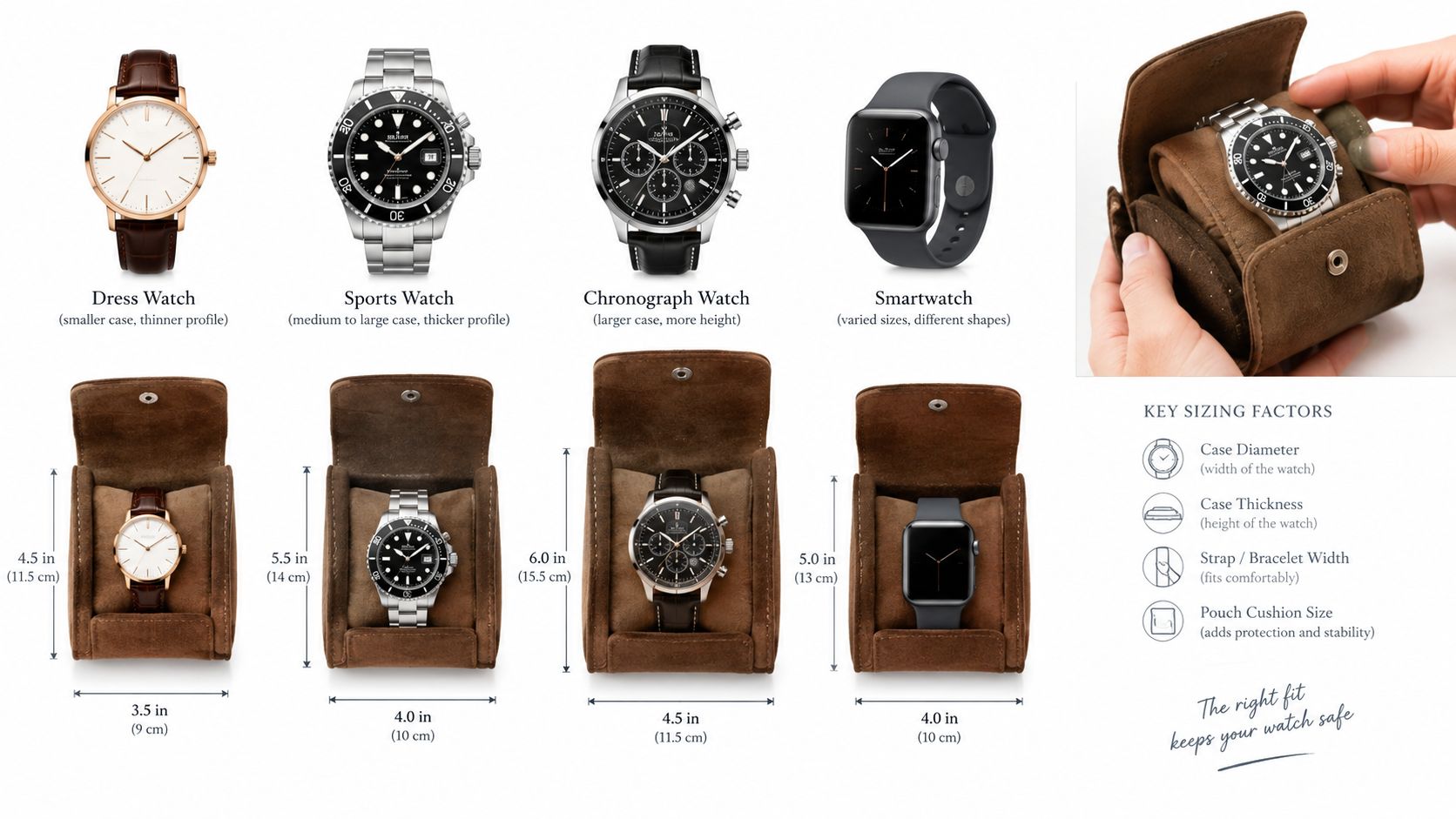
For owners who want a more structured storage format in the same family, the layout ideas in watch cases for automatic watches help clarify how internal spacing, cushion shape, and closure style affect fit.
Packing Tips for Flights, Hotels, and Daily Carry
The easiest way to damage a watch is to pack it like an afterthought. The better method is almost boring: immobilize it, isolate it, and keep it where you can reach it without rummaging. That routine works on flights, in hotels, and in daily carry.
A packing sequence that actually holds up
Start by securing the strap so the watch head doesn't spin around inside the pouch. If the case can shift, it should be held firmly enough to stay still without compression on the crown or crystal. Then place the pouch away from keys, chargers, speakers, and other metal objects that can bang into it during travel.
Keep the pouch in a ventilated part of your bag rather than burying it against damp clothes or toiletries. If you're carrying more than one delicate item, separate the watch from things that can bend, leak, or scratch. A thoughtful packing list for a trip like what to pack for a safari is useful here because it reinforces the same discipline, distinct compartments for distinct risks.
Airport screening without the myths
Carry-on X-ray and millimeter-wave scanners do not harm most mechanical watches, so the scanner itself is usually not the danger. The risks are impact, crushing, abrasion, and the opportunity to forget or misplace the watch during screening. That's why a valuable watch is better kept on the wrist unless you're instructed otherwise, or secured inside a zipped carry-on pocket rather than dropped loose in an open tray.
If your watch is vintage or magnetically vulnerable, keep it away from everyday magnets in the rest of your travel kit. Laptop speakers, phone mounts, tablet covers, and even some electronic-safe mechanisms are more relevant than the security lane. The sensible approach is to make the watch boring to handle and hard to separate from your bag.
Hotel habits that save the pouch
Hotel rooms create a second layer of risk. A pouch left on a bathroom counter can pick up moisture, heat, or both, and those conditions are bad for both the watch environment and the leather. Store it in a dry, shaded place, not beside a sink or under direct heat from a vent.
For broader bag selection around the same trip, the practical framing in best leather travel bags for men helps because the carrying case and the bag should work together, not fight for space.
Caring for a Leather Travel Watch Pouch
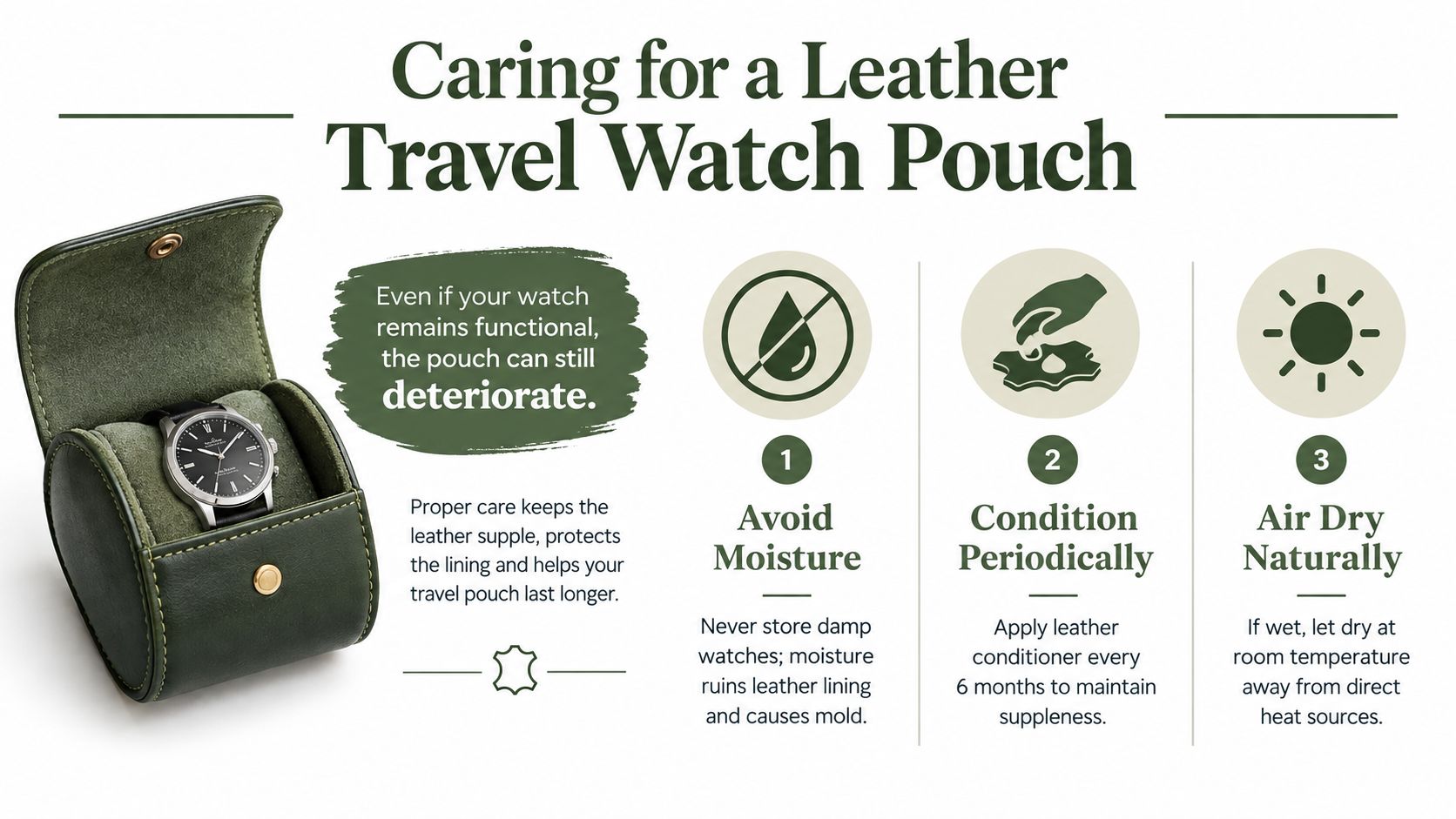
A leather enclosure can deteriorate even when the watch inside stays perfectly fine. That's the part most buyers miss. If the pouch gets wet, heated, or sealed up too long after use, the case can fail long before the watch does.
Keep humidity under control
Leather does best around 40 to 60% relative humidity, with daily humidity change kept below 5 percentage points and sustained levels above about 65% avoided because microbiological attack becomes more likely museum guidance on leather care. For travel, that translates into a simple habit, don't trap damp air inside the pouch after rain, sweat, or a humid hotel bathroom.
If the pouch gets wet, let it dry at room temperature and keep it away from direct heat. Heat accelerates ageing and can worsen adhesive or finish failure, which is why a vented repack is better than a rushed one. Full-grain leather is durable, but it still hates unstable humidity and prolonged heat.
Leather rule on the road: dry first, repack second.
Small habits that extend pouch life
A removable, washable inner cushion is worth having because it lets you clear out contamination without forcing the whole pouch through repeated moisture exposure. I also prefer a light-coloured lining, since dirt, damp spots, and wear show up faster than they do on dark interiors. That makes it easier to catch problems before they set.
The material choices matter as much as the shape. A pouch with good leather but poor interior hygiene will age badly, especially if you travel often. That's why the best-looking case isn't always the one that lasts, and why a simple maintenance routine beats heroics after the fact.
For readers who like to keep the leather side of their kit in order, how to condition leather is a useful complement because upkeep is part of the purchase, not an afterthought.
Recommendations by Traveler and Watch Collection
The right pouch depends on what you carry, how you pack, and where the watch stays during transit. A short flight with one quartz watch creates a different risk profile from a week-long trip with several high-value mechanical pieces. The broader market context is reflected in these Swiss watch export statistics, but the useful decision starts with your own route and packing habits.
Match the format to the traveler
A quartz owner on a short trip can usually use a soft travel watch pouch when the watch stays in carry-on and away from keys, chargers, and other hard objects. Choose a lining that will not scratch the crystal, and check that the closure cannot press against the case.
A smartwatch traveler needs clean separation from charging cables, buckles, and magnetic accessories. A compact pouch with a soft lining often works better than a bulky case, provided the watch cannot slide or rotate inside it.
A collector carrying two or three modern mechanical watches should choose a watch roll or structured multi-slot case. Separate compartments reduce contact between cases, while a firmer exterior helps when the bag is placed under an aircraft seat or handled during airport security.
Vintage-watch owners should use more isolation and less compression. Older finishes can show wear quickly, and protruding crowns need clear space from seams, zippers, and neighboring watches. For a high-value piece, a rigid case is usually the safer choice, even when it takes more room.
A quick pre-trip checklist
- Choose the format: match a soft pouch, roll, or rigid case to the route, bag, and watch value.
- Check the fit: the watch should not slide, flip, or rotate.
- Protect the crown: leave clearance around protruding crowns and pushers.
- Separate magnets: keep chargers, speakers, and magnetic accessories elsewhere.
- Use carry-on only: keep the watch with you rather than in checked baggage.
- Pack it dry: do not seal moisture into leather after rain, sweat, or a humid room.
For gift buyers or collectors building a practical travel set, gifts for the watch lover offers a useful way to consider the case alongside the watch routine.
Grainmark Leather makes watch cases and related leather goods for daily carry and travel storage. Browse the selection at Grainmark Leather.


