

Pocket Size Journal Guide: How to Choose and Use One
The most common advice about a pocket size journal is simple: choose the smallest one that fits your pocket. That rule gets the first half right and the important half wrong. A journal earns its place in daily carry only when it stays easy to carry and easy to write in, with paper, binding, and page area matched to the work you really do.
A compact notebook can be excellent for a shopping list, a meeting takeaway, a field observation, or a quick idea. It can also become an awkward little pad that forces cramped handwriting, constant page turns, and abandoned entries. The practical choice isn't the smallest journal you can carry. It's the smallest format that supports your normal writing without making every entry feel like a compromise.
Table of Contents
- Why the Smallest Journal Isn't Always the Best
- Understanding Pocket Journal Formats and Dimensions
- Paper Weight and Binding, The Writing Experience
- Choosing Full-Grain Leather for Daily Carry
- Historical Precedents, How Great Minds Used Them
- The Pocket Journal in Exploration and Creativity
Why the Smallest Journal Isn't Always the Best
Portability removes one kind of friction. A small journal slips into a jacket pocket, stays close during travel, and doesn't require a desk. But reducing the format too far introduces another kind of friction: less room per entry. A notebook that feels perfect in your pocket may feel restrictive the moment you write more than a few lines.
Handwriting can support reflection and memory because writers often process and reframe information instead of transcribing it word for word, as discussed in the Charlotte Observer's coverage of handwriting and note-taking. That benefit depends on having enough room to form readable notes. If every line is compressed into shorthand because the page is too small, the journal becomes a capture device rather than a useful thinking surface.
Carrying comfort versus writing comfort
Use the journal for several days before judging its size. Write the kinds of entries you typically make, not an idealized version of your routine. Record a short list, a paragraph from a meeting, a travel note, and an idea that needs space to develop.
Pay attention to where the format fails:
- Entry length: If a normal thought takes several pages, a tiny notebook may interrupt your concentration.
- Writing density: Narrow ruling and tight margins can make legible handwriting unpleasant.
- Page turning: Frequent page turns slow down references, lists, and sketches.
- Pen choice: A compact page can feel especially cramped with a broad nib or a pen that needs more expressive movement.
- Hand position: Left-handed writers may find certain bindings and narrow writing areas more troublesome.
Practical rule: Choose for the entry you make most often, not the journal you imagine carrying on an unusually disciplined day.
The same principle applies to other compact everyday objects. A smaller watch can disappear under a cuff and remain comfortable through a long day, but proportion and legibility still matter. The Heritage Timepieces 36mm watch guide is a useful comparison because it treats compactness as a question of fit and use, not just a race toward the smallest case.
Make the journal support the workflow
A pocket journal works especially well when its job is defined. Use one for rapid capture, one-line reflections, route notes, or a running list of tasks. Choose a larger format when you write full-page reflections, draw diagrams, develop research notes, or need several entries visible at once.
A refillable cover can help separate those jobs without forcing you to replace the outer case each time. The guide to refillable journal covers offers a useful way to think about replaceable inserts, especially when your preferred page format changes with the project.
Understanding Pocket Journal Formats and Dimensions
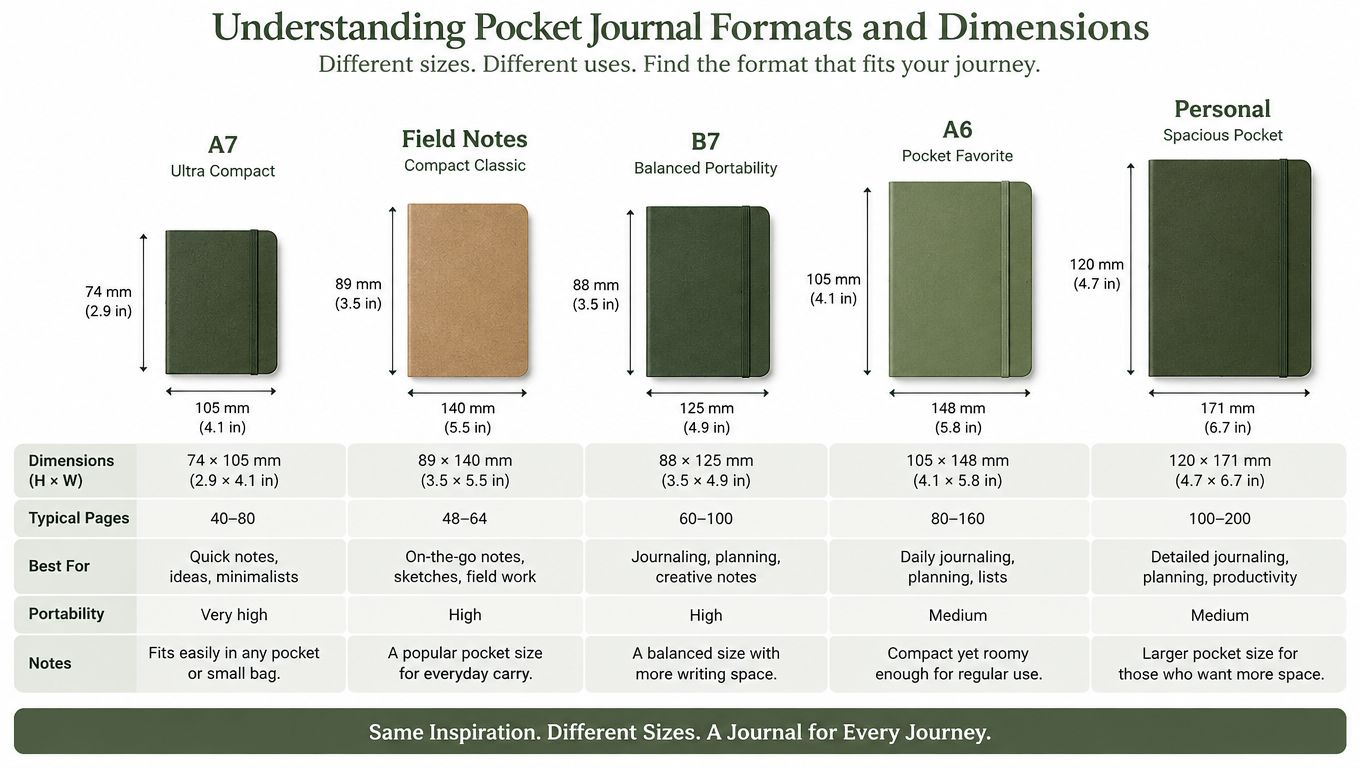
Marketing terms such as “mini,” “micro,” and “pocket” aren't precise enough for a fit check. Manufacturers use them differently, so compare the trimmed dimensions in millimeters before buying. The most technically defensible pocket format is A6, measuring 105 × 148 mm, or approximately 4.1 × 5.8 inches, according to the A6 paper specification.
An A6 page provides approximately 156.25 cm² of writing surface, while remaining substantially smaller than A5, which measures 148 × 210 mm. That gives A6 a useful middle position. It has enough area for ordinary notes while still fitting jacket pockets, small work bags, and travel organizers.
Why standardization matters
A6 follows the ISO 216 √2:1 aspect ratio. That ratio isn't just a technical detail. It makes the format predictable when you print, scan, replace, or archive pages. Two A6 sheets correspond approximately to one A5 sheet when arranged along the long edge, which makes it easier to move notes between related formats.
That consistency also helps when choosing inserts. A cover designed around a recognized size is easier to maintain than one built around an undefined “pocket” measurement. You can measure your existing paper, compare it with the stated trim, and avoid discovering that a replacement insert is too wide for the spine or too tall for the closure.
The A7 size notebook guide is useful when comparing smaller formats and deciding whether reduced dimensions suit quick capture or create too much writing restriction. The point isn't that A6 is always right. It's that exact sizing gives you a meaningful basis for the decision.
Match dimensions to the carry location
An A6 journal may fit a jacket pocket but feel too large for a trouser pocket, especially with a substantial leather cover. Inch-based formats are common in North American stationery, so convert carefully rather than relying on a product title. The cover, closure, pen loop, and insert stack all add to the final footprint.
Think about the object around the paper:
- Jacket pocket: A6 is often a practical balance between usable page area and carryability.
- Small work bag: A6 or a slightly larger format can work when writing comfort matters more than absolute compactness.
- Trouser pocket: A thinner, narrower notebook may carry better, but expect less room for reflective entries.
- Travel organizer: Standardized dimensions make replacement inserts and archival storage easier.
The right measurement is the one that accounts for both the insert and its cover. A bare paper block may fit comfortably while the finished journal catches on the pocket opening or presses against other daily-carry items.
Paper Weight and Binding, The Writing Experience
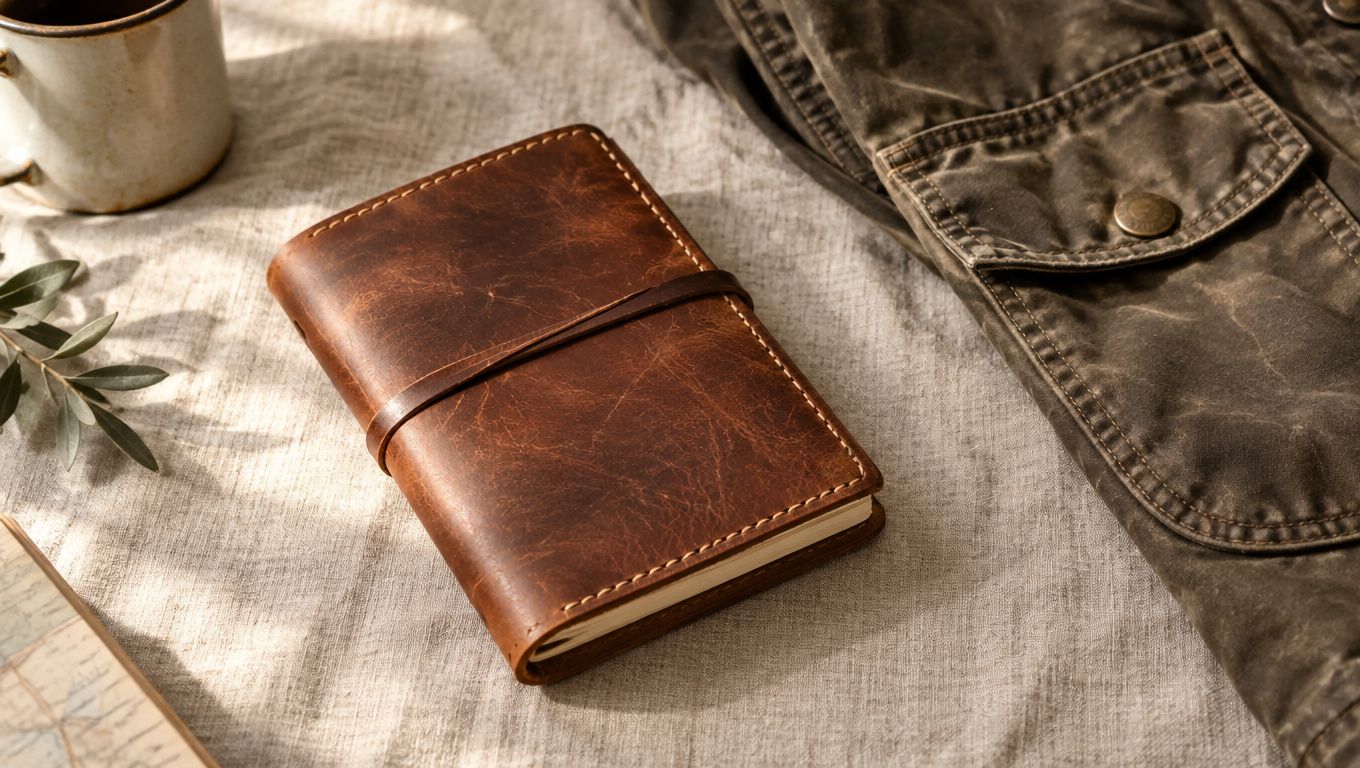
A handsome cover can't rescue paper that fights your pen. Paper engineering should match the intended writing instrument, rather than being judged only by thickness or a high gsm figure. Everyday pocket journals commonly use roughly 70 to 90 gsm, while around 100 gsm is a more practical target for fountain pens because greater basis weight generally reduces show-through and ink strike-through, as explained in this paper and notepad engineering guide.
That doesn't make gsm a complete performance test. Paper sizing, coating, absorbency, and surface smoothness can affect the result just as strongly. Two papers with similar weight may behave differently with the same ink, so the useful specification combines paper weight with stated pen compatibility and real testing conditions.
Test the paper with your actual pen
Start with the instrument you carry most. A ballpoint places different demands on paper than a wet fountain pen, and a gel pen can expose feathering or drying problems that a ballpoint won't reveal.
A practical test looks for four things:
- Show-through: Can you comfortably use the reverse side of the page?
- Strike-through: Has ink penetrated the sheet and damaged the following page?
- Feathering: Do ink lines spread into rough fibers?
- Surface drag: Does the paper slow or catch the nib?
If you use a fountain pen, test the exact ink and nib width you intend to carry. A paper block that handles a controlled sample may still behave differently during a fast note, where ink flow and pressure change.
The fountain pen and journal guide is a useful reference when the writing instrument is part of the selection rather than an afterthought. For a leather-covered pocket journal, a 90 to 100 gsm block with fountain-pen tolerance offers a practical balance between writing comfort and portability.
Binding changes the usable page
Binding determines how much of the page you can use. Saddle stitching opens relatively flat, which helps with quick notes, but it limits the thickness of the page block. Perfect binding can hold a thicker block, although the spine may resist lying flat and force one hand to hold the journal open.
Spiral binding offers the strongest lay-flat behavior and makes it easy to fold pages back. Its cost is external bulk, and the wire or plastic coil can snag inside a pocket or bag. A leather cover paired with a lay-flat-oriented insert is usually the most comfortable arrangement for daily writing because the cover protects the block without turning every note into a wrestling match.
Choosing Full-Grain Leather for Daily Carry
A pocket journal gets handled more roughly than its clean desk appearance suggests. It rubs against pocket fabric, presses against keys and chargers, bends inside a bag, and gets opened with one hand while the other is occupied. The cover needs flexibility, but it also needs enough structure to protect the pages and hold its shape.
Full-grain leather retains the hide's complete top grain. That natural surface brings strength, flexibility, and visible variation rather than a uniform finish that hides every mark. It won't remain pristine, and that is part of its usefulness. A cover that shows honest wear can still protect the insert while becoming easier to handle over time.
Why surface character matters
Corrected and heavily finished leathers can offer a consistent appearance, but the surface tells you less about how the cover will develop. A full-grain cover keeps more of the material's natural character. Scratches, bends, and changes in tone become part of the object rather than immediate reasons to replace it.
Crazy Horse leather is especially suited to this kind of tool. Natural wax treatment allows the surface to shift with handling, producing lighter marks and changes in tone as the fibers move. Those marks aren't defects in the same way a cracked coating would be. They record use, and gentle rubbing can often redistribute the finish.
A daily journal should look used because it is used. A surface that gains character without losing function is doing its job.
The full-grain leather meaning guide explains why the distinction matters when comparing leather covers. The important point for a pocket journal is practical: the cover must tolerate repeated flexing while keeping the insert protected and accessible.
Build for the wear points
Material alone doesn't determine durability. Inspect the areas that receive concentrated stress:
- Spine: It should flex without folding sharply or separating from the cover.
- Corners: Rounded or well-finished corners handle pocket abrasion better than sharp exposed edges.
- Closure: Elastic, snap, or strap closures should hold the insert without crushing it.
- Pen storage: A loop or sleeve should secure the pen without making the journal awkwardly thick.
- Insert fit: Loose pages shift and catch, while an over-tight block makes writing and replacement difficult.
A leather journal can be more material-intensive than a thin disposable notebook, so durability has to be earned through long service. Choose a cover you'll carry, fill the inserts rather than abandoning them, and replace only the paper block when the outer case remains sound.
Historical Precedents, How Great Minds Used Them
The pocket journal wasn't invented as a luxury accessory. Historical examples show a practical object designed to keep information close at hand. The Library Company of Philadelphia's account of portable notes to self and pocket writing materials traces the culture of compact note-taking through printed table-books in England during the 1570s and later nineteenth-century patented pocket diaries, pocket books, and writing tablets.
Those objects combined functions that modern users often separate across apps and accessories. A single compact book might include a calendar, diary pages, blank paper, an expandable pocket, a pencil holder, and even paper designed to be erased and reused. People used them for shopping lists, recipes, short memoranda, and personal reminders, not only for literary writing.
One object, several jobs
That multi-function design still offers a useful lesson. A pocket journal becomes more valuable when it solves a recurring problem in one place. A list can sit beside a quick observation. A travel expense can share a page with a location sketch. A short memorandum can remain visible instead of disappearing into a separate application.
The format also reflects how people work away from desks. A small writing surface is immediately available, which makes it suitable for information that would otherwise be forgotten before a larger notebook or digital device is ready. Its limits encourage concise entries, but the historical examples show that concise doesn't have to mean trivial.
Design for retrieval, not just capture
A pocket journal works better when the pages remain useful after the moment has passed. Give recurring notes a simple structure. Use a consistent mark for tasks, leave a margin for follow-up details, or reserve the final pages for addresses and reference notes. The method can stay informal, but the page should help you find information later.
The reusable-paper examples also point toward a broader principle: compact stationery has always involved material choices and maintenance. A journal isn't only a container for thoughts. It is a small information system, shaped by its paper, binding, storage features, and the habits of the person carrying it.
The Pocket Journal in Exploration and Creativity
The strongest argument for a pocket journal comes from people who needed reliable records outside controlled conditions. Charles Darwin used 15 field notebooks during the HMS Beagle voyage and related South American investigations, recording zoological, botanical, archaeological, and linguistic observations alongside latitude and longitude, barometer readings, temperature, depth soundings, sketches, diary entries, shopping lists, and financial information. These details are documented in this account of famous pocket notebooks and their users.
Lewis and Clark kept 18 traveling pocket journals. 13 were larger notebooks bound in red morocco leather, four were smaller paper-board volumes, and one was Clark's field notebook bound in elk skin. At the Menlo Park laboratory, Thomas Edison and colleagues collectively produced approximately 2,500 pocket notebooks during his lifetime, with each notebook containing about 200 to 250 pages, according to the same historical account.
What paper beats, and what it doesn't
Against a phone, a pocket journal has no battery requirement, no boot time, and no notification competing with the observation you meant to record. It also gives handwriting, sketches, arrows, and rough diagrams the same surface without requiring a separate interface. Digital notes win when you need search, duplication, synchronization, or fast sharing with other people.
A larger notebook offers better visibility and more comfortable space for diagrams, long-form writing, and several connected thoughts. It is the better tool when the work depends on spreading material out in front of you. The pocket format wins when the note must be captured immediately and the alternative is losing it entirely.
Choose by the moment of use
Use a pocket journal for:
- Field notes: Record observations while moving through a place rather than reconstructing them later.
- Travel details: Keep directions, expenses, names, and short impressions together.
- Creative capture: Catch phrases, thumbnails, and ideas before they become polished.
- Meeting takeaways: Write decisions and follow-up actions without opening a distracting device.
- Daily prompts: Keep entries short when consistency matters more than volume.
A digital tool remains preferable for material that needs collaboration, extensive searching, or frequent revision. A larger notebook is preferable when writing comfort and visual space dominate. The pocket journal sits between them as a deliberately limited tool, valuable because it is present, immediate, and physically separate from the noise of a screen.
For travelers who want a protected insert system rather than a fixed notebook, a Traveler's Notebook cover in A5 format can provide more room while preserving the habit of carrying replaceable sections. Select the format according to the work, then test the complete setup with your preferred pen before committing.
Grainmark Leather offers full-grain leather journals in Passport and Slim sizes for pocket carry, travel notes, quick ideas, lists, and short entries. Visit Grainmark Leather to compare a leather cover with your preferred insert format and build a daily-carry journal around the way you write.


