Article: Fountain Pen and Journal Pairing: A Practical Guide
Fountain Pen and Journal Pairing: A Practical Guide
A good fountain pen and journal pairing usually starts with a small disappointment. You open a handsome notebook, fill a pen with an ink you like, write a line, then watch the page betray you. The line spreads. The back side ghosts harder than you expected. Dry time slows you down. Or the opposite happens. The paper feels so slick and resistant that quick notes lose their ease.
That mismatch is why people keep asking the same question in different forms: which journal works with this pen, which ink works with this notebook, which case makes the set practical to carry, and what makes a good gift. The honest answer is that a fountain pen and journal never work as separate choices. They behave like a system.
Table of Contents
- A Quiet Moment at the Writing Desk
- What Actually Matters in Fountain Pen Paper
- How Nibs and Inks Behave on the Page
- Choosing a Journal Format That Fits the Way You Write
- Carrying and Storing a Fountain Pen the Right Way
- Building a Pen and Journal Set That Works as One
- Pairing Pens and Journals as a Gift That Lasts
A Quiet Moment at the Writing Desk
Late in the day, the best writing setups feel almost automatic. A pen comes out of a stitched leather sleeve. The cap has a little weight to it. The page opens without fighting back. The nib touches down, and within a few words you know whether the pairing is right.

That moment is why lists of “best notebooks” never quite solve the problem. A notebook can be lovely on a shelf and still fail with your actual pen. A sleeve can look refined and still be awkward if it adds bulk where you need quick access. Even a desk setup changes how often a pen gets used. If you keep pens visible in a desktop pen holder setup, you're more likely to rotate between inks and nibs instead of forcing one pen to do every job.
One object, not two
People often shop for the pen first and the journal later. In practice, they meet on the page. The journal decides how sharply the line holds. The pen decides how much liquid lands there. The carry piece decides whether the set survives a bag, commute, or gift box without looking battered a week later.
The fountain pen itself has a long history. Its roots reach back to at least 973 CE, with an early recorded mention tied to accounts of the Fatimid Caliph al-Mu'izz, and major turning points came with Petrache Poenaru's 1827 French patent and Lewis Edson Waterman's 1883 capillary feed patent that improved reliability, as summarized in the fountain pen history overview. From the 1800s through the mid-1900s, fountain pens dominated daily writing before ballpoints took over mass-market use, after which fountain pens moved more decisively into a collector and luxury niche in many markets.
What holds up in real use
After enough customer questions, the pattern becomes familiar:
- Desk writers usually care most about paper behavior and comfort over long sessions.
- Commuters care just as much about closure, protection, and bag carry.
- Gift buyers need compatibility more than prestige.
- Collectors often want one coordinated object. Pen, journal, and case in the same visual language.
A fountain pen and journal pairing succeeds when the writer stops noticing the setup and starts noticing the writing.
That is the standard worth using. Not hype. Not a brand ranking. Just whether the pen, paper, and carry choices cooperate.
What Actually Matters in Fountain Pen Paper
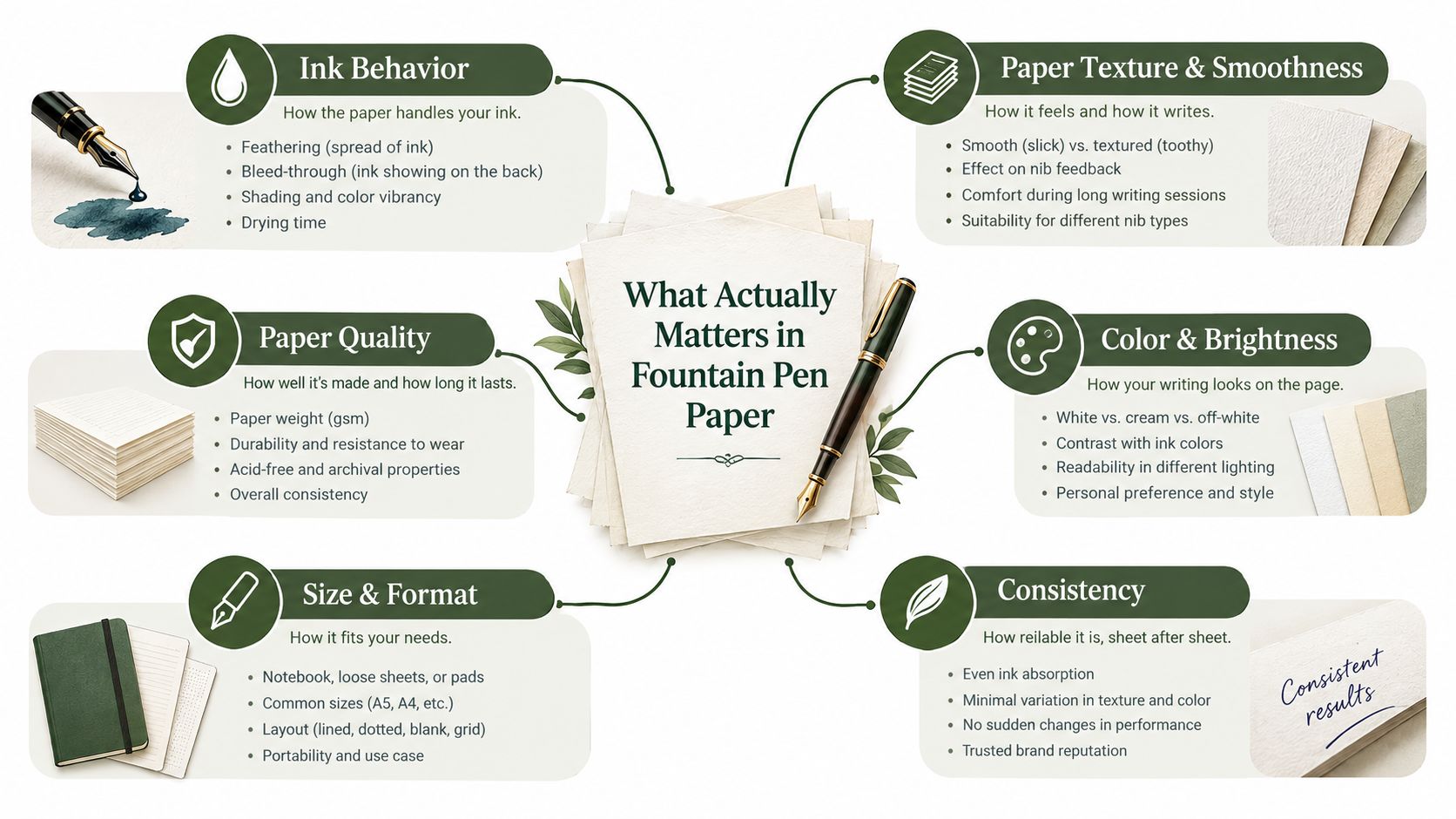
Paper decides whether a fountain pen feels precise or sloppy. GSM gets attention because it is printed on product pages, but it is rarely the first spec I use when helping someone choose a journal. For fountain pens, the bigger question is how the sheet manages liquid ink.
GSM tells you thickness, not ink control
GSM describes weight. It gives a rough sense of heft, stiffness, and how substantial the page will feel in the hand. It does not tell you, by itself, whether a wet nib will stay sharp or spread into the fibers.
That job falls largely to paper sizing. As explained in this overview of feathering and bleed-through in fountain pen journals, sizing slows how fast ink penetrates and travels through the sheet. Good sizing helps lines stay crisp. Weak sizing lets dye and water move outward, which leads to feathering, show-through, and in worse cases bleed-through that ruins the back of the page.
A heavier sheet can still behave badly. A lighter, well-sized sheet can write far above its weight.
Surface finish changes the writing experience
Two papers can share the same GSM and still feel completely different under the nib.
A smoother sheet usually shows shading and sheen more clearly because the ink sits closer to the surface. The trade-off is dry time. Left-handed writers, fast note-takers, and anyone who closes a notebook quickly will notice that delay.
A paper with more tooth gives more feedback and often feels easier to control during long writing sessions. It can also mute some of the ink's visual character. Neither option is universally better. The right choice depends on whether the writer values glide, feedback, quick handling, or ink expression.
Why paper specs alone disappoint people
Customers often ask for "thick fountain pen paper" and end up frustrated because thickness was not the problem. The full system matters. Nib wetness, paper sizing, ink chemistry, and even the journal format all affect the result on the page.
That is why a well-made 80 to 100 gsm journal can outperform a bulkier notebook for actual fountain pen use. Weight helps with opacity and page feel. Sizing and surface treatment do the harder work of keeping lines clean and both sides usable.
The same caution applies to specialty formats. A product like Traveler's Notebook refill inserts in 100g dovetail kraft paper may attract attention because of the weight and the format, but the test is still how that specific paper handles your usual nib and ink.
Practical rule: Match the paper to the pen you actually carry, not the spec that sounds premium.
A buying filter that works
Use this order when comparing journals:
- Check for sizing performance. Look for resistance to feathering, bleed-through, and heavy show-through.
- Check surface feel. Smooth paper favors ink display. Slight texture favors control and feedback.
- Use GSM as a secondary filter. It matters, but it is not the deciding factor.
- Judge the set, not the sheet alone. A journal that works at a desk may be the wrong choice for a leather cover, daily bag carry, or a gift set built around one pen.
That last point gets missed. A fountain pen journal is not just paper. It is part of a writing setup people carry, store, and often give as one coordinated object.
How Nibs and Inks Behave on the Page
A fountain pen setup succeeds or fails as a system. The nib sets the line width. The feed and ink set how much liquid reaches the page. The paper then has to hold that line in place long enough for it to dry cleanly.
A useful reference point comes from a 2022 study on fountain pen ink deposition, summarized in the study abstract on fountain pen ink deposition. The abstract points to ink wetness as the main driver, with surface tension playing the biggest role, followed by viscosity and conductivity. That matches what shows up at the counter and on the desk. A broad, wet writer can make decent paper look poor. A fine nib with a restrained ink often makes the same notebook perfectly serviceable.
Two common pairings
Use one ordinary absorbent notebook and switch only the pen.
A fine nib with a drier ink usually produces the easiest everyday result. Lines stay narrower, dry time stays reasonable, and note pages remain readable on both sides. The trade-off is visual character. You get less shading, less sheen, and less of the dramatic ink behavior that draws many people to fountain pens in the first place.
A broad nib with a wetter ink pushes the same page much harder. The line spreads more readily, feathering shows sooner, and dry times lengthen. On weak paper, the reverse side can become annoying or unusable, especially for fast notes, margin edits, or journaling in smaller books where every page matters.
Move both setups to a well-sized journal paper and the balance changes. The fine nib still behaves. The broader, wetter pen finally has room to show color depth and shading without turning every page into a blot test.
What changes with more demanding inks
Ink choice matters beyond color.
Highly saturated inks, heavy sheeners, and many iron-gall formulations expose paper weakness faster than a conservative blue or blue-black. That does not make them poor choices. It means they ask for a better match. If a customer wants crisp edges and rich color from a wet medium or broad nib, I usually steer the conversation toward sizing and surface finish first, not just paper weight.
Drying behavior also changes with paper surface. Smoother, more resistant sheets preserve line shape and show off ink character, but they can leave wet ink sitting on top longer. More absorbent papers shorten dry time, yet they often blur edges and mute shading. That is the trade-off people feel immediately in real use.
Notebook testing reflects the same pattern. Stronger paper handles medium and broad nibs more reliably, while office-style stock is far less forgiving. The practical takeaway from that ink amount and paper interaction study reference is simple: test your wettest pen and most difficult ink before buying a full stack of journals.
| Nib + Ink | Soft Paper (80gsm, lightly sized) | Mid Paper (90-100gsm, sized) | FP-Friendly Paper (100gsm+, coated) |
|---|---|---|---|
| Fine nib + dry ink | Clean lines, quick dry, modest ink character | Reliable daily pairing with cleaner edges | Crisp result, though some writers find the surface too slick |
| Medium nib + balanced ink | Often usable, some show-through possible | Good all-round match for work and journaling | Controlled line, fuller shading, slower dry |
| Broad nib + wet ink | Highest risk of feathering and bleed-through | Works if sizing is strong and dry time is acceptable | Best ink appearance and control, with the longest dry time |
Match your wettest pen and richest ink to the most resistant paper you are willing to carry.
That rule works better than shopping by GSM alone, and it helps when you are building a pen-and-journal set that needs to function as one carried object, not two separate items.
Choosing a Journal Format That Fits the Way You Write
People often overfocus on covers and underfocus on format. The better question is simpler: how do you write, carry, and revisit your pages?
Bound books for settled writing
A hardbound notebook suits desk journaling, correspondence, and longer sessions where the notebook lives mostly on a table. If you write at home, keep one pen inked for that book, and care about a finished archive on the shelf, a bound format makes sense.
A sewn book also gives emotional continuity. One volume, one season, one project. The trade-off is that you can't swap out paper once you learn the stock doesn't suit your pen.
Traveler and refillable systems for people who change their mind
Softcover traveler formats and refillable covers solve a different problem. They let you adapt. One insert for daily notes, another for letters, another for ink testing. That's especially useful if you alternate between papers with different fountain pen behavior.
For anyone comparing layouts before committing, a thoughtful daily writing journal guide is useful because it frames journaling by habit and purpose, not just stationery aesthetics. That mindset matters with fountain pens. The journal that fits your routine usually gets used more than the one with the most admired paper stock.
A practical example is a refillable leather journal format that accepts inserts rather than locking you into one paper choice. That kind of system works well for writers who haven't settled on one preferred sheet.
Loose sheets for specialized work
Loose-leaf pages and slipcase storage don't feel romantic in the same way, but they solve real problems. They work for calligraphy drills, planner pages, editing drafts, and any writing routine where you need to remove, rearrange, or file sheets.
They also make paper testing simpler. You can compare several stocks with the same pen and ink before buying a full journal.
| Format | Binding & Closure | Typical Paper Weight | Lay-Flat Behavior | Refill System | Best Use Case |
|---|---|---|---|---|---|
| Hardbound notebook | Sewn or casebound, usually no closure or an elastic | Varies widely | Usually best in the middle pages | None | Daily journaling, letters, project archives |
| Softcover traveler | Flexible cover, often elastic closure | Varies by insert | Good, depends on insert thickness | Yes | Light packing, mixed-use carry |
| Refillable cover system | Leather or synthetic cover with bands or sleeves | Depends on inserts chosen | Good to very good | Yes | Writers testing papers or juggling multiple notebooks |
| Loose-leaf or slipcase sheets | Separate sheets with folder or case | Fully variable | Perfectly flat when removed | Full replacement by sheet | Calligraphy, planners, correspondence drafts |
The right format is the one that supports your writing habit without asking you to tolerate a paper you already know you don't enjoy.
For fountain pen use, page count, lay-flat behavior, and refill availability matter more than decorative details.
Carrying and Storing a Fountain Pen the Right Way
A fountain pen that's perfect at a desk can become annoying in transit if you carry it badly. Most pen damage isn't dramatic. It comes from rubbing against keys, being crushed in a bag pocket, drying out after neglect, or picking up micro-scratches from careless storage.
Choose carry by situation, not by category
A single-pen leather sleeve suits everyday carry when one pen does most of the work. It keeps the barrel away from hard objects, adds a little friction so the pen doesn't slide around, and feels natural if you pull the pen out often during the day.
A double sleeve or zipper pouch makes more sense if you carry a second pen, a pencil, cartridges, or a small cloth. That's useful for meetings and travel, where redundancy matters more than speed.
A rigid pen box belongs on a desk or in longer-term storage. It also makes sense for gifting because presentation and protection arrive together.
A hard case with structured interior protection is the better travel choice for luggage, especially if the pen is going somewhere rougher than a briefcase or jacket pocket.
Practical habits that prevent small failures
Storage position matters between writing sessions. Many users prefer storing pens nib-up when resting them for a while, especially if they're moving the pen in and out of bags. That helps reduce the mess from any minor ink migration into the cap. A pen left nib-down may start quickly, but it can also concentrate ink where you don't want it during transport.
Heat matters too. Fountain pens and hot cars don't mix well. Ink expands, internal pressure changes, and a pen that behaved perfectly indoors can surprise you later.
For people who want more detail on home organization and longer storage routines, this guide on how to store fountain pens covers the category well.
Will leather scratch a pen
That depends more on grit and fit than on leather itself. Clean, properly sized leather is generally a protective material. Trouble starts when a sleeve is too tight, the lining holds debris, or the pen clip catches the edge repeatedly.
Use this checklist:
- Fit first: The pen should slide in without force but not rattle.
- Mind the finish: Lacquered barrels and polished clips show marks sooner than tougher resins.
- Check the environment: A sleeve in a clean bag pocket is safer than a bare pen in a crowded organizer.
- Travel smart: Keep pens capped, secure, and out of strong heat swings.
Leather has one quiet advantage in real life. If a minor leak happens, a soft sleeve is often gentler than a hard plastic tray or loose pocket, and it isolates the pen from the rest of your carry.
Building a Pen and Journal Set That Works as One
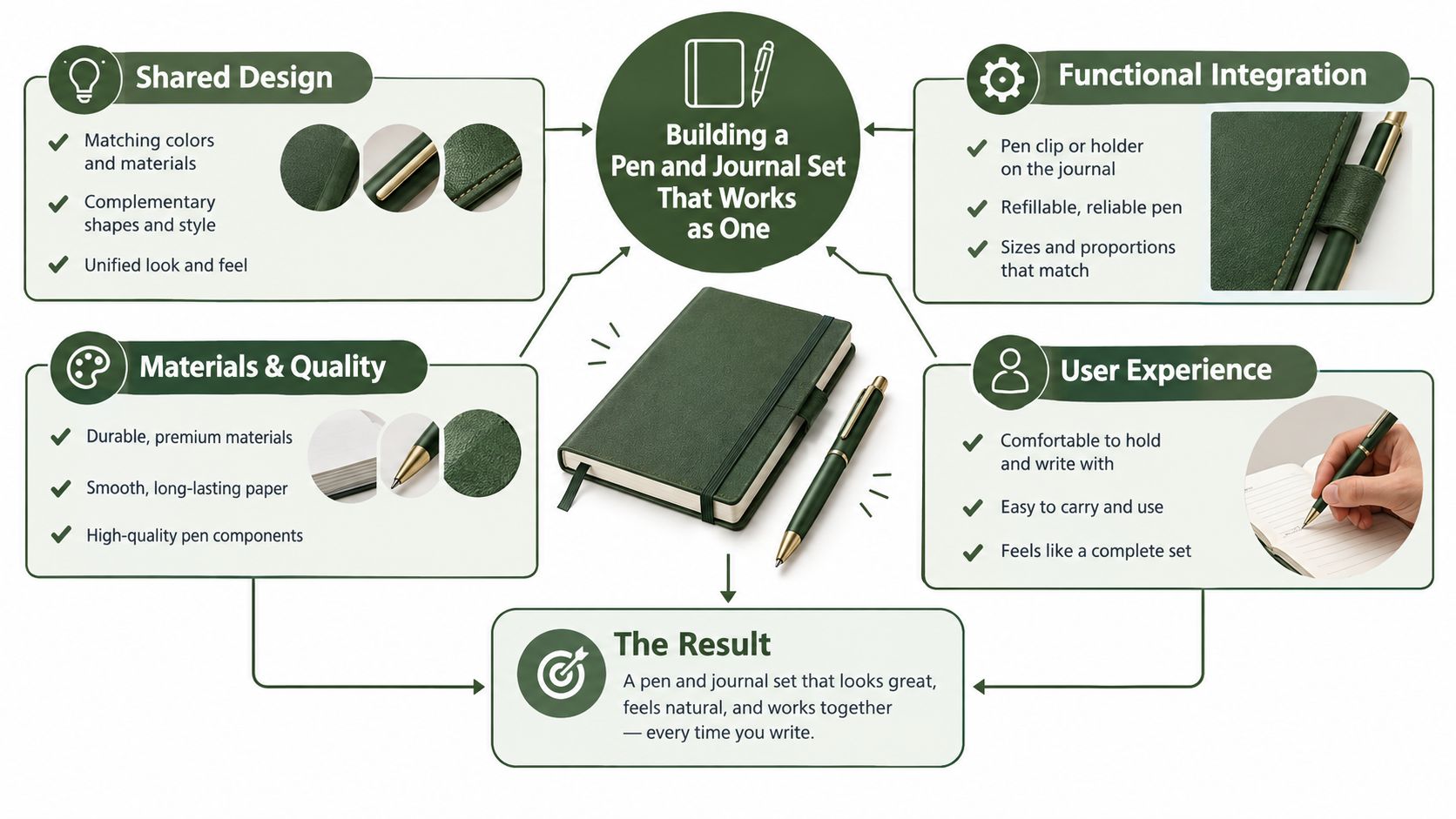
A fountain pen set usually succeeds or fails in a bag, not at the desk. The pen has to start cleanly on the paper you chose, the journal has to suit the way you write, and the carry method has to keep both together without turning them into dead weight.
Start with the full writing system
Many buyers stop at paper weight. That misses the interaction. A wet medium nib on well-sized 68 gsm paper can behave better than a broad, saturated ink on a poorly sized 90 gsm sheet. Paper feel, absorbency, dry time, and show-through all shift once the nib and ink enter the equation.
Build from your actual writing behavior. A compact pen with a fine or moderate medium nib, paired with a controlled ink, gives a journal more format options. A wetter writer narrows those options fast, especially if you want to use both sides of the page without distraction.
Then account for carry. A5 hardbound journal plus a large metal pen plus a thick zip case often sounds good on paper and gets left at home by week two. A coordinated setup works better when the scale is consistent across all three pieces.
A journal with pen holder setup can solve that neatly, but only if the loop, cover, and pen size are chosen together. Slim pens disappear into this format in a good way. Oversized pens can torque the cover, catch on the closure, or make the notebook awkward in hand.
One practical pairing logic
A reliable daily setup usually has these traits:
- Pen: a fine or medium nib that matches your handwriting size
- Ink: moderate flow, with drying behavior that suits note-taking rather than swatching
- Journal: well-sized paper chosen for clean lines, controlled show-through, and comfortable reverse-side use
- Carry: a cover, sleeve, or integrated holder sized for the actual barrel and clip
That pairing logic matters more than brand matching. Customers often try to fix a poor paper and nib pairing by changing storage, adding blotters, or switching covers. Those tweaks help at the margins. They do not change how that pen and ink behave on that sheet.
For readers who like to see how journaling tools are assembled into a working bundle, this Mr. Pen kit demonstration is useful as a visual example of how accessories change the experience from a loose collection of items into a functioning setup.
Build the set as one carry object
The strongest sets feel intentional in the hand. If the journal is soft and flexible, a heavy brass pen may pull the whole kit off balance. If the notebook has a firm structured cover, it can carry a slightly larger pen without feeling lopsided. Leather color matters for gifting, but fit matters more.
Grainmark Leather pen-holder journal approach lands in a practical middle ground. It treats the notebook, pen placement, and carry routine as one decision instead of separate purchases made in isolation.
A good-looking set only earns a place in daily use when the pen writes cleanly on the page and the journal carries the pen without fuss.
That is the difference between stationery that gets admired and stationery that gets used.
Pairing Pens and Journals as a Gift That Lasts
The best gift sets aren't the most expensive ones. They're the ones that spare the recipient from basic incompatibility. A fountain pen gift fails quickly if the notebook feathers badly, the case doesn't fit, or the setup feels too precious for everyday use.
Buy for the recipient's writing style
A beginner usually does better with a forgiving nib and a sized journal, not with the most demanding pen in the cabinet. A medium nib can work well if the journal paper is properly chosen. Someone who writes letters or enjoys visible ink character may appreciate a more expressive setup, but only if the notebook can handle it.
Push back on the common shortcut that says heavier paper is always better. It isn't. Practical notebook testing shows wide variation even among papers that sound suitable on paper. The more useful question is whether the journal is fountain-pen-safe across real nib and ink combinations, not just marketed as “ink friendly.” The verified research also notes a contrarian point many buyers miss: heavier paper is not always the best choice, and some 52 g/m² Japanese papers are praised because coating and sizing can outperform cheaper heavier sheets, as discussed in this piece on picking the right notebook for fountain pens.
A gift set that keeps working
Build the bundle around compatibility:
| Recipient | Pen Match | Journal Match | Carry Accessory |
|---|---|---|---|
| New fountain pen user | Medium nib with a controlled ink flow | Sized paper in the 80 to 100 gsm range | Single-pen sleeve |
| Dedicated journal writer | Fine or medium nib based on writing size | Lay-flat notebook with paper chosen for back-side usability | Journal cover or pen loop carry |
| Letter writer or expressive user | Broader or more characterful nib | More resistant paper that shows shading cleanly | Double-pen sleeve or desk box |
| Frequent traveler | Compact fountain pen or converter-friendly carry pen | Pocket or refillable notebook | Secure sleeve or zipper pouch |
Additions matter too:
- Include blotting paper: It helps with slower-drying combinations.
- Avoid shipping a pre-inked pen: Transit and pressure changes make that a needless risk.
- Prefer refillable journals for long-term use: They let the gift adapt as the recipient discovers what paper they like.
- Write on the first page: A short note shows how the gift is meant to be used.
The gift lasts when the recipient feels invited to write, not instructed to admire.
Grainmark Leather offers full-grain leather pen sleeves, journal covers, pen boxes, and travel-ready carry pieces that fit the practical side of a fountain pen and journal setup. If you want to build a coordinated writing set for daily use, travel, or gifting, visit Grainmark Leather and look at the pen and journal carry options as one system rather than separate accessories.