Slim Mens Briefcase: A Smart Buyer's Guide
You're probably staring at two or three tabs right now. One bag looks clean but suspiciously flat. Another claims to be “slim” while clearly built like a small suitcase. A third looks good in the product photos, but you can't tell whether your laptop will slide in cleanly or fight the zipper every morning.
That's the actual problem with buying a slim mens briefcase. Most guides obsess over leather color and brand names. The decision usually comes down to three things that buyers miss: depth, laptop compartment geometry, and when you're buying. Get those right, and the bag works for years. Get them wrong, and even expensive leather won't save it.
Table of Contents
- Why the Slim Briefcase Earns a Spot in Your Routine
- What Slim Really Means in a Mens Briefcase
- Size, Capacity, and Internal Organization
- Why Full-Grain Leather Is the Right Material Here
- Carrying Styles and How They Change the Bag
- Slim Briefcase vs Messenger, Backpack, and Crossbody
- Styling a Slim Briefcase for Professional Settings
- Choosing Well and Buying Smart
Why the Slim Briefcase Earns a Spot in Your Routine
On a crowded train, bulk gets exposed fast. The man with the deep gusset attaché is turning sideways at every seat row, while the person carrying a slim leather case tucks it close, slides under the armrest, and gets off the train without clipping anyone in the knee.
That's why a slim briefcase still matters. It isn't about carrying less for the sake of minimalism. It's about carrying the right load in a shape that moves cleanly through stations, elevators, office lobbies, and client floors.
A good slim mens briefcase stays close to the body, sits neatly under a seat, and doesn't fight you when the day jumps from commute to desk to meeting. If you want a broader sense of how leather work bags fit different routines, Grainmark's overview of leather briefcases and bags is a useful starting point.
What Slim Really Means in a Mens Briefcase
“Slim” gets abused in bag marketing. If the seller can't tell you the measurements, assume the word means nothing.
A slim briefcase is a compact carry format, not a downsized traditional attaché. One independent sizing guide describes slim attaché cases at about 16 x 3 x 12 inches, while standard briefcases are more often 16 to 18 inches wide, 3 to 6 inches deep, and 12 to 14 inches high. The same guide also maps width to common laptop fit, with roughly 16 inches wide for 13-inch laptops, 17 inches for 15-inch laptops, and 18 inches for 17-inch laptops. That's the useful part. Slim is measurable, not stylistic (briefcase sizing guide).
Three measurements that matter
Width comes first. If the bag is too narrow, the laptop fit turns into a diagonal jam instead of a clean horizontal slide. For most professionals, the sweet spot is enough width for a modern laptop and a document file without forcing the zipper corners.
Depth decides whether the bag is slim. This is the number buyers ignore most. Once depth starts creeping upward, the bag stops behaving like a slim briefcase and starts acting like a small general-purpose work bag.
Height matters more than people think. Too tall, and the bag stacks awkwardly on cafe seating, conference tables, and rolling luggage.
| Measurement | Slim Briefcase | Traditional Attaché |
|---|---|---|
| Width | About 16 inches in one slim format example | More often 16 to 18 inches |
| Depth | About 3 inches in one slim format example | More often 3 to 6 inches |
| Height | About 12 inches in one slim format example | More often 12 to 14 inches |
Why construction matters more on a slim bag
A deeper briefcase can hide mediocre build quality because volume masks stress. A slim briefcase can't.
When leather panels are flatter and compartments are tighter, every weak decision shows up faster. Cheap edge paint cracks sooner. Thin handle anchors wrinkle sooner. Loose internal structure lets the laptop drag against papers and corners.
Practical rule: The slimmer the profile, the less tolerance the bag has for sloppy construction.
There's also a historical reason the shape exists at all. The modern rigid briefcase form is commonly traced to the 1850s, after standardized paper sizes created a need for secure document transport, according to the same sizing reference linked above. Slim versions are the modern answer to a changed loadout. Less paper, lighter laptops, tighter commutes.
Size, Capacity, and Internal Organization
Most buyers make the wrong call. They shop by laptop screen size alone, then act surprised when the charger bulges the front panel or the zipper teeth strain at the corners.
Start with the load you carry. A slim briefcase is built for a laptop, charger, a thin notebook, and flat documents. It is not built for optimism.
Real-world slim business briefcases cluster around a narrow depth profile. Examples in the market include 13.98 x 1.57 x 10.04 inches for a 14-inch model and 16.8 x 3.3 x 12.8 inches for a 15.6-inch model. A Dell slim briefcase listed by HP shows 40 x 30 x 8 cm, 0.55 kg, and 12-liter capacity. The practical effect is simple. Less depth reduces bulk and improves carry comfort, but it also caps usable volume, so you need to prioritize a focused daily load (HP product listing with slim briefcase examples).
Check the laptop sleeve before anything else
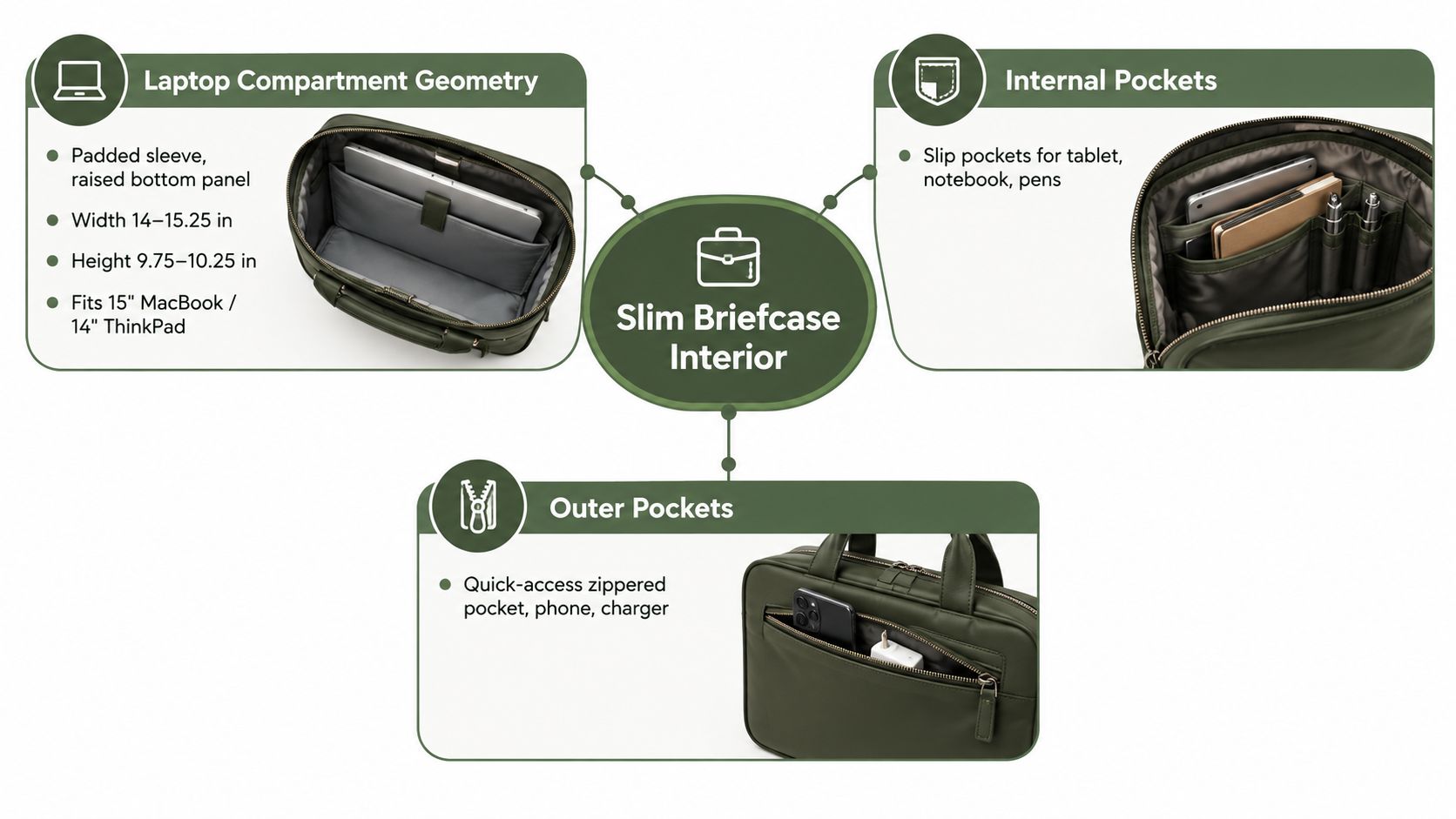
A padded laptop sleeve is not the same thing as an open interior with a token divider. You want a structured cavity with a raised bottom panel so the device doesn't take direct impact when the bag is set down.
Look for these signs:
- Raised base protection so the laptop doesn't sit directly on the bottom seam
- Padded side walls that stop edge pressure from files and chargers
- Sleeve width clearance that lets the laptop slide in without bowing the zipper line
- A clean opening angle so you can remove the device quickly at security or in a meeting
If the laptop compartment feels like a soft sleeve stitched into a larger pocket, be careful. That design lets the computer flex against documents and accessories. Over time, that's rough on corners, ports, and screens.
For more detail on what to look for in a work bag built around a computer, see this guide to a laptop leather briefcase.
What fits in the document section
The flat document zone is where a slim bag earns its keep. It holds papers cleanly, keeps a legal pad from curling, and stops your daily essentials from turning into a pile at the bottom.
A sensible slim layout usually needs:
- One zippered main compartment for the laptop and papers
- One quick-access exterior panel for a phone, badge, passport, or boarding pass
- Pen slots and a card pocket so small items don't migrate
- A cable pouch or defined accessory pocket for charger and mouse
What it usually does not need is a bottle pocket, umbrella tube, or giant admin panel. Those features push the bag outward and ruin the profile.
If your daily carry includes a water bottle, over-ear headphones, a packed lunch, and two power bricks, you don't need a slim briefcase. You need a different category of bag.
Don't buy empty space you can't use
A lot of slim bags photograph well because they're underpacked. Buyers then assume the silhouette will stay that clean at full use. It won't.
If the packed depth goes much beyond the slim range, the briefcase loses the whole point of its shape. It starts sagging, the side profile balloons, and the carry becomes awkward in tight spaces. The best slim briefcases work because they force discipline.
Why Full-Grain Leather Is the Right Material Here
Slim briefcases expose material quality faster than bulky bags do. There's less leather to absorb stress, less room for sloppy reinforcement, and fewer places to hide shortcuts.
That's why I push buyers toward full-grain leather for this category. On a slim profile, the material has to carry structure, resist edge wear, and age without looking tired after a year of commuting.
Where cheaper leather fails first
Top-grain can still work if the build is honest, but it's already sanded and corrected. Bonded leather is where I stop recommending. It may look tidy on day one, but on a slim briefcase the corners, handles, and edges take concentrated stress.
Watch these spots:
- Handle base wrinkling near rivets or stitched anchors
- Edge paint separation on the top handles and opening seams
- Flat panel lifelessness where the surface starts looking plastic instead of developing character
- Crease cracking at the gusset folds
Those aren't random flaws. They point to manufacturing choices. Thin splits under edge paint, weak reinforcement, or heavily corrected surfaces usually age poorly on a briefcase that flexes every day.
| Leather Type | Durability (Years) | Aging Behavior | Price Tier |
|---|---|---|---|
| Full-grain leather | Long-lasting with proper care | Develops patina and character | Premium |
| Top-grain leather | Moderate to strong, depends on build | Ages more evenly, less character | Mid to premium |
| Corrected-grain leather | Variable | Stays more uniform, can look flat with wear | Lower to mid |
| Bonded leather | Shorter-lived in hard daily use | Tends to degrade rather than improve | Low |
| Synthetic or coated canvas alternatives | Depends on fabric and reinforcement | Usually stays consistent rather than patinating | Low to mid |
What to inspect before you buy
You can tell a lot from product photos if you know where to look.
Check whether the grain varies slightly across larger panels. Real full-grain leather usually shows natural variation. Look at the edge finishing on the handles and opening. Thick, smooth, well-applied edges usually hold up better than thin, shiny paint lines. Examine the handle anchors. If they look decorative rather than structural, walk away.
If you want a plain-language breakdown of what separates better hides from corrected surfaces, this explainer on full-grain leather meaning covers the basics well.
What I'd buy: On a slim briefcase, I'd rather pay more for excellent full-grain leather and simpler hardware than pay for flashy fittings attached to mediocre leather.
Why the premium is justified here
On a duffle or a larger backpack, mediocre leather sometimes gets hidden by size and casual use. On a slim briefcase, every scratch, crease, and edge line sits in full view.
Full-grain leather also rewards long ownership. Condition it every 6 to 8 months if you use it regularly, keep it away from prolonged damp storage, and don't overload it. At that point the bag starts looking better with age instead of worse. That matters on a professional bag, because a slim briefcase is part of your presentation whether you admit it or not.
Carrying Styles and How They Change the Bag
Carry style isn't a small detail. It changes the hardware layout, the stress points, and the way the briefcase behaves on your body.
Most slim briefcases come in three formats: fixed top handle, detachable shoulder strap, or convertible handle-plus-strap.
Fixed top handle
This is the cleanest and most formal setup. No side hardware hanging loose. No strap clips ticking against the leather. The silhouette stays sharp.
Handle-only works best when your day looks like this:
- short office walks
- client presentations
- car commute
- rolling suitcase pairing
It fails when you need free hands for tickets, coffee, phone access, or transit poles.
Detachable shoulder strap
A detachable strap gives the bag a second life during the commute. It's less rigid, more practical, and easier through airports and stations.
The details matter here. I like a strap that feels proportionate to the bag and doesn't twist under load. If the side D-rings are placed too high or too far forward, the bag tips outward and knocks the thigh every few steps.
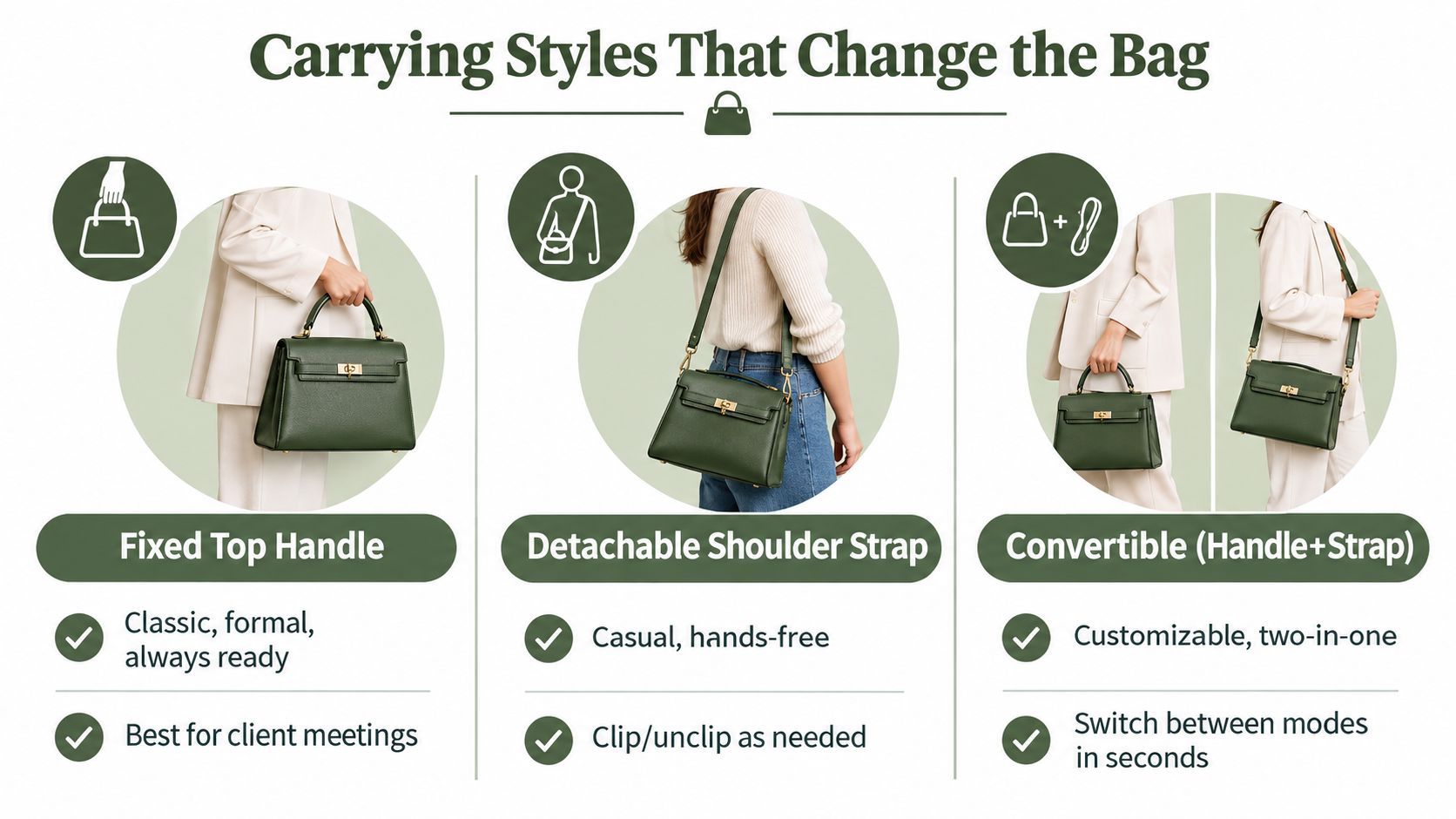
Convertible handle plus strap
This is the most flexible option, and for many commuters it's the smartest compromise. Carry it by hand into the meeting. Use the strap on the platform or in the terminal.
The catch is structural. Some convertible designs share anchor points between the handle structure and the shoulder hardware. If that anchor leather is weak, both systems suffer.
A related format worth comparing is the hybrid carry bag that shifts categories entirely. If you're weighing that route, this look at a leather briefcase backpack helps clarify where hybrid designs make sense.
For most professionals, convertible is the safe pick. For the most polished look, handle-only still wins.
Slim Briefcase vs Messenger, Backpack, and Crossbody
The slim briefcase is not automatically the right bag. It's the right bag for specific jobs.
Modern briefcases are getting slimmer as lighter laptops reduce the need for bulky interiors, and one 2026 buying guide cited by Forbes gives a representative slim leather model at 16 x 12 x 2.3 inches and 2.4 pounds. At the same time, broader trend coverage points to growing demand in men's shoulder and handbag-style categories, with projections of 6.4% CAGR for men's shoulder bags from 2026 to 2034 and 8.6% CAGR for men's handbags over the same period. That's the backdrop. Men are carrying more bag types now, not fewer (Forbes briefcase trend coverage).
When the slim briefcase is the right tool
Choose a slim briefcase when the bag will be visible in professional moments. Conference table. client handoff. reception desk. meeting room entrance. It's the most composed option of the group.
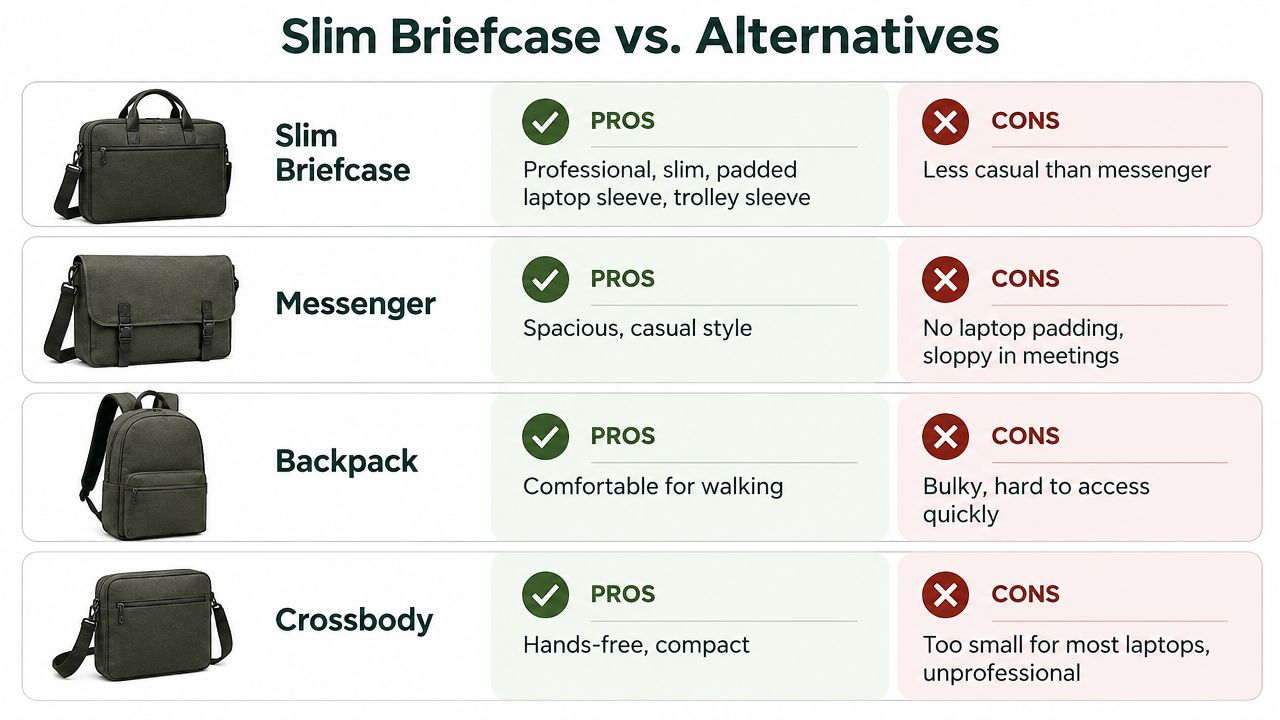
It also wins on one-handed access. A zipper-top slim brief opens cleanly while standing. A backpack usually requires a set-down or awkward shoulder swing. A messenger can dump contents into a sloped cavity if it's loosely packed.
When another bag is smarter
A messenger wins if you cycle and carry a bulkier load. A backpack wins if you haul cables, over-ear headphones, tablets, lunch, and backup layers. A crossbody wins on weekends and short city errands.
But each of those comes with a trade-off. Messenger bags can look sloppy in a formal room. Backpacks are practical but visually bulky. Crossbodies often work against tailoring and usually don't protect larger devices well.
If you want a narrower comparison between these two office categories, this guide to a leather briefcase vs messenger bag is useful.
My blunt recommendation
If you wear tailoring, meet clients, or place your bag on a boardroom table, buy the slim briefcase. If you carry too much to keep the silhouette flat, stop pretending and buy a backpack. Most disappointment in this category comes from buyers forcing one bag to do two different jobs.
Styling a Slim Briefcase for Professional Settings
A slim briefcase only looks refined when the rest of the outfit supports it. The bag doesn't need to match everything perfectly, but it does need to look intentional.
Overstuffing ruins more styling than bad color choices ever will. A sagging “slim” briefcase against pressed trousers makes the whole outfit look careless.
Boardroom use
For formal settings, keep it conservative. Espresso, dark brown, black, or oxblood work well. Hardware should read quiet, not flashy. Brushed silver or matte nickel usually looks cleaner than bright gold on a slim professional bag.
The shape matters too. A smaller form reads sharper at the table and under the arm.
| Setting | Leather Tone | Hardware Finish | Stitching Detail | Match With |
|---|---|---|---|---|
| Boardroom | Espresso, black, oxblood | Brushed silver or matte nickel | Minimal, tonal | Belt and shoes |
| Creative office | Tan, medium brown, textured darker tones | Matte metal | Contrast or visible craftsmanship | Boots, loafers, casual tailoring |
| Travel day | Tone coordinated with luggage | Understated metal finish | Clean and simple | Luggage, outerwear, watch |
Creative office
You can loosen the formula. A lighter tan, subtle contrast stitching, or visible natural grain gives the bag some personality without making it casual.
If your office leans design-heavy or hybrid, a slim briefcase can sharpen your look because it adds structure to softer clothing. Unstructured blazer, knit polo, pressed chinos, then a clean leather briefcase. That combination works.
Match the briefcase to the seriousness of the room, not to the loudest item in your wardrobe.
Travel day
Travel styling is usually overthought. Keep the briefcase within one shade of your luggage if possible. It doesn't need to be a perfect set. It just shouldn't look accidental.
Watch coordination is easy. If you wear a leather strap watch, keep the strap color within a close tone of the bag. If that sounds fussy, wear a bracelet watch and remove the matching problem entirely.
One practical note matters here. A broader market estimate places the narrower briefcase segment at about $3.75 billion in 2026, with North America at roughly $948 million, and projects the segment to reach around $5.37 billion by 2033. Another estimate values the men's business leather briefcase sub-segment at nearly $1.5 billion in 2024, growing to about $2.3 billion by 2033 at 5.0% CAGR. That tells you this isn't a dying niche. It's a stable professional category shaped around lighter daily carry and travel-friendly formats, including carry-on guidance such as 22 x 14 x 9 inches used by major airlines (business bag market context and carry-on framing).
Choosing Well and Buying Smart
They don't need more options. They need a filter.
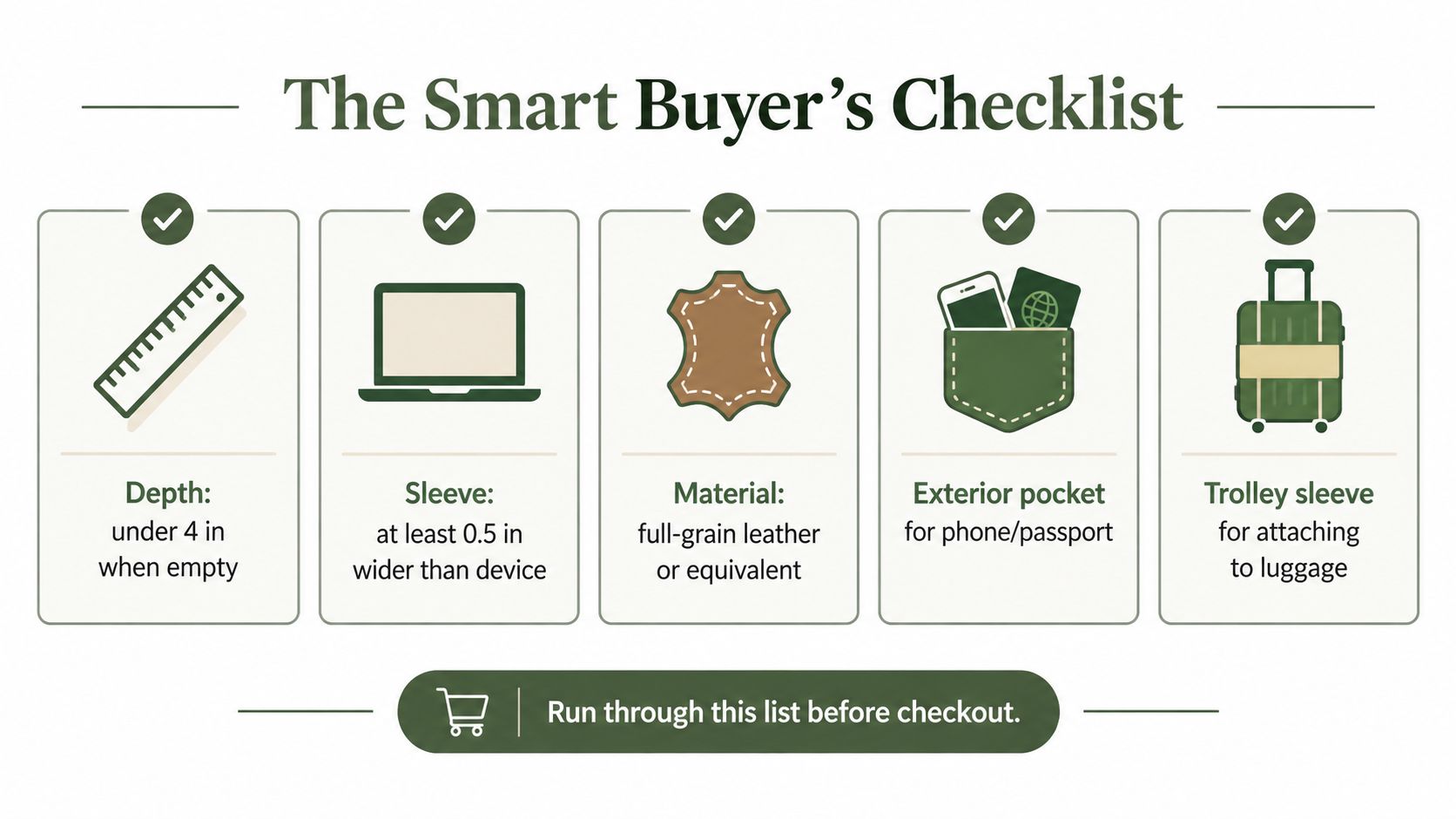
Use this checklist before you buy. If the bag misses two or three of these points, keep moving.
The shortlist that prevents regret
- Depth first: Keep the unloaded depth under 4 inches if you want a briefcase that still behaves like a slim brief.
- Laptop sleeve clearance: The sleeve should be at least 0.5 inches wider than the device so you're not stressing corners and zipper tracks.
- Material honesty: Choose full-grain leather if you want the bag to age well under daily flex.
- Handle reinforcement: Check the anchor points. Decorative tabs are not enough.
- Pocket discipline: You need quick-access storage, not a bag full of novelty compartments.
- Carry method: Buy for the way you move most days, not the way you wish you moved.
If you want a real-world example of this category, Grainmark Leather offers men's leather briefcases, including slim daily-carry styles built around a more formal, minimal profile.
Buy at the right time, not just the right price
Timing matters more in this category than most buyers realize. One independent market analysis says roughly 26% to 31% of annual men's work-bag volume lands in the late July to mid-September back-to-work period, and another spike runs from Black Friday through late December, driven in part by gift buyers who often don't know the recipient's exact carry needs. The same source also frames slim portfolios and laptop messenger bags as a key opportunity segment on Walmart Marketplace, with estimated weekly sales of 60 to 130 units and a $45 to $79 price range (seasonal work-bag demand analysis).
That should change how you shop. If you're buying for yourself, shop before the obvious gifting rush if you want the best selection. If you're buying as a gift, avoid guessing based on style alone. Laptop fit and loadout matter more than gift-wrap appeal.
Buying advice: A slim briefcase is easy to give badly. It's much harder to buy well than a scarf, wallet, or duffle because the dimensions have to match the user's real routine.
The broader shift is clear enough without hype. Laptops are thinner. Fewer professionals carry thick paper files every day. More men rotate between office, travel, and flexible work settings. That makes the slim briefcase one of the few traditional bag formats that still feels current when it's bought with discipline.
If you want a briefcase that respects those trade-offs, Grainmark Leather offers full-grain leather briefcases and related work carry designed for professionals who want structure without bulk. If your goal is a slim profile, better materials, and a cleaner daily carry, it's worth looking through their briefcase range before you settle for a bag that only looks slim when it's empty.