Traveler's Notebook Cover A5: The Complete Guide
You've found a cover labeled A5, ordered a stack of A5 refills, and then discovered that the pages either won't slide under the elastic or leave an awkward amount of empty space. That frustration usually isn't caused by poor leather. It comes from a size label that sellers use too loosely.
A true A5 traveler's notebook cover must fit pages measuring 148 × 210 mm, while the original Traveler-style Regular format is narrower and only resembles a slim A5 in height. Choose the wrong class and every later decision, from pocket placement to closure tension, becomes irrelevant. This guide focuses on the measurements that matter in real use, then applies them to leather, capacity, travel, and long-term care.
Table of Contents
- Why the Right Traveler's Notebook Cover A5 Matters
- Understanding A5 Sizing and Compatibility
- Leather Types and How They Age
- Features That Shape Daily Use
- Modular Refills Versus Fixed Inserts
- Travel and Workday Scenarios
- Care Tips for Long-Term Durability
Why the Right Traveler's Notebook Cover A5 Matters
The phrase traveler's notebook cover A5 describes two different buying intentions. One buyer wants a cover for standard A5 paper. Another wants the tall, narrow Traveler's Notebook experience, often called Regular size, with elastic cords running through the spine. Listings sometimes blur those categories, so a cover can appear “A5-compatible” while accepting only narrower inserts.
That distinction matters before you compare colors or pocket layouts. Standard A5 paper is 148 × 210 mm, while the Traveler's Company system began with a different, slimmer format. Traveler's Notebook was first released in March 2006 as a Midori product, following a design contest at ISOT in 2005. It initially shipped with five refill types in black or tan, then became the independent TRAVELER'S COMPANY brand in 2015. By 2021, it had reached more than 30 countries and territories, according to Nippon's history of the product.
Start with the insert, not the cover
Measure the notebook you already use. Record the page width and height, then measure the cover's internal space rather than relying on the product title. A cover intended for true A5 needs room for the full page width, plus clearance for leather thickness, stitching, page movement, and the elastic or cord system.
The cover also needs enough spine tolerance for the way you'll load it. A single thin insert behaves differently from several thick booklets, a folder, and a pocket accessory. Extra contents increase tension at the spine and can make a cover bow even when its length is correct.
Practical rule: If the seller gives only an exterior measurement, ask for the maximum insert size and the usable spine width before buying.
What the rest of the purchase depends on
Once the size is confirmed, your priorities become clearer:
- Leather quality determines how the folds and edges will look after repeated handling.
- Closure strength decides whether loose papers stay contained in a crowded bag.
- Pocket geometry controls whether tickets and cards sit flat or create spine bulk.
- Refill architecture determines whether the cover adapts to changing work or locks you into one notebook block.
A good cover should fit your paper without forcing it, close without strain, and carry only what you'll use. The most attractive cover is still a poor purchase if its insert channel is wrong.
Understanding A5 Sizing and Compatibility
A5 is a paper standard, not a synonym for every tall refillable notebook. The true format measures 148 × 210 mm, as documented in this A5 leather cover sizing reference. Those dimensions describe the sheet itself. A finished cover must be larger because it needs internal clearance for the page edges, leather, stitching, and closure.
Traveler-style Regular refills are narrower, commonly described as approximately 111 × 210 mm. They preserve the tall profile associated with the original system but leave more room along the sides for elastic binding and the spine fold. That makes Regular attractive for lists, vertical planning, and compact travel notes, but it doesn't make it a standard A5 format.
Compare the dimensions before ordering
| Specification | True A5 | Traveler Regular |
|---|---|---|
| Insert width | 148 mm | Approximately 111 mm |
| Insert height | 210 mm | Approximately 210 mm |
| Writing area | Broad, suited to standard A5 notebooks and planners | Narrow, suited to slim Traveler-style refills |
| Cover requirement | Must preserve clearance beyond the paper dimensions | Must allow for elastic cords and a narrower spine system |
| Main risk | A cover that's too tight can drag pages or stress binding | A cover that's too wide can leave inserts loose and unstable |
A genuine A5 cover commonly closes at around 16 × 22.2 cm, rather than the raw paper dimensions, because the maker must allow for material and construction. The useful question isn't whether the listing contains “A5.” Ask whether the internal pocket or elastic span accepts a 148 mm-wide insert.
Use the three-measurement check
Before checkout, measure:
- Insert width and height. Measure the paper block, including any exposed cover if it must sit inside a pocket.
- Internal clearance. Confirm that the cover leaves practical room beside the page edges instead of pressing them into the stitching.
- Spine and elastic tolerance. Check how much material the cords can hold without pulling the cover into a curve.
A Regular cover can't become a true A5 cover because the seller uses the word A5 in the title. If you already own Midori MD, Rhodia, Leuchtturm1917, or another standard A5 notebook, compare its actual measurements with the seller's stated internal dimensions. This guide to A5 leather journal covers is useful for checking the distinction between paper size and finished cover size.
The original TRAVELER'S NOTEBOOK ecosystem also matters. Traveler's Company doesn't make an official A5 Traveler's Notebook, although other makers sell A5-like refillable leather covers, as explained in this Traveler's Notebook FAQ. Treat “A5 Traveler” as a product category used by independent makers, not proof that you're buying an official size.
Leather Types and How They Age
Leather choice becomes obvious only after months of handling. A smooth cover can look perfect on a product page, yet the crease, corners, and closure area reveal whether the material was selected for durability or finished to look uniform.
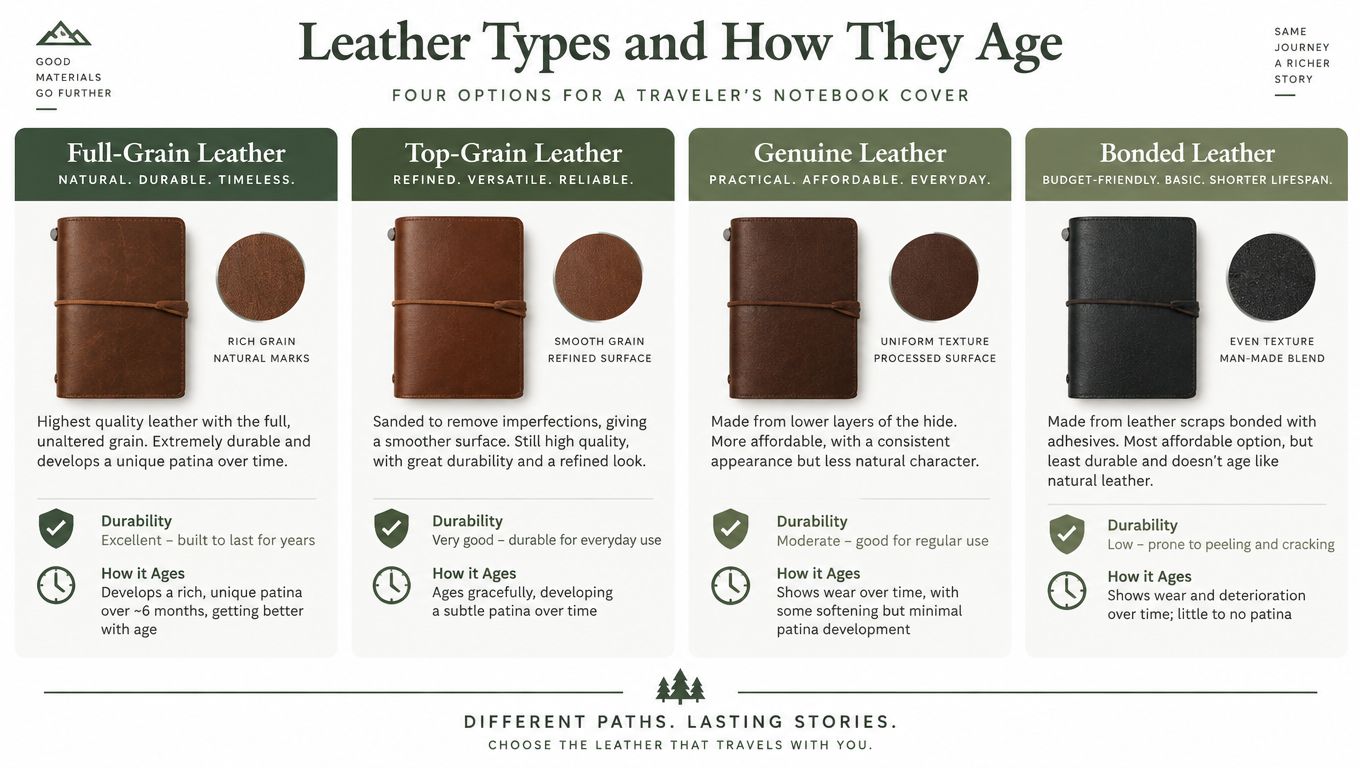
Full-grain leather keeps the hide's natural surface. It's the option I'd choose for a cover that will travel daily and gain character through use. Scratches show more readily, but they can often be worked into the patina with handling and conditioning. The surface records how you carry the notebook, which is exactly why two covers made from the same leather won't age identically.
Top-grain leather has been corrected or sanded for a more consistent appearance. It's a practical middle choice if you want fewer visible surface irregularities and a cover that looks more controlled in professional settings. It can handle regular travel well, but it gives up some of the distinctive grain and depth associated with a natural full-grain surface.
Don't confuse “genuine” with a quality grade
Genuine leather is a broad label, not a guarantee of premium construction. It may describe leather that has been split, heavily finished, or combined with other materials. For a notebook cover, inspect the fold and edge treatment rather than trusting the label alone. A cover that feels acceptable in the hand can still fail where the leather bends repeatedly.
PU and bonded synthetics make sense if you specifically want a non-animal material or a lower-cost cover. Their surface can look neat and consistent, but peeling at the fold is the main long-term concern. If you want an object that becomes more personal with use, synthetic coatings generally offer the wrong aging experience.
Inspect the seam before the hide
A strong hide can't rescue weak stitching. Look for bonded nylon or polyester thread, even spacing, clean turns around corners, and stitching that doesn't disappear into unfinished edges. Saddle stitching is my preference for stress points because each stitch is formed independently, while a failed section of a lock stitch can loosen more quickly along the seam.
For a deeper explanation of how vegetable-tanned leather develops its surface character, see this vegetable-tanned leather guide. In practice, buy full-grain when visible wear is part of the appeal, top-grain when you want a neater work accessory, and avoid making a “genuine leather” decision without examining the fold, edge, and thread.
Features That Shape Daily Use
Product photographs emphasize color and grain. Daily use exposes the less glamorous features: the pocket that catches a boarding pass, the elastic that stretches around a thick insert, and the spine that either flexes naturally or fights every page turn.
Start with pockets. Flat card slots suit business cards, transit cards, and folded receipts without adding much bulk. Full-height slip pockets are more useful for passports, boarding passes, cash, or a small sheet of paper, but they can make the cover feel overfilled when combined with several notebooks.
Match pockets to what you really carry
A commuter who carries one A5 planner probably doesn't need a travel folio packed with compartments. A person who uses the notebook as a trip organizer may value one flat pocket more than several decorative slots. The pocket should support your routine, not tempt you to turn a writing cover into a second wallet.
Pen loops deserve the same scrutiny. Elastic loops accommodate a wider range of pen diameters and make it easy to change from a slim ballpoint to a fountain pen. A stitched leather loop can look cleaner, but a tight loop may require you to unthread the pen or force the barrel through the opening.
Choose the closure for the bag, not the photograph
- Button snaps give dependable physical security and suit covers that will be pushed under seats or into crowded luggage.
- Magnetic clasps feel smooth and premium, but their holding power can decline with repeated stress or an overstuffed spine.
- Elastic bands open quickly and expand with changing contents, though they can slip around other objects in a bag.
The closure must tolerate the cover at its fullest useful load. A band that closes a thin insert beautifully may struggle once pockets, folders, and several refills share the spine.
Finally, examine the spine crease and edge finishing. Painted edges can look polished but may chip if the finish is brittle. Burnished or carefully folded edges usually feel more integrated with the leather. If you carry a pen every day, a purpose-built journal cover with pen holder can be a better fit than adding an awkward loop to a cover that wasn't designed for it.
Modular Refills Versus Fixed Inserts
The modular system wins when your notebook has several jobs. You can keep planning, meeting notes, sketches, and loose papers in separate inserts, then remove the completed material without replacing the entire cover. Elastic bands or rubber cords make that rearrangement quick, but they also introduce movement and bulk.
A fixed-insert cover takes the opposite approach. One bound block sits directly inside the leather, so the notebook feels more like a conventional book. It lies flatter, has fewer loose components, and tolerates rough handling well because nothing can slide out of a cord system.
Pick the binding that fits your working rhythm
| Factor | Modular Refill | Fixed Insert |
|---|---|---|
| Organization | Separate inserts for separate roles | One continuous writing space |
| Flexibility | Add, remove, and rearrange contents | Replace the block when it is finished |
| Flatness | Can become uneven as contents accumulate | Usually presents a more uniform writing surface |
| Travel behavior | Needs adequate elastic tension and spine room | Fewer moving parts to shift in a bag |
| Best use | Changing projects, planning, journaling, and mixed media | Sequential writing and a book-like feel |
A modular cover makes sense if your work changes format often or you want a refill ecosystem that can evolve over time. Commercial A5 systems commonly hold two Leuchtturm1917 A5 notebooks or up to four refills, although the practical limit depends on paper thickness, pockets, and elastic tension, as shown in these Traveler's Notebook cover examples. More inserts aren't automatically better. A crowded spine closes poorly and can warp the cover.
For refill ideas, browse these kraft-paper Traveler's Notebook inserts, then compare the system with the requirements in a guide to best productivity planners. The right setup might be one planner and one notes insert, not the maximum capacity advertised by the maker.
A modular cover should earn its bulk by replacing several separate notebooks. If it doesn't, choose the simpler binding.
Travel and Workday Scenarios
A weekend city break rewards restraint. Carry one writing insert, one slim folder, and a flat pocket for tickets or currency. That combination gives you a place for reservations and observations without turning the notebook into a heavy travel wallet.
For trip preparation, a resource such as PADL's Florida adventure checklist can help you decide what documents and small items belong in the cover. The notebook should hold the information you need at hand, not every object you might possibly use.
Let the longest routine determine capacity
A multi-leg work trip needs a different setup. Meeting notes can live in one insert, receipts in another, and planning in a third or fourth, provided the cover has enough spine room and a closure that stays secure. A button closure is my preference when the notebook will move through airport security, hotel rooms, and crowded work bags.
A daily commuter usually needs less. One main insert, a pen loop, and perhaps a single flat pocket keep the cover light and comfortable for repeated carrying. A multi-insert arrangement that feels useful during a long trip can become needless spine weight when it travels to the office every day.
Client meetings call for a more restrained presentation. Dark brown or black full-grain leather generally reads cleaner than a heavily distressed finish, especially when the cover sits beside a portfolio or laptop. Choose a cover whose pockets don't create a lumpy outline when closed.
Fieldwork changes the priorities again. Humidity, grit, and sudden rain punish exposed edges and weak stitching, so look for reinforced stress points and a leather treatment suited to moisture. Don't assume “water-resistant” means waterproof. Blot exposure promptly and keep the cover away from direct heat.
| Scenario | Sensible setup | Feature priority |
|---|---|---|
| Weekend break | One insert and a slim pocket | Compactness and quick access |
| Work travel | Several organized inserts | Spine capacity and secure closure |
| Commuting | One main insert and pen loop | Low bulk and comfortable carry |
| Client meetings | Clean, structured leather cover | Professional finish and flat closure |
| Field journaling | Protected edges and robust seams | Moisture tolerance and durability |
The best capacity is the one you use on your most common trip. Designing around a rare expedition usually leaves you carrying an overbuilt cover every ordinary day.
Care Tips for Long-Term Durability
Leather care should be regular and restrained. Too little attention allows grime and body oils to settle into the surface, while too much conditioner softens the leather and can leave the cover greasy. Your routine should protect the fold without changing the structure that lets the notebook hold its shape.
Use a simple maintenance cycle
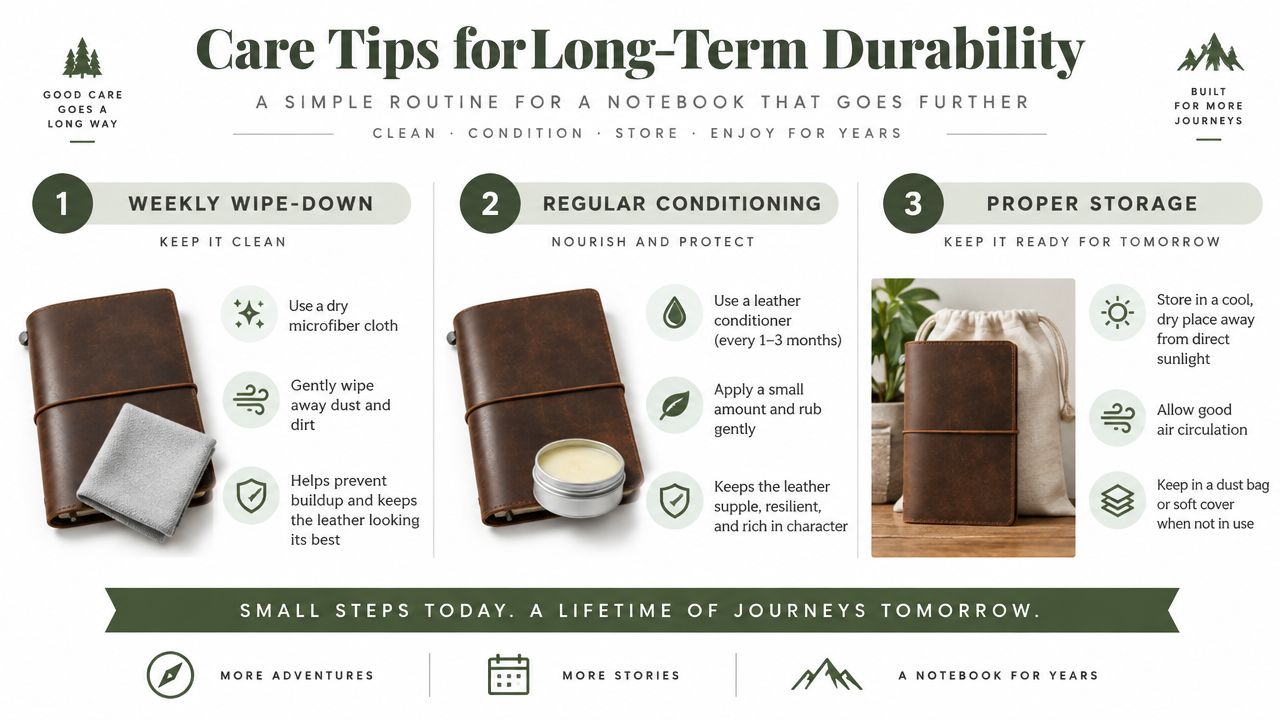
- Weekly: Wipe the exterior with a dry microfiber cloth. Remove dust and surface oils before they work into the grain or edge.
- Monthly: Apply a small amount of leather-specific conditioner, such as Lexol or Bick 4, to a soft cloth. Work it in lightly, allow it to absorb for about ten minutes, then buff away residue.
- After water exposure: Blot with a clean cloth. Don't rub, place the cover on a radiator, or use a hair dryer. Let it air-dry away from direct heat so the leather and spine don't distort.
- Every six to twelve months: Rotate the refill arrangement if the elastic binding points have developed a permanent crease. Changing the load helps distribute stress across the spine.
- Annually: Inspect and replace inner elastic bands when they lose resilience. Elastic often deteriorates sooner than a well-made leather cover.
Test any conditioner or soap on an inconspicuous area first. Different finishes absorb products differently, and a treatment that works on unfinished vegetable-tanned leather may darken a coated surface.
Store it empty and breathable
For longer storage, remove the refills and keep the cover flat or upright in a breathable cotton pouch. Avoid direct sunlight and large humidity swings, particularly conditions above 70 percent humidity, which can encourage moisture-related problems. Don't seal damp leather inside plastic, and don't stack heavy objects on the folded spine.
For everyday marks, start with the least aggressive response:
- Scuffs: Buff gently with a clean cloth and a small amount of conditioner.
- Ink: Blot carefully and seek the leather maker's advice before using solvent.
- Salt marks: Use a barely damp cloth or mild saddle soap, then allow the leather to dry naturally.
- Deep stains: Accept that some marks become part of the patina rather than risking a larger discolored patch.
The leather conditioning guide provides a useful reference for applying product sparingly. A cover that develops honest handling marks can look better than one kept pristine through aggressive cleaning.
Grainmark Leather offers the Chronicle refillable notebook in A5, with a full-grain leather cover, replaceable insert, fold-over construction, strap, and cardholder storage. If that format matches your measured paper and carry habits, visit Grainmark Leather to compare it with the rest of your everyday leather goods.