
Refillable Journal Covers: A Complete Buyer's Guide
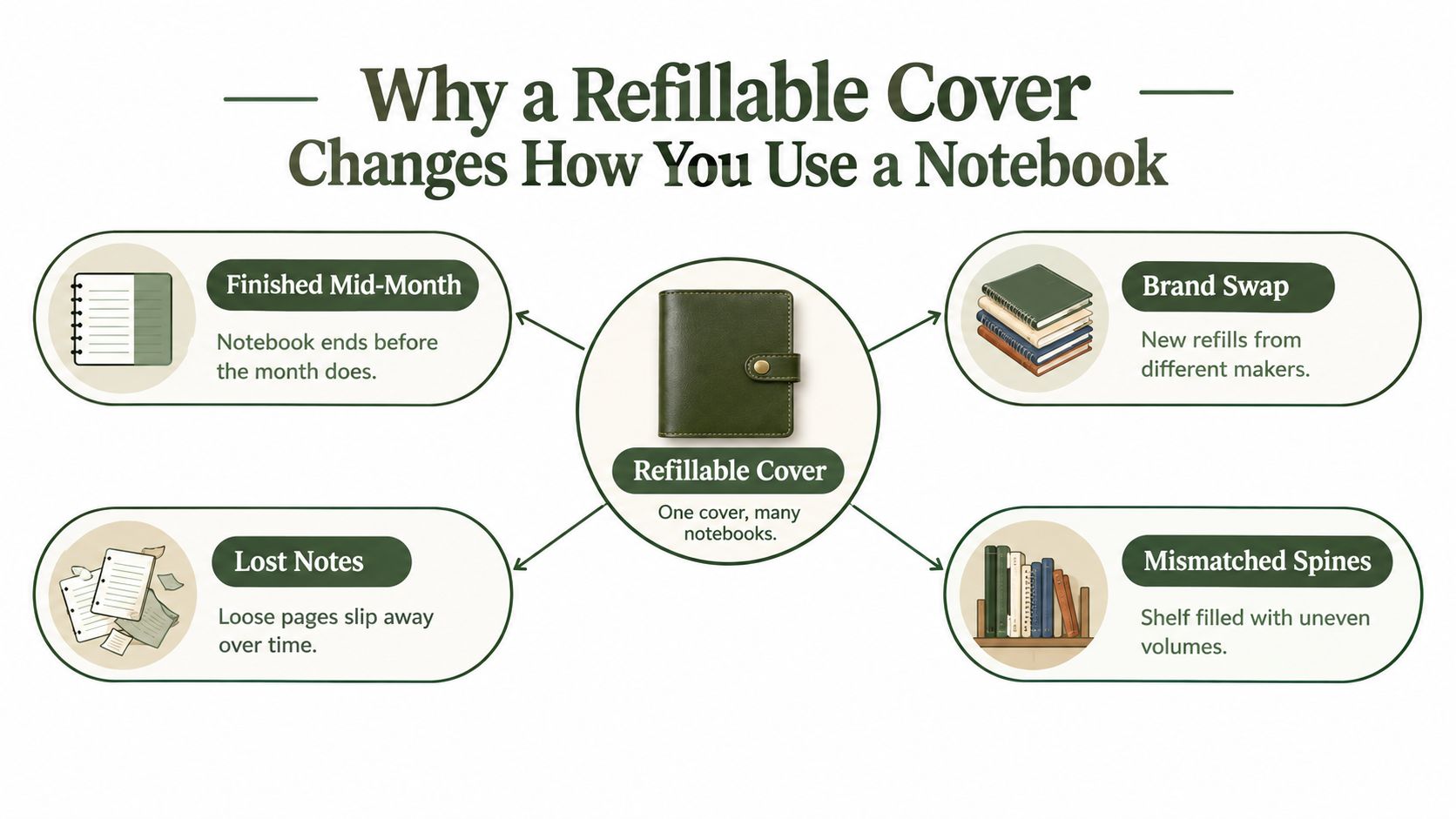
You finish a notebook halfway through the month, but your next one is a different size. A few useful pages remain, the notes you need are split between loose sheets, and the notebooks on your shelf have mismatched spines that make your writing history difficult to manage.
Refillable journal covers solve that problem by separating the long-life purchase from the consumable one. The cover stays with you, while the paper insert changes when you need a new format, layout, or notebook. Before buying, think less about finding one perfect notebook and more about choosing a cover that can support your writing habits for years.
Table of Contents
- Why a Refillable Cover Changes How You Use a Notebook
- The Three Main Refillable Cover Formats
- Why Full-Grain Leather Is the Standard for Long-Life Covers
- Sizing, Refill Compatibility, and Multi-Insert Setups
- Monogramming and Customization Options Worth Knowing
- How a Quality Leather Cover Ages Over Time
- Daily Care and Long-Term Maintenance
Why a Refillable Cover Changes How You Use a Notebook
You finish an insert during a busy week, slide it out of its cover, and replace it with fresh paper that matches the next task. The cover remains familiar in your hand, while the pages change with your work. That simple exchange makes a refillable system a long-life purchase rather than a notebook you discard when its pages run out.
Refillable journal covers have two working parts: a reusable outer shell and one or more removable paper inserts. The shell protects the paper and stays in service. The insert is replaced when it is full, damaged, or no longer suitable for the job. This division makes the ownership cycle easier to understand. You buy the cover once for its construction and fit, then choose consumable refills as your needs develop.
A bound journal joins its cover and pages permanently. A refillable journal separates them, using a pocket, elastic system, rings, or another mechanism to hold the paper in place. The category includes leather, paperback, and hardcover versions, so the construction does not dictate one material or one writing style. This overview of bound and refillable journals explains the distinction clearly.
Start with the ownership cycle
Before selecting leather, closure hardware, or personalization, decide what should stay with you and what should be used up:
- The cover is the durable object. It protects the inserts, records signs of use, and remains part of your daily routine.
- The insert is the consumable. You replace it when it is full, damaged, or no longer suited to the task.
- The format controls the ecosystem. A cover built for one insert size limits which refills will fit later.
- The hardware controls capacity. Elastic bands, rings, and pockets determine how many notebooks and accessories can travel together.
This division also lets one cover support different kinds of work. You could keep a ruled insert for correspondence, a dotted insert for sketches, and a planner insert in the same system. When one notebook ends, you replace that insert while keeping the others active.
The same logic suits reflective writing. If you are developing a prayer practice, a guide to digital tools for prayer journaling can help you decide between a dedicated insert, a broader daily journal, or a hybrid setup. The cover provides a consistent home for the practice as the paper changes.
Finished inserts can be stored by subject or date, while the active cover stays manageable for daily carry. You are building a paper system around an outer shell, not asking one notebook to serve every purpose indefinitely.
The category has also moved beyond a niche stationery format. A 2025 market report estimates refillable notebooks at 23.3% of the product-type segment, with that segment projected to grow at a 6.8% CAGR through 2034. It estimates the broader notebook market at $14.8 billion in 2025, projected to reach $24.6 billion by 2034. The market overview from DataIntelo provides those projections.
Practical rule: Choose the paper ecosystem first, then buy the cover that protects and supports it.
The Three Main Refillable Cover Formats
The format determines how your pages stay in place, how easily you can rearrange them, and how much you can carry. Three systems appear most often: ring binders, traveler's notebooks, and elastic insert folios.
| Format | Paper Mechanism | Lay-Flat | Refill Variety | Best For |
|---|---|---|---|---|
| Ring binder | Pages use punched holes and sit on metal rings | Usually strong, depending on ring size and page count | High, with planner pages, dividers, pockets, and specialty sheets | Planners and tab-heavy workflows |
| Traveler's notebook | An elastic band passes through the center fold of each insert | Generally good, especially with a modest number of inserts | Broad, but tied to the cover's specific format | Fountain pen users, journalers, and mixed notebooks |
| Elastic insert system | Elastic bands, corner straps, or pockets hold thin notebooks | Good for slim inserts, less consistent as capacity grows | Moderate, depending on the maker and insert dimensions | Minimalists carrying a few cards and notes |
Ring binders
Ring systems suit people who treat a notebook as an active filing cabinet. You can open the mechanism, move pages, add dividers, and group material by project. A planner user might keep appointments at the front, reference pages in the middle, and completed notes at the back.
The trade-off is bulk. Rings create a central mechanical spine, and the cover must leave room for that mechanism. They can also make a notebook feel less flexible in a bag, particularly when you add pockets, cards, and thick sections.
Traveler's notebooks
A traveler's notebook uses elastic bands to grip inserts through their center folds. You swap a finished notebook by lifting it away from the band and sliding a replacement into position. Multiple bands allow several thin inserts to share one leather cover.
This format works well if you like separate notebooks for separate jobs. A ruled insert can handle long-form writing, a dotted one can hold diagrams, and a planner insert can manage dates. The main limitation is thickness. As you add inserts, the cover becomes harder to close neatly and less comfortable to write in.
For a closer look at the tall, narrow format and its practical design choices, see this guide to the traveler's notebook cover in A5.
Elastic insert folios
Elastic folios use a simpler structure. An insert may slide under a strap, sit in a corner pocket, or attach to an internal elastic. These covers are often the slimmest option and work well for a small notebook, cards, receipts, or a short list of essentials.
Their restraint is also their limitation. You generally get fewer ways to rearrange pages, and refill choices may be narrower than with rings or common traveler's notebook formats. They're a good fit when you want a cover that disappears into a pocket or small bag, not a portable archive.
A quick selection rule is straightforward. Choose rings if you reorganize pages often. Choose a traveler's notebook if you want multiple removable notebooks and a writing-focused carry system. Choose an elastic folio if you want the lightest setup and can live with fewer insert options.
Why Full-Grain Leather Is the Standard for Long-Life Covers
You replace the paper inside a journal several times, but the cover may stay with you for years. If it will be opened, folded, carried, and refilled repeatedly, its material needs to tolerate daily handling without losing all of its character. Full-grain leather suits that ownership cycle because its natural grain and underlying fiber structure remain part of the surface instead of being replaced by a heavy corrective finish.

What you see in daily use
A vegetable-tanned leather cover changes as you use it. Oxidation, abrasion, and contact with your hands can darken the surface, soften the spine fold, and create a patina that reflects how you carry it. The result is less like a disposable accessory and more like a tool whose surface records its working life.
The word patina describes this gradual change in finish. It is not a protective coating, and it does not make every mark desirable. A deep scratch, water stain, or careless cleaning can still damage leather. Patina means the combined visual effect of ordinary contact and aging, not immunity from wear.
Leather grades can confuse first-time buyers:
- Full-grain leather retains the natural grain and fits a long-service cover when visible aging is part of the appeal.
- Top-grain leather has a more uniform surface because the outer layer has been lightly refined. It may look cleaner at first and show less natural variation.
- Corrected or heavily treated leather uses stronger surface treatment or embossed texture to create consistency. That approach can reduce the natural character many buyers want from a cover that will develop patina.
The choice matters because the cover is the long-life purchase, while the insert is the consumable. You are selecting the outer shell that will hold each new notebook, not choosing a finish for the first refill. A uniform surface works if you prefer a controlled appearance. Full-grain leather is a better match if you want the cover to change visibly as you use and carry it.
Leather also remains a familiar material in the notebook market, partly because it combines structure with a surface that can soften and develop character. That broader popularity does not make every leather cover suitable for long-term ownership. Construction, thickness, edge finishing, and the quality of the leather still need examination.
Judge a long-life cover by how it handles the next refill, not only by how it looks before the first page is written.
Thickness and flexibility involve a practical trade-off. A very soft cover folds easily, but it may provide less structure around a growing stack of inserts. A more substantial cover protects the paper and holds its shape, though it can feel less discreet in a small bag. Consider where the cover will spend most of its life, whether on a desk, in a briefcase, or in a coat pocket. For a closer look at expected durability and care, read this guide to full-grain leather lifespan.
Sizing, Refill Compatibility, and Multi-Insert Setups
You buy a refillable cover for years, then replace its paper as each insert fills. That ownership cycle makes sizing more important than the cover's appearance on day one. A well-made cover can still be the wrong choice if its paper height, width, spine, hole pattern, or elastic spacing does not match your refill system.
Start with the insert you already use. Labels such as “pocket” or “regular” are not consistent across makers, so measure the closed insert and examine how it is retained. A ring binder needs the correct hole pattern. An elastic system needs a compatible center fold and enough space for the insert to sit beneath the cover's edges.
Common systems and what they imply
| Size | Paper Dimensions | Common Refill System | Typical Insert Capacity |
|---|---|---|---|
| Varies by maker and pocket format | Small elastic or pocket insert system | One slim insert, sometimes paired with cards | |
| Field Notes | Confirm the specific Field Notes-compatible cover | Field Notes-style elastic insert system | One or several thin booklets, depending on hardware |
| A5 | Standard A5 paper size, with cover dimensions varying by maker | Ring, elastic, and folio systems | One substantial insert or several thin inserts |
| Traveler's Regular | About H220 × W120 × D10 mm for a standard leather cover | Traveler's notebook elastic system | Multiple slim inserts, depending on band arrangement |
| Traveler's Passport | About H135 × W100 × D15 mm for a standard leather cover | Passport-format elastic system | A compact combination of inserts and small carry items |
The Traveler's Notebook Regular and Passport measurements come from an independent retailer listing for these leather cover formats. Luiban's Traveler's Notebook leather cover specifications show how the systems remain slim while holding replaceable paper.
Independent product listings also describe starter kits with leather covers, refillable paper inserts, 80 gsm paper, and fountain-pen-friendly use. The listed Regular kit measures about 22.0 cm × 12.5 cm × 1.8 cm, while the Passport kit measures about 13.5 cm × 10.0 cm × 1.5 cm. JetPens' Traveler's Notebook starter kit listing provides those specifications.
Multi-insert setups
A multi-elastic cover separates different kinds of work without requiring several complete notebooks. One insert can hold a calendar, another can contain dot-grid pages, and a third can function as a pocket notebook. The cover stays with you as the long-life outer shell, while each paper module can be replaced when its job is finished.
Capacity depends on more than the number of bands. Insert thickness, paper density, pockets, and closure tension all affect how comfortably the cover closes. Adding a card insert or envelope may leave less room for paper than the raw band count suggests.
Before ordering, compare three measurements and one hardware detail:
- Width, so the insert does not protrude beyond the cover.
- Height, so the closure protects the page edges.
- Spine or folded thickness, so the insert sits securely.
- Retention hardware, including rings, elastic bands, straps, or pockets.
A cover should be judged against the refill system you plan to keep buying. Ask whether that exact refill matches the cover's dimensions and retention method, rather than relying on the brand name alone. A neutral guide to A5 leather journal covers explains the broader choice: you are selecting an ongoing paper ecosystem, not only an outer accessory. For Grainmark's sizing perspective, see this overview of leather journal covers in A5.
Monogramming and Customization Options Worth Knowing
Personalization has more value on a refillable cover than on a disposable notebook because the mark stays with the object after the first insert is finished. A set of initials on the outer shell can make the cover easier to recognize, more meaningful as a gift, and more connected to the years of writing it carries.
Choose the mark for the leather
Blind debossing presses a design into the leather without ink or foil. It has a quiet appearance and usually suits a classic cover that you expect to carry for a long time.
Foil debossing combines the impression with a metallic or dark finish. Gold, silver, and black are common choices, but the effect depends on the leather's color and surface treatment. A dark foil on a dark cover may be subtle, while a metallic foil creates a stronger contrast.
Some leather makers also offer stitched or burned-in initials. Those methods have a more handmade appearance and may work well when the maker performs the customization in-house.
Think beyond initials
Customization can include more than a name:
- Thread color can change the character of a stitched edge.
- Elastic color can add contrast or coordinate with the leather.
- Interior lining may be available as a material or color choice.
- Placement is usually limited to practical areas on the front panel.
Check the return policy before approving the customization. Personalized products typically can't be returned, and the result may vary with the leather surface. Corrected-grain or heavily pigmented leather may not take a deboss as cleanly as a natural full-grain surface.
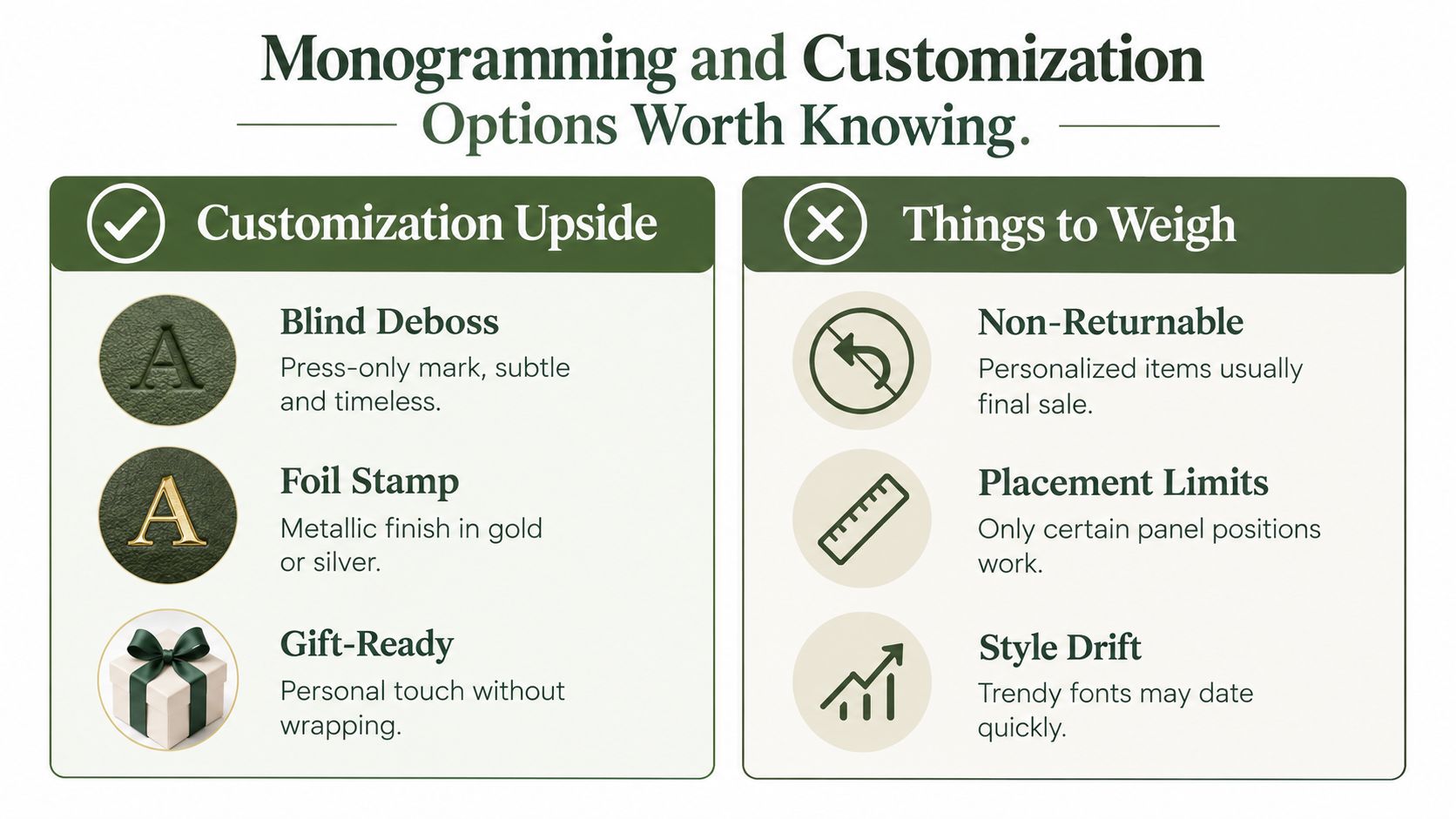
Lead time is another practical detail. Foil work and other custom processes can require additional production time, so confirm the maker's current schedule before ordering for a birthday, promotion, or travel date. Font selection deserves equal care. A simple typeface is more likely to remain readable and appropriate after the cover's style changes through use.
If you're comparing ideas for a personal present, this guide to personalised leather gifts in Australia offers useful context on how initials and custom details can shape a leather gift. For a refillable cover, the strongest personalization is usually restrained. A name or initials should identify the owner without competing with the leather.
You can also compare how personalized leather padfolios use customization within a larger writing accessory. The principle is similar: select the mark for long-term ownership, not for a short-lived trend.
How a Quality Leather Cover Ages Over Time
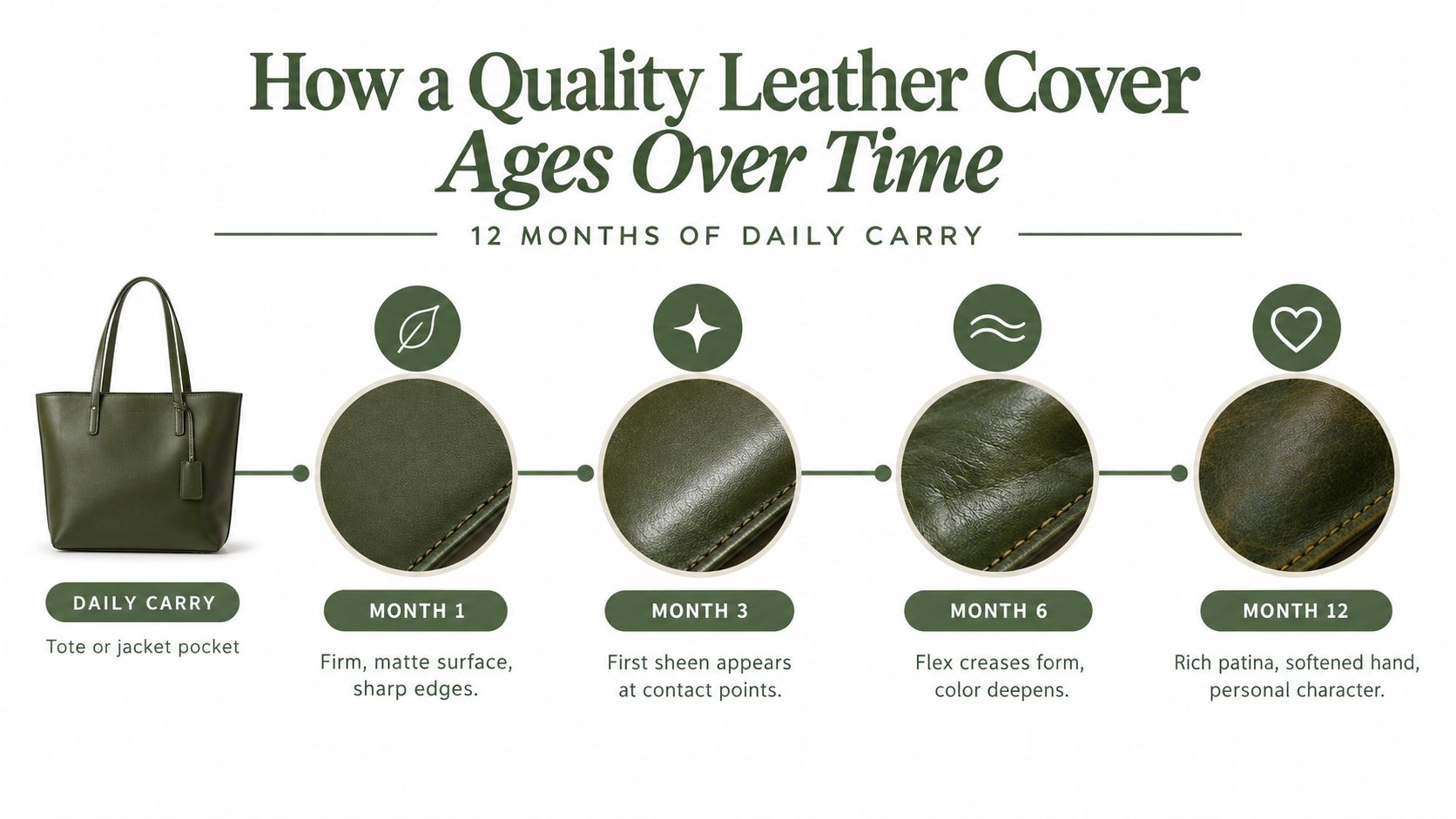
A full-grain leather cover rarely looks exactly the same after a year of daily carry. The change is easiest to understand through a routine rather than a product description.
You place the cover in a tote or jacket pocket each morning. During the first month, the leather feels firm and appears relatively matte. Light scuffs show where your fingers grip the front panel, but those marks sit on an otherwise new surface.
By the third month, the contact zones begin to look darker and smoother. The spine starts to soften as you open the cover repeatedly, and the leather responds to the way your hand folds and holds it.
Read the surface, not just the color
At six months, the cover may lie more naturally when opened. Corners can become slightly rounder, and exposure to light can make the overall tone warmer. The surface doesn't change evenly because your hands, bag, desk, and clothing don't touch every area in the same way.
At twelve months, the original scuff points may have blended into a darker, smoother panel. Less-handled areas retain more of the original appearance, creating contrast across the cover. That contrast is patina, not automatically damage.
The result depends on the leather finish and the way you carry it. Vegetable-tanned leather is known for developing a changing surface through oxidation, abrasion, and handling, which makes aging part of the design rather than an accidental side effect. A corrected or heavily treated surface may remain more uniform and may not develop the same depth of character.
The best way to understand your own cover is to document its starting point. Photograph it in natural light on the first day, including the front, back, spine, and corners. Later photographs will show whether a mark is ordinary wear, a new stain, or just a section of leather that has darkened through contact.
Photograph the cover before you use it. Memory is a poor reference for gradual change.
Aging should also influence your buying decision. If you want an object that stays visually consistent, look for a finish designed for uniformity and accept that the cover may show wear differently. If you want the shell to become a record of your habits, choose leather whose natural surface can change visibly and keep your care routine simple.
Daily Care and Long-Term Maintenance
Leather care works best as a small routine, not an occasional rescue operation. A refillable cover is handled frequently, so the aim is to remove surface dirt, control dryness, and prevent avoidable exposure to heat or moisture.
Use a light weekly routine
Once a week, wipe the cover with a dry, soft cloth. If surface grime needs more help, use a barely damp cloth and let the leather dry naturally. The cloth removes pocket lint, dust, and some of the oils transferred by regular handling.
Don't soak the cover or place it under a heater to speed up drying. Water can leave marks or change the leather's surface, while concentrated heat can dry and distort it. Alcohol-based cleaners, silicone polishes, and prolonged direct sunlight are also poor choices for a natural leather cover.
Condition sparingly
Conditioning is meant to replenish the leather's feel, not make the surface permanently wet or glossy. Apply a small amount of neutral leather balm to a clean cloth, test it on an unobtrusive area, and spread a thin layer over the cover. Allow it to settle, then buff away residue with a dry cloth.
A practical cadence is occasional monthly conditioning for a cover in frequent use, with adjustments for the leather's condition and the maker's guidance. Some leather needs less product than you expect. Too much balm can soften structure, darken the surface, or leave a tacky finish.
For a more detailed treatment process, follow this guide to conditioning leather correctly. Always check whether the product is intended for your specific leather finish before applying it across the entire cover.
Deal with common problems early
- Ink transfer: Light interior linings can pick up ink from loose pens or uncapped refills. Use a pen sleeve or keep writing instruments away from the lining when possible.
- Corner wear: Corners often rub against bags, desks, and pockets first. Small surface scuffs can usually be left alone or lightly buffed, depending on the leather.
- Deep scratches: Don't aggressively sand or scrub a deep mark. A leather repair specialist can assess whether the damage can be blended or whether the mark should remain part of the cover's history.
- Spills: Blot rather than rub, then allow the leather to dry at room temperature. Rubbing spreads the liquid and can push it deeper into the grain.
- Unused covers: Store the cover flat or lightly supported with clean paper so it keeps its shape. A dust bag or pillowcase provides a breathable layer, while a radiator, damp cupboard, or sunny windowsill does not.
The inserts deserve attention too. Remove a finished notebook before its paper block makes the cover strain, and avoid overloading the elastic system with accessories that prevent the cover from closing naturally. A long-life shell still needs a reasonable load.
Save this short action list: wipe regularly, condition sparingly, store flat, avoid heat, and treat scuffs early.
A refillable cover makes sense when you want one durable outer shell to stay with you while your paper needs change. Grainmark Leather offers the Chronicle, a full-grain leather refillable notebook with a replaceable insert and fold-over strap closure, alongside leather goods for writing and daily carry. Visit Grainmark Leather to compare that option with your preferred format, refill system, and personalization choices.