Leather Drawstring Pouches: The Essential Guide
You're halfway out the door when the loose change in your pocket starts competing with your keys, your watch is exposed inside a work bag, and a fountain pen is pressing against everything else. A small leather drawstring pouch solves that kind of friction without adding the bulk of a hard case or the shapelessness of a fabric sack.
The format is simple, but a good pouch depends on decisions that aren't obvious from a product photograph. Leather temper, panel thickness, seam reinforcement, cord hardware, storage humidity, and the shape of the object inside all affect whether the pouch becomes a dependable daily companion or an attractive item that quickly loses its structure.
Table of Contents
- What Makes Leather Drawstring Pouches Still Useful
- Understanding Leather Grades and Why Full-Grain Matters
- Choosing the Right Leather Thickness and Closure Build
- Best Storage Uses for Watch, Pen, Coin, and Gift Pouches
- How Environment and Humidity Change Pouch Longevity
- Premium Leather Versus Lighter or Moisture-Resistant Options
- How to Choose, Care for, and Gift a Leather Drawstring Pouch
What Makes Leather Drawstring Pouches Still Useful
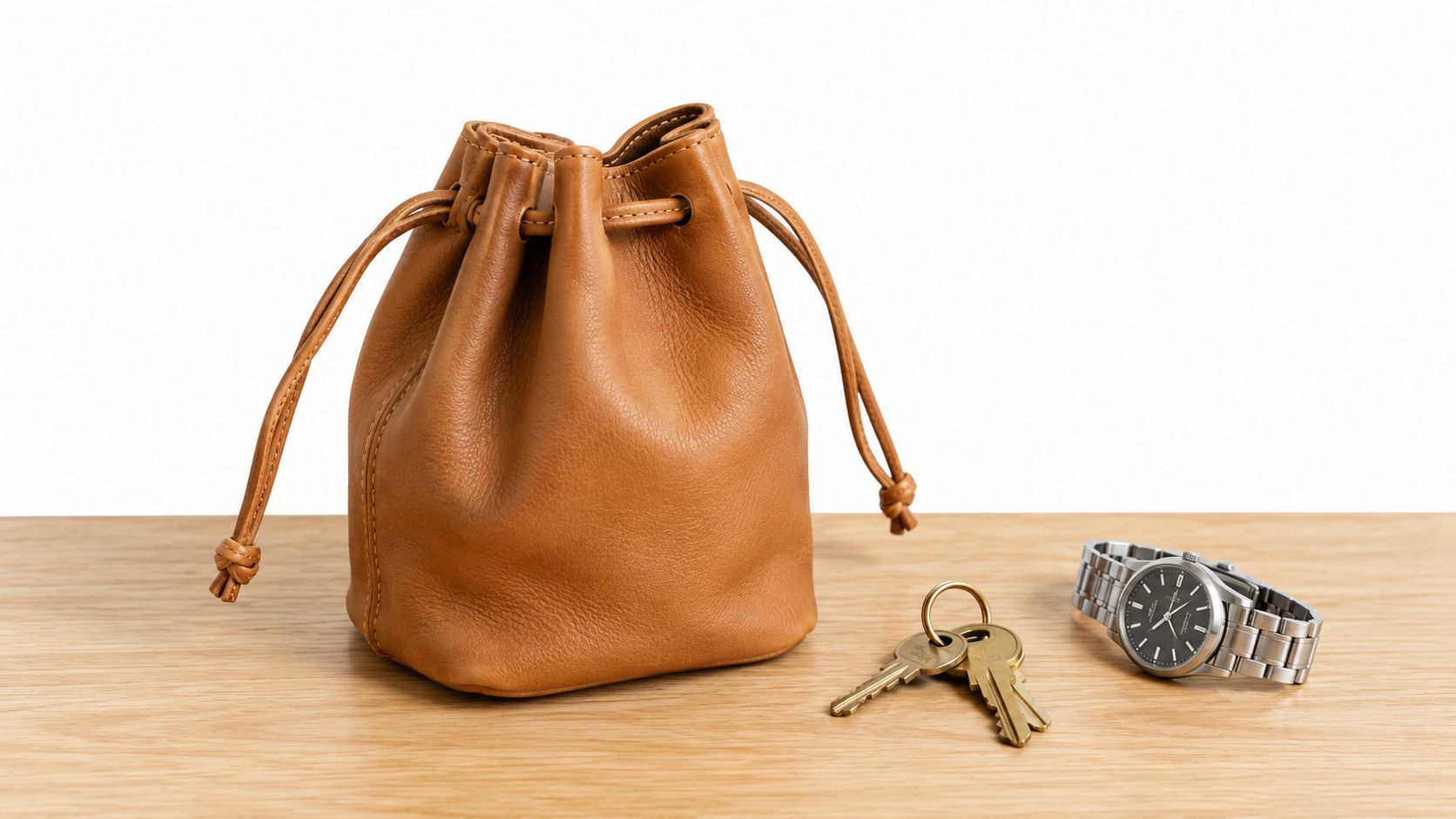
A leather drawstring pouch earns its place when you need separation, light protection, and fast access at the same time. A watch can sit inside one before you place it in a briefcase. Coins can stay together instead of moving through every pocket. A pen, pair of glasses, charging cable, or set of keys can have its own defined space.
The closure also keeps the design compact. Pulling the cord gathers the mouth without requiring a zipper track, snap flap, or rigid frame. That makes leather drawstring pouches useful for objects that don't need pressure-resistant protection but do need a barrier against scratches and contact with other items.
A traditional shape with modern logic
Leather drawstring pouches aren't merely costume accessories. Historical records document leather drawstring pouches as an early form of coin carry used from the 12th to the 16th centuries, often worn on men's girdles or belts for safety, as described in this history of bags and purses. That long period of use shows that the form addressed a durable practical need before built-in pockets became common.
The same logic applies to modern everyday carry. The pouch keeps small objects grouped, visible, and easy to remove from a larger bag. Its appearance also changes with handling. Scratches, darkened edges, and a developing patina can make a well-selected hide look more personal rather than just more worn.
Where the format falls short
A drawstring pouch isn't the right choice for every load. It won't stop a heavy object from pressing into a delicate watch, and a soft pouch won't replace a rigid glasses case or a fitted watch box when impact protection matters. The cinch closure also offers convenience rather than high-security protection, so it shouldn't be treated as theft-resistant storage.
Choose this format for organization and surface protection, not for crushing resistance or waterproofing. That distinction keeps expectations realistic and helps you decide when a pouch complements, rather than replaces, a more specialized case.
Understanding Leather Grades and Why Full-Grain Matters
Leather terminology can make a poor material sound better than it is. “Genuine leather” identifies leather content, but it doesn't by itself tell you how much of the original grain remains, how the surface was altered, or how the material will behave at a fold and seam.
Full-grain leather retains the natural outer grain of the hide. That surface gives a pouch character, but the practical benefit is more important: the material has not been heavily corrected to conceal every natural mark. With use, the surface can develop a patina instead of looking like a printed finish that has merely lost its coating.
Read the claim, then inspect the construction
A useful buying process has three stages:
- Identify the grain claim. Look for a clear statement that the pouch uses full-grain leather, rather than relying on vague words such as premium or luxury.
- Inspect the finish. Natural variation is not automatically a defect. Excessively uniform texture may indicate heavy correction or an applied surface treatment.
- Check the edges and seams. A strong hide can still fail if the cord channel is thin, the edge is poorly finished, or the stitching misses the stress path.
Corrected leather can offer a uniform appearance, and lower-cost leather may suit a buyer who prioritizes price or color consistency. The trade-off is that sanding, embossing, or coating changes how the surface handles abrasion and ages. A pouch that will be opened and closed repeatedly benefits from a material selected for structural performance, not just visual neatness.
Selection rule: Treat “genuine” as a category description, not a durability guarantee. Ask what the grain is, how thick the panels are, and how the closure is reinforced.
For a deeper explanation of terminology, compare the material descriptions in this guide to the grades of leather. The most useful rule is straightforward: choose full-grain when you want natural aging and long-term handling, then judge the pouch by its build rather than its label alone.
Choosing the Right Leather Thickness and Closure Build
A pouch usually fails at the points that move, gather, or carry tension. The body may look excellent while the mouth stretches, the gusset collapses, or the cord cuts into an under-reinforced channel. Construction decisions matter more than a polished product photograph.
For exterior panels, sourcing guidance places the practical working range at approximately 1.4 to 1.6 mm for leather drawstring pouches, because firm temper helps the body retain its shape while softer temper can sag at the gusset. This leather accessories sourcing guidance also supports reinforcing stress points with double stitching and selecting small, corrosion-resistant closures or cord hardware.
What to check before you buy
Panel thickness should suit the pouch's job. A slim pouch for a pen or cable needs enough body to avoid collapsing immediately, but excessive thickness can make the opening stiff and awkward. A coin pouch can tolerate more flexibility because its contents are less vulnerable to light compression.
Temper is the feel of the leather when you bend it. Firm leather springs back and supports a defined shape. Very soft leather feels pleasant in the hand, but it can create a sagging gusset and make the cord gather unevenly.
Stitching should follow the load. Double stitching at the cord channel, corners, and attachment points gives repeated tension more material to work against. Loose ends, widely spaced stitches, or a single fragile line at the mouth are warning signs.
Hardware should be compact and resistant to corrosion. Large fittings add bulk and can scratch nearby objects, while low-quality metal can discolor or seize after exposure to moisture.
A useful inspection is to open and close the pouch several times. Watch whether the cord travels smoothly, whether the mouth gathers evenly, and whether the channel twists. Repeated cinch cycles pull the leather inward, so thicker full-grain panels and reinforced seams help reduce deformation, protect closure alignment, and lower the risk of tearing where the cord gathers the opening. For broader construction checks, use this guide to assessing leather bag quality.
Best Storage Uses for Watch, Pen, Coin, and Gift Pouches
The right pouch begins with the object, not the product category. A watch needs a soft interior and enough room to avoid scraping its case against the closure. A pen needs a narrow channel or sleeve that prevents it from moving against metal tools. Coins need a tough mouth and a body that won't become uncomfortable when carried with other items.
Eyewear requires more care. A slim pouch can keep spectacles away from keys inside a larger bag, but it won't provide the crush resistance of a rigid glasses case. Travelers can use a wider format for cables, adapters, coins, or small personal items, provided the contents aren't sharp enough to cut the leather or heavy enough to distort the body.
For collectors and retailers, the pouch can also become part of a presentation system. A retailer organizing loose pieces may find these jewelry decluttering tips for retailers useful when deciding which items need separate compartments, display support, or a simpler grouped format.
Pouch Format Matching Guide
| Item | Recommended Pouch Feature | Why It Matters |
|---|---|---|
| Watch | Soft lining, shaped body, secure but gentle drawstring | Reduces rubbing while keeping the watch contained inside a larger bag |
| Fountain pen | Slim sleeve or separated channel | Limits movement, scratches, and contact with other writing tools |
| Coins | Durable mouth and reinforced gathering area | Handles repeated opening and closing without making the pouch unnecessarily rigid |
| Eyewear | Roomy soft pouch for light protection, rigid case for travel | Prevents surface contact, but acknowledges that soft leather won't resist crushing |
| Cables and small tech | Wider opening and flexible body | Makes irregular items easier to load and remove |
| Gift items | Neutral format with optional personalization | Lets the recipient use the pouch after the presentation moment |
Size should follow the object with a little working room, not a large empty interior. An oversized pouch lets delicate contents shift, while an undersized one puts pressure on the cord channel and corners. Pen users can also compare specialist advice in this guide to storing fountain pens, especially when ink, clips, and delicate finishes are involved.
How Environment and Humidity Change Pouch Longevity
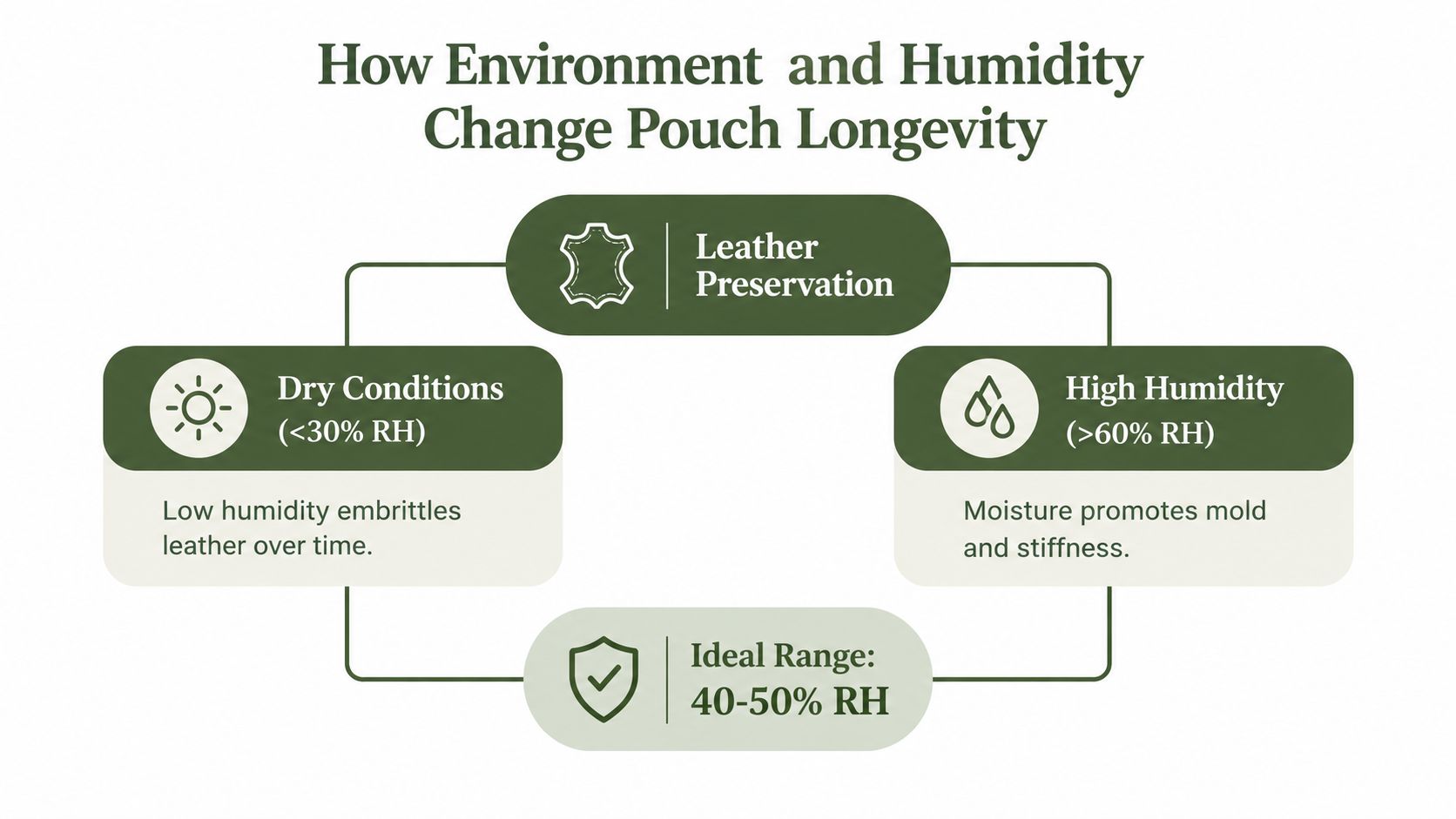
Leather responds to the air around it. Store a pouch in a damp suitcase and the material can soften, stain, or distort. Leave it for a long period in very dry air and the leather can become stiff, with greater crack risk at fold lines and around the cord channel.
Conservation guidance recommends avoiding conditions below 30% relative humidity, where leather can embrittle, and above 65% relative humidity, where mold growth and hydrolytic degradation become concerns. For leather objects, the practical target is a stable 45% to 55% relative humidity at approximately 18 to 20°C, according to the Canadian Conservation Institute's leather care guidance.
Store the pouch as a small environment
The pouch affects the objects inside it, and the objects affect the pouch. Coins can bring surface moisture or residue. Pens can leak. A watch or pair of glasses can transfer oils to the interior. Before storing the pouch, empty it, wipe away visible dust with a soft cloth, and let any damp contents dry separately.
Avoid sealing leather in a humid travel bag for extended storage. At the other extreme, don't place it directly beside a heater or in harsh sunlight. Stable conditions are more useful than aggressive treatment because repeated swings between damp and dry air stress the leather, cord, lining, and hardware together.
This full-grain leather lifespan guide is a useful companion when planning long-term care. The central principle is simple: keep the pouch clean, dry without excessive heat, and away from environments that make the leather either brittle or persistently soft.
Premium Leather Versus Lighter or Moisture-Resistant Options
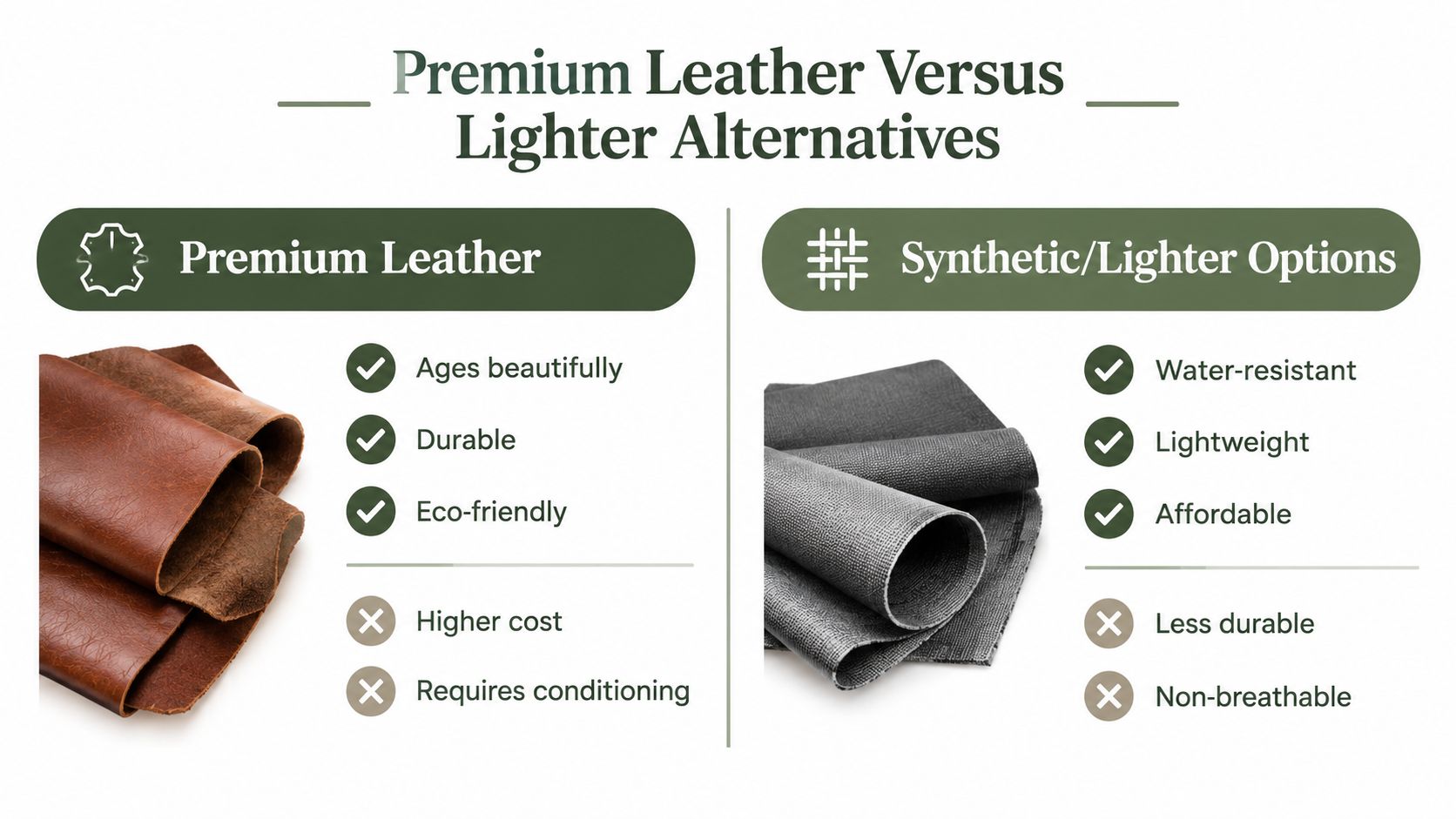
Premium leather and synthetic alternatives solve different problems. Leather gives a pouch a substantial hand feel, a natural surface, and an appearance that can change attractively with use. Lighter or moisture-resistant materials may be better for wet commutes, outdoor travel, or situations where weight and easy cleaning matter more than tactile character.
Industry coverage describes eco-friendly materials, transparent sourcing, and circular services as important influences on luxury small leather goods in 2025, while product guidance emphasizes periodic wiping and dry storage for leather pouches. The implication is practical: buyers increasingly assess not only how a pouch looks when new, but also whether they can maintain, repair, and keep using it.
Match the material to the conditions
Leather suits a desk, briefcase, wardrobe, or controlled travel environment where presentation and long service matter. It works especially well for a watch, pen, gift, or small personal item that you handle frequently and want to age with use.
A coated synthetic or technical textile pouch can make more sense for wet weather, camping, beach travel, or a bag that is likely to be placed on dirty surfaces. It may be lighter, easier to wipe clean, and less sensitive to brief moisture exposure. The trade-offs can include a less breathable surface, less convincing aging, and limited repair options depending on the construction.
Market coverage places premium leather pouches toward the higher end of small-goods pricing, while separate industry reporting says approximately 34% of new tool-pouch launches in 2025 used sustainable materials, as reported in this premium pouch market coverage. Those signals describe a split in buyer priorities rather than a universal winner. Choose leather if you value presentation, tactile quality, and repairable long-term use. Choose a lighter or moisture-resistant option if exposure, weight, and low maintenance lead the decision.
How to Choose, Care for, and Gift a Leather Drawstring Pouch
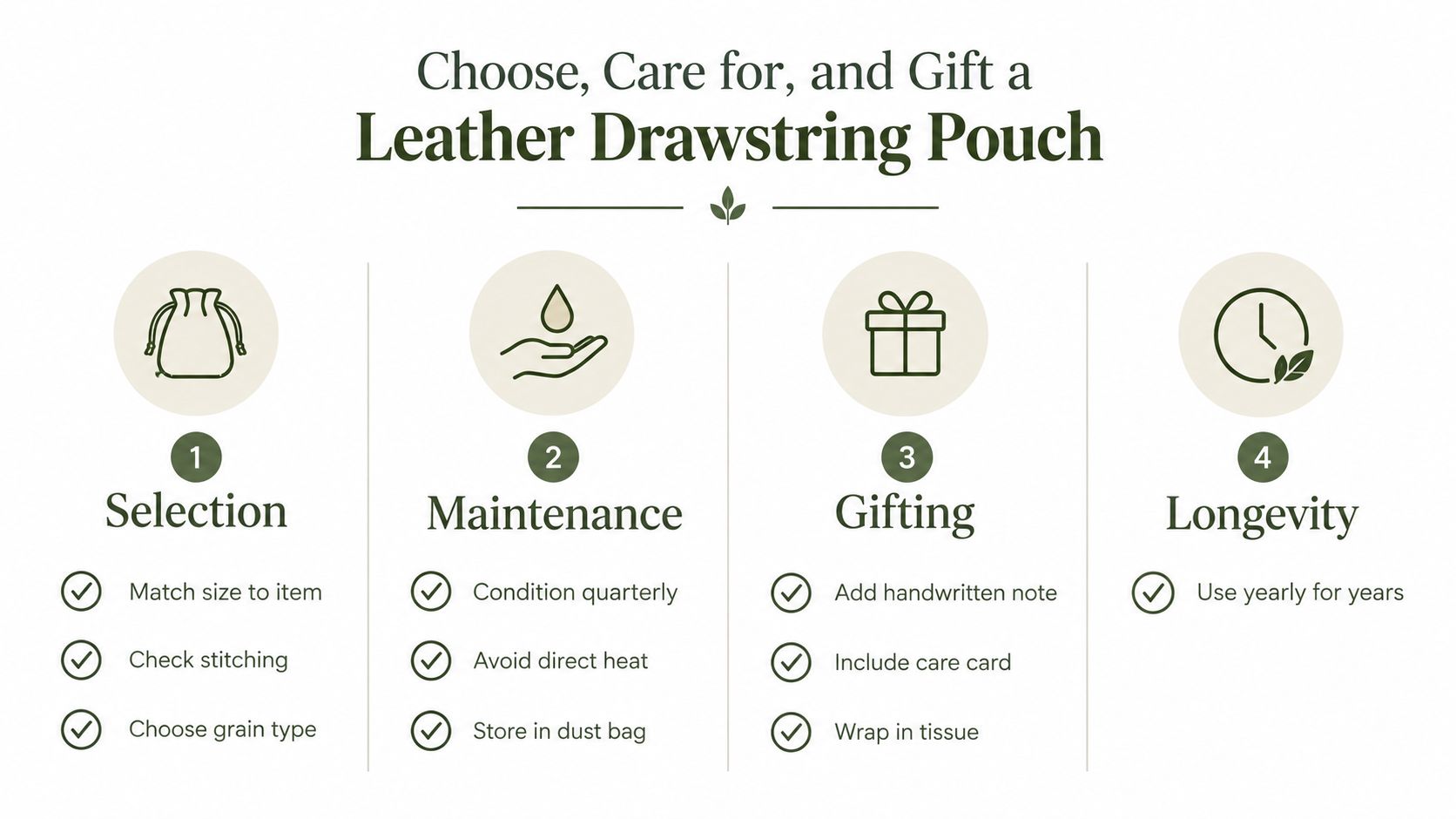
Start with the item you want to carry. Measure its length, width, and any protruding clip, crown, or fitting, then select a pouch that leaves enough room for insertion without forcing the drawstring channel. Check the seams at the mouth and corners, feel the leather's temper, and confirm that the closure moves without catching.
Care should stay conservative. Wipe surface dust with a clean, soft cloth, keep the pouch away from direct heat, and store it in a dry place where it won't be crushed. Use a leather-specific conditioner only when the material and finish call for it, and test any product on an inconspicuous area first. This practical guide to conditioning leather can help you avoid applying too much product or using a treatment unsuited to the finish.
Make the gift fit the habit
A pouch becomes a stronger gift when it reflects what the recipient already carries. Pair a slim format with a fountain pen, choose a protective style for a watch, or select a wider pouch for travel essentials. A handwritten note, care card, and simple tissue wrapping add thought without turning the package into decoration that can't be used.
Personalization can make a practical object feel deliberate, particularly for a milestone or professional gift. The best choice still depends on construction first. A monogram won't compensate for weak stitching, poor sizing, or a closure that pulls unevenly.
Review the pouch once in a while for loose threads, edge wear, stiffness, or moisture marks. Early attention is easier than repairing a torn cord channel after the leather has already stretched. With the right size, full-grain construction, sensible storage, and restrained care, a leather drawstring pouch can serve as a compact organizer for years rather than a novelty bought for one occasion.
Grainmark Leather offers full-grain leather pouches and specialist storage for watches, writing instruments, eyewear, travel items, and other everyday essentials, with personalization available on select gifts. Visit Grainmark Leather to compare pouch formats and choose a piece that matches what you carry.