

Best Watch Storage Box Guide for Collectors
The most popular advice about buying a best watch storage box is also the least useful: count the slots, choose the nicest finish, and buy the largest box your budget allows. That approach fails because a watch carried through airports, displayed on a desk, and stored as part of a mixed mechanical and smartwatch collection faces completely different risks.
Search behavior reflects that split. One 2025 trend analysis found that “watch travel case” drew the strongest interest, followed by “watch display case,” while “watch storage organizer” remained negligible. The same analysis described a later spike in travel-related searches, particularly around November 2025, while “luxury watch storage case” attracted very little interest. Those patterns suggest that shoppers aren't looking for one universal container. They're choosing between portable protection, home presentation, and increasingly, hybrid storage for traditional watches and smartwatches. (Accio watch storage trends)
Table of Contents
- Rethinking the Generic Watch Storage Box
- Comparing Daily Boxes Travel Cases and Collector Chests
- Evaluating Full-Grain Leather and Interior Linings
- Sizing Pillows and Planning for Collection Growth
- Managing Humidity and Securing Movements in Transit
- Adapting Storage for Smartwatches and Hybrid Collections
- Selecting the Right Leather Case for Your Lifestyle
Rethinking the Generic Watch Storage Box
A generic watch storage box sounds sensible until you ask what the box must do. A commuter may need a compact case that protects one spare watch inside a work bag. A frequent flyer needs restraint, impact resistance, and a closure that won't open in transit. A collector displaying several pieces at home may care more about visibility, access, spacing, and how the case sits in a room.
Slot count comes after that decision, not before it. A beautiful glass-topped box can be excellent on a dresser and poor in checked luggage. A crush-resistant travel case can protect a watch superbly while looking completely out of place beside a desk lamp and a leather writing pad. A roll may save space, but it won't provide the same separation or presentation as a structured chest.
The practical question: Where will the watch spend most of its time, and what kind of damage is most likely in that environment?
The market itself supports this use-case split. The global luxury watch box market was valued at $1.2 billion in 2025 and is projected to reach $2.1 billion by 2034, with a projected 6.8% compound annual growth rate. The same report says multiple-watch boxes held 35.2% of the category and Asia Pacific represented 38.5% of revenue. (MarketIntelo luxury watch box market) Those figures describe a broad category, but they don't mean every buyer needs a large collector chest.
For packaging and presentation references, Packaging Panda's storage box range is useful for seeing how different box structures serve different contents. Watch storage requires more than attractive packaging, though. The interior must support the watch without stressing the bracelet, the exterior must match the handling conditions, and the closure must suit how often the box moves.
Start with three questions:
- Portable protection: Will the case travel in a briefcase, carry-on, or luggage?
- Home display: Will it remain on a shelf or dresser and open frequently?
- Hybrid organization: Must it accommodate smartwatches, charging accessories, and watches with different case shapes?
Once those answers are clear, material and capacity become much easier to judge. The best box isn't the one with the most compartments. It's the one whose architecture matches the collection's real routine.
Comparing Daily Boxes Travel Cases and Collector Chests
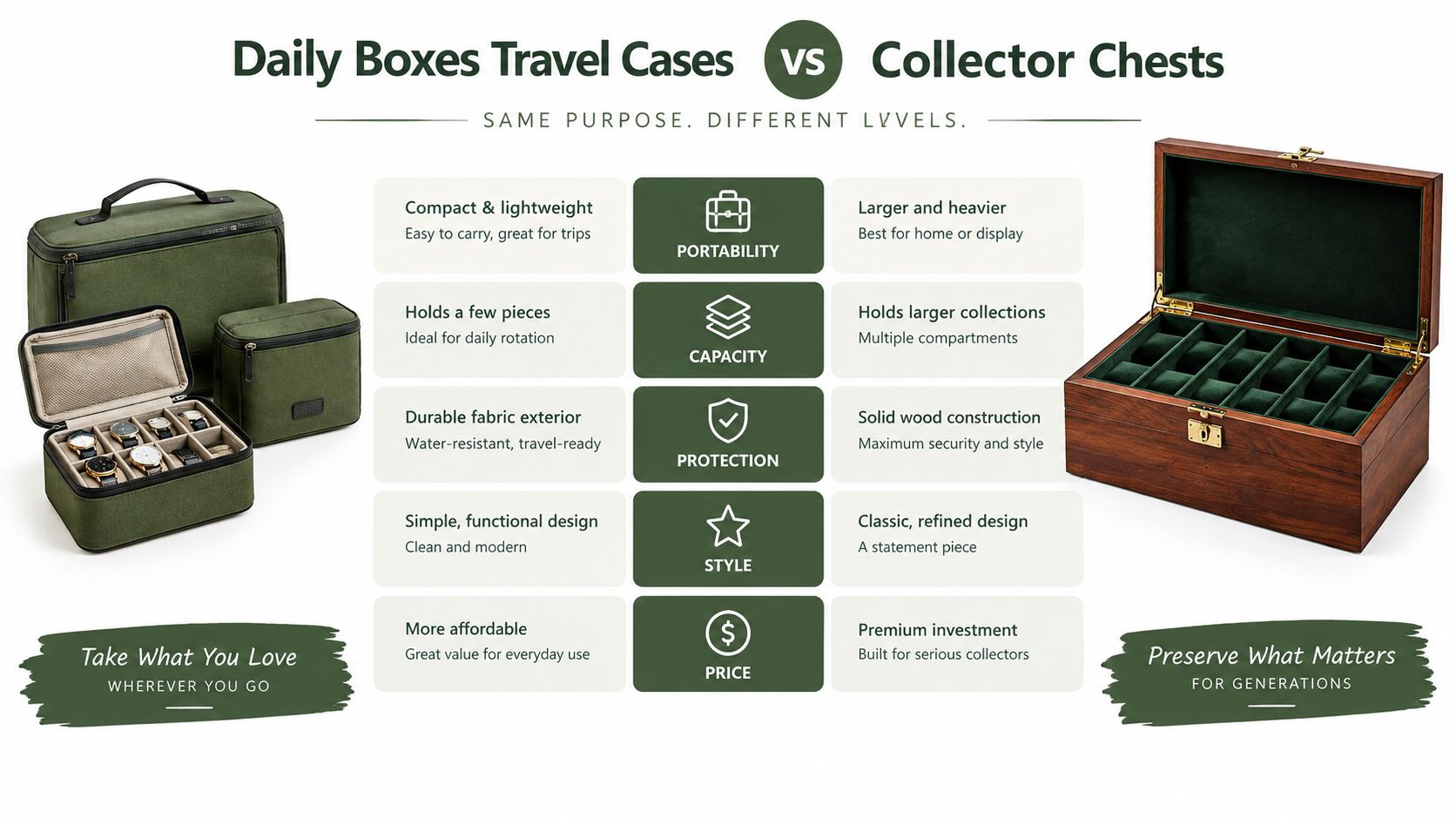
Three formats cover most practical needs: the compact daily box, the rugged travel case, and the larger collector chest. They overlap in appearance, but their construction priorities differ sharply.
A daily box suits someone who rotates a small group of watches between work and home. It should open quickly, keep watches separated, and fit comfortably on a desk or shelf. A removable cushion is valuable because it lets you position a bracelet without forcing it over a fixed, oversized pillow. Rigid walls matter, but extreme crush protection may be unnecessary if the box stays inside a controlled home or office environment.
A travel case is built around movement restraint. It needs a secure closure, a structure that resists compression, and enough internal padding to prevent watches from touching one another. The travel market was estimated at $0.4 billion in 2025 and is projected to reach $0.6 billion by 2034, at a projected 5.2% CAGR. The same report says multiple-watch cases held 32.5% share, Europe accounted for 35.0% of revenue, and box watch cases represented 12.0% as a storage-oriented subcategory. (MarketIntelo travel watch case market)
Watch storage form factors compared
| Form Factor | Best Use Case | Protection Level | Portability |
|---|---|---|---|
| Daily box | Desk, bedside table, office drawer | Moderate, focused on separation and light impact protection | Easy to move |
| Travel case | Flights, luggage, commuting, short trips | High, with emphasis on closure, crush resistance, and movement restraint | Very high |
| Collector chest | Home storage and display | Moderate to high, depending on frame and lid construction | Low |
A collector chest earns its space through access and presentation. It should let you see the collection without repeatedly opening individual watch packaging, and it should leave enough room between cushions for fingers, bracelets, and crown clearance. Wood, leather, glass, and metal can all work, but the finish shouldn't distract from the functional details beneath it.
A roll can be convenient for a flight, but it isn't a substitute for a chest. A chest can organize a collection beautifully, but it usually isn't the right object to place inside a suitcase. For unusual hygiene or equipment-storage requirements, a portable germicidal UV lamp belongs to a different category entirely. Ultraviolet equipment shouldn't be treated as a replacement for a correctly lined watch case or as a reason to expose watch materials unnecessarily.
For a closer look at the decisions involved in choosing a compact format, see this guide to a watch travel case for men. The useful distinction is simple: daily boxes organize, travel cases restrain, and collector chests present.
Evaluating Full-Grain Leather and Interior Linings
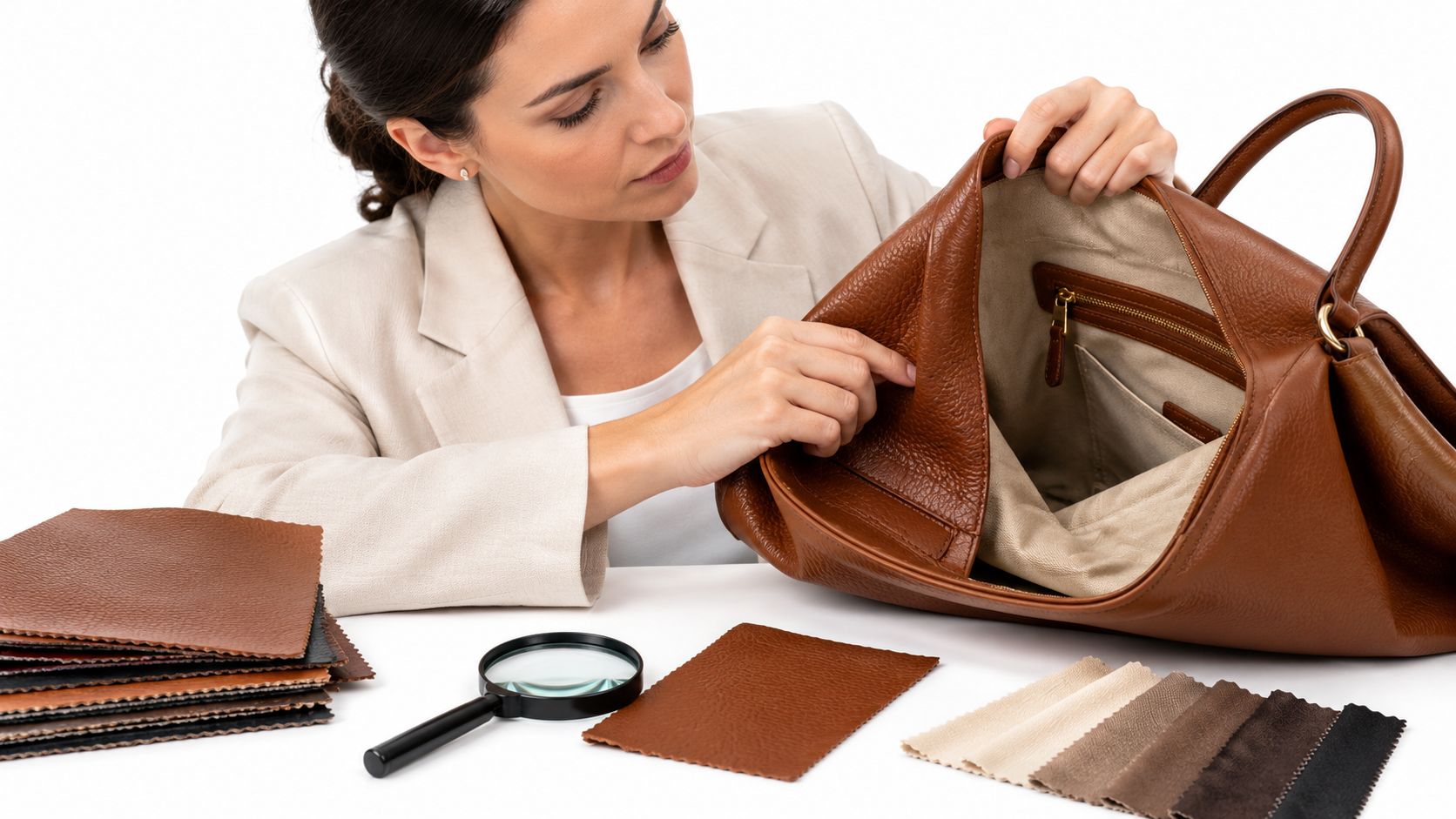
A leather exterior can be beautifully made and still protect a watch poorly. The lining, seams, and contact points determine whether storage prevents abrasion or introduces it.
Full-grain leather retains the hide's natural grain instead of being heavily sanded for a uniform surface. It usually develops character with use rather than just losing its finish. Wax-treated leather, including Crazy Horse-style finishes, may show handling marks that blend into the surface over time. Corrected leather and synthetic coverings can look consistent when new, but their durability depends on the coating, backing, and edge treatment.
Inspect the case as a complete structure. Check where the lining meets the frame, where adhesive may collect in corners, and how the stitching is finished around cushions and dividers. A supple outer shell does not compensate for a rough interior that can mark a polished case, bracelet, or crystal.
Why the lining matters more than the label
A soft, non-abrasive interior gives the watch a safer contact surface. Microfiber, velvet, suede, and alcantara are common choices, while cheap felt or synthetic material installed with acidic adhesive can create longer-term concerns for finishes. The pillow should support the bracelet without forcing it outward. Case & Strap guidance on watch boxes offers useful context when comparing case interiors.
Run a fingertip along every accessible edge. No hard rim should catch a case as the watch is removed. Stitching should lie flat, with loose thread kept away from the caseback and bracelet. The interior should also remain clean and stable after repeated handling, especially in a portable case that will be opened frequently.
Suede may feel luxurious, but its nap and backing still require inspection. This guide to suede lining and fabric explains why the material name alone does not show how a lining will perform in a structured case. Check for shedding, a strong chemical smell from adhesive, and a surface that remains smooth after repeated contact.
Construction details worth checking
- Edge finishing: Wrapped or painted edges should remain even and resist cracking around the lid.
- Stitching: Thread should be tight, regular, and recessed from areas that touch the watch.
- Pillow attachment: Cushions should be removable so bracelets can be adjusted without damaging the case.
- Interior contact: Rivets, fasteners, and exposed backing material should stay away from the watch.
- Material behavior: The lining should remain soft and intact rather than becoming rough with use.
The right architecture depends on the storage intent. A portable protection case benefits from abrasion-resistant lining and tidy finishing. A home display box can prioritize presentation, provided its interior remains gentle. A hybrid smartwatch case needs a lining that tolerates frequent handling and accommodates charging accessories without placing them against the watch. Leather supplies the outer skin. The lining and finishing decide how well the case serves its purpose over time.
Sizing Pillows and Planning for Collection Growth
Slot count alone does not determine whether a watch box will work. The usable capacity depends on case thickness, bracelet shape, cushion design, and the space your fingers need to remove each watch without scraping neighboring pieces.
Begin with an inventory. Separate watches stored daily from those needing wider compartments, then identify the largest case, thickest watch, longest bracelet, and any unusual shapes. A box may hold every watch on paper yet prove awkward if cushions compress poorly or dividers leave no hand clearance.
Plan for 20–30% growth beyond the current collection when choosing capacity. Empty compartments preserve separation and give you room to change the rotation without immediately replacing the box. This reserve also helps when a future watch has a broader bracelet or taller case than your current pieces.
A practical sizing method
- Measure the largest watch. Record case diameter and thickness, then allow for crowns, pushers, and angular case profiles. A square or tonneau case can consume more usable space than its stated width suggests.
- Match pillows to bracelet shape. The cushion should hold the bracelet closed without distorting it or forcing the spring bars outward. Fixed pillows suit consistent collections, while compressible or removable versions accommodate different bracelet lengths.
- Check access, not just capacity. Leave enough room to grip the cushion and lift the watch cleanly. Tight compartments turn routine handling into contact between cases, clasps, and dividers.
- Assess the storage setting. A compact case suits a small rotation or portable protection. A larger home display format works when the room can accommodate it and unused slots will remain easy to access.
Collections often mix oversized sports watches, thick chronographs, vintage pieces, and smartwatches. A pillow designed around a slim dress watch may support one category poorly, especially when bracelet links or charging accessories change the required space. Choose the case architecture according to intent: portable protection, home display, or hybrid smartwatch storage.
For a home display option, Grainmark Leather's 24-slot watch display box shows why capacity should follow the collection rather than lead it. More compartments help only when their dimensions suit the watches and the box has a practical place to stay.
Managing Humidity and Securing Movements in Transit
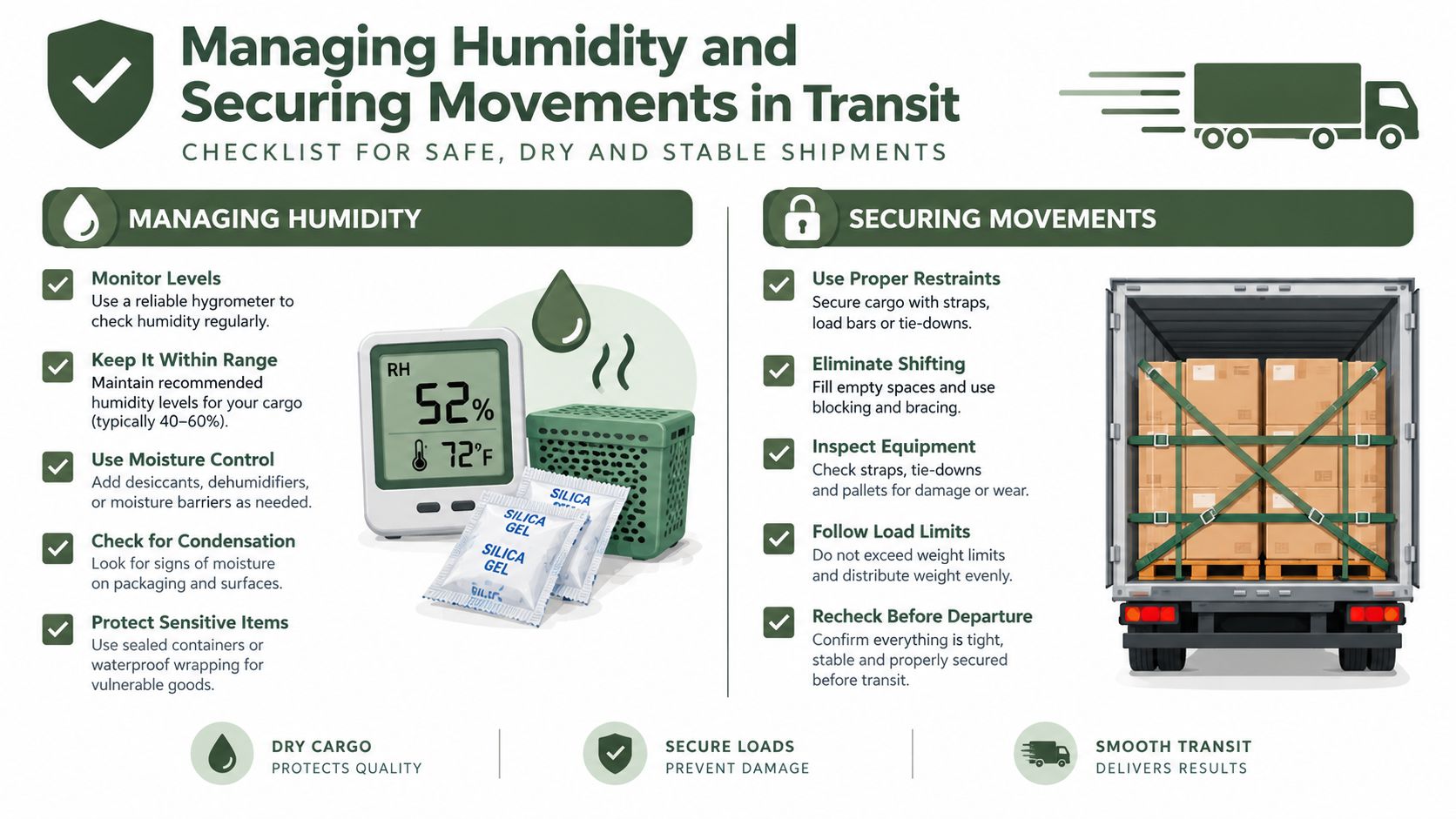
A watch case can look secure while still allowing moisture, friction, and movement to work against the collection. Transit protection therefore depends on two separate controls: keeping the environment dry and holding each watch firmly enough to prevent contact with the case or neighboring pieces.
As noted in our humidity and movement guide, suitable humidity control still matters, but the case itself should not be treated as a moisture-management system. Use a replaceable silica gel or other humidity-control insert in its own compartment, where it cannot rub against a watch. Check and replace it as needed. Keep desktop chests away from damp rooms, direct heat, and windows, and avoid leaving travel cases in vehicles or other areas with sharp temperature changes.
What stops movement damage
For travel, crush-proof construction, secure closure, and a close-fitting interior matter more than decorative leather or excess capacity. A fixed rail or stitched support keeps the cushion from sliding inside the case, while a properly shaped pillow prevents the watch from rocking during handling. The fit should hold the case and bracelet without pressing against the crown, pushers, or crystal.
A hard shell suits checked luggage and crowded bags because it resists compression. A structured leather case is easier to carry in a briefcase, but its lining, edge finishing, and stitching need inspection. Loose threads, exposed hardware, or a thin lining can create abrasion points over time. The closure should resist accidental opening while remaining easy to operate in a hotel room or airport lounge.
Separate the watch from buckles, spare straps, tools, and charging cables. These items can become abrasive when they share an unstructured compartment. Give each watch a restrained position, then place hard accessories in a separate pocket.
Water resistance belongs to the watch as well as the container. Buyers should choose the right waterproof watch for the conditions they expect to encounter, while remembering that a storage case cannot repair a compromised seal or replace routine maintenance. A well-built travel case reduces handling risk. It does not make careless storage safe.
Adapting Storage for Smartwatches and Hybrid Collections
A watch box designed only around round mechanical watches can be a poor fit for a mixed collection. Many owners rotate between an automatic dress watch, a quartz field watch, and a smartwatch that needs charging before the next commute. Storage should follow those uses, not just count slots.
Smartwatches need clearance around the case and strap, plus a defined place for the charging puck or cable. The charger should not rub against the screen or become trapped under another watch. A round pillow may hold the device, yet fail to organize its accessories or accommodate a squared case with prominent sensors. Lid height also matters, especially when a thick smartwatch and strap sit together.
Build around the collection you actually wear
A hybrid case should separate watches by their physical demands:
- Mechanical watches: Use soft, stable supports that hold the bracelet without forcing it outward.
- Quartz watches: Provide clear separation and quick access, particularly beside heavier pieces.
- Smartwatches: Leave charging clearance and keep metal buckles and cables away from the display.
- Unusual cases: Use adjustable or removable supports for rectangular, tonneau, and oversized designs.
The market is responding with compact travel cases for smartwatch users and modular storage that includes technology-oriented features. An analysis from Accio projects the watch case market to reach about $3.574 billion by 2033 from 2025, suggesting room for specialized formats instead of one universal case. (Accio watch box analysis for women)
Material choice still affects daily use. Leather can provide a structured exterior and a comfortable hand, while the interior needs soft lining, firm dividers, and stitching that will not loosen around repeated strap changes. A case should also keep accessories from occupying the same space as the watch. Separating chargers from bracelets reduces clutter and limits contact with the screen or polished surfaces.
A collector may prefer to keep a smartwatch apart from mechanical pieces. A modular layout accommodates that preference while giving every watch the support and clearance its construction requires. Grainmark Leather's 4-slot smartwatch case is one example of a compact format built around smartwatch organization rather than a conventional collector chest. Check the compartments, lid height, removable supports, and accessory space against the devices you own.
Selecting the Right Leather Case for Your Lifestyle
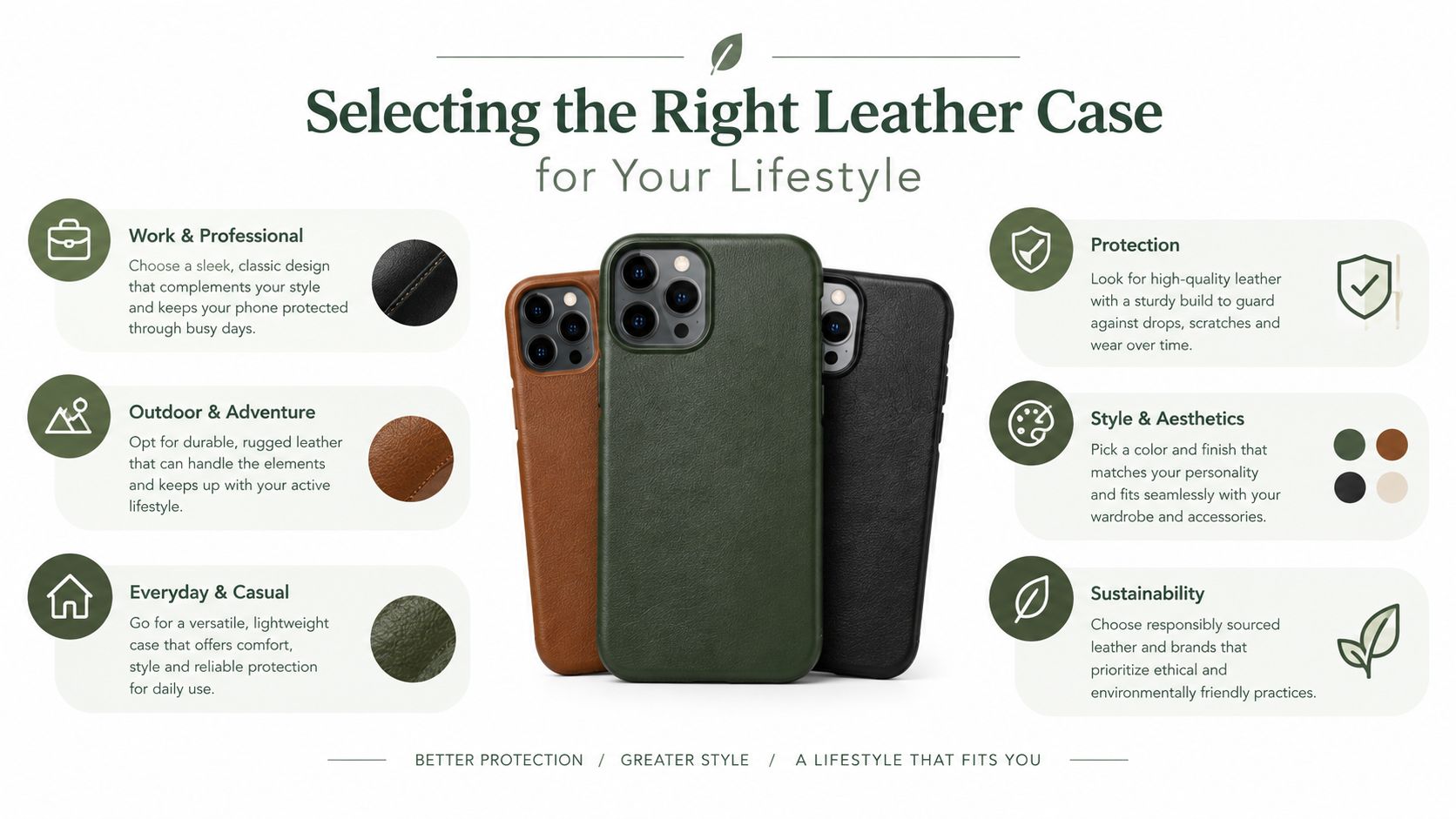
The right case depends on where the watch spends its time, not on slot count alone. Daily carry, home display, and hybrid smartwatch storage require different architectures, so match the shell, closure, and interior to the routine.
For a commuter, handling matters more than decoration. Choose a compact case with a rigid body, dependable closure, and cushions that can be removed or repositioned. It should sit securely inside a work bag, with enough support to prevent the watch from shifting when the bag is placed down.
Frequent air travel calls for stronger protection. Crush-resistant walls, a closure that stays shut under pressure, and fixed supports prevent watches from contacting one another. Leather works well as an exterior when the case travels in a carry-on, but a soft roll offers limited impact protection.
At home, lid clearance and interior construction decide whether a display chest serves the collection well. The largest watch should close without pressing against the lining, while bracelets need separate spaces and cushions sized to the cases. Glass, wood, and leather can suit the room, yet soft lining, stable dividers, and tight stitching protect the watches more directly than a glossy finish.
A buying checklist that survives real use
- Capacity: Buy for the watches you wear now, with room for the collection to grow.
- Fit: Measure the widest, thickest, and least conventional watch.
- Interior: Reject rough felt, exposed adhesive, loose threads, and hard contact points.
- Closure: Match the latch, zip, snap, or lock to the movement the case will endure.
- Portability: Use a structured compact case for daily carry and a reinforced shell for luggage.
- Maintenance: Learn how to condition leather without saturating the lining or transferring product onto the watches.
- Hybrid readiness: Leave charging clearance for smartwatches and adjustable supports for different case shapes.
Build around the collection you wear. Grainmark Leather offers compact watch cases, smartwatch formats, and larger display boxes, giving buyers several leather storage architectures to compare with their routines.
Visit Grainmark Leather to compare full-grain leather watch cases, smartwatch storage, and collector display boxes by capacity and use case. Check the lining, stitching, closure, and cushion fit before committing.