

Leather Billfold Wallet Mens: A Complete Guide for 2026
You sit down after a long day and feel the familiar pressure of a wallet that has become more storage case than daily accessory. It carries old receipts, rarely used cards, and enough folded cash to push awkwardly against your hip. Your phone may handle payments and identification in many situations, but the physical wallet still has to work when a battery dies, a terminal fails, or you need a card quickly.
The challenge isn't finding a wallet that claims to hold everything. It's finding a leather billfold wallet for men that holds what you use without becoming uncomfortable. Material quality, folding pattern, loaded thickness, and pocket position matter more than a long list of compartments.
Table of Contents
- Why the Leather Billfold Wallet for Men Still Matters
- The Evolution and Market Force of Men's Billfolds
- Understanding Leather Grades and Durability
- Layouts, Capacity, and Pocket Ergonomics
- Choosing the Right Wallet for Your Use Case
- Essential Care Tips for Long-Lasting Leather
- Final Thoughts on Selecting Your Perfect Billfold
Why the Leather Billfold Wallet for Men Still Matters
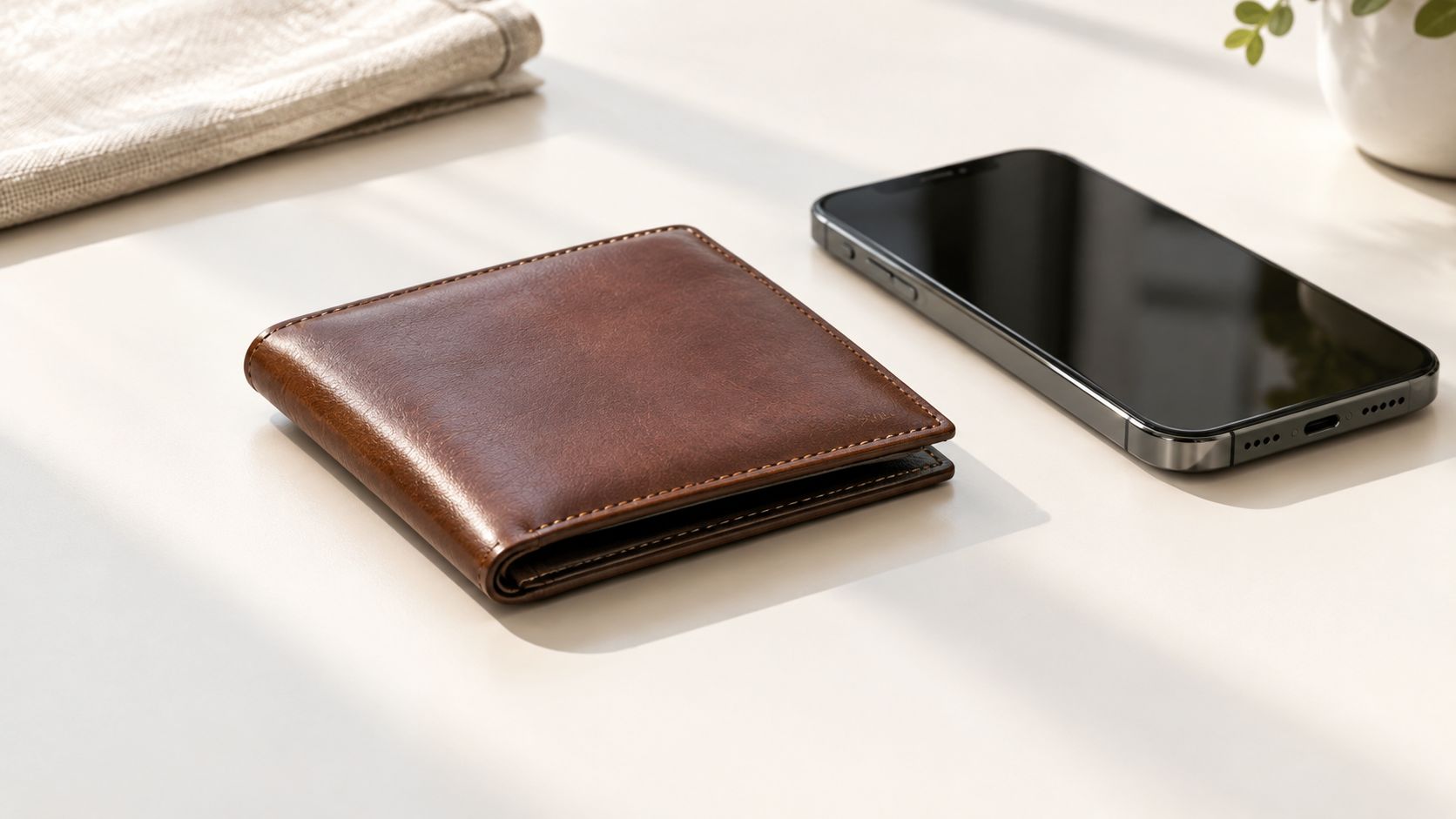
A man can leave home with a smartphone, keys, and a wallet that seems almost unnecessary. Then the phone battery runs low, a shop's payment reader refuses a mobile transaction, or a driver's license is needed at a counter. The physical wallet earns its place because it gives you a dependable, immediate way to carry payment cards, identification, and cash without depending entirely on electronics.
The problem appears when a wallet grows unnoticed. One membership card becomes several. Receipts remain tucked behind the bill compartment. A second ID window gets used as a storage pocket. After enough weeks, the original billfold shape is still there, but the object no longer behaves like a comfortable everyday accessory.
The value of a physical carry
A well-made leather wallet also offers a tactile quality that digital tools can't replace. You can feel the grain, see how the surface changes with handling, and develop a familiar arrangement for cards and notes. That physical organization makes routine transactions quicker because you know exactly where each essential item belongs.
Craftsmanship matters here, but only when it serves daily use. Clean edges, secure stitching, and a fold that opens without fighting your hand make a difference every time you pay. A decorative wallet with poor spacing can be more frustrating than a plain one built around sensible access.
Practical rule: A wallet should support your routine, not preserve every item your routine has accumulated.
Empty every compartment before choosing a replacement. Keep the cards and cash you use regularly, set aside the rest, and then select the smallest leather billfold that closes naturally around that load. The best choice isn't the wallet with the biggest advertised capacity. It's the one you won't notice while walking, sitting, or reaching for a card.
The Evolution and Market Force of Men's Billfolds
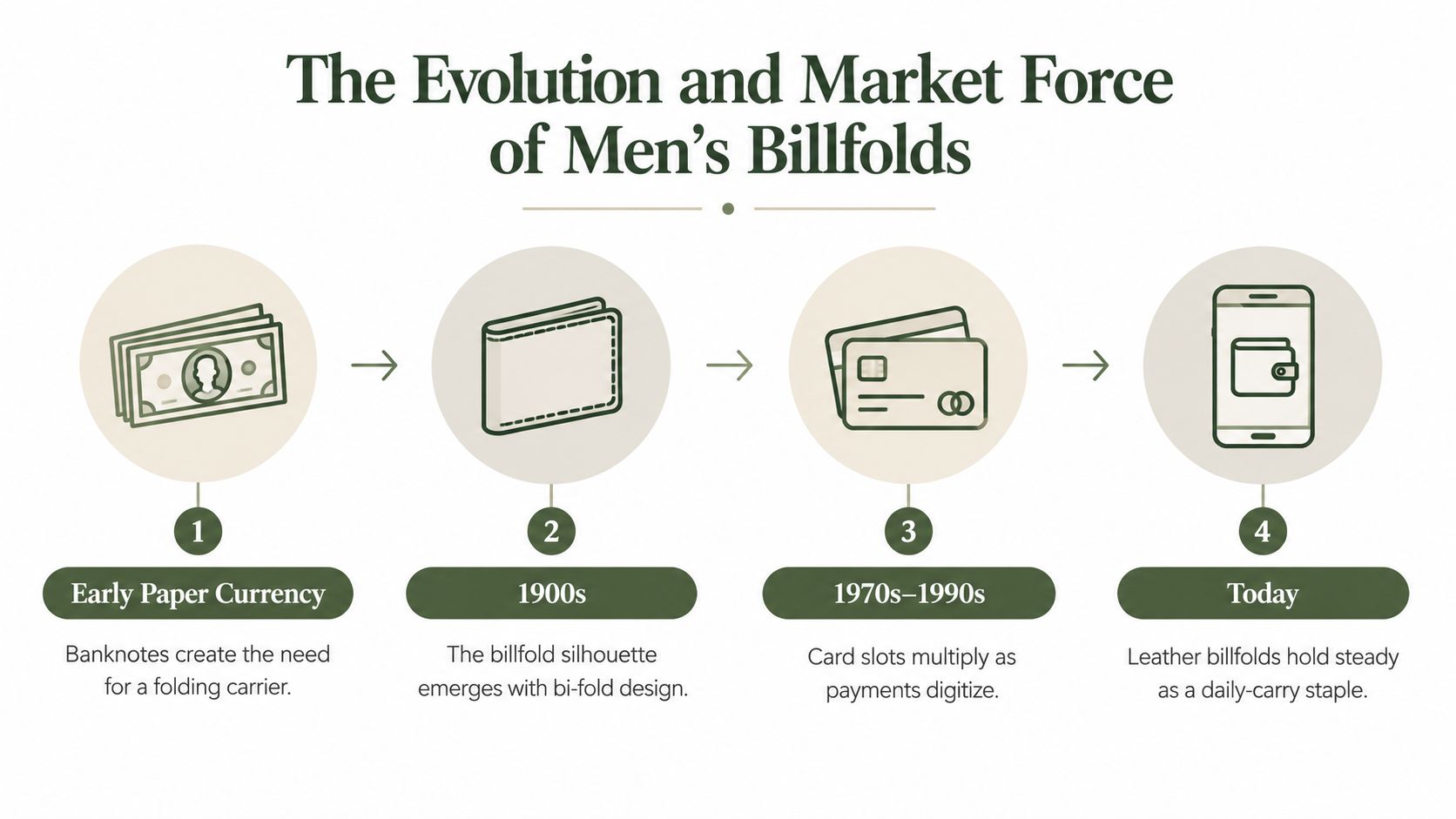
A leather billfold makes sense only when its folded profile matches the money and cards it carries. Paper currency introduced in America by the Massachusetts Bay Colony in 1690, creating demand for a holder that could protect and fold banknotes, as described in this historical guide to men's billfold wallets. Earlier leather pouches served coins and other valuables, while the billfold developed around folded paper money.
Credit cards changed the interior in the early 1950s. Card slots were added beside the bill compartment, establishing the pocket-sized format familiar today. A billfold folds bills, usually through a bifold or trifold construction. The wider wallet category includes formats that do not fold paper currency.
Why the format remains commercially important
The classic layout remains practical because it protects folded notes, separates cards, and fits familiar clothing pockets. Traditional designs commonly offer three to eight card slots, plus spaces for identification or calling cards, according to the billfold design overview from Gentleman's Gazette. That advertised capacity can hide the actual trade-off. Each slot adds leather and lining, and every loaded layer increases thickness at the point where the wallet presses against the body.
Market estimates show that the category still has commercial weight. One estimate puts the global men's wallet market at USD 11.92 billion in 2026, projecting USD 17.91 billion by 2035 and a 4.5% CAGR, as reported by Business Research Insights. A separate estimate values the wider wallets market at USD 11.4 billion in 2025 and projects USD 18.7 billion by 2034. Its product breakdown gives bi-fold wallets the largest share at 38.2%, while leather represents about 54.7% of total revenue.
Those figures describe demand, not a required loadout. Digital payments reduce the need for cash, yet a compact physical wallet still serves routines that span shops, travel, identification, and places where payment options vary. Choose the slot count by measuring daily contents, then judge the closed thickness in a trouser pocket. A wallet marketed for more cards may be less comfortable than a smaller billfold used at its intended capacity.
Understanding Leather Grades and Durability
A wallet can look supple in the shop and still struggle after months of folding, friction, and pocket pressure. Leather grade affects how it handles those repeated movements, so assess the hide beneath the finish rather than relying on a marketing label.
Full-grain leather comes from the outermost layer of the hide and retains its natural grain structure. Its unsanded fibers provide structural integrity and breathability. Handling can also produce a patina, rather than just wearing through a decorative coating. Those properties suit a billfold carried every day, as explained in this guide to choosing a durable leather wallet.
What to inspect before buying
Start with the surface. Natural variation in grain and texture is normal, while a perfectly uniform finish can suggest heavier surface treatment. Appearance alone, however, cannot confirm the grade.
Check the fold, edges, and stitching next. The fold receives repeated stress and should flex without early cracking. Edges should look even and remain securely finished. Stitching should run consistently, with no loose loops or skipped sections. Inspect the interior as well. A durable outer hide cannot offset weak lining, unsupported card slots, or poorly joined layers.
For a clearer comparison of full-grain, top-grain, corrected, and bonded constructions, use the Grainmark Leather guide to leather grades. Sanding and combining lower layers can produce a consistent appearance, but those processes also affect how the material wears and ages.
Why full-grain can be the practical choice
A full-grain billfold often feels firm at first, particularly around the card slots and central fold. That initial resistance is useful when the wallet must hold its shape. With regular use, the leather can soften and conform to its contents without immediately collapsing or peeling.
Lower-grade materials may feel soft from the start, but softness does not establish durability. Loose slots can stretch quickly, and a thin surface coating may crack or wear away under daily friction. For a wallet that must remain comfortable as its contents change, assess the leather first, then inspect whether the construction reinforces the fold, edges, lining, and slot openings that receive the most movement.
Layouts, Capacity, and Pocket Ergonomics
A wallet may accept every card listed in its product description and still carry badly. Usable capacity is the load that lets the wallet close, remain reasonably flat, and stay comfortable during a full day. Marketing capacity measures available space. Pocket comfort measures what that space does to your clothing and movement.
For back-pocket carry, independent guidance recommends keeping a loaded wallet under about 0.6 inches. Front-pocket carry works better at about 0.5 inches, according to this wallet thickness and pocket comfort guide. Extra thickness shifts as you walk, presses into the hip, and makes the pocket opening harder to use. A wallet that holds more is not automatically a better wallet.
Compare the common layouts
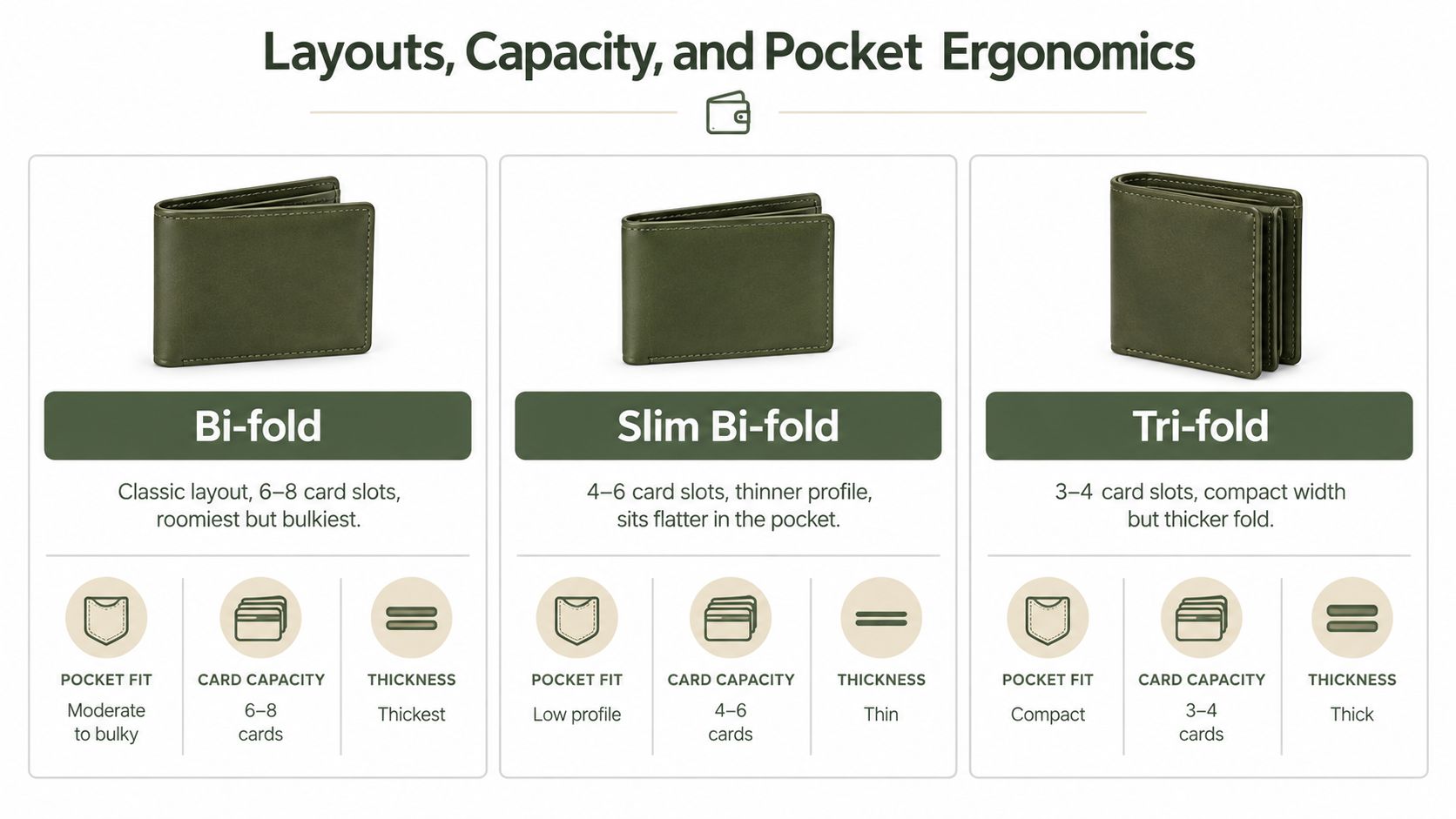
| Layout | Typical arrangement | Where it works |
|---|---|---|
| Classic bifold | Traditional bill compartment with several card slots | Back-pocket carry and regular cash use |
| Slim bifold | Reduced layering and fewer storage areas | Front-pocket carry or a restrained card load |
| Trifold | Three panels with more folding surfaces | Organized storage when compact width matters more than thickness |
A classic bifold is easy to use. The cash compartment opens in one motion, and the cards stay visible. Its drawback appears gradually. Each card, receipt, and interior layer forces the two halves farther apart.
A slim bifold controls that buildup by limiting storage. It suits front-pocket carry when you keep only active cards and a modest cash fold. For front-pocket carry specifically, this minimalist leather wallet selection guide outlines which formats maintain comfort under everyday loads.
A trifold spreads cards across three panels and can reduce width. The additional folds also create more layered material, so it may feel thicker even when it looks compact. Choose based on the dimension that causes trouble in your usual pocket.
Test the real load
The bifold capacity guidance from WalletGear places traditional billfold layouts around three to eight cards and notes slimmer formats for front-pocket carry. Treat that range as a starting point, not a capacity guarantee.
Load the wallet with the cards you use. Add your normal cash, then sit, walk, and reach into the pocket. Strain at the fold, pressure against your clothing, or the need for both hands to remove a card shows that the marketed capacity exceeds your practical capacity.
Carry test: Choose the smallest layout that holds your real essentials, then leave unused slots empty.
Choosing the Right Wallet for Your Use Case
A wallet can fit its advertised card count and still feel wrong in a pocket. Choose around the items you carry each day, then check how that load affects sitting, walking, and reaching for a card. A dark brown full-grain bifold suits an office setting, yet it may be excessive for someone carrying a few cards in a front pocket. A slim card-first design has the opposite problem when cash, receipts, or business cards are part of the routine.
Match the format to your routine
Minimalist carry calls for a slim bifold with limited slots and a straightforward cash fold. Fill only the spaces needed for payment cards, identification, and regularly used cards. Empty slots are useful because they preserve flexibility without encouraging unnecessary buildup.
Office use can justify a classic bifold if you exchange business cards or carry folded notes. Keep those items temporary. Receipts and business cards quickly turn a tidy wallet into a paper bundle, adding bulk that the pattern was not designed to manage.
Travel changes the calculation. RFID protection can be useful in crowded places or on trips, but it is not automatically necessary for every buyer. Leather alone does not provide RFID protection. Check the product specification and review the practical advantages and limitations of RFID wallets before paying for that feature.
Use the market as context, not as a shortcut
As noted earlier, bi-fold and leather formats occupy a strong position in the men's wallet market. Those market figures explain the wide range of available designs, not the capacity your pocket can comfortably support. Your routine remains the better guide.
Load the wallet with your usual cards, cash, receipts, or business cards. Sit down, walk, and remove a card with one hand. If the fold strains, the wallet presses into your clothing, or access becomes awkward, its marketed capacity exceeds its practical capacity.
Grainmark Leather offers full-grain leather wallets and cardholders, including bifold designs with RFID protection, coin storage, and ID windows. Personalization may suit a gift, provided the added detail does not interfere with the fold or pocket comfort.
Essential Care Tips for Long-Lasting Leather
Leather care is mostly about preventing avoidable stress. A wallet doesn't need complicated treatment, but it does need sensible handling.
Keep the surface clean
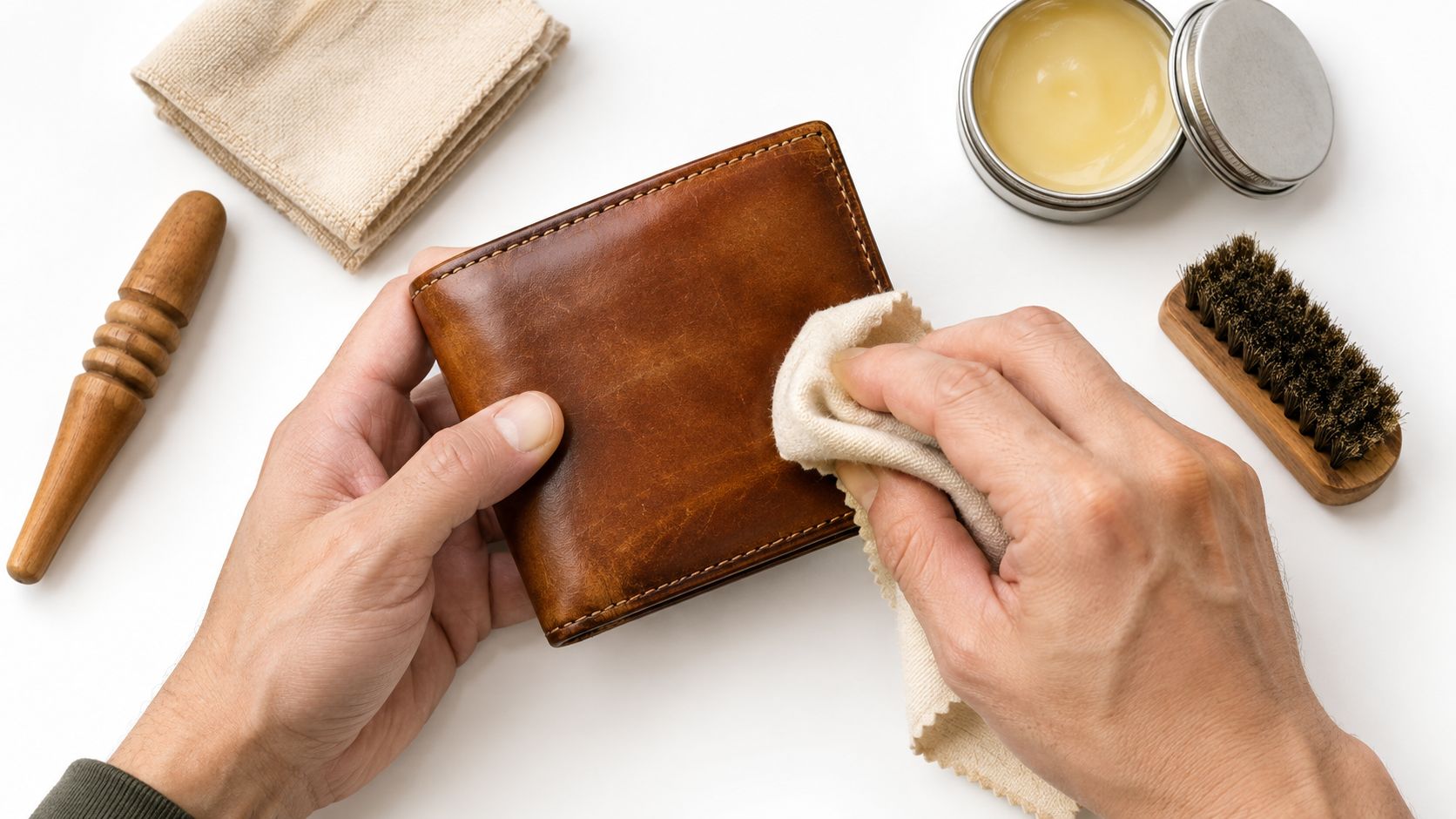
Remove the contents and wipe loose dust away with a soft, dry cloth. If the surface needs more attention, use a barely damp cloth and apply light pressure. Don't saturate the leather, and don't scrub a mark aggressively because friction can alter the finish.
Water and heat create particular problems. If the wallet becomes wet, blot it and let it dry naturally at room temperature. Direct heat can dry the leather unevenly and make the fold less flexible.
Condition sparingly
Apply a suitable leather conditioner in a small amount, testing it first on an inconspicuous area. Work it across the surface with a soft cloth, then allow it to absorb before returning the cards. The leather conditioning guide from Grainmark Leather provides a practical approach to choosing and applying conditioner.
Don't condition a wallet just because it looks dry after one busy day. Over-conditioning can leave the surface greasy and may soften areas that need to retain structure, especially around card slots.
Control the causes of wear
- Empty it regularly: Remove receipts, expired cards, and loose paper before they increase pressure at the fold.
- Avoid forced storage: Don't push extra cards into slots that already resist insertion.
- Protect the fold: Store the wallet away from standing water, intense heat, and prolonged direct sunlight.
- Let it rest: If you own another suitable wallet, rotating use can reduce repeated stress on one billfold.
Care won't turn a poorly made wallet into a durable one. It will, however, help good leather retain its shape, finish, and comfortable handling for longer.
Final Thoughts on Selecting Your Perfect Billfold
The right leather billfold wallet for men is a controlled compromise. You want enough room for the cards and cash your routine demands, but not so much space that the loaded wallet becomes a burden. You want leather that can handle repeated flexing, but you also need stitching, edges, and folds built to support that material.
Use a simple decision sequence:
- Count your actual contents. Separate daily essentials from items you carry out of habit.
- Choose the pocket first. Back-pocket and front-pocket carry impose different thickness expectations.
- Select the smallest workable layout. A bifold offers familiar access, a slim bifold limits bulk, and a trifold trades width for additional folding.
- Inspect the construction. Full-grain leather, clean stitching, finished edges, and a stable fold matter more than a crowded feature list.
- Plan for maintenance. Keep the wallet dry, remove unnecessary contents, and condition it carefully when the leather needs help.
The guide to the best leather for wallets can help you compare material choices before you decide. Your final selection should feel natural in the pocket and hand, not merely impressive in a product photograph.
A useful billfold becomes quieter with time. You stop noticing its weight, find every card without searching, and see the leather develop character from your own routine. That is the standard to apply: comfortable capacity, dependable construction, and a format you'll carry every day.
Explore Grainmark Leather for full-grain leather wallets, cardholders, and other men's daily-carry goods, including bifold formats designed around practical organization. Choose a wallet that matches your card load and pocket habits, then make it part of a carry system built for regular use.