

Overnight Travel Bag Men
At 6 a.m., a consultant climbs into a rideshare with a laptop in one hand and a battered weekender in the other. The bag refuses to zip over a blazer, the shoulder strap keeps sliding off, and the whole thing looks more suited to a gym locker than a client lobby. That small failure is usually enough to expose a larger buying mistake: choosing an overnight travel bag for men by appearance instead of by the way it must work.
A useful one-night load is compact but demanding: a laptop or tablet, charger, dress shoes, a folded shirt, toiletries, fresh underwear, and perhaps a light jacket. Men often force that kit into a hiking backpack or stretch an open tote until its seams look nervous. Neither option handles the move from airport to meeting particularly well. The right bag needs a sensible silhouette, practical capacity, durable construction, and an interior that protects the items you carry. The best leather travel bags for men should be judged by those details, not by a logo stamped on the front.
Table of Contents
- The One-Night Trip That Decides Your Next Bag
- What Counts as an Overnight Bag for Men
- Sizing and Carry-On Rules That Decide Gate Performance
- Duffle vs Weekender vs Backpack vs Tote
- How to Pack an Overnight Bag Without Overstuffing
- Leather, Lining, and Hardware Worth Paying For
- Caring for a Leather Overnight Bag on the Road
- A Simple Buying Checklist and Common Mistakes to Skip
The One-Night Trip That Decides Your Next Bag
The overnight trip is where a bag earns its place. A long holiday can justify a suitcase, and a gym visit can justify a basic duffle. One night for work sits between those uses, demanding enough room for real clothing but not enough to excuse an oversized holdall.
The load that causes trouble
Start with the items that cannot be compromised. Your laptop needs protection, your shoes need separation from clothing, and your shirt needs to arrive without deep creases. Chargers, toiletries, and underwear take little space individually, yet they create clutter when the bag has one undivided cavity.
A consultant flying to a presentation needs a bag that can sit in a rideshare trunk, slide into an overhead bin, and stand neatly beside a reception desk. A sales representative driving between cities may care more about a wide opening and a shoe compartment. The bag category stays similar, but the useful design changes with the itinerary.
Shop-floor rule: If the bag only looks good when empty, it isn't a travel bag. It's a prop.
A backpack built for hiking gives you hands-free movement, but its technical shape can look wrong with well-fitted clothing. A soft tote can look polished, but its open top offers little protection and demands disciplined packing. A refined weekender usually makes the strongest compromise, provided you check its loaded measurements and don't treat “overnight” as a guarantee of airline compliance.
The decision comes down to four questions. What shape fits your work setting? How much do you really pack? Which materials can take repeated abrasion? Can you close the bag without forcing the zipper? Answer those before comparing colors, monograms, or brand names.
What Counts as an Overnight Bag for Men
“Overnight bag” is a useful retail term, but it covers several shapes. The dictionary record places the term's first use in 1920–1925, defining it as a travel bag large enough for clothing and personal articles for a one-night trip. The broader duffel lineage reaches back to the late seventeenth century, with the name connected to Duffel, Belgium, and durable cloth used for sailors' bags before military adoption. That history explains why the category still favors rugged, soft-sided utility over delicate fashion.
Four shapes, four jobs
A duffle is the simplest form. Its long body, single main compartment, and top or U-shaped zip make it efficient for clothing, gym gear, and informal trips. It lies flat in an overhead bin, but it can slump when placed on the floor and offers limited protection for a folded shirt.
A weekender is a more considered duffle. It normally has a flat base, end handles, a removable shoulder strap, and sometimes a separate shoe compartment. It looks appropriate in a hotel lobby and handles business-leisure travel better than a cylindrical gym bag. For a practical overview of men's canvas duffle bags, pay attention to how the fabric, base, and carry system work together rather than treating canvas as a single quality category.
The carry-on backpack prioritizes movement. It keeps both hands free, provides quick laptop access, and suits trains, public transport, and long walks between terminals. Its weakness is compression. A shirt can arrive crushed unless the internal frame, packing cubes, or flat laptop sleeve give it support.
A large tote is the most casual and often the most visually approachable. It offers a wide opening and easy access, but soft sides, an open top, and a lack of shoe separation make it dependent on careful packing. It works better for a light train journey than for a presentation trip with dress shoes and electronics.
Match the bag to your behavior
- Consultant who flies and presents: Choose a structured weekender with a protected device sleeve and a quick-access pocket.
- Sales representative driving between cities: Choose a durable duffle or weekender with a wide opening and a separate shoe area.
- Founder moving through airports and dinners: Choose a polished weekender with a detachable strap and restrained hardware.
- Remote worker taking weekend trains: Choose a backpack or relaxed tote if hands-free movement matters more than formal presentation.
Ignore the label on the product page. Match the silhouette to how you board, exit, walk, and enter a room.
Sizing and Carry-On Rules That Decide Gate Performance
Airline geometry matters more than the name on the product tag. Delta and United specify a maximum carry-on size of 22 × 14 × 9 inches, including handles and wheels, and Delta also limits total linear dimensions to 45 inches, as detailed in this carry-on sizing guidance. Use that as your ceiling. It does not mean every bag sold as “carry-on” will behave well at the gate.
For a one-night trip, the right size is the one that fits your load without bulging. A separate airline carry-on guide backs up the same point: a bag can be within the rules and still fail in practice if it is packed badly or built too stiffly. One guide places 25 liters at one-night capacity, 35 to 50 liters for two nights, and 40 liters as a balanced carry-on target, according to this overnight bag sizing guide. Treat those bands as packing guidance, not a universal airline standard.
Measure the bag loaded
Leather changes the equation. A structured base, rigid end panels, thick walls, and exterior pockets eat into usable space, and they can push the loaded bag beyond its advertised footprint. A soft bag can do the same thing if you overfill it, because a wedge shape is what gets refused at the sizer, not the empty bag on a shelf.
Practical rule: Pack your real overnight kit, then measure the bag. Empty dimensions tell you little about gate performance.
Weight matters too. A heavy leather bag gives you less room, practically speaking, for a laptop, shoes, and jacket than a lighter textile bag. The bag may still meet the airline dimensions and still be a pain to lift into the overhead bin or carry through the terminal.
| Bag Type | Typical Dimensions (in) | Loaded Capacity | Gate-Bin Risk |
|---|---|---|---|
| Compact overnight | 18–20 in long, depth under 9 in | About 25 liters | Low if lightly packed |
| Mixed-travel weekender | 20–22 in long, within the airline footprint | About 25–40 liters | Moderate when leather or structured |
| Large weekender | Often beyond the practical overhead footprint | Above 40 liters | High |
| Soft duffle | Variable, often flexible when empty | Variable | Moderate to high when overfilled |
For mixed travel, choose a 20–22-inch bag only after checking the depth and loading it first. If you fly regional routes or stay in premium cabins, an 18–20-inch weekender is easier to live with. Skip any bag labeled “carry-on” until you have checked the manufacturer's full exterior dimensions, including handles and hardware.
Duffle vs Weekender vs Backpack vs Tote
The four shapes solve different travel problems. The duffle gives you space and flexibility, the weekender adds control, the backpack improves mobility, and the tote gives fast access at the expense of protection. Your itinerary should decide the winner.
| Silhouette | Access | Capacity (liters) | Structure | Best For |
|---|---|---|---|---|
| Duffle | Wide top opening | Variable | Low to moderate | Gym-to-office trips and driving |
| Weekender | Top zip with organized sections | About 25–40 | Moderate to high | Client-facing overnight travel |
| Backpack | Front and top access | Variable | Moderate | Trains, transit, and walking |
| Tote | Open top or shallow closure | Lower | Low | Light commuting and casual travel |
Choose by itinerary
For a client-facing city trip, take the weekender. Its flat bottom keeps clothing from collapsing, and a shoe compartment prevents polished footwear from sitting directly against shirts. It also looks deliberate without becoming formal luggage.
For a gym-to-office overnight, the duffle wins. It accommodates shoes, workout clothing, and a change of clothes without forcing every item into a separate narrow pocket. The trade-off is a less composed shape when the bag is partially filled.
For a train commute, use a backpack if you'll be walking or changing platforms. A shoulder bag that keeps both hands free is worth more than a decorative leather handle, but you'll need to place folded shirts above the laptop sleeve and avoid cramming the main compartment.
A tote can work for a light overnight, especially if the trip involves a short walk from car to hotel. It isn't a substitute for a structured travel bag when you carry shoes, electronics, and formal clothing together. For a compact leisure load, these cruise shore day packing tips offer a useful reminder that easy access and packability matter, though a shore-day tote has different protection needs from a business weekender.
The more walking your itinerary includes, the more valuable hands-free carry becomes. The more presentations it includes, the more valuable structure becomes.
A briefcase-versus-backpack comparison can help if your overnight bag must also function during the workday. The briefcase vs backpack guide is relevant here because the best travel solution may be a weekender paired with a separate work case, rather than forcing one bag to perform every job.
How to Pack an Overnight Bag Without Overstuffing
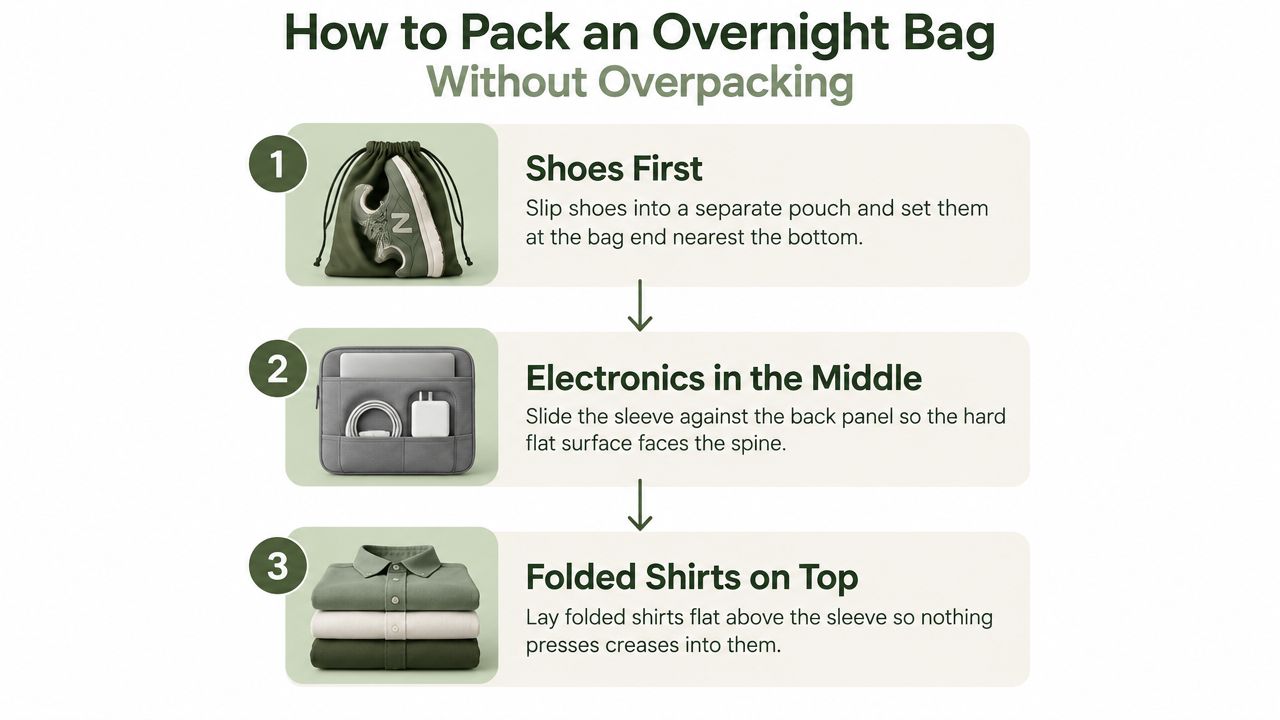
Pack by protection, not by the order in which you find things. Shoes, electronics, and folded shirts need different treatment, and placing them randomly guarantees wasted space and avoidable damage.
Build the base first
Put shoes in a separate pouch and place them at the end nearest the bottom panel, with the soles facing outward. This creates a stable base and keeps dirt away from clothing. Don't fill the shoes with bulky items, but small socks can use the empty space without distorting the footwear.
Slide the laptop or tablet into a thin protective sleeve. Set it against the bag's firmest back panel, with the flat surface facing your spine when you carry the bag. That position reduces contact with shoes and gives the device a stable plane instead of leaving it exposed in the middle of soft clothing.
Finish with clothing and small items
Roll knitwear and casual trousers to fill gaps without creating hard pressure points. Fold collared shirts flat and lay them on top of the sleeve, where nothing presses sharp creases into the collar or placket.
Use the interior pocket for chargers, cables, and keys. A compact men's toiletry bag for travel keeps liquids and grooming items together, which is more efficient than scattering them through the main compartment.
Leave visible room before closing the zip. The ideal overnight bag looks half full rather than inflated, leaving space for a folded jacket or a small purchase on the return journey. If the zipper requires two hands, the bag is already overpacked.
Leather, Lining, and Hardware Worth Paying For
Leather should be judged as a working material, not as a decorative surface. Travel bags rub against car trunks, hotel floors, seat frames, and overhead-bin interiors. Independent luggage-testing guidance identifies abrasion as a major failure point around bottom panels, corners, and shoulder-strap contact zones, with testing commonly associated with Martindale or Taber methods and standards including ASTM D4966, ISO 12947, and ASTM D3884, as explained in this bag fabric testing guide.
That makes construction more important than a glossy product description. Reinforced fabrics such as 600D polyester, 500D nylon, and higher-denier ballistic nylon are used where repeated rubbing is expected. Leather needs the same engineering discipline. A premium hide won't save a bag if its base flexes excessively or its strap attachment pulls against a weak seam.
Know the leather finish
Full-grain leather retains the natural grain and dense outer fibers of the hide. It develops visible character with use, but it still needs reinforcement at handles, corners, and attachment points. Top-grain leather has been corrected or sanded for a more uniform surface, which can look cleaner but gives you less of the original grain.
Crazy Horse leather is a wax-treated full-grain finish. It can show scuffs quickly, then develop a changing surface character as you handle and condition it. Choose it if you want a bag that can look better with travel rather than one that must remain visually perfect.
The lining deserves attention. Cotton drill or canvas generally gives a sturdy interior that suits repeated packing, while thin polyester can tear at pocket and seam intersections. Check whether the lining is neatly anchored where the bag opens, because a loose lining catches zippers and turns daily use into a repair problem.
Inspect the load-bearing parts
Look for YKK Excella or equivalent quality zippers, solid brass or stainless-steel D-rings, and handle attachments that are stitched, riveted, or otherwise reinforced. Decorative stamped alloy can look impressive on a product page but may bend or fracture under a loaded shoulder strap.
A wide, detachable shoulder strap with real padding matters more than an extra exterior pocket. The strap carries the weight during the moments when handles become awkward, particularly between a curb, a security queue, and a hotel desk.
Caring for a Leather Overnight Bag on the Road
A leather overnight bag doesn't need elaborate treatment. It needs a small routine performed consistently, especially after trips involving rain, grit, and rough luggage surfaces.
Four habits that preserve the bag
Wipe it after every trip. Use a soft, barely damp microfiber cloth to remove dust and surface residue. Let the bag air-dry naturally before storing it. This keeps grime from working into the grain and helps the handles retain a cleaner finish.
Condition it periodically. Apply a thin layer of a suitable, wax-free leather conditioner every few months. Work it into the grain with a soft cloth, allow it to settle, and buff gently. The point isn't to make the leather greasy. It's to maintain suppleness and prevent dry areas from appearing around folds and handles.
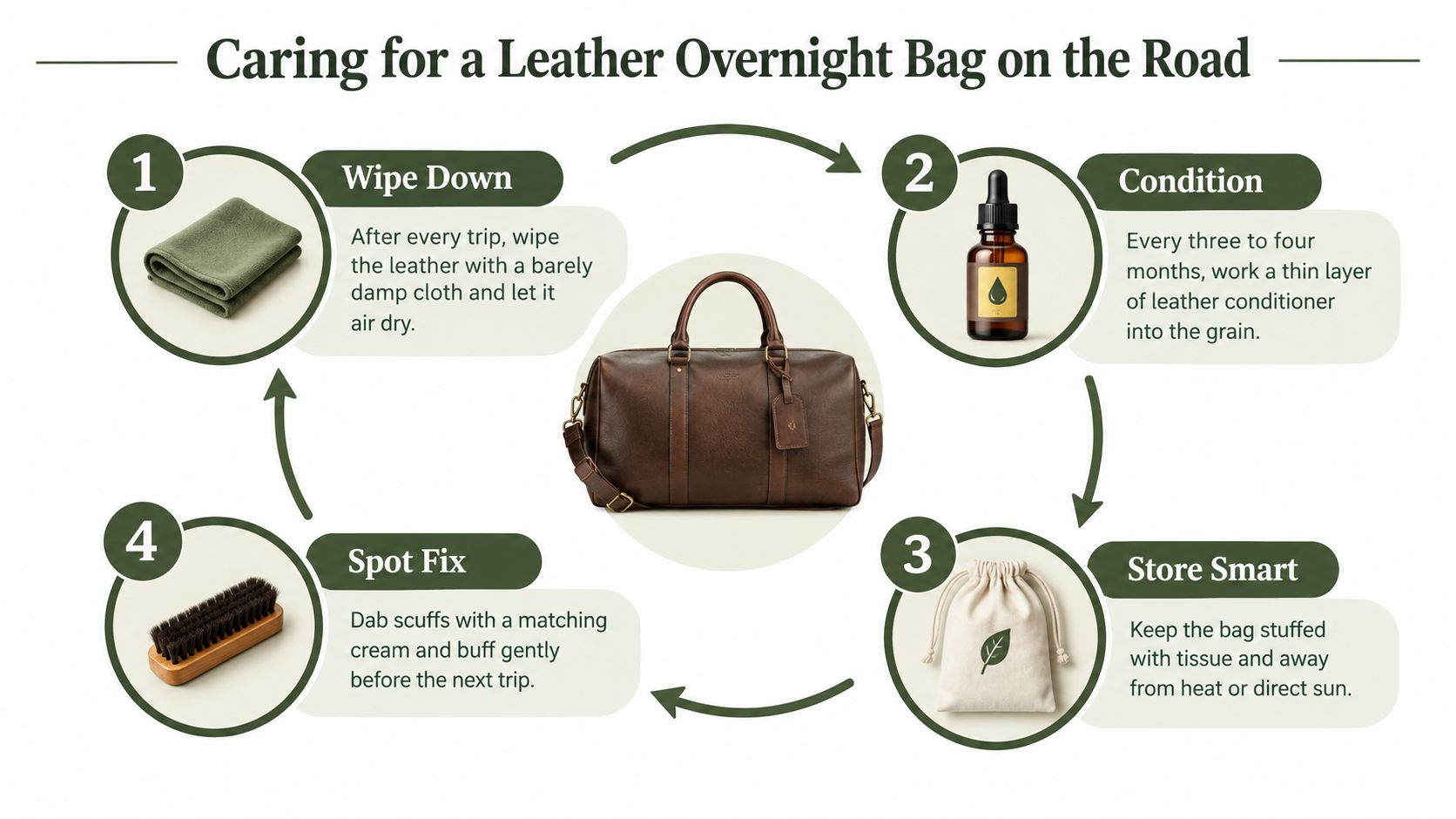
Store it with support. Use a breathable dust bag and fill the interior with clean paper or tissue so the base and handles keep their shape. Keep it away from direct heat and strong sunlight. A radiator may dry a wet bag quickly, but it can also stiffen and distort the leather.
Deal with marks immediately. Blot rain rather than rubbing it, and let moisture evaporate at room temperature. For minor scuffs, test a matching cream on a hidden area before applying a small amount to the mark. Buff lightly, and don't chase every natural variation out of a full-grain hide.
Five-minute standard: Clean the surface, check the corners, inspect the handle attachments, and put the bag away supported. That routine prevents small travel damage from becoming structural damage.
Avoid household oils, aggressive solvents, and heat-based fixes. Saddle soap can also be the wrong choice for pull-up or waxed leather because it may alter the finish and leave the surface uneven. If you're unsure which product suits the hide, follow a focused guide on how to condition leather before treating the entire bag.
A Simple Buying Checklist and Common Mistakes to Skip
Take this checklist into the shop or keep it open on the product page. A bag can look refined and still fail the job the moment you load it for a real overnight trip.
Check the bag before you buy
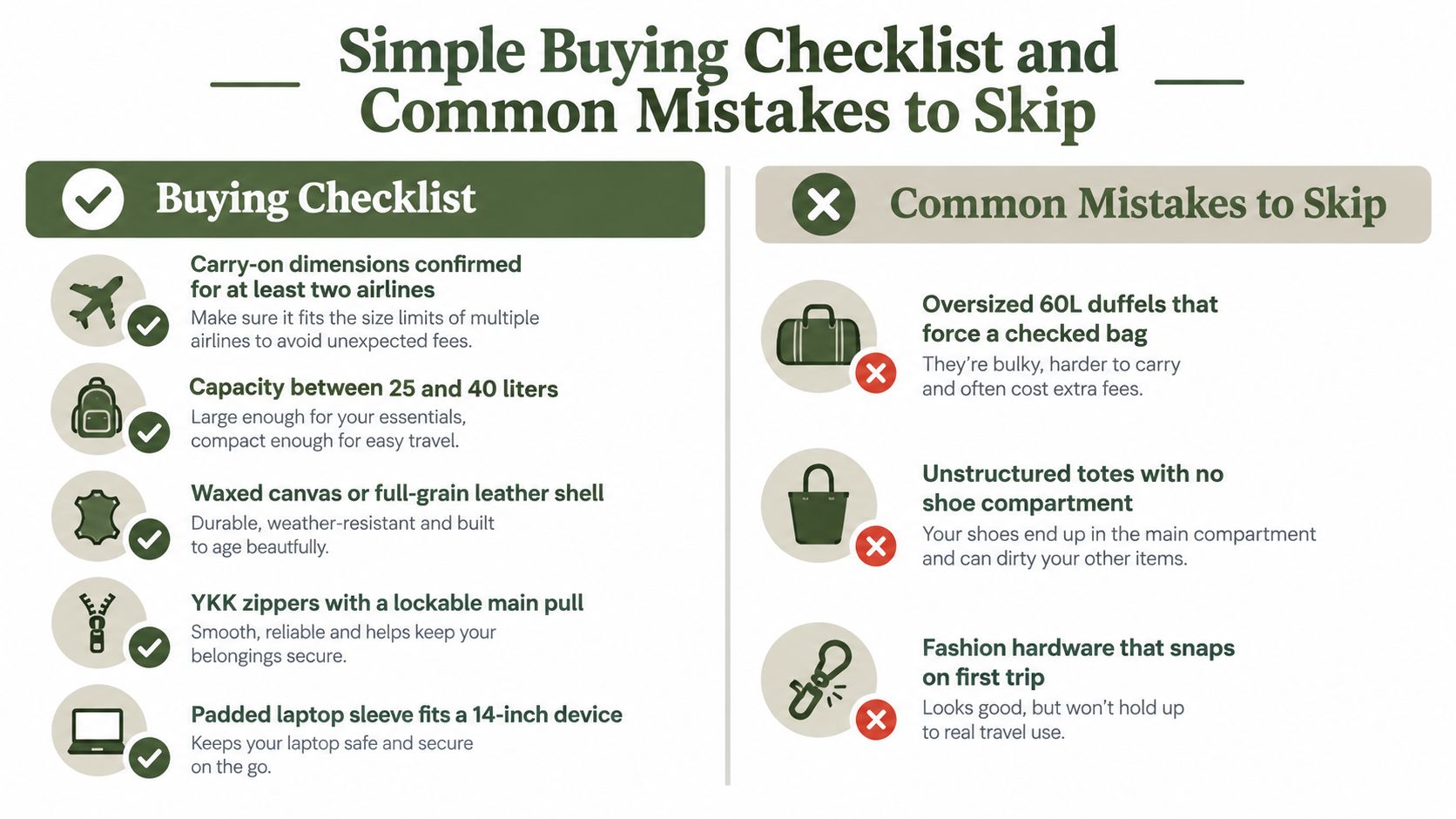
- Confirm the footprint: Compare the exterior dimensions with the carry-on rules you fly under, and include depth, handles, and hardware in that check.
- Keep capacity realistic: For a one-night load of laptop, shoes, shirt, and toiletries, anything above 40 liters is dead weight you will pay for at the gate.
- Inspect the shell: Choose full-grain leather or a durable textile with reinforcement at the base and strap points, because those are the first parts to fail.
- Test the hardware: Look for reliable zippers, solid rings, and handle attachments that do real work instead of just looking finished.
- Protect your device: The laptop sleeve should fit your own computer and sit against a firm panel, not sag into the main compartment.
- Separate the dirty items: A shoe compartment or laundry pocket beats another shallow exterior slot every time.
- Carry it loaded: The shoulder strap needs enough padding, and the handle drop should keep the bag from striking your thigh while you walk.
The infographic below pulls the main checks and the common buying mistakes into one view.
Skip these predictable mistakes
Buying an oversized duffle is the fastest way to turn an overnight trip into a checked-bag problem. More volume does nothing if the bag misses the aircraft size limits or becomes too heavy to carry comfortably.
Choosing a completely unstructured shell leaves folded clothing crushed and makes the bag look sloppy in a meeting. You want some give, but the base and back panel still need enough support for the load.
Ignoring handle drop creates a small annoyance that becomes constant. If the bag grinds against your thigh while you walk, you will grab the shoulder strap even when the handles should be the easier option.
Skipping the test-load hides the main failure points. Put in the laptop, shoes, toiletries, shirt, and charger before you decide whether the opening, pockets, and zipper layout suit you.
Treating leather as disposable wastes the material's main advantage. A full-grain bag needs basic cleaning, conditioning, and proper storage if you want it to age well instead of dry out and sag.
Grainmark Leather builds full-grain leather duffles and weekenders with the reinforced bases and padded straps this checklist calls for. Bring your actual overnight packing list to Grainmark Leather, measure the bag loaded, and pick the one that works in the airport and still looks right in the meeting room.