
Card Holder Crocodile: The Complete Ownership Guide
You're standing at a customs desk with a new crocodile card holder in your luggage, and the question isn't whether the texture looks genuine. It's whether the seller can explain what species it is, where the hide came from, how it was processed, and whether the finished item can legally cross the border. Even for a small luxury accessory, provenance, construction, and moisture management matter as much as appearance.
A well-made card holder crocodile can be exceptionally refined, compact, and durable in daily handling. It can also be a poor purchase if the leather is badly finished, the slots are over-tensioned, or the paperwork is vague. Treat the item as both a precision leather good and a regulated wildlife-trade product, and the buying decision becomes much clearer.
Table of Contents
- What Makes a Card Holder Crocodile Distinct
- Material Science and Tanning Construction
- Legal Sourcing and CITES Compliance
- Durability Myths and Moisture Sensitivity
- Practical Care Routine for Daily Use
- Choosing the Right Style and Finish
- Building an Informed Exotic Leather Collection
What Makes a Card Holder Crocodile Distinct
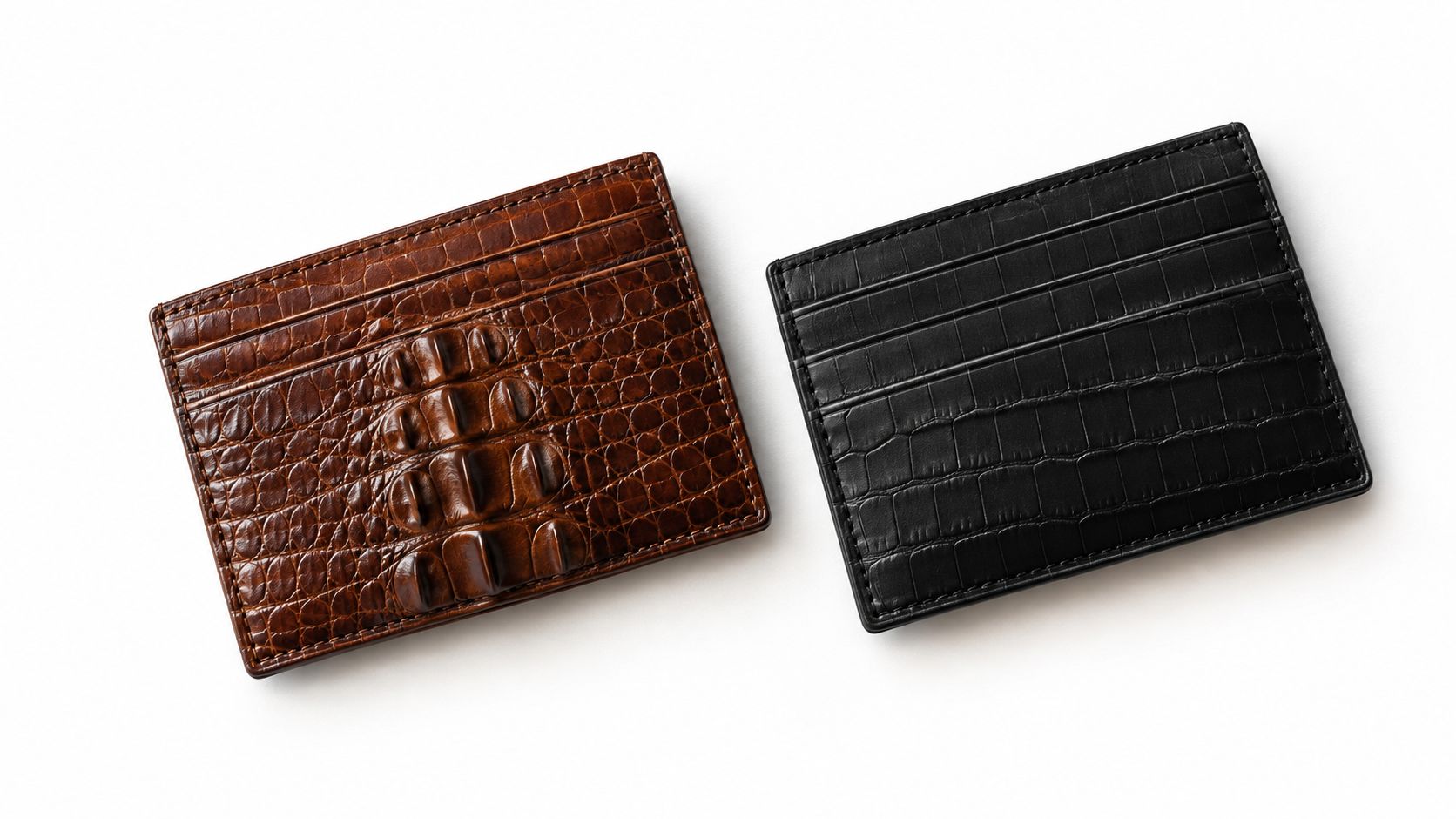
The first impression comes through the hand. Genuine crocodile has a scale pattern that varies naturally across the panel, with changes in size, spacing, and alignment that no embossed cowhide reproduces perfectly. The surface may feel firm beneath the fingers, while the fold and slot areas should still flex without sounding dry or developing sharp stress lines.
A patterned leather can imitate the visual effect at a lower cost and with more predictable uniformity. Genuine crocodile, by contrast, carries the natural structure of the hide, including the scale pattern and the underlying features that influence how a maker selects, cuts, skives, and positions each panel. A useful guide to distinguishing natural grain from imitation texture is this reference on how to spot real leather.
Small format, demanding construction
CITES classifies credit-card holders within “small crocodilian leather products,” alongside belts, handbags, key fobs, notebooks, purses, shoes, tobacco pouches, wallets, and watch straps. The classification confirms that a card holder isn't merely ordinary leather with an exotic print. It's a finished product made from a regulated wildlife material. (CITES trade report)
The compact format suits crocodile particularly well. A card holder uses relatively small panels, and a skilled maker can place attractive scale sections where they'll be seen most, rather than needing a large uninterrupted hide. That helps explain the historic connection between crocodilian leather and compact luxury articles such as wallets, handbags, and belts, as documented by the Food and Agriculture Organization.
What matters in the hand is not just whether the scales look impressive. Check whether the fold is aligned, whether the slot openings are cleanly cut, and whether the leather feels balanced rather than brittle or excessively coated. Natural pattern is a starting point, not proof of quality.
Material Science and Tanning Construction
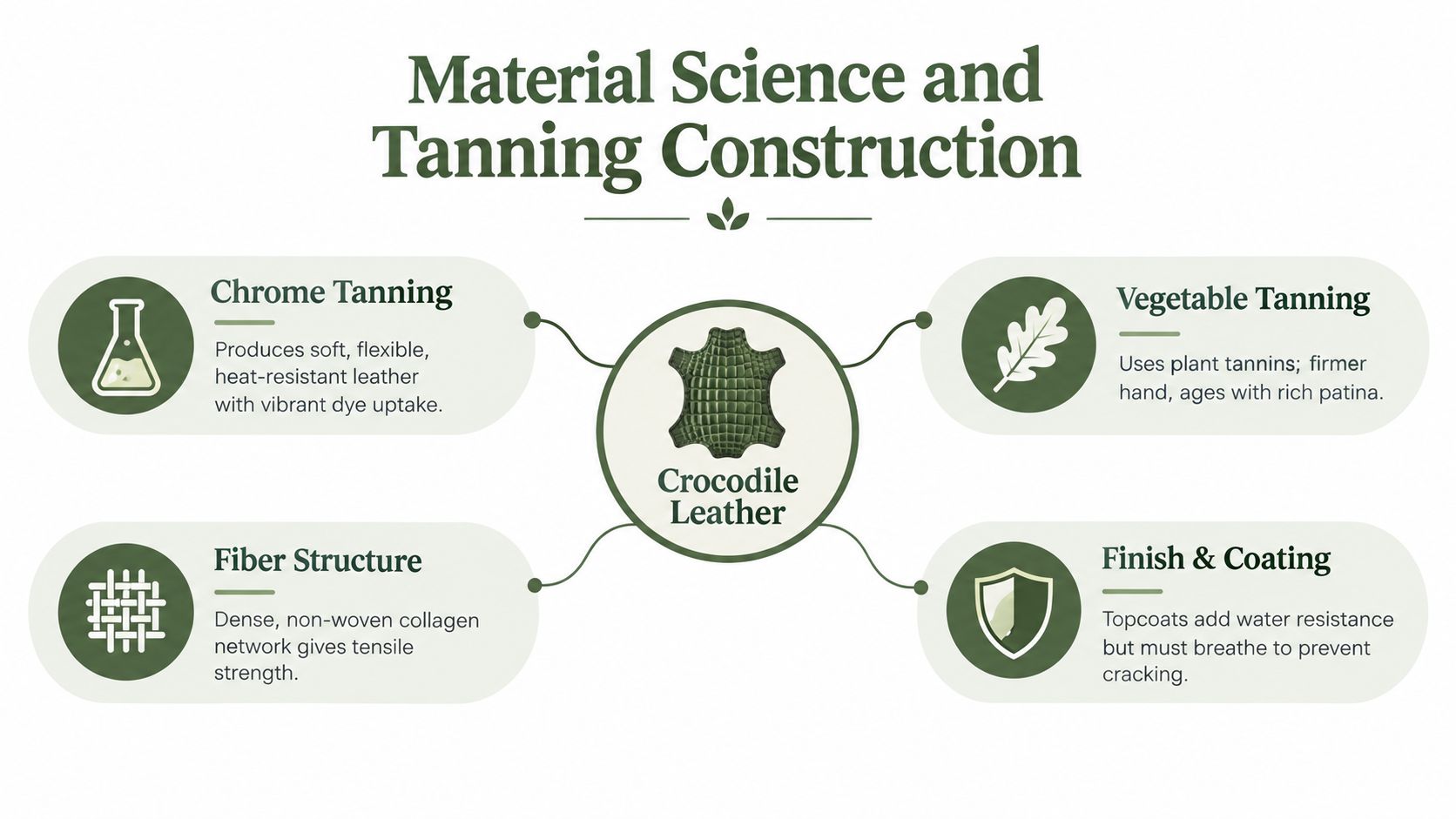
Crocodile skin doesn't arrive at the workbench ready for a card holder. Tanning and finishing determine how its collagen structure behaves after cutting, folding, dyeing, and repeated handling. The Food and Agriculture Organization's technical guidance on crocodile skins identifies chrome tanning as generally preferred because it can be controlled more consistently between batches and produces better physical properties. Vegetable tanning used alone can reduce tensile strength and make dyeing more difficult.
What the tannery changes
Retanning, dyeing, conditioning, and finishing adjust thickness, moisture content, oil content, suppleness, and surface appearance. Those variables determine whether a folded card holder feels controlled or fights its own construction. A rigid scale area paired with a poorly prepared fold can concentrate stress at the slot openings and along the spine.
Construction should support the leather's behavior. Look for:
- Consistent panel thickness: Uneven stock can create a lumpy fold and inconsistent slot tension.
- Clean skiving: Folded edges should be reduced neatly without exposing weak, ragged fibers.
- Reinforced slots: The opening should resist stretching without a heavy ridge that damages cards.
- Controlled flexibility: The fold should move smoothly, without cracking, sharp creasing, or a plastic-like stiffness.
- Stable edge finishing: Painted or burnished edges should be even and firmly bonded to the underlying layers.
A maker who specifies only “genuine crocodile” hasn't given you a technical grade. Ask whether the skin was chrome tanned or processed through another validated system, how it was retanned, and how the final moisture and finish were controlled. For a broader comparison of hide behavior in other leather products, durable tote bag materials offers useful context, although a crocodile card holder has different structural demands.
Vegetable tanning can still appeal to buyers who prefer a firmer hand and developing patina, but it shouldn't be treated as automatically superior for a thin folded exotic. The relevant question is whether the complete tanning and finishing process delivers the flexibility, strength, and surface stability the format requires. This overview of vegetable-tanned leather helps clarify why tanning choice must be matched to use rather than treated as a prestige label.
Legal Sourcing and CITES Compliance
A crocodile card holder is a regulated wildlife product, not just a small leather wallet. CITES includes card holders among small crocodilian leather products, so international transactions can require wildlife documentation even after the skin has been tanned and the item manufactured. Its trade reporting recorded 3.5% direct exports and 96.5% re-exports in 2004 for this category. (CITES trade report)
That split shows why the finished holder may pass through several jurisdictions. The seller should explain its commercial chain instead of offering only a generic assurance that the leather is “real.”
What responsible disclosure looks like
Before buying, request these details, particularly if the holder will cross a border:
- Species identification: “Crocodile” is incomplete if the seller cannot identify the species.
- Source country: The country of origin should be stated clearly.
- Production route: Farmed, ranched, or wild-harvested material should be identified.
- Tannery or manufacturer: A named processor creates a more useful traceability record than “imported leather.”
- Export documentation: The seller should explain which paperwork applies to the destination and shipping route.
- Tagging information: CITES recommends universal non-reusable tagging for crocodilian skins entering international trade, including raw, tanned, and finished skins.
These checks reflect the trade's history. The FAO describes a decline from a late-1950s peak of more than 5 million crocodile skins traded annually to later world trade of no more than 1.5 million skins per year, with Caiman crocodilus representing at least two-thirds of the cited total. It also reports that by 2025, Australia had 21 saltwater-crocodile farms holding about 130,000 crocodiles, supplying almost 60% of internationally traded saltwater crocodile skins. (FAO crocodilian leather overview)
Those figures make provenance part of the product's commercial identity, not decorative paperwork. A seller unable to identify species and origin presents a sourcing risk regardless of the holder's finish. Buyers can review a brand's stated materials information, while keeping the standards separate: CITES compliance isn't the same as independent sustainability or animal-welfare certification.
Durability Myths and Moisture Sensitivity
Crocodile leather is durable, but “indestructible” is the wrong operating assumption. Comparative testing reported genuine crocodile leather at approximately 30 MPa tensile strength, while tear performance was more than seven times higher than a synthetic laminate. The same research found that genuine crocodile had the greatest moisture sensitivity among the tested materials, with strength and stiffness changing more under humidity. (Comparative crocodile leather research)
Strength and vulnerability are different properties
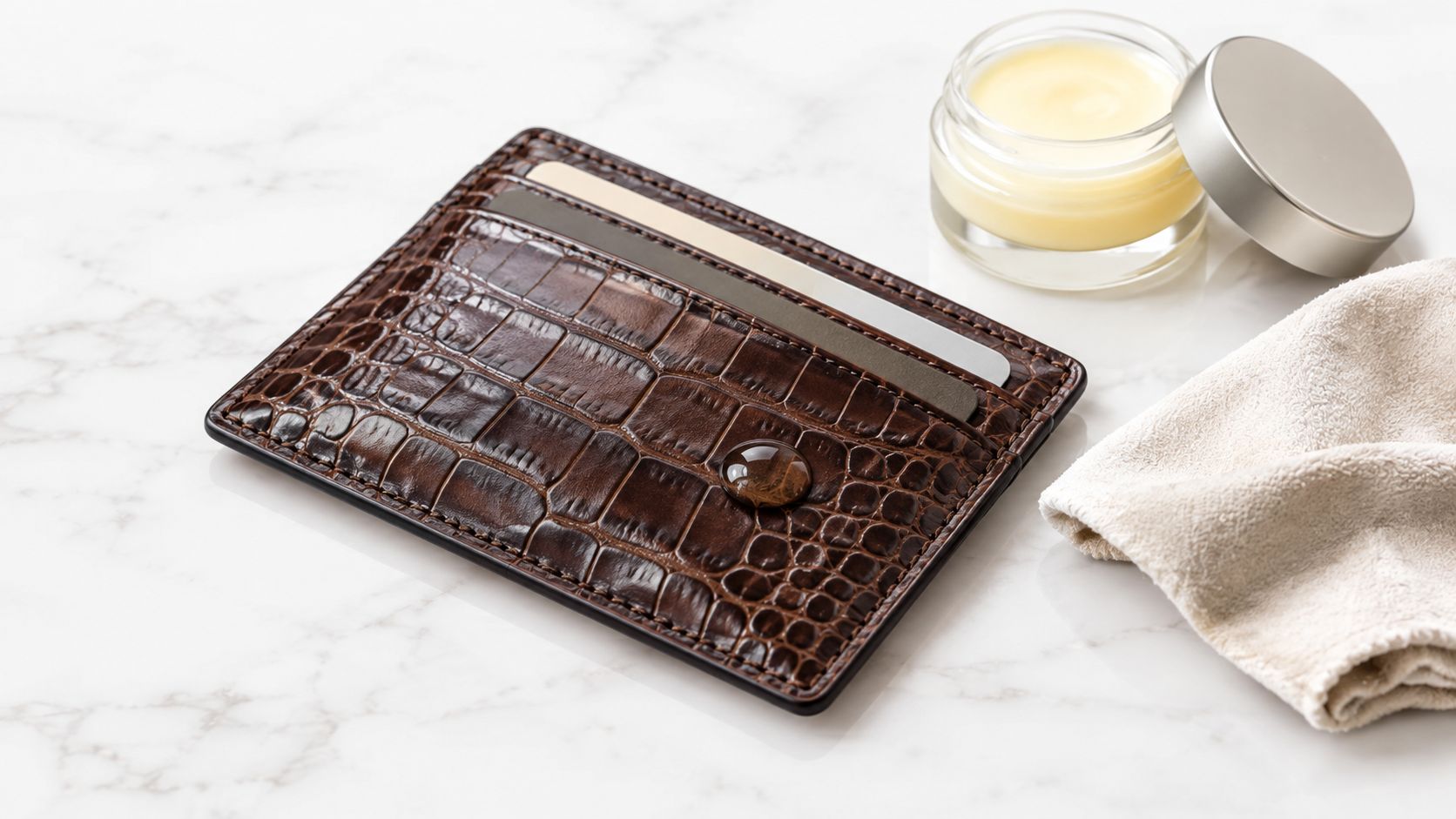
The distinction is practical. Tear resistance helps a card holder withstand abrasion, pulling, and ordinary handling when dry. Moisture sensitivity describes how water uptake changes the collagen network, which can alter stiffness, strength, and dimensional behavior. A damp pocket, humid bag, rain-soaked countertop, or repeated exposure to sweat can therefore affect performance even when the surface still looks attractive.
The scale structure also makes preparation important. Poorly conditioned leather or an overly dry finish can create concentrated stress around slot corners and fold lines. A well-designed holder uses rounded slot corners, sensible pocket tension, and edge treatment that limits moisture accumulation at exposed cuts.
Practical rule: Buy crocodile for its material character and workmanship, not because marketing promises immunity from the environment.
Embossed leather may be the better practical choice for someone who regularly carries cards in wet conditions or wants a uniform pattern that's easier to replace. Genuine crocodile offers a distinctive natural surface and strong dry tear performance, but it asks for more disciplined ownership. The dry rot prevention guide is also useful background for recognizing why storage conditions matter across leather goods, though crocodile requires particular caution around humidity and finish.
Practical Care Routine for Daily Use
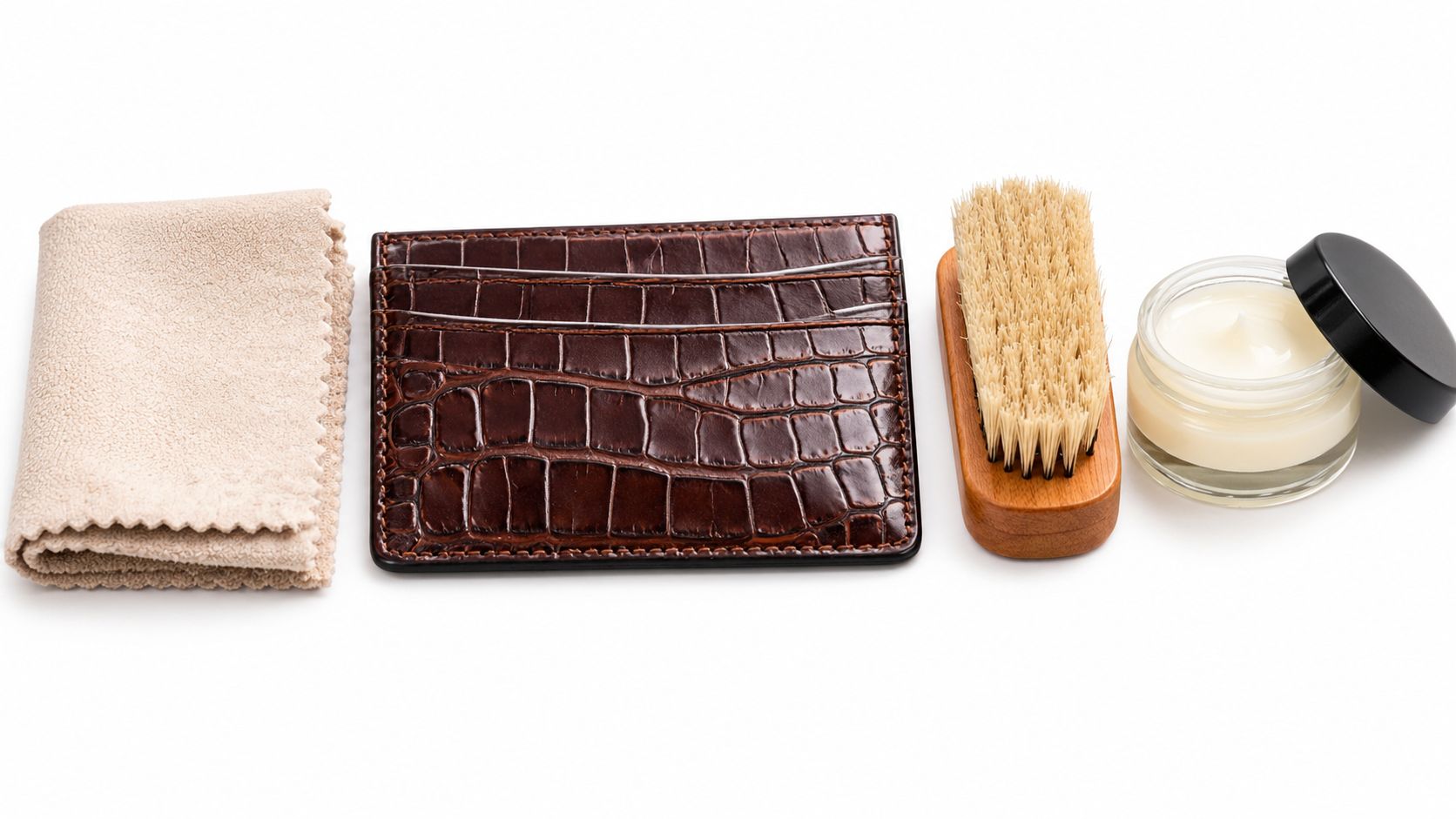
Treat a crocodile card holder as moisture-sensitive from the first day. Its care routine should protect the finish, prevent abrupt drying, and avoid forcing conditioner into a surface that may already have a sealed glaze or polish.
After rain or humidity
- Remove the cards and empty the holder. This lets air reach the interior and prevents wet cards from pressing against softened slot edges.
- Blot, don't rub. Use a clean, soft, dry cloth to lift surface moisture without dragging it across the scales.
- Air-dry gradually. Leave the holder at room temperature, away from radiators, hair dryers, windows with strong direct sun, and other heat sources. Direct heat can damage the finish, accelerate shrinkage, and make the leather brittle.
- Wait before conditioning. Don't apply cream while the leather is damp, and don't assume a heavy treatment will restore a wet finish.
- Ask a specialist first. Matte, glazed, and highly polished surfaces respond differently. A professional should approve any conditioner, particularly if the product has a lacquered or strongly reflective topcoat.
For routine cleaning, use a soft dry cloth and remove dust with light passes. Avoid soaking, household detergents, and alcohol-based cleaners. Alcohol can disturb color and finish layers, while excess liquid can migrate into folds, slot edges, and lining materials.
Storage that prevents avoidable damage
Keep the holder in a breathable environment, away from sealed damp spaces and strong heat. Don't compress it under heavy objects, and don't overfill the slots to “train” the leather. The best routine is modest: controlled use, gentle surface cleaning, gradual drying, and expert advice before applying a product. Further guidance on how to condition leather can help with general principles, but exotic finishes deserve product-specific caution.
Choosing the Right Style and Finish
The right card holder depends on how you carry it. A genuine crocodile panel rewards close inspection, while an embossed alternative offers consistent texture, easier replacement, and fewer provenance questions. Neither choice is automatically correct. The trade-off is between natural material character and regulated sourcing on one side, predictable uniformity and simpler ownership on the other.
Compare the surface before the label
A matte finish tends to show the leather's texture without a strong reflective coating, but it may reveal handling marks and moisture changes more readily. A glazed finish offers a more controlled sheen and can make colors appear deeper. A highly polished finish creates the strongest visual statement, yet surface scuffs, streaks, and inappropriate cleaning may be especially conspicuous.
The finish should match your routine:
| Use pattern | More suitable direction | What to inspect |
|---|---|---|
| Formal, occasional carry | Polished or glazed crocodile | Even sheen, no cloudy patches, clean scale transitions |
| Frequent business use | Restrained glaze or matte finish | Flexible fold, reinforced slots, stable edges |
| Humid or wet environment | Embossed alternative or conservatively finished leather | Easy-care surface, replaceability, seller guidance |
These are practical tendencies, not guarantees. A strong topcoat doesn't make the holder waterproof, and a matte surface isn't automatically more breathable or more durable.
Open and close the holder several times before buying. Cards should enter with controlled resistance, not force. Check that stitching follows the perimeter cleanly, that slot corners are rounded rather than sharply notched, and that the fold doesn't buckle. A beautiful center scale can't compensate for stretched openings or a poorly skived spine.
Also inspect the reverse and interior. Makers sometimes reserve the most attractive panel for the outside while using thin, unstable components inside. Construction symmetry, edge control, and slot geometry reveal more than a dramatic photograph.
Building an Informed Exotic Leather Collection
A crocodile card holder makes sense in a collection when it fills a real role rather than duplicating an everyday item you'll expose to unnecessary risk. Start with the use case. If you need a formal accessory for controlled environments, genuine crocodile can deliver a distinctive surface and compact luxury. If you need a rainproof, low-maintenance pocket tool, an embossed alternative may be the more rational choice.
Then separate the buying decision into four checks:
- Material: Is the surface genuine, correctly identified, and suitable for the intended fold and slot construction?
- Process: Can the seller explain tanning, retanning, finishing, and conditioning in concrete terms?
- Provenance: Are species, source country, production route, and relevant export documents available?
- Service: Can the maker advise on cleaning, repairs, finish damage, and future maintenance?
Sustainability language deserves the same scrutiny. Legal sourcing demonstrates compliance with wildlife-trade rules, but it doesn't automatically prove independent environmental performance or animal-welfare standards. Traceability is valuable because it lets a buyer understand the route from source to finished product. It shouldn't be confused with a universal ethical certificate.
A premium exotic accessory earns its place through transparent origin, precise construction, and realistic care requirements.
The best card holder crocodile is therefore not the one with the loudest gloss or the most dramatic scale pattern. It's the one whose material, construction, documentation, and intended use agree with one another. Verify before purchase, inspect the fold and slots in person where possible, and accept that moisture control is part of ownership rather than an optional refinement.
Grainmark Leather offers carefully selected leather cardholders and small goods for disciplined everyday carry, alongside specialist cases for travel, watches, pens, cigars, and eyewear. Visit Grainmark Leather to compare practical formats and choose a well-built leather accessory that matches how you actually carry your essentials.


