How to Spot Real Leather: 8 Reliable Tests
You can usually tell real leather by its grain irregularity, fibrous cut edge, warm hand, and slow water absorption. Start with non-destructive checks: inspect the grain and any exposed edge, feel the surface temperature, smell for a hide scent, and run a discreet water-drop test on an inconspicuous area. Full-grain leather, certified by suppliers who follow Leather Working Group standards, shows all four signals clearly.
Table of Contents
- What does real leather look like at a glance?
- How real leather should look, feel, and smell
- Non-destructive tests you can run at home or in a shop
- Destructive tests: what they show and why to avoid them on finished goods
- How different leather types behave under tests
- Red flags to watch for before you buy
- Why quick tests have limits: a materials-science note
- Key Takeaways
- Why being able to authenticate leather matters more than most buyers realize
- Full-grain leather goods from Grainmarkleather
- Useful sources and further reading
What does real leather look like at a glance?
Run through this checklist in 60–90 seconds before anything else. No tools required, no damage done.
- Grain: Look for irregular pores and subtle surface variation. A perfectly uniform, repeating pattern is printed, not grown.
- Cut or hidden edge: Check inside a pocket, under a flap, or along a seam allowance. Real hide shows a dense, fibrous, suede-like cross-section.
- Temperature: Press your palm flat for a few seconds. Real leather warms to your hand; plastic surfaces stay cool or feel inert.
- Smell: Lean in close. Full-grain leather carries a faint, earthy tannery scent. A sharp chemical or plastic smell points to a synthetic surface.
- Water drop: Place a single drop on an inconspicuous spot. On uncoated full-grain leather, the drop slowly absorbs and darkens the surface. On synthetic material, it beads and sits.
- Stitching and labels: Heavy, even stitching through thick material and a label that states a specific grade (full-grain, top-grain) are positive signals. A label that reads only “genuine leather” without grade detail is worth scrutinizing further.
Pro Tip: In a store, the inside pocket lining seam or the underside of a strap gives you the clearest edge view without touching the exterior. If you are considering an expensive item and cannot inspect an edge, ask for a swatch before committing.
How real leather should look, feel, and smell
Grain irregularity is the clearest visual signal. Animal hide develops pores and surface texture through biological growth, so no two square inches are identical. A printed grain on PU or PVC repeats at regular intervals, often visible to the naked eye when you scan a large surface area. Corrected and finished hides are real leather but have been sanded and embossed to hide imperfections, which gives them a more uniform look that can be mistaken for synthetic material.
Temperature and texture tell a second story. Real hide contains collagen fibers that conduct and retain heat differently from a plastic film. When you press your hand flat against full-grain leather, it warms within a few seconds and the surface gives slightly under pressure, then recovers with a soft wrinkle. Synthetics tend to feel uniform and slightly rigid, and the surface wrinkle, when it appears at all, is sharper and less organic.
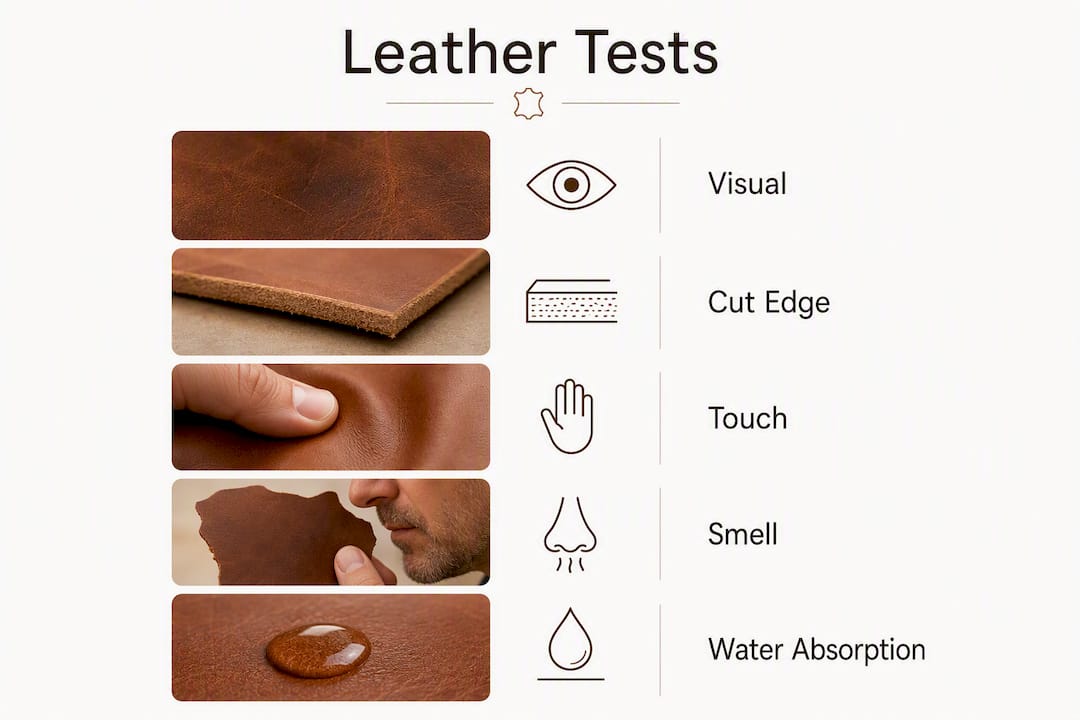
Smell is harder to fake than grain. The tannery process leaves a characteristic earthy, slightly animal scent that persists for years in well-made goods. Some sellers apply leather-scented sprays to synthetic surfaces, but the scent fades quickly and lacks depth. If the smell disappears after a few minutes of handling, treat it as a flag rather than confirmation.
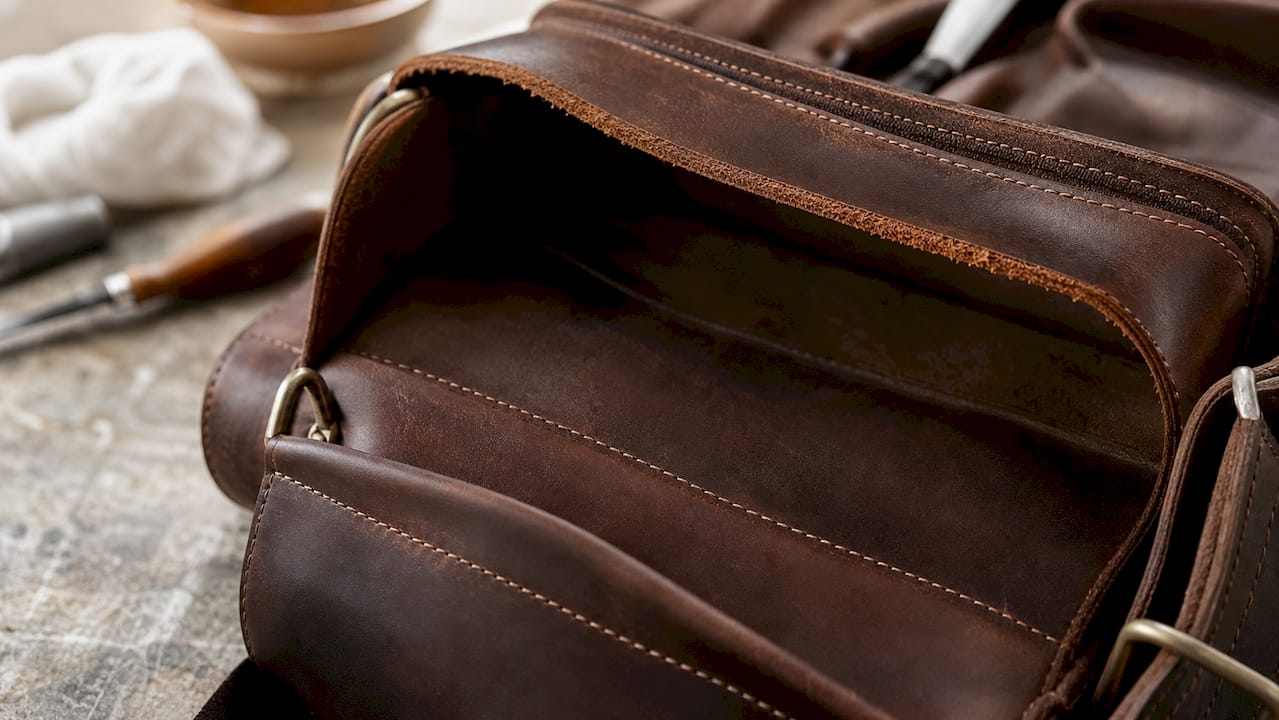
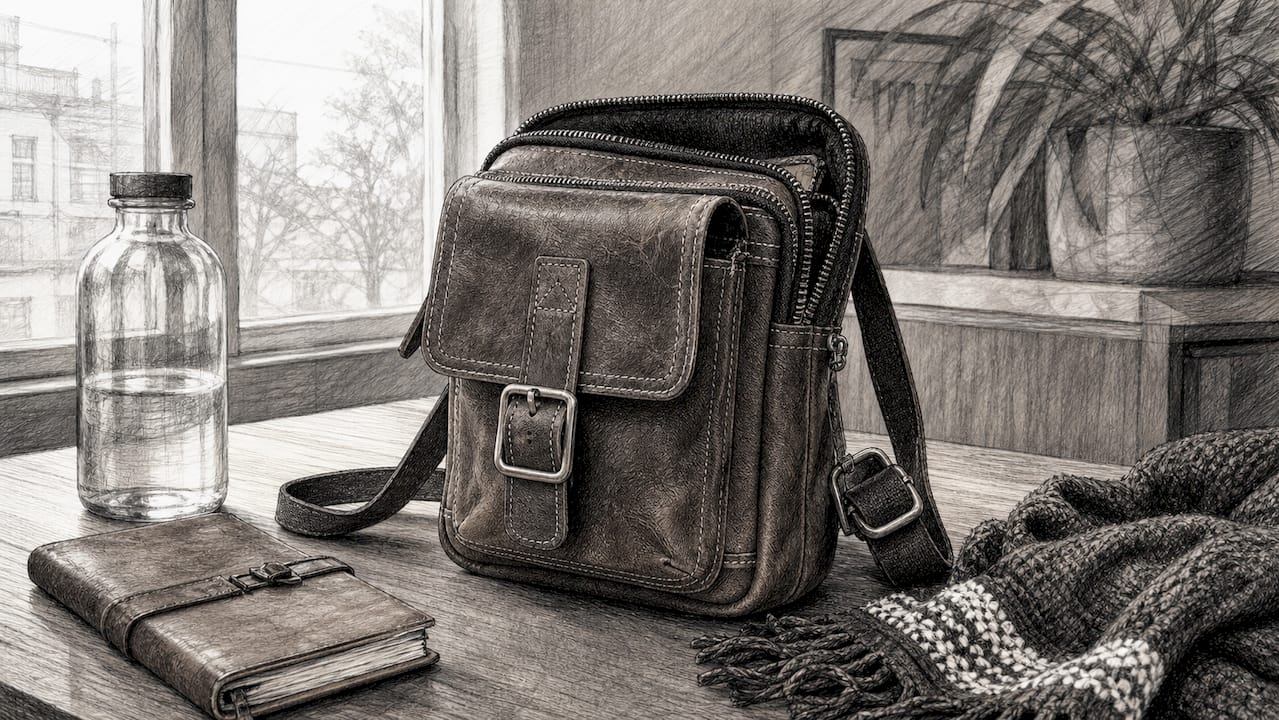
Visually, the best inspection points are seams, inside pockets, and the underside of straps, where finishing is minimal and the raw material is more exposed. On a full-grain leather crossbody bag, for example, the interior seam allowance will show fibrous hide rather than a clean fabric or plastic edge.
Non-destructive tests you can run at home or in a shop
These five procedures are repeatable, require no specialist equipment, and leave the item undamaged.
-
Edge and backing inspection. Find a hidden cut edge — inside a pocket, under a buckle, or along a strap end. Real leather shows a dense, fibrous cross-section; bonded leather shows a thin skin layer over a fabric backing; PU shows a fabric or knit backing under a plastic coating. This is the single most reliable non-destructive check available for accessories.
-
Water-drop test. Place one drop of water on an inconspicuous area. On full-grain or lightly finished top-grain leather, the drop slowly absorbs and darkens the surface within 30–60 seconds. On synthetic surfaces, the drop beads and does not absorb. Caveat: heavily finished or pigmented leathers can repel water similarly to synthetics, so a beading drop alone does not confirm fake.
-
Press, wrinkle, and flex test. Pinch a small section of the surface between two fingers and release. Real hide wrinkles softly and recovers gradually, much like skin. Synthetic surfaces either resist the pinch or spring back immediately with a sharp crease.
-
Magnifier or loupe inspection. A basic 10x loupe, available at most hardware stores, makes repeating grain patterns and laminated edges obvious within seconds. A loupe also reveals whether the surface grain is three-dimensional and random (real) or flat and repeating (printed). This is one of the fastest in-store checks available.
-
Label and stitching check. Examine the product label for a specific grade designation. Check stitching for consistent tension through thick material. Loose threads or stitching that sits on top of a thin surface layer rather than through it suggests lower-quality construction.
Pair at least two tests before drawing a conclusion. Heavily finished leathers can repel water and display uniform grain, so relying on a single test risks a false negative on real material.
Destructive tests: what they show and why to avoid them on finished goods
The burn test is definitive when applied to a sacrificial sample. Real hide chars slowly, leaves a gritty ash, and smells like burnt hair. PU and PVC melt, bead into a hard residue, and produce a sharp chemical odor. The difference is immediate and unmistakable.
Do not perform the burn test on a finished item. Even a small flame applied to the surface of a bag, wallet, or strap causes permanent damage. Reserve this test for scrap offcuts or a swatch the seller provides specifically for testing. The same applies to cutting: a cross-section view of the material is highly informative, but cutting into a finished product destroys it.
Safer alternatives that give comparable confidence:
- Request a swatch or offcut from the seller before purchasing an expensive item.
- Ask for a material specification sheet or a supplier certificate (Leather Working Group certification is one recognized standard).
- Use a loupe to inspect the edge and grain without any cutting.
If a seller declines to provide a swatch or specification for a high-value item, that refusal is itself a signal worth noting.
How different leather types behave under tests
Understanding what each material category looks like under testing reduces false positives, particularly when finishes are involved.
| Material | Grain appearance | Cut edge | Water response | Aging behavior |
|---|---|---|---|---|
| Full-grain | Irregular, natural pores | Dense, fibrous | Slow absorption | Develops patina |
| Top-grain | Lightly sanded, more uniform | Fibrous, slightly cleaner | Moderate absorption | Some patina, less than full-grain |
| Corrected/finished | Embossed, very uniform | Fibrous beneath coating | May repel (heavy finish) | Minimal patina |
| Bonded | Uniform, often shiny | Thin skin over fabric backing | Beads or repels | Peels and flakes |
| PU/faux | Repeating printed grain | Fabric or knit backing under plastic | Beads, no absorption | Surface cracks and peels |
The table shows why corrected leather can confuse a quick test. It is real hide, but sanding and embossing produce a surface that looks and behaves more like a synthetic at first glance. The cut edge remains the deciding factor: fibrous hide underneath a coating is still hide.
Pro Tip: Top-grain leather often carries a thin, microporous protective finish that maintains breathability. This differs from PU, where the plastic layer is the structural surface. If the edge shows fibrous hide and the surface breathes slightly under your palm, you are looking at real material regardless of how uniform the grain appears.
For a detailed breakdown of grade terminology, the grades of leather guide covers full-grain through bonded with practical buying notes.
Red flags to watch for before you buy
These signals, taken together, warrant pausing a purchase and asking more questions.
- Perfectly uniform grain across the entire surface with no variation in pore size or depth.
- Sealed, smooth edges with no visible fibrous material, particularly on straps and gussets.
- Price well below market rate for the claimed grade. A full-grain leather duffel bag priced at a fraction of comparable items is unlikely to be full-grain. Price alone is not proof, but combined with other signals it helps assess plausibility.
- Labels that read only “genuine leather” without specifying a grade. “Genuine” is a grade designation, typically applied to corrected or lower-finished hides, not a quality claim.
- Mismatched backing: a premium exterior with a thin fabric or plastic backing visible at any edge.
- PU aging signs on older items: surface cracking and peeling rather than a deepening patina.
Three things to confirm before completing a purchase:
- Inspect at least one inside edge or seam allowance for fibrous hide.
- Ask for a material specification or swatch if the item is high-value.
- Confirm the return policy and whether the seller offers a warranty. A one-year warranty on construction and materials, as Grainmarkleather provides, is a concrete signal of confidence in the product.
Why quick tests have limits: a materials-science note
Household tests are useful but not infallible. Two categories of material can defeat them.
The first is heavily finished real leather. High-pigment or lacquer coatings on corrected hides create a surface that repels water, shows uniform grain, and feels slightly plastic. The hide underneath is genuine, but the finish masks every sensory signal a quick test relies on. In these cases, the cut edge remains the only reliable household check.
The second is novel bio-fabricated or plant-based materials. These are increasingly present in the market and do not behave like conventional PU or like animal hide. Standard tests may produce inconclusive results, and provenance documentation or lab analysis may be the only reliable verification.
Materials scientist Theanne Schiros notes that many products labeled “vegan leather” are still largely plastic-based, and that assessing sustainability requires examining the percentage of plant-based content and the polymer used, not just the product label.
The “vegan = sustainable” assumption does not hold across all products. Many plant-based leather alternatives rely on petroleum polymers for structural integrity, and the environmental footprint depends on the specific material mix and processing method. Checking material specifications rather than relying on marketing labels gives a more accurate picture.
For purchases where provenance matters, Leather Working Group certification at the tannery level is one of the more reliable third-party standards available.
Key Takeaways
The most reliable way to identify real leather is to combine the cut-edge inspection with at least one sensory test, then verify grade language on the label before buying.
| Point | Details |
|---|---|
| Start with the cut edge | A fibrous, suede-like cross-section is the single most reliable non-destructive tell. |
| Pair smell and water tests | Neither test alone is conclusive; used together they significantly narrow the range of possibilities. |
| Avoid destructive tests on finished goods | The burn test is definitive but damages the item; request a swatch instead. |
| Read grade labels carefully | “Genuine leather” is a grade, not a quality claim; look for “full-grain” or “top-grain” specifically. |
| Grainmarkleather for verified full-grain | Grainmarkleather’s bags and accessories are made from full-grain leather and carry a one-year warranty. |
Why being able to authenticate leather matters more than most buyers realize
The ability to identify real leather is not just useful at the point of purchase. It shapes every decision that follows: how you condition the item, whether a repair is worth the cost, and what the piece will be worth in five years. A full-grain bag that develops patina is a different object at year ten than it was when new. A PU bag is not.
There is also a practical care dimension. Real leather responds to conditioning in ways that synthetics do not. Knowing what you own determines whether periodic conditioning with a product like leather balm makes sense, or whether you are applying it to a plastic surface that cannot absorb it. For readers who want to go deeper on care, the guide on removing stains from leather covers maintenance without damaging the surface or patina.
The tests in this guide are not complicated. Most take under two minutes. The return on that two minutes, for a bag or wallet you plan to carry for years, is considerable.
Full-grain leather goods from Grainmarkleather
Grainmarkleather makes full-grain leather bags, wallets, and accessories with heavy-duty stitching and a one-year warranty on every item. Material specifications are listed on each product page, and the construction is visible at the edges and seams.
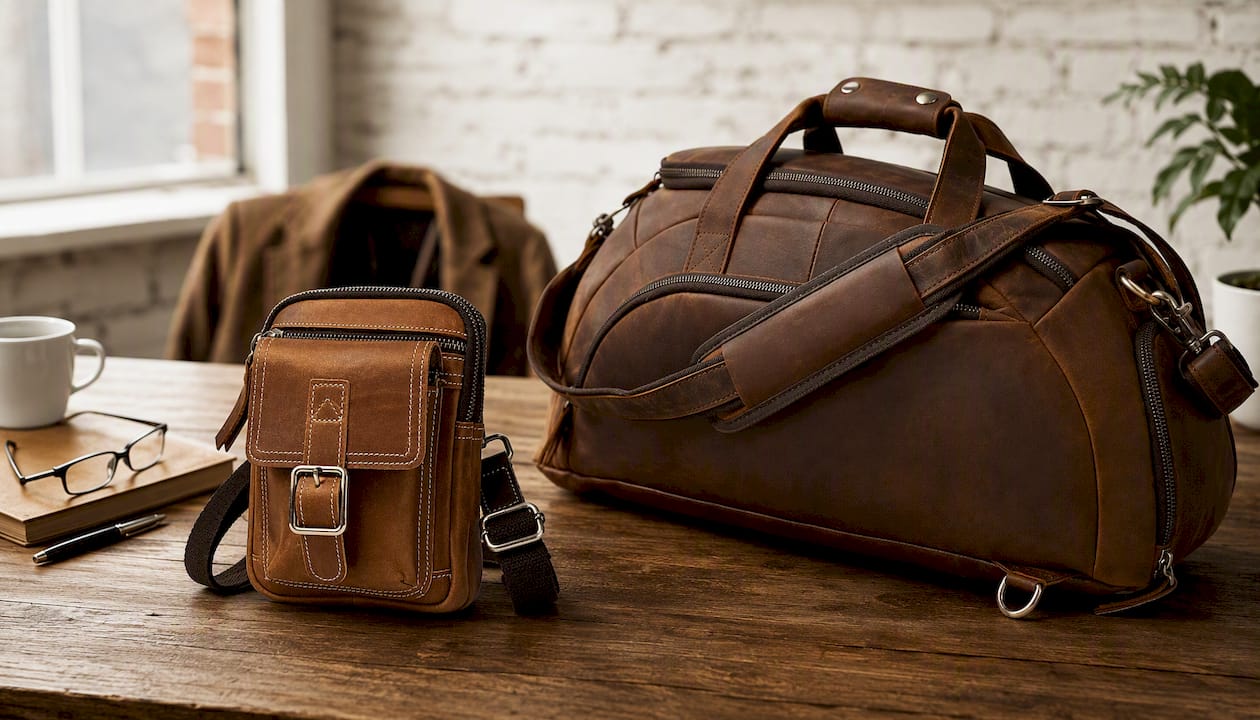
The full-grain leather crossbody bag and the full-grain duffel and backpack are two items where the edge inspection described in this guide is straightforward to perform. Grainmarkleather also offers leather embossing for customization, with the base material remaining full-grain throughout. Browse the full leather bags collection or contact the team to request material details before ordering.
Useful sources and further reading
- Leather Working Group — tannery-level environmental and traceability certification standard
- What Is Vegan Leather Made Of? — Wirecutter/NYT — materials-science overview of plant-based and synthetic alternatives
- Real Leather or Fake? How to Distinguish — Tannins.org — practical identification reference
- PU Leather vs Real Leather — IsItLeather — detailed comparison of aging and structural behavior
- Grades of Leather Explained — Grainmarkleather — full-grain through bonded, with buying notes
- What Is PU Leather and Why Does It Matter — Grainmarkleather — focused explainer on synthetic leather behavior and limitations