

Watch Box for Large Watches: How to Get the Right Fit
The new box looks right on your dresser, but your diver sits proud of its cushion. The lid closes only when you press it, and the crown leaves an impression in the lining. Keep testing that fit and you could end up with a returned box and a scratched caseback.
A watch box for large watches needs more than an oversized label. You need usable compartment measurements, a cushion that suits the closed bracelet, and enough room to remove the watch without brushing its neighbours. An expensive finish won't compensate for the wrong internal geometry.
Table of Contents
- Measure the Whole Watch Before You Shop
- Minimum Compartment Sizes for Large Watches
- Cushions, Pillows and Compartment Depth
- Materials and Shock Protection That Matter
- Travel Box or Display Box for Large Watches
- Pick Your Box From Your Measurements
Measure the Whole Watch Before You Shop
The full envelope is the space your watch occupies, including its controls, lugs, crystal and closed strap or bracelet. Case diameter is only part of that envelope.
Large is also relative. As Deployant's discussion of large watches explains, the IWC Portugieser Reference 325 measured about 41.5 mm when introduced in 1939, when many contemporary men's watches were closer to 32 mm. A size label tells you how someone classifies a watch, not whether a particular cushion and compartment will accommodate it.
Take measurements without marking the watch
Use a digital caliper set to millimetres, a soft measuring tape and a clean, flat work surface. Start with the watch dial-up on a lint-free cloth, and use protected caliper jaws without squeezing the case. Lift and support the watch when measuring thickness so the jaws don't drag across the crystal or caseback.
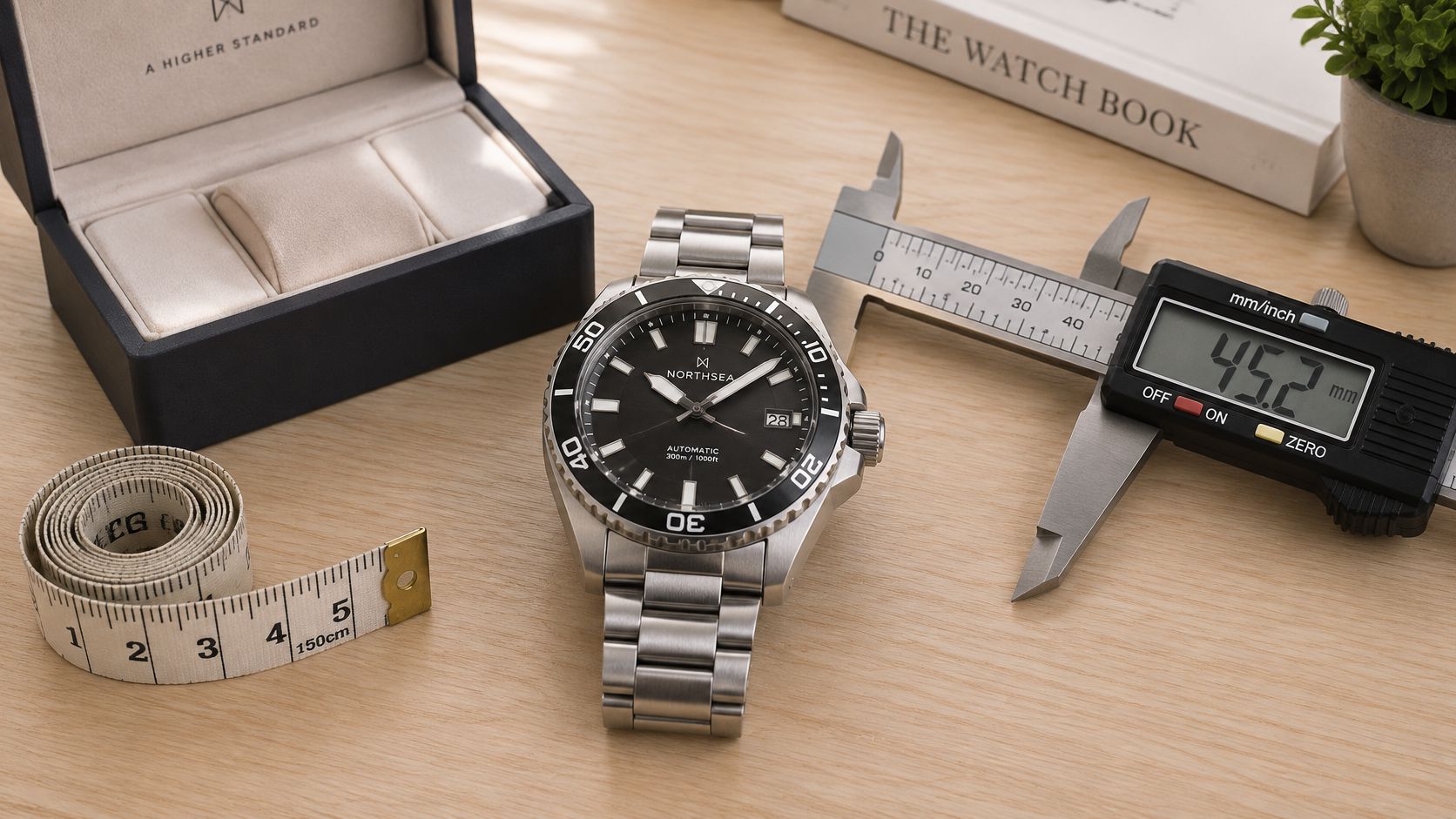
- Measure case diameter. Measure across the case, excluding the crown and pushers. Keep this baseline separate from the full width so you can interpret product descriptions correctly.
- Record lug-to-lug length. Measure from the outer tip of a lug to the opposite lug's outer tip. Include projecting end links separately if they extend beyond the lugs without articulating downward.
- Measure total thickness. Take the distance from the caseback to the highest point of the crystal or bezel, whichever stands taller. Dial height isn't relevant to lid clearance.
- Find the full width. Measure across the complete watch, including crown guards, crown and pushers. Don't assume controls project equally on both sides.
- Check the closed bracelet or strap. Record its inside circumference with a soft tape, then measure clasp bulk. A bracelet laid open tells you little about the cushion it needs.
- Compare like with like. Match the complete width, length and seated height to the compartment's usable dimensions. External box measurements include the shell, lining and dividers.
- Allow free space. Reject an exact dimensional match. The watch needs clearance for loading, cushion compression and ordinary movement, not just enough space to be pushed inside.
Independent watch-sizing guidance from Lug & Leather emphasises lug-to-lug length as a useful fit predictor. In storage, that measurement helps expose a problem diameter alone can conceal: a compact-looking case with long lugs that reach the compartment walls.
Measure the storage position too
Keep both bare-watch measurements and measurements taken with the watch seated on its intended cushion. A thick clasp underneath can raise the case, while a rigid bracelet can hold it at an angle. The box must accommodate the assembled shape, not merely the case laid flat.
Use this guide to watch case size to distinguish the dimensions sellers commonly quote. If a listing gives only the box's outside dimensions, ask for the internal slot width, usable length, cushion circumference and clearance beneath the closed lid.
Pass rule: Every part of the seated watch must fit with free space around it, and the lid must close without touching the crystal, crown or pushers.
Minimum Compartment Sizes for Large Watches
A broad pilot watch can fit inside a box marketed for oversized watches and still sit badly: the latch closes, but the watch leans and its crown meets the lid. The cause may be a compartment that narrows near the top or a cushion that raises the case. Fit depends on the usable internal shape around the whole watch, not the box label or its widest opening.
Older storage proportions may not suit contemporary cases. aBlogtoWatch's explanation of large watch sizes describes typical men's watches of about 37–39 mm in the 1990s and gives the 2002 IWC Big Pilot's dimensions as approximately 46.2 mm wide and 15.8 mm thick. That width-and-thickness combination shows why a slot that looks generous from above can still lack room for the seated watch.
Fit Conditions by Watch Type
There is no universal minimum compartment size for each watch category. Use these fit conditions to assess the actual watch and the compartment's narrowest usable points. The category is a starting point, not a dimensional specification.
| Watch type | Case diameter | Total thickness | Compartment fit condition |
|---|---|---|---|
| Classic dress watch | Measure the case, including any unusual shoulders separately | Include a domed crystal and projecting caseback | Fit the seated watch with unobstructed space above it |
| Mid-size sports watch | Measure across the case and its controls | Include bezel and crystal | Allow for the closed clasp beneath the cushion |
| Large sports watch | Check full width against the slot | Measure the tallest point | Clear the watch without compressing the pillow |
| Large pilot watch | Include crown projection as well as case width | Measure crystal to caseback | Accommodate the seated case and its natural tilt |
| Chronograph with pushers | Include the complete pusher envelope | Measure crystal to caseback | Keep the lid clear of crystal and controls |
| Wide-bezel diver | Measure the widest bezel or case edge | Include raised bezel and crystal | Leave space above the highest surface |
| Smartwatch | Start with the manufacturer's dimensions, then include projecting controls | Include the sensor housing underneath | Check the assembled watch with its strap closed |
Worked example: For the 46.2 mm by 15.8 mm Big Pilot, those figures describe the case's width and thickness, not the required slot size. The compartment must also accommodate its crown, the watch's seated position and any tilt, while leaving space above the crystal. Measure the usable opening at the narrowest point and check the full assembly in the box.
What Changes the Fit
Pushers need clearance where they sit, not just at the compartment floor. A divider that curves inward may leave room below the watch while pressing against controls higher up. A rigid bracelet can also project outward at its first links before turning down, so the slot must fit its shape without forcing it inward. A domed crystal needs room beneath the lid, including where lining or trim hangs lower.
Different types of watch cases occupy a slot differently. A rectangular case may use corners that a round case leaves empty, while a broad crown or projecting controls can make the usable width smaller than the opening suggests.
Check the narrowest usable part of the compartment, not its widest opening.
Cushions, Pillows and Compartment Depth
The cushion is the seat belt of the box. It should restrain the watch without strangling the bracelet, pressing a control or forcing the strap into an unnatural curve. A stiff pillow isn't automatically secure, and a soft pillow isn't automatically gentle.
Choose the cushion system around the watch's weight, bracelet shape and storage position. Treat diameter-based compatibility claims as a starting point, not a substitute for trying the closed bracelet around the pillow.
Cushion types and where each fits
| Cushion type | Best for | Clearance behaviour | Main trade-off |
|---|---|---|---|
| Fixed foam pillow | A dedicated watch whose closed bracelet matches the pillow | Keeps a repeatable position but offers little adjustment | An unsuitable profile can push against the crown or raise the case |
| Removable pillow | A mixed collection with different straps and case depths | Can be exchanged for a lower-profile support | Can shift during transport if it doesn't seat securely |
| Curved cushion | Round cases that need support beneath their edges | Can hold lugs away from compartment walls | A pronounced curve suits fewer case shapes |
| Adjustable strap cradle | Rigid bracelets and deployant clasps | Supports the closed assembly without forcing a tight bend | Adds complexity and can consume usable slot width |
| Divider or stacked tray | Several watches stored in the same box | Separates neighbouring cases | Dividers reduce width; stacked trays also restrict height |
Removing a pillow creates space, but it also removes restraint. Don't solve a depth problem by leaving a heavy watch loose on the compartment floor. Substitute a suitable low-profile support or choose a deeper box.
A fixed pillow works well when a dedicated watch sits naturally on it and stays level. A removable system makes more sense when you regularly switch between leather straps, substantial bracelets and deployant clasps.
Test support before closing the lid
Fasten the watch around the cushion using the same strap setting you wear. The fastening should close with gentle cushion compression, without levering the clasp shut or making the links stand away from their natural curve.
Check orientation carefully. With the crown facing a side wall, the cushion must resist rolling; with the watch turned so the crown faces upward, the crown becomes another high point to clear. Neither position should use the crown as a support.
A flat pillow can also hold a watch closer to the lid than expected. Look across the compartment from the side while lowering the lid slowly, stopping before any contact. Never use the latch to pull the lid past resistance.
- Check the clasp underneath. It should rest without digging through the padding toward the caseback.
- Inspect the lugs. They should remain clear of dividers when you gently tilt the open box over a padded surface.
- Try normal removal. You should be able to lift the cushion without dragging the case against a wall.
- Inspect after testing. Fresh pressure marks near controls indicate a contact point worth investigating.
For mechanical collections, the same fit considerations apply when choosing a watch case for automatic watches. Storage should support the complete watch, not clamp the movement's housing between a pillow and a lid.
Materials and Shock Protection That Matter
The shell and lining matter as much as the compartment layout. A roomy box with a flexible body can deform in luggage, while a rigid box with poor restraint can let the watch strike its own interior.
Judge each component by the risk it controls. Leather is an exterior material, not proof of crush resistance, and plush upholstery isn't evidence that the structure underneath can absorb a knock.
Separate structural protection from surface protection
A rigid wood body or well-constructed leather-over-board shell helps resist external pressure. Check the lid, corners and hinge area rather than judging rigidity from the base alone. A lock secures the closure; it doesn't strengthen a weak lid.
The lining serves a different purpose. Resilient padding can soften contact, while a clean, smooth surface reduces abrasion during loading and removal. Compare suede lining and fabric by their construction and upkeep as well as their feel, since either can hold grit if neglected.
Individual compartments prevent metal-to-metal contact, but dividers must remain stable when the box moves. A loose insert that folds aside under a heavy bracelet offers little separation. Cushion retention matters just as much as cushion softness.
Soft lining protects the finish only when the watch stays where you put it.
Treat magnetic hardware as a separate question
Citizen's mechanical-watch maintenance guidance warns about strong shocks and advises keeping mechanical watches at least 5 cm from objects that generate magnetic fields, since magnetism can continue affecting accuracy after exposure ends. A storage box therefore needs sensible hardware as well as padding.
A concealed magnetic clasp isn't automatically harmless because it looks small. Ask whether the maker has assessed the field at the watch's resting position, including the nearest compartment. Without that information, a mechanical latch or zip avoids an unnecessary uncertainty.
Don't assume a watch's magnetic-resistance claim covers every closure, orientation and exposure condition. Follow the watch manufacturer's guidance rather than treating resistance as permission to store it against a magnet.
Use this buying checklist:
- Rigid shell. The lid and walls should resist ordinary handling pressure without bowing toward the watch.
- Resilient lining. Padding should recover after compression, with no exposed staples, sharp seams or gritty surfaces.
- Stable individual slots. Dividers and cushions should remain seated when the empty box is moved.
- Appropriate closure. Prefer non-magnetic hardware unless the maker can substantiate safe separation for magnetic components.
For travel, inspect the closure while the box is loaded. A lid that stays shut when empty may behave differently when an overfilled cushion presses against it.
Travel Box or Display Box for Large Watches
A travel box prioritises impact and abrasion protection inside a bag. A display box prioritises access, visibility and an orderly place to return each watch. Neither format automatically provides the other's strengths.
Start with how you'll use it, not how many watches appear in the product photograph. A large home chest can be awkward to pack, while a compact travel case can be tedious to open every morning.
Travel box vs display box for large watches
| Factor | Travel box | Display box |
|---|---|---|
| Closure | Secure zip or latch; a rigid lid is useful against external pressure | Solid or glazed lid for storage, or open top for immediate access |
| Slots | Compact layouts with restrained cushions | Broader layouts that can prioritise spacing and visibility |
| Protection priority | Impact, abrasion and accidental opening in a bag | Dust exclusion, organised access and separation at home |
| Footprint | Must fit your luggage without being squeezed | Can occupy a dedicated shelf, drawer or cabinet |
| Large-watch fit check | Confirm restraint and closed-lid clearance in the packed position | Confirm access and separation with neighbouring slots occupied |
A soft roll can accommodate a watch by flexing around it. That doesn't mean the same watch will fit a rigid leather box, where the shell fixes the available shape. Conversely, flexibility that makes a roll easy to load may provide little resistance when another object presses against it.
For a heavy pilot watch, I would favour a compact rigid travel box if the luggage is likely to be crowded. A roll is useful when its structure keeps watches separated and the straps can curve naturally. Don't fold an integrated bracelet sharply just to make the roll close.
Make daily access part of the decision
Glass lids exclude dust when properly closed, but they don't block direct sunlight. Open trays offer immediate access without dust protection. Both belong somewhere shaded and unlikely to be knocked during ordinary household use.
A display layout also needs finger space. Load neighbouring compartments before deciding whether the arrangement works, then remove the central watch without lifting the others. A nominally full box isn't useful if every change of watch requires rearranging the collection.
This guide to a watch travel case for men can help narrow the portable format. A practical split is a dedicated rigid case for the watch you take away most often, with a display box or fitted drawer for the collection that stays home.
Pick Your Box From Your Measurements
A premium box won't protect a watch kept in a poor location. Padding doesn't regulate temperature, and a leather exterior doesn't make a sunny windowsill suitable for storage.
Seiko's mechanical-watch guidance warns that temperatures below 5°C or above 35°C can affect mechanical watches and also cautions against magnetic exposure. Choose a stable indoor location rather than expecting the container to compensate for heat, cold or nearby electronics.
The windowsill below is a placement to avoid, not a model for displaying the collection.
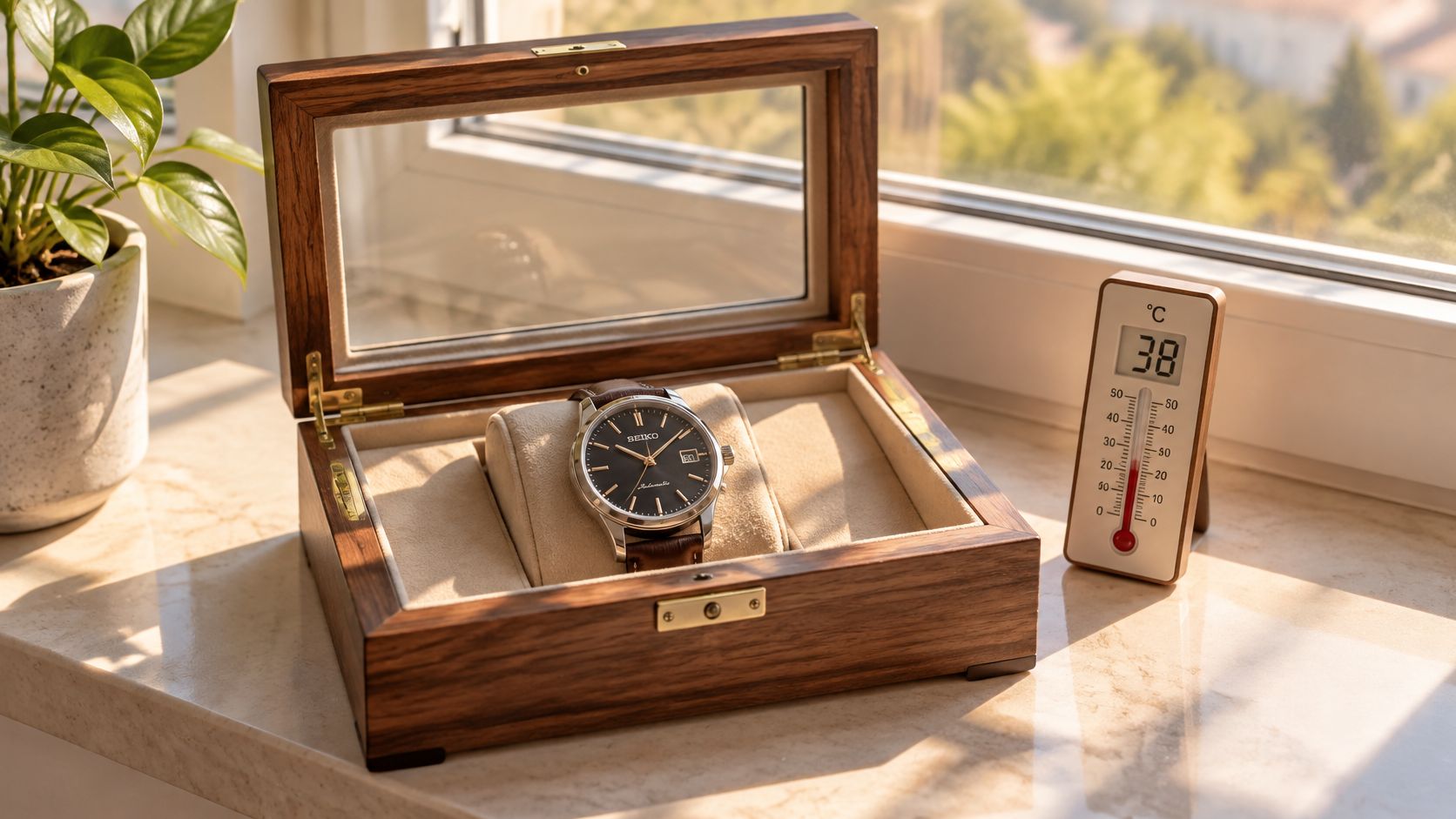
Choose the location before the finish
Keep the box away from radiators, direct sunlight, vents and places where conditions change sharply. Don't leave a travel case in a parked vehicle just because its contents are concealed.
On a desk, give watches their own area instead of placing the box among speakers, charging accessories and devices with magnetic attachments. A cabinet shelf can be more suitable than the most convenient patch of desktop. Keep the interior dry, and don't put a damp strap straight into closed storage.
Placement check: Choose somewhere you would comfortably leave the watch itself, then use the box to add organisation and physical protection.
A box also doesn't replace servicing or water-resistance checks. If a watch changes its behaviour after storage, investigate the watch and its surroundings rather than assuming that more padding will solve the problem.
Turn the measurements into a purchase decision
Use a short buying sequence to keep appearance from taking over the decision:
- Count the watches going inside. Include awkward bracelets and rarely worn pieces, not just the watches shown in your usual rotation.
- Choose the job. Decide whether you need luggage protection, home display or separate storage for each.
- Request usable internal dimensions. Confirm width, length and closed-lid clearance, including any narrowing caused by lining or dividers.
- Match the support. Check cushion circumference, compressibility and retention against your closed straps and bracelets.
- Confirm the return conditions. A careful at-home fitting may reveal an interference point that photographs can't show.
Grainmark Leather's collector-grade watch chests and travel rolls are options to compare with rigid travel cases and fitted drawers. Assess the listed internal figures and cushion arrangement rather than choosing by exterior size or slot count.
Keep your measurement sheet after buying. It gives you a practical compatibility check when you change a strap, resize a bracelet or add a watch with a different case shape.
Grainmark Leather offers compact watch boxes, collector-grade watch chests and travel storage for organising timepieces at home and away. Visit Grainmark Leather with your watch measurements in hand, and compare the compartment geometry and cushion format before choosing a case.