Types of Briefcases: A Complete Guide to Styles and Uses
Which briefcase protects a laptop better on a crowded train, a rigid attaché case or the soft leather bag you reach for every morning? The honest answer surprises people who shop by appearance. The stiff, formal case usually wins on document protection and loses badly on carry comfort.
Most buying advice sorts the types of briefcases by how formal they look and stops there. That leaves out the two questions that decide whether you'll still be carrying the thing in three years. Does the load stay stable over the walk from the station? Does the interior keep a laptop, a charger and a stack of paper from grinding against each other?
Judge every format on three tests instead: shoulder load over a real commute, laptop protection when the bag is set down hard, and paper protection over a month of daily handling. A case can pass one and fail the others, and knowing which one you can't afford to fail narrows six formats down to one or two.
Table of Contents
- Briefcase Types at a Glance
- Attaché Cases and Portfolios for Formal Work
- Soft and Travel Briefcases for Laptop Carry
- Matching a Briefcase to Your Commute
- Keeping Papers Safe Inside the Case
- Repairability and Years of Use
Briefcase Types at a Glance
Six formats cover almost everything sold as a briefcase today.
| Type | Structure | How It Is Carried | Best For |
|---|---|---|---|
| Portfolio | Flat, handleless case for papers in a slim sleeve | Under the arm | Papers, tablets and meetings |
| Padfolio | Portfolio with an integrated writing pad | Under the arm or in hand | Note-taking in meetings and interviews |
| Attaché case | Rigid box with top handle and hinged opening | Hand carry | Formal documents and presentations |
| Soft leather briefcase | Flexible leather panels, often with expandable gussets | Hand or shoulder strap | Daily office carry |
| Travel briefcase | Multiple compartments for devices and accessories | Hand or shoulder strap | Commuters and business travelers |
| Convertible briefcase | Briefcase with hidden or detachable backpack straps | Hand, shoulder or back | Mixed commutes with walking or transit |
The rows differ on rigidity, capacity and formality, not only on looks. Portfolios emphasize papers and presentation, attachés emphasize structure and protection, and travel briefcases emphasize organization and device space, so one word covers bags that behave nothing alike, as the history of the briefcase shows: the modern briefcase grew from several carrying formats rather than one invention.
Two rows deserve a closer look. The soft leather briefcase is the most common everyday choice for professionals who carry a laptop and documents together, because flexible panels and gussets absorb a load that a rigid box can't. The convertible briefcase hides or detaches backpack straps, and it's the row to pick when your commute mixes walking, stairs and transit.
Then run the test. Write down what you carry on a normal Tuesday: laptop, charger, folder, water bottle, keys. Find the row whose structure matches that list, not the row that matches your job title.
Attaché Cases and Portfolios for Formal Work
The collection below shows the formality gap in one frame, with flat portfolios and organizers in front and structured cases behind.
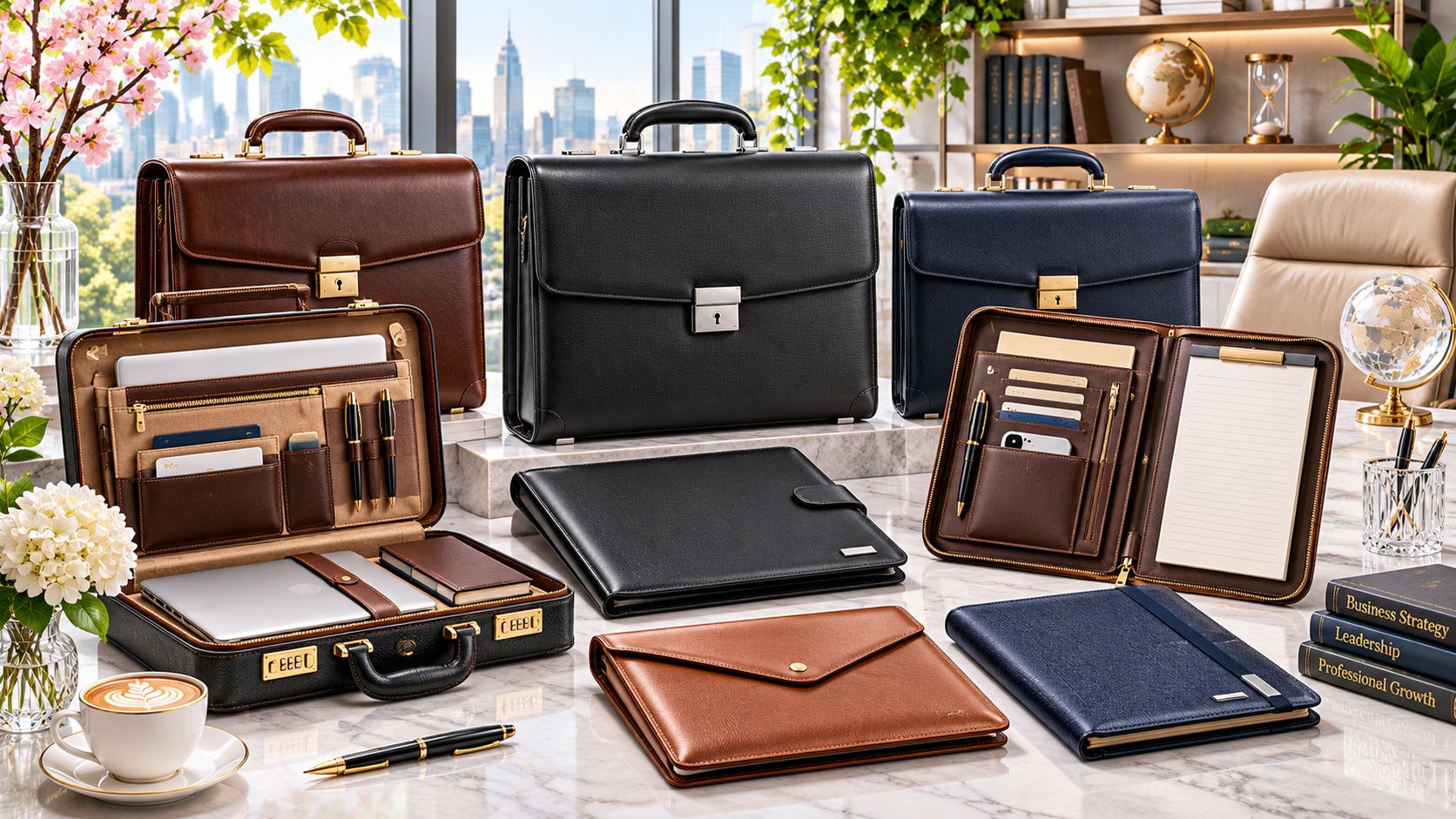
The attaché case works like a small suitcase: a rigid rectangular shell, a top handle and a hinge that splits the interior into two main sections when you open it. The name comes from its historical association with diplomatic attachés working at embassies and consulates, and the shape still reads as official business in a way a soft bag doesn't, as Von Baer's history of the briefcase sets out.
Where the Box Shape Came From
The design belongs to a broader shift toward framed luggage, where hinged metal frames let a case open wide and hold its shape instead of collapsing like a soft bag. Framed formats such as the Gladstone bag made it easy to lay a case open and inspect every document inside, and over the following decades the narrow rectangular form settled into the shape we'd recognize as a briefcase today.
That framing explains the difference you feel in the hand. An attaché holds its shape when empty, keeps paper from bending, and opens flat so a client can read a document without you wrestling with a flap. A portfolio works the other way: flat, handleless, carried under the arm like a clipboard, sized for papers, a tablet and a thin notepad.
The commute cost is the catch. An attaché hangs all its weight on one top handle, so a long walk punishes your arm, and the rigid shell gives nothing on an overstuffed day. A portfolio is the lightest option in the category, though it shields paper only while the leather stays flat and the edges stay closed.
The trade-off in one line: an attaché buys protection with weight and rigidity, while a portfolio buys portability by giving up structure.
Which One Your Day Calls For
If you hand printed documents to clients, carry contracts or exhibits, or need the case to stand upright on a conference table, the attaché earns its weight. If your day is a notepad, one tablet and a few sheets, a portfolio or a padfolio is enough, and you'll notice the lighter arm by evening. A zippered version stops loose pages sliding out of a case that gets tilted on a train, so check a portfolio with a zipper before you commit.
Quick test: count how many sheets of paper leave the house with you tomorrow. More than a folder's worth puts you in attaché territory. A handful means you're carrying structure you don't need.
Soft and Travel Briefcases for Laptop Carry
Once a laptop joins the load, the buying criteria change. Paper forgives a bent corner. A laptop chassis does not, and most of the damage happens during the ordinary parts of a commute: setting the bag down, tipping it on a train seat, catching it on a door frame.
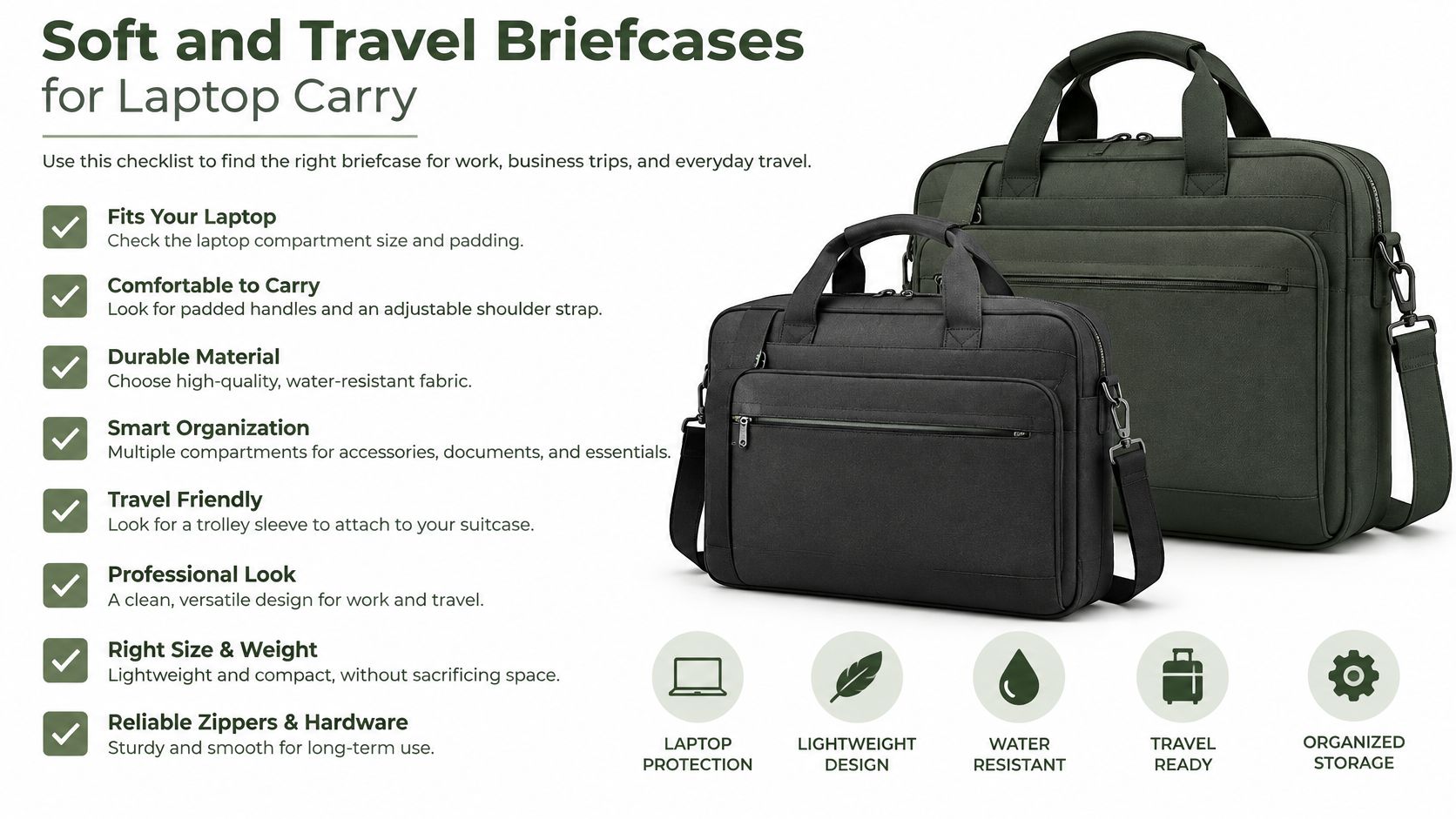
A structured briefcase beats an unstructured soft case when documents and electronics must stay separated and protected, because rigid panels and dedicated compartments reduce bending, compression and object-to-object contact. Structure here is an engineering choice, and it has a price: rigid walls weigh more and flex less against your leg on a crowded platform.
Reading a MIL-STD-810H Claim
Hangtags print MIL-STD-810H because it sounds absolute. The standard is a catalogue of environmental stress categories: vibration, shock, temperature, humidity and more, each run under a different test method. A tag that names the standard without naming the methods tells you almost nothing, because a bag tested for vibration faced a different schedule than one tested for drop shock or rain. The useful question is always which methods the maker ran, and on what hardware.
Even a genuine test report describes laboratory conditions: a defined schedule, a sample, a rig. Treat the label as evidence that a procedure was followed, and treat the construction checks below as what protects your device every day.
The Five Checks That Matter
- Suspended, padded laptop compartment. Suspension holds the base of the device off the bottom of the bag, so setting the bag down sends the impact into foam rather than into the chassis.
- Reinforced base. Bottom corners meet every pavement, train floor and cafe tile, and an unprotected base wears through before anything else fails. Metal feet or a double layer of leather buys years.
- A closure that stops the device sliding out. A zip that runs past the corner, or a flap with a buckle, keeps the laptop inside when the bag tips on a seat.
- A handle or strap anchor that isolates the device. A handle mounted directly above the laptop sleeve turns every swing of your arm into a jolt on the machine; an anchor that routes load into the bag's frame spares it.
- A separate pocket for the charger and cables. A metal plug riding against a screen lid is one of the most common ways a laptop gets scratched.
A portfolio carries paper and thin stationery well. Once a laptop, charger, notebook and accessories share one carry system, compartments do the work, and a travel briefcase with dedicated zones overtakes everything slimmer. Past a few kilograms of load, padded straps and the habit of switching shoulders matter more than one extra pocket.
What to Confirm on the Spec Sheet
Check the sleeve dimensions against the physical measurements of your laptop, since a chassis can run wider than its advertised diagonal suggests. Confirm padding sits on both faces of the sleeve rather than only the back. Look for a base with structure under the lining and a strap that clips to metal hardware rather than to stitching alone. If you carry a 15.6-inch machine, start from a laptop sleeve sized for a 15.6-inch laptop and match the briefcase to it.
Matching a Briefcase to Your Commute
Formality is one criterion. It's rarely the one that decides whether a bag works.
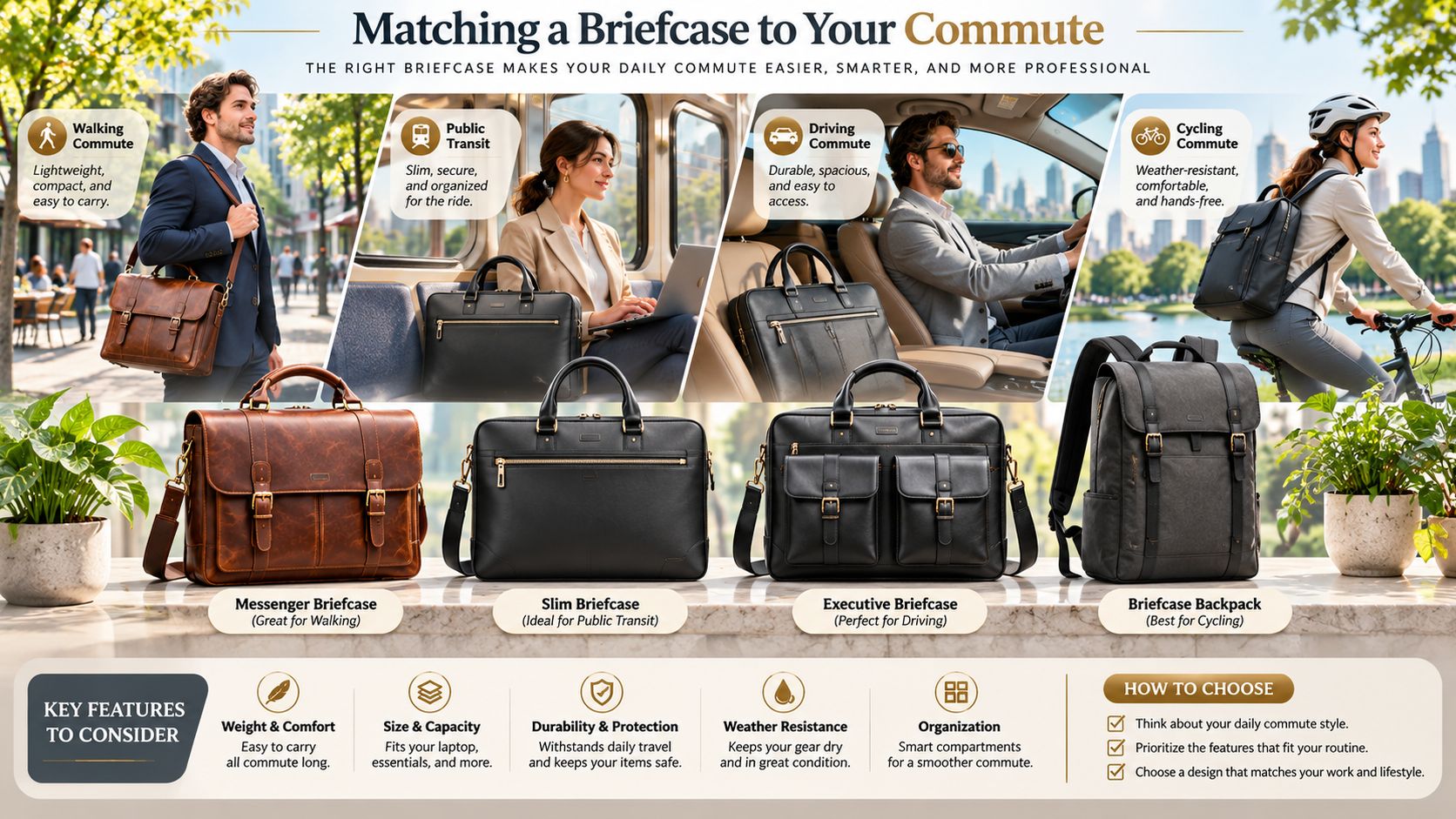
The Five Variables That Decide
- Carrying duration. Under ten minutes on foot and almost any format works. Past twenty, load distribution starts to matter more than leather grade.
- Laptop weight. A 1.2 kg ultraportable forgives a single-shoulder strap. A 2.5 kg workstation plus a brick charger doesn't.
- Stairs. Hand carry is fine on a flat platform and miserable over four flights, which is where a convertible or backpack format earns its place.
- Weather exposure. Wet walks favor a close-fitting flap or a sealing zip, and a leather you can condition rather than a suede lining that stains for good.
- One or two shoulders. A detachable strap adds versatility, but it doesn't fix asymmetric loading when the bag always rides on the same side.
| Commute or Trip | Better Format | Why It Fits |
|---|---|---|
| Car to office with a short indoor walk | Structured or soft briefcase | Formality matters more than load balance |
| Long walk or stairs on the route | Convertible briefcase or backpack-style case | Two-shoulder carry spreads the weight |
| Subway or crowded transit | Slim laptop briefcase or backpack | Compact profile and hands-free carry |
| Cycling to work | Backpack | Load stays close to the back and clear of the handlebars |
| Hybrid days with laptop and papers | Travel briefcase with padded laptop sleeve | Dedicated space for device, charger and documents |
What the Carry Numbers Say
Backpacks dominate everyday carry, and the market reflects it. The global laptop carry case market was valued at USD 7.4 billion in 2025, and backpacks accounted for more than 48.5% of it by product type that year, according to Grand View Research's laptop carry case analysis. Briefcases remain a serious category, but they're no longer the default way people move a laptop between home and office.
The physical explanation is straightforward. A backpack puts the load across two shoulders and close to the spine, and leaves both hands free for a rail, a coffee or a bike. Business Insider's guide to commuter bags makes the same point from the testing side: backpacks, messenger bags and slim laptop cases often deliver better ergonomics for everyday commuting, while a traditional attaché can be poorly suited to subways and bicycles.
A detachable shoulder strap is a convenience, not a fix. If the bag only ever hangs on your right side, you're still carrying the whole load on one shoulder for the length of the commute.
Hybrid work made the problem bigger. A typical Tuesday load now includes a laptop, charger, headphones, notebook, water bottle and personal items, and that list travels between home and office several days a week. A comparison of briefcase and backpack carry helps if you're weighing those two directly. The question worth answering isn't which format looks most professional in a meeting room. It's which one stays comfortable and stable over the commute you regularly make, while still passing as work-appropriate when you arrive.
Keeping Papers Safe Inside the Case
Paper rarely dies of one bad day. It dies of acidity, humidity, light and a folder that presses a crease into the same corner every morning. A document briefcase is therefore an enclosure system, not a leather shell.
Three Storage Decisions
- Acid- and lignin-free folders, mats or a document box. The Library of Congress guidance on caring for paper recommends these materials for works on paper, because ordinary folders off-gas and stain the sheets they're meant to protect.
- A polyester film sleeve when a contract, certificate or print needs extra stiffness and protection from handling.
- A stable, cool, dry environment. The same guidance identifies roughly 35% relative humidity for works on paper as protective, which is drier than most homes and far drier than a car.
Reading the Humidity Numbers
For mixed paper collections, the Library of Congress advises stable humidity no higher than roughly 55%. Above 60%, warping and mold risk climbs. Below about 30%, paper contracts and distorts. Those thresholds are why a hot car in summer and a damp hallway cupboard are both bad homes for anything you care about.
Paper damage is cumulative. A crease, a humid week and an acidic folder each do a little, and the combination is what you notice two years later.
Choosing the Case Around the Paper
A slim portfolio is efficient for a short commute with a few sheets or a tablet, and that's the honest limit of it. Contracts, certificates, artwork or archival notes need a structured document case with rigid support, a flat and generously sized compartment, and low-friction separators. Carry enough capacity that papers aren't compressed against acidic inserts or unstable plastics, and don't overpack, because pressure is what transfers a crease. An organizer insert with flat dividers keeps sheets from sliding into a stack that bows at the middle. Oversized sheets should stay flat or be rolled, never folded repeatedly along the same line.
The limit is worth stating plainly. The case limits handling and transport stress and nothing more. It is not a humidity-controlled vault, so don't leave a signed contract in a hot car or inside a damp bag overnight.
Repairability and Years of Use
The cheapest briefcase is the one you buy once. Score a candidate on years of use rather than on how it looks under shop lighting, because the details that decide longevity are visible if you know where to look.
Four Checks Before You Pay
- Stitched main seams, not glue alone. Look inside the gusset at the seam joining the body to the base. Glue fails at the point where the load concentrates, usually within a couple of years of daily carry.
- Replaceable hardware. Zips, feet, clasps and handle rings should be standard sizes and fitments, not proprietary mouldings, so a cobbler can source a replacement.
- Edge finishing and a lining that can be repaired or swapped. Painted edges wear through first at the corners. A lining that's stitched in can be replaced; one glued to the shell usually can't.
- A leather you can clean and condition. If the surface can't be revived, the whole case leaves service when it scuffs, no matter how good the structure is.
The Repair Economy Behind the Decision
Leather-industry coverage now treats durability, repairability and longer product life as core buying points, and repair demand is expanding alongside resale and circular consumption, as Leather Mag's analysis of repair and sustainability describes. One 2025 estimate puts global leather-goods repair services at USD 2.81 billion, projected to reach USD 6.165 billion by 2035. Treat those figures cautiously: they come from a commercial market-research source and cover leather goods broadly, not briefcases alone.
For scale, the global luxury briefcase market was valued at USD 4.7 billion in 2024, and leather briefcases accounted for more than 55% of global sales that year, according to Growth Market Reports' luxury briefcase market report.
The sustainability question isn't whether leather is good or bad in the abstract. It's whether the case you buy is still in service in ten years, and whether anyone near you can replace a zip.
Alternatives marketed as eco-friendly can carry lower durability or weaker performance under load, and leather's own case rests on sourcing, tanning, longevity and whether the item gets repaired rather than replaced.
Matching Material to the Protection You Specified
Once the type, commute and document checks are done, the material choice takes minutes. Grainmark Leather makes briefcases in full-grain, Crazy Horse and cowhide leather, in black, brown, red, burgundy and coffee, with cotton or polyester lining, so you can match the interior to what you protect: cotton for a soft surface against paper and devices, polyester where you want a lining that wipes clean. Then ask whether handles and stitching can be repaired locally, and read up on care and restoration for a worn leather bag before the first scuff rather than after it.
Grainmark Leather stocks briefcases, portfolios and A4 padfolio cases in full-grain, Crazy Horse and cowhide leather, so the format you settled on after the commute and document checks is available in a leather and lining that suits it. If this guide pointed you toward a structured case for contracts and certificates, or a compartmented travel briefcase for laptop days, you can compare those formats side by side rather than guessing from photographs. Visit Grainmark Leather to see the briefcase, portfolio and organizer range together.