How to Store Jewelry for Travel: Safe Packing Steps
You are packing tonight, and the jewelry is still in a heap on the dresser. A chain is looped through a hoop, two rings are stacked, and the bracelet you want for dinner is mixed in with pieces you will not touch for a week. How to store jewelry for travel starts before the case comes out. Sort every piece into wear, carry-on, or leave at home. Convenience, visibility, and security pull in different directions, and the sort is where you settle that trade-off.
Table of Contents
- Why Travel Jewelry Gets Lost and Damaged
- Decide What to Wear, Store or Leave
- Pack Jewelry for Travel Step by Step
- Separate Pieces by Material and Hardness
- Protect Jewelry From Water and Hotel Theft
- Control Moisture and Tarnish on the Road
- Confirm Your Travel Case Before You Leave
Why Travel Jewelry Gets Lost and Damaged
A fine chain comes back from a trip knotted around an earring back. A ring face looks dull after a harder stone rubbed against it. A thin bracelet removed at security never makes it back into the pouch. None of that requires a dropped suitcase. Movement, contact, and a short lapse of attention are enough.
The causes are ordinary. Chains knot when pieces share space. Settings scrape when bags shift on conveyor belts or under seats. Softer metals mark against harder stones. A piece set down “for a second” at screening or on a hotel nightstand can be gone by the time you reach for your phone. Water and public exposure create another route to loss. A pool, a beach, an open suitcase, or a jewelry box left visible on a desk gives the wrong opportunity.
The scale is large enough to matter. According to Jewelers Mutual's newsroom summary of its August 2023 study, 35% of surveyed consumers reported losing jewelry while traveling, while 87% said they traveled with their engagement rings. The Plumb Club's 2024 Engagement Ring Trends Study reported that 72% of engagement-ring damage occurred while traveling. Those figures describe different problems, loss and damage, but both belong to normal travel rather than rare once-in-a-decade trips.
Where the harm actually starts
Most damage is contact plus loose storage. A single dramatic drop is uncommon. The usual pattern is several pieces sharing one soft sack, then riding for hours while the bag is lifted, scanned, set down, and shoved under a seat. Harder stones rub softer ones. Clasps catch links. A damp ring goes into a pouch and stays damp until you unpack.
The same pattern can hit a daily-wear band, an heirloom locket, and a costume chain. What changes is how much protection you owe the piece. A replaceable hoop can ride in a simple slot. A high-value or sentimental piece needs its own lined space, a closed case, and a clear plan for who is holding the bag. Separation also stops the knot before the first taxi ride, which is why sorting comes before packing.
Before you touch a pouch, list every piece you might bring. Mark each one wear, carry-on, or leave at home. If you cannot name where it will sit for the whole trip, it stays home.
Decide What to Wear, Store or Leave
A ring on your finger through the checkpoint feels controlled. You know where it is, and it is not buried at the bottom of a bag. That instinct has limits. Wearing jewelry can reduce one kind of exposure while creating another, once the piece leaves your body for a tray, a belt, or a folded jacket.
TSA guidance on jewelry permits jewelry in carry-on bags, advises travelers to keep valuables with them rather than in checked baggage, and allows passengers to request private screening for jewelry and other valuables. Losses tend to happen more often while pieces are being worn than while they are packed, so wearing is a trade-off, not a default. A piece on your hand is easy to track until you take it off. The advantage disappears the moment it sits in a bin or on a belt while you are gathering shoes, laptop, and boarding pass.
What I would actually wear
I would wear only low-profile, easily replaceable pieces in transit. A plain band, small hoops, a simple chain. High-value or sentimental items belong concealed in a compact, zippered carry-on case. Do not take jewelry off into a security tray. It gets overlooked, swept aside, or picked up by the wrong person while you are reassembling your belongings.
Practical rule: If a piece would hurt to lose, it does not travel on your body through a crowded checkpoint.
Destination changes the same choice. In a crowded terminal, on public transport, or in an unfamiliar area, discreet storage beats a visible luxury piece. Flash draws attention you do not need while you are reading signs, stacking bags, and keeping track of boarding details. On an international trip, check that country's customs rules for high-value goods and declare what the rules require. Allowances are not the same everywhere, so the declaration belongs in the packing decision.
Four-factor check per piece
Ask each question for every piece and act on the answer before you pack.
| Factor | Question to ask | Action if yes |
|---|---|---|
| Value | Would losing it be a serious financial loss? | Keep it in the case, not worn |
| Visibility | Would it draw attention in a crowd or terminal? | Keep it concealed; wear only low-profile pieces |
| Screening exposure | Must it leave your body or bag at security? | Request private screening or pack it in the carry-on |
| Continuous possession | Can you keep it in sight at all times? | Carry it personally; never place it in checked bags |
Run the four factors on one piece at a time. A wedding band you never remove may pass as worn if you will not take it off at the checkpoint. A cocktail ring fails visibility and value, so it goes in the case. A pair of everyday studs can be worn. The heirloom bracelet fails continuous possession the moment you would have to set it down, so it stays zipped in the bag you are holding.
This sort is deliberate and quick. Value decides whether the loss would matter. Visibility decides whether the piece advertises itself. Screening exposure decides whether the checkpoint creates an unnecessary handoff. Continuous possession decides whether the piece stays with you in practice, not just in principle.
When the sort is done, you have a short wear list and a shorter carry list. Everything else stays home. That is the pile the packing routine is allowed to touch.
Pack Jewelry for Travel Step by Step
The routine is the same for a weekend and a long haul. You are building a case you can open in a hotel without untangling anything, and you are keeping that case where you can see it.
A 2025 travel study from Jewelers Mutual found that 52% of respondents wore their engagement ring while traveling, compared with 50% who wore their wedding ring. Jewelry stays in active use on trips, which is exactly why loose storage fails. The same guidance says to keep valuables on you or in a carry-on, because checked luggage creates greater exposure to loss and theft. Store the pieces in a structured, zippered case inside that carry-on, not in the checked bag.
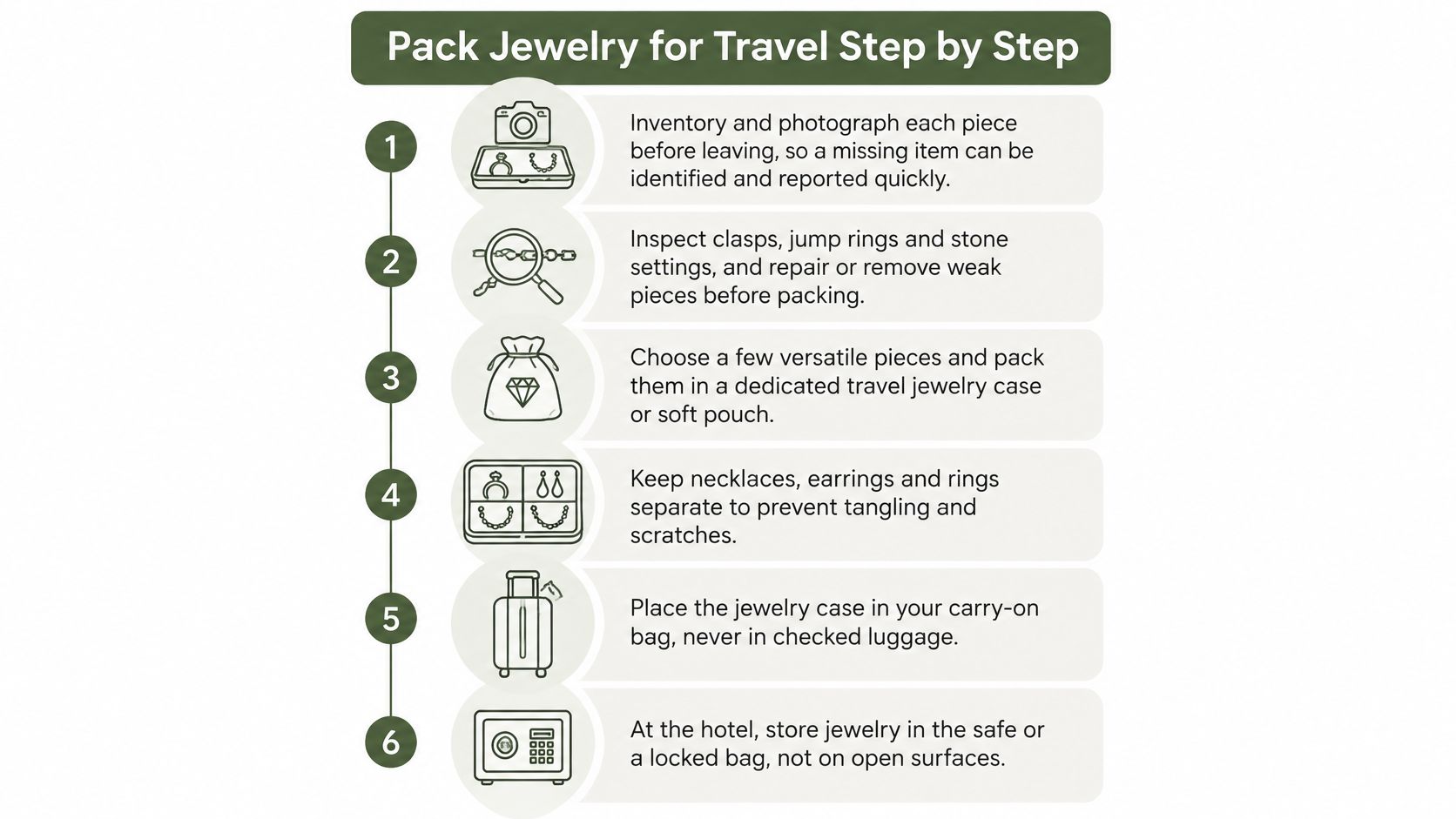
Six steps that hold up in transit
- Inventory and photograph each piece. Lay the carry list on a plain surface and shoot a clear photo of the group, then a closer shot of anything with a distinctive setting. If something is missing later, you can describe it and show it. The slip is packing from memory and discovering the gap after you have left the house.
- Inspect clasps, jump rings, and stone settings. Tug each clasp, look for a thinned jump ring, and check that no stone rocks in its seat. Repair or leave behind anything loose. Travel vibration finishes a weak clasp. The slip is “it has been fine for years,” then finding the chain in the case and the pendant somewhere in the lining.
- Clean and dry every piece completely. Wipe perspiration, lotion, and sunscreen with a clean soft cloth, then air-dry until no cool spot remains. A damp piece sealed in a pouch traps moisture against metal. The slip is a quick rinse and an immediate zip.
- Give each piece its own soft, non-abrasive pouch or lined compartment. One piece, one space. Shared pouches let chains knot and let harder surfaces rub softer ones. The slip is “they are all small, one pouch is fine.”
- Lay necklaces flat or hang them, and park earrings in individual compartments or small containers. Flat or hung chains do not fold into knots in the first hour of movement. Earring pairs that share a tiny box stay pairs. The slip is coiling a chain into a corner and tossing both earrings into a pocket.
- Put the closed case inside a personal item or carry-on you keep in sight. Not the checked bag. Not an outer pocket you will set on a chair. Prepare the case before you leave and keep visual control of that bag through transit. A watch does not belong in the same slot as a chain. A separate travel watch pouch keeps the case and bracelet off rings and links. The slip is dropping the organizer into checked luggage because the carry-on “feels full.”
Do not place jewelry loose in a security bin. It is easy to forget and easy for someone else to take while you are collecting a laptop. If an officer needs to see a piece, you want the closed case in your hands, not a scatter of metal in a tray.
What you should see when you arrive
Open the case at the hotel. Necklaces are still flat. No stone is rattling. Every earring still has its partner. Rings are not stacked. If you see a knot or a shared slot, fix it before the next leg. A compartmentalized case is not a nicety. It limits abrasion, keeps pairs together, and makes a fast count possible when you are repacking at 6 a.m.
Separate Pieces by Material and Hardness
Once each piece has its own space, the next question is which space. Hardness decides the layout. A harder gem or a polished metal edge will mark a softer neighbor if luggage compression pushes them together. Stones below 7 on the Mohs scale are more vulnerable to everyday scratching, so pearls, opal, and turquoise stay isolated from harder gems.
Gem-A's buying guide on gemstone jewellery care is clear on the sequence that prevents metal-to-metal contact, chain tangling, and abrasion between gemstones. Keep pearls, opal, and turquoise away from harder stones. Do not stack rings or bracelets. For several items, use a rigid, padded case so compression cannot force settings together, and carry that case in hand luggage where you can reach it at screening. GIA's recommendation, as that guide records it, is the same idea in short form: separate storage, a soft or breathable pouch for pearls, and carry-on transport.
Storage needs by jewelry type
| Jewelry type | Concern | Storage method |
|---|---|---|
| Pearls | Soft surface; harder gems scratch it | Breathable soft pouch in its own compartment |
| Opal and turquoise | Below 7 on the Mohs scale; scratch easily | Padded compartment, kept away from harder stones |
| Diamond and sapphire | Hard (10 and 9 on the Mohs scale); can scratch softer stones | Individual soft pouch, kept away from pearls and opal |
| Chains and necklaces | Knot when loose | Laid flat or hung on an organizer |
| Rings and bracelets | Scrape against each other when stacked | Individual slot, never stacked |
| Earrings | Lose pairs and scratch each other | Each pair in its own small compartment |
Pearls want a breathable pouch, not a sealed plastic sleeve. Opal and turquoise want padding and distance from diamond and sapphire, which will scratch them long before anything scratches the diamond. Chains want to lie flat or hang so links cannot fold. Rings and bracelets want a slot each. Stacked bands look tidy for ten seconds and then the settings chew each other. Earrings want the pair kept together in a small compartment so one post does not vanish into a seam.
A jewellery box built for rings is useful here because a ring bar or individual ring slot stops the stack. The same logic applies in a travel roll. If two rings share a channel, they are stacked, even if the case looks organized.
Several pieces loose in one pouch is the failure mode. Movement knots the chains and lets hard stones abrade softer stones and precious-metal surfaces.
Count the compartments against the pieces. If a diamond shares a slot with a pearl, an opal, or a soft plated chain, move the hard stone. The pouch rule you already followed only works when the neighbor in the next slot cannot reach across and scratch.
Protect Jewelry From Water and Hotel Theft
Water and guest rooms account for a large share of losses that have nothing to do with the airport. Data summarized in the 2025 Jewelry Travel Study found that 38% of people who lost jewelry lost it near a body of water, including a beach, pool, ocean, or lake. Among people whose jewelry was stolen, 1 in 5 reported that the theft occurred in a hotel room.
That pattern sets three rules. They are simple, and people skip them because the pool is “just for a minute” and the room “feels private.”
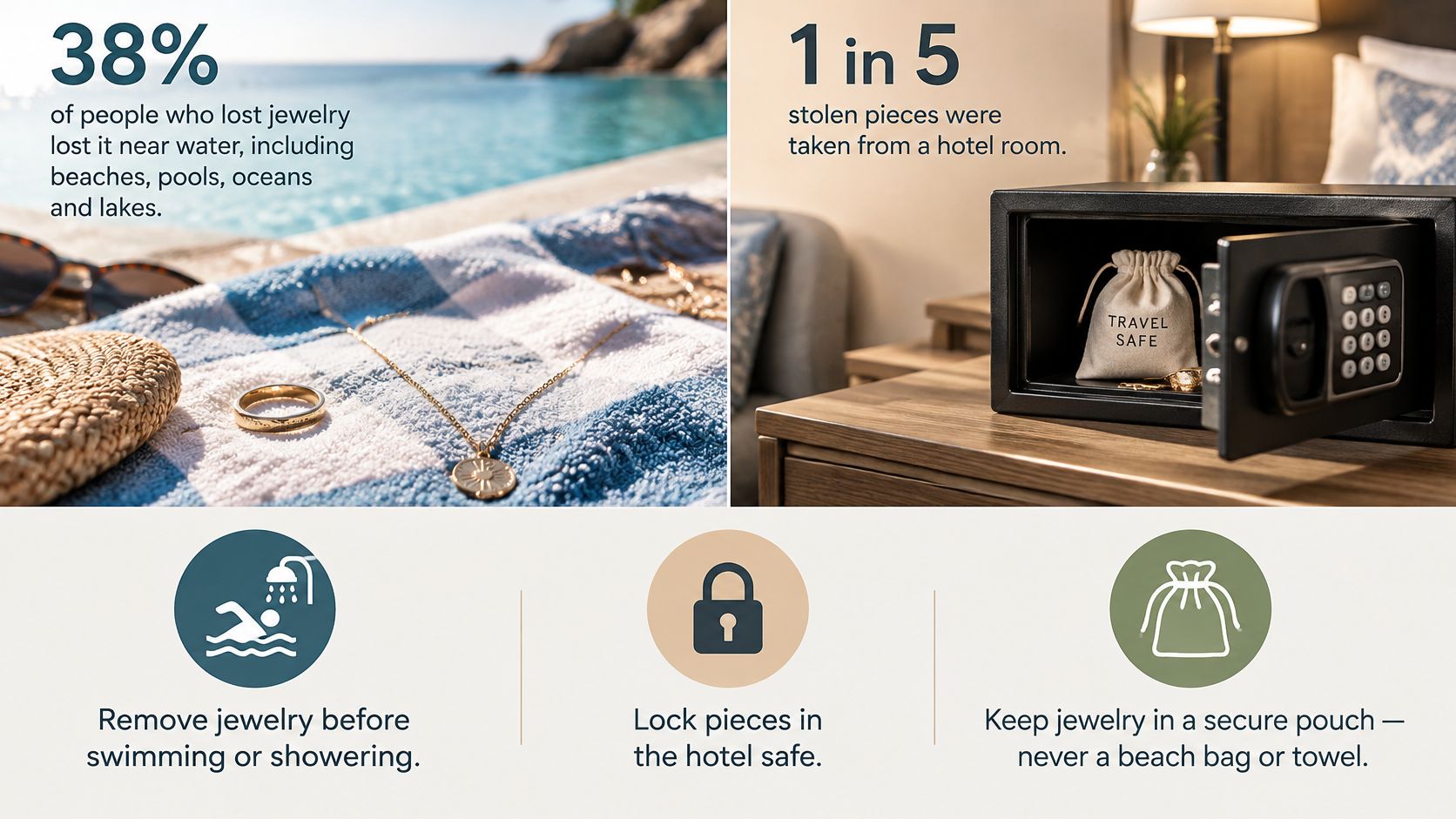
Three rules that cover the room and the water
Take it off before water. Swimming, beach time, a shower, or a hot tub. Chlorine, salt, sand, and a wet finger that lets a ring slip are the usual story. Remove the piece, then dry it fully before it goes back into any case. A watch on a leather strap has the same problem near water. The closed-case habit in how to store automatic watches is the right model: off the wrist, in a case, not on a towel.
Use a closed case, and keep that case out of sight. Not the bathroom counter, not the bedside table, not the open suitcase. Those are the surfaces people use because they are empty, and they are also the surfaces a housekeeper, a roommate, or a casual visitor sees first. A visible box invites a look. A case inside a drawer or inside the bag you are using does not.
Use the hotel safe for the pieces that would hurt, or carry them. When the safe works, the high-value items go in it. When it does not, or when you do not trust the keypad, those pieces stay on you in the closed case. Judgment matters. A safe you cannot reopen is not a plan. Test it with the door open before you load it.
The case itself should be water-resistant enough that a splash or a damp toiletry bag next to it does not soak the lining. A closed organizer also cuts impact and the chance you set a single ring down while you move between airport, hotel, and the next city.
The same spot every night
At each stop, do a short room check. Find one closed place for the case. Confirm the safe opens and locks if you plan to use it. Put the case in the same spot every night so you are not scanning the room at checkout. Nothing stays on the sink “until morning.” Morning is when people leave pieces behind.
Control Moisture and Tarnish on the Road
Once pieces are separated, moisture is the quiet problem. A sealed case full of damp metal corrodes. Humidity speeds silver tarnish. Heat, perfume, and leftover lotion do their own damage. The fix is not one humidity trick for every material.
Conservation guidance for silver display environments commonly targets approximately 30%–50% relative humidity, while specialist care guidance warns that humidity accelerates silver tarnish, as laid out in Oath Jewelry's fine jewelry care guide. Treat that range as a silver display reference, not a number you must hit in a hotel. On the road you control what you can: dry pieces, a fresh desiccant that does not touch the metal, and no bathroom storage.
Moisture and care by material
| Material | Moisture approach | Avoid |
|---|---|---|
| Sterling silver | Silica-gel packet in the outer case, not touching jewelry | Sealing damp pieces; toothpaste or rough paper cleaning |
| Pearls | Breathable soft pouch | Airtight containers and aggressive drying |
| Gold and platinum | Dry fully, then store in a soft pouch | Perfume, cosmetics and household chemicals |
| Opal and turquoise | Keep dry in a padded compartment | Prolonged heat and direct sunlight |
| Plated or costume pieces | Dry thoroughly and wrap in cloth | Trapped moisture and abrasive rubbing |
For sterling silver and other tarnish-prone metals, add a fresh silica-gel packet or an anti-tarnish insert to the outer case. Do not let it touch the jewelry. Seal the case only after every piece is fully dry. If you want a fuller home routine for the same metal, these anti-tarnish silver storage tips from Evo Dyne Products cover packets, cloth, and what not to seal while a piece is still damp. Pearls and some porous stones want air. Aggressive drying and a fully airtight box are the wrong move for them. Gold and platinum still need a full dry-down and distance from perfume, cosmetics, and household chemicals. Opal and turquoise stay dry, out of prolonged heat, and out of direct sun.
Skip bathrooms and wet toiletry bags. Shower steam is a tarnish accelerator, and a leaky bottle of lotion will undo a careful pack.
After every swim or shower
- Wipe: Use a clean soft cloth on perspiration, sunscreen, and residue.
- Air-dry fully: Wait until the metal is no longer cool to the touch.
- Inspect: Look for a loosened stone or a clasp that opened.
- Return: Put each item back in its own compartment.
- Outer pouch: Place the organizer inside a water-resistant travel pouch.
Two pitfalls undo the table. Sealing damp pieces in one container traps moisture and promotes corrosion. Cleaning with toothpaste or rough paper scratches metal and finishes. If a piece looks dull, wipe it. Do not scrub it in a hotel sink.
At the hotel, a flat jewelry display tray is a better daytime hold than the bathroom ledge, as long as you put the pieces away again before you leave the room. The tray is for pieces that are dry and in use, not a place to abandon them.
Confirm Your Travel Case Before You Leave
The night before, you are not repacking from scratch. You are checking that the earlier choices survived a busy evening. I would rather find a gap on the bed than at the checkpoint.
Photo inventory: The pictures match the pieces in the case, and a copy lives on your phone, outside the case, so you can report a missing item without opening every zipper in public.
Fully dry: No piece feels cool or looks spotted. If one is damp, it stays out until it is not.
Layout: Every necklace is flat or hung. Every earring pair sits together. Nothing hard shares a slot with something soft.
Bag choice: The case is inside the carry-on or personal item, not the checked bag, and you know which pocket.
If the case has too few compartments for the pieces you refused to leave behind, do not improvise with a jumble of loose bags. Buy a structured, zippered jewelry case with separate pouches or slots before the trip. When you compare options, look for individual compartments, a size that fits your carry-on, and a closure that stays shut in transit. Our jewelry cases are built for that compartmentalized carry, and the Cases Collection also includes pen cases, watch cases, cigar cases, eyewear cases, necktie cases, tech organisers, CD & DVD cases, and AirPods cases if the same bag needs to hold more than jewelry. A gold jewelry box is the home-side comparison when you want the same separation after you unpack.
Pack one test case this week and open it after a walk around the block or a night in the hall closet. Shake it once. If a chain has knotted or two rings have met, you still have time to add a slot. That is the point of the rehearsal. The airport is a bad place to discover the case was one compartment short.
Grainmark Leather makes full-grain leather jewelry cases and travel organizers with separate compartments, so rings, chains, and small pieces are not left loose in a bag. If you are sorting a carry-on this week, compare a structured case against the pieces you travel with, then visit Grainmark Leather to choose one that fits the bag you already carry.