What Is Pull Up Leather and How the Finish Ages
Pull-up leather is an oil-and-wax finish that flashes lighter wherever the hide is bent, stretched, or pressed. It is not a separate leather grade, and dramatic color change is not evidence that the hide is stronger than other full-grain leather.
Most of the advice floating around treats pull-up as the premium tier, a word that ranks above ordinary leather and guarantees a better bag. That assumption costs people money. A technical leather reference describes pull-up as smooth leather or nubuck finished with a greasy, oily, or waxy layer, which makes the word a finishing method rather than a category of hide (Leather Dictionary). Other descriptions tie the effect to aniline-dyed leather. Either way, the term points at a surface treatment, not a tanning process and not a strength rating.
What you meet on the shelf is usually aniline or lightly protected grain leather, sometimes nubuck, carrying mobile oils, waxes, or both in the surface. Push a thumb into it and the finish shifts aside, so that spot reads paler. The flash is the whole phenomenon. It tells you the finish is mobile, and nothing about how the hide was tanned, how thick it is, what lines the inside, or how the edges were built.
Table of Contents
- What Pull-Up Leather Is
- How the Pull-Up Effect Appears
- Oil Versus Wax and How the Surface Ages
- Pull-Up Beside Other Leather Finishes
- Pull-Up Leather on Bags and Cases
- How to Care for the Pull-Up Look
- Decide If Pull-Up Leather Fits the Piece
What Pull-Up Leather Is
Three labels answer three different buying questions, and pull-up collapses none of them. Sellers fold construction, tannage, and finish into one word because it sells better. Split them and the bag tells you far more.
| Label | What it describes | What pull-up does not decide | Ask the seller |
|---|---|---|---|
| Construction | Full-grain, top-grain, split, or nubuck | Whether the hide kept its grain or is stronger | Hide grade and thickness |
| Tannage | Chrome, vegetable, or combination tanning | Which chemistry made the hide stable | Chrome, vegetable, or combination |
| Finish | Mobile oils, waxes, or both, plus any topcoat | That color change equals durability | Oil-heavy or wax-heavy, and whether a topcoat is present |
One briefcase can be full-grain, chrome-tanned, and oil-finished. Another can be top-grain, vegetable-tanned, and wax-finished. Both sellers may call them pull-up, and both would be technically correct. They'll feel different in the hand, hold their shape differently, and behave differently in a rain shower.
Questions that get a real answer
Ask for these as separate facts, in writing if you're buying at a distance.
- Hide grade: full-grain, top-grain, split, or nubuck, stated plainly rather than implied.
- Thickness: given in millimetres, because a thin panel and a heavy panel of the same finish behave like different materials.
- Lining: suede, cotton, microfiber, or polyester, since the lining decides how the piece holds shape and how it feels against a hand.
- Edge construction: burnished, painted, or folded, which is where cheap work shows first.
- Finish family: oil-heavy or wax-heavy, and whether a topcoat sits over the surface.
A maker who can answer that list is selling a hide. A seller who can't is selling a word. If you want the wider map of hide grades and how they're named, our breakdown of the grades of leather covers the vocabulary that sits underneath any finish.
Two more expectations worth setting before you pay. Dye transfer onto a pale shirt, the occasional scratch, and uneven tone across a single panel are characteristics of this finish, not automatic defects. The same naming logic applies to other treated materials, and the Indian River Furniture upholstery overview is a straightforward primer on how finishes get described and compared when you're buying something that has to survive daily contact.
How the Pull-Up Effect Appears
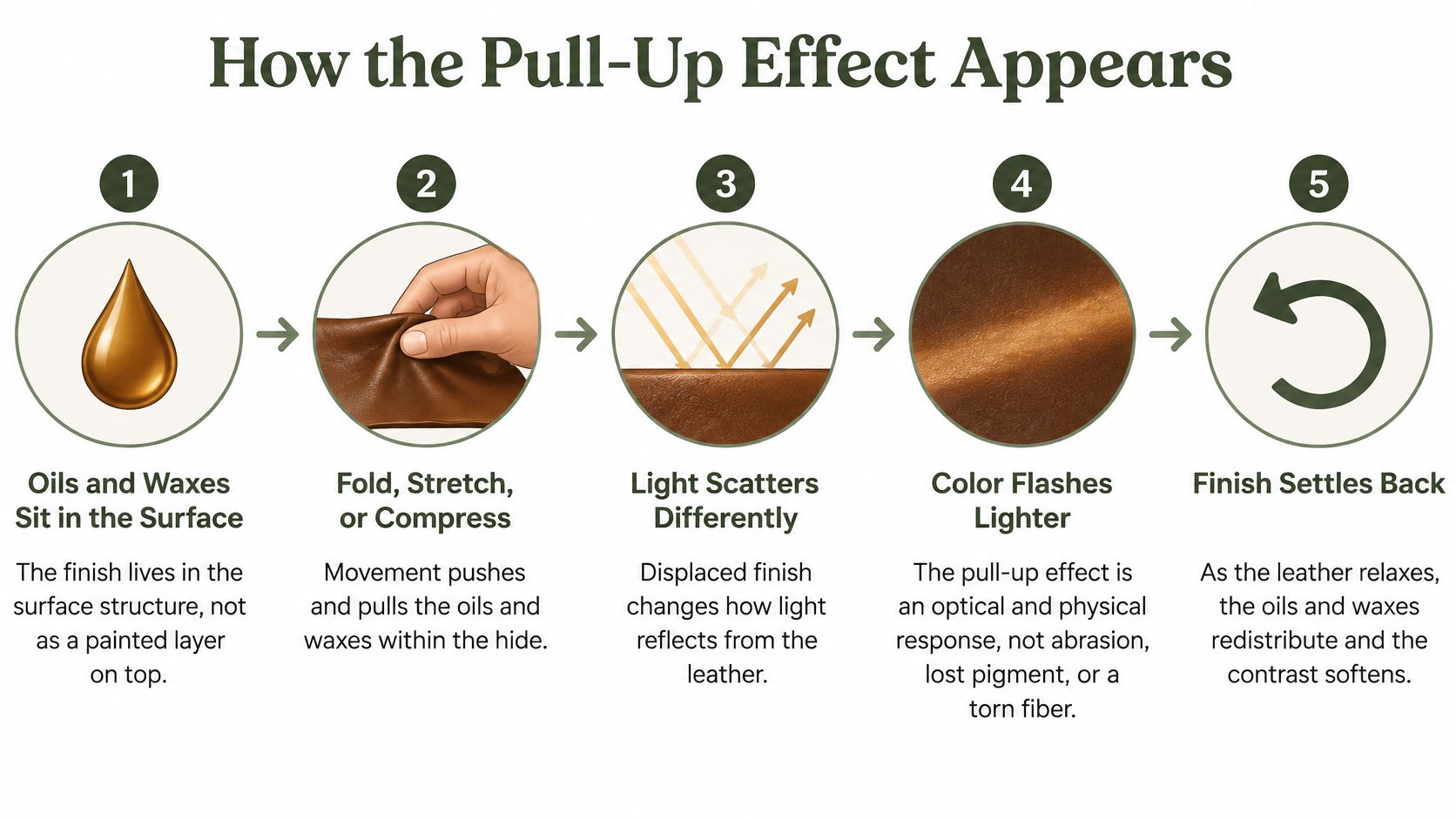
Open the flap of a new pull-up portfolio and press the fold flat with your palm. The crease turns pale almost instantly, a light line across a dark panel. Ease the pressure off, rub the spot with a warm thumb, and within a minute or two some of the darker tone creeps back. Nothing was scraped away, no pigment failed, and the leather isn't damaged.
A useful picture: the finish behaves like the wax on a candle someone pressed with a fingernail. The wax moved under the pressure. It didn't flake off.
That is the mechanism in plain terms. Pull-up is a finish applied most commonly to grain leather, with mobile oils, waxes, or both introduced into the hide (Lineapelle). Folding, stretching, or compressing displaces those materials inside the surface structure, and the affected zone reflects light differently, so it reads lighter for a while.
Why some marks fade and others don't
Releasing the tension, warming the area with your hand, or rubbing it can redistribute some of the oils and partially restore the darker tone. How strong the effect is, and how completely it reverses, depends on the oil-to-wax formulation, how heavily the finish was applied, the dye color, how absorbent the hide is, its thickness, moisture, temperature, and whether a topcoat sits over the finish.
Where it shows up first on a working bag
On a briefcase, the lightening collects in predictable places. The handle goes first, then fold lines, then pocket openings, then corners, because those are the points that flex every time you lift it. That pattern is an expected use signature rather than a flaw report.
Judge the piece by what the finish can't disguise.
- Fiber integrity: loose or hairy fibers on a cut edge tell you the hide was thin to start with.
- Stitching: even spacing, no skipped locks, thread weight that matches the panel.
- Edge construction: burnished and waxed edges hold their shape; painted edges crack and peel.
- Real cracking: a split in the surface is a defect. A pale crease is not.
A mark that stays pale after the leather has been warmed and allowed to relax is more likely a scratch or a spot of finish loss than ordinary pull-up flash. Those same mechanics are what make Crazy Horse leather look the way it does, with wax shifting under flex and buffing back into a mottled surface.
Oil Versus Wax and How the Surface Ages
Two hides, same dye lot, same tannery floor. One comes back soft and slightly grippy, the other firm with a dry, almost chalky top. The hide isn't what changed. The recipe did.
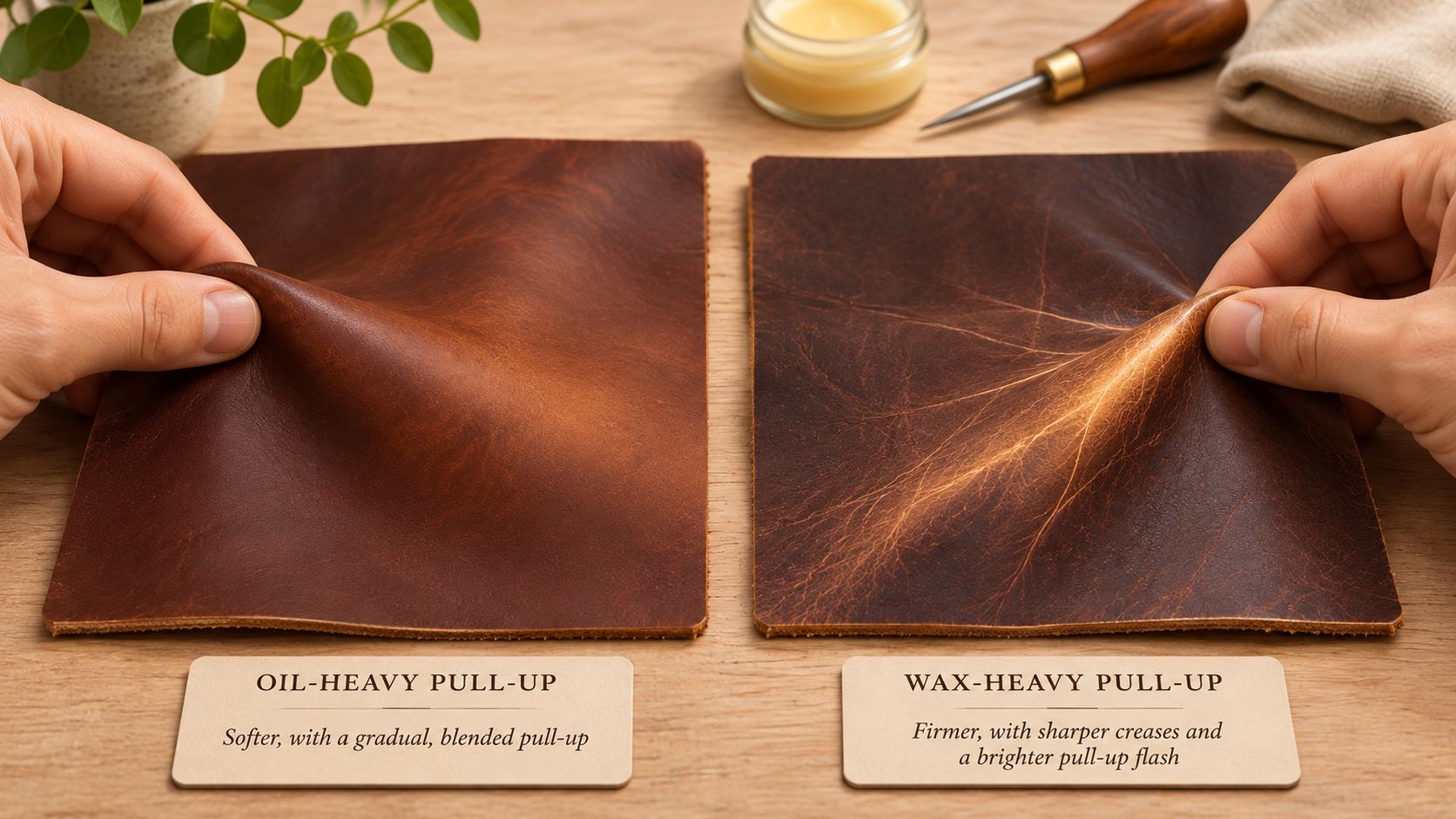
Pull-up makers load the surface with oils, waxes, or a blend, and that balance decides how the leather feels and how quickly color moves (TLS San Martin). Oil-heavy formulations generally produce a softer hand and a more gradual color change. Wax-heavy formulations tend to feel firmer and throw sharper highlights or surface bloom, the faint cloudy film that buffs away with a dry cloth.
| Trait | Oil-heavy pull-up | Wax-heavy pull-up |
|---|---|---|
| Hand | Softer and more supple | Firmer, with more body |
| Color change | More gradual lightening | Sharper highlights when stressed |
| Surface | Often a deeper, slightly greasier sheen | Can show wax bloom and crisper contrast |
| Best match | Wallets, pouches, and pieces that flex daily | Structured briefcases, boxes, and cases that should hold an edge |
How the surface ages, in order
Think in three stretches instead of one vague idea of patina.
The first weeks bring fast creases at every flex point. A new portfolio shows pale lines at the fold and along the spine before the month is out, and a briefcase handle starts to lighten on the second or third commute.
The first year is where the two-tone map builds. Hands, pockets, and desk edges push the oils around unevenly, so high-contact zones go darker and glossier while low-touch panels stay close to their original shade.
Beyond that, warmth and friction darken the busy areas and soften the hand further. Grain, wrinkles, and small scars stay visible the whole time, because this finish isn't a thick pigment coat sitting over the hide.
The same mobility that makes pull-up look alive also makes water spots, dye rub-off onto a light shirt, and uneven darkening from skin oils more likely than on a heavily pigmented surface. Buy it for the look and accept the handling that comes with it.
Match the recipe to the object. A wallet, cardholder, or pouch lives in a pocket and flexes hundreds of times a day, so a softer, oil-rich surface suits it. A structured briefcase that needs to keep a firm edge does better with a waxier, firmer hide. Either way, the piece is chosen for visible aging rather than a permanently uniform face, and our notes on full-grain leather lifespan explain what a well-tanned hide is doing underneath that finish.
Pull-Up Beside Other Leather Finishes
The quickest way to understand pull-up is to see what it isn't. Sellers blur the line between aniline, semi-aniline, pigmented, corrected grain, and pull-up, and the confusion almost always starts with tanning.
Every hide is tanned first, the step that replaces water in the skin with agents that bind to collagen and make the material resistant to heat and decay. Chrome tanning is estimated to account for approximately 60% to 90% of global leather production, takes about two or three days in drums, and produces pale blue "wet blue" leather before dyeing and finishing (Edgepedia). Plant-tannin vegetable methods go back more than 2,000 years. For a buyer, the takeaway is short. Any of those hides can carry a pull-up finish, because the name describes the treatment applied after or near the end of tanning.
Ranked by how much hide stays visible
The finishes differ in how much of the original surface shows and what happens when something scrapes it.
| Finish | What you see | Reaction to a scuff or bend | Stain resistance |
|---|---|---|---|
| Aniline | Open grain, scars, and wrinkles | Marks stay, with little color flash | Low |
| Semi-aniline | Most of the grain under a thin coat | Marks less readily than bare aniline | Moderate |
| Pigmented | Even color, grain partly hidden | Coat resists change and can look plastic | Higher |
| Pull-up | Grain plus an oily or waxy sheen | Stress looks lighter, then partly darkens | Low to moderate |
| Corrected grain | Sanded and rebuilt even face | No true pull-up flash | Higher where the coat is intact |
Aniline is dyed through with little or no surface pigment, so grain, scars, and wrinkles all show, and water, ink, and rub marks land fast. Semi-aniline adds a thin protective coat while most of the grain stays visible, which is why it handles light stains better than bare aniline. If you want to know how the unprotected version behaves across years of use, this piece on how aniline leather ages walks through it clearly.
Pigmented leather carries a thicker color coat that hides more variation and resists staining and fading, sometimes at the cost of a slightly plastic look. Corrected grain is sanded and rebuilt so the face reads even, and it never gives you a true pull-up flash. Pull-up itself usually begins as aniline or lightly protected grain, then takes the mobile oils and waxes, so a bend looks lighter and can partly darken again once warmth and rubbing do their work.
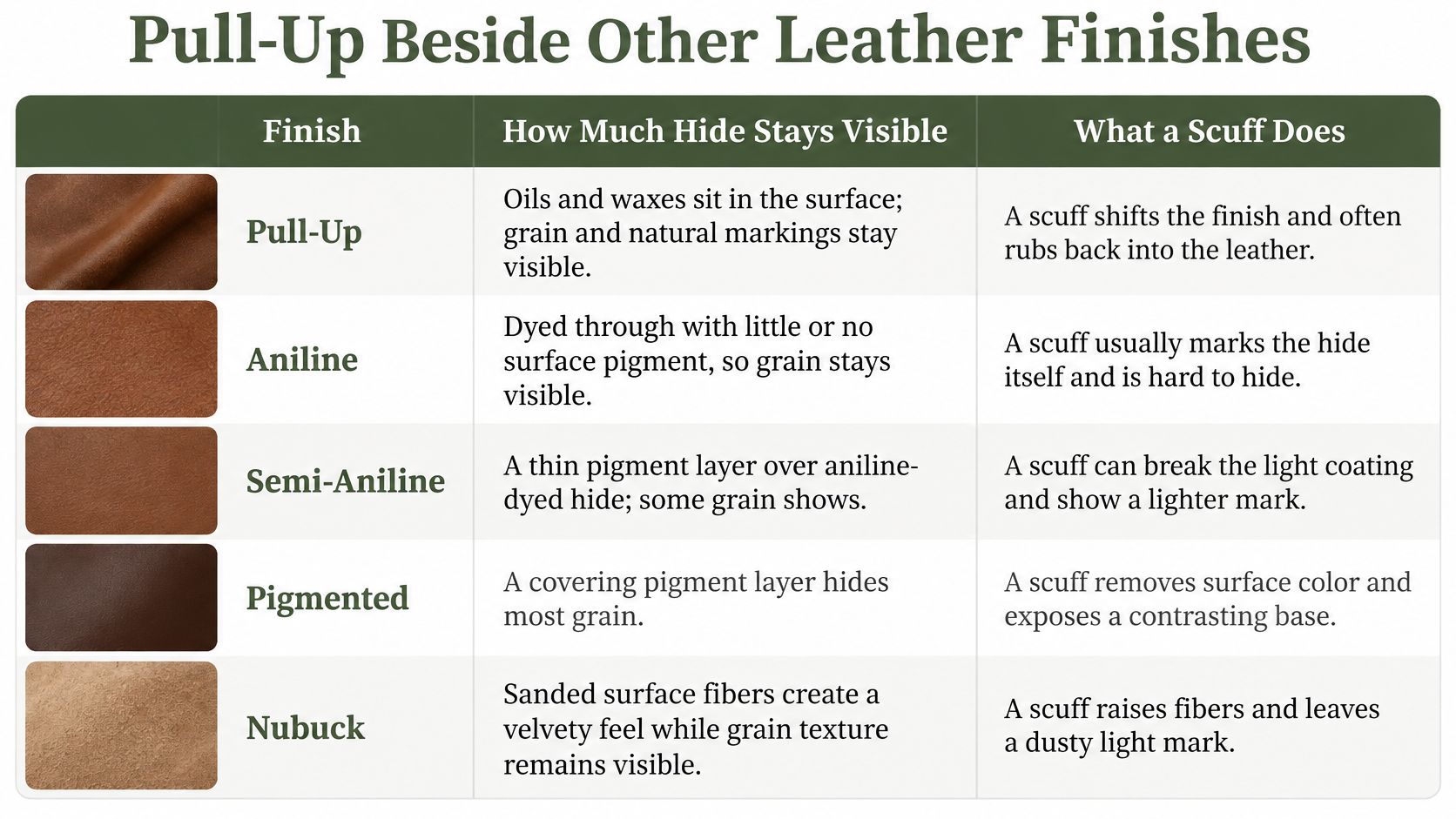
Choose pigmented when the brief is one even color that survives a commute and a client meeting. Choose pull-up when visible grain and a surface that changes are the point, and expect easier dye transfer and water spotting than a heavy pigment coat gives you.
Pull-Up Leather on Bags and Cases
Pick up a full-grain briefcase in a pull-up or Crazy Horse style and the first pale mark arrives sooner than you'd expect. Within a week of commuting, the handle has a lighter band where your fingers close, the flap crease has gone milky along its length, and the bottom corners have picked up two soft highlights from being set down on a train floor.
Crazy Horse is worth naming here, because shoppers treat it as a separate material when it's really a style of this same family. It's an oiled, often waxed grain leather, chosen for the pale flash and uneven patina rather than for a hide grade the name doesn't promise.
The first pale mark on each piece
- Briefcase: the handle, then the flap crease, then the corners. Months in, the palm rest on the front panel darkens while the rest sits near the original shade.
- Portfolio: the fold and the spine, where documents press the leather flat every working day.
- Watch case and pen box: little flex, so the patina gathers at the lid edge and the finger spots that open it a hundred times, not across the whole panel.
- Wallet or cardholder: fastest of all, because it lives in a pocket, absorbs skin oil, and bends at the same crease every time it closes.
- Travel roll or duffel: strap burn and luggage scuffs, which read as lighter streaks across the body.
The trade is honest. A briefcase gains a personal record of use and can leave a faint mark on a light shirt. A watch case looks lived-in on a desk and won't stay showroom-even once several people have opened it.
If you want to compare formats before committing, our leather briefcases and bags show how the same finish reads across structured and soft shapes.
How to Care for the Pull-Up Look
Care isn't a product. It's a decision. Before you buy a tin of anything, settle which surface you want a year from now: the original matte, high-contrast flash, or a darker, smoother patina that has absorbed every hand it passed through. Those two goals call for different products and very different amounts.
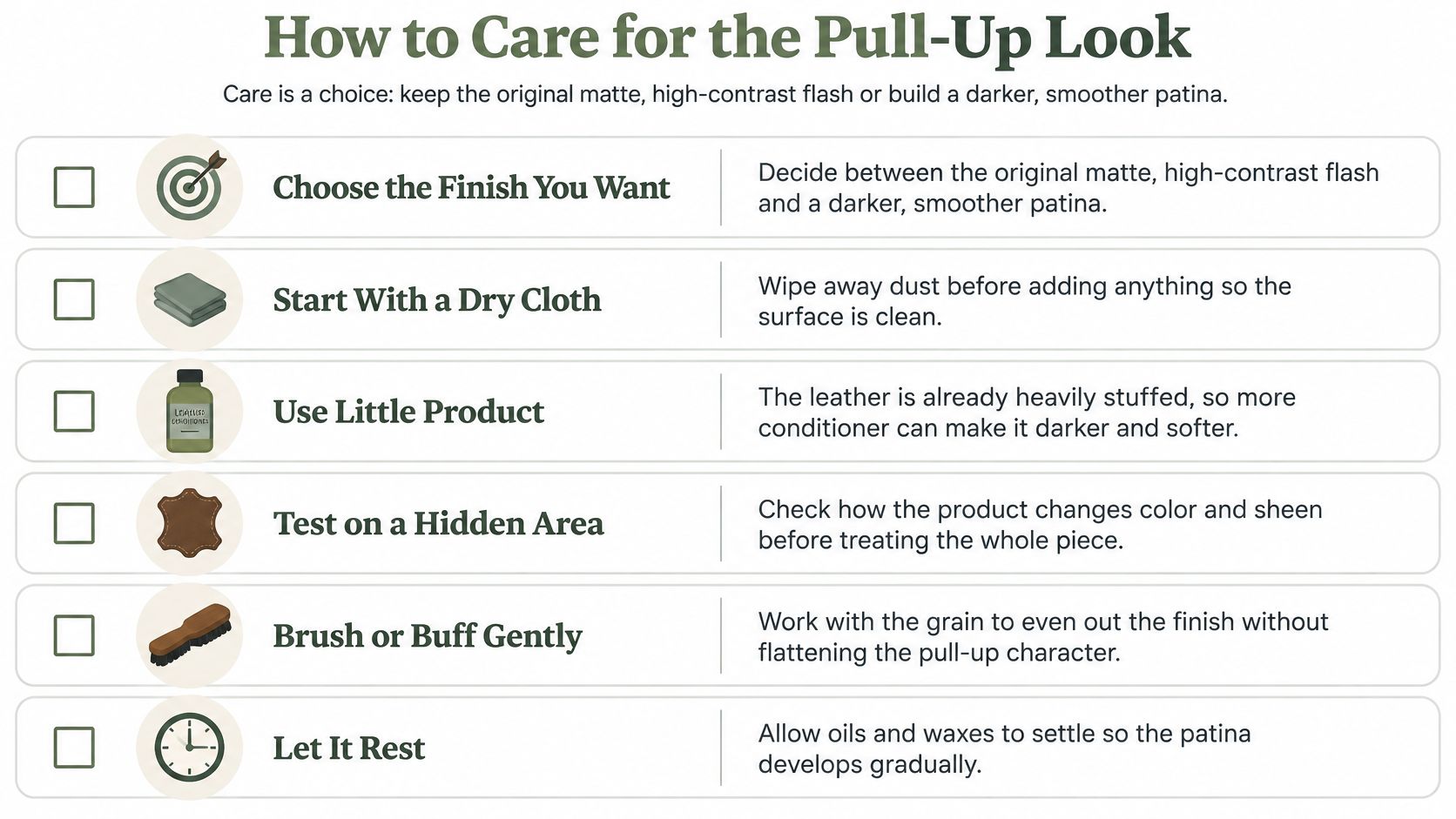
Specialist guidance recommends conditioning rarely and lightly, applying a thin coat, and testing first in a concealed area, and it notes that wax-containing products deepen the pull-up effect while wax-free products suit owners who want to stay lighter (Leather Craft Haven). The reason is straightforward. Pull-up leather starts out heavily stuffed with oils and waxes, so a generous coat doesn't protect it, it alters it. A heavy application can permanently darken the surface, raise the gloss, flatten the color burst, or leave the piece feeling greasy for weeks.
The smallest safe routine
- Dust with a dry soft cloth. Clear the grit before anything wet touches the grain.
- Blot spills, don't rub. Rubbing drives a spill sideways into the pores and spreads the mark.
- Skip household wipes, solvents, and unapproved saddle soap. These strip the finish unevenly and leave a dull patch.
- Test on a hidden edge. The inside of a flap or the underside of a strap shows you the color shift before you commit.
- Use the smallest amount that restores suppleness, then buff. A pea-sized dab is plenty for a portfolio panel.
- Rest the piece away from radiators and soaking rain. Heat and water move the oils unevenly and leave tide lines.
Condition when the leather feels dry, not when the calendar says so. Hands on a briefcase handle, a watch-case lid, or a pen box darken those spots faster than the surrounding panels, and that's use rather than neglect.
If a pale stress mark bothers you: warm it with your hand and rub gently with a soft cloth. Never sand it, and never paint over it.
The same principles that keep furniture leather presentable apply to a bag or a case, and this guide on how to protect leather furniture covers the spill-and-heat rules in more depth. For technique, our walkthrough on how to condition leather takes you through application and buffing step by step.
Care preserves the hide. It doesn't freeze the color, and that's the reason to buy the finish in the first place.
Decide If Pull-Up Leather Fits the Piece
Buy pull-up when the object will be handled daily and you want grain, creases, and a record of use more than a fixed color. Skip it when the brief is stain resistance, a matched set that must stay identical, or a surface that has to photograph the same after a year of carry. There's no wrong answer there, only a mismatch between the finish and the job.
Four things are worth confirming before payment, because the finish name covers none of them: the hide grade stated in words, the thickness in millimetres, the lining material, and how the edges are finished. A burnished edge on a full-grain panel is a different object from a painted edge on a corrected hide, even when both sellers say pull-up.
Start with one daily piece instead of a full matching set. A single briefcase or pen case lets the first season of lightening read as character rather than as a surprise, and a 30-day return window lets you live with the hand-feel before you commit. At Grainmark Leather we craft our pieces in full-grain leather, and we treat natural markings and wrinkles as normal, because full-grain develops a rich patina over time and each hide's imperfections keep a piece unique. That is exactly the expectation pull-up asks of its owner.
Browse Grainmark Leather for full-grain briefcases, portfolios, watch cases, and pen boxes, including pieces in Crazy Horse leather on hand-selected hides, and see how this finish reads on the shape you carry. Pick one piece, carry it for a month, and let the handle tell you whether the surface suits the way you work. Every order comes with a 30-day return policy if the hand-feel turns out wrong.