

How to Store Automatic Watches Without Damage
The most popular piece of storage advice for automatic watches is also the one that costs you the most. Keep it on a winder, the reasoning goes, so it never stops, never needs setting, and never seizes. That advice sells winders. It doesn't protect movements, and a stopped automatic isn't a damaged automatic. It's a watch whose mainspring has run down, sitting with less strain on its components than it carries on your wrist.
What harms a stored watch is duller and far more fixable. Moisture condensing on a cold caseback. A bracelet resting against a clasp for eight months. A crown left half out. A box parked next to a speaker. Get those four things right and the watch comes out of storage running exactly as it went in.
Table of Contents
- Storage Targets and Put-Away Routine
- Days Months and Years Off the Wrist
- Humidity and Leather Watch Cases
- Travel Magnets and Retrieval Checks
- Choose a Case by How Many Watches Move
Storage Targets and Put-Away Routine
Most guides to storing automatic watches start with the box. Start with the room instead, because no case rescues a bad room.
The commonly quoted storage window is 50 to 80°F (10 to 27°C) with relative humidity below 50%, limits aimed at reducing internal condensation and the corrosion that follows it. Read those as outer boundaries rather than goals. They rule out the bathroom, the attic, the basement, a parked car, and any wall shared with a radiator or a window in direct sun.
That list covers most of the places people keep watches.
Why Stability Beats a Perfect Number
Different sources quote slightly different figures, and the number matters less than the steadiness around it. The condensation ceiling sits below 50% relative humidity. For a watch going away for a season or longer, the quoted window tightens to 50 to 70°F (10 to 21°C) with humidity in a 40 to 60% band, held there with passive desiccant and a hygrometer that gets read.
Those two sets describe one principle from opposite ends. A dry room that spikes during a wet week is worse than a room holding a middling level all year, because the swing is what puts water on cold metal. Temperature behaves identically. Lubricants and gaskets don't mind 19°C; they mind going from 19°C to 30°C and back every afternoon.
The practical translation is a room you'd be comfortable reading in, with the door shut, away from exterior walls that sweat. A bedroom wardrobe shelf, an interior hallway cupboard, a study drawer.
A digital hygrometer costs less than a strap and turns all of this from guesswork into a reading. Put it in the safe or cabinet where the watches live, not in the hallway you walk through on the way to the kitchen.
The Targets by Situation
The situation sets the numbers and the position.
| Situation | Temperature | Humidity | Position | Winder |
|---|---|---|---|---|
| Daily rest off the wrist | 10 to 27°C (50 to 80°F) | Below 50% RH | Crown per maker, on a soft pillow | Not needed |
| Multi-month or longer rest | 10 to 21°C (50 to 70°F) | 40 to 60% RH | Stopped, crown secured | Optional, not protective |
| Humid or monsoon room | Stable, avoid swings | Monitor; don't seal damp leather | Separate from a wet strap | No |
| Travel day or weekend | Cabin, never a hot car | Dry single slot | Padded, no metal contact | No |
| Safe or cabinet | Same room target | Hygrometer, not guesswork | One watch per soft compartment | No |
Two rows carry the weight. The first is what you do on a normal Tuesday night. The second is what you do when a watch goes into a drawer for a season, and it's the row where people go wrong by leaving the watch on a winder instead.
The Put-Away Routine, Step by Step
Six steps, in this order, with the reason for each.
- Wipe and dry before anything else. Soft dry cloth over case, bracelet and clasp, then let the watch sit in open air until sweat or rinse water has fully gone. A damp watch sealed into a closed box keeps that moisture against the metal, and a fogged crystal is how it announces itself weeks later.
- Seat the crown as the maker specifies. Push-in crowns go home with light thumb pressure. Screw-down crowns get finger-tight only. An extended crown is a path for dust and moisture, and an over-torqued one wears the threads that keep water out.
- Give the watch its own padded slot. Case, crystal, bracelet and clasp should touch lining, never another watch. That's the entire point of a compartment, and it's why a shared tray defeats the purpose of a good case.
- Place the box in the stable room. Away from windows, radiators, damp walls, bathrooms and anything with a motor or a magnet inside it.
- Let the movement stop. Wind by hand only when the maker says the watch should stay ready, and don't sit there cycling the crown for entertainment. A run-down mainspring is rest, not a fault.
- For a long rest, document it. Reference number, a photo of the dial and caseback, and a look at the crystal and seals before the lid closes. One practical storage guide puts the target at roughly 10 to 27°C with humidity below 50% to limit condensation and material degradation, and advises inspecting valuable or vintage pieces every 6 to 12 months, which is easier to keep to when you've written down the date the watch went away.
If a perpetual or annual calendar makes resetting tedious, buy a winder with adjustable turns per day and rotation direction. Read up on choosing the right watch winder before spending, because a unit set to the wrong rotation just runs the movement one way for a year.
Practical rule: the room does more for a stored watch than the box does. Fix the room first and the box only has to stop scratches.
Formats differ far more in how much separation they give than in how well they control air. Rigid boxes, rolls, chests and zip pouches all do the same job when the interior is soft and each watch has its own space, which is the useful lens for comparing the main types of watch cases. One caution applies to leather specifically: in humid air, a closed leather case holds moisture against the caseback instead of releasing it. If the room runs damp, leave the lid cracked or move the watch somewhere the air moves.
Two Slips That Cause Most Box Damage
Stacking watches on one pillow. Bracelets and clasps are the hardest objects in the box. Press two watches together for a few months and the polished links come out with a fine crosshatch of scratches that no polishing cloth fully removes.
Boxing a watch that's still damp. From a sweaty wrist, from a rinse under the tap, from a wet strap after rain. Water goes in with the watch and stays there, held against metal in a closed space. If you've just washed a bracelet, dry it properly and give it an hour in open air first.
A third deserves mention because it looks like care: the watch left running on a winder for months, in a room nobody checks, beside a phone charger.
What Good Storage Looks Like the Next Morning
Lift the lid and the crystal should be clear, with no haze at the edges and nothing beaded under the glass. The crown should sit where you left it, seated or screwed down, not nudged out by the pillow. The bracelet should show no fresh marks, which tells you nothing shifted overnight. Wind it ten turns, set it, and wear it.
Days Months and Years Off the Wrist
The habits that keep a watch healthy across a weekend aren't the ones that carry it through three years, and most storage advice blurs the two into one list. Split the timeline and the decisions get simple.
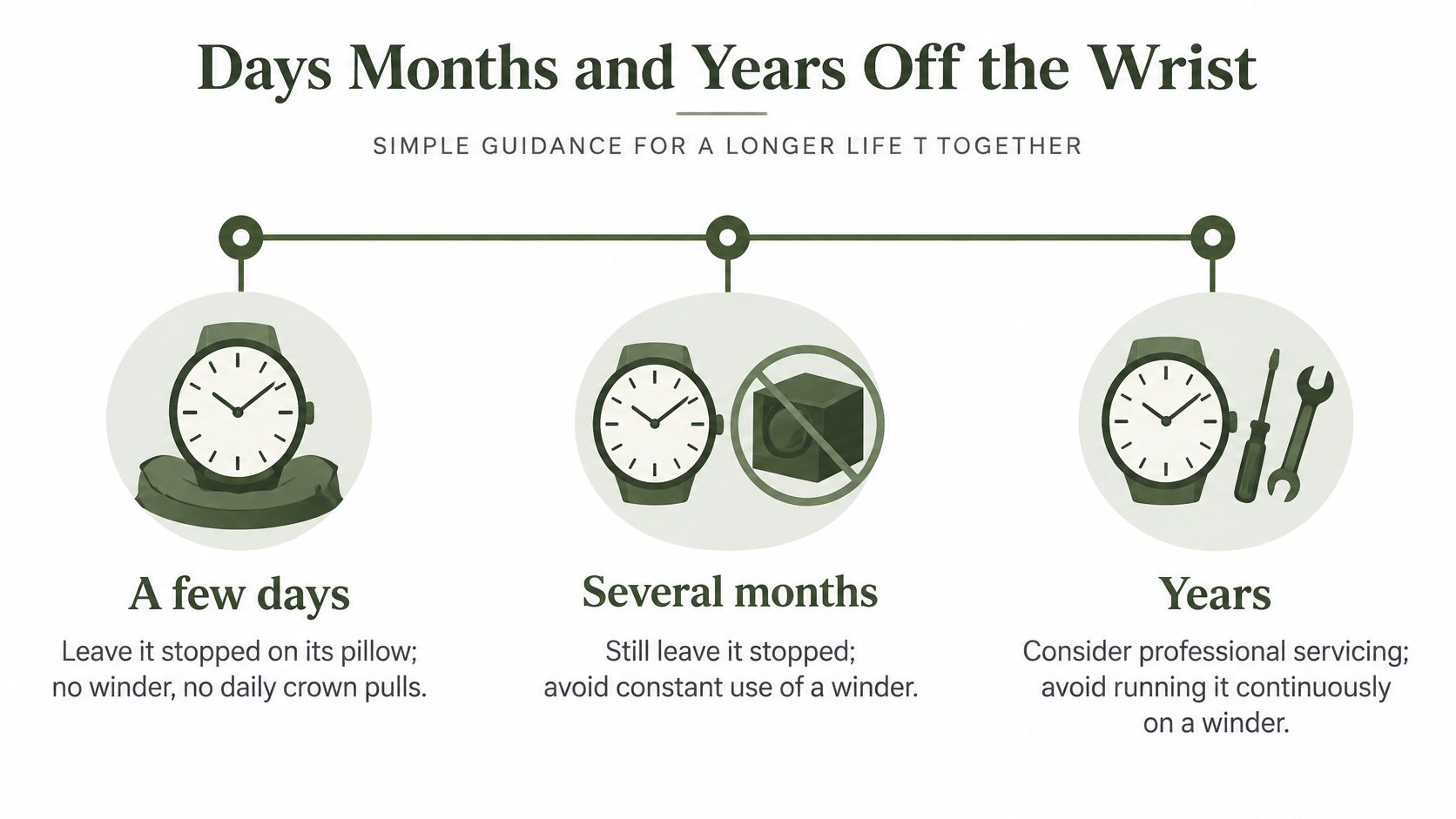
A few days. Leave it stopped on its pillow. No winder, no daily crown pulls, no setting the date for the pleasure of watching the wheels move. An automatic that runs down in a drawer is behaving correctly.
Several months. Published guidance splits here. One watch-care guide argues there's no need to keep a stored mechanical watch running and recommends letting it wind down, while other advice suggests winding it periodically so lubricants redistribute, as this comparison of winders and storage practice sets out. Both positions chase the same goal: oil that stays where it belongs rather than pooling in one spot. They disagree on whether a stored watch should run to achieve it.
My call is to leave the movement stopped for ordinary storage, and to follow the maker's own instructions when the watch has a calendar, moonphase, GMT or anything else that's fiddly to reset. Setting a three-hander takes twenty seconds. Setting a perpetual calendar wrong takes a watchmaker.
Decision rule: if putting the watch right takes under a minute, let it stop. If it takes ten, a winder earns the shelf space.
Years. A winder is convenience, not protection. Continuous running adds wear to the movement and doesn't replace a service, so a watch that lives on a rotor-driven stand for three years arrives at the watchmaker with more hours on it, not fewer.
Put the case somewhere sensible, which for a long-stopped watch means a padded compartment such as a simple leather watch case rather than a bag of loose accessories.
Record the purchase date and the last service date, on paper, inside the box. If you don't know the service history, have a watchmaker look before you trust the water resistance, and don't take a "water resistant" casework claim at face value after years of dormancy. A rate that jumps after a long rest is information, not noise, and it's cheaper to investigate than to ignore.
Humidity and Leather Watch Cases
A leather case is padding and organisation. It isn't a dehumidifier, and in a damp room a closed pouch can hold moisture directly against the caseback, which makes it worse than leaving the watch on an open shelf. Leather is not automatically the safer material. It's the more breathable-looking one.
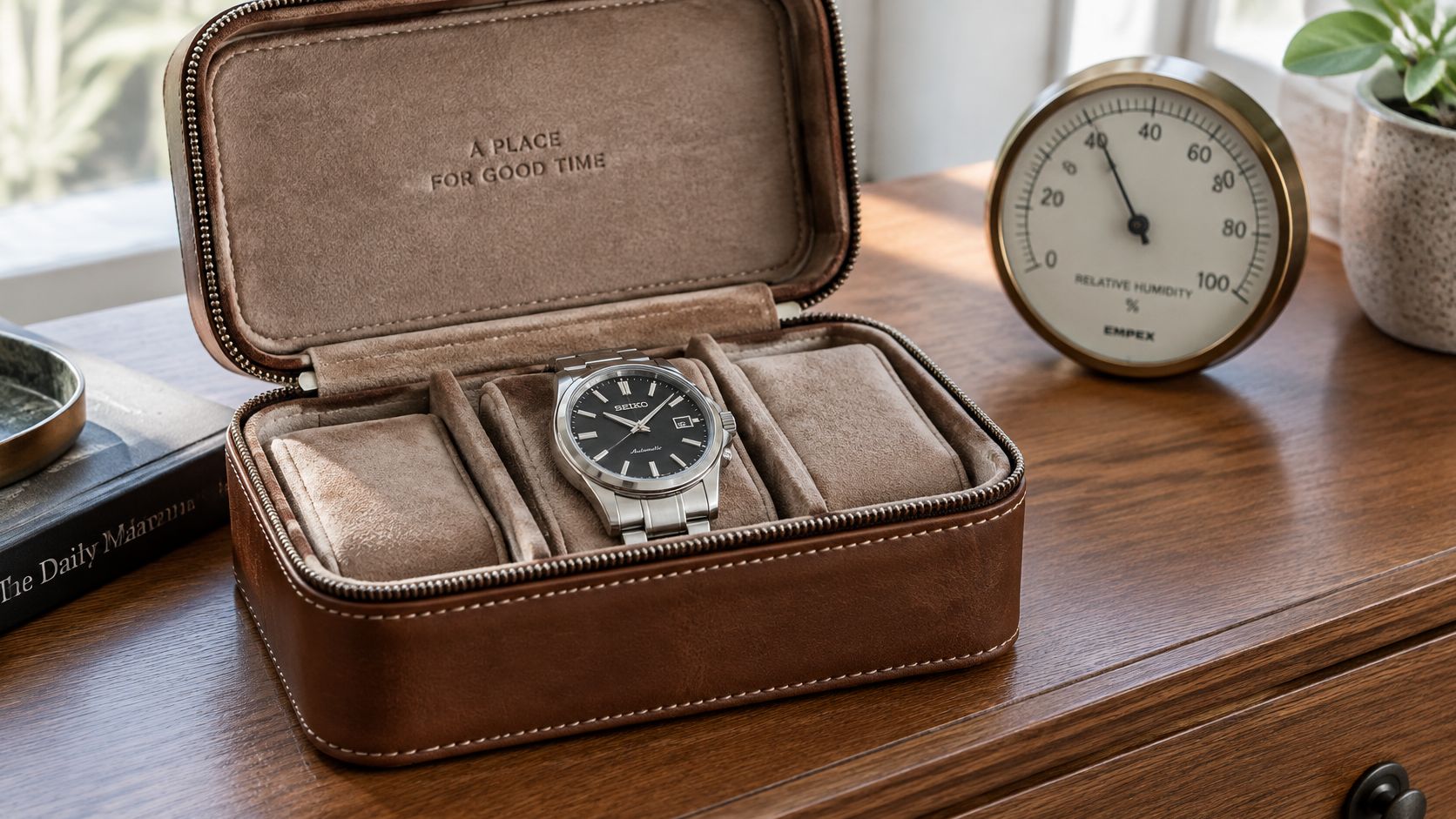
The band most often quoted for indoor air is around 40 to 60% relative humidity, according to this watch care reference, while condensation risk pushes the ceiling lower. Those two numbers pull against each other, and the tension explains why "somewhere dry" is useless advice on its own. Too wet and you condense on the caseback. Too dry and gaskets and leather linings both suffer.
Measured, Not Guessed
Buy a hygrometer and put it where the box sits, not in the next room. Read it in the morning and again on a wet evening, because the evening number is the one that matters. A cabinet that reads fine in July can hit uncomfortable territory in a monsoon week without anything visibly changing.
If you're in a dry, heated flat, that band is easy and you'll spend most of your effort keeping the box away from a radiator. If you're in a tropical or monsoon climate, the same closed pouch that protects a watch in December holds damp air against steel in August.
What Leather Does in Wet Air
Leather takes on and releases moisture slowly, which is why it feels dry while the lining behind it is still holding water. A pouch that was clamped shut after a rainy commute keeps that humidity in contact with the case. Ventilation beats sealing when the interior is damp: open the lid, let both watch and lining reach room temperature in moving air, and only then close it.
- Keep the case off damp walls. A wardrobe backing onto an exterior wall is a worse home than a hallway cupboard.
- Dry the strap separately. A soaked leather strap against a steel case is a moisture source in direct contact. Take it off, dry it flat, and reunite them later.
- Inspect after wet weeks. A trace of fog under the crystal means stop and get it looked at, not wipe and carry on.
Desiccant, Used Properly
Silica gel belongs in the cabinet, never loose against a crystal or a strap where it can abrade or over-dry the surface it touches. Refresh it when the indicator changes color or when the sachet stops doing anything, which in a humid room can be every few weeks. Don't build a desert. Heavy desiccant dries leather out over time, and a cracked lining is its own repair.
Care for the case as leather, separately from caring for the watch. Wipe off dust with a soft cloth and apply a small amount of leather cream if the leather feels dry, which is the same approach set out in this guide to how to condition leather. That's maintenance for the accessory, not a coating for the timepiece.
If the room is damp, open air and a hygrometer beat a shut leather pouch every time.
Travel Magnets and Retrieval Checks
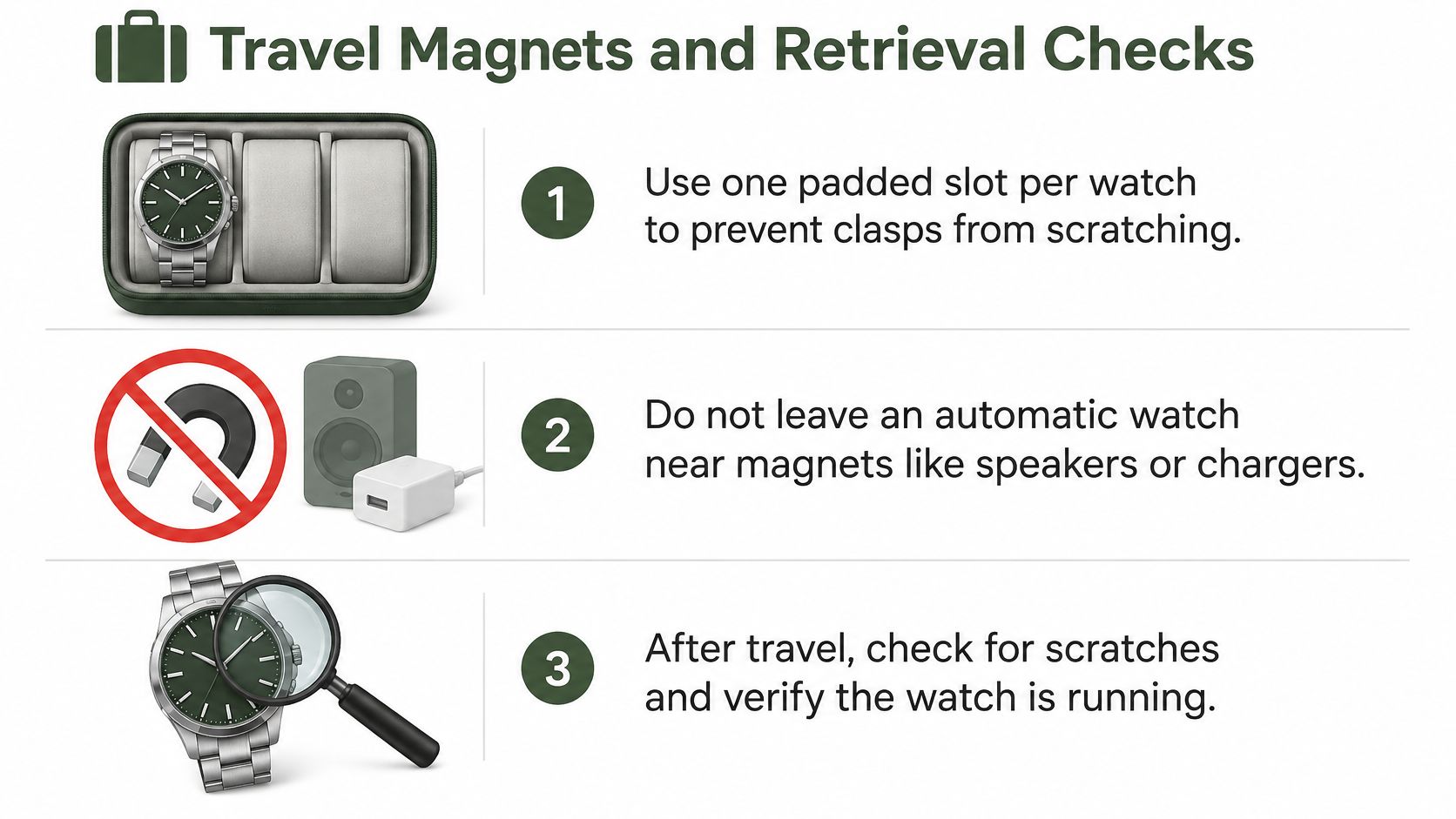
Travel breaks good home setups because everything is compressed into a bag with keys, chargers and a spare strap. One padded slot per watch is the whole defence. A clasp skating across a polished bezel in a rucksack does more cosmetic damage in four hours than a year in a drawer.
Skip the dashboard and the parked car entirely. Heat swings inside a closed vehicle outrun anything a case can buffer, and a hotel bathroom shelf undoes the humidity work in one shower.
Magnets Are Closer Than You Think
Bell & Ross identifies magnetism, shocks, vibration, gravity and ageing oils as factors that reduce mechanical precision, and notes that magnetic exposure can produce significant time gain or loss. The manufacturer advises avoiding close or direct contact with phones, Wi-Fi equipment, security gates and speakers, and references the ISO 764 and NIHS 90-10 magnetic-resistance standards for its watches, as detailed in the brand's technical FAQ.
In storage terms, that means the box doesn't sit on a speaker, a fridge motor, a laptop, a charging station or a wireless charger. A security gate is something you walk through, not a place to park a bag for an hour.
The same FAQ puts a complete service at every four to six years, with the specific timing depending on movement, use, accuracy changes and water-resistance condition. Treat that as a milestone, not a guarantee.
Before You Fasten It On
A two-minute check catches nearly everything.
| Symptom | Likely cause | Next action |
|---|---|---|
| Fog or droplets under the crystal | Condensation from a humidity or temperature swing | Don't wear it; see a watchmaker |
| Sudden gain or loss of minutes | Magnetic field from a speaker, phone or charger | Demagnetise before assuming a service |
| Crown stiff or gritty | Dried oil, debris, or an over-tightened crown | Stop forcing it; get it checked |
| Rust or marks at the caseback | Moisture held against the case | Service and replace compromised seals |
| New scratches on bracelet or bezel | Watches or clasps stored together | Move each watch to its own padded slot |
A wild rate after months in a desk drawer usually means magnetism and a demagnetise, not a strip-down. A gritty crown doesn't get better with force, and abrasion marks tell you the pieces were stored touching.
When a watch leaves the house, the case should be built for the job. A leather watch travel case with individual compartments keeps each piece apart in hand luggage, which is where watches belong, never in checked baggage.
Choose a Case by How Many Watches Move
The right case is a capacity question before it is a taste question. Count the watches that leave the box in a given week and buy for that number plus one slot, because the day you add a piece is the day two watches start sharing a compartment.
A single watch worn most days needs one padded slot in a stable drawer. No winder, no chest, no ritual. A compact daily box earns its place as soon as two or three watches rotate, since each piece needs its own compartment and steel should never meet steel. Past four or five pieces that mostly stay home, the requirement stays the same and only the furniture gets bigger: a chest with compartments that keep every watch apart, crown and clasp clear of the next case.
Shared space is where clasp marks come from. The 2025 U.S. watch-owner study from Jewelers Mutual found that 83% of watch collectors own multiple watches, which is exactly the situation where a shared tray starts costing you scratches.
Match the Format to the Job
- The Daily Compact: for the watch worn this week, kept by the bed or in a desk drawer in the dry room you already chose.
- The travel case: for anything leaving the house, sized so a 42mm case clears the lid with room to spare.
- The Collector's Series chest: for the set that stays home, with compartmentalized storage that keeps each watch apart and clearance for the crown.
All Grainmark Leather products carry a 1-year manufacturer's warranty covering defects in materials or craftsmanship. It does not cover patina, accidental damage or water exposure, which is why the watch goes into the case dry or not at all.
Whichever format you pick, it belongs in the dry room, away from the bathroom and the windowsill, and the lining should be soft enough to leave no mark on a crystal or a bracelet over months of contact. Judge cases on separation and clearance rather than shelf appeal, the same criteria this guide to choosing a watch storage box uses.
Tonight, run three checks. Dry the watch, seat the crown, set it in its own slot, then put a hygrometer where the box lives. If the rate is already erratic or the crystal is fogged, skip the new case and see a watchmaker first.
Grainmark Leather sells full-grain leather watch cases in compact daily, travel and collector chest formats, so the routine above has somewhere to happen. Browse the Grainmark Leather collection to match the case to how many watches move in your week.