
Single Watch Boxes Guide: Types, Sizing and Protection
What if the box fits your watch on paper, but fails it in a suitcase or a humid hotel room? That gap is where most buying advice for single watch boxes stops short. It focuses on leather colour or wood finish, and skips the fit and climate questions that decide whether a crystal stays clear and a movement keeps time.
Treat your choice as a match between one specific watch and the places you'll take it. You'll need its dimensions, the kind of cushioning that holds it still, and a lining that suits your home climate. Once you've got those three things, material and style become easy decisions instead of guesses.
Table of Contents
- Travel, Display and Daily Single Watch Boxes Compared
- Matching Box Size to Your Watch Dimensions
- Leather, Wood and Lined Interiors Compared
- Cushioning and Clearance That Stop Impact Damage
- Magnetic Fields and Humidity to Plan Around
- How to Pack a Single Watch for Travel
- Maintaining the Box and Watch Between Trips
- Choose a Single Watch Box You Will Keep for Years
Travel, Display and Daily Single Watch Boxes Compared
Is this box for moving the watch, showing it, or putting it down at home each night? Start there, because a box that's excellent at one job is often poor at the other two.
| Box type | Best for | Closure | Main trade-off |
|---|---|---|---|
| Travel single box | One watch carried in luggage or a bag | Rigid lid with secure latch | Bulkier and less visible |
| Display single box | Watch shown on a desk or shelf | Open lid or glass top | Little protection in transit |
| Daily drawer box | Watch rotated at home | Soft flap or open top | Minimal impact protection |
| Gift presentation box | Giving a watch as a gift | Hinged lid with branded lining | Often lacks travel padding |
What each format does well
A travel single box uses a rigid shell, a lid that latches shut, and a tight cushion that grips the strap. It's built for compression in a suitcase and knocks in a day bag. You won't see much of the dial while it's closed, and that's the point.
A display box does the opposite. An open or glass top keeps the dial visible on a desk, but there's little to absorb a drop. A daily drawer box is really a shallow resting place for a watch you wear often. It's convenient, quick to use, and it won't protect against much beyond dust and light contact.
A gift presentation box is made for the moment someone lifts the lid. The lining looks smart and the hinge feels ceremonial, yet the padding is often too thin for luggage. Don't mistake a good unboxing for travel protection.
One box or a shared chest
Think of a single box as a private hotel room. A multi-watch chest is a dormitory where each watch sits close to its neighbours, and reaching for one means disturbing the rest.
A watch you wear often, value highly, or carry away from home justifies its own box. A rotating collection that stays at home suits a shared chest.
If you own one watch and travel monthly, choose the travel format and accept the bulk. If you mainly look at the watch on a shelf and rarely move it, choose display and accept that you'll need something else for trips.
Matching Box Size to Your Watch Dimensions
Will the box hold your watch without letting it slide or pressing against it? Start with three measurements: case diameter across the face, excluding the crown; thickness from caseback to crystal; and lug-to-lug length from the tip of one lug to the opposite tip.
Diameter alone can mislead. Long lugs may overhang a cushion, while a tall crown or pusher can press against the lid. The guide to measuring watch case size explains how these dimensions affect fit.
Use the table as a starting point, then compare the guidance with your watch's measurements. The ranges describe common styles, not fixed rules.
| Watch style | Typical thickness | Interior guidance |
|---|---|---|
| Dress or vintage watch | 7–10 mm | Snug cushion with 2–3 mm clearance |
| Sport or diver watch | 11–14 mm | Deeper cushion to clear the crown |
| Oversized diver or chronograph | 14–17 mm | Large cavity; check crown and pusher clearance |
| Smartwatch | 10–14 mm | Cradle or insert, rather than a deep compartment |
| Integrated-bracelet model | 10–15 mm, depending on model | Cavity sized to bracelet width, not strap |
Why fit is a care decision
A well-fitted box limits small knocks and pressure points that can accumulate over years. Poor fit can also leave a watch sliding around, or put repeated pressure on its crown, pushers or crystal. Those risks matter especially for a single watch, because the box must suit that specific case and bracelet or strap.
Check whether the cushion holds a small vintage watch securely without squeezing it. For a large diver, confirm that the lid closes without forcing the watch down. An integrated bracelet should sit without twisting; a smartwatch may need a shaped cradle instead of a deep pocket.
The crown clearance check
- Compare interior dimensions: Check them against your watch's diameter, thickness and lug-to-lug length.
- Close the lid slowly: Stop if the crown or pushers meet resistance.
- Inspect for contact: Pressure against the crystal indicates that the cavity is too shallow.
Vintage watches call for a gentle fit. Their thin cases and softer crystals benefit from a cushion that supports the strap without squeezing the case.
Leather, Wood and Lined Interiors Compared
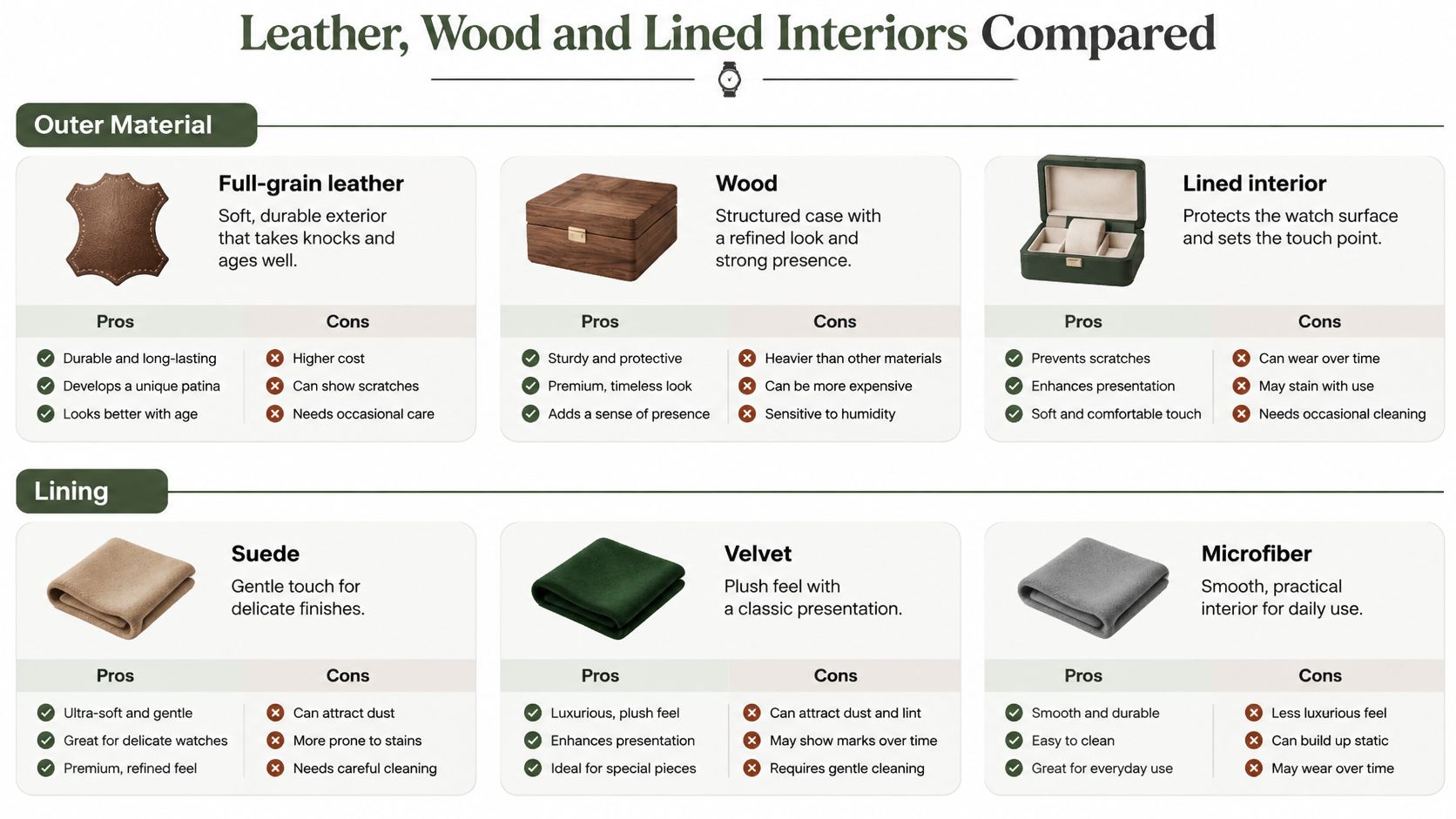
The shell handles impact and the lining handles contact. Judge them separately, because a handsome exterior can hide a lining that's wrong for your climate.
| Material | Protection strength | Moisture behaviour | Upkeep |
|---|---|---|---|
| Full-grain leather exterior | Good scratch resistance, soft wear | Can trap moisture in humid rooms | Occasional conditioning |
| Wood shell | Rigid, strong against crushing | Stable when sealed; holds moisture if unsealed | Dust and occasional polish |
| Suede or microfibre lining | Gentle on case and crystal | Dries quickly | Brush clean |
| Textile padding | Light cushioning, compresses fast | Absorbs moisture | Replace when flattened |
Outer materials in plain terms
Full-grain leather gives you a soft, durable exterior that takes scratches, bends without cracking, and develops character over years. The catch is inside. A leather-lined interior can hold moisture in a humid room, so keep the box dry and leave the lid open for a while after a wet trip.
Wood gives you the most rigid shell and the best resistance to crushing. It's heavier, and it needs a sealed or well-finished interior so the wood itself doesn't hold damp against the watch.
Linings and your climate
Suede and microfibre protect the case and crystal from abrasion, and you can brush them clean. If you're weighing those options, our comparison of suede lining versus fabric explains how each feels and wears. Textile padding is light and inexpensive, but it compresses fastest and absorbs moisture.
Make the decision by use. If you travel often, prioritise a rigid shell and a lining you can clean easily. If you live somewhere humid, choose a breathable interior that dries quickly over one that merely feels plush.
Practical rule: A material claim such as eco-friendly isn't a substitute for checking the lining, the seams, and how the box is built.
Cushioning and Clearance That Stop Impact Damage
Your goal is simple. Hold the watch still so it can't build up speed and strike the wall of the box.
Movement increases collision distance and turns one impact into secondary strikes. That's why a loose watch in a pretty box can come out worse than a snug watch in a plain one.
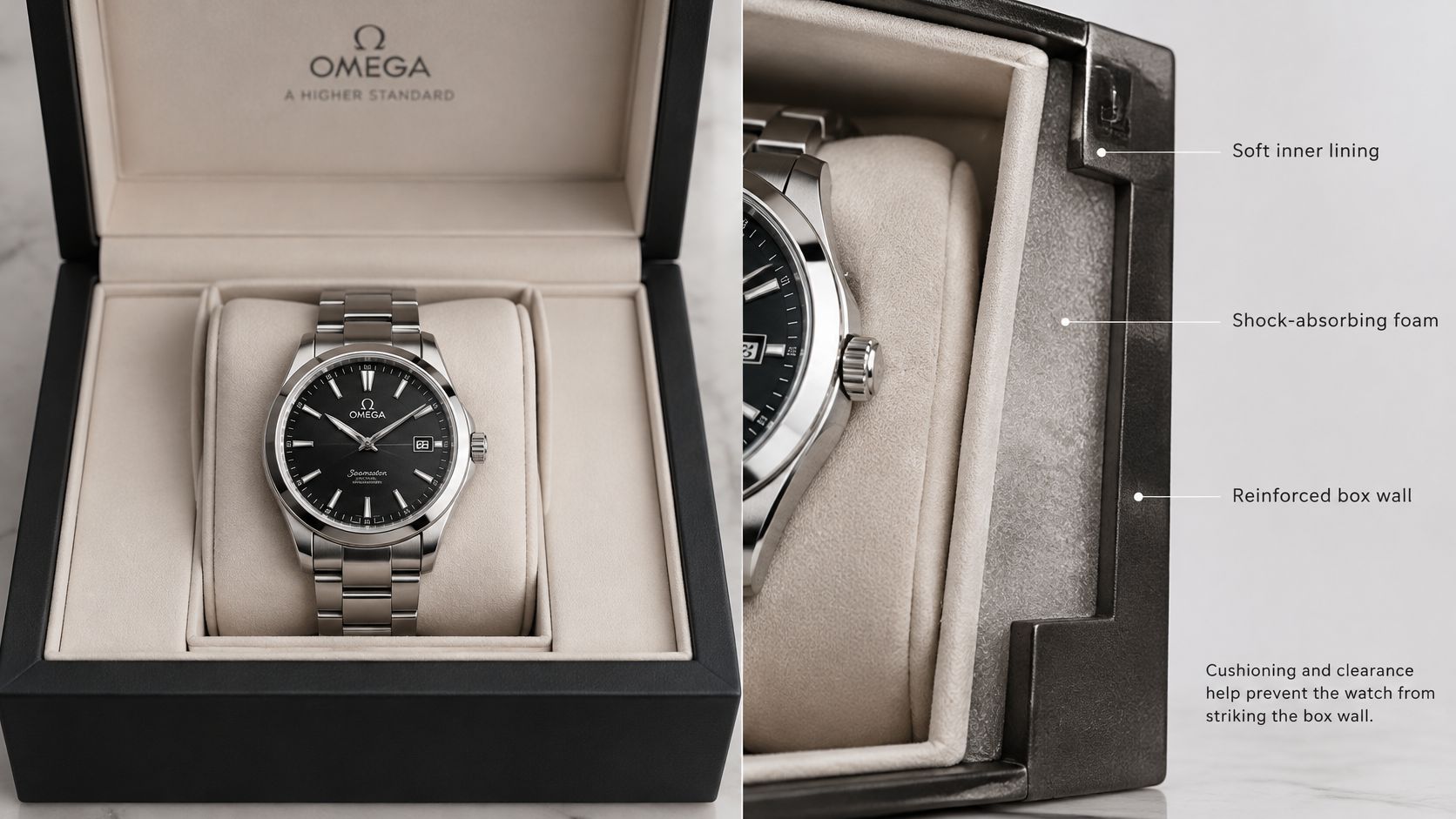
For a sense of scale, ISO 1413:2016 evaluates shock-resistant wristwatches by simulating a free fall from 1 metre onto a horizontal wooden floor. That test doesn't certify a storage box. It gives you a useful engineering benchmark for what a drop in luggage can transmit.
Features that matter in order
- Close-fitting cushion: It holds the watch around the case or strap so it can't slide.
- Progressive compression: The cushion should give gradually, not bottom out against a hard shell.
- Clearance zone: Leave space around the crown and pushers so they aren't pressed into the lid.
- Hardware placement: Keep seams, snaps, and metal parts away from the crystal and caseback.
The same edge logic applies beyond watches. If you're packing fragile items for a move, Foam Edge Protection UK shows how profiled foam guards corners and edges from direct contact, which is the principle your cushion should follow at a smaller scale.
A simple drop test
Load the box with the watch, close it, and drop it from a short height onto a padded surface. Then check clasp security, whether the cushion stayed in place, whether the crystal touched anything, and whether the watch still keeps time. A decorative box often fails at the first two checks.
Magnetic Fields and Humidity to Plan Around
Padding can support physical protection and scratch isolation. It can't, by itself, support a claim of magnetic shielding. Those are three separate claims, and blurring them leads buyers to expect protection a leather or wood box was never tested to provide.
ISO 764:2020 defines a magnetic-resistant watch around exposure to a homogeneous, continuous direct-current field of 4,800 A/m, while enhanced magnetic resistance applies to fields of at least 16,000 A/m encountered at close proximity. Magnetic shielding in a box would require field-strength testing and before-and-after rate measurements. Ordinary materials mainly provide separation and cushioning.
This matters for mechanical watches. A magnetised hairspring can cause large rate errors even when the case looks undamaged, so the first sign of trouble is often poor timekeeping, not a scratch.
Everyday sources to keep away
- Magnetic closures: Found on bags, cases, and some clasps.
- Speakers and tablet covers: Both sit close to a watch in travel bags.
- Charging accessories: Cables and docks often share the same pocket.
- Strong neodymium magnets: Used in some cases and fastenings.
For a compact box, choose a nonmagnetic mechanical closure where you can. If your box has a magnetic closure, carry it in a separate pocket away from other gear. Automatic owners can also review our notes on a watch case for automatic watches for closure and storage considerations.
Humidity needs the same plain approach. Store the watch dry, and never box it while it's still wet from rain or sweat. Keep the box out of direct sun and hot cars. If you're unsure what your watch can handle in water, watch water resistance ratings explained is a helpful refresher before you assume a damp watch is safe to seal away.
How to Pack a Single Watch for Travel
Packing well takes two minutes once it's a habit. Each step removes one common cause of damage.
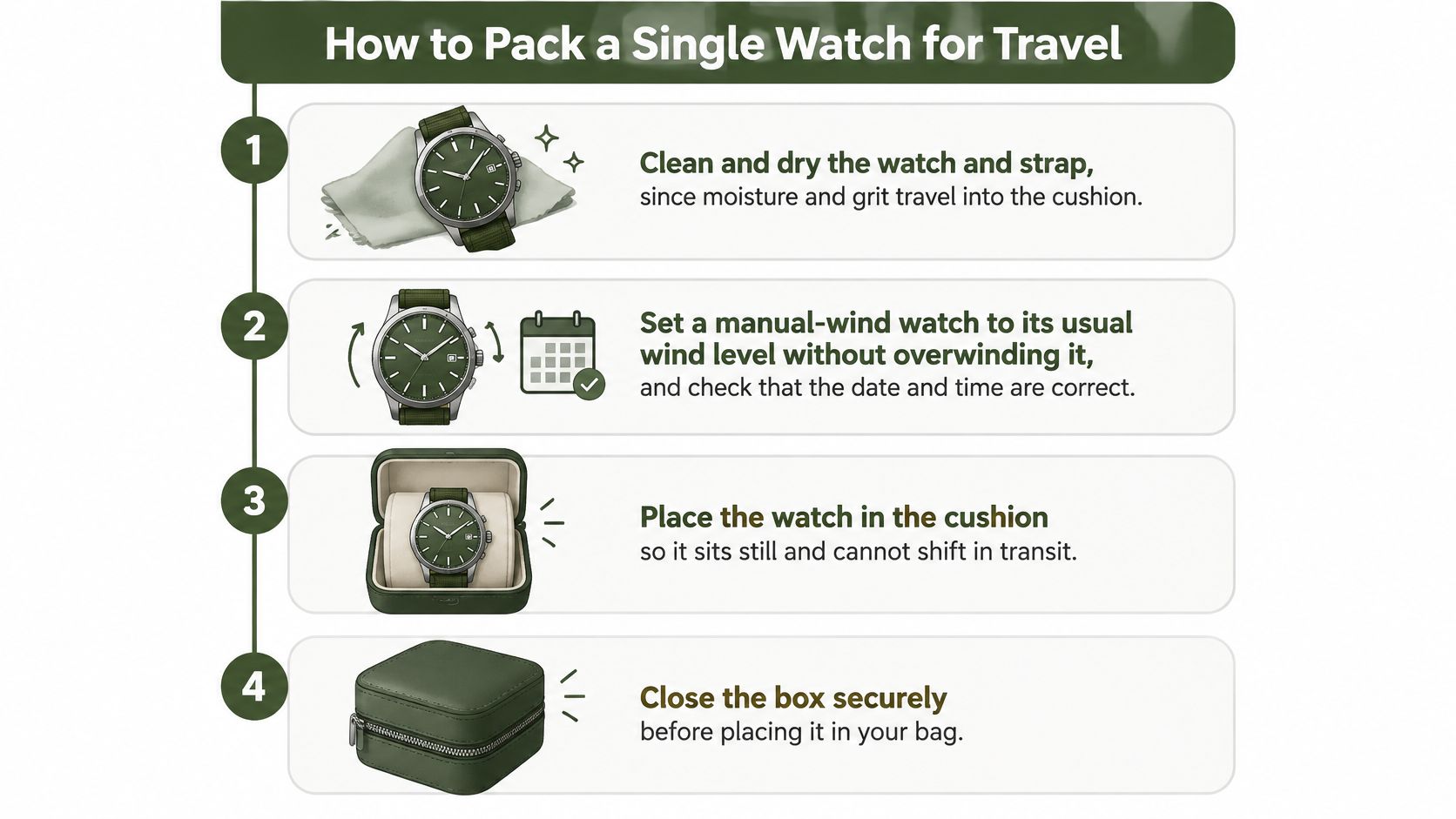
- Clean and dry the watch and strap. Moisture and grit travel straight into the cushion and then rub against the case for the whole journey.
- Set the watch as you normally would. Wind a manual-wind watch to its usual level without overwinding it, and confirm the date and time so you can check timekeeping later.
- Fasten the bracelet or strap. A closed strap forms a loop around the cushion and stops the watch sliding inside the box.
- Seat it in the cushion with care. Position the crown in its clearance zone, not pressed against the lid or the wall.
- Shake the closed box gently. If you hear or feel movement, the cushion is too loose or the watch is too small for the cavity. Fix that now, not after the flight.
- Latch the lid and choose the pocket. Place the box in a padded pocket away from phones, speakers, and charging cables.
- Carry it in hand luggage where possible. If it must go in a checked case, wrap the box in a soft layer and pack it away from hard edges.
Making the routine stick
Keep a short packing checklist in the box lid so the routine stays the same every trip. Consistency matters more than perfection. You'll catch a loose cushion or a damp strap because you're looking for the same things in the same order.
If you prefer a softer format for short trips, our guide to the travel watch pouch explains where a pouch works and where a rigid box is safer. Don't use a pouch as a substitute for a latched box in checked luggage. It doesn't resist crushing in the same way.
If it rattles in your hand, it will rattle in your bag. That one check prevents most travel scratches.
Maintaining the Box and Watch Between Trips
Care between trips is short and mostly dry. You're removing grit, checking compression, and making sure nothing goes back into the box damp.
Caring for the box
Wipe the lining with a dry microfibre cloth after each trip. Brush suede or microfibre clean so dust doesn't build up into an abrasive layer.
Condition full-grain leather occasionally with a leather-safe product, and test it on a hidden spot first. Our step-by-step guide on how to condition leather covers amounts and timing so you don't overdo it. Dust or polish a wood shell with a dry cloth, and confirm the interior stays sealed or well finished.
Check cushion compression each season. Press the cushion and watch how it recovers. Replace textile padding once it has flattened, because a flat cushion lets the watch move and defeats the purpose of the box.
Caring for the watch before it goes back in
Store the watch dry. Never box it while it's wet from rain or sweat, and leave the lid open for a while after a wet trip so the interior can air.
In humid rooms, keep the box in the driest room available. Keep it out of direct sun and hot cars, where heat and trapped moisture work together.
A quick routine after each trip
- Inspect the lining and cushion: Look for grit, flattening, or loose stitching.
- Check clasp and hinge operation: They should close securely without forcing.
- Confirm the watch is ready: It should keep time and show no moisture under the crystal before you return it to the box.
Choose a Single Watch Box You Will Keep for Years
What will make a single watch box useful years from now: a finish you like, or a fit that protects the watch you own? Start with its expected lifespan, whether its lining or cushion can be replaced, and how easily it can be repaired. Consider weight and disposal, too.
A compact, repairable box may serve longer than a cheaper disposable one, even if that box carries a green label. Compare full-grain leather, textile, wood, molded plastic, and recycled materials by durability, repairability, weight, and end-of-life disposal.
For someone with one daily watch, a single box also avoids unused space in a larger chest. That context matters as the McKinsey State of Fashion Watches and Jewellery report notes the pre-owned watch market was projected to reach approximately $29–32 billion in sales by 2025.
Personalisation can make a box more meaningful as a gift, but it may make resale or replacement less practical. Weigh that trade-off against how long you expect to keep both the watch and its case.
Grainmark Leather's watch cases include smart watch cases, The Daily Compact, watch boxes, The Collector's Series watch chests, and watch accessories. Compare The Daily Compact for one-watch use with the Collector's Series for multi-watch storage, then check each option against your watch's measurements and the conditions where you store it.
Measure the watch before you shop. Choose a box that fits its dimensions, suits your climate, and matches how you travel. At Grainmark Leather, the watch case range includes The Daily Compact and The Collector's Series watch chests.