
Watch Display Cases for Men: How to Choose
Buy the biggest glass-top box you can afford and your watches are protected. That's the advice repeated on most product pages, and it's wrong in ways that cost you polished flanks, bent bracelets and fogged crystals. A lid that shows dials doesn't stop two steel cases knocking together, keep a cushion from forcing a bracelet into a tight bend, or hold humidity steady on a sunlit dresser.
Judge watch display cases for men the way you'd judge a good leather bag. Look at the hide, the stitching, the lining and how the piece holds its shape under daily use. Then ask what each watch faces, where it lives, how often it rotates, and whether it travels. Size follows use, not the other way round.
Table of Contents
- Why a Case Protects Your Watches, Not Just Displays Them
- Matching Format and Slot Count to Your Rotation
- Materials and Cushions That Limit Damage
- Display Placement Versus Closed Storage
- Packing a Case for Travel
- How to Care for the Case and the Watches
- Choose the Case for This Month
Why a Case Protects Your Watches, Not Just Displays Them
A case prevents contact, shock and environmental damage. Everything else, including how handsome it looks under glass, comes second. Most men buy one after the first scratch, and by then a drawer has already done the work you paid to avoid.
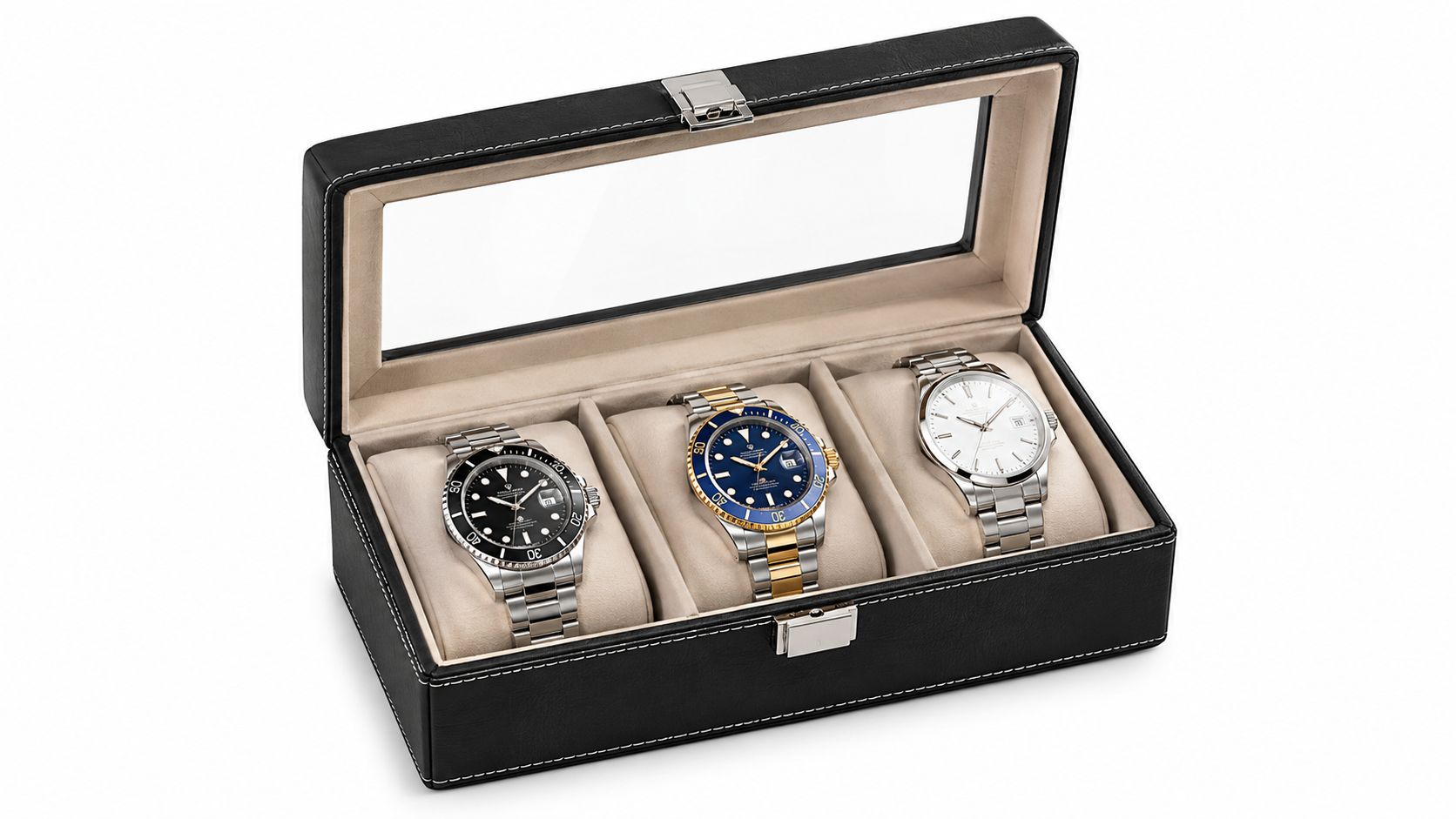
A loose watch in a drawer slides every time you open it. One polished bezel rubs a neighbour's bracelet, a clasp kisses a crystal, and fine marks collect long before you notice a single incident. A compartmented case gives each piece its own slot, so opening, closing and carrying don't turn storage into abrasion.
Three Jobs a Drawer Cannot Do
- Separate hard surfaces: Dividers keep cases, crystals and bracelets from touching, even when the case is lifted or tipped.
- Hold a natural curve: A cushion supports a strap or bracelet in a gentle arc instead of letting it fold flat under the weight of the watch head.
- Give rotation a fixed place: You reach for the watch you want without digging under others, which is when most nicks happen.
Those basics matter because watches aren't disposable accessories. The Swiss federal overview of watchmaking notes that wristwatches generated 95% of industry export revenue, with an average price above USD 1,500 per item. At that level, protective storage is part of ownership, not presentation dressing.
A handsome box can still fail on the risks that matter most. Impact can displace delicate movement parts or crack a crystal. Magnetism can spoil accuracy, and temperature swings can draw moist air past seals. If a case doesn't address contact inside the slot and conditions around it, it's furniture, not protection.
If two watches can touch when you tilt the case, you don't have protection. You have a nicer drawer.
Start with format and slot count for your rotation. Then check lining, cushions, placement and travel use before you spend anything.
Matching Format and Slot Count to Your Rotation
Choose by where the watch spends most of the week, then size to the watches you wear. A commuter with two pieces gains nothing from a twelve-slot chest, and an heirloom set is poorly served by an undivided roll.
| Format | Typical slots | Usual home | Closure | Main job |
|---|---|---|---|---|
| Daily box | 1-4 | Nightstand or drawer | Flap, snap or zip | Protect the watches worn this week |
| Collector chest | 6-12 or more | Desk or cabinet | Lift lid, sometimes glass and a lock | Organise long-term display and papers |
| Travel case or roll | 1-6 | Inside a bag or suitcase | Zip or wrap with tall dividers | Stop watches touching in transit |
| Strap organiser | Straps, not watches | Drawer | Zip or fold | Keep bracelets and straps from tangling |
A daily box works when it's compact, rigid and easy to open one-handed at a nightstand. A collector chest earns its footprint only if you use the tray, store papers with the watches, or keep pieces unworn for weeks. A travel case or roll is a different tool, built around dividers and a secure closure rather than display.
Count the Active Rotation, Not Future Purchases
Multi-watch ownership is now normal, but that doesn't justify maximum capacity. The 2025 Jewelers Mutual watch study, based on more than 1,500 U.S. adult watch owners, reports that 83% of collectors own multiple watches and more than 70% of collectors have some form of insurance. Those figures point to rotation and records, not to buying the largest lid available.
Use three bands and stay honest about which one fits:
- One to two slots: A true daily rotation, short trips, or one watch worn while another rests.
- Four to six slots: A compact working collection with daily, formal and weekend roles covered.
- Larger chests: Organised long-term storage, documentation kept together, or high-value pieces separated deliberately.
Empty slots aren't harmless. They waste desk and drawer space, make a case awkward to carry, and tempt you to fill space you didn't need. I would pick the smallest format that holds the active rotation plus one spare slot, especially if one piece is large or thick. If case diameter or height is your constraint, check guidance on choosing a watch box for large watches before you assume a standard cushion will fit.
Photograph each watch as you assign it a slot. Record references and receipts in the same routine, and keep high-value pieces in a lockable or discreet closed case rather than an open display in a shared room.
Materials and Cushions That Limit Damage
Protection is control of contact, not a soft appearance. A plush-looking interior can still shed fibres across a dial or let a watch roll into its neighbour.
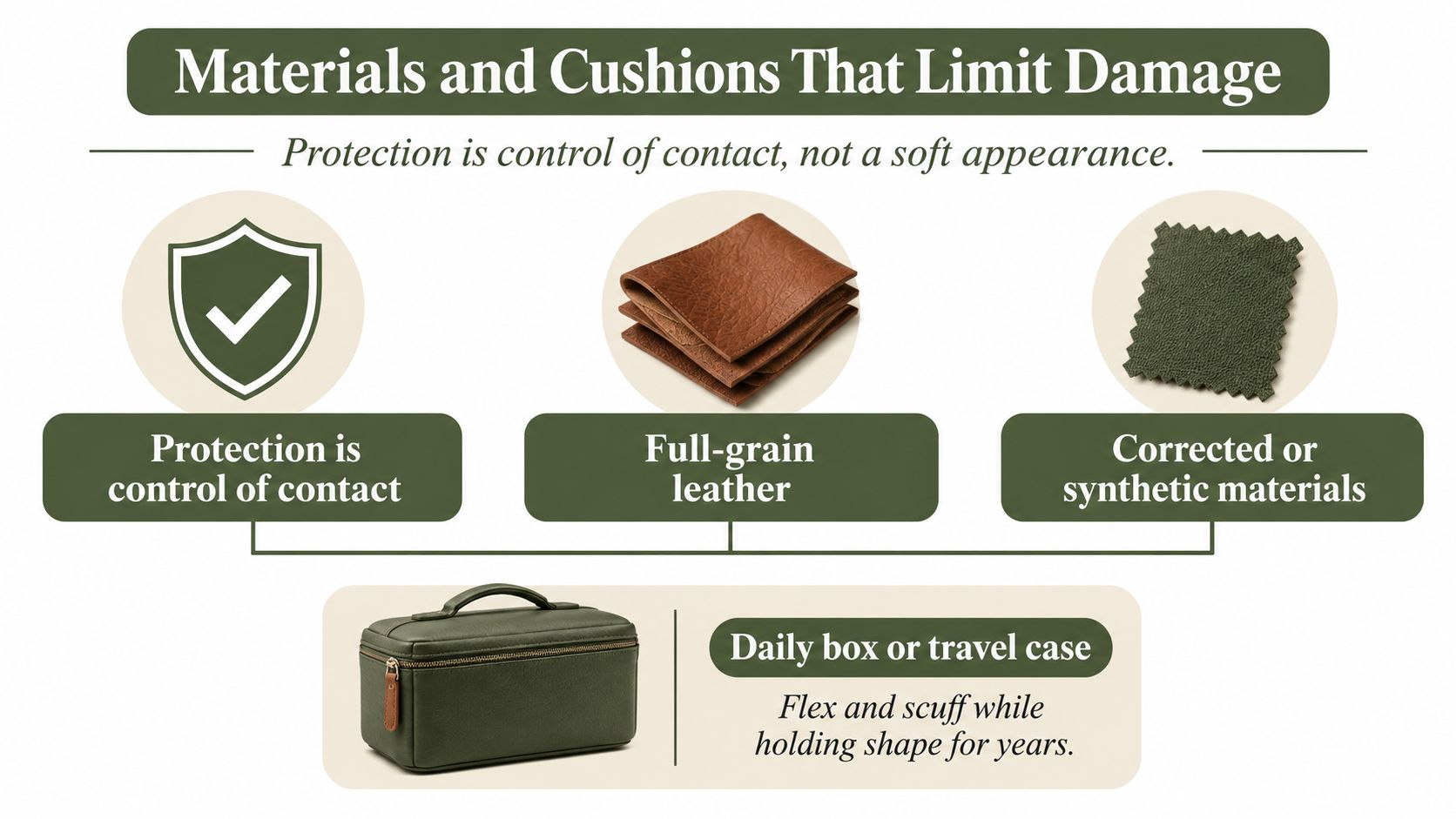
Full-grain leather keeps the outer hide intact, so a daily box or travel case can flex, scuff and still hold its shape for years. Corrected or thinly finished leather looks even at first, then wears through at corners, folds and hinge lines where your hands work it daily. On a travel piece, check stitching at stress points the way you'd check a bag handle. Loose thread at a hinge tells you more than surface shine.
Inside, the lining must be non-abrasive and non-shedding. Suede, microfibre or tight cotton won't sand polished flanks each time you lift a watch out. If you are weighing interior options, compare the trade-offs in suede lining versus fabric rather than judging softness by touch alone.
Cushions and Dividers Do the Real Work
Each slot needs a compressible cushion that holds the watch without forcing an integrated bracelet into a sharp bend. Removable pillows beat fixed narrow ones because they fit thick dive cases, small dress watches and different lug widths. A fixed narrow pillow can point-load lugs or a clasp, concentrating pressure exactly where you don't want it.
| Component | Choose | Avoid | Damage it prevents |
|---|---|---|---|
| Outer shell | Full-grain leather | Corrected or thinly finished leather | Scuffing and wear at corners and hinges |
| Lining | Suede, microfibre or tight cotton | Loose or shedding fibres | Sanded polished flanks and crystals |
| Cushion | Removable, compressible pillow | Fixed narrow pillow | Bent bracelets and point loading on lugs |
| Divider | Tall, rising above the watch | Low divider | Contact between watches during transit |
| Closure | Nonmagnetic where feasible | Magnetic clasp near the movement | Magnetised balance spring |
That contact-first view matches Horology Kings guidance on watch maintenance, which warns that watches stored close together can abrade polished cases, bracelets and crystals when a case is carried or a lid is closed. It also notes that magnetic exposure can magnetize ferrous movement components, including the balance spring, causing abnormal timekeeping.
Magnets are the less obvious risk. Keep magnetic clasps away from watch compartments, favour a nonmagnetic closure where feasible, and don't store the case beside speakers, charging pads or magnetic phone holders. If the cushion bends the bracelet or the lining sheds, the interior is wrong even when the exterior looks expensive.
Display Placement Versus Closed Storage
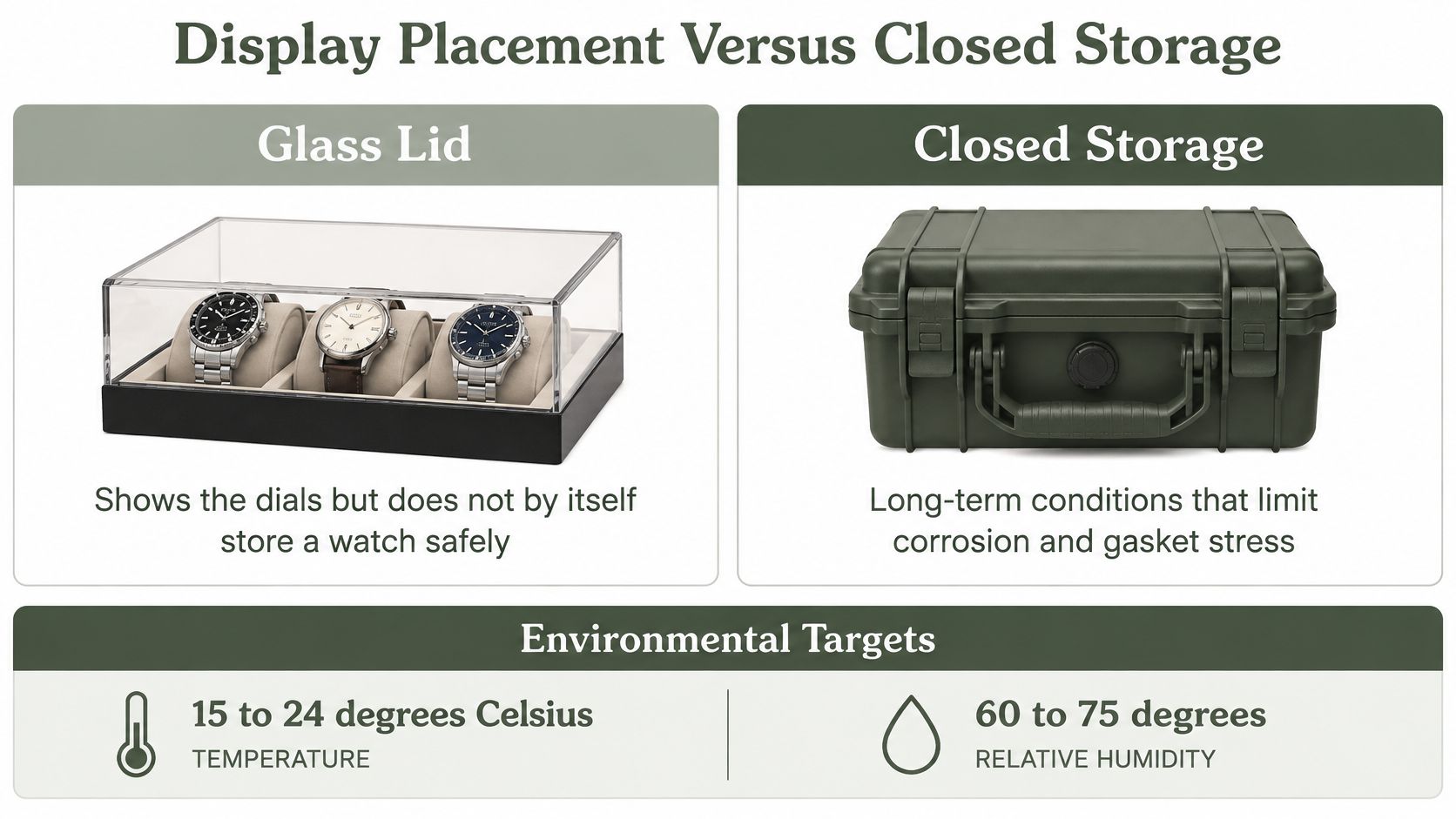
A glass lid on a sunny dresser looks like care. In practice it can heat the interior, fade a leather strap and cycle temperature every afternoon. A monitored closed chest in a shaded room does the opposite work, even if nobody sees the dials.
| Factor | Target | Avoid | Risk it limits |
|---|---|---|---|
| Temperature | 15-24 °C (60-75 °F) | Repeated swings | Expansion and contraction drawing moist air past seals |
| Relative humidity | 40-60% | Humidity that stays outside range | Condensation and corrosion |
| Location | Stable indoor room | Bathroom, garage, attic or exterior-wall cabinet | Humidity spikes and temperature swings |
| Light | Out of direct sun | Sunlit glass display | Heated glass and faded straps |
Those ranges come from We Know Watches guidance on long-term storage without damage, which puts long-term storage at 15-24 °C (60-75 °F) and 40-60% relative humidity. Temperature swings are the particular concern because repeated expansion and contraction can draw moist air past crown or caseback seals, increasing condensation and corrosion risk.
What Closed Storage Needs That Display Doesn Not Provide
A practical chest is rigid, closes properly and includes a replaceable desiccant compartment and a digital hygrometer you can read without unpacking every watch. Loose silica packets dropped against a bracelet aren't a compartment. They shift, touch metal and tell you nothing about whether conditions are in range.
Keep the case in a stable indoor room, never a bathroom, garage, attic or a cabinet on an exterior wall. A bedroom display needs shade and stable air. A travel case needs dividers that prevent contact while a bag moves. Those are different problems, and one product rarely solves both equally well.
Monitoring rule: Treat the ranges as a check, not a promise. Good storage can't compensate for damaged gaskets, an unsealed crown or overdue servicing.
If you also rotate rings or cufflinks on the same dresser, keep them separate from watch slots. A jewelry display tray beside the case is safer than loose metal pieces sharing a watch compartment. Inspect watches and lining together, and follow a brand's stricter limits when they exist.
Packing a Case for Travel
Pack for the trip, not for the display. A watch that stays home faces no zip teeth, no shifting luggage and no hot car.
- Choose structure first: Pick a roll or travel case with tall dividers and a zip or wrap, so each watch sits in its own slot and can't slide into a neighbour when luggage shifts.
- Load the vulnerable piece carefully: Put the largest or most delicate watch in the slot with the most cushioning, and keep it clear of the zip so the teeth can't scratch the crystal.
- Test cushion fit at home: Check each removable cushion against lugs and case thickness before you leave, because a deep dive watch in a shallow pillow can rest on its crystal once the case closes.
- Carry it with you: Keep the case in hand luggage or a day bag rather than checked baggage, where it faces heavier impact and bigger temperature changes.
- Slow down on arrival: Let the case reach room temperature before opening it if it has sat in a hot car or sunlit room, then wipe sweat from cases and straps before you store them again.
- Recreate home conditions: Store the travel case in a stable indoor spot, not in a hot vehicle or on a balcony.
Only pack the watches you'll wear. Each extra piece adds weight, contact risk and something else to keep track of in a hotel room. If you travel with rings or other small valuables alongside watches, practical steps to keep jewelry secure in hotels are worth applying to the same day bag routine.
A roll suits soft packing around clothes. A rigid travel case suits a briefcase or cabin bag where other hard objects press in. For format differences that affect men who commute as well as fly, compare options for a watch travel case for men against how your bag is packed, not how neat it looks empty.
Pack one watch on your wrist and one in the case for most short trips. A third watch usually travels for photographs, not for wear.
How to Care for the Case and the Watches
Care is a short routine, not a restoration project. Do the same six checks in order and you'll catch most problems while they're still cheap.
- Wipe before storage: Clean metal and crystal with a clean dry cloth before the watch goes in, so sweat doesn't sit in the lining overnight.
- Set the cushion properly: Rest the case flat and let each bracelet or strap curve gently, with no clasp pressing into a neighbouring watch.
- Close and confirm separation: Shut the lid fully and confirm dividers still separate every watch, especially after travel.
- Check humidity: Read the hygrometer if your chest has one, and replace the desiccant when humidity stays outside the target range.
- Inspect every few weeks: Lift each watch and look for lining rub, loose stitching, shedding fibres or a flattened cushion, then air the interior briefly in a dry room.
- Condition only the exterior: Condition full-grain leather lightly and rarely, and never put oil on a suede lining or on the watches themselves.
Technique matters more than product quantity with leather. If you are unsure how much conditioner a case exterior needs, follow a specific routine for how to condition leather and stop before the surface feels tacky.
A chipped crystal or loose crown is a service issue, not a case issue. Keep that watch out of a shared slot until it's sealed and serviced again, because a compromised piece can shed debris and needs different handling from a healthy watch in rotation.
Choose the Case for This Month
Decide in a fixed order. Looks come last, after job, slots and fit.
First, name the primary job. Is this daily carry from nightstand to wrist, a desk collection that stays closed for weeks, or travel protection inside a moving bag? One answer should dominate. If travel is occasional, don't let it dictate a bulky everyday chest.
Second, set slots to the active rotation plus one spare. Don't buy capacity for watches you might own next year. You can add a second, purpose-built case later and end up with a better match than one oversized compromise.
Third, check the build. You want a durable outer shell, a non-shedding lining, removable cushions and tall dividers if the case will travel. Run a thumb along stitching, squeeze each cushion, and close the lid with your tallest watch inside. The lid shouldn't press the crystal.
Closure and Monitoring Depend on How Long It Stays Shut
Fourth, judge closure and monitoring by dwell time. A hygrometer and desiccant bay matter most when a chest stays closed for weeks. A lock or plain closed box suits valuable watches in a shared room better than glass. For a two-watch daily box you open every morning, easy access and cushion fit matter more.
Fifth, confirm depth and lid clearance with the actual watches, including a thick diver on a bracelet. Manufacturers measure slots differently, and a beautiful case that forces a bend is the wrong case.
I would start with the format that matches this month's rotation, then add a travel case only if more than one watch leaves home. Grainmark Leather's watch cases come as smart watch cases, The Daily Compact, watch boxes, The Collector's Series watch chests and watch accessories. Within that range, the Slim 2-Slot Watch Case listed at €43,16 suits a two-watch daily or weekend carry, while the 12-Slot Watch Strap Organiser sold for €71,96 keeps bracelets and straps out of watch pillows and in their own compartments.
Visit Grainmark Leather to choose a full-grain case sized to the watches you rotate, from a slim two-slot carry to collector chests and strap organisers. Pick the format that matches this month's use, check cushion fit with your tallest watch, and give each piece its own protected slot.