Personalized Leather Dopp Bag: Sizes, Monograms and Care
You're standing at the bathroom counter the night before a flight, trying to force a toothbrush, a razor and three bottles into a pouch that looked generous online. The zipper strains, the corners bulge, and you already know you'll be digging through it on a wet hotel sink tomorrow. That's the moment when size, leather quality and personalization stop being shopping details and start deciding whether a personalized leather dopp bag works on a trip.
A good one should fit your carry-on, survive damp counters and repeated opening, and still show your initials clearly after years of handling. I'd judge it in that order. Looks come last.
Table of Contents
- Dopp Bag Sizes and What Fits Inside
- Full-Grain Leather and Build Quality That Lasts
- Personalization Methods and How Initials Age
- Carry-On Rules and How to Pack the Dopp Bag
- Gift and Everyday Use Scenarios
- Cleaning, Drying and Long-Term Care
- Confirm These Points Before You Order
Dopp Bag Sizes and What Fits Inside
You're in the security line with a bag that's too full to zip cleanly and too bulky to slide easily from your carry-on. The traveler behind you is already unpacked. You're still wrestling bottles upright while your toiletries spill toward the tray. Most of that frustration was decided when you picked the size.
Most buyers need one of three sizes, and the right one depends less on how much you own than on how you'll travel. A bag that's perfect in checked luggage can waste precious carry-on space. A compact bag that suits an overnight trip will punish you on day four of a longer stay.
The Three Sizes That Cover Most Trips
Dopp bag sizes by trip and contents
| Size | Approximate dimensions | Typical contents | Best for |
|---|---|---|---|
| Compact | about 6 x 4 x 3 in (15 x 10 x 8 cm) | Razor, toothbrush, two or three travel bottles | Overnight trips and tight carry-on limits |
| Standard | about 9 x 5 x 4 in | Full daily routine, travel-size bottles, shaving kit, small charger | Trips of one to two weeks |
| Large | about 11 x 6 x 5 in | Full-size bottles, electric razor, charger cable | Extended travel and checked luggage |
The compact size works when your routine is minimal. You'll fit the basics, but there's no spare room for an electric razor, a second charger or a bulky shaving brush. If you regularly add items at the last minute, you'll outgrow it fast.
The standard size is the one I'd recommend for most readers. It holds a full daily routine without encouraging you to pack products you won't use, and it sits flat along the side or spine of a carry-on. For trips of one to two weeks with travel-size bottles, it's usually the balanced choice.
The large size solves a different problem. It's built for full-size bottles, longer stays or checked luggage where volume matters less. In a carry-on, that extra bulk has a real cost, and it can tempt you to pack more liquids than your allowance covers.
Bigger isn't more convenient if the extra space just invites bottles you'll have to remove, rearrange or leave behind at screening.
A Three-Question Check Before You Choose
- How many days are you away: One night points to compact, several days to two weeks points to standard, and extended travel may justify large.
- Will the bag ride in a carry-on: If yes, measure the space left after clothes and shoes, not the empty suitcase.
- Do you carry full-size bottles: If you do, be honest about whether they'll travel in checked luggage or stay home in smaller containers.
Don't choose by dimensions alone. Lay out everything you'd normally pack, including the razor case and charger, then compare that pile with the bag's footprint. If the pile already looks crowded on the counter, it won't improve inside leather walls.
Those dimensions are approximate, and makers measure gussets and zipper allowances differently. Measure against your own luggage before ordering, especially if your carry-on is already tight. A standard personalized leather dopp bag that fits your suitcase and your routine will serve you better than a larger one bought for capacity you'll rarely use.
Full-Grain Leather and Build Quality That Lasts
Full-grain leather means the top grain layer stays intact rather than being sanded and corrected to hide surface marks. For a toiletry bag, that matters because the surface faces repeated opening, compression in luggage, damp counters and friction from bottles. A corrected surface can look flawless on day one and still wear less gracefully where it folds and rubs.
That doesn't make full-grain a guarantee. Thickness, tanning, lining, stitching and hardware decide whether the bag keeps its shape or starts failing at the gusset and zipper ends. Judge the whole build, not the leather label alone.
What to Check, in Order
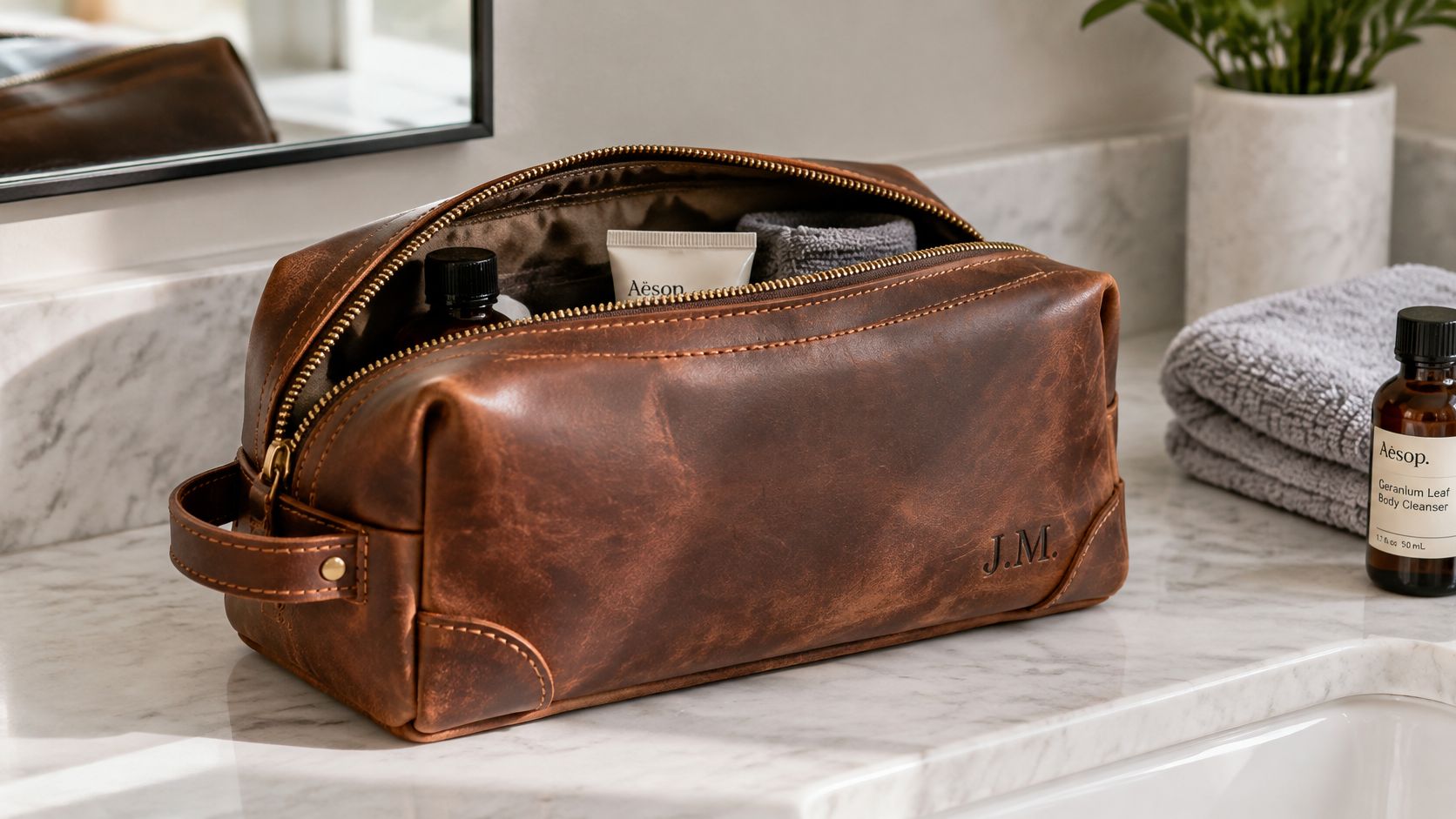
Start with the exterior leather. It should feel substantial enough to hold a boxy shape when empty, without being so stiff that the mouth won't open wide. A structured bag lets you see a razor beside a toothbrush instead of forcing you to tip everything onto the counter.
Next, check the lining. Cotton feels traditional, but a wipe-clean coated fabric is easier to manage after a shampoo leak. Ask whether the lining is fixed or removable, because that affects how thoroughly you can clean and dry it.
Then look at edge finishing, zipper quality and stitching density. Edges should look sealed and even, the zipper should run without catching at the corners, and stitching in the gusset should be tight and reinforced. Stress concentrates where the sides fold and where you pull the zipper open every morning, so that's where weak construction shows first. Our guide to judging leather bag quality covers these construction checks in more detail.
Tests That Map to Real Toiletry Use
Serious makers can test samples before production instead of relying on appearance. The leather quality management protocols include ISO 3376 for tensile strength and elongation, ISO 3377-1 for tear strength, ISO 5402-1 for flex resistance, ISO 11640 for dry and wet rubbing fastness, and ISO 3378 for grain-cracking resistance.
Those names sound abstract until you map them to travel. Repeated opening stresses the grain and seams, bottle friction can cause color transfer or surface wear, and damp bathrooms make wet-rub performance especially important. Flex testing matters because it exposes cracking, whitening and delamination under repeated bending.
- Lining check: Is it wipe-clean, and can spills reach the leather shell?
- Gusset check: Is the fold reinforced where the bag opens and compresses?
- Evidence check: Can the seller share sample testing or test results for abrasion, flex, tear and wet-rub performance?
I'd also ask where the personalization sits. Embossing on a relatively flat panel avoids high-flex zones such as the gusset fold or zipper ends, which reduces stress on the letters. Treat the leather, lining, edge paint and personalization area as one system, because a strong hide can't compensate for a weak liner or a zipper that fails first.
Personalization Methods and How Initials Age
The decision isn't just whether to add initials. It's whether those initials will still be legible after repeated folding, bathroom moisture, cleaning and years of being pulled from luggage. Each method ages differently, and placement can matter as much as the method itself.
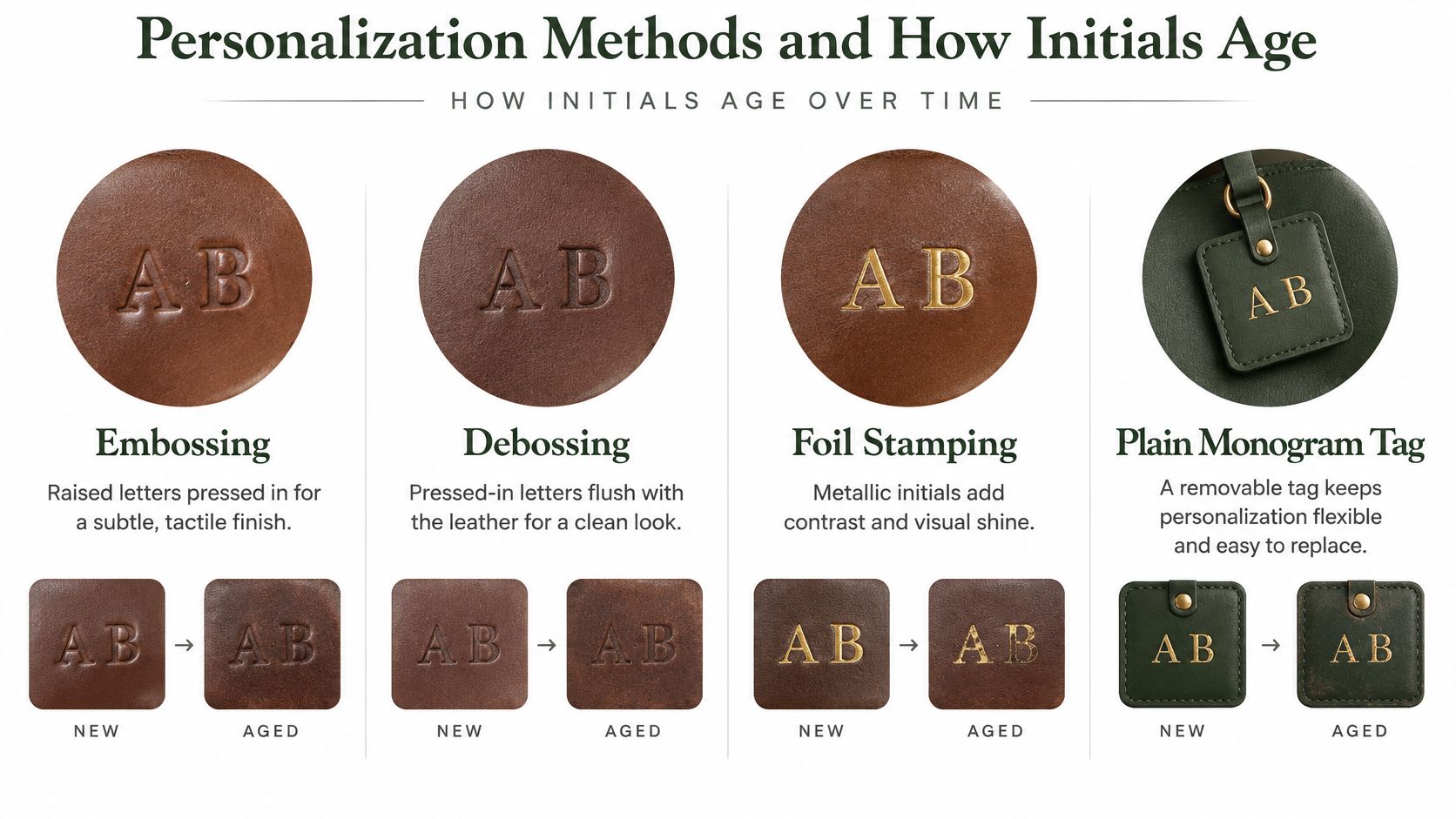
Monogram methods and how they wear
| Method | How it looks | Typical wear pattern | Best for |
|---|---|---|---|
| Embossing | Raised letters pressed into the leather | Can soften with repeated folding and handling | Decorative pieces on rigid panels |
| Debossing | Letters pressed in, flush with the surface | Keeps its shape and ages more evenly | Everyday travel use |
| Foil stamping | Metallic film applied to the surface | Can flake or fade under friction | Formal gifts on flat panels |
| Painted or ink | Colored paint or ink on the surface | Can rub off with moisture and abrasion | Accent details with light use |
How Each Method Wears
Embossing gives you raised, tactile letters, but those raised edges take the contact when the bag rubs against other items. On a rigid panel, it can hold up well. On a flap that folds every time you open the bag, the letters can soften and lose definition sooner.
Debossing presses the letters into the surface, so the surrounding leather takes much of the everyday abrasion. It's subtler than foil and usually ages more evenly with the hide. For a bag you'll use weekly, I'd choose debossing on a flat panel as the default.
Foil stamping creates the sharpest contrast, especially in gold or silver, which is why it suits formal gifts. The trade-off is plain, since a surface film can flake or fade where hands, counters and luggage rub it. Painted or ink initials offer color choice, but moisture and abrasion can wear them, so they're better as light-use accents than as the main mark on a hard-working toiletry bag. Our complete buying guide to leather bags with initials is useful if you're comparing layouts before committing.
Placement and the Gift Risk
Keep a monogram to a few characters on a flat, relatively rigid exterior panel. Avoid the gusset fold, zipper ends and any flap that bends every time the bag opens. A short monogram also stays legible at a smaller size, while a full name needs more space and gives friction more edges to attack.
Placement rule: If the leather bends there every day, don't put the initials there.
For gifts, confirm the recipient's initials, preferred name order and spelling before ordering. A monogram that's wrong, too formal or not to their taste turns a thoughtful gift into something they can't exchange easily and may not want to use. Personalization also reduces resale and hand-me-down flexibility, so it suits a known long-term owner best.
My two defaults are simple. Choose subtle debossing on a flat panel for everyday durability, or foil on a flat panel for a formal gift while accepting that it needs gentler handling. Don't pay for a method that looks sharp in product photos but sits where toiletries, moisture and folding will wear it fastest.
Carry-On Rules and How to Pack the Dopp Bag
Yes, you can use a personalized leather dopp bag in a carry-on, but it's an outer organizer, not a replacement for the transparent liquids bag. Under the TSA liquids, aerosols and gels rule, liquids, gels, aerosols, creams and pastes must generally be in containers of 3.4 oz (100 mL) or less, fit in one clear quart-size bag, and be accessible during screening.
That's the U.S. baseline. Airlines and destinations can apply stricter requirements, so check your carrier and destination separately before you fly. Don't assume that a routine that worked on one route will pass unchanged on another.
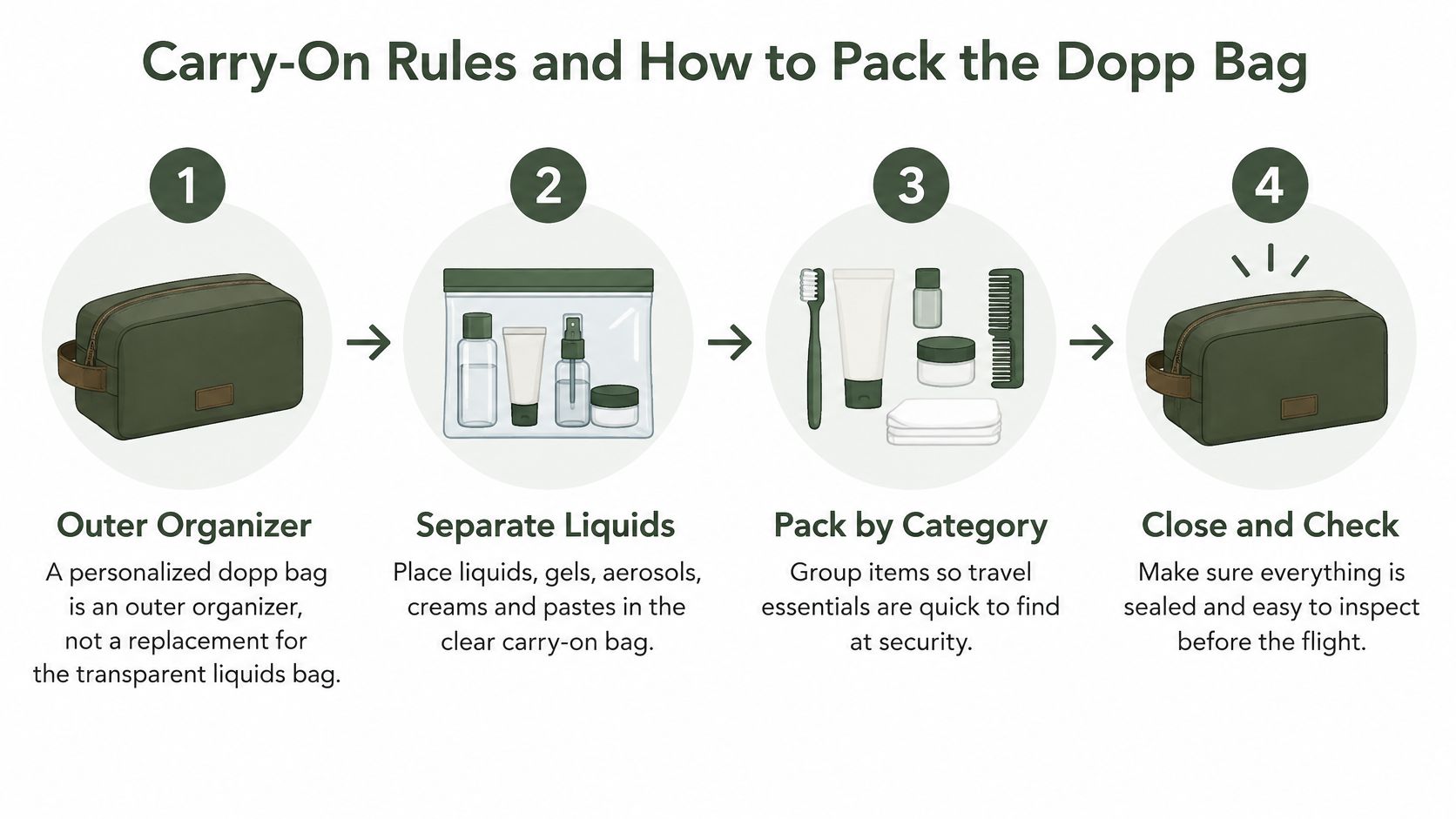
Pack in This Order
- Place the clear liquids bag where you can remove it first: Put it on top or in the most accessible part of the dopp bag, so screening doesn't require unpacking everything else.
- Load solid items into the leather bag: Bar soap, a deodorant stick and a razor can sit outside the liquids bag and form a stable base.
- Group compliant containers together: Keep liquids, gels, creams and pastes together in the clear bag instead of scattering them through pockets.
- Keep leak-prone bottles upright: Use an internal gusset, elastic loop or sealed compartment so caps stay up and movement doesn't loosen them.
- Position the monogrammed panel thoughtfully: Face it so removing the bag doesn't scrape the initials against the tray or hide them under straps and clothing.
If security asks you to remove toiletries, the clear bag comes out for screening while the leather bag can remain organized around the solids. That separation is the point. The leather bag gives structure in your luggage and on the counter, while the clear bag handles compliance at the checkpoint.
When you're deciding what belongs in that clear bag for outdoor or sunny trips, a skincare safe bug repellent packing list can help you sort repellent and skin products before you start transferring them into travel containers. Decide the liquid list first, then pack the bag around it. That order prevents the common mistake of filling a large dopp bag and discovering the liquids still don't fit the allowance.
An oversized bag creates a false sense of capacity. It can hold more, but it doesn't grant you more carry-on liquids, and every extra bottle adds weight and leak risk. Pairing the dopp bag with the right luggage matters too, which is why our guide to choosing a men's travel duffle bag is worth checking if your toiletries compete with shoes and clothes for the same space.
Test the setup at home before a real trip. Pack it fully, weigh it if your carry-on is close to a limit, and confirm the clear bag comes out in one motion without forcing the zipper. If you can't do that calmly in your hallway, you won't do it calmly in a security line.
Gift and Everyday Use Scenarios
Personalized gifts aren't a niche preference. Coveo's holiday shopping findings state that in 2024, personalized or custom gifts accounted for 35% of top gift-category purchases among U.S. consumers. A dopp bag fits that demand well when the recipient travels and you know enough about their routine to choose correctly.
Say you're buying for groomsmen or colleagues. A neutral leather color, a standard size and subtle initials suit a wide audience without looking overly personal. Confirm each person's initials and name order individually, because one wrong letter affects the whole set. Our ideas for personalized leather gifts for him can help you compare this option with other formats.
A graduation or retirement gift needs a different check. Ask how the recipient travels now, not how you imagine they'll travel later. Someone who mostly takes overnight trips may prefer a compact bag, while a new consultant flying weekly needs standard capacity and a lining that wipes clean. Style matters too, since a formal foil monogram won't suit everyone.
For your own frequent travel, personalization has a practical side. Initials make a common brown or black bag easier to identify in shared bathrooms, gym bags and family luggage. You'll benefit most if you keep one durable kit packed with duplicates, so you're not transferring toiletries between home and travel every week.
The downside is flexibility. A monogrammed bag is harder to resell, lend or pass to someone else, and a recipient can't exchange it if the size is wrong. For shared family use or a temporary need, plain leather is often smarter.
Personalize for a known recipient or for your own long-term bag. Keep gifts plain when the details are unconfirmed.
Cleaning, Drying and Long-Term Care
The musty smell hits when you unzip the bag at home, days after the trip ended. The liner still feels slightly damp, a bottle cap has left a ring, and the leather has sat closed in a warm bathroom cabinet. That smell is a moisture problem first and a leather problem second.
Damp toiletry containers can create conditions that support bacterial or mold growth, especially after moving through airports, hotel bathrooms and luggage interiors. The San Diego Union-Tribune cleaning guidance warns against packing toiletry containers while wet, since retained moisture can support microbial growth. Dry every bottle, razor case and toothbrush holder before it goes back inside.
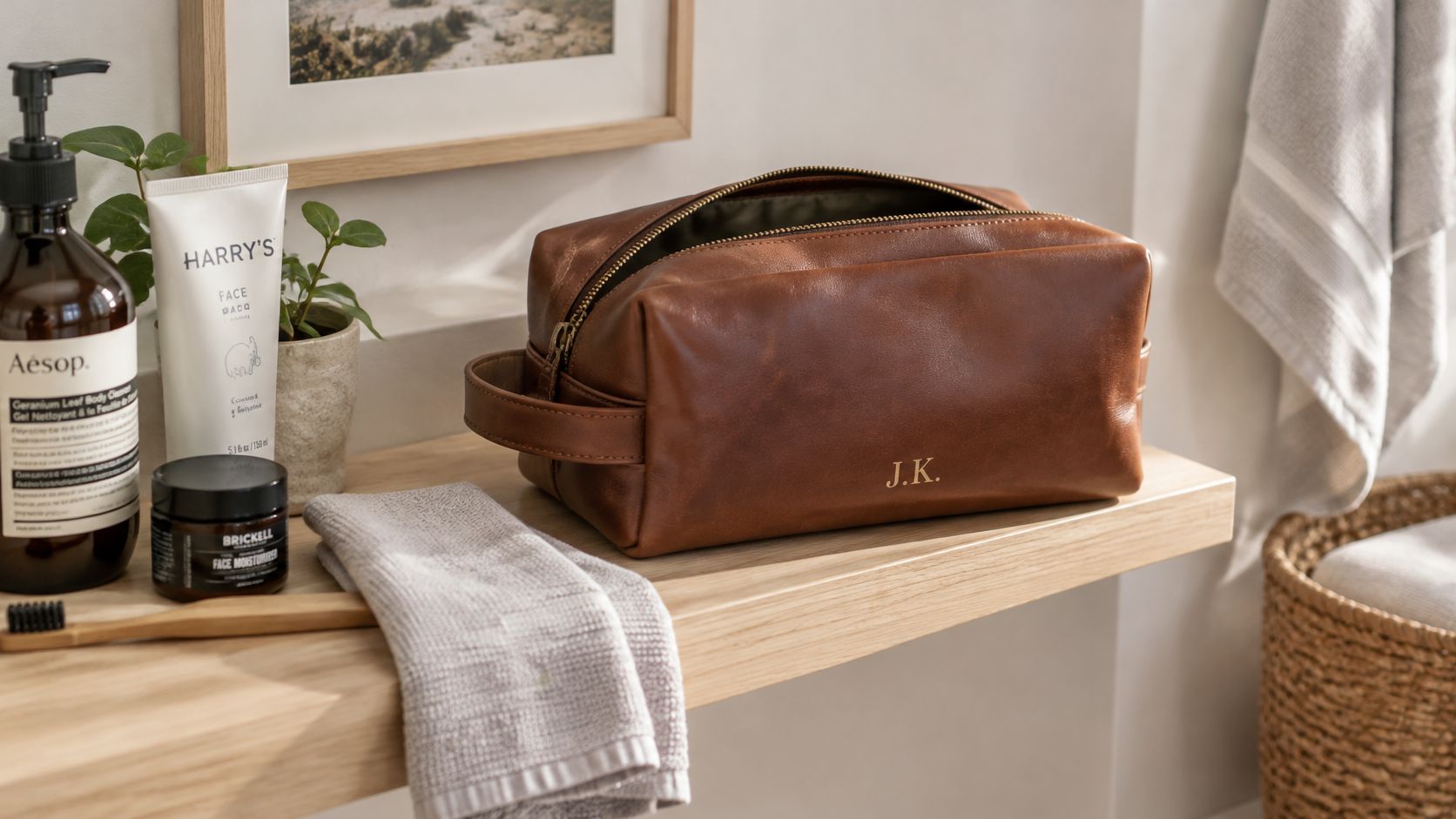
The Moisture Rules That Prevent Most Damage
Wipe the liner with a damp cloth and mild soap, then air-dry the bag fully with the zipper open before storing it. A wide opening matters here, because a narrow enclosed cavity traps humidity even after the surface feels dry. If your bag has a removable liner or sealed compartment, use it for leak-prone items and keep bottles upright in elastic or segmented holders.
Keep the monogram dry. Cleaning and abrasion can degrade embossed or printed detail, and foil or paint needs even more caution. Don't scrub the personalized panel with a wet cloth, and don't store damp items against it.
For the leather, wipe it dry after exposure to bathroom moisture and use a light conditioner sparingly when pale or dry patches appear. Avoid direct heat, radiators and long sun exposure, which can dry the surface unevenly. Store the empty bag stuffed loosely with paper so it holds its shape without stretching the gussets. If a leak reaches the leather itself, our advice on getting stains out of leather explains what to try before a stain sets.
Dopp bag problems, causes and fixes
| Symptom | Likely cause | Fix |
|---|---|---|
| Musty smell | Damp liner or toiletries packed wet | Empty, wipe the liner, air-dry fully with the zipper open |
| Dry, pale patches on leather | Moisture or lost natural wax | Wipe dry, apply a light conditioner sparingly, keep away from heat |
| Monogram lifting or flaking | Friction and moisture on foil or paint | Stop wet-wiping that area and ask the maker about repair |
| Stain inside the bag | Leaking bottle that was not upright | Clean the liner, keep bottles upright, replace a damaged liner |
Make this a monthly routine and a post-trip habit. Empty the bag, wipe the liner, let it dry open, then inspect the seams, zipper ends and monogram. Catching a loose stitch or lifting foil early gives you a repair option. Ignoring it until the next trip turns a small defect into permanent wear.
Confirm These Points Before You Order
Don't start with the monogram. Start with fit and construction, then personalize only after the bag itself is right. A personalized leather dopp bag that's the wrong size or hard to clean won't become useful because the initials look good.
- Match the size to your trip and luggage: Use the dimensions, measure your carry-on, and lay out your actual toiletries before choosing.
- Confirm the build: Look for full-grain leather, a wipe-clean lining, a reinforced gusset, sealed edges and a zipper that runs cleanly at the corners.
- Choose the method for expected wear: Pick debossing for daily use or foil on a flat panel for a formal gift, knowing foil needs gentler handling.
- Write the monogram out in full: Check spelling, initials and name order against the recipient's details or your own preference before you submit it.
- Read the personalized policy: Confirm how returns, repairs and replacement work for personalized items, since they may not follow the standard route.
- Photograph the bag on arrival: Take clear photos before first use so any defect in leather, stitching or lettering is documented immediately.
Check the product page for the exact item name, current price, currency and personalization terms before ordering, because options can change. For reference, our Leather Toiletry Bag, The Dopp is sold for €93,56, and our website has a section for Personalised Leather Gifts if you're comparing gift formats.
Your next step is straightforward. Pick the size, run the carry-on pack test at home with the toiletries you'd take, and write the monogram layout down exactly as it should appear. If any of those three checks feels uncertain, resolve it before you order rather than after the initials are pressed in.
If you're ready to choose a personalized leather dopp bag that's sized for real carry-on packing and built for repeated travel, explore the full-grain leather toiletry bags and personalised gift options at Grainmark Leather. Pick your size first, confirm the monogram layout in writing, and order a bag you'll still want to use after the first trip.