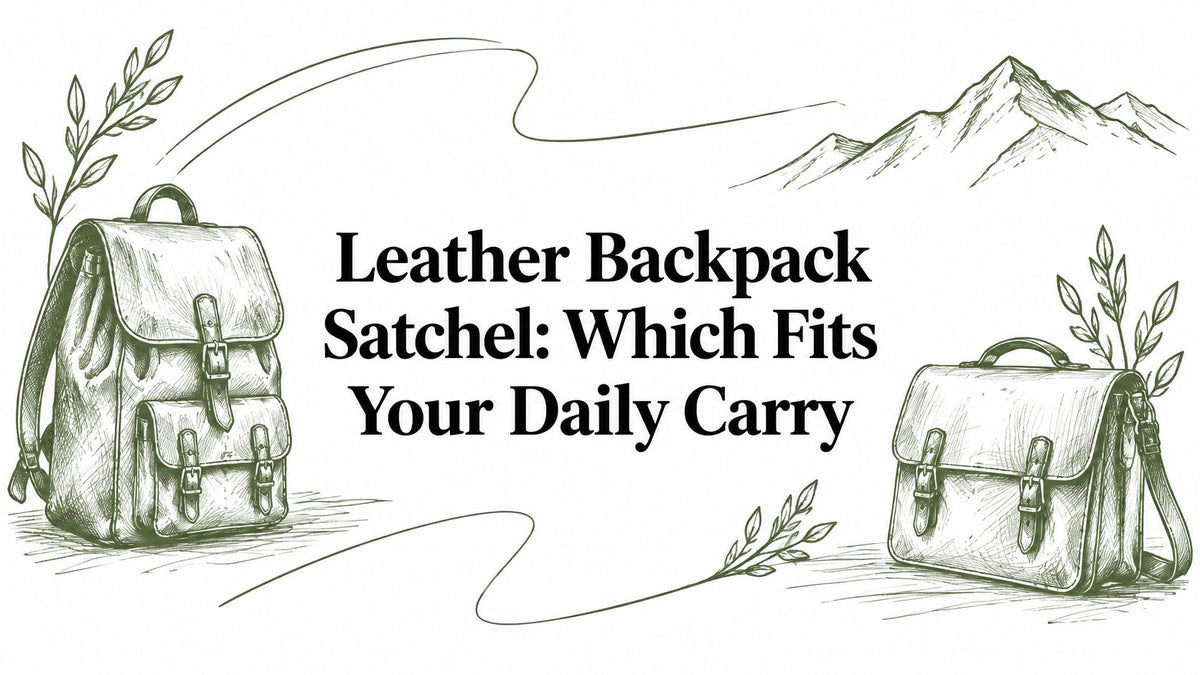
Leather Backpack Satchel: Which Fits Your Daily Carry
The bag you're eyeing is probably the wrong shape for the day you have. Not in a dramatic way. In a small, daily, shoulder-aching way that shows up around week three, when the strap has worn a groove through your coat and you've started carrying the laptop in your hand because the bag got too heavy to keep on one side.
Say your Monday looks like this. A 45-minute walk to the train with a 14-inch laptop, a charger, lunch, and a folder of documents. Then a client meeting across town, where you'd rather not walk in looking like you're heading to a hostel. Two bags solve that day differently. One keeps your hands free and your load balanced. The other makes you look like the person who runs the meeting. Many buy for the second reason and live with the first consequence.
Table of Contents
- What Separates a Leather Backpack From a Satchel
- Capacity, Laptop Fit and Real Carried Weight
- Comfort, Strap Design and Posture on Long Walks
- Commute, Office and Travel
- Build Quality, Leather Grade and Ownership Over Years
- Care, Weather and Long-Term Maintenance
- How to Test a Bag Before You Buy It
- Choose the Bag That Matches Your Daily Load
What Separates a Leather Backpack From a Satchel
A leather backpack distributes its load across two shoulders. A satchel hangs from one shoulder or is carried by hand, with a flap and a more structured shape. That difference matters most over a long walk: the backpack keeps the load closer to your back, while a satchel's weight pulls to one side.
| Criterion | Leather backpack | Leather satchel |
|---|---|---|
| Carry method | Two straps, hands free | One handle or shoulder strap, hands partly occupied |
| Load position | Naturally close to the back | Sits lower and away from the back unless structured |
| Typical capacity | Mid to high, depends on back panel | Mid, often built around a laptop and documents |
| Formality | Casual to smart-casual | Smart, closer to a briefcase |
| Walking comfort | Better over 30 or more minutes | Good for short walks, weaker under heavy load |
| Access while carrying | Top or back zip, slower | Flap or front pocket, quicker |
| Best for | Walking or transit commutes, travel days | Office days, meetings, short trips |
The trade-off is straightforward. A backpack spreads weight across both shoulders, while a satchel offers quicker access to items under its flap or in a front pocket. With a backpack, you may need to take it off or swing it around to reach the main compartment.
Formality also shapes the choice. A satchel's structured profile reads closer to a briefcase; a backpack tends to look more practical. Structured backpacks can still suit a smart-casual workplace, and satchels with a detachable shoulder strap can be carried hands-free. On light-load days, a smaller cross-body bag can share a satchel's flap-and-strap structure, like a tweed accessory for Highlandwear outfits.
For a closer look at how the office-oriented briefcase compares with a backpack, see this briefcase and backpack comparison. Choose by how the bag carries your usual load over the length of your walk, not by shape alone.
Capacity, Laptop Fit and Real Carried Weight
Ignore litre counts until you know what your daily items weigh and measure. Capacity only means something when it's defined as real objects, so here's the working definition: one 13 to 16 inch laptop, one notebook or A4 pad, a charger and cable, two document folders, a water bottle, and whatever else lives in your pockets by day's end. That's a mid-size load, and it's what most capacity claims should be measured against.
Leather adds empty weight, and the material changes the maths. A full-grain leather backpack of the same internal volume will weigh more than a nylon or canvas bag, and the difference lands on your shoulders before you've packed anything. It also affects where the mass sits, because a thick leather back panel holds its shape rather than draping.
In practice, a leather backpack usually suits a 14 or 16 inch laptop in a padded sleeve, with room left for a lunch container or a second layer. Many satchels are sized around a 13 to 14 inch laptop plus a flat document pocket, and the structured flap limits how much the bag can expand. Buy the format for the laptop and documents you carry on an ordinary day, not the largest device you might someday own.
Organisation that stops the load shifting
A large, unstructured main compartment is the most common design fault. Everything drifts to the furthest corner, the bag pulls away from your spine, and the strap has to do more work to hold it there.
- A separate padded laptop sleeve that sits against the back panel, so the heaviest item stays where the harness can manage it.
- A zipped inner compartment for cables and small valuables, so nothing you need at a turnstile ends up at the bottom.
- Pen slots or a slim organiser panel if you sign documents or carry a fountain pen; loose pens in a leather lining scratch and pierce it.
- A front or flap pocket reserved for the things you reach for standing up: card, phone, transit pass, keys.
Practical rule: if you can turn the packed bag upside down and hear everything fall to one end, it will do that against your spine all day.
The ten-minute load test
Pack the bag with the heaviest combination you carry. Close it properly. Then walk ten minutes, including a flight of stairs, before you decide anything. Pay attention to three things: does the base swing, does the bag sit against your back, and does the strap dig anywhere specific.
Before you shortlist anything, write down two numbers. The empty weight of the bag and the weight of your usual daily load, laptop included. Add them. If the total surprises you, the bag is wrong, whatever the product page says. For a closer look at how laptop-ready leather formats handle this differently, these leather laptop briefcase options show the flat-profile approach for readers who don't want a full backpack.
Comfort, Strap Design and Posture on Long Walks
Backpacks feel easier for a structural reason, not a stylistic one. The load rests on both shoulders and sits close to the spine, so your torso carries it rather than one set of neck muscles. A satchel concentrates the same weight on one side of your body. Over a short walk you won't notice. Over 45 minutes, twice a day, you will.
The features that matter are unglamorous. Padded, adjustable shoulder straps wide enough to spread pressure. A back panel that holds the bag upright instead of letting it sag into a doughnut. A hip belt or sternum strap once you're carrying real weight, because they transfer part of the load off your shoulders and stop the bag rolling side to side as you walk.
Strap geometry you can check in the shop
The lower strap should leave the pack near your lower torso and drop away cleanly. If it pulls straight across the front of your shoulder or cuts into your armpit, the angle is wrong for your frame and no amount of adjustment will fix it. This is the single most common fitting failure with structured leather bags, which tend to have fixed attachment points rather than sliding ones.
Long straps look relaxed in a product photo and cause trouble in use. Slack straps lower the bag, push your shoulders forward, and make your upper back do the work. Set them short enough that the bag rides high on your back. If a bag only feels comfortable when the strap is fully extended, it isn't fitting you.
Single-shoulder carry is worth naming because so many satchels invite it. It shifts the load to one side, and the fatigue builds unevenly through your neck and shoulder over the day. If you plan to carry a heavy laptop in a satchel, plan to swap the shoulder partway through the walk.
The bag that wins a long commute is rarely the one that looks best in a photograph. It's the one whose straps you stop thinking about by day four.
Turning body weight into a load limit
A widely used guideline for daily carried load is 10 to 15 percent of body weight, total, bag included. Here's how that works out:
| Body weight (kg) | Load at 10% | Load at 15% |
|---|---|---|
| 50 | 5 kg | 7.5 kg |
| 60 | 6 kg | 9 kg |
| 70 | 7 kg | 10.5 kg |
| 80 | 8 kg | 12 kg |
| 90 | 9 kg | 13.5 kg |
A 70 kg reader has a working ceiling of roughly 7 to 10.5 kg for everything on their shoulders. That budget includes the empty bag. A leather backpack of 1.5 kg leaves you 5.5 to 9 kg for a laptop, charger, lunch, documents, and anything else. A heavier structured bag eats a larger share of the allowance before you've packed a single item.
Where people get this wrong: they compare bags by capacity and ignore that a heavier empty bag reduces usable capacity within a safe load. Two bags with identical interior volume are not equal if one weighs a kilo more.
Close with a ten-minute test under full load. Wear it properly, both straps, adjusted high. Watch for two signals: pressure points on top of the shoulder, and any sway in your lower back as you walk. Either one means the harness or the load position is fighting you, and no leather grade will compensate.
Commute, Office and Travel
Three routines, three different answers. Many individuals only plan for one of them and then wonder why the bag disappoints on the other two days of the week.
The commute
A 30 to 60 minute walk or transit journey with a laptop, lunch and documents is the backpack's home ground. Your hands stay free for stair rails, turnstiles, and a coffee. The bag sits centred, so nothing pulls you sideways on the platform.
A satchel can handle this if the load is light and the walk is short, and it saves you the moment of swinging the bag off to pay a fare or show a pass. Once the walk passes half an hour with a laptop inside, the arithmetic turns against it. Verdict: walking or transit commutes over 30 minutes belong to the backpack.
The office
Desk-based professionals who shuttle a laptop and papers between meetings are the satchel's natural user. A structured flap and a flat profile sit alongside a suit or a smart jacket without looking like you brought gym kit to a client meeting. It also opens flat on a desk, which matters more than people admit when you're pulling out documents in front of someone.
The working compromise: one bag that looks like a briefcase on the outside and carries its load against the back panel can serve both the walk and the meeting.
Verdict: if your week is mostly short walks and seated work, pick the satchel.
Travel days
Airport, train and hotel days reward two straps. Backpacks held an 18.6% share of the $5.11 billion global leather travel bag market in 2025, about $0.95 billion, according to Dataintelo's leather travel bag report. Travellers have already made the choice: on a long terminal walk, a bag on your back beats a bag on one shoulder.
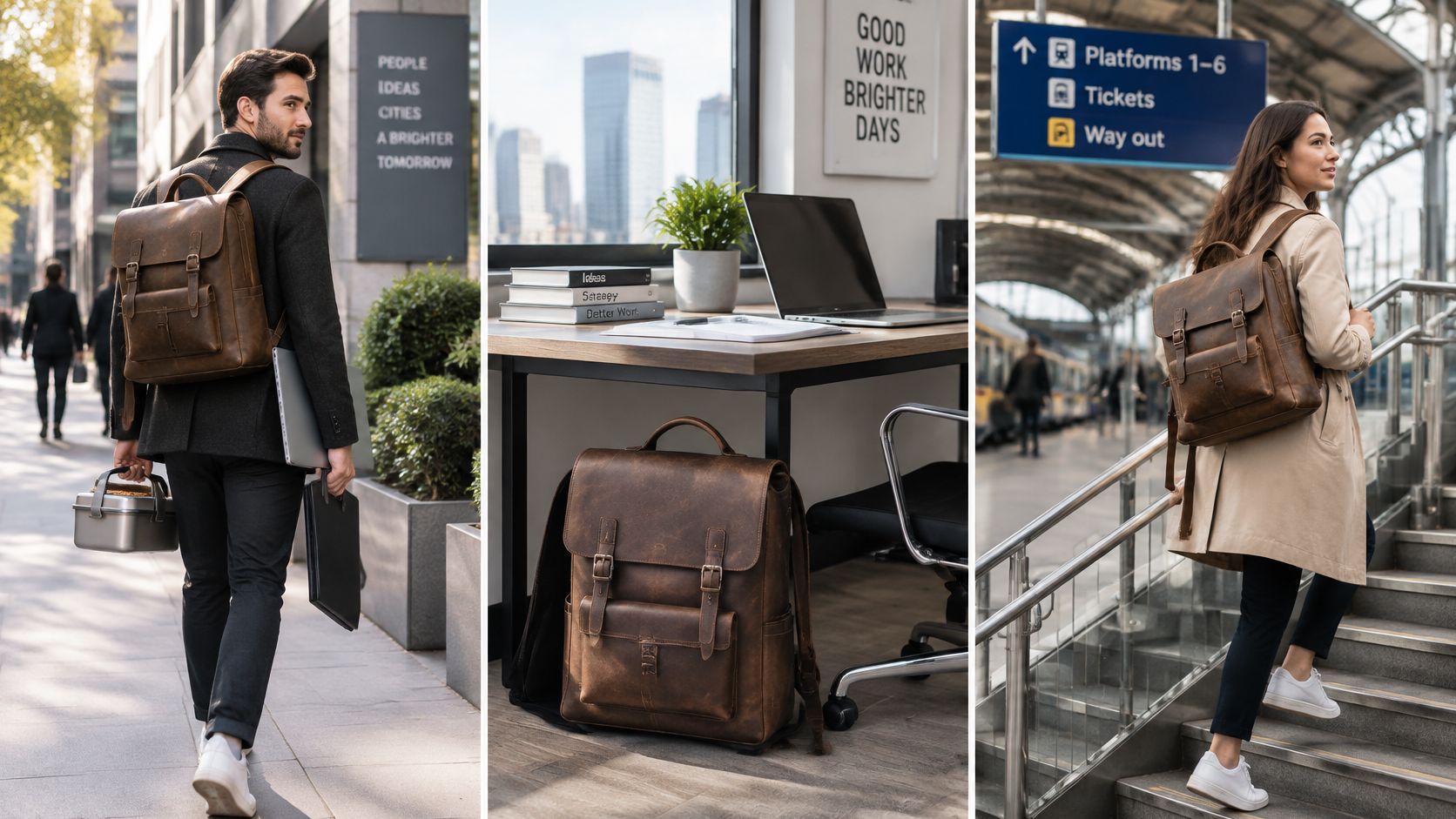
Satchels still earn their place on travel days. A bag with a shoulder strap clips over a trolley handle more naturally and stays put through the concourse, while a backpack either goes on your back or under the seat.
Verdict: for flights and rail, choose the backpack; for a single overnight by car or train, the satchel with a luggage pass-through is easier.
Mixing the two routines is where most buyers overspend on the wrong one. If your work week is spent steering meetings and your best leather backpacks for work shortlist leans structured rather than sporty, you can cover the office and the walking day with one bag.
Build Quality, Leather Grade and Ownership Over Years
Leather grade governs how the bag ages more than the price does. The same cut of hide treated two ways will look and behave differently after three years of daily use.
| Leather grade | What it is | How it ages | Fit for daily carry |
|---|---|---|---|
| Full grain | Entire top layer of the hide, untreated surface | Develops patina; can stiffen if neglected | Best for long-term daily carry |
| Top grain | Sanded top layer, more uniform surface | Smooth, shows scratches sooner | Good for structured office bags |
| Crazy horse | Full grain with heavy wax finish | Lightens and darkens where handled | Good for relaxed, casual carry |
| Genuine | Split layer with surface coating | Surface can crack or peel over time | Budget choice with shorter lifespan |
Full grain keeps the strongest top layer intact and develops a patina where your hand rests. Top grain has been sanded for uniformity, so it looks sharper out of the box and shows its scratches sooner. Crazy horse takes full grain and gives it a heavy wax finish that shifts colour at the handled edges, which suits relaxed use but rarely looks polished at a client meeting. Genuine leather, in the trade sense, means a split layer under a surface coating: fine for a couple of years of light use, prone to cracking and peeling at the flex points after that.
The cost-per-year calculation
Durability alone doesn't make a bag a good buy. A premium design pays off only if you use it for a long time, so run the arithmetic before you commit.
Take the purchase price, estimate the years of daily use you realistically expect, and divide. A bag bought at a premium and used five days a week for eight years divides down further than a cheaper bag that delaminates in year two and gets replaced twice over the same period. Include the replacement cost of the cheaper bag, not just its sticker price, and the gap usually narrows or disappears.
The calculation that matters: purchase price divided by years of daily use. Compare that figure against the cost of buying and replacing a cheaper bag over the same stretch.
Environmental claims deserve the same discipline. A 2025 life-cycle assessment compiled 56 studies across 6 tanneries and 11 countries, and found that the farming stage strongly affects most environmental categories, while also calling for better raw material and processing data, as detailed in the IULTCS newsletter summary. That means no single carbon number applies to every leather bag, and a label alone doesn't settle the question. Long service life, repairability, resale, and repurposing change the picture more than a category claim does.
A useful comparison of how these grades behave across a full product run sits in this guide to the grades of leather. Repairability is the quieter half of the equation: reinforced bar-tacked stitching at handle joins and corners, and hardware you can unscrew and replace rather than rivets that must be drilled out, extend a bag's working life by years.
Care, Weather and Long-Term Maintenance
Leather sheds light rain if it's been treated, but it is not waterproof. Soaked leather can stain, stiffen as it dries, and take on water marks along the seams. A handful of habits keeps a daily bag looking like it did in year one.
- Blot rain marks immediately with a dry cloth. Don't rub. Press the water out and let the bag dry naturally, away from heat.
- Condition every three to six months with a leather conditioner, working it in with a cloth and buffing off the excess. Test on a hidden area first, especially on lighter browns.
- Keep it out of direct sun and away from radiators, car dashboards included. Heat dries the oils out and the surface cracks along the flex lines.
- Stuff the body with acid-free paper when you store it, so the shape holds and the lining doesn't crease into permanent folds.
Crazy horse finishes behave differently by design. The wax darkens and lightens where the bag is handled, so it develops a mottled look. That's the point of the finish, but it makes the bag a weaker choice for wet-weather commuting where you want an even surface.
Hardware check once a season: tighten rivets and buckles, check the strap ends for fraying or cracking, and replace a worn strap end before it splits under load. A strap that lets go on a station stair is a laptop on the floor, not a nuisance. The full routine, including which products to use on full-grain and top-grain finishes, is set out in this guide to cleaning a leather backpack.
Care is what converts a higher purchase price into years of service. The cost-per-year figure only holds up if the bag is still in rotation in year five.
How to Test a Bag Before You Buy It
Run this in the shop, or in the first ten minutes after the parcel arrives while the return policy still covers you. Each step has a reason and a common slip.
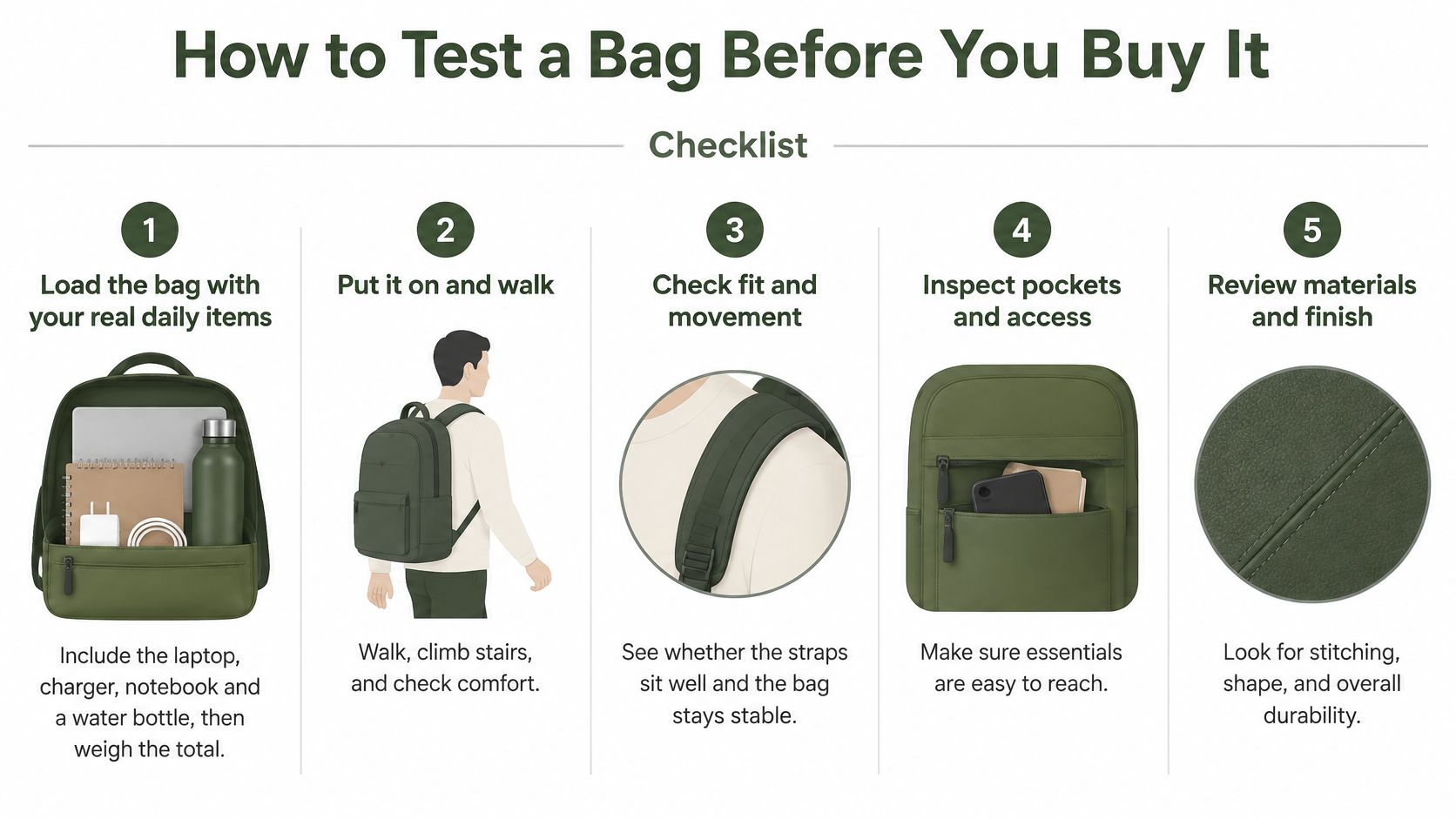
- Load it with your real daily items. Laptop, charger, notebook, water bottle, documents. Weigh the total. The slip: testing with an empty bag, which hides every problem you'll have.
- Put it on with both straps and set it high. The bag should sit against your upper back, not on your hips. The slip: wearing it slung low because that's how it looked in the photo.
- Check the lower strap's line. It should drop away near your lower torso without pressing into the armpit or pulling across the front of the shoulder. The slip: adjusting the strap only for length, never for angle.
- Walk five to ten minutes, including stairs. Note shoulder pressure, sway at the lower back, and whether the base swings out. The slip: standing still in the shop and calling it comfortable.
- Pull on the strap attachments and inspect the stress points. Handle joins and corners should have dense, even stitching. The slip: admiring the leather and never looking at the seams.
- Open it fully and check the laptop sleeve. It should be padded and sit against the back panel, not float in the middle of the bag. The slip: assuming a sleeve exists because the listing mentions one.
- Confirm the empty weight and the return window before you pay. The slip: discovering both after the tags are off.
A good result feels unremarkable. The bag sits still, the load stays against your back, nothing rubs the shoulder, and you forget you're wearing it on the walk to the car. If any single step produces a nagging doubt, that doubt will still be there in month six.
Choose the Bag That Matches Your Daily Load
Here's the verdict in one line. If your daily load tops roughly 10 percent of your body weight (about 7 kg for a 70 kg reader) or you walk more than 30 minutes each way, choose a backpack. If you carry under 5 kg, mostly seated or short walks, and the room you walk into cares how you look, choose a satchel.
The middle cases are the ones worth thinking about. A structured leather backpack covers office plus travel when your week splits between both. A satchel with a shoulder strap covers mixed days where some walking is involved but the load stays light. Both are compromises, and both work if you're honest about which routine dominates.
Four pass marks before you buy:
- Laptop fit confirmed in a padded sleeve against the back panel, not just a stated screen size.
- Empty weight written down and added to your daily load, so the total against your shoulders is a number you chose.
- Leather grade matched to use. Full grain for years of daily carry, top grain for a sharp office bag, genuine for a short budget term.
- Strap width and adjustment that stays comfortable fully loaded, not just on an empty trial.
Our Leather Backpacks collection lists 12 backpacks in Black, Brown and Red, across Full Grain, Crazy Horse, Top Grain and Genuine Leather, so you can compare grades and empty weights directly rather than guessing from photographs.
Write down your real daily load and your actual routine before you choose anything. Then buy the bag that fits that list. The one that looks best in photos is usually the one that ends up in the wardrobe by spring.
Grainmark Leather makes full-grain leather backpacks, briefcases and travel bags for professionals who want one bag to survive years of daily use. If you're weighing a backpack against a satchel, compare our Leather Backpacks collection by grade, empty weight and laptop fit, and pick the format that matches your actual commute rather than the one that photographs best.