How to Pack a Toiletry Bag for Any Trip
Six forty in the morning, one shelf in a hotel bathroom, and the toiletry bag is tipped onto the counter because the thing you need sits at the bottom. The toothpaste is under a crumpled plastic bag, the razor has slid behind the tap, the contact lens case never left the suitcase. Nothing is lost. Everything is in the wrong place.
A bigger bag doesn't fix that, and neither does a better memory. What fixes it is deciding where each item lives before anything gets packed, then using the same addresses on every trip the way you'd use the same drawers in a kitchen. The layout gets decided once and reused.
Security screening, leak protection and medicine access usually get handled as three separate problems with three separate fixes: a plastic bag, a spare zip bag, a pill case rattling loose at the bottom. Give the kit fixed zones and one layout covers all three. The routine starts with a sketch, not a bottle.
Table of Contents
- Map Your Toiletry Bag Into Zones Before You Pack
- Where Each Item Goes
- Choose Travel Sizes, Decant, or Use Hotel Products
- How to Pack Your Toiletry Bag Step by Step
- Seal, Test and Check Before You Leave
Map Your Toiletry Bag Into Zones Before You Pack
A toiletry bag packed by zone works like a small travel health kit, and the CDC's pack smart guidance sets the contents at that level: prescription and over-the-counter medicines for the whole trip plus extra in case of delays, sunscreen with SPF 15 or higher, insect repellent, aloe, alcohol-based hand sanitizer, water-disinfection tablets and a health-insurance card, with contact lenses and solution, hydrating eye drops, glasses, earplugs, masks and a first-aid kit on the same list.
Treat that list as a placement instruction. The same guidance says medications and first-aid supplies belong in a durable, water-resistant container kept readily accessible during travel. A blister pack buried under a towel fails that test.
| Zone | Contents | Placement |
|---|---|---|
| Liquids bag | Toothpaste, shampoo, conditioner, lotion, sunscreen in containers up to 100 mL | Top or front, removable in one quart-size bag |
| Medications and health kit | Prescriptions, pain relief, plasters, hand sanitizer | Front pocket, easy to reach |
| Dry grooming tools | Toothbrush, comb, nail clippers, cotton items | Middle compartment |
| Solids | Bar soap, solid shampoo, deodorant stick, toothpaste tablets | Separate pocket, away from liquids |
| Sharp or rigid items | Safety razor cartridges, tweezers | Dedicated sleeve |
| Destination extras | Insect repellent, water tablets, contact lens solution | Outer pocket for quick access |
The two zones with the strongest case for their position are the liquids bag and the health kit. Liquids sit at the top or the front because they leave the kit in one motion at screening, and anything else sharing that pocket slows the pull. The medicines pocket faces outward because a headache at 2am shouldn't involve unpacking a bag on a hotel floor.
Solids and sharps get their own addresses for a different reason: they damage other items. A deodorant stick rolling loose cracks a bottle cap. A loose razor cartridge scratches a leather lining and slices a toothbrush head. Destination extras go in an outer pocket, since repellent, water tablets and lens solution are what you reach for on arrival rather than every morning.
Take a concrete case. Three days on business, one kit, a hotel room dark at 5am, and three things needed before the first meeting: the razor, the toothpaste tablets and the small medicine case. Razor in the left sleeve, tablets in the solids pocket, case in the front pocket, and one hand finds all three without opening the liquids bag at all.
A zone you can't reach at 2am is just storage.
Dental gear earns a fixed home in the middle compartment rather than a loose slot, since toothbrushes and toothpaste sit among the most commonly forgotten travel items. Once the zones are set, count what each one needs and work out which zone fills up first. That answer usually decides whether you need a bigger kit or fewer products. If the vocabulary is the sticking point, this dopp kit vs toiletry bag comparison settles it before you spend money.
Where Each Item Goes
One rule decides most of it. The U.S. Transportation Security Administration's 3-1-1 standard puts every liquid, aerosol, gel, cream or paste in a container of 3.4 fluid ounces (100 milliliters) or less, all of them inside one clear, resealable, quart-sized bag, one bag per passenger at screening. The TSA travel tips factsheet names toothpaste, shampoo, conditioner, sunscreen, mouthwash and lotion among the products it covers.
The items that cause the most confusion split like this.
| Item | Carry-on | Checked bag |
|---|---|---|
| Toothpaste or shampoo up to 100 mL | Yes, in the liquids bag | Yes |
| Toothpaste or shampoo over 100 mL | No, even if partly empty | Yes |
| Bar soap or solid shampoo | Yes | Yes |
| Aerosol deodorant or spray | Yes, only within the 100 mL limit | Yes |
| Medications | Yes, keep with you | Yes, keep a carry-on supply |
| Safety razor with cartridges | Yes | Yes |
| Loose razor blades | Avoid, poorly protected | Yes, packed in checked luggage |
The Edge Cases That Slow the Line Down
The half-full bottle is where travelers get caught. Volume is judged by what the container holds, not by what's left inside it, so a 200 mL shampoo bottle with 60 mL remaining still fails screening. Decant a week's worth into a cabin-size bottle and leave the big one in checked luggage.
- Dense or unusual products: the TSA notes that items triggering an alarm may receive additional screening, so keep heavy, odd-shaped or metallic pieces together in one place where a secondary check takes seconds instead of ten minutes.
- Solid swaps: bar soap, solid shampoo, deodorant sticks and toothpaste tablets remove items from the quart bag entirely, which is the only way to gain capacity without buying a second pouch.
- International departures: U.S. limits don't travel with you. Check the rules of the airport you're flying out of rather than assuming what works at home works everywhere.
A bag that already separates the quart pouch from dry tools and medications needs no repacking on the security tray. If your kit is one open cavern, bag organizers that fit inside a carry-on do the work the zones would.
Choose Travel Sizes, Decant, or Use Hotel Products
A quart bag fills up fast, so choose the source of each product before you start packing. There are three practical routes, and each suits a different trip. The decision comes down to trip length, product type and whether the accommodation is a known quantity or a guess.
| Option | Best for | Limit |
|---|---|---|
| Travel-size products | Short trips and thick creams or gels | Each container 100 mL or less |
| Decanted refillable bottles | Favourite products and frequent travel | Each container 100 mL or less |
| Hotel products | Confirmed supplies at the accommodation | Carry only what the room does not supply |
Travel sizes suit short trips and products that refuse to decant: thick creams, gels and anything that clings to the walls of a refillable tube. You pay more per millilitre for that convenience, and a drawer of half-used travel bottles is the usual result. Buy them for a four-day trip and for one stubborn product, not for the whole routine. Keep the unopened spares in a fixed dry pocket so they do not take space from the bottles you use.
Decanting favours products you already trust and travellers who fly often. 25% of 1,000 surveyed UK adults said they decanted existing toiletries into smaller containers before traveling, according to 100Green's research conducted by 3Gem. The trade-off is labelling. An unmarked bottle of white liquid gets sniffed and guessed at in a hotel shower. A strip of tape on the cap with the product name settles it. For the liquids zone, decant only what the trip needs plus a small margin, because extra product buys nothing at security.
Hotel products save the most space and suit rooms confirmed to supply shampoo and body wash. 36% of 5,134 surveyed U.S. adults preferred small hotel toiletry products such as shampoo, against 23% who preferred large refillable products, according to YouGov, so relying on the small bottles is a reasonable choice for many travellers. The limit is simple: carry only what the room does not supply, because every extra tube returns the quart bag to a loose pile.
Pick by Trip Length
Four nights in a city hotel with a confirmed amenity list is a one-bag trip. Decant the two products the room does not supply and skip the rest. Two weeks in a rental flat with no guaranteed shampoo, no guaranteed hand soap and the nearest shop an hour away flips the calculation. In that case, decanted favourites plus one full-size bottle in checked luggage earn their weight.
Verdict for most trips: under a week, bring decanted or travel-size products and nothing else. Over a week, confirm what the accommodation supplies and pack only the gap.
Body care complicates the count more than haircare does. If a back-acne routine is part of your week, this comparison of bacne sprays and cleansers is worth reading before deciding what travels, because a spray bottle competes for liquids space while a bar cleanser counts as a solid and rides free. Keep that distinction in the same zone you use for soap and cleanser, so the routine stays intact without opening every pouch.
Shaving gear is the other bundle that splits across zones. Shave cream is a gel and travels in the quart bag, while cartridges and the razor itself are solid tools for the sleeve. Packing a shaving kit for men with a bag and then splitting them at packing time is faster than hunting for a razor at the bottom of the liquids pouch. Whatever containers you choose, they still have to meet the carry-on limit.
How to Pack Your Toiletry Bag Step by Step
Order beats list. Inventory first, classification second, containers third, packing last, because each step depends on the one before it. The TSA describes the same two-stage method in its FAQ on liquids, aerosols and gels: take stock of every toiletry, then sort each item by what it is.
Here's the sequence end to end, with the failure each step prevents.
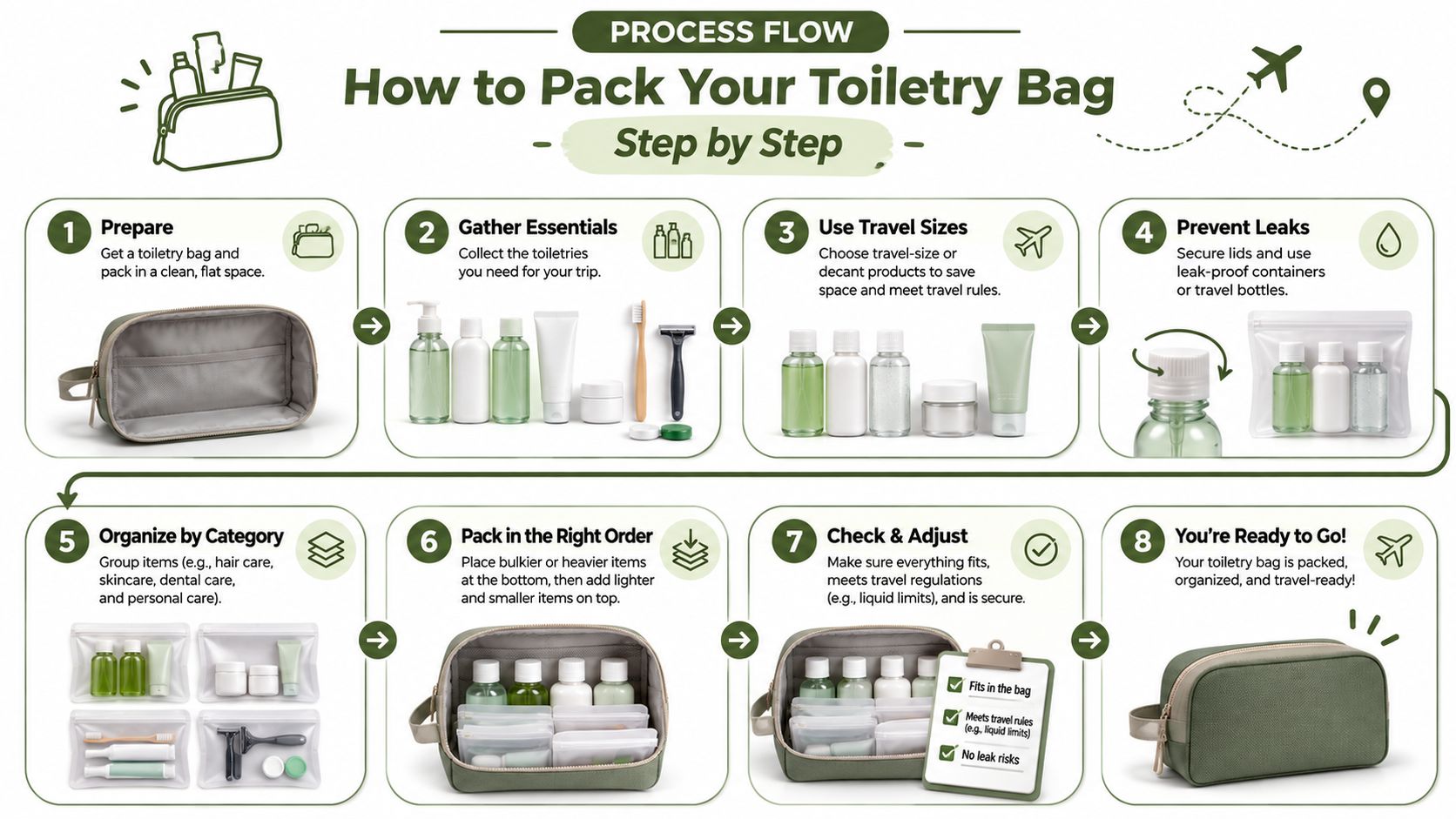
- Empty the shelf onto the bed. Every bottle, tube and tin comes out, including the ones already sitting in the travel kit. Remove duplicates until there's one of each. The common slip is packing the kit without checking the shelf, which is how a half-used deodorant stays home and gets bought again abroad.
- Classify, don't judge. Each item is a liquid, gel, aerosol, cream, paste, solid or accessory. The category decides the zone, and brand or price decides nothing. A pricey serum in a 120 mL bottle is checked luggage, while a cheap bar of soap has the easiest trip of anything in the bag.
- Decant only the trip's worth. Fill travel bottles with what you'll use plus a day's margin. Overfilling spends space in the quart bag you can't buy back, and a full bottle is more likely to leak under cabin pressure on the return leg.
- Stand the liquids upright. Caps up, seals level, bag at the top or front of the kit so it leaves in one pull at screening. Bottles laid on their side put the cap at the lowest point, which is exactly where a drop of shampoo wants to sit.
- Give solids their own pocket. Bar soap, a shaving stick, deodorant, toothpaste tablets. Every item moved out is capacity returned to the liquids bag.
- Load dry tools in the middle. Comb, toothbrush, spare razor cartridge, nail clippers, cotton items. These are the pieces that get damp if they sit beside a bottle with a loose cap.
- Zip, position, and leave it alone. The kit goes at the top of the case or the front of the carry-on, with the liquids bag nearest the opening. Packing liquids last means digging for them at the tray with a queue behind you.
If the quart bag itself is the weak point, spend a few minutes on the measurements to find the right 3-1-1 bag rather than trusting a supermarket zip bag that splits at the seam on its second trip. A kit with a removable front compartment solves the same problem from the other side, and toiletry bags built around an accessible front pocket keep pouch and contents moving together.
The sign the order is working: the liquids bag comes out in one motion, the rest of the kit stays where it was, and nothing gets repacked on the tray table.
Seal, Test and Check Before You Leave
A conditioner bottle with a cap that was closed but not seated empties itself across a shirt and the bag lining somewhere over the Atlantic. The shirt is replaceable. The stain in a leather lining isn't, and the shirt wasn't the only thing in the bag.
Sealing starts before packing. Close every bottle firmly, then wipe the threads and the cap, because a smear of product on the thread is what stops a cap seating properly in the first place. Add a secondary seal to the high-consequence liquids, the shampoo, conditioner, mouthwash and anything fragranced: a small zip bag per bottle, or a layer of cling film across the top before the cap goes back on.
Heavier bottles go at the bottom, with socks or a cloth packed around them as shock absorbers. Sharp and rigid items stay in their sleeves so they can't puncture a tube or scratch a neighbour, and toothbrushes and razors are kept away from creams and cosmetics. Damp items either dry before the bag closes or live in a washable compartment. The TSA's liquids, aerosols and gels rule is direct about the part that matters: liquids over 100 mL belong in checked baggage, and carry-on liquids come out for screening.
The Test That Catches Most Failures
Zip the case fully, turn it upside down for several seconds, and inspect the zipper, seams and lining for seepage or pressure. A bag that passes this on the bedroom floor is unlikely to fail in a hold, where the pressure change does the work for a badly seated cap.
Then check the layers behind the liquids. When the kit goes into checked luggage, put the whole thing inside a larger plastic liner, so one failed cap costs a liner and not a wardrobe. Loose blades are the item to think hardest about, because a safety razor with cartridges and a handful of unprotected blades are treated differently at screening. A cartridge you can replace at a pharmacy anywhere isn't worth an argument at security.
If the kit itself is the constraint, a larger men's toiletry bag with a wipe-clean interior carries the extras without pushing them into your clothes.
The Night-Before Check
Pack the night before, not in the morning, and run one list against the zones instead of against memory. Before the door closes, the same discipline covers the flat as much as the bag.
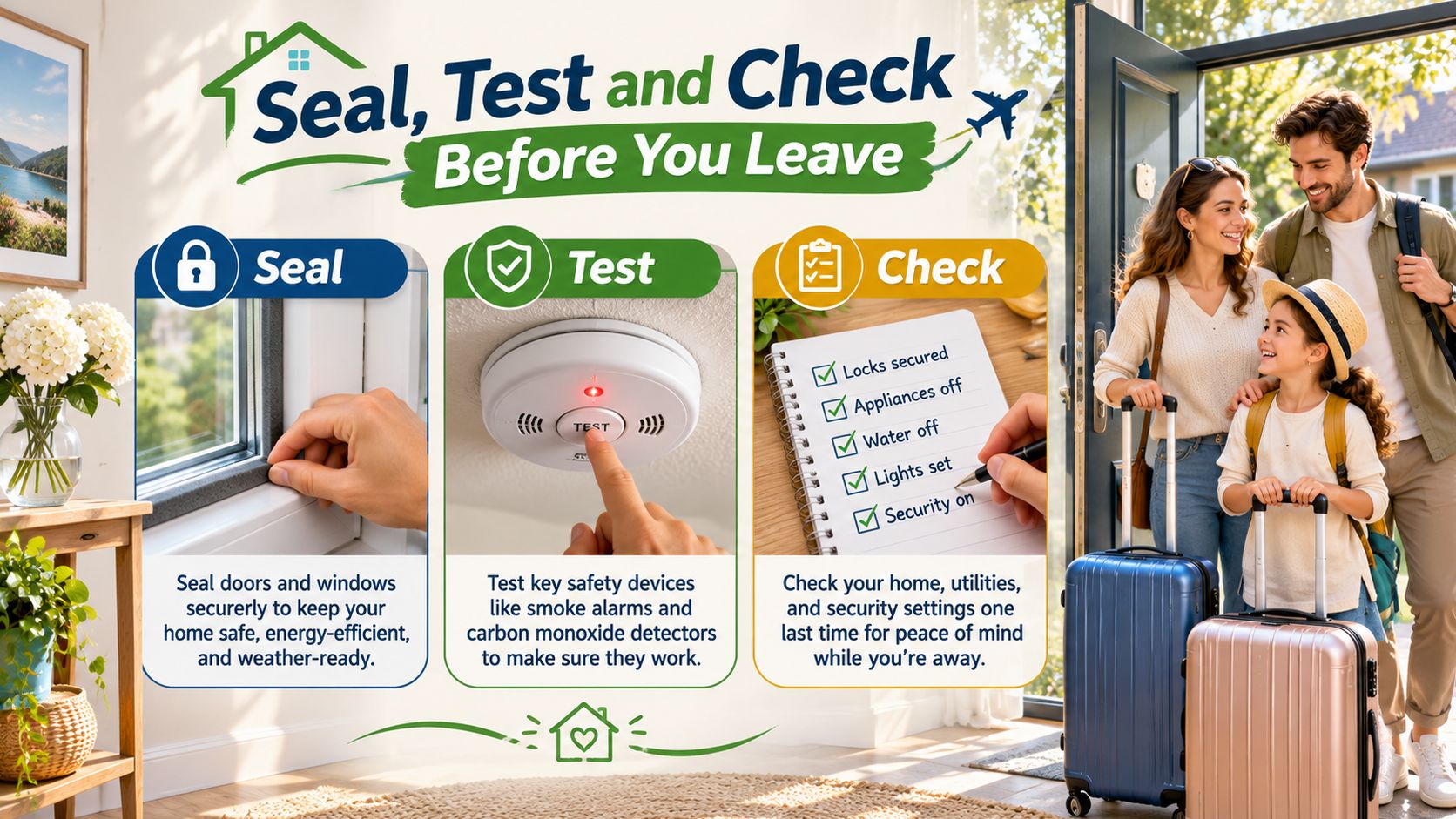
- Medicines: prescriptions and over-the-counter supplies for the whole trip, plus a few extra days in case of delays, with the health-insurance card in the same pocket.
- Eyes and ears: contact lenses and solution or spare glasses, hydrating drops, earplugs, masks.
- Sun and insects: sunscreen of at least SPF 15, insect repellent if the destination needs it, aloe for the day you forget the sunscreen.
- Hygiene: hand sanitizer, toothbrush and toothpaste, deodorant, razor and a spare cartridge.
- Destination extras: water-disinfection tablets, a small first-aid kit, anything the climate or itinerary demands.
Tick each zone against the list, zip the case, then run the closure test once more. Forgetting is common enough that the two-minute check earns its place: 32% of 2,000 surveyed Americans said they had forgotten toiletries or beauty products on vacation, according to Talker Research's survey commissioned by Crystal Geyser Alpine Spring Water. Two minutes at home saves a pharmacy hunt in a city where you don't speak the language.
The bag you pack into matters as much as the order you pack in. Grainmark Leather makes full-grain leather toiletry bags built for this layout, with The Dopp at €93,56 sitting alongside briefcases, backpacks, duffle bags, portfolios and wheeled bags in the Bags collection. Browse the Grainmark Leather range before your next trip and pick a kit that gives the liquids bag, the medicine pocket and the dry tools their own address.