

Is Full Grain Leather Waterproof? What Really Happens
No, full-grain leather isn't waterproof: it can resist light rain and brief splashes, but prolonged exposure lets water soak in, and an untreated natural-leather sample in a coating study absorbed a droplet completely within 15 minutes. That isn't a universal safe-exposure limit, because the finish, condition and construction change how a particular item responds.
The popular advice to apply conditioner and stop worrying about rain leaves out the most important questions. How wet will the bag get, how long will it stay wet, and can water enter through its closure? A well-maintained leather panel won't protect a laptop if rain runs through the zipper above it.
Table of Contents
- Full-Grain Leather Is Water-Resistant, Not Waterproof
- Why Full-Grain Leather Absorbs Water
- How to Read a Waterproof Claim
- Why Construction Decides Whether a Bag Stays Dry
- Protection Options and Their Trade-Offs
- How to Dry and Care for Wet Leather
- Confirm Water Protection Before You Buy or Carry
Full-Grain Leather Is Water-Resistant, Not Waterproof
Full grain describes the hide's retained outer grain, not a waterproof specification. That intact surface can delay penetration, but it doesn't turn a porous material into a sealed barrier. Tanning, finishing, conditioning and assembly all affect the protection a finished item provides.
The distinction matters because a few droplets and a saturated briefcase require different responses. The Canadian Conservation Institute's leather-care guidance explains that direct water contact can damage most leather, with the severity strongly affected by processing, finish and condition. An intact-looking surface isn't permission to leave a bag in the rain.
Water exposure and expected outcome
Treat these outcomes as practical risk categories, not guaranteed performance ratings. Delicate finishes, worn areas and already-damaged leather need greater caution.
| Exposure | Likely Outcome | First Action |
|---|---|---|
| Brief splash or dew | May bead and shed from intact grain, though unprotected areas can darken | Wipe dry with a soft cloth |
| Light rain for a few minutes | Surface may darken briefly; lasting damage is less likely when wiped promptly | Wipe promptly and air dry away from heat |
| Hours of rain or saturation | Absorbs water; risk of staining, stiffening or shrinkage | Dry slowly, then assess before conditioning once fully dry |
| Submersion or standing water | Can stiffen, shrink and embrittle the leather | Assess condition; expect possible lasting damage |
| Water entering a zipper or seam | Moisture reaches lining and contents | Empty the bag, dry the interior and check seams |
A dark patch means the surface has changed with moisture, not necessarily that the item is ruined. Stop the exposure and let it dry before judging the result. Trying to rub the colour back while the leather is wet can make the affected area larger.
Don't use the table as a countdown. A lightly finished portfolio might mark during an exposure that a heavily finished travel bag tolerates, while a bag sitting on a wet floor faces a different problem from one carried beneath an umbrella.
Practical rule: Treat water-resistant as a limit on exposure, not a promise of protection in any weather.
For documents, watches and electronics, choose protection around the consequences of a leak. If losing the contents would be expensive, use a separate waterproof inner pouch rather than relying on the leather's appearance.
Why Full-Grain Leather Absorbs Water
A dense wool coat can shed a drizzle and still soak through in a downpour. Leather behaves similarly in one important respect: a compact exterior delays wetting without eliminating the moisture-holding structure underneath.
The grain is the first barrier. Beneath it, interconnected collagen fibres can take up and carry moisture, so a smooth surface doesn't mean the interior is impermeable. Water that reaches exposed edges or unfinished areas can also bypass some of that surface protection.
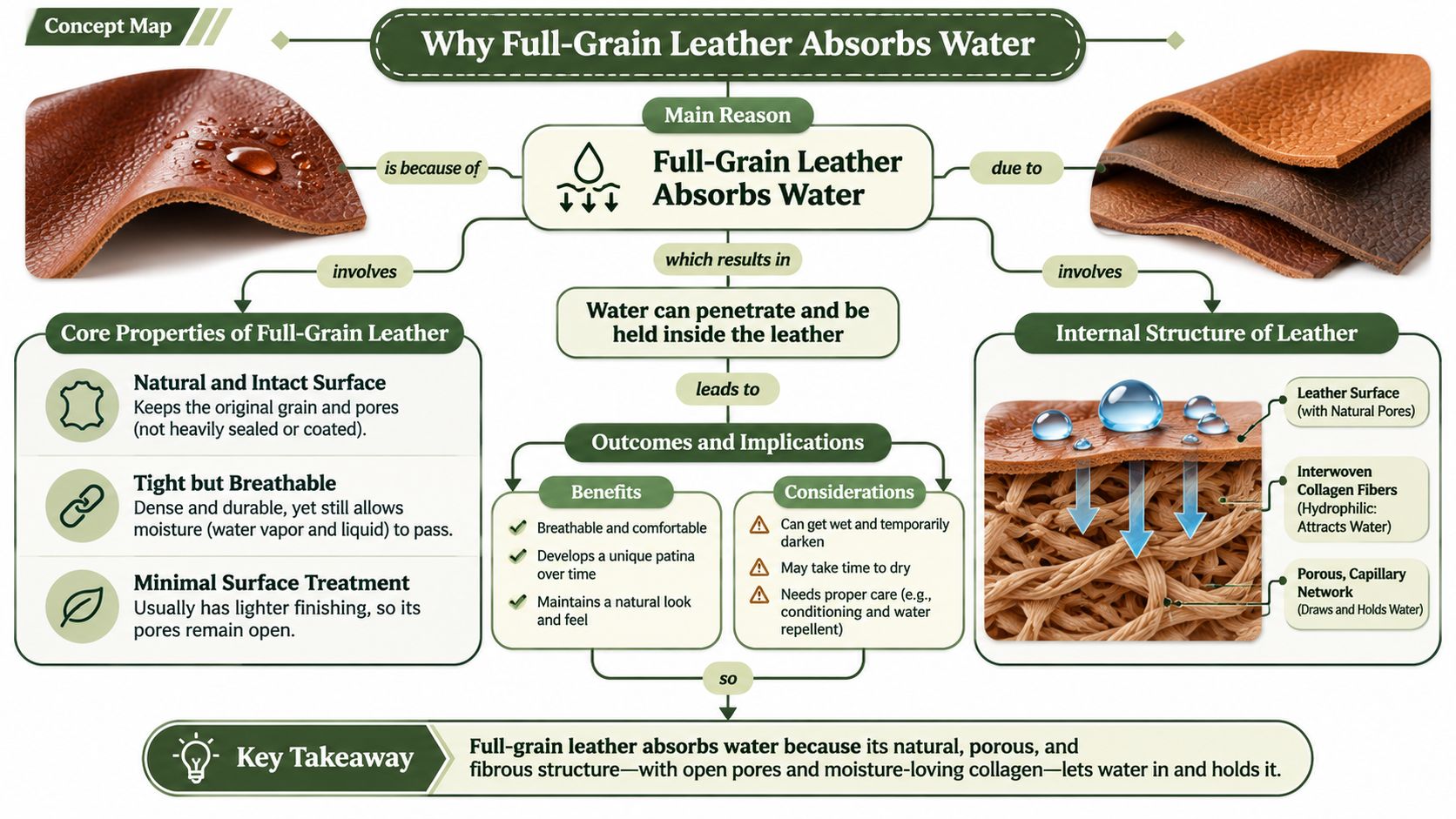
Beading measures the surface, not the whole story
In an academic leather-coating study, untreated natural leather began with a water contact angle of 81.83°, but the droplet spread and was completely absorbed within 15 minutes, with the angle falling to 0.33°. Those results describe that sample under the study's conditions, not every full-grain bag.
A contact angle describes the shape a droplet makes against a surface. A droplet that stays rounded indicates better initial repellency than one that spreads flat, but the first moment doesn't establish what happens during sustained contact.
Temporary repellency means water initially beads or runs off. A meaningful waterproof claim needs evidence that the material or product prevents penetration under defined conditions, including the relevant exposure duration and pressure.
What changes absorption
Several manufacturing choices influence the result:
- Tannage: The tanning process changes how the fibre structure responds to moisture.
- Fatliquoring: Oils introduced during manufacture affect fibre lubrication and water behaviour.
- Surface finish: Waxes, coatings and other finishes can delay wetting, with different effects on appearance.
- Edge construction: Exposed cut edges provide access that a finished face may resist.
- Exposure duration: Continued contact gives water more opportunity to enter.
For a buyer, the useful question isn't whether the bag uses a respected leather grade. Ask what finish is present and how that finish should be maintained.
Don't deliberately soak a new purchase to test it. A home droplet test may leave a mark and still won't tell you whether the assembled bag can withstand rain. Beading is a useful observation during ordinary use, not a substitute for documented performance.
How to Read a Waterproof Claim
A waterproof claim is only useful when you know what was tested, under which conditions, and with what result. A seller who identifies a standard but provides no outcome hasn't yet told you how the product performed.
Leather testing separates properties that shoppers often combine. Absorbing liquid water, resisting penetration and transmitting water vapour are different behaviours. Passing a test for one doesn't establish the others.
Match the method to the promise
The ISO 2417:2025 static water-absorption standard measures absorption after immersion intervals including 15 minutes, 30 minutes, 60 minutes, 120 minutes and 24 hours. An absorption result therefore needs its exposure interval attached to it.
The leather-testing overview accompanying ISO 14268 distinguishes liquid-water testing under ISO 5404 from vapour-transmission testing under ISO 14268 and ASTM D5052. The latter describes breathability, not whether rain will reach your belongings.
For example, a seller may offer a vapour-permeability result as evidence that leather breathes. That's useful information, but it doesn't answer how much liquid the leather absorbs or when water penetrates it.
Grade terminology deserves the same care. The leather buying advice from Giorgi Bros, from Giorgi Bros. Furniture, offers background for comparing leather descriptions; our guide to grades of leather provides further context for interpreting material labels. Neither a grade name nor a premium-sounding description replaces a water-performance result.
Ask for the result, not just the label
Put these questions to the seller:
- Which standard was used? Request the named method, not a general assurance that the leather was tested.
- How long did exposure last? For immersion testing, ask for the immersion interval; for another method, ask for its relevant conditions.
- What was the result? Look for the measured absorption or penetration outcome and any stated acceptance criterion.
- What did the test cover? Establish whether it assessed a leather specimen or the complete assembled product.
A test on a leather sample doesn't establish that a closed bag will keep its contents dry.
A bare waterproof label without a named method, relevant conditions or measurable result isn't evidence you can use to plan a wet commute. Prefer a clearly limited claim over an absolute promise nobody can explain.
Why Construction Decides Whether a Bag Stays Dry
Say rain beads neatly on a briefcase's front panel, but a document inside becomes damp along its top edge. The leather face may have performed adequately while the closure allowed water through.
A bag is an assembly. Inspect the openings and junctions with the same care you'd give the hide, using a leather bag quality checklist to separate attractive workmanship from features that matter for your intended use.
Follow the possible entry routes
Seams and stitch holes come first. Needle holes interrupt the panel, and water can enter along stitching or adjoining pieces; tidy stitches alone don't establish that a seam is sealed.
Zippers create another route. Teeth, tape and the gaps around the ends can admit rain, particularly when the opening faces upward. A flap or covered closure helps shelter that vulnerable area, but don't assume a standard zipper is watertight.
Edges and the base deserve a close inspection. Cut edges can take up moisture, and a bottom panel placed on a wet platform or bathroom counter remains in contact with water rather than shedding it.
The lining affects what happens after entry. An absorbent lining, such as cotton or suede, can hold moisture against documents or accessories; ask what it's made from and whether any water-resistant layer is included.
Handles and straps are easy to overlook. Unsealed attachment points, undersides and folded areas can become wet and transfer moisture to adjoining parts, even if the main panel remains relatively dry.
Flexing changes the challenge
Carrying, lifting and packing bend leather while it's exposed. A static surface observation doesn't reproduce that movement.
The ISO 5403-1:2025 dynamic water-resistance method uses repeated linear compression of a partially immersed leather specimen to measure resistance to water penetration. It evaluates material under movement, though a specimen result still doesn't certify every closure on a finished bag.
Before buying, check:
- Seam protection: Look for documented sealing where weather protection matters.
- Closure coverage: Prefer a sheltered zipper or overlapping flap for rain exposure.
- Interior specification: Confirm the lining material and any water-resistant barrier.
- Base design: Examine exposed edges and avoid designs that collect water around the opening.
Don't perform an improvised sink test. Inspect construction, request the relevant specifications, and protect sensitive contents separately when the weather exceeds the product's stated limits.
Protection Options and Their Trade-Offs
The strongest treatment isn't automatically the best choice. You may gain surface repellency while losing some of the colour variation, softness or patina you bought the leather for.
A continuous seal can also interfere with breathability and future conditioning. The Rustic Town leather-care guide discusses these protection trade-offs and notes PFAS restrictions affecting fluorinated treatments in some US states. Don't assume every spray chemistry is suitable, available or compliant wherever you live.
Protection options compared
A neutral conditioner is primarily a suppleness treatment, not a rain shell. Wax builds a more noticeable barrier, while sprays depend heavily on their formulation and compatibility with the existing finish.
| Option | What It Does | Main Trade-Off |
|---|---|---|
| Neutral leather conditioner | Keeps fibres supple and may add slight water resistance | Needs periodic reapplication; may darken some finishes |
| Wax or wax-based balm | Forms a repellent film on the surface | Can alter feel, breathability and patina |
| Silicone or fluorinated spray | Can give strong surface repellency when compatible with the leather | Can reduce breathability; fluorinated products face PFAS restrictions in some US states |
| No treatment | Preserves the existing feel and natural patina development | Leaves absorption governed by the existing finish; needs prompt drying after wetting |
Leaving leather untreated isn't neglect when the maker specifies it and the use is sheltered. Conversely, applying a thick wax coating to a lightly finished office portfolio may solve a problem you rarely encounter while permanently changing the surface.
Choose around actual exposure. For regular wet-weather travel, comparing leather with other constructions, including those discussed in our canvas travel bags guide, can be more useful than repeatedly adding heavier treatments. Canvas itself isn't a waterproof guarantee either; its finish and assembly still need checking.
Apply less, assess more
Use these rules before treating the whole item:
- Patch-test discreetly: Choose a concealed area with the same finish, apply a small amount, and inspect it after drying for colour, gloss and feel changes.
- Follow the maker or tannery: Match the care product to the particular leather rather than buying solely by the full-grain label.
- Avoid household improvisation: Furniture polish, general-purpose sealants and indiscriminate sprays aren't substitutes for a compatible leather-care product.
Treatment boundary: A repellent coating can improve the surface. It can't repair an open seam or redesign an exposed zipper.
I would choose the lightest compatible treatment that suits the expected exposure, then use an external rain cover when conditions become more demanding. More product isn't a reliable route to more protection.
How to Dry and Care for Wet Leather
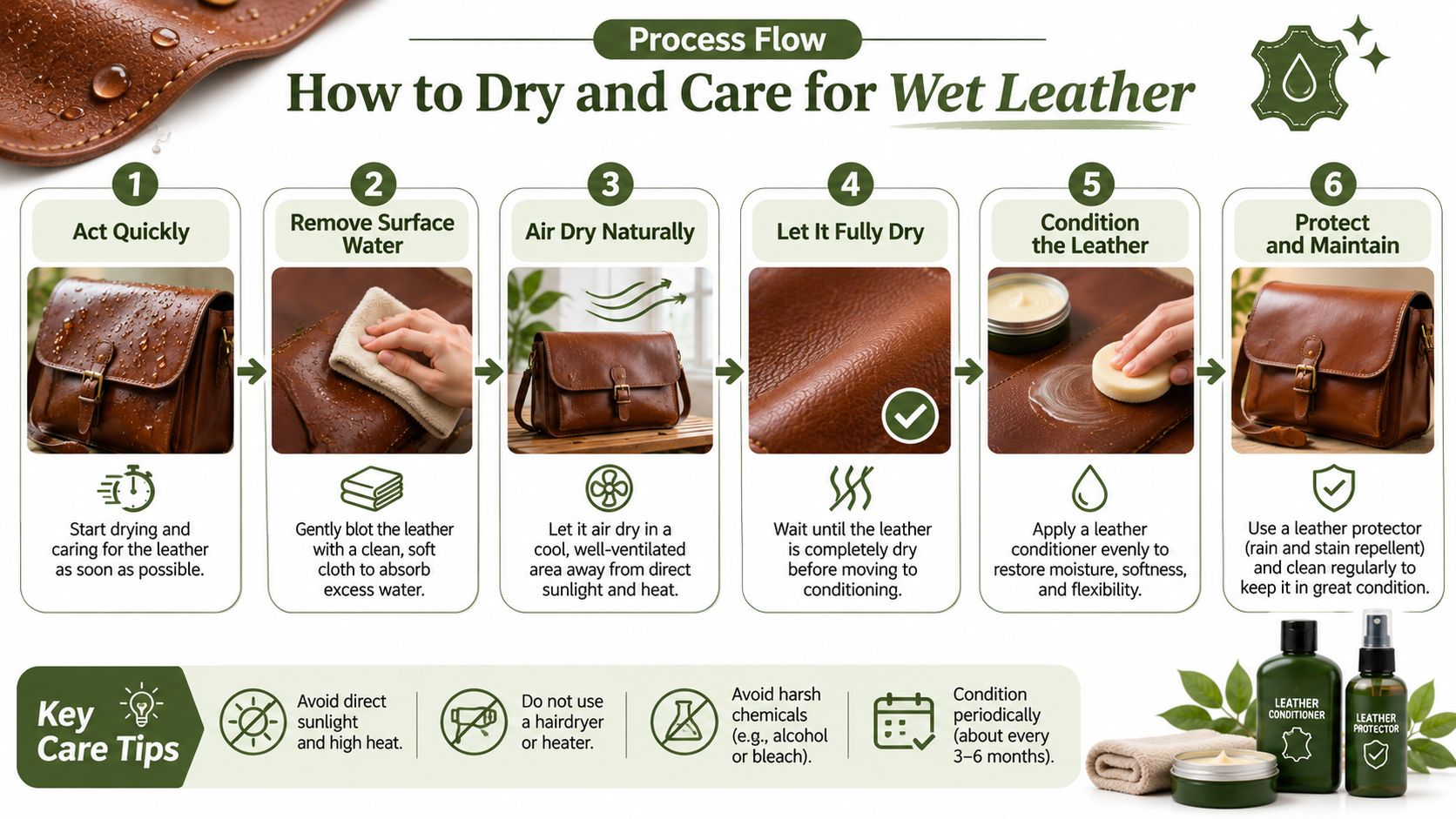
Once leather gets wet, the priority is to remove free water and let the whole item dry without distorting it. Don't try to restore colour or softness while you're still dealing with a damp lining and saturated seams.
ISO's water-vapour permeability standard addresses vapour passing through leather, not a guaranteed drying schedule. Judge readiness by the item's condition, including hidden areas, rather than setting a deadline.
A controlled drying sequence
- Blot the surface immediately. Press a clean, soft, dry cloth against the water and lift it away, moving to a dry part of the cloth as needed. Don't scrub, because friction can disturb a wet finish and spread the affected area.
- Empty the bag completely. Remove papers, electronics, loose inserts and anything in internal pockets, then open the compartments. Leaving a damp notebook or fabric pouch inside keeps moisture against the lining and slows your ability to inspect it.
- Support the shape loosely. Put clean, unprinted absorbent paper or a soft dry cloth inside, without stretching the panels or forcing the zipper closed. Replace the stuffing when it becomes damp, and avoid printed paper that could transfer ink.
- Air dry at room temperature. Set the item in a ventilated place away from radiators, heaters, hair dryers and direct sunlight. Don't accelerate drying with heat, which can contribute to stiffness, shrinkage and distortion.
- Check hidden areas before conditioning. Feel inside pockets, around seam junctions and beneath folded sections; the exterior may appear dry before the interior is ready. Don't apply a heavy coating to damp leather or close it inside a dust bag while moisture remains.
- Condition cautiously once fully dry. Test a compatible neutral conditioner on a concealed patch, let it settle, and check for unwanted darkening or texture changes. If suitable, apply a thin, even coat rather than saturating the leather; our guide to conditioning leather explains the application process.
- Inspect the complete item. Check the lining, zipper, stitching and base for persistent dampness, distortion or separation. Don't force stiff panels back into shape or assume conditioner will reverse structural damage.
Check the storage environment too
If clothing stored beside the bag smells musty, deal with that separately before returning everything to the cupboard. CleanOnline, North York's Premium Dry Cleaners, explains how to stop closet odours returning after washing; that clothing guidance isn't a reason to wash leather or apply laundry products to it.
After drying, look for an even colour relative to the original finish, a supple feel and no newly stiff or cracked areas. Persistent hardening, major staining or distortion warrants assessment by a leather repair specialist, not another layer of conditioner.
Confirm Water Protection Before You Buy or Carry
Choose for the weather you'll encounter. A sheltered commute, an exposed walk in daily rain and wet-climate travel place different demands on a bag, especially when the contents include electronics or valuable accessories.
Outdoor activities deserve their own packing decision. If you're comparing the Fayrway golf trolley range for course transport, separately assess how you'll shelter your leather wallet, watch case or document pouch during rain; the trolley choice doesn't establish those accessories' water protection. For bathroom and luggage exposure, our men's toiletry bag travel guide offers another practical use-case comparison.
Make the decision before the wet day
- Match exposure to protection: Decide whether ordinary splash resistance is enough or whether you need a rain cover and waterproof inner storage.
- Verify the claim: Request the named test, exposure conditions and result, and confirm whether the claim covers the assembled item.
- Prepare compatible care: Patch-test the recommended treatment and keep a soft blotting cloth with your travel supplies.
- Read the guarantee: We offer a 1 Year Guarantee. Check its terms before purchase rather than assuming it covers water damage.
Our full-grain leather pieces have the same material limits described here, so read each product page for its particular construction and care requirements. Many marks and scratches on our products can be gently rubbed out, but that isn't a promise that water staining or saturation damage can be reversed.
Today, list the weather situations your bag will face, then inspect its seams and zipper before buying or packing it. Respect water-resistant as a boundary, and choose separate protection whenever a leak would put important belongings at risk.
Grainmark Leather offers full-grain leather bags, cases and small goods for daily carry and travel. Visit Grainmark Leather to compare the formats you need, then check the individual material and construction details against your wet-weather routine before choosing.