
Correct Humidity for Humidor: Target Range and Fixes
The correct humidity for most humidors is 65% to 70% relative humidity, with about 69% as the practical setpoint for general storage. Holding that band steady does more for your cigars than touching 70% exactly and drifting around it.
Most humidor problems start at the gauge, not the cigars. A digital hygrometer that reads three points high, sits against a wet sponge, or gets checked thirty seconds after the lid opens hands you confident, wrong numbers, and every adjustment after that chases a fiction. Verify the instrument, change one thing at a time, and judge the result over days rather than minutes.
That's the working method: pick a target inside the band that matches how you store and how you smoke, prove your measurement is honest, then correct drift slowly enough for the tobacco to follow. The specifics start with which number fits your situation.
Table of Contents
- The Right Humidity Range for Each Storage Situation
- Why a Stable Range Beats a Single Number
- How Temperature Changes the Right Humidity
- How to Calibrate Your Hygrometer Before Adjusting
- What to Do When Your Reading Drifts
- Diagnosing Symptoms That Contradict the Gauge
- Set Up Your Humidor to Hold 65 to 70 Percent
The Right Humidity Range for Each Storage Situation
The default is 65% to 70% relative humidity, and the middle of that band is where I'd start anyone with a mixed collection. The Boveda humidity guide sets out the setpoints plainly: 65% RH for smokers who want a drier profile or an easier burn, 69% RH for general storage, and 72% RH for unusually dry or leaky environments. That last figure is a repair setting for a box that leaks or lives in desert air. It isn't a new default.
Cigar Star's 2024 guidance lands on the same band, stating that a humidor hygrometer should consistently read between 65% and 70% RH (Cigar Star). Two independent recommendations agreeing on a range rather than a single digit tells you something about how tobacco behaves.
| Storage situation | Target RH | Temperature | Reason for adjustment |
|---|---|---|---|
| Mixed collection, general storage | 65-70% (69% setpoint) | Stable, about 21°C (70°F) or below | Conservative band for most premium cigars |
| Drier smoke or easier burn | 65% | Stable, about 21°C (70°F) or below | Lower RH gives a drier cigar with an easier draw |
| Dry climate or heated home | 69-70% | Stable, about 21°C (70°F) or below | Dry air pulls moisture out, so expect to refill more often |
| Humid climate or frequent opening | 65-68% | Stable, about 21°C (70°F) or below | A lower target reduces mold risk when air exchange is high |
| Long-term aging | 68-70% | Cool and stable, 16-18°C where possible | Stable conditions matter more than the exact figure |
| Travel humidor | 65-70% | Away from heat and direct sun | Sealed liner and minimal opening keep the target |
| Cuban cigars (Habanos guidance) | 65-70% | 16-18°C | Cooler and slightly drier than the 70/70 rule |
Read the table as a lookup, not a menu. Find the row that matches your storage first, set that target, and treat everything after this as the work of holding it. The temperature column matters as much as the humidity one.
If your storage moves, the same targets apply in a different container, which is the trade-off behind choosing between a cigar case and a travel humidor. A sealed box in a fixed room holds a setpoint far more easily than a case that rides in a jacket pocket.
You'll know the setup is working when the gauge sits inside your chosen band for several days without large swings and the cigars feel firm and springy under a gentle squeeze, never brittle, never spongy.
Why a Stable Range Beats a Single Number
Relative humidity measures how full the air is, not how much water sits in the box. Warm air holds more moisture than cool air, so 70% RH in a room at 65°F and 70% RH in a room at 78°F are different quantities of water, and cigars feel the difference. Think of the air as a sponge that swells as it warms: the same percentage of fill means more water in a larger sponge.
The 70/70 rule, roughly 70% RH at 70°F (about 21°C), has been the shorthand for generations, and Tobacconist University's preservation guidance treats it as a reference point rather than a requirement. That guidance reports cigars stored successfully across roughly 65% to 70% RH, with some smokers preferring about 60% to 65%, and notes that many tobacconists outside the United States run 60% to 64% RH for long-term storage. Dropping from 70% to 65% is a five-point move, and for preservation or a firmer, cooler smoke it can be entirely deliberate.
A hygrometer reading is a snapshot of that moment, which is why one number tells you so little. What you want is the pattern.

Why the published numbers differ
Seth's Humidor's 2024 storage figures put cigars at 65% to 72% RH and describe 65% to 75% RH as a wider acceptable range. Set that beside the guidance above and the honest conclusion isn't a magic number. It's a band with a safe center, and the center shifts with your climate, your seal, and how you like to smoke.
A humidor that holds 66% to 69% without swings is healthier than one that hits 70% every afternoon and drops to 62% overnight. The tobacco reacts to the movement, not the average.
Pick the band that fits your smoking and your storage goals, write it on a note inside the lid, and hold it. That's the rule to carry forward.
How Temperature Changes the Right Humidity
Cigar moisture is an equilibrium, not a setting you dial in and forget. Tobacco exchanges water vapor with the surrounding air until the two settle, and where they settle depends on humidity and temperature together, which the Cigarista storage guide spells out.
That's why the Cuban benchmark runs cooler than the American shorthand. Habanos guidance for finished Cuban cigars, as Cigarro's humidity guide reports it, specifies 65% to 70% RH at 16°C to 18°C, which is about 60°F to 64°F, a shade drier and noticeably cooler than 70/70. Cool storage also buys safety, since keeping the box below roughly 70°F leaves a practical margin against tobacco beetles, while warmth combined with high humidity is what turns a damp humidor into a mold problem with an unreliable burn.
Where the humidor sits matters
- Direct sunlight: a windowsill box heats on one side and stays cool on the other, so the wall-facing cigars run wetter than the room-facing ones.
- Radiators and HVAC outlets: forced air dries a humidor out faster than its humidifier can compensate, and the gauge shows the loss before the cigars do.
- Exterior walls: a cold outer wall creates a temperature gradient across the box, and gradients are what produce localized condensation instead of even moisture.
Picture a humidor on a sunny sill in January. The glass-facing side can sit several degrees warmer than the side against the wall, the warmer side holds more moisture, and the cigars nearest it absorb water the rest of the box never sees. Moving the box two feet onto a shaded shelf fixes more than rotating the cigars ever will.
In a portable format the same logic applies with less margin. A leather travel humidor carried in a bag spends the day near a body or a car window, so keep it out of heat and open it as little as you can. Repeated air exchange overwhelms passive humidity control in dry climates and at altitude.
What you're after is boring stability. Not one impressive reading, but a temperature that doesn't spike and a humidity band that doesn't jump.
How to Calibrate Your Hygrometer Before Adjusting
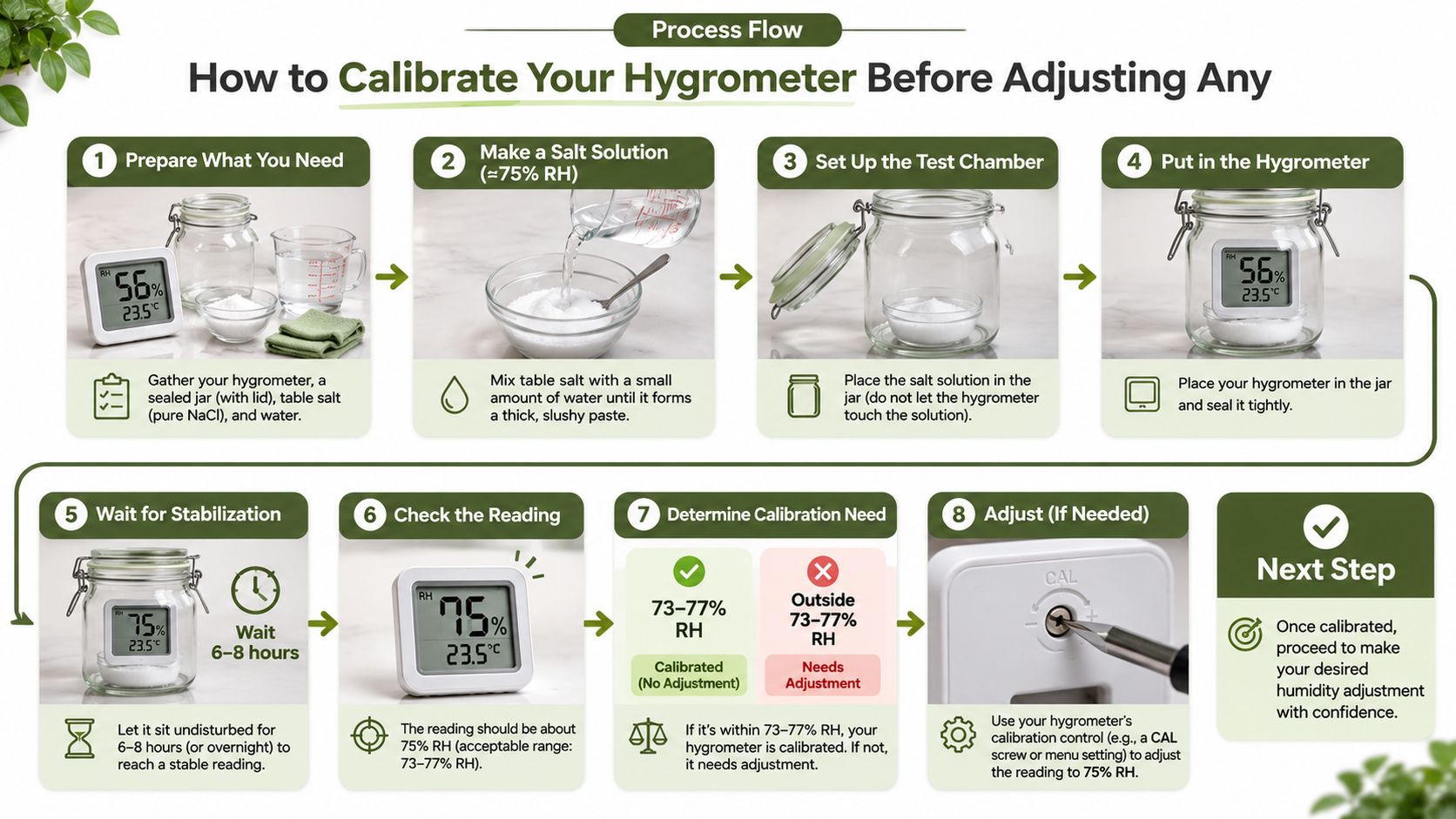
Calibration turns a display into a usable measurement. Do it before adding water, removing humidification, or blaming the box. A gauge that reads confidently but sits several points off will push every later decision in the wrong direction.
- Seal the gauge with a salt slurry. Put a small dish of damp, not flooded, salt inside a sealed container with the hygrometer and leave it several hours. A saturated salt environment settles at a known humidity, which is why this check is a reference rather than a guess. The common slip is too little water, which leaves the salt unsaturated and the reference worthless.
- Bring in a second gauge. Set a backup digital hygrometer in the same container or box and see whether the two agree within about three points. One display can lie to you all year; two that disagree tell you to keep looking.
- Reposition the one that stays. Mid-height inside the humidor, away from the humidification media, not touching the cedar wall. A gauge pressed against a wet sponge or a damp wall reads the media, not the air your cigars live in.
- Close the lid and wait. Give a closed humidor 24 to 48 hours to stabilize before you believe a number. Reading straight after opening gives a falsely low figure, because the dry room air that just rushed in is what the sensor sees.
- Read at the same time daily for a week. Daily readings turn a snapshot into a pattern. Note the number, the room temperature, and whether anyone opened the box that day.
- Recalibrate or replace if it misses the reference. A gauge off by more than about three points should be adjusted to match the reference or retired. A cheap digital unit with a drifting sensor creates every problem you're trying to solve.
Prefer a digital gauge over an analog dial, and change the battery before you blame the humidor. A 4-cigar leather travel case with a digital hygrometer puts the instrument where the cigars are, which makes step five easy to keep doing on the road.
What to Do When Your Reading Drifts
Small, slow corrections beat large ones, because cigars rehydrate and dry at different speeds. The wrapper takes on water faster than the filler, so a dramatic fix can crack a cigar that was merely thirsty.
Over-humidification is the failure that gets missed, because nothing looks wrong for weeks. In a Cigar Aficionado humidor review, one tested unit started at 76% RH, climbed as high as 78%, and only fell below 72% after six weeks. Six weeks above target is six weeks of cigars absorbing water nobody intended them to have.
| Hygrometer reading | What it means | First action |
|---|---|---|
| Below 60% | Too dry, with wrapper cracking risk | Add humidification in small steps over several days |
| 60-64% | Acceptable for a drier profile or long-term preservation if stable | Adjust only if the cigars feel dry |
| 65-70% | Target band | Hold steady and check weekly |
| Above 72-75% | High, with mold and soft cigars more likely | Remove excess humidification, inspect cigars and ventilate briefly |
Above roughly 72% to 75% RH, mold and overly soft cigars become more likely, as Cigsor's humidity guide sets out. A short-lived excursion above the band is less alarming than repeated swings, so watch the direction of travel across a week rather than one afternoon's display.
Change one thing: adjust a single variable, close the lid, and give it three or four days before judging. A smoker who tops up the water, swaps the pack, and opens the box to check is measuring his own intervention, not the humidor.
Room conditions drive the box. If your humidor lives in a living space, an air quality monitor for living room conditions that tracks temperature and humidity shows a seasonal shift coming before the cigars feel it.
A 7-cigar leather travel humidor with a built-in hygrometer makes that easier, because the reading travels with the cigars instead of staying on a desk.
Diagnosing Symptoms That Contradict the Gauge
The complaint that matters most is the one where the display says 70% and the cigars feel wrong anyway. Trust neither the number nor your hands until you've checked both, because a confident gauge and a confident smoker can both be mistaken.
Run the sequence in this order
Verify the instrument first with the salt test, then check temperature and placement, then inspect both the cigars and the wood. Only after several days of steady readings should you change anything, and then in small increments. The Unicorn Hunters humidor humidity guide recommends validating with a salt test that should read about 75% RH in a sealed environment, and warns that dried cigars need gradual reconditioning because the wrapper swells faster than the filler and cracks. It also lists the usual suspects behind unstable readings: frequent opening, poor seals, undersized humidification, temperature, airflow, and overcharging.
| Symptom | Likely cause | First fix |
|---|---|---|
| Gauge reads 70% but cigars feel dry | Gauge out of calibration or badly placed | Run a salt test and move the gauge away from humidification |
| Soft, damp cigars with fuzzy or colored patches | Over-humidified, likely mold | Remove affected cigars, reduce humidity and ventilate briefly |
| Even white dust on cigars | Plume, a harmless crystallization | Leave in place and keep storage steady |
| Wrapper cracking after adding moisture | Rehydrated too quickly | Recondition over several days in small increments |
| Humidity will not rise | Empty, undersized or leaking humidification | Refill, match the product size to the box, then check the seal |
The plume and mold distinction is worth slowing down for. Plume is an even, powdery white dust that brushes off a wrapper, and it's a sign of stable aging rather than a fault. Mold is fuzzy, raised, and often colored, and it can extend into the foot of the cigar where you can't see it. Discard the cigars with fuzzy patches, wipe the cedar, and drop your target a point or two.
One closing rule covers the whole sequence. When the gauge and the cigars have disagreed for more than a week, trust the salt test and the tobacco, not the display, then correct in small steps.
Set Up Your Humidor to Hold 65 to 70 Percent
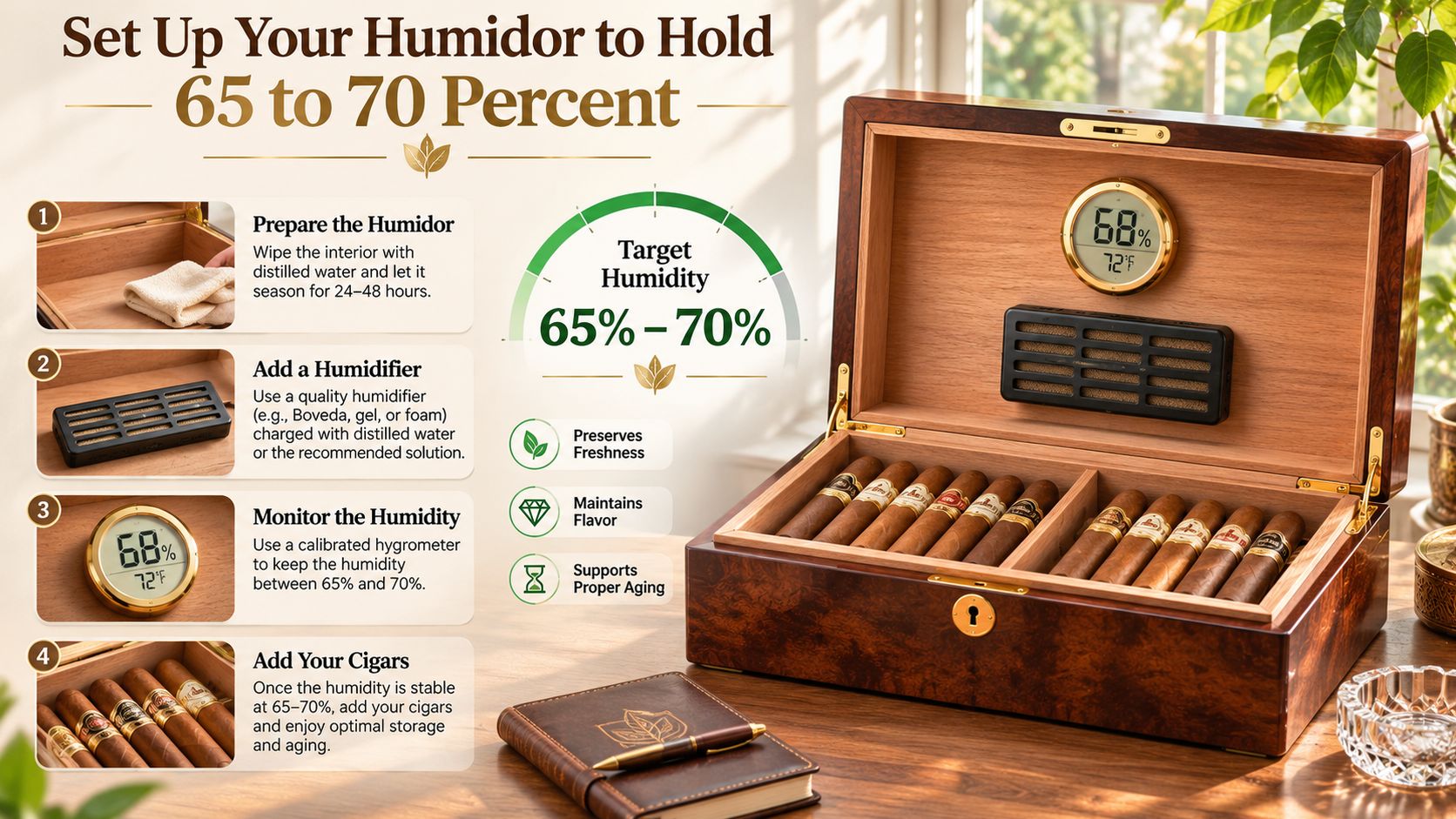
Season the wood before you ask it to hold anything. A new or dried-out cedar humidor is conditioned while empty, with a seasoning pack rated well above any storage target, and cigars stay out of it until the wood holds your chosen target on its own once the pack comes out. A box that has drifted dry is brought back in small increments across several days, not one large addition, so the wrappers don't swell faster than the fillers and split.
Then the routine.
- Choose one target from the table at the top and commit to it.
- Use one humidification method. Two products rated at different levels fight each other and neither wins.
- Check weekly for the first month, then every week or two once the pattern is clear.
- Keep the box over half full so moisture has cigars to distribute across rather than bare wood.
Match the format to the habit. Cigar cases come as pocket tubes, travel humidors and desktop boxes, and each solves a different problem: a tube protects a single cigar in a jacket, a travel humidor carries a small selection through airports and hotel rooms, and a desktop box stays put where conditions are steadiest. For at-home storage, CigarGrail's humidity guidance puts a well-sealed home humidor at 65% to 69% RH for many premium cigars, which is squarely inside the band.
Leather needs almost nothing. Wipe off dust with a soft cloth and apply a small amount of leather cream if the leather feels dry, then keep the case away from the car's glovebox in summer. Smoking accessories, from cutters to rolling papers, filters and machines for hand-rolled tobacco, want the same treatment: a dry drawer, well away from the humidor's moisture.
A leather cigar storage case with humidor compartments and a lighter slot keeps the tools and the cigars in one place without mixing the two.
The first week decides everything: calibrate the gauge, write down seven daily readings, and change nothing until you can see the pattern. Most humidor problems are solved by good data, not by more water.
That's your next step. Run the salt test this week, log the numbers, and adjust only after the trend is clear.
Grainmark Leather builds the storage side of this routine in full-grain leather, from a 7-slot humidor with a built-in digital hygrometer for the shelf at home to compact travel cases that carry the gauge with the cigars. If you'd rather hold a band than chase a display, browse the humidors and cigar cases at Grainmark Leather and pick the format that matches how you store and travel.