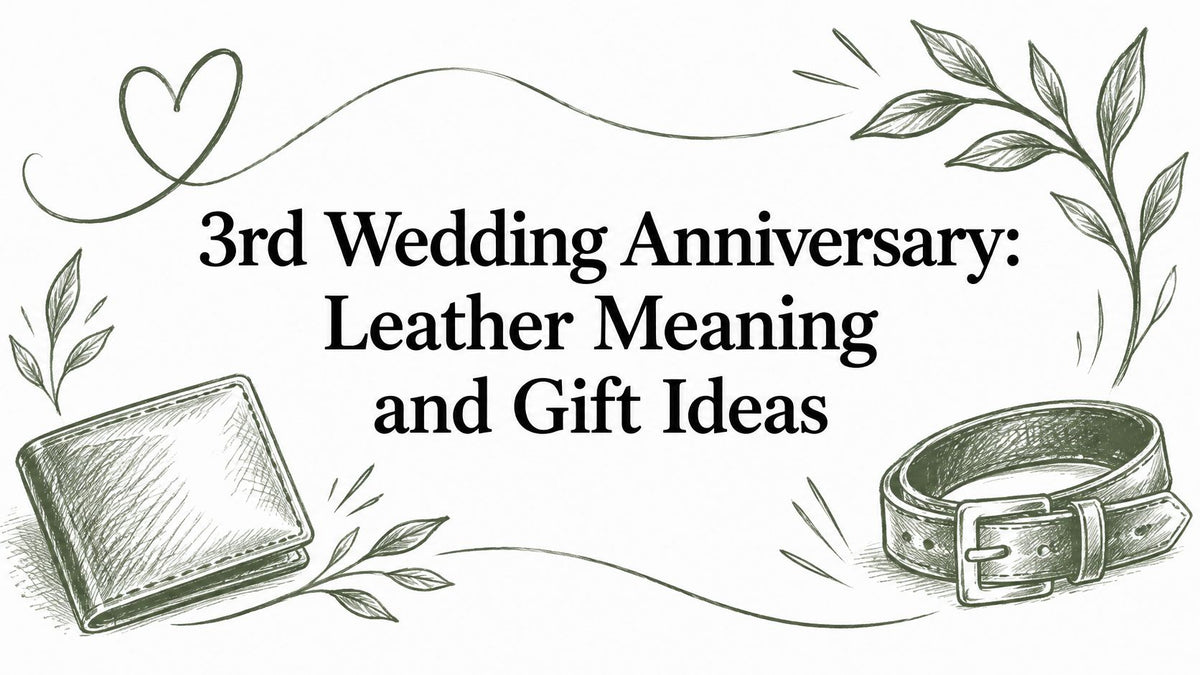
3rd Wedding Anniversary: Leather Meaning and Gift Ideas
Leather is the traditional gift for a 3rd wedding anniversary, and the convention is younger than almost every gift guide admits. It comes from a twentieth-century retail list, not from centuries of folklore, which means you are free to treat it as a design brief rather than a rule.
That distinction matters, because the standard advice is to buy leather, buy it early, and buy something that looks unmistakably like leather. That advice pushes couples toward objects that don't fit anyone's actual week. A thick belt for a partner who works from home. A briefcase for someone who cycles to a studio. Both are technically on theme, and both end up in a cupboard.
What's worth keeping is the idea underneath the tradition: three years of marriage has moved past the brittle early stage into something with more give. Leather bends without breaking, which is exactly the quality a third year tends to develop. It is one way to say that, not the only one. A couple that reads the tradition as a brief can ask what durability, flexibility, and care look like in their own household, then choose the object that answers. The label matters less than the fit.
Table of Contents
- What the Third Wedding Anniversary Traditionally Means
- What Leather Symbolizes in a Marriage
- Leather or a Non-Leather Keepsake Chosen by Values
- Leather Gift Ideas Matched to the Recipient
- How to Judge Leather Quality Before You Buy
- Storing Leather Gifts So They Last
- Choose Your Third Anniversary Gift This Week
What the Third Wedding Anniversary Traditionally Means
Leather is the traditional third-anniversary material in the gift lists used across the United States and the United Kingdom, and the word "traditional" deserves a closer look before you plan around it. This tradition has a publication date.
Emily Post's 1922 etiquette book, the reference most households consulted, named only eight anniversary materials: paper, wood, tin, crystal, china, silver, gold, and diamond. Year three had no material assigned at all. For the first decades of the twentieth century, a couple reaching their third anniversary had no themed gift to buy.
Where the leather assignment actually comes from
The leather assignment is a documented publishing decision: an expanded anniversary list put leather at year three in 1937, when the American National Retail Jewelers Association revised the older etiquette materials into a longer commercial list. The motive was practical. Jewelers and leather goods shops gained a reason to sell something in years that had previously been blanks, and couples gained a prompt for what to buy.
That origin story is useful, not embarrassing. A convention with a date behaves like a design brief: it tells you the material and leaves the meaning, the object, and the budget entirely to you.
| Source | Year-three material | What it shows |
|---|---|---|
| Emily Post etiquette book (1922) | None assigned | Lists eight materials, none for year three |
| American National Retail Jewelers Association list (1937) | Leather | Documented source of the leather assignment |
| Modern gift guides | Leather, with crystal or glass as the alternative | Crystal or glass offered as the modern alternative, linked to clarity and openness |
Why the material fits the year
A retail invention survives for decades only if it rings true, and leather did. The material is durable, flexible, protective, and it gets more comfortable with use. Read those four words as a description of a marriage past its first stage and the assignment stops looking arbitrary. Staying power, the ability to bend without breaking, the job of guarding what matters, and a partnership that gets easier to live inside once it has been worn in: that is the meaning the tradition hands you.
Practical rule: Treat leather as the default theme and then judge the object on its own merits. The theme is a starting point, not a purchase order.
Because the tradition is a brief rather than a rule, you can adapt it to what your household values. A couple that avoids animal products can work the same four ideas into a non-leather keepsake. A couple that prizes experiences over objects can treat the theme as a loose prompt. Crystal and glass, the commonly cited modern alternative, carry their own meaning of clarity and openness, so decide which idea you want the gift to carry before you shop.
If you'd rather mark the day with a retrospective than an object, memorial tribute video inspiration covers how to pace three years of photographs into something watchable.
What Leather Symbolizes in a Marriage
Leather earns its place at year three because of three properties that map onto what a marriage is doing by then. Each one has an object you can picture.
The three properties below are the ones couples tend to recognize first.
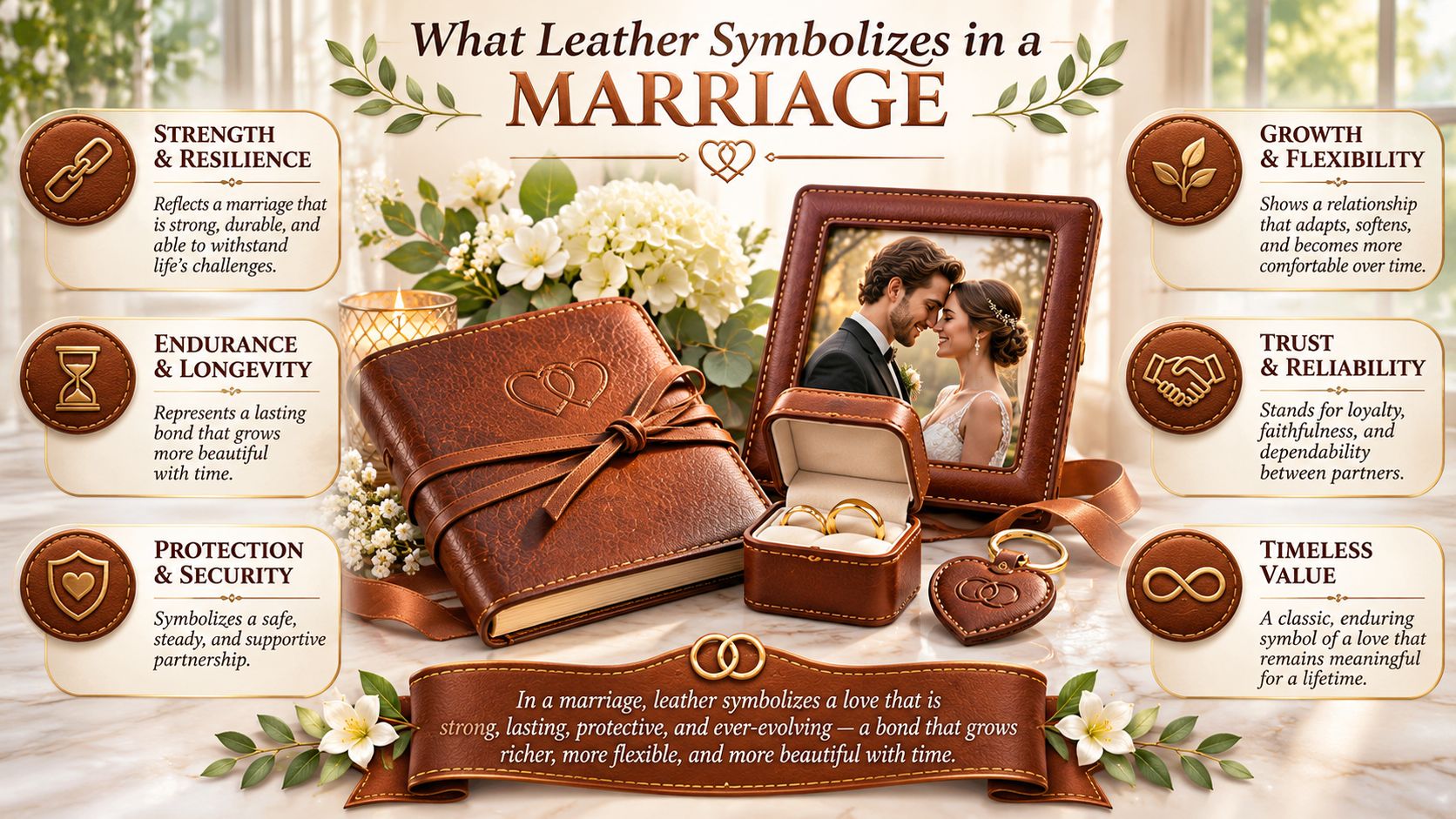
Durability is the obvious one. A full-grain briefcase carried five days a week will outlast three job titles and two laptops, and the lifespan of full-grain leather comes down to how the hide was tanned and how often it's conditioned. That's the claim worth making about a marriage at three years: it keeps working while the circumstances around it change.
Flexibility is the more interesting property. New leather is stiff. Wear it and it bends where your body bends, softens at the fold, and stops fighting your habits. Couples do the same thing. The routines that felt like compromise in year one become the shape of the week by year three.
Protection is the third. A strap holds a bag closed. A case keeps a watch from knocking against keys. In a marriage the equivalent is the set of small routines that guard what you both care about: who handles the finances, who remembers the appointments, who calls the family back.
Why patina beats pristine
Leather gains character through use. A scratch on a journal cover from a trip, a dark patch where a hand always grips a handle, a softened edge on a wallet: none of these are damage. They're the record.
Materials that must stay flawless work the other way. They get handled less, wrapped more, and end up in a box. That's a poor metaphor for a partnership, and a poor use of a gift.
A gift that has to stay pristine isn't a metaphor for a marriage. A gift that improves with handling is.
The reading is interpretive, not a rule, and couples are free to take it differently. Some see the durability and nothing else. Others care about the softening.
Three years is early in a longer story, and the demographic picture backs that up. Census Bureau analysis of marriage duration found that among people who married between 1970 and 1974, about 58% of men and 57% of women stayed married for at least 20 years. A third anniversary is the opening chapter, not the ending.
Three questions to ask each other
- What has worn well? Name the part of the relationship that has needed no maintenance this year.
- What has needed adjusting? Name the friction you've both worked around rather than solved.
- What do you most want to protect over the next twelve months? Time, sleep, a savings goal, a friendship, a parent's health.
Leather or a Non-Leather Keepsake Chosen by Values
Most gift pages present the choice as a list: leather is traditional, crystal is modern, pick one. That isn't a decision framework, and it leaves out the couples who'd rather not buy an animal-derived object at all, or who'd rather put the money toward a trip.
The gap is real. A recent anniversary gift guide reports that 65% of consumers prefer a live experience over a physical gift and that 73% prefer a sentimental gift over a generic one. If those numbers describe you and your partner, the literal leather object may be the wrong answer to the right question.
Honoring the tradition can mean adapting its meaning rather than buying the most literal version of it. Three questions get you to a choice before any product format is on the table.
1. What should the gift say? Staying power and shared routine point one way. A ritual built around honesty and openness points another. A shared experience says something different again: that the two of you are still choosing time together over stuff.
2. How will it be used? Every day, a few times a year, or displayed on a shelf. Daily use rewards material quality. Occasional use rewards presentation. Shelf display rewards neither, so don't pay for durability you'll never test.
3. What do your values and budget allow? If animal-derived materials are off the table, that's settled, and the answer is a durable non-leather keepsake or an experience. If sustainability is the driver, buy fewer things and buy them well.
What the answers point to
- Daily use and long wear: leather, chosen on construction rather than on the theme.
- Reflection or a shared home ritual: crystal or glass, used as the centerpiece of an evening rather than a shelf ornament.
- Animal-free living or sustainability: a durable non-leather object, or a shared experience with a small keepsake attached to it.
Neither route is less traditional. Crystal sits inside the same anniversary convention, and a couple who chooses it hasn't opted out of anything.
Say you both travel for work. A leather travel journal paired with a trip you've already booked does more than either alone, because the object records the journey instead of standing in for it. If you go the leather route and want something that ages rather than peels, vegetable-tanned leather is the specification to look for on the label.
Leather Gift Ideas Matched to the Recipient
Before you look at formats, settle the question the previous section raises: is leather right for this person at all. If it is, match the format to how they carry things.
| Recipient need | Leather format | Why it fits |
|---|---|---|
| Document-carrying professional | Structured briefcase or portfolio | Padded laptop sleeve and organized pockets for files |
| Frequent traveler | Duffle bag, wheeled bag or toiletry bag | Structured interior and strong handles for loaded trips |
| Watch or pen collector | Watch case, pen case or eyewear case | Separate compartments stop objects scratching each other |
| Journal writer | Travel journal or notebook cover | Daily use, and the leather ages with the owner |
| Prefers no animal-derived material | Non-leather keepsake | Durable alternative that keeps the anniversary meaning |
How to read a row
The middle column is the object. The right-hand column is the reason, and that's the part that decides whether the gift gets used. A briefcase only earns its price if the recipient carries documents and a laptop most days. A duffle only makes sense if they take short trips rather than long ones, since a bag that's too big for a weekend stays at home.
A collector's needs are narrower than they look. Watches and pens scratch each other when they share a pocket or a drawer, so the value of a case is separation, not padding. The same logic applies to eyewear: a hard case protects a frame, a soft sleeve protects a lens.
Buying rule: Match the format to the load the item will carry, not to the theme.
Personalization turns a good object into a dated one
Monogramming, initials, the wedding year, or a short phrase all convert a functional item into something tied to a date. If you want a name or a date added, personalized leather anniversary gifts are the category to browse, and our Personalised Gifts section sets out what can be embossed on eligible pieces.
Order early. Personalization adds a production step before the item ships, and a name that arrives after the anniversary is a worse gift than an unmarked one that arrives on time.
Three questions close the decision. How does your partner carry things on a normal Tuesday? Where will the item live when it isn't in use? What would they reach for every day if it were already in the house? Answer those, choose the row, and then check the quality points below before you pay.
How to Judge Leather Quality Before You Buy
The failure point most gift buyers miss isn't the leather. It's the attachment. A handle or strap usually tears where it meets the bag, at the stitching or the rivet, long before the hide itself gives out. Judge the piece at those joints first.
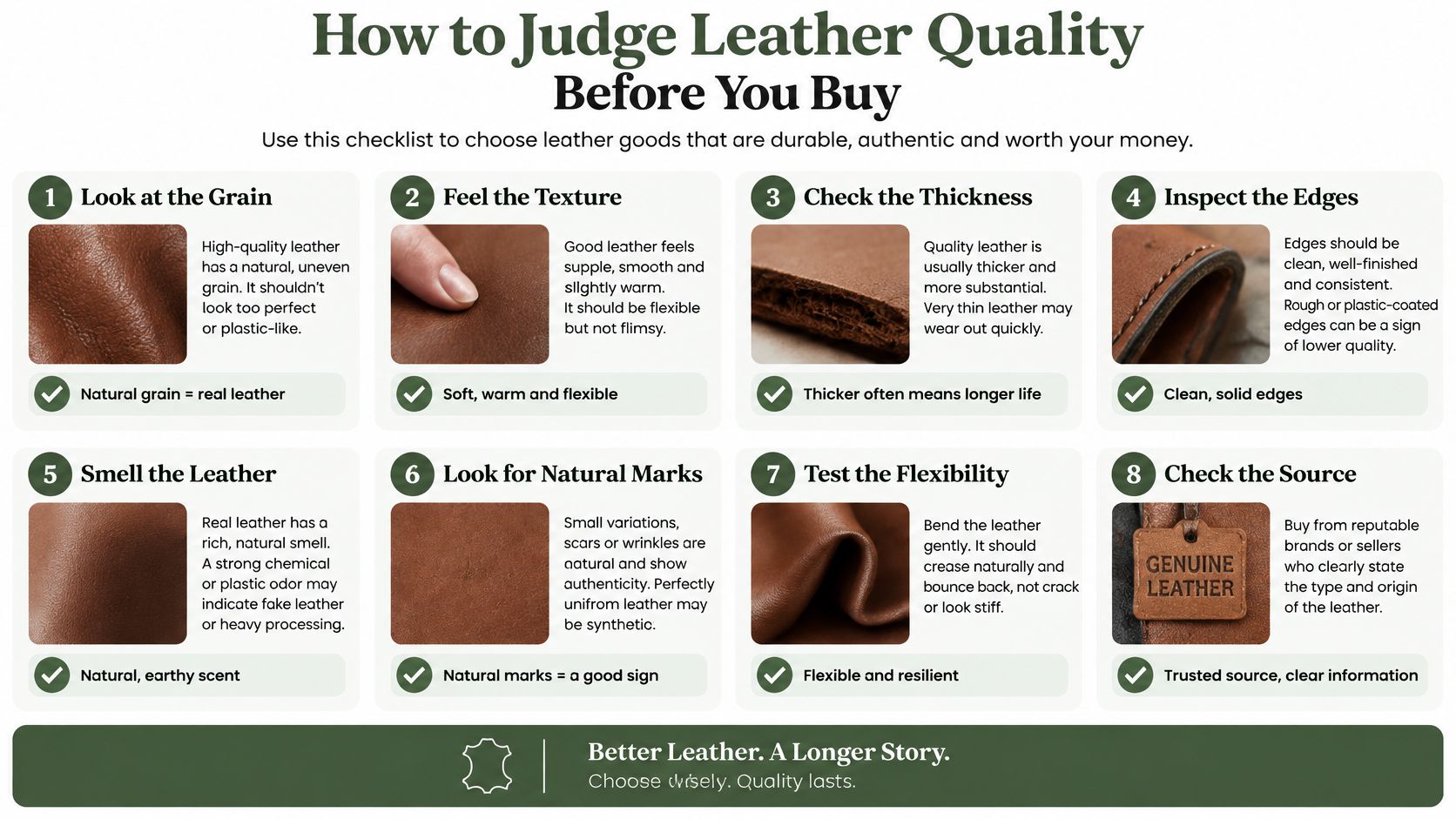
Then work through the checks in this order.
- Grain. Full-grain leather keeps its top layer, so it marks and softens rather than peeling away in sheets. If the listing doesn't state the grade, that's an answer in itself. The grades of leather run from full-grain down to bonded, and the difference in lifespan is large.
- Seams. Look for reinforced or double stitching at handles, corners, and strap ends, with even spacing. Uneven stitching is a sign of a machine pushed too fast.
- Hardware. Rivets, buckles, and zippers should be firmly fixed and, ideally, from a maker you can name. A loose rivet is the cheapest thing to fix and one of the most common reasons a bag fails.
- Lining. A cotton or similar lining protects contents and shows how much care went into the parts nobody sees. A glued-in synthetic lining that puckers at the seams tells you where the money went.
- Compartments. A laptop sleeve has to be sized to the actual device, not to a generic 15 inches. Pen slots and interior pockets should match a routine you've watched your partner follow.
- Handle strength. Leather resists pulling at handles, straps, seams, and closures through its tensile behavior, which is why research on leather's mechanical properties treats tensile strength as a core performance measure. In practice, a thin or loosely anchored handle is the warning sign.
Construction matters more than the anniversary label because the label can't carry a laptop. A plain, well-built piece will still be in use when a themed one with a decorative stamp has gone soft at the base and started to sag.
Pick the bag up by one handle with a load inside. If the attachment shifts or the leather stretches visibly, put it back.
Storing Leather Gifts So They Last
A leather gift lasts as long as the conditions in the room where it lives. The Canadian Conservation Institute's guidance on caring for leather puts stable storage at 45 to 55% relative humidity and 18 to 20°C, with the National Park Service advising a slightly wider band of 40 to 60% humidity.
| Factor | Recommended range | Risk outside the range |
|---|---|---|
| Relative humidity | 45-55% (Canadian Conservation Institute) or 40-60% (National Park Service) | Below 30% brittleness and cracking; above 65% mold and fiber breakdown |
| Temperature | 18-20°C | Temperature changes shift relative humidity, so swings add stress |
| Light | Out of direct sunlight | Ultraviolet exposure harms the leather surface over time |
| Heat sources | Away from radiators and heating registers | Dry heat increases brittleness and cracking risk |
The causal chain behind the numbers
Dry air pulls moisture out of the hide, and leather that has lost moisture goes brittle and cracks along the folds. Damp air does the opposite and worse: above roughly 65% humidity, mold can grow and the fibers themselves begin to break down through hydrolysis. Temperature belongs in the same conversation because warming a room lowers its relative humidity, so a radiator doesn't just dry the leather, it changes the whole microclimate around it.
Five rules for the room it lives in
- Ventilate. A cupboard with airflow beats a sealed box.
- Move it away from heat. Radiators, heating registers, and the shelf above a stove are all bad neighbors.
- Keep it out of long sun. A windowsill will fade a strap within a season.
- Skip the plastic bag. Trapped moisture has nowhere to go.
- Dry damp leather slowly. Room temperature, no hair dryer, no radiator.
Don't overload handles or closures either. A bag packed past its design load stretches at exactly the points you checked in the shop.
These rules matter most for cases. A watch case, cigar humidor, pen box, or eyewear case only protects its contents if the leather around them stays dry and stable. A case stored in a damp basement introduces the mold it was bought to prevent.
Storage rule: Ventilation beats enclosure every time.
A leather gift is only as durable as the place it's kept. Conditioning leather once or twice a year keeps the fibers supple between those environmental checks.
Choose Your Third Anniversary Gift This Week
The third anniversary gets marketed as pure celebration, and the research is more interesting than that. A UK study of 2,000 married people reported that couples were happiest in their third year, while other research summarized by The New York Times found that marital satisfaction may begin declining within roughly three years. Both can be true at once: strong attachment sitting alongside new pressure from money, work, housing, or caregiving.
Which means the useful question isn't only what to buy. It's how to mark a year that may feel ordinary, or stressful, or different from the honeymoon. A four-step format works better than a restaurant booking.
- Review what has become easier. Name two things that no longer require negotiation. That's a real measure of progress.
- Name one unresolved friction. One, not five. Money, chores, a family obligation, whatever keeps resurfacing.
- Agree on one shared experiment for the next few months. A weekly walk, a savings target, a trip booked in advance.
- Exchange one useful object tied to your daily life, so the anniversary leaves something in your hands you'll touch again next week.
The gift works as a prompt for shared history and planning. It isn't proof that the relationship is perfect, and it doesn't need to be.
The order to make the decisions
Confirm the partner's daily routine. Choose the values route and the format. Run the quality checks. Plan where the item will live. Add personalization if it helps. Then confirm the stated leather grade and the personalization lead time before you order, and leave enough days for both. Grainmark Leather offers a 1 Year Guarantee, which takes some of the risk out of ordering a piece you can't handle first.
A third anniversary deserves an object that gets better with handling, and that's the whole case for full-grain leather. Grainmark Leather makes briefcases, portfolios, travel bags, and specialist watch, pen, and eyewear cases in full-grain hides, with monogramming and embossing available on eligible pieces through our Personalised Gifts section. Start with the format your partner will reach for on a Tuesday, check the grain, the seams, and the handle attachments, and then choose the piece at Grainmark Leather.