Personalized Leather Journal: How to Choose
The usual advice for choosing a personalized leather journal starts with a thick cover and an attractive monogram. That's incomplete. A handsome cover can outlast brittle pages, while a pressed inscription can damage the very paper you wanted to preserve. Choose the journal as a working object first, then decide whether its paper, personalization, and storage make it worth keeping.
Table of Contents
- Match the Journal to How It Will Be Used
- Why Full-Grain Leather Is the Cover That Ages
- Personalization That Stays Readable and Private
- Sizes and Paper That Keep the Writing
- Gifts and the Pre-Order Check
- How to Care for the Cover and the Pages
Match the Journal to How It Will Be Used
Journal match by how it will be used
| Use | Size to start with | Paper | Personalization that stays useful |
|---|---|---|---|
| Daily desk writing | A5 | Cream, lined or dotted, tested with your everyday pen | Initials on the lower corner |
| Travel notes | Pocket or A6 | Compact insert with low show-through and a surface suited to your pen | Initials or an unambiguous year, not a full name |
| Fountain-pen journal | A5, lay-flat if possible | Fountain-pen-friendly stock with stated bleed and feathering behavior | Shallow initials away from the page block |
| Milestone gift | A5 | Substantial cream stock the recipient already likes | A year or familiar initials |
| Work or meeting notes | A5 or A4 | Lined for running notes, dotted for mixed notes and diagrams | Small monogram that reads in a meeting |
A thick leather cover is only part of the purchase. You're choosing a surface that flexes, pages that must accept a particular pen, and a mark that should still make sense after a change of role or routine. Circle the row closest to the journal's main use before comparing finishes.
For daily desk writing, A5 is a sensible starting point because it offers space without demanding a clear desktop. Choose ruling that matches how you already write rather than buying blank pages for an imagined future habit.
Travel needs a different compromise. A journal that fits comfortably in your actual bag is more useful than a larger book you leave behind; the pocket-size journal guide helps frame that carry decision.
Let the writing task set the priorities
Fountain-pen users should put paper behavior and opening comfort ahead of decorative hardware. A stiff closure or raised spine becomes irritating when your hand has to work around it on every page.
For a milestone gift, familiar paper is safer than an impressive-looking stock the recipient dislikes. For work notes, check whether the page accommodates headings, actions, and diagrams without crowding.
If meetings are the main use, try the page layout before committing to the book. Zemith's guide to outline notes for better retention offers a useful way to judge whether your headings and supporting details need ruled structure or more open space.
Practical rule: Buy for the writing habit the recipient has, not the habit you hope the gift will create.
Keep the material labels separate from these use decisions. Full-grain describes the retained outer grain of the hide, not its tanning chemistry, and a heavy sheet isn't automatically permanent paper. Neither label excuses an uncomfortable binding or ink that spreads across the page.
Why Full-Grain Leather Is the Cover That Ages
Think of the grain as the skin on a well-used briefcase, not a coat of paint. When the original surface remains, the cover can show handling as changes in sheen, tone, and texture rather than relying entirely on an applied finish to look presentable.
Say you carry a journal beside a laptop sleeve. Its corners rub against the bag, your thumb catches the same edge, and the hinge bends whenever you open it. Those contact points tell you more about a cover's suitability than its untouched appearance in a product photograph.
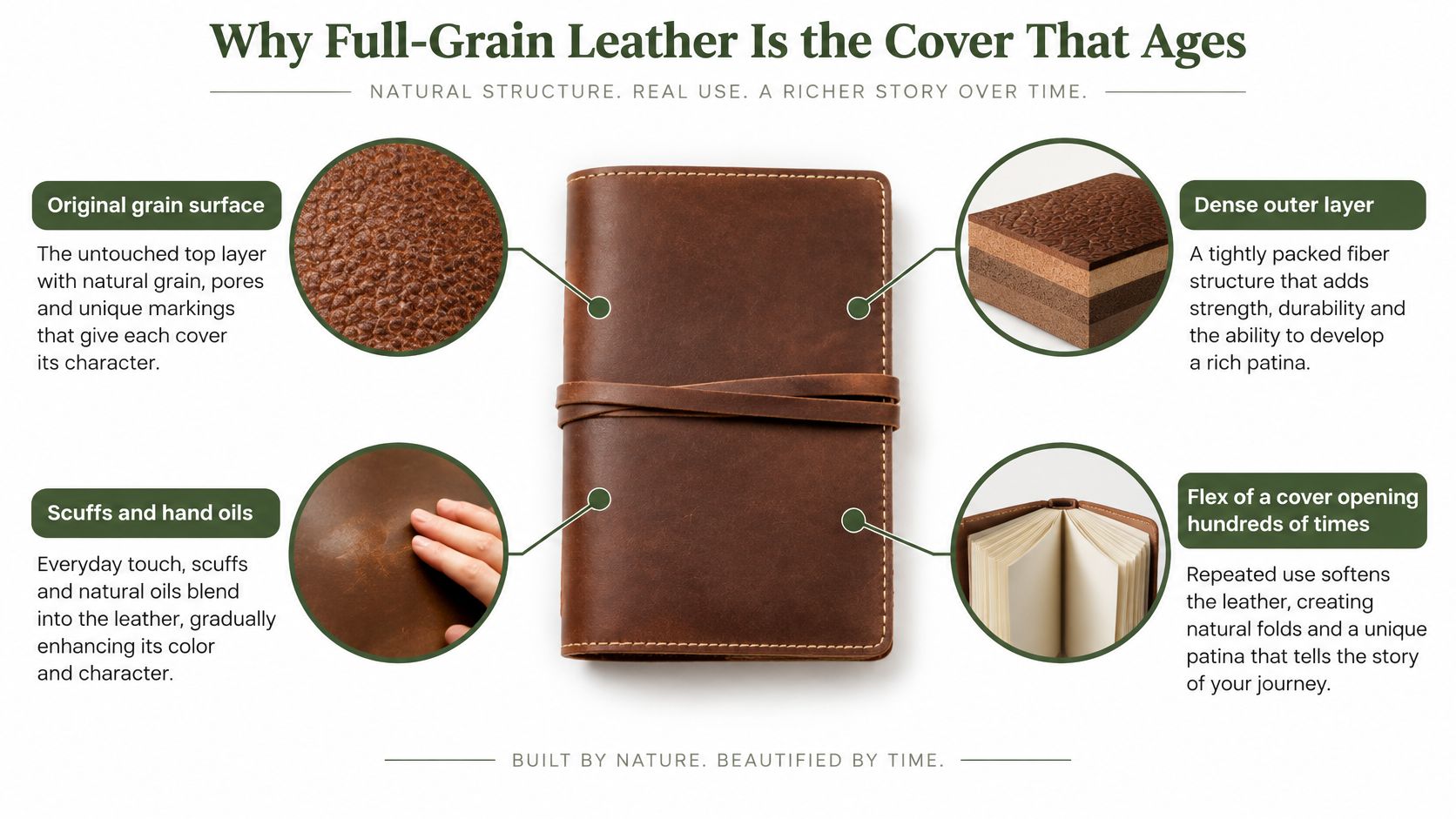
Grain retention and tanning answer different questions
Full-grain leather retains the natural grain surface. It's a useful specification for a cover that will encounter friction, hand oils, and repeated flexing, but it doesn't tell you everything about softness, finishing, or construction.
Tanning makes hide into a stable working material. The leather-science discussion in Heritage Science explains how tanning agents interact with collagen to improve mechanical strength and thermal stability, and describes vegetable-tanned leather with firmness, chemical stability, and wear resistance.
Vegetable tanning and chrome tanning are different chemical routes. Neither term substitutes for a statement about grain retention: a full-grain hide can be chrome-tanned, while vegetable tanning alone doesn't establish that the original outer surface remains.
Use the guide to leather grades to separate these descriptions before comparing covers. Then look beyond the label to the hinge, edges, and how the leather is supported.
- Check the bend. A firm cover should open without forcing the book shut against your hand.
- Inspect the finish. An opaque coating may conceal the surface you're trying to evaluate.
- Examine the edges. Rough cutting, loose lining, or exposed adhesive won't improve even if the leather is full-grain.
Accept character without excusing defects
Natural wrinkles and grain variation aren't the same as poor construction. Expect differences in texture and color, but don't treat a lifting corner or failing seam as desirable character.
Corrected leather can provide a more uniform appearance, which some buyers prefer. The trade-off is that a heavily finished surface may age through changes to its coating rather than through the exposed grain; peeling isn't an inevitable property of every corrected leather.
For personalization, I'd favor shallow debossing or controlled foil stamping over a deep cut. The aim is to make a readable mark without unnecessarily disturbing the surface that must keep flexing. Judge the cover by its retained grain and construction, not by thickness alone.
Personalization That Stays Readable and Private
Restraint usually makes personalization more useful. A discreet mark can establish ownership without turning a work notebook into a public name badge or tying a reusable cover to a job the owner may leave.
Meaningful control matters more than offering a text box. A study of digital-gift customization identified text entry, image uploads, color selection, and template choice as contributors to user satisfaction. For leather, that translates into checking the actual lettering, placement, and contrast rather than approving a generic example.
Cover marks compared
| Method | What it does | How it ages | Main risk |
|---|---|---|---|
| Blind deboss | Presses letters into the grain with no foil | Edges can soften visually; contrast remains subtle | Excess pressure can dent the board and underlying sheets |
| Foil stamp | Heat-sets metallic or colored foil into a shallow impression | Provides contrast, though exposed foil can wear | Waxy or oily finishes can complicate adhesion |
| Hot stamp, unspecified | Uses heat and pressure, either blind or foiled | Blind marks remain tonal; foiled marks retain added contrast while intact | Excess heat or dwell can glaze the grain |
Specify the result, not just the process name
Hot stamping isn't a separate visual finish. Ask whether the finished mark is blind or foiled, and inspect an example on the same leather finish and color you're choosing.
Blind debossing suits someone who wants an understated cover. Foil is useful when readability matters more than discretion, but a bright letter isn't automatically more durable: surface preparation and controlled application still matter.
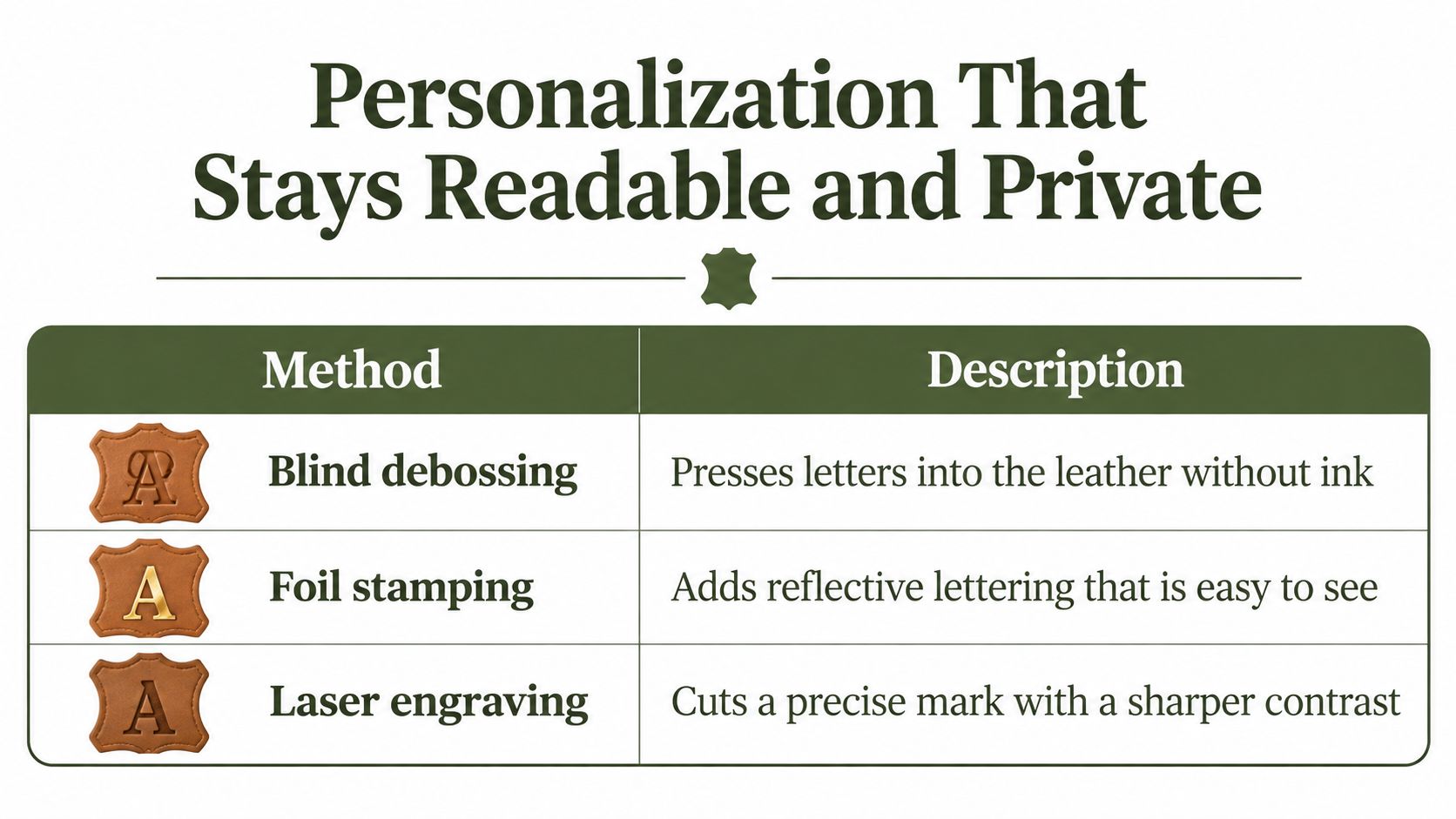
Laser engraving changes the surface rather than pressing a die into it. Don't assume its appearance or depth will match stamping; judge a sample rather than relying on the method's name.
Keep the information proportionate
Choose initials, an unambiguous year, or a short phrase. A full legal name, employer, or role can reveal more than the owner wants when the journal sits on a café table or passes through airport security.
For people keeping pastoral or community records, HolyJot's guidance on classifying private church information provides useful context for separating information that belongs on a visible cover from information that needs more careful handling.
- Preview exact characters. Accents, punctuation, and letterforms must appear in the approval, not just in the order message.
- Confirm name order. Don't assume every naming convention maps neatly onto a familiar monogram.
- Resolve date ambiguity. Spell the month if a numeric date could be read differently.
- Treat approval as permanent. Stamped leather can't be erased and reset.
Default to the front cover's lower area or a corner, with the writing block protected during production. A removable label offers flexibility; an endpaper inscription offers privacy but should be applied with the sheet isolated. Avoid pressing through the first page into the sheets beneath it.
Sizes and Paper That Keep the Writing
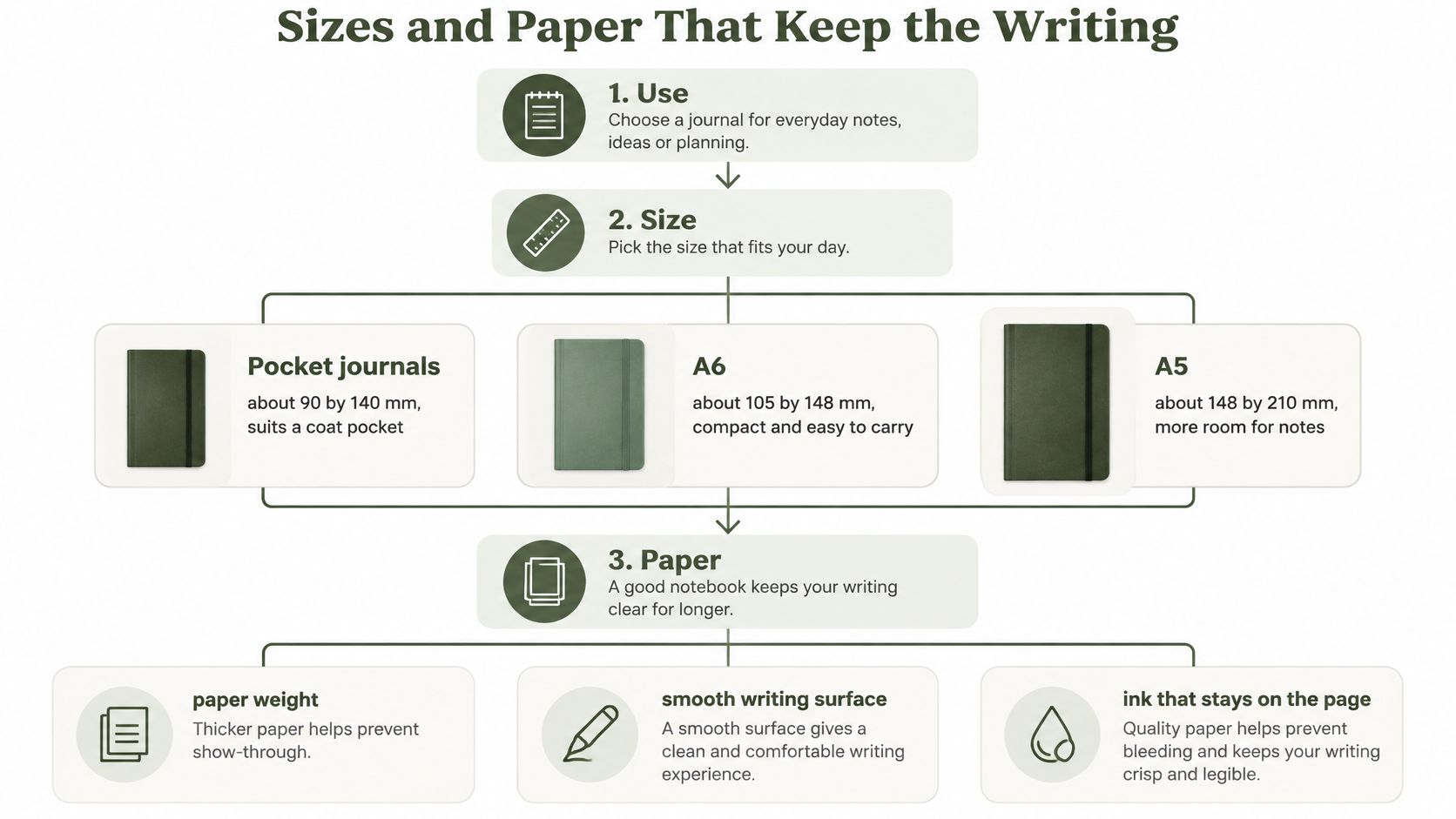
Start with the journal's closed dimensions, usable page area, and paper specification. A format name doesn't tell you whether a wraparound cover fits your pocket, whether a closure adds bulk, or how much writing space disappears into the gutter.
Page sizes and paper specs
| Format | Typical use |
|---|---|
| Coat-pocket carry; check the complete cover against the pocket | |
| A6 | Travel notes; favor easy opening and paper suited to quick entries |
| A5 | Daily paragraph and sketch; choose ruling around the writing task |
| A4 | Meeting notes and pasted documents; account for the loaded book's bulk |
Don't judge carrying comfort from an empty cover. A thick insert, pasted tickets, and a pen loop can turn a slim-looking journal into an awkward package.
For binding, open the book near the front, middle, and back if you can examine it physically. A book that behaves well only at its center may frustrate someone who writes across the whole spread.
Separate writing performance from permanence
Paper weight describes mass per area, not a complete quality standard. Surface treatment and absorbency affect feathering and bleed-through, while opacity determines how distracting the writing on the reverse looks.
A ballpoint user may prefer a little tooth. A fountain-pen user needs an explicit account of ink behavior, ideally supported by a writing sample; the fountain pen and journal guide helps with that pairing. A heavier sheet can still perform poorly with a wet nib.
A page can feel luxurious under your hand and still be a poor choice for preserving what you write.
For long-term keeping, acid-free alone is an incomplete specification. Permanent paper also needs resistance to the chemical changes that weaken cellulose as it ages.
The Library of Congress paper-preservation FAQ describes permanent paper under ANSI/NISO Z39.48 as having a pH of 7.5–10.0, at least a 2% alkaline reserve, less than 1% lignin, and good tear resistance. Those requirements address more than how the paper feels on the day you buy it.
Read the specification like a maker
Acids progressively shorten cellulose chains, and moisture can accelerate that deterioration. Buffered, lignin-free stock is therefore a more useful starting point for a keepsake than an unexplained archival label.
Look for distinct answers to these questions:
- Permanence. Does the maker identify a permanent-paper standard rather than offer only a broad longevity claim?
- Composition. Is the stock described as lignin-free and buffered?
- Ink behavior. Does the specification distinguish bleed-through, feathering, and show-through?
- Replacement. If the cover is refillable, can future inserts meet the same requirements?
Don't assume a refillable cover makes every refill equally suitable. A disposable meeting insert and a family-history volume can use the same leather shell while requiring very different paper.
Gifts and the Pre-Order Check
Pick the routine before you pick the monogram. A full-grain cover may outlast the handwriting inside it. Paper permanence, the depth of the personalization, and where the book is stored decide whether the gift becomes a keepsake or a handsome object with fading pages.
A retirement journal too bulky for the desk drawer, or a travel book with paper that bleeds, remains inconvenient after the occasion ends.
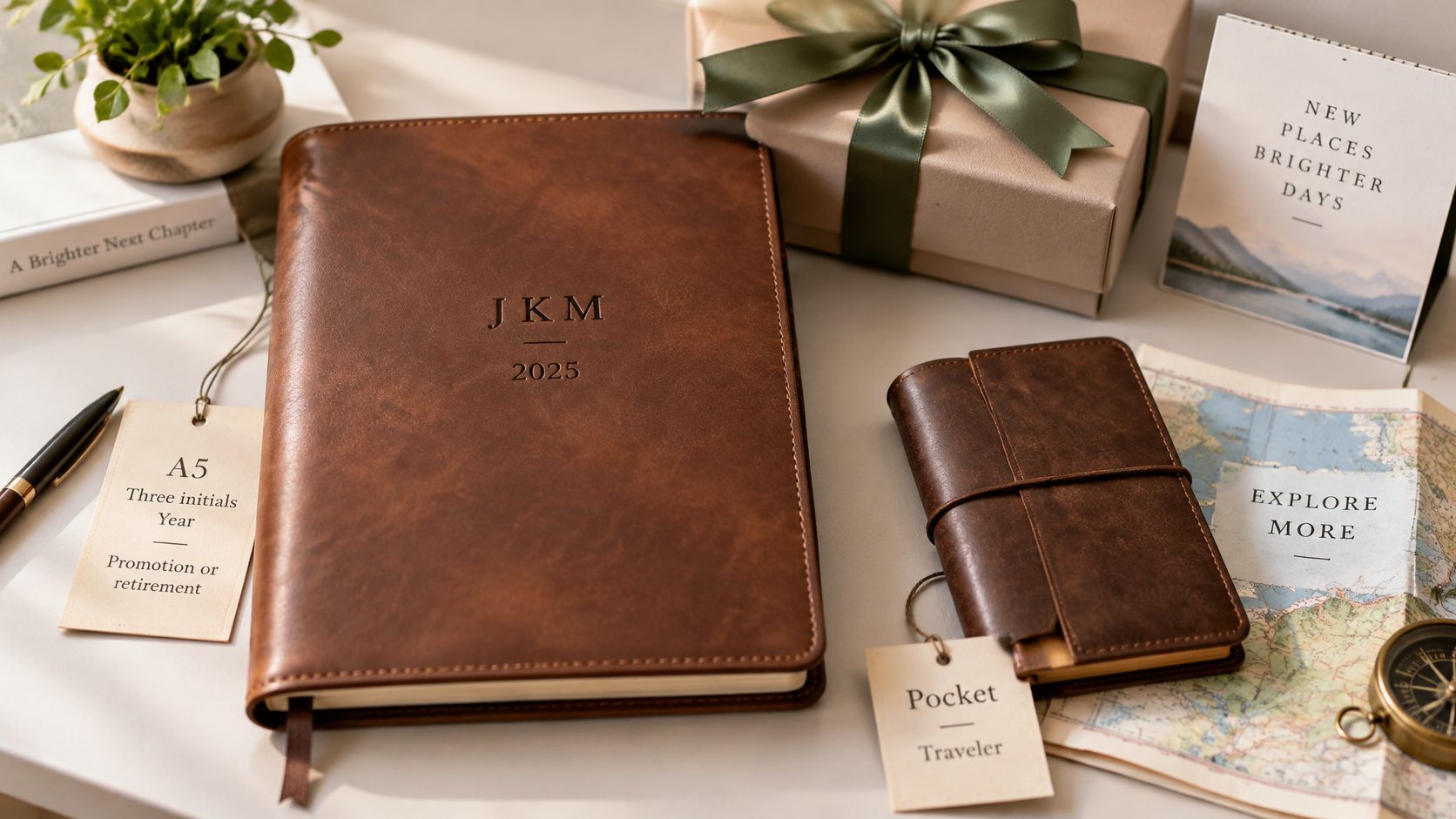
Personalization has appeal, but it is the shallow layer. A stamped name changes how the cover looks. It does not improve the paper, the binding, or the ink behavior. Use it to identify the book or mark the occasion, not to carry the gift on its own.
Match the occasion to an actual routine
Promotion or retirement. Start with work notes if that is the daily use, then ask what happens after the event. Initials leave room for a later role or a personal project. An employer's name fixes the book to one job. Add a year only if the recipient keeps dated records.
A traveler's gift should fit the luggage the person carries. Pocket or A6 is a reasonable starting point, but a protective closure may matter more than an elaborate inscription. Favor a book that can be retrieved and opened without unpacking everything around it.
For a wedding or anniversary, a short date and the couple's preferred initials can carry the meaning without covering the grain. Confirm how both people use their names rather than guessing at a shared surname or a formal monogram convention.
A fountain-pen enthusiast will notice the paper before admiring the packaging. Put the budget into a compatible writing surface and comfortable binding, then choose an unobtrusive mark. If the recipient is particular about inserts, a suitable refillable arrangement may be more considerate than a permanently bound surprise.
For a new-baby keepsake, remember that a parent will probably do the writing. Leave room for observations, pasted mementos, or letters, and choose permanent paper rather than treating the child's name as the feature that makes the book an archive.
Approve the book before approving the stamp
Use this pre-order check in sequence:
- Confirm the use. Name the job: daily writing, travel, fountain-pen use, a milestone keepsake, or work notes.
- Check the physical fit. Compare the closed cover with a familiar notebook or the intended bag compartment. Include closures and any pen attachment.
- Verify the pages. Read the permanence claim separately from the ink-performance claim. If either is absent, don't assume the leather's quality fills that gap.
- Approve the exact mark. Read every character, confirm placement and date format, and review the preview before production.
Check the stated production and delivery arrangements before committing to an occasion date. Don't plan around an assumed dispatch time, and don't approve an unfamiliar font merely because the sample initials look attractive.
The best gift inscription leaves the recipient room to make the journal their own.
Grainmark Leather's Small Goods range includes travel and journals alongside wallets, cardholders, pouches, and accessories. Its Personalised Leather Gifts section lists customization options on eligible items, so choose by the individual listing rather than assuming every journal takes the same mark.
For a recipient who also carries a pen or loose writing tools, the leather gifts for writers guide can help you build a useful pairing without adding pieces that never leave the drawer. Keep the journal anchored to its job: the travel choice should travel, and the desk choice should invite regular writing.
How to Care for the Cover and the Pages
Durable leather doesn't make the journal archival. Paper, ink, adhesives, and the storage environment all affect whether the writing remains readable, so care for the journal as a mixed-material object rather than as a leather accessory alone.
The Library of Congress guide to caring for paper recommends clean handling, limited light exposure, cool and relatively dry conditions, and protective enclosures. Those principles matter as much for a filled personal journal as for loose documents.
A routine that protects both materials
- Let a new cover settle into use. Don't saturate it with conditioner to accelerate softness or patina. Excess product can migrate toward the lining, adhesives, and paper.
- Dust the closed cover with a soft, dry cloth before applying anything. Skip household cleaning wipes, alcohol, and general-purpose polish; they aren't substitutes for a leather-care product compatible with the finish.
- Condition only when needed. If the surface appears dry, test a small amount of neutral conditioner on a concealed area first. Apply sparingly to the leather, keeping it away from foil, seams, exposed page edges, and the spine's adhesive areas.
- Give ink time to dry. Use a clean blotting sheet when appropriate, especially with a wet fountain pen. Closing a damp page against another sheet can transfer writing before you notice the problem.
- Keep the journal away from direct sunlight, radiators, and hot storage spaces. Don't leave it on a windowsill because the leather looks attractive there; display conditions and preservation conditions aren't always compatible.
- Enclose a finished volume. Use a suitable protective box or enclosure in a stable indoor location, away from plumbing, damp walls, and strong light. Keep the book supported rather than wedged tightly between uneven objects.
- Don't vacuum-seal the journal or put it away damp. If it becomes wet, separate it from other belongings and seek conservation advice for valuable writing rather than applying a hairdryer or radiator heat.
- Preserve the original writing during repairs. For a refillable journal, archive completed inserts instead of discarding them. For rebinding, keep the marked cover where practical and specify appropriate replacement materials without sacrificing the written sheets.
Judge the result without over-treating it
The leather-conditioning guide can help you distinguish routine surface care from unnecessary treatment. More conditioner isn't better care, especially when paper sits directly behind the cover.
A useful care test: The cover should feel serviceable, the mark should remain readable, and the pages should stay clean and flat.
An even patina is welcome; tackiness, lifted foil, musty odor, or waviness calls for attention. Inspect a stored journal occasionally so you can correct its surroundings before a small problem becomes damage to the writing.
Grainmark Leather offers full-grain leather goods and personalization on eligible gifts, including journals. Visit Grainmark Leather to compare the available journal options, then check the paper, carry format, and exact personalization before choosing the one you'll want to keep.